Background:
Child birth is a universally celebrated occasion, yet everyday for thousands of women child birth is
experienced not as a joyful event as it should be, but as a private hell that may even end in death. The objective of
this study is to determine the complications of normal delivery and cesarean section on the mothers and new born.
Methods:
A descriptive study was conducted in two selected hospitals of Rupandehi district, Nepal. Data was
collected as per pretested structured proforma from 550 respondents who were the mothers and new born delivered
normally and through cesarean section randomly till the completion of sample size and analyzed by using SPSS,
MANOVA and Chi-square test to determine associations between categorical variables.
Results:
In a total of 550 deliveries,25.8% were cesarean delivery, 42.7% motherssuffered from delivery related
complications, common were PPH (21.1%), prolonged labour (8.5%) and wound infection (7.6%). 35.5% of
newborn had complications, common were respiratory distress (6.3%) and neonatal jaundice (4.2%).
Conclusions:
Delivery related complications were higher among Lower segment cesarean section compared to
vaginal delivery in mothers and newborn.
Keywords:
Cesarean section; child birth; maternal complication; new born; vaginal delivery.
Complications among Mothers and New Born Due to
Delivery Process in Rupandehi District Nepal
Shanta Sharma,1 Indra Dhakal2
1Department of Community Medicine, Devdaha Medical College and Research Institute, Kathmandu University, Rupandehi, Nepal. 2Department of Orthopedics, Lumbini Zonal Hospital, Butwal, Rupandehi, Nepal.
Correspondence:
Dr Shanta Sharma, Department of Community Medicine, Kathmandu
University, Devdaha Medical College and Research Institute, Rupandehi, Nepal.
Email: [email protected], Phone: 9841227068, 9857035444.
ABSTRACT
J Nepal Health Res Counc 2018 Apr-Jun;16(39): 190-4
INTRODUCTION
Globally, 80% of maternal deaths are due to direct obstetric complication, 61% of which occur in the postpartum period, more than half of which take place during delivery or within 1 day of delivery. About 17% of maternal death happens during child birth itself. This can be attributed to pregnancy related complication occurring throughout the pregnancy, labour, childbirth and in the postpartum period. Current estimates indicate that only 56% of deliveries receive care. In developing countries complication of delivery and child birth are leading causes of death. Every year, almost 8 million still births and early neonatal deaths occur.1
Complications of delivery process are one of the leading causes of maternal and neonatal mortality and morbidity in Nepal. Such problems can be reduced through proper care during delivery process to the mother as well as new born.2,3So our study aimed to compare maternal
and fetal complication associated with types of delivery process.
METHODS
A descriptive study was conducted in Rupandehi district, Nepal. Rupandehi District was selected purposively because Rupandehi District is one of the terai districts where most of the delivery occurs. There are 18 Hospitals in Rupandehi district where delivery services are offered.4 Purposively, 2 hospitals were selected. They are Lumbini zonal hospital (Government) and Siddhartha children and women hospital (Private Mission Hospital). Mothers and new born delivered through normal delivery and caesarean section in selected hospitals were study unit. Data was collected as per pretested structured performa from 550 respondents randomly till the completion of sample size. A set of structured pre-tested schedule was used for data collection.Data was collected through direct interview by the researcher with the help of schedule and was analyzed using SPSS, Manova and Chi square test to determine association between categorical variables.
Original
Article
Ethical approval was taken from Sam Higginbottom Institute of Agriculture, Technology & Sciences, institutional ethical committee for biomedical Research on Human Participants, SHIATS, Allahabad, and Nepal health research council (NHRC) Kathmandu, Nepal. Authorities of Selected Hospitals and Respondents were fully informed about objectives of study and verbal consent was taken before data collection.
RESULTS
In a total of 550 deliveries, majority of respondents belonged to age group 25-29 (37.6%), followed by age group 20-24 years (29.1%), age group 30-34 years (26.9%), 4.5% were above 35 years age and 1.8% was below 19 years age.
Table 1. shows that majority of respondents had vaginal mode of delivery.
Table 1. Mode of delivery of the respondent.
Mode of delivery Frequency Percentage
Vaginal 408 74.20
LSCS 142 25.80
Total 550 100.00
Table 2. Shows that majority of respondents has postpartum hemorrhage followed by prolonged labor and wound infection.
Table2. Maternal complications.
Maternal Complications (Total - 236 mothers)Percentage
Prolonged labour 8.50
Cephalopelvic disproportion 1.80
Mal presentation 2
Mal placentation 0.80
Vaginal tear 6.40
Postpartum hemorrhage 21.10
Vulval hematoma 0.20
Wound infection 7.60
Pyrexia 2.20
Breast infection 0.90
Surgical injury 0.50
Maternal death 0.50
Emergency hysterectomy 1.40
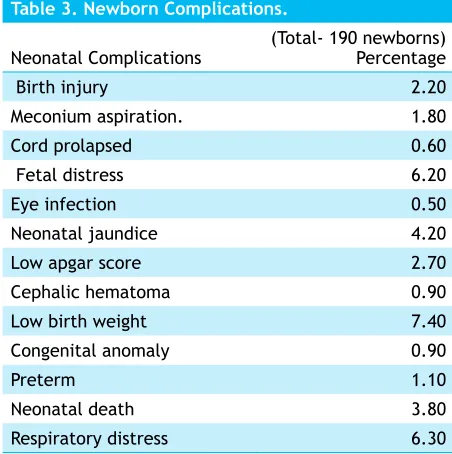
Table3. shows that common new born complication was low birth weight followed by fetal distress and neonatal jaundice.
Table 3. Newborn Complications.
Neonatal Complications (Total- 190 newborns)Percentage
Birth injury 2.20
Meconium aspiration. 1.80
Cord prolapsed 0.60
Fetal distress 6.20
Eye infection 0.50
Neonatal jaundice 4.20
Low apgar score 2.70
Cephalic hematoma 0.90
Low birth weight 7.40
Congenital anomaly 0.90
Preterm 1.10
Neonatal death 3.80
Respiratory distress 6.30
Table4. shows that there is association between
maternal complications and mode of delivery. Maternal comlpications are higher in LSCS.
Table 4.Association between Mode of delivery and maternal complications.
Mode of
delivery Present (236) Absent (314)Maternal complication Total (550) Vaginal 28.9% 45.3% 74.2% (408) LSCS 13.8% 12.0% 25.8% (142)
Total 42.7% 57.3% 100.0%
(χ2= 9.11, Level of significance = 0.05% for 1 df, P<0.05 Significant)
Table 5. shows that there is association between neonatal complications and mode of delivery. Neonatal complications are higher in LSCS.
Table 5. Association between Mode of Delivery and Neonatal Complications.
Mode of
delivery Neonatal complicationPresent (190) Absent (360) Total (550) Vaginal 21.1% 53.1% 74.2%
LSCS 13.5% 12.4% 25.8% Total 34.5% 65.5% 100.0% (χ2= 26.12, Level of significance = 0.05% for 1 df, P<0.05 significant)
DISCUSSION
this is the most fertile phase of women’s life. Nepal demographic-and health survey (2016) shows that there was a significant raise in median age for getting marriage amongst girls during the last 15 years, from 16.4 years in 1996 to 17.9 years in 2016. This is another clear indication of a continuing shift to later marriage in Nepal. The proportion of women age 15-19 who were married by age 15 declined by 10 percentage points from 1996 (14 %) to 2016 (4%).5
Majority of respondents had vaginal mode of delivery 74.20 % followed by LSCS 25.80 %. Similar study reported that total number of deliveries during the period was 1632, out of them 411 deliveries were by cesarean section thereby making a lower segment cesarean section rate of 25.18%.6 Our results are consistent with previous studies which shows similar rates of LSCS and the recent rise in LSCS rate has became a worldwide phenomenon.7 Lower segment caesarian segment rate in U.S.A has increased to 29.1%, England 21.5 percent, and in Latin American nations 40%.7 Nine countries participated in the Asia global survey: Cambodia, China, India, Japan, Nepal, Philippines, Sri Lanka, Thailand, and Vietnam. Obtained data for 1,09,101 of 1,12,152 deliveries reported in 122 recruited facilities (97 percent coverage), and analyzed 1,07,950 deliveries. The overall rate of caesarean section was 27·3 % (n=29,428).8
Furthermore, the common maternal complication were postpartum hemorrhage (116 deliveries, 21.1%), prolonged labor (47 deliveries, 8.5%) followed by wound infection (42 deliveries, 7.6%). Similar study on total population of 3,298,319, comprising 12% of Nepal population showed that pregnancy and delivery-related causes are amongst the top ten reasons for MM in Nepal. The main direct cause, hemorrhage has been dramatically reduced, down from 41% in 1998 to 24% in 2006.5 In India, post partum hemorrhage (25.6%) ranks first as the cause of maternal death, followed by prolong labour (6.2%).9 A study was undertaken in the department of Obstetrics and Gynecology at Kasturba hospital, Delhi. In total of 100 deliveries, it was found that 8% of patients developed post-partum hemorrhage (6% in vaginal and 2% in cesarean group).10
Another major complication was prolonged labor (8.5%) which is similar to the study showed that approximately 8% of all pregnant mothers did suffer from prolonged labour.11 Another prospective study carried out in Mymensing Medical College Hospital, Department of Obs and Gynae from January 1996 to March 1996. In total 100 patients, prolong labour was present in 10.0% and Wound infection in 11.0%, which is similar to this study.12
Similarly, retrospective study which included 1632 patients delivered by LSCS at GMERS Medical College, sola between June 2013 to December 2013, out of which 411 delivered by LSCS thereby making a LSCS rate of 25.18%, and prolong labour included 10.94% of deliveries.13
Study also noted that wound or postpartum infection was 7.6% and the similar study found that 5.5% of vaginal normal deliveries and 7.4% of abdominal deliveries were complicated with postpartum infection.14 Similar study shows that wound infection were present in 9% of deliveries (cesarean delivery 6% and vaginal delivery 3%).10 Current literature reviews have shown that post operative infection can be up to 30 % following an LSCS. At Hornsby Ku-ring-gai Hospital baseline data for women undergoing LSCS found that post-operative infection were as high as 20%.15
Majority of newborn complication were low birth weight (40 newborn, 7.4%), respiratory distress (35 newborn, 6.3%) and neonatal jaundice (23 newborn, 4.2%). A study performed by the Agency for Healthcare Research and Quality (2011) showed that out of total 3.8 million births in the U.S.A. in 2011, approximately 6.1% were diagnosed having low birth weight.16 Similar study showed Low birth weight in 4 percent of vaginal and 8% of LSCS deliveries.10
Another common fetal complication wasrespiratory distress (6.2%). Indian Journal of maternal Child Health (1996) mentioned that the incidence of respiratorydistress ranges from 2.2% to 7.6% in developed countries and from 0.7% to 8.3% in India.17 Another cross-sectional retrospective study, conducted between January 1995 and December 1998, all patients consecutively admitted for Deliveries at Hospital Israelita Albert Einstein HIAE) were included in study. A total of 8,457 medical records were analyzed, respiratory distress occurred in 260 (3.5% of total). Of these, 200 (2.7%) were born by C-section.18
This study shows that maternal and newborn complications were significantly associated with mode of delivery and was considerably high in LSCS compared to vaginal delivery. Similar study showed that risk of maternal mortality and morbidity is increased for caesarean section as compared to vaginal delivery.22 In similar study caesarean section in developing countries
is associated with significant increase in maternal morbidity.23 Similarly, a six months prospective, observational study was conducted, including 320 Patients, maternal morbidity was noted in 12.76% of the patients who had a Cesarean section and in only 2.74% of patients who had vaginal delivery.24
CONCLUSIONS
Approximately half of the mother suffered from delivery related complications (42.7%), common were PPH (21.1%), prolonged labour (8.5%) and wound infection (7.6%). One third newborn had complications (34.5%) and the common were low-birth-weight (7.4%), respiratory distress (6.3%) and neonatal jaundice (4.2%). Maternal and newborn complications were significantly associated with mode of delivery and were considerably high in LSCS compared to vaginal delivery.
ACKNOWLEDGEMENTS
We would like to acknowledge all the respondents for their kind cooperation during this study. We are grateful to all the members of Faculty of Health Sciences, Sam Higginbottom University of Agriculture, Technology and Sciences, Allahabad, India for their academic guidance and support.