FPGA Implementation of Elliptic Curve Cryptoprocessor
for Perceptual Layer of the Internet of Things
V.Kamalakannan
1,* and S.Tamilselvan
21Research Scholar, Department of Electronics and Communication Engineering, Pondicherry Engineering College, Puducherry, INDIA.
2Associate Professor, Department of Electronics and Communication Engineering, Pondicherry Engineering College, Puducherry, INDIA.
Abstract
Today’s developing era data and information security plays an important role in unsecured communication between Internet of Things (IoT) elements. In IoT, data are transmitted in plaintext for many reasons. One of the most common reason is the availability of hardware. Many IoT products are inexpensive components with limited memory and computational resources. Such devices might be unable to support the computationally intense cryptographic functions of asymmetrical cryptography. If designers considered the privacy implications of unencrypted data, they have limited options for encryption because of the hardware platform. Therefore the designers have to create their own security protocols or implement stripped-down versions of existing security protocols. The second option has a better chances. Evidence recommends such a modified protocol would run efficiently on small devices. Elliptic Curve Cryptography (ECC) is used to ensure complete protection against the security risks such as confidentiality, integrity, privacy and authentication by implementing an Elliptic Curve Cryptoprocessor. The work focuses on high-performance Elliptic Curve Cryptoprocessor design, optimized for Field Programmable Gate Array (FPGA) implementation, using the concept of asymmetric and hash algorithms. A novel cryptographic algorithm consisting of matrix mapping methodology and hidden generator point theory is to be applied for encryption/decryption between the sender and receiver whereas Elliptic Curve Digital Signature Algorithm (ECDSA) designed using Keccak Secured Hash Algorithm (SHA) algorithm is applied for the validation of the encrypted data. The proposed Cryptoprocessor operates at a minimum period of 6.980 ns and maximum frequency of 143.276 MHz. This work focuses on the practicability of public key cryptography implementation for devices connected in the perceptual layer of IoT.
Keywords: Internet of Things, Perceptual layer, Wireless Sensor Network, Elliptical Curve Cryptography, Elliptic Curve Digital Signature Algorithm.
Received on 02 July 2018, accepted on 09 October 2018, published on 15 October 2018
Copyright © 2018 V.Kamalakannan et al., licensed to EAI. This is an open access article distributed under the terms of the Creative Commons Attribution licence (http://creativecommons.org/licenses/by/3.0/), which permits unlimited use, distribution and reproduction in any medium so long as the original work is properly cited.
doi: 10.4108/eai.15-10-2018.155739
1. Introduction
Internet of Things (IoT) is a global network of interoperable devices. The physical things generally connected in the perceptual layer are Wireless Sensor Networks (WSNs), Radio Frequency Identification (RFIDs), etc., [1]. According to the IoT concept, these
*Corresponding author. Email:[email protected]
devices meet new challenges related to the amount of data exchange, data transferring like storing and retrieving with each other. Thus the demand increases for securing the information from Men in Middle (MIM) attack. The information transmitted pose serious threats to the privacy as they can be tracked anytime, anyplace and by anyone [2]. As these devices have limited processing and memory capabilities, securing by implementing cryptographic
Research Article
2 algorithm becomes difficult. Thus an attacker can exploit a weakness in an IoT devices. Therefore cryptographic techniques are applied to protect the data stored, processed and shared, between the devices [3], [4]. A cryptoprocessor is constructed on FPGA using the concept of asymmetrical cryptography and hash algorithm. Cryptographic algorithm consisting of matrix mapping methodology and hidden generator point concept is applied for encryption/decryption whereas modified ECDSA using Keccak SHA-3 algorithm is applied for validation of the encrypted data. A novel version of data security method based on ECC-SHA combinational is implemented on FPGA for Internet of Things devices [5]. An introduction to IoT is provided in section II and the novel Elliptic Curve Cryptoprocessor implementation in section III, modified Elliptic Curve Digital Signature algorithm in section IV. The Proposed cryptoprocessor is provided in section V and the implementation of proposed cryptoprocessor in performed in section VI. The simulation results of Cryptoprocessor are explained in section VII and result analysis in section VIII. The conclusion is discussed in section IX and is followed by references.
2. Internet of Things
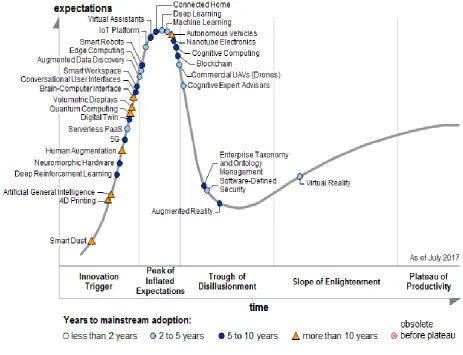
The concept of IoT was explained in 1999 by Kenn Ashton and was defined as a dynamic global network infrastructure by International Telecommunication Union (ITU) and International Energy Research Centre(IERC) [6]. The idea of IoT was evolved from the concept of Internet. From the research it is said that by 2020 around 50 billion devices will be interconnected with each other. It is considered as an emerging field and is specified in the Gartner’s IT hype cycle shown in Figure 1. IoT are different from the existing distributed system because of limited connectivity.
In the IoT scenarios, constellation of wireless devices having a number of key properties such as mobility, wireless, embedded use, diversity and scale; that yields several vulnerabilities related to security. In the non-secure channel, challenges related to security have to be tackled for devices as well as the information [7]. The devices connected in the IoT have their own security requirements, thus in the IoT to ensure confidentiality, authentication, integrity encryption of the information and authentication has to be provided.
Figure 1. Gartner’s Hype cycle
The internal architecture of IoT is built based on the security deficiency. As shown in the Figure 2, IoT is normally considered as three layered architecture consisting of the perception or perceptual layer, the network layer and the application layer [8].
APPLICATION LAYER
APPLICATION SERVICE DATA SECURITY (SMART HOME)
APPLICATION SUPPORT SECURITY (CLOUD COMPUTING) NETWORK
LAYER
NETWORK TRANSMISSION AND INFORMATION SECURITY (MOBILE COMMUNICATION/INTERNET) PERCEPTION
LAYER
PERCEPTION LAYER LOCAL SECURITY (RFID/SENSORS/GPS/ZIGBEE)
INFORMATION SECURITY
PHYSICAL SECURITY
MANAGEMENT SECURITY
Figure 2. SecurityArchitecture of IoT
The bottom layer is the perception layer or perceptual layer that receives the information through WSNs and RFIDs and passes this information to the middle layer. The middle layer is the network layer which process the information received from the perception layer. The top most layer is the Application layer which generally processes enormous data [9], [10]. This layer segregates the information based on the devices. These enormous data are managed through cloud computing. IoT security is primarily a management issue involving a highly efficient cryptographic algorithms providing confidentiality, integrity, and authenticity [19].
3. Novel Elliptic Curve Cryptography
Protocol
The normal ECC primitive protocols are configured with the points on the Elliptic Curve, a generator point ‘G’ is selected publicly available and distributed over the network by the Certificate Authority (CA) [11], [12]. In these protocols, the requirement of CA makes it difficult to implement security. The information shared by the CA can be breached by the intruders, making the network susceptible to MIM attack.
Hence to elucidate this exposure and to secure the network against MIM attacks, maintaining the security for each session of communication between the two nodes without a common generator point is suggested. Therefore a generator point is shared only between the devices connected to communicate. This concept is implemented in the ECC primitive protocols [21], [23].
3.1. Initialization Stage
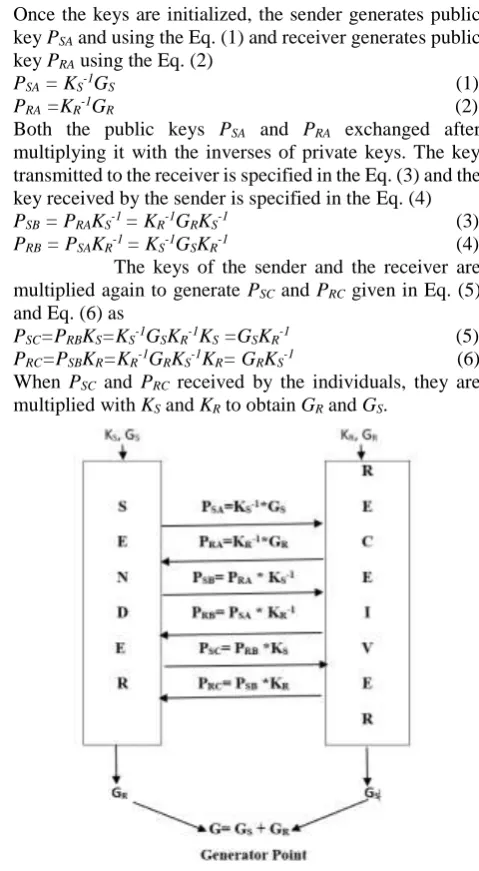
Let us consider two nodes shown in Figure 3 in the WSN. It is assumed that both nodes i.e, sender and receiver select their generator points, GS and GR individually apart from
the private keys, KS and KR. The inverse of the private keys
KS-1 and KR-1 are also computed.
Once the keys are initialized, the sender generates public key PSA and using the Eq. (1) and receiver generates public
key PRA using the Eq. (2)
PSA = KS-1GS (1)
PRA =KR-1GR (2)
Both the public keys PSA and PRA exchanged after
multiplying it with the inverses of private keys. The key transmitted to the receiver is specified in the Eq. (3) and the key received by the sender is specified in the Eq. (4) PSB = PRAKS-1 = KR-1GRKS-1 (3)
PRB = PSAKR-1 = KS-1GSKR-1 (4)
The keys of the sender and the receiver are multiplied again to generate PSC and PRC given in Eq. (5)
and Eq. (6) as
PSC=PRBKS=KS-1GSKR-1KS =GSKR-1 (5)
PRC=PSBKR=KR-1GRKS-1KR= GRKS-1 (6)
When PSC and PRC received by the individuals, they are
multiplied with KS and KR to obtain GR and GS.
Figure 3. Computational process for Generator point The sender computes the receiver’s generator point in Eq. (7) as
PRC*KS=KS-1*GR*KS=GR (7)
The receiver computes the sender’s generator in Eq. (8) as PSC*KR=KR-1*GS*KR=GS (8)
The generator points GS and GR are added to
generate a common generator points between the sender and receiver given in Eq. (9) as
G = GS + GR (9)
Hence the sender and receiver exchanges information between them and generated using ‘G’ and computing P, 2P….. kP.
3.2. Authorization Stage
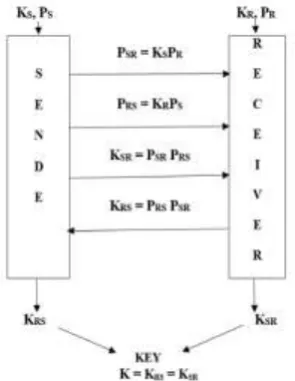
4 shown in the Figure 4 for every session of transmission between the sender and receiver. Thus authorization has to be provided for transmission.
Figure 4. Computational process for Key The public key and the private keys of the transmitter are PS and KS whereas for receiver PR and KR. The sender
generates PSR and transmits it to receiver, similarly receiver
generates PRS and transmits it to sender. The sender then
generates KSR in Eq. (10) and the receiver generates KRS in Eq. (11) as
KSR =PSRPRS (10)
KRS =PRSPSR (11)
The key for ECC process is specified in Eq. (12) as K= KRS + KSR (12)
3.3. Novel Cryptographic Algorithm
The Elliptic Curve Cryptography is implemented using matrix mapping methodology. In matrix mapping method the alphanumeric characters are mapped on to the points of the Elliptic Curve are represented in the form of m x n matrix. The points in the matrix form are multiplied with a non-singular matrix and is explained in steps below. It is assumed that both the sender and the receiver of the message to know non-singular matrix A.
Step 1: The original message M of length n is taken for consideration and transformation of the alphanumeric characters into points on Elliptic Curve represented in Eq. (13).
[P1(x1, y1),P2(x2, y2) … Pn (xn, yn)] (13)
Step 2: Matrix of 3 x r is created as shown in Eq. (14)
M = [
𝑃1 𝑃2 𝑃3 𝑃𝑟
𝑃𝑟 + 1 𝑃𝑟 + 2 𝑃𝑟 + 3 𝑃𝑠 𝑃𝑠 + 1 𝑃𝑠 + 2 𝑃𝑠 + 3 𝑃𝑛
] (14)
With 𝑟 =𝑛
3and 𝑠 = 2𝑛
3
Step 3: Select a matrix ‘A’ of order 3x3 as in Eq. (15), such that ‘A’ is non-singular diagonal.
A =[
𝐴11 𝐴12 𝐴13 𝐴21 𝐴22 𝐴23 𝐴31 𝐴32 𝐴33
] (15)
Step 4: Compute Q = AM given in Eq. (16) as
Q = [
𝐴11 𝐴12 𝐴13 𝐴21 𝐴22 𝐴23 𝐴31 𝐴32 𝐴33
] [
𝑃1 𝑃2 𝑃3 𝑃𝑟
𝑃𝑟 + 1 𝑃𝑟 + 2 𝑃𝑟 + 3 𝑃𝑠 𝑃𝑠 + 1 𝑃𝑠 + 2 𝑃𝑠 + 3 𝑃𝑛
] (16)
Step 5: The Q matrix is a set of points is given in Eq. (17) as
Q = [
𝑄1 𝑄2 𝑄3 𝑄𝑟
𝑄𝑟 + 1 𝑄𝑟 + 2 𝑄𝑟 + 3 𝑄𝑠 𝑄𝑠 + 1 𝑄𝑠 + 2 𝑄𝑠 + 3 𝑄𝑛
] (17)
The message ‘M’ to be transmitted after matrix mapping is (Qxi, Qyi). For encryption of the message, select
the generator point ‘G’ and the shared secret key ‘K’ compute KG in Eq. (18) as
KG= (K1, K2) = (Kx, Ky) (18)
The ciphertext (C1i, C2i) is computed by Eq. (19) and Eq.
(20) as
C1i = (Qyi Kx + Qxi) mod p (19)
C2i = (Qyi + Qyi KxKy + QxiKy) mod p (20)
For decryption, the ciphertext (C1i, C2i) is considered and
the message is computed using the Eq. (21) and Eq. (22) as Qyi = (C2i - KyC1i) mod p (21)
Qxi = (C1i - Qyi Kx) mod p (22)
At the receiver end the decrypted values are represented in the matrix Q and the following step occurs in demapping process
Step 1: The receiver performs inverse of matrix selected and is given in Eq. (23) as
A-1=[
𝐴𝑎1 𝐴𝑎2 𝐴𝑎3 𝐴𝑏1 A𝑏2 𝐴𝑏3 𝐴𝑐1 𝐴𝑐2 𝐴𝑐3
] (23)
Step 2: The resultant of the inverse matrix and encrypted data are considered to compute the Elliptic Curve mapped message M = A-1Q represented in Eq. (24).
M = [
𝐴𝑎1 𝐴𝑎2 𝐴𝑎3 𝐴𝑏1 𝐴𝑏2 𝐴𝑏3 𝐴𝑐1 𝐴𝑐2 𝐴𝑐3
] [
𝑄1 𝑄2 𝑄3 𝑄𝑟
𝑄𝑟 + 1 𝑄𝑟 + 2 𝑄𝑟 + 3 𝑄𝑠 𝑄𝑠 + 1 𝑄𝑠 + 2 𝑄𝑠 + 3 𝑄𝑛
] (24)
Step 3: The resulting set of points is given in Eq. (25) as
M = [
𝑃1 𝑃2 𝑃3 𝑃𝑟
𝑃𝑟 + 1 𝑃𝑟 + 2 𝑃𝑟 + 3 𝑃𝑠 𝑃𝑠 + 1 𝑃𝑠 + 2 𝑃𝑠 + 3 𝑃𝑛
] (25)
Step 4: This Elliptic Curve point mapped message is remapped with ASCII characters to get back the original information.
The receiver performs inverse of matrix selected and the resultant of the inverse matrix and decrypted data are considered to compute the Elliptic Curve mapped message M. This Elliptic Curve point mapped message is remapped with ASCII characters to get back the original information The decryption process is verified as
Qyi = C2i - KyC1i
= (Qyi + QyiKxKy + QxiKy) - Ky (QyiKx + Qxi) (mod p)
= Qyi + QyiKxKy + QxiKy- QyiKxiKyi – QxiKy
= Qyi
Qxi = C1i - QyiKx
= QyiKx + Qxi - QyiKx = Qxi
4. Modified Elliptic Curve Digital
Signature Algorithm
.In the proposed ECDSA model hidden generator point concept is applied to authenticate the encrypted message communicated between the devices connected in the perceptual layer of IoT [13], [14].
Considering two nodes as sender and receiver in the WSN. These nodes have individual generator points, GS
and GR with their unique private keys, KS and KR. After
initializing the keys generation process, both devices exchange the generator points GS and GR and generate a
common generator point by the initialization process explained in sub section 3.1. Hence the sender and receiver exchanges information between them by considering common generator point ‘G’ and computing P, 2P, 3P….. kP[17]. [18].
The sensor nodes must securely share a key before encryption. The shared secret key is generated and refreshed between the sender and receiver. The public key of sender and receiver are PS and PR. are exchanged using
DHKE process and a key is generated by the method explained in the section 3.
Considering the generator point ‘G’ and key ‘K’, scalar multiplication is performed to compute KG provided in Eq. (26), to be applied for signature generation and signature verification process.
𝐾𝐺 = (𝐾1, 𝐾2) = (𝐾𝑋, 𝐾𝑌) (26) From the initialization and authorization stage, the values of K and G are known. This scheme processes are discussed as following steps
To generates the signature for message M the signer using the values of K and G by performing the following steps:
Step 1: Calculate h = HASH (M) = SHA-3 (M) Step 2: Compute KG= (x1, y1)
Step 4: Compute r = x1 (mod p)
Step 5: Compute s = (K + (r xnor h))G (mod p). The signature pair thus generated is (r, s) The verifier verifies the signature using K and G from the initialization and authorization stage for message M by performing the following steps:
Step 1: Verify that s is integers in [1, p − 1]. If not, the signature is invalid
Step 2: Compute KG= (x1, y1)
Step 3: Compute r = x1(mod p)
Step 4: Compute u = (r xnor h) mod (mod p) Step 5: (x2, y2) = (s - uG)
Step 6: The signature is valid if v = x2 (mod p) = r,
invalid otherwise.
4.1 Proof of Proposed ECDSA Scheme
Signature send by sender to receiver is (r, s) and s can be generated only by Sender because of its private key Step 1: Compute s = wG = (K + (r xnor h) G Step 2: Compute s = (K + u) G where u = (r xnor h) Step 3: Compute s = KG + uG
Step 4: Compute KG = s - uG = (s - uG) = (x2, y2)
Therefore
LHS = KG = (x1, y1) and r = x1 (mod p)
RHS = (s - uG) =(x2, y2) and v = x2(mod p)
Hence v=r
The improved ECDSA scheme reduce the computational cost while keeping the same security as original ECDSA. They are suitable for the users who have limited compute capacity [15], [16].
5. Proposed Elliptic Curve
Cryptoprocessor
With the development of Integrated Circuits technology, WSN is growing strong and is widely used in special fields. As it has limited energy, communication and storage resources, encryption and authentication protocols must be improved [20], [22]. In the proposed cryptoprocessor the security of information transmitted by devices in the IoT is implemented. This cryptoprocessor plays a major part by applying methods such as key generation using Diffie Hellman Key Exchange process and hidden generator concept requiring exchange of messages during the transmission of data.
Considering two nodes as sender and receiver in the WSN. These nodes have individual generator points, GS
and GR with their unique private keys, KS and KR. After
initializing the keys generation process, both devices exchange the generator points GSand GR and generate a
common generator point by the initialization process explained in sub section 3.1. Hence the sender and receiver exchanges information between them by considering common generator point ‘G’ and computing P, 2P, 3P….. kP.
The sensor nodes must securely share a key before encryption. The shared secret key is generated and refreshed between the sender and receiver. The public key of sender and receiver are PS and PR. are exchanged using
DHKE process and a key is generated by the method explained in the sub section 3.2.
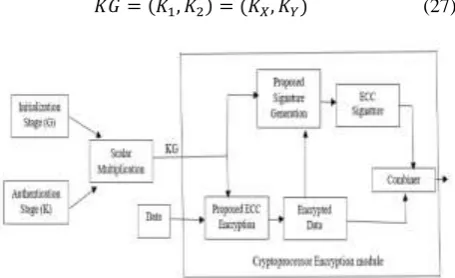
Considering the generator point ‘G’ and key ‘K’, scalar multiplication is performed to compute KG provided in Eq. (27), to be applied for encryption/decryption and signature generation and verification process.
𝐾𝐺 = (𝐾1, 𝐾2) = (𝐾𝑋, 𝐾𝑌) (27)
6 In the proposed Cryptoprocessor transmitter model represented in Figure 5, by considering the value of KG, the plain data is encrypted by applying proposed ECC encryption process to generate cipher data. The cipher data is applied to proposed ECDSA protocol for signature generation. The hash function SHA-3 Keccak algorithm is considered for generating signature. The two ECC primitive protocols outputs i.e., encrypted data and signature are mutually combined in transmitter before transmission.
Figure 6. Cryptoprocessor Receiver
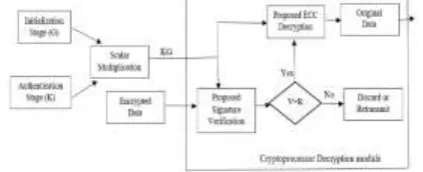
In the proposed Cryptoprocessor receiver model represented in Figure 6. The combined data i.e., the encrypted data and signature are separated in the receiver verification and decryption process. Considering the value of KG, the cipher data is applied to proposed ECDSA protocol for signature verification. If the signature is verified the cipher data is decrypted by applying proposed ECC decryption process to generate plain data else the cipher data is discarded. The hash function SHA-3 Keccak algorithm is considered for verifying the signature.
6. Implementation of Proposed Elliptic
Curve Cryptoprocessor
The hardware implementation proposed Cryptoprocessor model was realized in Verilog HDL and simulation carried out using ISim simulation tool in XILINX for verifying its functional correctness. For validating the functional correctness Xilinx 14.3 synthesis tool used to do synthesis. The wireless sensor nodes in the network transfer or exchange information between the nodes. The input data to be transmitted in hexadecimal form DA2A806A1F4A1F4A1F4A1F4A1F0652D9. The 128 bits of data divided into 16 blocks and is encrypted using modified ECC algorithm with matrix mapping methodology.
In the initial stage, a generator point ‘G’ is computed individually by the sender and receiver. The sender has the choice to choose an Elliptic Curve, represented as Y12=(X13+3X1+4)mod43, where a=3, b=4 and p=43. To
find out the points on an Elliptic Curve we compute Y12
mod 43 for Y1= 0 to 43 and compute Y12=(X13+3X1+4) mod
43 for X1= 0 to 43. Considering the values the elliptic
points available on the curve a generation point GA = (30, 41) was selected.
The Elliptic Curve individually chosen by the receiver is Y22=(X23+9X2+9) mod 29, where a=9, b=9 and p=29. To
find out the points on an Elliptic Curve we compute Y22
mod29 for Y2= 0 to 29 and compute Y2=(X2+9X2+9) mod
29 for X2= 0 to 29. Considering these values the elliptic
points available on the curve a generation point GB = (22, 26) was selected.
The shared generator point is calculated by generating the sender’s secret key KSas 13 and receiver’s secret key
KRas 25. Generator point between two nodes for each
communication session is generated and common generator point is calculated based on the proposed method and is generated as
GC = GA + GB = (14, 34) + (21, 18) = (12, 1) = G Considering G = P = (12, 1), scalar point multiplication is performed to calculate 2P, 3P,………up to 256P, and are mapped with the hexadecimal equivalent representation, 00 to FF, where each block is of 8 bits. The scalar multiplication is performed by point addition and point doubling process. The hexadecimal characters are than mapped to the scalar multiplied points.
The hexadecimal equivalent of the individual block is mapped to a scalar multiple of the generator point and is represented in a matrix form. Let M be the matrix form of key of length n =16 and is given in Eq. (28) as
M=|
𝐷𝐴 2𝐴 80 6𝐴 1𝐹 4𝐴 1𝐹 4𝐴 1𝐹 4𝐴 1𝐹 4𝐴 1𝐹 06 52 𝐷9
|=
|
(127,148) (115,109) (072,104) (191,100) (225,082) (108,173) (225,082) (108,173) (225,082) (108,173) (225,082) (108,173) (225,082) (228,042) (113,215) (201,135)
| (28)
A 4*4 matrix is selected in Eq. (29) such that |A| ±1
A=|
1 1 1 1 1 2 1 2 1 1 1 0 1 4 2 3
| (29)
The mapping is accomplished by multiplying the non-singular matrix with the message matrix to get Q matrix represented in the Eq. (30) as
Q=AM=|
(115,101)( 94,229)(153, 81)( 55,135) ( 30, 90)(216,213)( 88, 22)(181, 88) (176,203)(110, 68)(110, 68)( 42,187) (185, 22)(229,169)( 31,210)( 52,135)
| (30)
In modified Diffie Hellman key exchange process a random number KS is generated by sender is 13 and a random number KR generated by receiver is 25. The public key shared by sender and receiver are PS = PR= 45.
Hence PSR = KS PS = 13 x 45 mod 233 = 119
Hence PRS = KR PR = 25 x 45 mod 233 = 193
K = KSR = KRS = PSR PRSmod p = 119 x 193
mod 233 = 133
This is the number with generator point applied to Eq. (6.1) to get
KG= 133 (12, 1) mod 233 = (131, 133) The elements of the Q matrix are encrypted using modified ECC algorithm represented in Eq. (16) and Eq. (17)
C1i = (Qyi Kx + Qxi) mod p
C2i = (Qyi + Qyi KxKy + QxiKy) mod p
The ciphertext (C1i, C2i) is computed to get C Matrix
specified in Eq. (31)
C= |
(223,29)(182,188)(2,142)(114,117) (147,30)(196,183)(70,60)(109,34) (137,71)(12,201)(12,201)(122,180) (167,106)(6,119)(71,162)(111,142)
| (31)
The signature of A for message M is the pair (r, s) = (d3, 565d)
The Receiver receives the cipher text and the ciphertext (C1i, C2i) is decrypted using Eq. (16) and Eq. (17) to get Q
matrix specified in Eq. (32) as Qyi = (C2i - KyC1i) md p
Qxi = (C1i - Qyi Kx) mod p
Q=|
(115,101)( 94,229)(153, 81)( 55,135) ( 30, 90)(216,213)( 88, 22)(181, 88) (176,203)(110, 68)(110, 68)( 42,187) (185, 22)(229,169)( 31,210)( 52,135)
| (32)
Consider the inverse of the non-singular matrix specified in Eq. (33)
A-1 = | |
−1 2 1 − 1 −2 1 1 0 3 − 3 − 1 1 1 0 − 1 0 |
| (33)
In the receiver the message in the form of Elliptic Curve points are calculate by multiplying the inverse of non-singular matrix with the decoded Q matrix. The message is de-mapped to get back the information in the Hexadecimal formatshown in Eq. (34).
M=A-1Q
M=|
(127,148) (115,109) (072,104) (191,100) (225,082) (108,173) (225,082) (108,173) (225,082) (108,173) (225,082) (108,173) (225,082) (228,042) (113,215) (201,135) |
M=|
𝐷𝐴 2𝐴 80 6𝐴 1𝐹 4𝐴 1𝐹 4𝐴 1𝐹 4𝐴 1𝐹 4𝐴 1𝐹 06 52 𝐷9
| (34)
7. Simulation Results of
Cryptoprocessor
The proposed cryptoprocessor transmitter and receiver was realized in Verilog HDL and simulation carried out using ISim simulation tool in XILINX for verifying its functional correctness.
Figure 7. Top module of Cryptoprocessor Transmitter
Figure 8. Block Diagram of Cryptoprocessor Transmitter
Figure 9. Expanded Block Diagram of Cryptoprocessor Transmitter
8
Figure 11. Block Diagram of Cryptoprocessor Receiver
Figure 12. Expanded Block Diagram of Cryptoprocessor Receiver
Figure 13. Simulation Results of Cryptoprocessor Transmitter
Figure 14. Simulation Result of Cryptoprocessor Receiver
Figure 15. Top Module of Proposed Cryptoprocessor
Figure 16. Block Diagram of Proposed Cryptoprocessor
Figure 17. Expanded Block Diagram of Proposed Cryptoprocessor
Figure 18. Simulation Result of Proposed Cryptoprocessor
For validating the functional correctness Xilinx 14.3 synthesis tool used to do synthesis. The top module, block diagram and the expanded block diagram of the proposed cryptoprocessor transmitter generated are shown in the Figure 7 to Figure 9 and proposed cryptoprocessor receiver generated are shown in the Figure 10 to Figure 12. The simulation result of the transmitter block is presented in Figure 13 and receiver block is presented in Figure 14. The proposed cryptoprocessor was realized in Verilog HDL and simulation carried out using ISim simulation tool in XILINX for verifying its functional correctness. For validating the functional correctness Xilinx 14.3 synthesis tool used to do synthesis. The top module, block diagram and expanded block diagram of the proposed cryptoprocessor is generated and is as shown in the Figure 15 to Figure 17. The simulation result of the transmitter block is presented in Figure 18.
8. Result Analysis of Cryptoprocessor
The cryptoprocessor transmitter and receiver are synthesized and the device utilization summary, timings summary and memory utilization is tabulated in Table 1. The hardware implementation of Elliptic Curve Cryptoprocessor transmitter and receiver has been implemented. The transmitter and receiver are designed using Verilog HDL, and implemented on a Genesys Virtex-5 5XC5VLX50T-1FF1136 FPGA Development board by XILINX to evaluate the area and speed. The transmitter operates at a frequency of 151.366 MHz and performs the encryption operation in 6.606 ns. The receiver operates at a frequency of 140.089 MHz and performs the encryption operation in 7.138 ns.
Table 1 Synthesis Summary of Cryptoprocessor Transmitter and Receiver
Cryptoprocessor Transmitter Receiver
Parameters Used Used
Number of Slice Registers
13407 5628
Number of Slice LUTs
24452 5058
Number of LUT flip flop pairs used
8892 2349
Total Real Time to Xst Completion
1345.00 secs 339.00 secs
Total CPU Time to Xst Completion
1344.87 secs 338.21 secs
Total Memory usage 1482412 KB 591916 KB Minimum period 6.606 ns 7.138 ns Maximum
Frequency
151.366 MHz 140.089 MHz
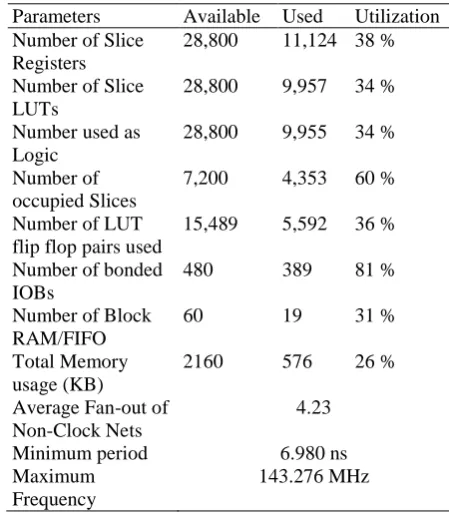
The proposed cryptoprocessor is synthesized and the device utilization summary, timings summary and memory utilization is tabulated in Table 2. The hardware implementation of proposed Cryptoprocessor has been
implemented in this chapter. The Cryptoprocessor is designed using Verilog HDL, and implemented on a
Genesys Virtex-5 5XC5VLX50T-1FF1136 FPGA
Development board by XILINX to evaluate the area and speed. The system operates at a frequency of 143.276 MHz and performs the operation in 6.980 ns.
Table 2 Synthesis Summary of Proposed Cryptoprocessor
Parameters Available Used Utilization Number of Slice
Registers
28,800 11,124 38 %
Number of Slice LUTs
28,800 9,957 34 %
Number used as Logic
28,800 9,955 34 %
Number of occupied Slices
7,200 4,353 60 %
Number of LUT flip flop pairs used
15,489 5,592 36 %
Number of bonded IOBs
480 389 81 %
Number of Block RAM/FIFO
60 19 31 %
Total Memory usage (KB)
2160 576 26 %
Average Fan-out of Non-Clock Nets
4.23
Minimum period 6.980 ns
Maximum Frequency
143.276 MHz
9. Conclusion
10
Reference
[1] Ashton, K (2009). That “Internet of Things” Thing: In the Real World Things Matter More than Ideas. RFID Journal, pp. 97-114.
[2] Manoj Kumar S (2015). An Analysis of Authentication Schemes for Internet of Things. International Journal of Engineering Sciences & Research Technology, vol. 4, no. 6, pp. 978-984. [3] Weizhe Zhang, Baosheng Qu (2013). Security
Architecture of the Internet of Things Oriented to Perceptual Layer. International Journal on Computer, Consumer and Control (IJ3C), vol. 2, no.2, pp. 37-45. [4] Sundmaeker H, Guillemin P, Friess P, Woelfflé S (2010). Vision and challenges for realizing the IoT. Cluster of European Research Projects on the IoT— CERP-IoT.
[5] William Stallings (2011). Cryptography and Network Security-Principles and Practice. Pearson Education. [6] Jayavardhana Gubbi, Rajkumar Buyya, Slaven
Marusic, Marimuthu Palaniswami (2013). Internet of Things (IoT): A Vision, Architectural Elements, and Future Directions. Future generation computer system (Elsevier),vol.29, pp. 1645-1660.
[7] Manoj Kumar S (2015). An Analysis of Authentication Schemes for Internet of Things. International Journal of Engineering Sciences & Research Technology, vol. 4, no. 6, pp. 978-984. [8] Jorge Granjal, Edmundo Monteiro, and Jorge Sá Silva
(2015). Security for the Internet of Things: A Survey of Existing Protocols and Open Research Issues. IEEE Communication Surveys & Tutorials, vol. 17, no. 3, pp. 1294-1312.
[9] Sheetal Kalra and Sandeep K. Sood (2015). Secure Authentication Scheme for IoT and Cloud Servers. Journal of Pervasive and Mobile Computing, vol. 24, issue C, pp. 210-223.
[10] HuiDan Gao, YaJun Guo, JianQun Cui, HengGeng Hao and Hui Shi (2012). A Communication Protocol of RFID Systems in Internet of Things. International Journal of Security and Its Applications, vol. 6, no.2, pp. 91-102.
[11] Rajam STR, Kumar SBR (2015). Enhanced Elliptic Curve Cryptography. Indian Journal of Science and Technology, vol. 8, no. 26, pp. 1-6.
[12] Chelton WN, Benaissa M (2008). Fast Elliptic Curve Cryptography on FPGA. IEEE Transactions on Very Large Scale Integration (VLSI) System, vol. 16, no. 2, pp. 198-205.
[13] G. Provelengios, P. Kitsos, N. Sklavos, and C. Koulamas (2012). FPGA-Based Design Approaches of Keccak Hash Function. Proceedings of 15th Euromicro Conference, pp. 648–653.
[14] Elhadjyoussef Wajih, Benhadjyoussef Noura, Machhout Mohsen & Tourki Rached (2012). Low Power Elliptic Curve Digital Signature Design for Constrained Devices. International Journal of Security (IJS), vol. 6, no.2, pp. 1-14.
[15] Greeshma Sarath, Devesh C Jinwala and Sankita Patel (2014). A Survey on Elliptic Curve Digital Signature Algorithm and its Variants. Computer Science & Information Technology (CS & IT) –CSCP, pp. 121– 136.
[16] Al Imem Ali, Prince Isitc, H (2015). Comparison and Evaluation of Digital Signature Schemes Employed in NDN Network. International Journal of Embedded systems and Applications (IJESA), vol.5, no.2, pp. 15-29. [17] Debiao He and Sherali Zeadally (2015). An Analysis of RFID Authentication Schemes for Internet of things in Healthcare Environment Using Elliptic Curve Cryptography. IEEE Internet of Things Journal, vol. 2, no. 1, pp. 241-247.
[18] Farooq, M.U, at.el. (2015). A Critical Analysis on the Security Concerns of Internet of Things (IoT). International Journal of Computer Applications, vol. 11, pp. 1–6.
[19] Farheen Fatima, at el. (2015). , Internet of things: A Survey on Architecture, Applications, Security, Enabling Technologies, Advantages & Disadvantages. International Journal of Advanced Research in Computer and Communication Engineering, vol. 4, no. 12, pp. 498-504.
[20] Dindayal Mahto and Dilip Kumar Yadav (2017). RSA and ECC: A Comparative Analysis. International Journal of Applied Engineering Research, vol. 12, no. 19, pp. 9053-9061.
[21] Swapnoneel Roy and Chanchal Khatwani (2017). Cryptanalysis and Improvement of ECC Based Authentication and Key Exchanging Protocols. MDPIi Journal of Cryptography, vol. 1, no. 9, pp. 1-25. [22] Dr.S.Vasundhara (2017). Elliptic curve Cryptography
and Diffie- Hellman Key exchange. IOSR Journal of Mathematics (IOSR-JM), vol. 13, no. 1, pp. 56-61. [23] Muneer Ahmad Dar and Javed Parvez (2017). Security
Enhancement in Android using Ellipic Curve Cryptography. International Journal of Security and Its Applications, vol. 11, no. 6, pp.27-34.