Optimizing Ontology Mapping Using Genetic
Algorithms (OOMGA)
Aarti Singh
Department of Computer Science, Guru Nanak Girls College, Yamuna Nagar, Haryana, India Email: [email protected]
---ABSTRACT---Ontologies play a vital role in knowledge representation in artificial intelligent systems. With emergence and acceptance of semantic web and associated services offered to the users, more and more ontologies have been developed by various stack-holders. Different ontologies need to be mapped for various systems to communicate with each other. Ontology mapping is an open research issue in web semantics. Exact mapping of ontologies is rare to achieve so it’s an optimization problem. This work presents and optimized ontology mapping mechanism which deploys genetic algorithm.
Keywords: Genetic Algorithm , Ontology, Ontology Alignment , Ontology Mapping, Optimized Ontology Mapping.
--- --- Date of Submission: Feb 12, 2018 Date of Acceptance: March 07, 2018 ---
---1. Introduction
S
emantic web emphasizes on incorporating meaning with information displayed on the web. Ontologies are the backbone of knowledge exchange in semantic web where ontology is the taxonomy for a domain representing concepts, objects, attributes and their relationships with each other. Ontology represents shared conceptualization (Gruber,1995) of a domain for use in semantic driven application in present Internet, where shared conceptualization refers to the commonly accepted understanding for conceptual model of a domain under consideration.Ontologies (Singh et al.,2011) find applicability in system engineering, semantic web, artificially intelligent systems, information extraction and aggregation to name a few areas. Ontologies ( Singh et al., 2010) aim to capture the knowledge in a generic and formal way so that it may be reused and shared across applications and by groups of people.However, with wide acceptance of internet based applications more and more ontologies are developed by various stakeholders for different purposes, making their interoperability difficult. Further, considering the large size of internet, its users and variety of applications being used; it is difficult to force users to work with a single ontology for a domain. However, in order for different applications to communicate with each other and exchange knowledge, it becomes essential for ontologies to be interoperable. This has been considered as an important issue by semantic web community and many efforts has been made in this direction in names of ontology alignment or ontology mapping. Some researchers have tried to focus on optimizing ontology mapping, however the reason for optimizing ontology mapping and scenario requiring it are not clearly stated. Before moving further, some basic terms
related with ontologies need to be made clear. Next subsection throws light on some such terms:
1.1 Technical Preliminaries
This section briefly explains some terms which need to understood clearly for understanding this work: a. Ontology Mapping: Ontology mapping refers to
method of translating concepts of one ontology into concepts defined in some other ontology. Ontology mapping usually involves some loss of information however, it doesn’t lead to inconsistencies. Ontology alignment and articulation are used synonymously for ontology mapping. These are defined as:
Ontology Alignment: refers to establishing a set of binary relations between the vocabularies of two ontologies.
Ontology Articulation: involves generation of rules through which fusion or merging or ontologies can be carried out. Conditions of ontology alignment are referred as articulation (Chitra & Aghila,2014).
b. Similarity Measure:Similarity is numeric measure of the degree to which two objects are alike . Similarity measures focus on providing concrete basis for finding similarity among two entities belonging to separate ontologies. Two objects must have similar characteristics to be comparable. Formal definition of similarity between two objects x and y as given by Ehrig and Sure (2004) states:
sim(x, y) ∈ [0..1]
sim(x, y) = 1 → x = y: two objects are identical.
sim(x, y) = 0: two objects are different and have no common characteristics.
sim(x, y) = sim(y, x): similarity is symmetric
Many text similarity measures exist in the literature. Broadly similarity measures may be classified as (Lee et al.,2008):
1) Manual similarity measurement by agreement among experts: This is accepted gold standard for similarity measurement where most derived metrics have been evaluated using peer review standard to assess their performance. However, this approach is infeasible due to lack of scalability.
2) Information–content based similarity measurement: It involves computing frequency with which a term appears with another in a given piece of information. This approach takes a statistical view of information for computing closeness of two terms.
Second category above is mostly focused due to availability of mathematical formulas for concrete justification of decision. In this category, vector space model (VSM) measures are widely accepted which consider a text as vector of terms, joined with some frequency.VSMs perform well on tasks that involve measuring the similarity of meaning between words,
phrases, and documents (Turney
&Pantel,2010).Methods in this category include: Dice coefficient, overlap coefficient, Jaccard similarity and cosine similarity etc., however cosine similarity measure outperforms others (Thada&Jaglan, 2013). This work makes use of Cosine similarity and Jaccard Coefficient. Thus both these measures are defined below:
c. Cosine Similarity: This is the most popular technique to measure similarity of two frequency vectors. These vectors may be simple or weighted. It can handle both binary and non-binary vectors. Let a and b be two frequency vectors having n elements each:
a=<a1,a2,a3,- - - - -,an>
b=<b1,b2,b3, - - - -, bn>
then cosine of angle θ between these two vectors is calculated as:
𝒔 , = ∑𝒊= 𝒊. 𝒊
√∑𝒊= 𝒊.√∑𝒊= 𝒊
(1)
cosine similarity value may range from [-1,1] , it will be -1 when the vectors point in opposite directions and it will be +1 if the vectors point in the same direction (more details may be found in Turney &Pantel, 2010).
d. Jaccard Index or Jaccard coefficient: is useful to measure similarity between two objects having binary attributes.It measures the similarity between two sample sets and is defined by the size of intersection between the two sets divided by the size of union of the two sets. Jaccard
coefficient J (Renjith& Chandrika,2013) can be computed as:
𝑱 =𝑻 +𝑻 +𝑻𝑻 (2)
where 𝑇 refers to terms common in both objects. 𝑇 refers to unique terms in one object and 𝑇 refers to unique terms in second object. Jacaard index of value 1 indicates that data objects are completely similar whereas value 0 indicates they are completely dissimilar.
After understanding basic terms, now reason for optimized ontology mapping needs to be understood. Since ontologies are being designed by different sources, there is lack of consistency in taxonomies being used by them, even if they are designed for the same domain. Two different ontologies designed for same domain may refer same concept with different names or different concepts with same names, or they may focus on different attributes of the concepts. Now, when one concept say c1 from ontology say O1
has to be mapped to some concept c2 in ontology O2
then, first c1 has to be searched in O2 for a match,
using some similarity measure. Now, two possibilities are there, one is that some match may be found and second is that no match may be found. If the match is found in the form of synonymous concept of c1 then it
is good otherwise some relationship needs to be established between concepts of O1 and O2 in order to
ensure mapping. Ontology extension and intension relationships (Singh et al., 2011) are being used for this purpose. By focusing only on similarity measure based ontology mapping, there are chances that no similarity between two concepts may be found and mapping can’t be established. This will lead to wasted search time. Ontology mapping is an optimization problem since, here it is not essential to get exact matching of conceptsin even homogeneous domain ontologies, leave apart the heterogeneous domain ontologies.
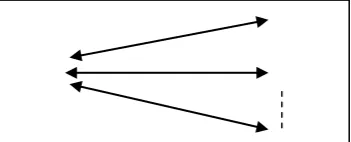
However, another aspect can be to match one ontology with many possible ontologies existing in the same domain and to find closest possible matching ontology. Thus optimized ontology mapping process may be defined as “mapping one ontology with n other ontologies existing in a domain, to find closest possible matching ontology, when no exactly matching ontology otherwise exists”. Optimization techniques focus on finding a satisfying solution (optimal one) in the case, where no solutions otherwise exists [24]. Figure 1given below illustrates ontology mapping as an optimization problem.
Ontology mapping involves searching concepts of ontology in another one. Size of these taxonomies can be quite large, leading to increased time and space complexity of search processes. Thus, heuristic search techniques need to be employed to reduce the number of alternatives to be explored in the search space. Heuristic search techniques make use of a fitness function to decide next alternative to be explored among many available alternatives. It is usually implemented by assigning weights to various alternatives i.e. candidates in a search space. However, manual assignment of these weights is not practically feasible nor desirable in web based applications. A still better mechanism for searching ontologies and automating computation of fitness function is use of machine learning techniques such as Genetic algorithms.
Consequently, the main aim of the current work is to present a genetic algorithm based optimized ontology mapping technique.
The rest of paper is structured as follows: Section 2 provides brief overview of genetic algorithm and its working. Section 3 presents survey of relevant literature in ontology alignment, ontology similarity parameters and genetic algorithms. Section 4 introduces the proposed mechanism, experimental analysis is illustrated in section 5. Finally, section 6 concludes this work.
2.
Genetics for Ontology Mapping: An
Overview
Genetic Algorithm (GA) (Man et al.,1996) is based on evolutionary theory that follows principal of
‘survival-of-the-fittest’. It was presented by J.H.Holland in 1970s and has proved to be significant instrument for scientific and engineering applications (Malhotra et al.,2011) since then.GA works on natural process of evolution like reproduction, mutation, recombination and selection for providing solutions of complex and conflicting problems. Due to availability of cheap and high-speed computational components, GA has emerged as an appealing solution for wide range of complex , time consuming tasks such as information retrieval (Thada& Jaglan,2013), ontology mapping (Wang et al.,2006) and text mining etc. GA starts with an initial population, where population refers to a set of possible solutions for a problem. Each member of population is termed as a chromosome and it represents a string of genes where a gene represents a bit pattern. The goal is to obtain a set of most suitable chromosomes or most suitable individual chromosome after some iterations of GA. Suitability of a chromosome for a particular problem is measured using fitness function (Renjith& Chandrika, 2013). A population obtained after some iterations is called as a generation.
Effectiveness of next generation is enhanced by applying reproduction, crossover and mutation operations. Purpose of these operations is to mix or recombine genes of parents for production of their
off-springs in next generations. Here reproduction refers to selecting fittest chromosome based on its fitness value. Crossover refers to exchanging genes between two individual chromosomes of a population for producing new off-springs. Mutation deals with randomly changing genes in a chromosome. It is of two types i.e. Point mutation and chromosomal mutation. In Point mutation only a single gene is altered in a chromosome, whereas in chromosomal mutation few genes are altered completely.
Thus process of GA for problem solving may be summarized as follows:
1) Obtain a set of initial population 2) Iterative execution of:
(i) Evaluation (ii) Selection (iii)Reproduction (iv)Crossover (v) Mutation
3) Convergence to a solution
Next section presents literature review in the relevant domains.
3. Literature Survey
This section explores existing literature on ontology similarity measures and mapping mechanism and various methods available for ontology mapping optimization.
Man et. al. (1996) in [7], have introduced GA as a complete entity in which knowledge can be integrated to develop framework for a design tool. Authors highlighted that Genetic algorithms may be used as optimization tool.
Maedche and Staab (2001) in [1], has considered ontology as semiotic sign systems that are used to communicate meaning. They have proposed a methodology to measure the extent to which two ontologies overlap and fit with each other at various semiotic levels. However, evaluation of proposed method with real world data is left as part of future work.
Wiesman and Roos (2004) in [4], introduced an agent based domain independent method for ontology mapping based on learning relationship between ontologies. However, mapping between different representations of the same concepts can’t be handled properly. Authors emphasized that context dependent ontology mapping is an NP-Hard Problem. Further, an extension of this method to learn a mapping between groups of interrelated concepts has been left as part of future research.
approach. It makes use of Naïve Bayes learning technique which applies well to long textual elements but is less effective with short, numeric elements. Wang et. al. (2006) in [8], have developed a genetic algorithm based optimization procedure for ontology matching problem taking it as a feature-matching process. Global similarity measure has been taken as fitness function between two ontologies based on feature sets.
Martinez-Gil et. al. (2008) in [2], presented Genetics for Ontology Alignments (GOAL) approach, to compute the optimal ontology alignment functions for a given ontology input set. However, a multi-objective strategy, avoiding unwanted deviations from precision and recall values is left as part of future study. Further, the authors emphasized that there should be a technique which given the specifications of an ontology matching problem, may compute the optimum alignment function. So that, ontology alignment problem may be solved accurately and without human intervention. This would lead to real interoperability in the semantic web.
Lin and Sandkuhl (2008) in [14], provided a review on exploiting Wordnet for ontology mapping. Authors emphasized that synonyms can help solve naming conflicts [4] among various ontologies, while mapping and Wordnet thesauri can help improve similarity measures dealing with ontology mapping. A design structure for development [12] of ontological databases in general had proposed by Singh et. al. (2010) in [11]. This work elaborated minute details to be considered while designing ontology databases to make knowledge interchange language independent.
Malhotra et. al. (2011) in [6], have discussed the concept and design procedure of genetic algorithms as an optimization tool. They have applied GA for process control in induction motor drive, speed control of gas turbine, etc. and optimized control parameters for them. Singh et. al. (2011) in [10] have proposed an agent based ontology mapping mechanism for mapping in homogenous as well as heterogeneous domains, in order to facilitate interoperability between multi-agent systems developed by different stakeholders for different purposes. This mechanism makes use of ontology extension and intension concepts. However this work doesn’t consider optimization while ontology mapping.
Hartung et. al.(2013) in [3], presented Generic Ontology Matching and Mapping Management (GOMMA) framework which works on n-gram matching for computing the similarity of concept names and synonyms. This work outlined use of Graphical Processing Unit (GPU) for highly parallel string matching. The GPU based execution of algorithms like n-gram matching requires some efforts to overcome the CPU limitations but boosts performance. However, effect of different kinds of GPU hardware on GPU-based similarity computations has been left as part of future research.
Singh and Anand (2013) in [13],developed an agent based mechanism for automatic construction of domain ontologies. Authors have used mapping between already existing ontologies to construct new ontology thus reducing time and efforts required in this process. A comparison and summarization of various existing techniques is given as follows in Table 1.
Table1. Comparison of Existing approaches S.
No.
Name of
mechanism
Author Name
Technique used
Style of mapping
Results Limitations
1 Lexicon based ontology
comparison
Maedche and Staab (2001) in [1]
Semiotics view of ontology is considered
Syntactic and Semantic comparison level used. Composite matching technique
Much more experiences are needed to use ontology similarity measures.
Ontologies are compared as sign systems. Lexicon, reference functions and semantic cotopy are used for this purpose. Optimization is not considered.
2 Wiesman and Roos approach
Wiesman and Roos (2004) in [4]
Agent based ontology mapping mechanism
Automatic, joint attention technique used
Ontology mapping is based on labels and independent of domain knowledge
Ontology mapping is of concern, optimization is not addressed
3 GLUE[9] Doan et al. (2004) in [9]
Joint Probability Distribution of Concepts, Multi-Strategy learning method
Semi-automatic 3-18% accuracy in matching
Naïve bayes learning technique used, works well with long textual terms, not effective for short numeric terms
4 GAOM Wang et al. (2006) in [8]
Feature Matching process, global similarity measure is been used
Genetic Algorithm used, automatic mapping
Not mentioned Structural properties of ontologies are only considered. Semantics has been ignored.
5 Genetics for Ontology
Alignment (GOAL)
Martinez et al. (2008) in [2]
Genetic Algorithm Single goal-driven search, automatic mapping method
Precision and Recall is better than GAOM
Single-strategy ontology mapping. Ontology mapping optimization is not considered.
6 IAM3I Singh et al. (2011) in [10]
Multi-agent system based ontology mapping
Automatic, ontology extension and
Homogeneous and heterogeneous ontologies can be
used 7 Generic Ontology
Matching and Mapping
Management (GOMMA)
Hartung et al (2013) in [3]
n-gram string comparison
Semi-automatic GPU based mechanism of optimization, suffers from memory constraints.
Memory must be pre-allocated on target device. Works only for integer values.
From the above table it can be concluded that, although many efforts have been made towards ontology mapping, optimization of ontology mapping still is an open research issue. It is clear that Genetic algorithms may be used for problems having large search spaces. Some researchers have already used ontology mapping with this technique, however still there is scope for a mechanism which may incorporate, semantic knowledge in optimization process. Therefore, the motivation to the current work is to develop an approach for optimizing ontology mapping using Genetic algorithms as introduced in the next section.
4.
The Proposed Optimizing Ontology
Mapping
Using
Genetic
Algorithms
(OOMGA) Approach
This work presents Optimized Ontology Mapping using Genetic Algorithm (OOMGA) mechanism for optimal ontology mapping. This mechanism takes into consideration synonymous concepts existing in compared ontologies along with usual method of term frequency based mapping. Reason for deploying GA among all machine learning techniques is that GA
specializes searching along very high dimensional search spaces, as this problem is.
This work focuses on finding the optimal matching ontology from large number of ontologies existing corresponding to a source ontology. Considering source ontology SO1consisting of n concepts and k
target ontologies are available for mapping each consisting of m concepts then total number of comparisons required to choose best match will use the following equation :
Optimal_matching(SO1)=f(n×k×m) (3) In order to solve this problem using GA, both the fitness function (FT) and the evaluation function need to be decided. The ontology taxonomies (hierarchy) (OH) will act as input in formation of chromosomes of sample space, where a chromosome is a collection of i genes.
For formulating genes, OH will be traversed starting from root node to leaf node in depth first order, one such traversal will produce one gene, and traversal of complete OH will produce i genes {g1,g2,g3,---gi}. Thus source ontology hierarchy OHs can be
represented as a chromosome Cswhere
Cs={g1s,g2s,g3s,---gis}(4)
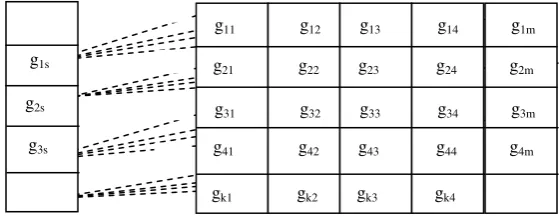
Ontology mapping will involve comparison of Cs(OHs) with {C1(OH1),C2(OH2),----Ck(OHk)} as
shown below in figure 2:
Figure 2. Process of Ontology Mapping using GA Subsequent to these comparisons between the two genes, it is required to compute their similarity, which is a vector-space category problem. The vector space model, also known as term-vector model, represents a textual document as vectors of terms or words. Here similarity of a query in a vector space of a document may be calculated using cosine similarity(Turney and Pantel,2010) (also known as normalized correlation coefficient) or Jaccard coefficient as discussed in section 1.1 .
For textual vectors, cosine similarity lies between 0 & 1. However, Cosine similarity doesn’t consider magnitude or semantics of terms. Rather it only
focuses on syntactic similarity of two vectors, which is not sufficient for optimizing ontology mapping. While comparing two ontologies, similar terms may be expressed using different strings such as Person and Human are synonyms but their cosine similarity would be 0. However, if we consider contextual similarity of these terms, these are similar.
Consequently, contextual similarity should also be considered in order to provide optimal mapping between ontologies. Therefore, Jaccard coefficient
s
g1s
g2s
g3s
1
2
3
4
k
g11 g12 g13 g14 g1m
g21 g22 g23 g24 g2m
g31 g32 g33 g34 g3m
g41 g42 g43 g44 g4m
between two genes, as follows:
1s,
11
1s 11 1s 11J g
g
g
g
g
g
(5)The Jaccard coefficient (J) between two genes would be 1 or close to 1 if they are either identical or near identical, however it will be 0 in case of unidentical genes.
The fitness function ofthe proposed framework is defined as:
1 11
1 11_
cos_
s,
(
s,
)
fitness
fun
sim g
g
J g
g
(6)
or two ontologies then theJaccard coefficient (J) will be 0 or close to zero. Then, the similarity will depend mainly on Cosine_similarity of genes.
4.1 Example for mapping between two educational ontologies
To clarify the above stated concept, consider the two exampleontologies as shown in figures 3 and 4. Both these ontologies are from education domain, one represents part of university ontology and other illustrates part of school ontology.
Figure 3. Part of University Ontology
Figure 4. Part of University Ontology
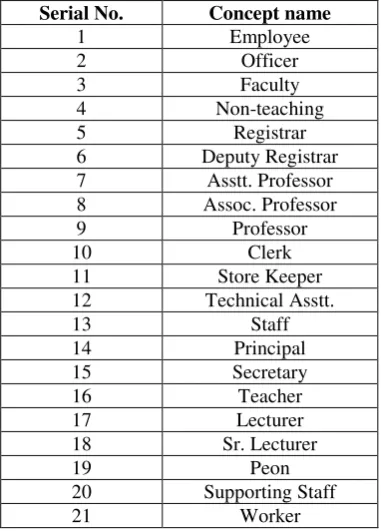
To find mapping between these two ontologies, first concepts need to be checked for their synonyms. For this, all unique concepts of both ontologies will be assigned unique numeric value and will be stored in a linear arraytermed as Unique Identification Array (UIA) as shown in table 2, where the serial no. of a concept in the array will signify numeric value associated with it.
Now, all these terms are checked for their synonyms from thesaurus based Wordnet dataset, in order to include contextual similarity of different terms in the two ontologies under consideration. These synonyms are saved as a row in a two dimensional matrix, called asSynonym Set Matrix, as shown in Table 3 below. Each row in table 3 corresponds to a concept of UIA
i.e. table 2 , where concept no. field indicates position of concept in UIA. For example first row of table 3 contains synonyms for concept no. 1 in UIA table i.e. table 2.
Employees
Officer Faculty Non-Teaching
Registrar Deputy Registrar
Asstt. Professor
Assoc.
Professor Clerk Store-Keeper
Technical Asstt. Professor
Staff
Officer Faculty Non-Teaching
Table 2. Unique Identification Array (UIA)
Serial No. Concept name
1 Employee
2 Officer
3 Faculty
4 Non-teaching
5 Registrar
6 Deputy Registrar
7 Asstt. Professor
8 Assoc. Professor
9 Professor
10 Clerk
11 Store Keeper
12 Technical Asstt.
13 Staff
14 Principal
15 Secretary
16 Teacher
17 Lecturer
18 Sr. Lecturer
19 Peon
20 Supporting Staff
21 Worker
Now, every concept of source and target ontologies has a synonym set associated with it. These synonyms are represented in numeric values from using UIA table. For example: concept employee has synonym set {staff, worker} which can be represented as {13,21} using positional value of staff and worker from table 2, similarly term faculty has synonym set {13,16,17} .
For generalization, when comparing two genes for similarity i.e., to check,
if g
1s
g
11
where:g1s={employee, faculty, asstt. prof.} ={1,3,7}(7)
g11={staff, faculty, lecturer}={13,3,17} (8)
Before comparing g1s is scanned from synonym set matrix (table 3) and its synonymous set termed as syn_set is generated by replacing each term with all its synonyms one by one. For example syn_set for g1s is given below:
syn_set (g1s )= {{13,21},{13,16,17},{17}}
using this, g1s can be rewritten in expanded form as shown below.
g1s={{1,3,7},{13,3,7},{21,3,7},{1,13,7},{1,16,7},{1,
17,7},{1,3,17}} (9)
g11={13,3,17} (10)
As compared to original equations (7) and (8) where only one term was matching exactly, new equations
(9) and (10) provide exact matching of all three terms at second subset in equation 9, based on contextual similarity of these terms. Now J-coefficient for g11 and all subsets will be computed and maximum value among all calculated values will be considered as J-coefficient of original pair (g1s , g11). For more relevant and lesser false negatives while matching, the fitness function is to be computed.
This similarity calculation mechanism is better than cosine similarity alone as it incorporates contextual similarity of terms in various ontologies.
4.2 Work Flow of OOMGA
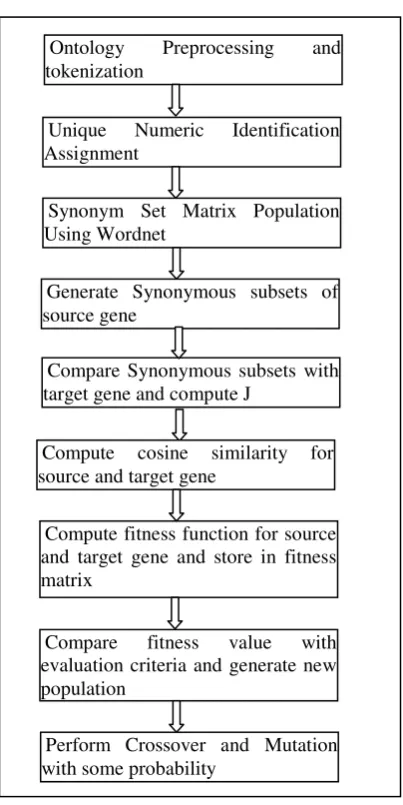
Figure 5 given below illustrates work flow in OOMGA. For optimized ontology mapping, initially concepts of source ontology will be converted into genes. All unique terms of these genes will be entered into UIA and will be assigned unique integer values. Further, synonyms of all unique terms will be obtained from Wordnet and will be inserted into synonym set matrix. Afterwards, genes will be converted into numeric sets. Then synonymous set (syn_set) will be generated for source gene and it will be used for computing Jaccard coefficient from target gene. In this process, J value for contextually similar genes will become close to one. Cosine similarity of source and target genes will also be computed.
Concept No.
Synonyms
1 Staff worker
2 CEO OSD
3 Teacher Lecturer staff
4 Person not in
teaching
5 - - -
6 - - -
Figure 4. Fitness Matrix
Then, fitness function between two genes will be computed using equation (6) and will be stored in fitness matrix shown in Table 4 given below.
Purpose of Table 4 is to keep record of fitness function values when source gene is compared with different target genes. Based on a threshold value, genes will be selected for next generation and then mutation and crossover operations will be applied with some probability (To be decided at the time of experiment) to generate next generation.
This process will be repeated on all ontologies under consideration for mapping and best matching ontologies would be considered as optimal matching pair.
4. Conclusions and Future Work
This work presented an optimized ontology mapping technique deploying genetic algorithm.GA specializes searching along very high dimensional search spaces
so it is a promising technique for optimized ontology mapping. Further, proposed technique deploys a similarity calculation mechanism that is better than cosine similarity alone as it incorporates contextual similarity of terms in various ontologies while mapping optimization. However, proposed mechanism is still in process of implementation. Future work involves its implementation and comparison with existing techniques.
References:
1. Maedche, A., &Staab, S. (2001). Comparing ontologies-similarity measures and a comparison study (p. 16). AIFB.
2. Martinez-Gil, J., Alba, E., & Aldana-Montes, J. F. (2008, October). Optimizing ontology alignments by using genetic algorithms. In Proceedings of the workshop on nature based reasoning for the semantic Web. Karlsruhe, Germany.
Gene No.
Fitness value
g1s Fitness_val
(
g1s, g11) Fitness_val(
g1s, g12)-
-
g2s Fitness_val
(
g2s, g11) Fitness_val(
g2s, g12)-
-
g3s Fitness_val
(
g3s, g11) Fitness_val(
g3s, g12)-
-
ure 5. Work flow in OOMGA
Ontology Preprocessing and tokenization
Unique Numeric Identification Assignment
Synonym Set Matrix Population Using Wordnet
Generate Synonymous subsets of source gene
Compare Synonymous subsets with target gene and compute J
Compare fitness value with evaluation criteria and generate new population
Perform Crossover and Mutation with some probability
Compute cosine similarity for source and target gene
(2013, January). Optimizing Similarity Computations for Ontology Matching-Experiences from GOMMA. In Data Integration in the Life Sciences (pp. 81-89). Springer Berlin Heidelberg.
4. Wiesman, F., & Roos, N. (2004, July). Domain independent learning of ontology mappings. In Proceedings of the Third International Joint Conference on Autonomous Agents and Multiagent Systems-Volume 2 (pp. 846-853). IEEE Computer Society.
5. Euzenat J. (2004), ‘Evaluating Ontology Alignment Methods’. Published in proceedings of Dagstuhl Seminar on Semantic Interoperability and Integration, September 2004, Wadern, Germany. 6. Malhotra R., Singh N. and Singh Y. (2011),
‘Genetic Algorithms: Concepts, Design for Optimization of Process Controllers’. Published by Canadian Center of Science and Education in International Journal of Computer and Information Science, Vol. 4, No.2, March 2011,pp. 39-54. 7. Man, K.,F., Tang, K.,S. and Kwong, S. (1996). Genetic Algorithms: Concepts and Applications. IEEE Transactions on Industrial Electronics, 43(5),519-534, OCTOBER 1996.
8. Wang, J., Ding, Z., & Jiang, C. (2006, December). GAOM: Genetic algorithm based ontology matching. In Services Computing, 2006. APSCC'06. IEEE Asia-Pacific Conference on (pp. 617-620). IEEE. 9. Doan, A., Madhavan, J., Domingos, P., & Halevy, A. (2004). Ontology matching: A machine learning approach. In Handbook on ontologies (pp. 385-403). Springer Berlin Heidelberg. (GLUE Approach) 10. Singh, A., Juneja, D., & Sharma, A. K. (2011). Design of an Intelligent and Adaptive Mapping Mechanism for Multiagent Interface. In High Performance Architecture and Grid Computing (pp. 373-384). Springer Berlin Heidelberg.
11. Singh, A., Juneja, D., & Sharma, A. K. (2010). General Design Structure of Ontological Databases in Semantic Web. International Journal of Engineering Science and Technology, 2(5), 1227-1232.
12. Singh, A. and Anand,P.(2013). State of Art in Ontology Development Tools. International Journal of Advances in Computer Science & Technology, 2(7),96-101, July 2013.
13. Singh, A. and Anand,P. (2013). Automatic Domain Ontology Construction Mechanism.
exploiting wordnet in ontology matching. In Artificial Intelligence in Theory and Practice II (pp. 341-350). Springer US.
15. Ehrig, M., & Sure, Y. (2004). Ontology Mapping-an integrated approach. In the Semantic Web: Research and Applications (pp. 76-91). Springer Berlin Heidelberg.
16. Lee, W. N., Shah, N., Sundlass, K., &Musen, M. (2008). Comparison of ontology-based semantic-similarity measures. In AMIA annual symposium proceedings (Vol. 2008, p. 384). American Medical Informatics Association.
17. Gruber, T. R. (1995). Toward principles for the design of ontologies used for knowledge sharing. International journal of human-computer studies, 43(5), 907-928.
18. Gao, Y., & Gao, W. (2012). Ontology similarity measure and ontology mapping via learning optimization similarity function. International Journal of Machine Learning and Computing, 2(2), 107-112.
19. Turney, P. D., &Pantel, P. (2010). From frequency to meaning: Vector space models of semantics. Journal of artificial intelligence research, 37(1), 141-188.
20. Chitra, S., &Aghila, G. (2014). A survey on tools and algorithms of ontology operations. Research Journal of Engineering Sciences, 3(5), 12-25, May 2014.
21. Jing, L., Zhou, L., Ng, M. K., & Huang, J. Z. (2006, April). Ontology-based distance measure for text clustering. In Proceedings of the Text Mining Workshop, SIAM International Conference on Data Mining (Vol. 23).
22. Thada, V., &Jaglan, V. (2013). Comparison of Jaccard, Dice, Cosine similarity coefficient to find best fitness value for web retrieved documents using genetic algorithm. International journal of Innovations in Engineering and Technology (IJIET), 2(4), 202-205, August 2013.
23. Renjith, S., & Chandrika, A. (2013). Fitness function in genetic algorithm based information filtering- a survey. International Journal of Computer Science and Mobile Computing, 80-86, December 2013.
24. http://www.merriam-webster.com/dictionary/ optimization