Original Research Article
Knowledge and practices regarding food hygiene and health profile of
food handlers in eateries in a town in Southern Karnataka
Meera George
1, Pretesh Rohan Kiran
2*, Sulekha T.
2, Gautham Antony Joseph
2INTRODUCTION
Food is the basic need for sustenance of human life. Food can be contaminated from the production level to consumption level. Unsafe food and water has been a human health problem since history was first recorded, and many food safety problems encountered today are not new.1 Proper food preparation can prevent most food borne diseases. Worldwide, food and contaminated water borne diseases are a major health burden leading to high morbidity and mortality. The global burden of infectious
diarrhea involves 3-5 billion cases and nearly 1.8 million deaths annually, mainly in young children is caused by contaminated food and water.2 Food-borne disease outbreaks are defined as the occurrence of 2 or more cases of a similar illness resulting from ingestion of a common food or when observed number of cases of a particular disease exceeds the expected number.2
The chances of food being contaminated depend largely on the health status of food handlers their hygiene, the knowledge and practices of food safety.3Nearly 30% of
ABSTRACT
Background: A food handler is anyone who works in a food business and handles food, or surfaces that are likely to come into contact with food. The chance of food becoming contaminated depends largely on the health status and knowledge and practices of food safety of food handlers. Current statistics on food borne illnesses in various industrialized countries show that up to 30% of cases may be caused by poor food handling techniques, and by contaminated food served in food service establishments.
Methods: A cross sectional study was undertaken among 150 food handlers working in eateries in Anekal town, Bangalore Urban district, to determine their health profile and assess their knowledge and practices regarding food hygiene. A pre-validated, structured questionnaire was used to assess the knowledge and practices among food handlers. Knowledge and practice scores were categorized to find associations between levels of score and demographic variables.
Results: The mean age of the study subjects was 33.68±12.86 years. Fever and dizziness was reported by 39 (26.6%) of food handlers. Poor knowledge was found in 80 (53.3%) and poor practice in 83 (55.3%) regarding safe food hygiene. An increase in age and education levels showed a positive association with knowledge and practice of safe food hygiene.
Conclusions: Given high levels of poor knowledge and practice regarding safe food hygiene among these food handlers, there is an urgent need to address this issue that may translate into increased morbidity and suffering among populations served by these food handlers.
Keywords: Food handler, Safe food hygiene, Health profile
Department of Community Medicine, 1Travancore Medical College Kollam, Kerala, 2St John’s Medical College, Bangalore, Karnataka, India
Received: 12 March 2018 Accepted: 04 April 2018
*Correspondence: Dr. Pretesh Rohan Kiran, E-mail: [email protected]
Copyright: © the author(s), publisher and licensee Medip Academy. This is an open-access article distributed under the terms of the Creative Commons Attribution Non-Commercial License, which permits unrestricted non-commercial use, distribution, and reproduction in any medium, provided the original work is properly cited.
cases may be caused by poor food handling techniques, and contaminated food served in food service establishments. Safety includes the processing and storage of food as well as knowledge, attitudes and practices of food handlers, regarding this aspects.4
A food handler is anyone who works in a food business and handles food, or surfaces that are likely to come into contact with food (e.g. cutlery, plates). A food handler may be involved in food preparation, production, cooking, display, packing, storage or service.5
Unsafe water used for the cleaning and processing of food; poor food-production processes and food handling (including inappropriate use of agricultural chemicals); the absence of adequate food storage infrastructure; and inadequate or poorly enforced regulatory standards–these all contribute to a high risk environment.6 Common food borne illnesses are acute food poisoning, typhoid, cholera, helminthiasis etc. Common symptoms of food borne illness range from mild gastritis, bloated abdomen, loose stools, vomiting, fever to complications like severe dehydration, intestinal perforation and death.7
A majority of working class in our set up end up consuming at least one meal a day from eateries near the workplace. In the modern world many people consume food from restaurants and road side food establishments where proper food hygiene practices are usually not followed and so the consumer is at risk of infections. Many people are involved in these establishments as there is no need of training and big investments.8 Repeated food poisoning and other diarrheal diseases increase the sickness absenteeism and prevent utmost productivity.1 Proper knowledge regarding proper food handling and usage of safe water is necessary for all food handlers.
Objectives
To assess the knowledge and practices regarding food hygiene among food handlers in eateries in a town in Southern Karnataka.
To determine the health profile of food handlers in eateries in a town in Southern Karnataka.
To determine factors associated with knowledge and practice levels among these food handlers regarding food hygiene.
METHODS
This was a cross sectional study done in 2016. The sample size was calculated using an estimated 60% good practice in a study done in Tamil Nadu9 using the formula: n=z2 (p q)/d²
With an absolute precision of 10% and a confidence interval of 95% the calculated sample size is 94. Anticipating a non-response rate of 20%, the total sample
size was calculated to be 112.We collected data from 150 food handlers.
The study was initiated after obtaining approval from Institutional Ethics Committee. There were total 50 eateries in the study area. 150 food handlers employed at 30 eateries were interviewed during the study period. All those involved in preparation, production, display, packing, and storage & serving food in eateries in Anekal town were included in the study. The food handlers were interviewed till the sample size of 150 was reached. The interviewers explained the purpose of study before administering the questionnaire and were asking questions in the local language
The interview schedule was devised from modified Sharif and Al- Malki questionnaire which was used to assess knowledge and practices of the food handlers in military hospitals in Jordan.10 This is modified to suit the Indian setting and reliability was checked (Chronbach’s alpha 0.82).
The interview schedule had 4 parts. The first part consisted of the sociodemographic detail of the food handlers. The second part had the list of common morbidities found in food handlers. The handlers were asked whether they have suffered from any of the diseases in past 3 months.
The third part of interview schedule consisted of 14 questions regarding knowledge and the fourth part had 22 questions regarding practices among food handlers. The answers of each question was either Yes, No or Don’t know. The correct answer was given a score of 1 and the incorrect answer as 0. In the knowledge part, people who scored below 50th percentile of highest score were having poor knowledge, 50th-75th percentile - fair knowledge, >75th percentile - good knowledge. In the practice part; people who scored below 50th percentile were following poor practice, 50th-75th percentile- fair practice, >75th percentile - good practice.
Data was entered in Microsoft Excel and analyzed using SPSS version 16. Knowledge and practice scores were categorized to find associations between levels of score and demographic variables.
RESULTS
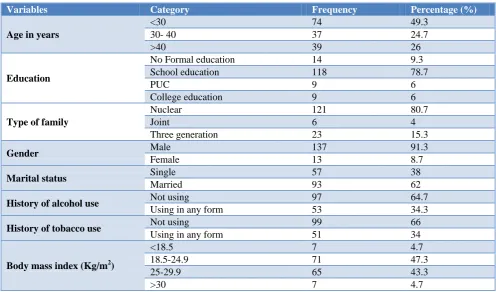
Table 1: Socio demographic profile of study subjects.
Variables Category Frequency Percentage (%)
Age in years
<30 74 49.3
30- 40 37 24.7
>40 39 26
Education
No Formal education 14 9.3
School education 118 78.7
PUC 9 6
College education 9 6
Type of family
Nuclear 121 80.7
Joint 6 4
Three generation 23 15.3
Gender Male 137 91.3
Female 13 8.7
Marital status Single 57 38
Married 93 62
History of alcohol use Not using 97 64.7
Using in any form 53 34.3
History of tobacco use Not using 99 66
Using in any form 51 34
Body mass index (Kg/m2)
<18.5 7 4.7
18.5-24.9 71 47.3
25-29.9 65 43.3
>30 7 4.7
n=150.
Table 2: Reported chronic diseases.
Chronic diseases
Category Frequency Percentage (%)
No reported chronic illness 129 86
Diabetes Mellitus 5 3.3
Hypertension 9 6
Diabetes and Hypertension 7 4.7
n= 150
Table 3: Socio demographic factors with knowledge score.
Variables Category Knowledge score Chi square
value P value
Poor knowledge (%) Good knowledge (%)
Education
No Formal education 13 (92.1) 1 (7.1)
36.76 <0.05#
School education 63 (53.4) 55 (46.6)
PUC 4 (44.4) 5 (55.6)
Degree 0 9 (100)
#p value calculated by Fishers exact test p<0.05 is significant
Table 4: Sociodemographic factors with practice score.
Variables Category Practice score Chi square
value P value
Poor practice (%) Good practice (%)
Education
No Formal education 12 (85.7) 2 (14.3)
16.65 <0.05#
School education 66 (55.9) 52 (44.1)
PUC 3 (33.3) 6 (66.7)
Degree 2 (22.2) 7 (77.8)
Marital Status Single 40 (70.2) 17 (29.8) 10.2 <0.05*
Married 43 (46.2) 50 (53.8)
Table 5: Association between knowledge score and practice score.
Variables Category Practice score Chi square
value P value
Poor practice (%) Good practice (%) Knowledge
score
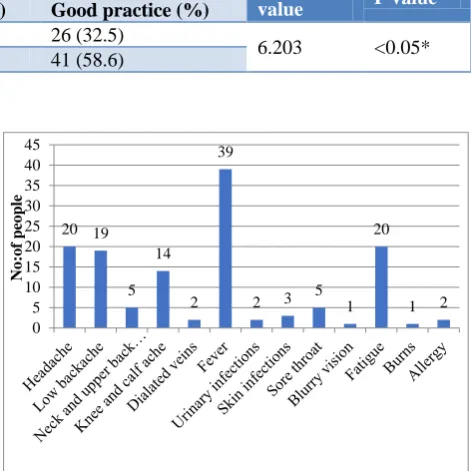
Poor knowledge 54 (67.5) 26 (32.5)
6.203 <0.05*
Good knowledge 29 (41.4) 41 (58.6)
*p value calculated by Chi square test p<0.05 is significant.
The Figure 1 and 2 showed that 80 (53.3%) of study subjects had poor knowledge and 83 (55.3%) had poor practice regarding safe food hygiene.
Figure 1: Knowledge score.
Figure 2: Practice score (n=150).
Table 2 showed that 129(86%) food handlers not reported any chronic illness. Among them 23(17.8%) were diagnosed to have increased blood pressure during the study.
Figure 3 showed that majority of food handlers reported that they suffered from at least one episode of fever in the past 3 months.
Factors associated with knowledge and practice score
For further analysis the fair and good score were combined as good score in both knowledge and practice aspect.
Figure 3: Types of reported acute illnesses (last 3 months).
Table 3 showed the association between knowledge score and socio demographic variables. It was found that higher the education higher the knowledge regarding safe food hygiene. No significant association was found between knowledge score and age, gender, marital status and type of family.
Table 4 showed the association between practice score and socio demographic variables. It was found that those who have college education had good practice regarding safe food hygiene. Also we found that those who are married were following good practice may be due to perceived feeling of responsibility among married people. No significant association was found between knowledge score and age, gender and type of family.
As seen in Table 5, the proportion of food handlers who had good knowledge had a significantly higher good practice (58.6%), as compared to those with poor knowledge (32.5%).
DISCUSSION
The purpose of the study was to assess the knowledge and practice of safe food hygiene among food handlers. We also determined the health profile of food handlers.
In a study done among food handlers working in canteen in a tertiary care hospital, Tamil Nadu, the knowledge of food borne diseases was 46.67%, mode of transmission - 33.33% and mode of prevention-36.67%.9 This result was different from our study where 53.3% of food handlers
80 (53.3%) 44
(29.3%) 26 (17.4%)
Poor Knowledge Fair Knowledge Good Knowledge
83 (55.3%) 45(30%)
22 (14.7%)
Poor Practice
Fair Practice
Good Practice
20 19
5 14
2 39
2 3 5 1 20
1 2 0
5 10 15 20 25 30 35 40 45
No
:of
peo
had poor knowledge regarding safe food hygiene. This may be due to the fact that majority of subjects were temporary contractors and majority had only school education which decreases awareness regarding food safety. Lack of proper training and repeated reinforcement also play a big role in this unawareness.
A study of food handlers in Maharashtra showed that majority of study subjects suffered from respiratory illness where as in our study majority suffered from fever in our study (26%).11 The common illness was different because our study was done in summer seasons where viral fevers are common than respiratory illnesses.
In a study done among food handlers working in canteen in a tertiary care hospital, Tamil nadu9 during inspections the practice was poor in view of hand washing and personal hygiene (40%), not using gloves, cap while handling food (33.33%). This was different from our study where 55.3% of study subjects followed poor practice, which can be attributed to poor knowledge and lack of strict regulations and also absence of frequent inspections in the establishments.
In a study done in Agartala, India among street food vendors regarding knowledge of hand washing and food handling practices showed that 70.5% of vendors store unsold food for next day.12 Out of 234 vendors 32.1% with secondary and 44.9% with primary education knew that un clean hands and dishes can transmit diseases.85.5% of the vendors were keeping the cooking surface dirty and using locally available cheap oils for cooking which was similar to our study.
In a study done among 83 food handlers including cooks, food servants and cleaners working in the mess and hospital canteen of a rural Private Medical College, Bijapur 32.5% subjects knew correctly the names of diseases transmitted through food.13 Majority of food handlers were practicing safe methods of food preparation and serving, and cleaning of food establishment which was more compared to our study because this study was not done in an organized setting which does not follow food safety guidelines.
From this study, we had found that lack of proper food safety guidelines for minor establishments, irregular safety and quality checking, lack of training regarding safe food hygiene contributes largely for poor knowledge and poor practice of proper food safety and safe food hygiene.
CONCLUSION
In our study 53.3% of food handlers had poor knowledge and 55.3% of the study subjects were following poor practice regarding safe food hygiene. Majority of food handlers suffered from fever in past 3 months in our study (26.6%). About 48% study subject were overweight and obese. The people who were diagnosed to have
increased blood pressure were advised for salt restriction and regular follow up.
We recommend provision of health check up and inspection of eateries at least once a year which should be made mandatory. Also there is a need to impart awareness about the food hygiene its importance and impact on public health especially on the use of glove, hair cap and mask to prevent spread of infections via nasal carriers and unclean hands.
Funding: No funding sources Conflict of interest: None declared
Ethical approval: The study was approved by the Institutional Ethics Committee
REFERENCES
1. WHO Publication Department of Food Safety, Zoonoses And Food borne diseases: www.who.int/foodsafety/en, 2006.
2. CD Alert, Monthly Newsletter of National Centre for Disease Control, Directorate General of Health Services, Government of India; 13(4): December 2009.
3. Chapter 8 .Water, Sanitation and hygiene measures in emergencies. The John Hopkins and the International Federation of Red Cross and Red Crescent societies.
4. WHO Publication on Food Safety: What you should Know, Available at: http://www.searo.who.int/ entity/world_health_day/2015. Accessed on April 24, 2017.
5. Health and hygiene requirement of food handlers. Department of Primary Industries. Food authority. 6. WHO estimates of the global burden of food borne
diseases .Food borne disease burden epidemiology reference group 2007-2015. December 2015. 7. Centre for Disease Control, Food Borne Germs and
Illnesses, Available at:
https://www.cdc.gov/foodsafety/foodborne-germs. html. Accessed on April 24, 2017.
8. Mensah P, Yeboah-Manu D, Owusu-Darko K, Ablordey A. Street foods in Accra, Ghana: How safe are they? Bulletin: World Health Organization. 2002;80:546-54.
9. Anuradha M, Dandekar RH. Knowledge, Attitude and Practice among food handlers on food borne diseases: A hospital based study in tertiary care hospital. Int J Biomed Advance Res. 2014;5(4):196-8.
10. Sherif L, Obaidat MM, Al-Dalalah MR. Food hygiene, knowledge, attitudes and practices of the food handlers in military hospitals. Food Nutrition Sci. 2013;4:245-51.
11. Prabhu PM, Shah RS. A study of food handlers in Public Food establishments in Maharashtra, India. Int J Sci Res. 2014;3(7):1485-9.
food vendors of Agartala, a north eastern city of India. J Evol Med Dental Sci. 2013;2(43):8318-23. 13. Udgiri R, Yadavnnavar MC. Knowledge and Food
Hygiene Practices among Food Handlers Employed in food Establishments of Bijapur City. Indian Journal of Public Health. 2009;53:240-1.