Volume 35, 2011 97
ndege, t. m. (1992). Pupils’ Academic Achievement and Their Family Socio-Economic Background. A Case Study of Boarding, Rural Day and Sub-Urban Day Primary Schools in Kisii District. unpublished m.ed thesis, moi university.
todaro, m. p. (1977). Economics for Developing World. london: longman publishers ltd.
Advised by Julius K. Maiyo, Masinde Muliro University of Science and Technology, Kakamega, Kenya
received: July 12, 2011 accepted: September 01, 2011
Richard P. Kimiti Doctorate Student, Kenyatta University, P. O. Box 43844-00200, Nairobi, Kenya.
Email: [email protected]
David M. Mulwa Doctorate Student, University of Pune, P. O. Box 1264-90100, Machakos, Kenya.
Email: [email protected]
Samuel N. Waweru PhD, Associate Dean, School of Education, Kenyatta University, P. O. Box 43844-00200, Nairobi, Kenya.
Email: [email protected]
Elizabeth N. Muema Lecturer, Machakos Teachers’ College, P. O. Box 124-90100, Machakos, Kenya.
Email: [email protected]
Titus M. Kituka Lecturer, Machakos Teachers’ College, P. O. Box 124-90100, Machakos, Kenya.
Email: [email protected]
THE GRAPHICAL REPRESENTATION
REGISTER AS SUPPORT IN
UNDERSTANDING CONCEPTS OF
CALCULUS
Elena Fabiola Ruiz Ledesma
National Polytechnic Institute, México E-mail: [email protected]
Abstract
Students taking a calculus course for the very first time have generally had an intuitive approach to infinity, which has likely had to do with “real life” events, such as the infinite nature of the Universe. The students have not usually reflected upon any of the mathematics aspects of infinity and to a certain extent this hampers their understanding within a mathematical context. When learning about the concept of limit (essential in order to adequately build calculus concepts) knowledge of infinite processes is required. Moreover if the task of teaching calculus is restricted to its algebraic aspects without paying attention to the use of non-algebraic representations, it is very difficult for students to arrive at a deep understanding of calculus. It is even difficult to conceive of a student being able to comprehend calculus without having first developed visual skills tied in to building calculus concepts, for example.
Key words:calculus, graphical representation register visuali�ation graphical representation register visuali�ationvisuali�ation.
Introduction
there are several problems inherent in the learning of calculus that results in secondary school students and teachers being unable to reach a certain level of depth in their calculus-related conceptions. one of the learning issues that has been detected among students is that of the concept of function. the problem facing secondary school students and some of their teachers (see hitt, 1996, 1997, 1998a and 1998b) with respect to developing a deep understanding of the concept of function is that generally the students and some of their teachers restrict themselves to an algebraic manipulation of the concept, which limits their understanding. usually tasks that have to do with connecting different representations of a concept1 are not considered by many
teachers to be essential to building mathematical knowledge and, in particular, teachers tend to minimize conversion tasks related to the concept of function.
Problem of Research
two problems are shown in this paper:
1. some of the difficulties faced by both students and teachers when learning calculus and the importance of the use of the graphic representation as support to understanding some concepts.
curve to join the points. this produces two types of conflicts among students (and in some teachers as well):
● The first is associated with a lack of overall vision concerning the behavior of
functions. this conflict can immediately be noted when a task is requested on the basis of using the graph of a function to build the corresponding algebraic expression.
● The second has to do with the conception of function as a continuous function. The
conflict can be seen when the request is made to build different functions that meet certain characteristics. an example of this can be seen in the exercise: build three different functions f1, f2, f3 from the real into the real, such that |f1(x)|=|f2(x)|=|f3(x)|=2, for every real x.
Research Focus
The Graphical Representation Register
as for the work per se of the graphical, tabular and algebraic representation registers, as well as of the problem, as is pointed by hitt (2003), and arcavi & hadas (2002), who underscores that visualization enables statements to be understood and activities to be carried out, and although it does not lead to the correct answer, it does enable the person solving a problem to delve deeply into the situation being solved. the author moreover states that visualization constitutes the link to seeking the solution to the problem raised.
the foregoing researcher (hitt, 2003 and arcavi & hadas, 2002) also points out that mathematical visualization of a problem plays an important role, and involves understanding the word problem by bringing into play varying representations of the situation in question, thus making it possible to undertake an action that will possibly lead to solving the problem.
the foregoing researcher (hitt, 2003 and arcavi, 2002) also points out that mathematical visualization of a problem plays an important role, and involves understanding the word problem by bringing into play varying representations of the situation in question, thus making it possible to undertake an action that will possibly lead to solving the problem.
according to the theory of importance about the use of different representations in the mathematics teaching, what it has to be done is to introduce the mathematical concepts with activities that can give the work with different representations.
this can be easier to understand with an example of a case shown by duval (1998) where a high-school professor was interviewed and was asked to make the graphic of a function that is shown in the figure 1.
Figure 1: It is a function in parts.
also duval asked him to analyze it as x=0. the teacher made two graphics as is shown in figure 2 and said that the derivate en x=0 was equal to zero.
of education in the 21st century Volume 35, 2011 99
after that duval suggested the teacher to take his geometric idea as a conjecture and to justify it with an algebraic process.
his answer is shown in figure 3.
Figure 3: Algebraic representation done by the teacher.
duval pointed out that if the teacher had used a graphic calculator probably the result on the screen would have suggested to review the first idea allowing him to see that in the variable zero is not derivable.
in the other hand from the foregoing point of view, the work of ben-chaim (200�),from the foregoing point of view, the work of ben-chaim (200�), eisenberg & dreyfus (1990), hitt (2003) and Zimmermann (2001), inter alia, are food for thought concerning the role played by visualization in the understanding of calculus.
the literature for instance, duval (1998) and hitt (2003)provides clear examples of educational experimentation in which visualization is a paramount element in the task of learning calculus. the researchers in this context have pointed to learning difficulties that exist with respect to the topics of functions, limits, continuity and function derivative and integral.
Methodology of Research
General Background of Research
for the documentary phase of the research, a review was undertaken of the specialized literature in the fields of semiotic representations, use of representation registers, the importance of technology and the concept of function.
the methodological orientation stands within a qualitative perspective, which means that the qualitative aspects of the experimental process were fundamentally observed. this was carried out through the following phases:
● determination of the sample of professors to whom the interview would be applied.�eter�ination of the sa�ple of professors to who� the interview would be applied. ● transcription in the classroom.Transcription in the classroo�.
● analysis of results of the transcriptions�nal�sis of results of the transcriptions ● discussion.�iscussion.
● determination of findings and conclusions.�eter�ination of findings and conclusions.
Sample of Research
Transcription 1
Teacher “Have the students determine the algebraic representation of the following problem: “Antonio’s father will be twice as old as his son in five years.” y = age of Antonio’s father: (Dependent variable). x = Antonio´s age: (Independent variable.) Algebraic model.
y
=
2
x
+
�
”.Student 1: “The age of the father is a function of the son’s age”. Transcription 2
Teacher: Establishing the Algebraic Representation of the Problem; we could allocate a series of ages to Antonio, as follows: If Antonio has not yet been born, how old is his father?
the teacher writes the following on the blackboard:
( )
x
f
y
=
( )
x
=
2
x
+
�
f
( ) ( )
años
f
0
=
2
0
+
�
=
�
; (years)Teacher: “So by the time Antonio is 10, 15 and 20 years old, how old will his father be? By the time Antonio is 10 years old, his father will be 25 years old.
f
(10) = 2 (10) + � = 20 + � = 2�
Transcription 3
Teacher:By the time Juan is 15 years old, his father will be 35 years old.
f
(1�) = 2 (1�) + � = 30 + � = 3�
By the time Juan turns 20, his father will be 45
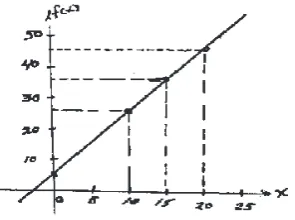
We can use the previous example to interpret the problem graphically using ordered pairs (x, f(x)) where:
x = Antonio’s age.
f(x) = Antonio’s father’s age.
Thus we obtain the following points and note them as F(x) = {(0, 5) (10, 25) (15, 35) (2 0, 45)}
y = f (x)
f (x) =2 x + �
of education in the 21st century Volume 35, 2011 101
Figure 4: Draw of a graph in the Cartesian system.
Instrument and Procedures
because of the use of a qualitative methodology the procedure consist in an analysis of each referred transcription in three moments in the classroom
Analysis of Results Analysis concerning transcription 1
the manner in which the word problem is presented would appear to be closer to an algebraic interpretation such as:
y
=
2
(
x
+
�
)
, which differs from that provided by the teacher. however the most important point is that actually the teacher has raised an equation rather than a function. does the teacher clearly understand the difference between an equation and a function?because of the way in which the teacher presented his example, it appears as though he is presenting an example that he has previously developed in class.
Analysis concerning transcription 2
the teacher proposes to assign values to x in order to find those of y, yet when he proposes zero indicating that the son has not yet been born, the father would be � years old, which is unrealistic. What would happen if one proposes that x has a value of 1, then y would have a value of 6, and the question that would arise is: can a child of 6 have a 1 year old son?
Analysis concerning Transcription 3
the teacher goes from a discreet case to a continuum without providing any explanation whatsoever. he moreover fails to mention the meaning that can be given to negative ages.
Results of Research
clearly the mathematics teacher wants to present an example from “real life” in order to introduce the concept of linear function. the approach he follows will assuredly produce a limited and mistaken conception of the concept among his students. When proposing examples from “real life”, teachers must be exceedingly careful. it is always a good idea to use examples that have been well thought out and that do not lead to incoherent ideas such as those seen in the teacher’s example. mathematics applications are much too important to be jeopardized by proposing incoherent examples that will ill teach students, running the additional risk of inuring students to incoherencies and logical contradictions instead of leading them to a deeper
realize that he is continuously incurring in logical contradictions, both from the standpoint of mathematics and of common sense (a six-year old father who has a one-year old son!). in short, one can state that as a result of the teaching, one would have students who would be unable to generate a cognitive conflict (able to recogni�e that something is wrong) when faced with a contradiction, students whose problem-solving performance would be low.
the problem is that if the teacher is unaware of that pitfall, he/she will be unable to help students. consequently the cognitive conflicts will intensify to such an extent that theyconsequently the cognitive conflicts will intensify to such an extent that they will become obstacles along the road to learning functions, hence also on the road to learning calculus.
Discussion
promoting mathematics visualization by using different representations and by making reflexive use of new technologies that in turn make it possible to give a concrete meaning to mathematical notions is important. With this, a concept can be built by way of coordinating the myriad representations related to the concept in question, and the task can be achieved free of contradictions.
the majority of mathematics teachers do not allow their students to use graphic calculators and computers because they believe that using those tools will hinder their students’ operating abilities. however in view of the serious nature of the problem of learning calculus it might very well be advisable to analyze the contribution such tools could make to solve that particular problem
Conclusions
the research reported demonstrate the need to coherently utilize different representations that will make it possible to approach the problems more efficiently. students predominantly resort to algebraic representations yet if they make mistakes they are unable to recognize where the mistake is. moreover since they tend to use graphic representations in a very limited manner, they do not have any additional considerations that could serve as a means of support to imbue their algebraic processes with greater certainty or to raise a red flag, as it were, in case a mistake has been made.
developing skills linked to mathematics visualization can give students the impetus needed to delve to a deeper level of calculus-related concepts. new materials must absolutely be designed for this integral development, hence refraining from the standard to date of placing much too much emphasis on one single type of representation – the algebraic representation. We must break away from that idea and provide students with a richer notion that will enable them to carry out deeper tasks while they are learning concepts of calculus.
Note
articulation among representations is accomplished by considering conversion tasks between representations. an example of this is: in the case of functions, the task of going from a graphic representation of a function to an algebraic representation, and vice versa.
of education in the 21st century Volume 35, 2011 103
References
arcavi, a., & hadas, n. (2002). computer mediated learning: an ex-ample of an approach. in f. hitt (ed.), Representations and mathematics visuali�ation. international Group for the psychology of mathematics education north american chapter and cinvestav-ipn. méxico, p.21-39.
ben-chaim, d., lappan, G., & houang, r. (200�). the role of Visualization in the middle school mathematics curriculum. Focus on Learning Problems in Mathematics, Winter edition, Vol. 11, no. 1, p. 49-60.
demana, f., & Waits, b. (1998). pitfals in Graphical computers, or Why a single Graph isn’t enough. College Mathematics Journal, Vol. 19 no. 1, p. 177-183.
duval, r. (1998). registros de representación semiótica y funciona- miento cognitivo del pensamiento. in: f. hitt (ed.), Investigaciones en matemática educativa II. Grupo editorial iberoamérica, Vol. �Grupo editorial iberoamérica, Vol. �no. 1, p. 101- 120.
eisenberg, t., & dreyfus, t. (1990). on the reluctance to Visualize in mathematics. in Zimmermann W. & cunningham s. (eds), Visuali�ation in Teaching and Mathematics, Vol. 3. no. 2, p. 2�-37.
hitt, f. (1996). sistemas semióticos de representación del concepto de función y su relación con problemas epistemológicos y didácticos. en f. hitt (editor), Investigaciones en Educación Matemática Grupo editorial iberoamérica, méxico, Vol. i no. 1, p. 24�-264.
hitt, f. (1997). sistemas semióticos de representación. Revista Avance y Perspectiva, cinvestav, méxico. Vol. 16, no. 1, p. 12-23.
hitt, f. (1998a). difficulties in the articulation of different representations linked to the concept of function. Journal of Mathematical Behavior, Vol. 17 no. 1, p. 123-134.
hitt, f. (1998b). Visualización matemática, representaciones, nuevas tecnologías y curriculum. Revista Educación Matemática, Vol. 10, no.1, p. 23-4�.
hitt, f. (2003). funciones en contexto. editorial pearson. educación (prentice hall). méxico, p 34-�6.
Zimmermann, W. (2001). Visual thinking in calcullus. in Zimmermann W. & cunningham s. (eds),nking in calcullus. in Zimmermann W. & cunningham s. (eds), Visuali�ation in Teaching and Mathematics. series. usa. maa. Vol 3. no. 1, p. 127-138.
Advised by Martin Bilek, University of Hradec Kralove, C�ech Republic
received: September 10, 2011 accepted: October 14, 2011
Elena Fabiola Ruiz Ledesma Researcher, The Superior School of Computer Sciences, National Polytech-nic Institute, Mexico.