*Corresponding author:Sarala Devi G ISSN: 0976-3031
Research Article
STRUCTURAL AND GAS SENSING PROPERTIES OF ZnO: NiO NANOCOMPOSITE
TOWARDS HYDROGEN GAS
Siva Prasada Reddy P
1,3., Manasa M.V
1,2., Sarala Devi G*
1,2.,
Adi Narayana Reddy B
1,2and Nageswara Rao G
31
Inorganic & Physical Chemistry Division, CSIR-Indian Institute of Chemical Technology,
Habsiguda, Hyderabad-500607
2
Academy of Scientific and Innovative Research (AcSIR), CSIR-Indian Institute of Chemical
Technology (CSIR-IICT) Campus, Hyderabad
3
Department of Inorganic & Analytical Chemistry, Andhra University, Visakhapatnam
DOI: http://dx.doi.org/10.24327/ijrsr.2017.0811.1073
ARTICLE INFO ABSTRACT
In the present study we describe the design, fabrication and gas sensing performance of p-NiO/n-ZnO nanocomposite synthesized by sol-gel followed by impregnation method. The formation of ZnO: NiO nanocomposite was confirmed by Energy Dispersive X-Ray (EDX) and X-Ray Diffraction (XRD) analysis. The microstructure of the sample was visualized by Transmission Electron Microscope (TEM) which revealed the formation of hexagonal structure of size ~10nm. Furthermore, we investigated the gas sensing performance of ZnO: NiO nanocomposite which showed excellent sensitivity and selectivity towards hydrogen in comparison to other interfering gases. The significantly improved performance was thoroughly explained in terms of adsorption – oxidation - desorption pathway. The achieved features make the sample a prospective candidate for
the fabrication of H2 gas detection sensor.
INTRODUCTION
Nanotechnology is a new area of science which involves working with materials and devices at the nanoscale region. Nanostructured materials have triggered tremendous motivation to explore the possibilities in various shapes and size for sensing applications. ZnO an n-type II–VI semiconductor material with wide and direct band gap energy of 3.37 eV and high exciton binding energy of 60 m eV. Semiconductor oxides have attracted a lot of attention throughout the world, due to their wide applications in luminescence, photosensitization, magnetism, lithium batteries and gas sensors especially in the field of gas sensors (1-3). Nanostructure-based sensors have become the focus of intensive research because of the advantages of higher sensitivity and rapid response associated with individual nanostructures due to the high surface-to-volume ratio compared to thin film gas sensors (4, 5). Metal oxide nanomaterials are the most important class of materials due to their excellent properties and wide applications in various areas of science and technology (6-9).
Nanocomposites based on the combination of p-type and n-type semiconducting (SC) oxides have come under intense scrutiny for the possibility of joining the intrinsic properties of individual components with the multifunctional behavior exhibited by low-dimensional materials (10-13). In this regard, p-n oxide-based nanocomposites have been investigated for various technological applications, such as magnetism, optoelectronics, photocatalysis, and gas sensing (14-16). As regards gas sensing applications, the combination of p- and n-type nanomaterials can provide higher sensitivities and faster responses due to the formation of a more extended depletion layer (17, 18). The synergistic combination of these two SCs paves the way to the development of gas sensors characterized by improved sensitivity/selectivity and mild working temperatures (19).
H2 is a clean, efficient, and renewable energy source that will be extensively used in the future for power generation in automotive and energy-storage industries (20-22). However, safety issues involving H2 gas such as a wide explosive concentration range (4−75%), low ignition energy (0.02 mJ),
Recent Scientific
Research
International Journal of Recent Scientific Research
Vol. 8, Issue, 11, pp. 21432-21437, November, 2017
Copyright © Siva Prasada Reddy P et al, 2017, this is an open-access article distributed under the terms of the Creative Commons Attribution License, which permits unrestricted use, distribution and reproduction in any medium, provided the original work is properly cited.
DOI: 10.24327/IJRSR CODEN: IJRSFP (USA)
Article History:
Received 16th August, 2017
Received in revised form 25th
September, 2017
Accepted 23rd October, 2017
Published online 28th November, 2017
Key Words:
Siva Prasada Reddy P et al.,Structural And Gas Sensing Properties of ZnO: NiO Nanocomposite Towards Hydrogen Gas
and high flame propagation velocity are major challenges in the development of H2-based applications (23-25). However, there is a serious safety concern. Excellent monitoring and leak detector systems are required because hydrogen is invisible, odorless, and highly flammable. Considerable research has been focused on the development of hydrogen (H2) based energy storage to overcome environmental problems associated with fossil energy sources, such as air pollution, global warming, and exhaustion of the Earth’s resources (26), leak detection sensors etc. (27).
Among various gas sensor materials, metal oxide semiconductor (MOS) gas sensors also known as chemiresistor, are promising sensing materials and extensively used for monitoring hazardous and toxic gases due to their advantages such as high sensitivity, fast response and recovery, low detection limits simple sensing mechanism, lower maintenance costs, better stability, and simplicity in fabrication (28, 29). The higher sensitivity with regard to the chemical sensors is attributed to the behavior of grain boundaries formed at the interfaces of the nano grains, which exhibits a large change in resistance during adsorption and desorption of gas molecules showing significant influence on gas sensing performance (30-33). Effective H2 sensor for early detection of leaks, quantification at low concentration is necessary and LEL (lower explosive limit) of 4% by volume coupled with its colourless and odorless nature poses a challenge for safety requirements and precautions (34).
In the case of oxide gas-sensing materials, it is generally a surface controlled process that is responsible for the sensitivity. The detection and monitoring of toxic and noxious gas emissions is extremely important for human safety and environmental protection (35-37). In order to make the sensors more efficient, there is a need to develop materials to suite the generic technologies (38). In nanomaterials, because the surface-to-bulk ratio is much greater than for coarse materials, surface properties become paramount, which makes these materials particularly appealing in applications in which such properties, are exploited as in gas sensors (39).
Recently, an observation on graphene/PANI nanocomposite based sensor where the sensitivity of S=16.5% towards 10,000ppm H2 gas is reported by Laith Al-Mashat et al (40). Reinaldo David Martinez-Orozco et al reported a sensitivity of S=17% towards 30,000ppm H2 gas using Palladium – graphene (PdGO) nanostructures (41).
The present work aims to describe the behavior of ZnO: NiO nanocomposite towards H2 gas as a safety concern. The results show that the NiO is crucial for enhancing the interaction between H2 molecules and the sensing surface thereby increasing the sensor response to S= 0.90 which is the key for improving H2 gas sensing performance and selectivity. Hence ZnO: NiO is found to be a suitable candidate for development of sensitive and selective H2 gas sensor.
MATERIALS AND METHODS
Synthesis of Nanocomposite
Zinc oxide (ZnO) nanoparticles were synthesized via sol-gel protocol. In a typical synthesis procedure 0.5x10⁻³M (3.2g) of Poly ethylene glycol (PEG) was dissolved in distilled water
under stirring to which 0.015M (3.4g) of Zinc acetate was added and the solution was adjusted to pH7 by addition of ammonia solution. The mixture was further stirred for 4hrs and filtered, washed with D.I. water, rinsed with acetone and finally dried in hot air oven at 60oC/ 8h. The dried compound was calcined at 400oC for 4hrs to get ZnO nanoparticles.In order to investigate the affect of NiO on gas sensing properties of ZnO, 1wt% of (optimized) percentage of NiO was added to ZnO by impregnation method to form ZnO: NiO nanocomposite. The formed material was pulverized manually and calcined at 400oC to obtain pure ZnO: NiO nanocomposite.
For chemical-sensor application, ZnO: NiO nanocomposite thick films were fabricated by mixing the powder with DI water and the resulting paste was applied on alumina tube substrate having silver electrodes on either sides. The sensors thus fabricated were fired at 400 oC for 2hrs. The changes in electrical resistance during adsorption desorption of gas molecules on the material surface is estimated by measuring the electrical resistance of the sensor in air (Ra) to that in presence of test gas (Rg), The sensitivity S, defined as the ratio (Ra −Rg/Ra). All the gas sensing measurements were carried out towards 1000 ppm H2 gas in the temperature range of 50 - 400 oC.
Equipment used for characterization of ZnO: NiO Nanocomposite
X-ray powder diffraction data was recorded on Siemens (D5000) diffractometer using Cu Kα radiation (λ = 1.5406 A°) in the range of 2θ = 2–65 o. Particle size was recorded by particle size analyzer Horiba SZ100. The morphological Evaluations were carried out by transmission electron microscopy (TEM). A drop of the reaction mixture was placed over carbon-coated copper grids and the solvent was allowed to dry. Images were acquired on a Philips Technai-FE 12 TEM (120 KV). The energy dispersive X-ray spectroscopy (EDX) analysis was performed by scanning electron microscopy (SEM) with Model S520 (Hitachi, Japan) equipped with an EDX detector (Model: Oxford LINK-ISIS 300). The EDX spectrum was measured at 10 kV accelerating voltage.
Gas sensor process
Fabrication of the sensor element
sensor element Rs. A chromel–alumel thermocouple (TC) was placed on the device to indicate the operating temperature. The schematic of the measurement set-up is shown in
publication (Ranjith kumar, et.al. (12)). The sensitivity (S), defined as the ratio (S=R
and Rg are the sensor resistance in air and in test gas,
respectively. The response time is defined as the time required for the variation in conductance to reach 90% of the equilibrium value after which a test gas is injected. The recovery time is the time necessary for the sensor to return to its original conductance state in air.
RESULTS AND DISCUSSIONS
Energy Dispersive X-Ray Spectra
Figure 1 represents the compositional analysis of ZnO: NiO nanocomposite under the energy dispersive X
(EDX). The EDX spectrum confirms the presence of Zn, O & Ni signal in the sample without any other impurities, strongly indicates the high purity of the final product obtained
X-Ray Diffraction
Chemical composition, crystal structure and phases of ZnO: NiO nanocomposite was examined by powder X
(XRD) as shown in the figure 2.
Figure 1 EDX spectrum of ZnO: NiO nanocomposite
Figure 2 X-Ray Diffraction Patterns of (a) ZnO (b) ZnO: NiO
Nanocomposite
alumel thermocouple (TC) was placed on the device to indicate the operating temperature. The up is shown in our previous
Ra-Rg/Ra), where Ra
are the sensor resistance in air and in test gas, respectively. The response time is defined as the time required for the variation in conductance to reach 90% of the as is injected. The recovery time is the time necessary for the sensor to return to
the compositional analysis of ZnO: NiO nanocomposite under the energy dispersive X-ray analysis e presence of Zn, O & in the sample without any other impurities, strongly
product obtained.
composition, crystal structure and phases of ZnO: NiO nanocomposite was examined by powder X-ray diffraction
The sharp diffraction peaks indicate the high crystalline hexagonal ZnO (JCPDS card no. 89
constants of a=b=3.24Ao c=5.20A peaks appearing at 37.21o and 43.22
and [012] crystal planes are attributed to NiO 89-7390) with lattice constants of a=b=2.95A
= =90o and the other planes in the shown pattern are attributed to ZnO respectively. The cryst
calculated by Scherrer’s formula,
D = K.λ/βCosθ
where K is Scherrer’s constant (~0.9) wavelength (̴ 1.54 Ao), β is full width
Bragg’s diffraction angle. The crystallite size is calculated to be 17.76nm.
FTIR-Spectrum
The typical FTIR spectrum of ZnO: NiO Nanocomposite is shown in figure 3. Mixed phases of ZnO: NiO is observed in the synthesized nanocomposite, the peak around 400
corresponds to Zn-O stretching vibration and peak at 900 1000cm-1 corresponds toNi-O stretching vibration. Broad band at around 3000- 3500cm-1
vibrations, possibly from H2O, another broad pe
correspond to hydroxyl group of chemisorbed and/or physisorbed H2O molecules on the particle surface.
Transmission Electron Microscopy
Particle size and nano structure
has been examined through Transmission electron microscope (TEM) as shown in Figure 4(a, b). It indicates that ZnO: NiO nanocomposite is uniform in crystalline size having hexagonal structure. It reveals that the crystalline size
the range of 10-20nm, which is consistent with the results of XRD analysis.
EDX spectrum of ZnO: NiO nanocomposite
of (a) ZnO (b) ZnO: NiO
Figure 3 FTIR Spectrum of ZnO: NiO Nanocomposite
Figure 4 a,b TEM i
The sharp diffraction peaks indicate the high crystalline hexagonal ZnO (JCPDS card no. 89-7102) with lattice c=5.20Ao, ==90o =120o. The and 43.22o corresponding to [101] and [012] crystal planes are attributed to NiO (JCPDS card no. 7390) with lattice constants of a=b=2.95Ao c=7.22Ao, =
and the other planes in the shown pattern are attributed to ZnO respectively. The crystallite size was calculated by Scherrer’s formula,
D = K.λ/βCosθ (1)
K is Scherrer’s constant (~0.9), λ is the X-Ray ), β is full width at half maximum and θ is Bragg’s diffraction angle. The crystallite size is calculated to be
The typical FTIR spectrum of ZnO: NiO Nanocomposite is shown in figure 3. Mixed phases of ZnO: NiO is observed in site, the peak around 400-500cm-1 O stretching vibration and peak at 900-O stretching vibration. Broad band
corresponds to O-H stretching O, another broad peak at 1604cm-1 correspond to hydroxyl group of chemisorbed and/or
O molecules on the particle surface.
Transmission Electron Microscopy
Particle size and nano structure of ZnO: NiO nanocomposite has been examined through Transmission electron microscope (TEM) as shown in Figure 4(a, b). It indicates that ZnO: NiO nanocomposite is uniform in crystalline size having hexagonal structure. It reveals that the crystalline size of the sample are in 20nm, which is consistent with the results of
FTIR Spectrum of ZnO: NiO Nanocomposite
Siva Prasada Reddy P et al.,Structural And Gas Sensing Properties of ZnO: NiO Nanocomposite Towards Hydrogen Gas
Particle size analysis spectrum
Particle size distribution of ZnO: NiO Nanocomposite is shown in Figure 5 which picturises the particle size analysis spectrum of NiO impregnated in ZnO. The spectrum clearly shows that most of the particles are approximately 15 nm respectively.
Gas sensing characteristics
To investigate the effect of NiO loading into nano ZnO, different wt% (i.e., from 0.6wt% to 5wt% - coded as ZN0.6, ZN0.8, ZN1, ZN3, ZN5) of NiO was incorporated into nano ZnO and the sensor response of all the samples were studied. As shown in Figure 6. It is seen that 1wt% NiO impregnated ZnO (ZN1) shows higher sensitivity of S=0.9 comparatively, thus the sample ZN1 was optimized and used for further studies.
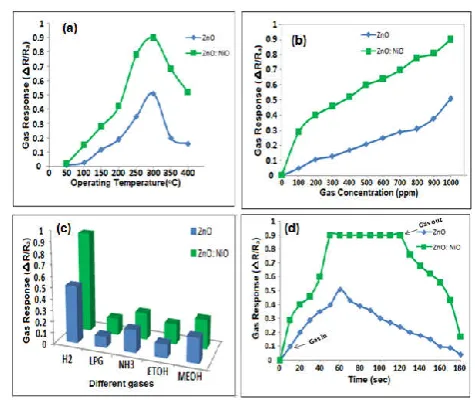
Figure 7a shows the gas sensing of ZnO: NiO nanocomposite as a function of operating temperature towards 1000ppm of H2 gas. The response increases with increase in operating temperature and reaches maximum limit at 300oC followed by a decrease with increase in operating temperature. Optimization of the operating temperature is crucial for establishing high sensitivity of the sensor to the target gas. Further, a significant enhancement in the performance could be achieved with the incorporation of NiO. The sensing response increases as a function of concentration and reaches saturation, and also
shows reasonably good response to low concentration of 100ppm as shown in figure 7b.
Figure 7c shows the sensing responses to different interfering gases like ammonia, LPG, Ethanol, Methanol and hydrogen to 1000ppm gas at 300oC. The selectivity is measured for evaluating the specificity of ZnO: NiO sensor by comparing the response to different gases, the sensor showed higher response to H2 compared to other test gases. Response and recovery times are the important parameters of gas sensors, which can be defined as the time taken for the sensor to reach 90% of its total change in sensitivity after exposure to H2 gas and the time taken for the sensor to reach its initial sensitivity value once the H2 atmosphere ceases to exist. The ZnO: NiO sensor exhibited a response and recovery time of ~50s & ~60s respectively at 300oC towards 1000ppm H2 as shown in figure 7d.
Gas Sensing Mechanism
A plausible gas sensing mechanism based on adsorption – oxidation - desorption pathway, which plays an important role in gas sensing mechanism is proposed. At equilibrium, the sensor surface is exposed to oxygen (O2) in air Oxygen molecules are adsorbed on the ZnO:NiO (ZN) nanocomposite surface gets ionized ,creating adsorbed oxygen species (O2 ,O-, O2-) on the sensor surface.
O2 gas <—> O2 ads + e- <—> O2 ads- + e-⃖ ⃗ Oads- + e- ⃖ ⃗ O2- (2)
Figure 5 Particle size analysis spectrum ofZnO: NiO nanocomposite
Figure 6 Sensitivity vs. Operating temperature for different wt% of
NiO incorporated ZnO
Figure 7 Gas sensor response of ZnO and ZnO: NiO nanocomposite
towards 1000ppm of H2 gas at 300oC (a) Operating temperature (b)
different gas concentrations of H2 (c) different interfering gases (d) as a
function of response time
Figure 8 Gas Sensing Mechanism of ZnO: NiO sensor in (a) air medium
The ionization of oxygen molecules occurs due to the capture of electrons from the conduction band of ZN sample acting as electron acceptors, resulting in electron depletion region with reduced electron mobility near the oxide surface. This phenomenon enhances the surface potential and the work function. Further, when the sensor is exposed to air, O2 adsorbed on the ZN sample, traps electrons from the conduction band due to strong electro negativity of the oxygen atom, and produces adsorbed oxygen O2n- (ads) as shown in Eqn. (2). Thus an increase in electrical resistance is observed.
→ + (3)
+ → (4)
+ → + (5)
When the sensor is exposed to reducing gas in the present study hydrogen, the hydrogen molecules react with the adsorbed oxygen species and a chemical redox reaction occurs between H2 and O2n- (ads), the gas gets oxidized releasing electrons on the sensor surface. Electrons produced from this redox reaction as shown in Eqn. (3) reduces the depletion region there by resulting in drop in its resistance thus increasing the sensitivity of the sensor as illustrated in Fig. 8. As the redox reaction is exothermic it results in fast desorption of produced H2O molecules from the surface as shown in Eqn. (4). When the hydrogen ambient is removed in presence of air, the accumulated layer of electrons would be eliminated as shown in Eqn. (5) leading to the recovery of initial resistance.
CONCLUSIONS
In summary the compositional and elemental analysis of the sample examined by EDX spectrum confirmed the presence of Zn, O and Ni signal. The sensor based on ZnO: NiO material showed excellent sensitivity and selectivity towards H2 gas. The high response was obtained at 300oC towards1000ppm of H2 gas with response and recovery times of ~50s and ~60s respectively. The present material is a novel and cost effective and is a suitable candidate for development of sensitive and selective H2 gas sensor.
Acknowledgement
Authors gratefully acknowledge DST for Grant-in-Aid Project – Instrument Development Project (GAP-0262), CSC-0114, CSC-0123 for financial assistance. P S P Reddy is grateful to Department of Science and Technology (Grant-in-Aid Project 0262) for project assistantship throughout the research work. M.V. Manasa acknowledges Department of Science and Technology -INSPIRE fellowship grant and B. Adi Narayana Reddy is thankful to University Grant Commission (UGC) for Senior Research Fellowship.
References
1. Hao Shan, Changbai Liu, Li Liu, Jinbao Zhang, Haiying Li, Zhen Liu, Xiaobo Zhang,Xiaoqing Bo, Xiao Chi, (2013), Excellent Toluene Sensing Properties of SnO2−Fe2O3 Interconnected Nanotubes, ACS Appl. Mater. Interfaces, 5, 6376-6380.
2. Sunghoon Park, Hyunsung Ko, Soohyun Kim, and Chongmu Lee, (2014), Role of the Interfaces in Multiple
Networked One-Dimensional Core−Shell Nanostructured Gas Sensors, ACS Appl. Mater. Interfaces, 6, 9595-9600.
3. Yang Liu, Yang Jiao, Zhenglin Zhang, Fengyu Qu, Ahmad Umar, Xiang Wu, (2014), Hierarchical SnO2 Nanostructures Made of Intermingled Ultrathin Nanosheets for Environmental Remediation, Smart Gas Sensor, and Supercapacitor Applications, ACS Appl. Mater. Interfaces, 6, 2174-2184.
4. Hamoon Hedayat, P. Siva Prasada Reddy, M.V. Manasa, G. Sarala Devi, J.V. Ramana Rao, G. Nageswara Rao, (2017), Nanostructure evolution of zinc stannate: A suitable material for liquefied petroleum gas detection, Journal of Alloys and Compounds, 704, 413-419. 5. Nandan Singh, Raju Kumar Gupta, and Pooi See Lee,
(2011), Gold - Nanoparticle-Functionalized In2O3 Nanowires as CO Gas Sensors with a Significant Enhancement in Response, ACS Appl. Mater. Interfaces, 3, 2246–2252.
6. D. Bekermann, A. Gasparotto, D. Barreca, C. Maccato, E. Comini, C. Sada, G. Sberveglieri, A. Devi, R. A. Fischer, (2012), Co3O4/ZnO Nanocomposites: From Plasma Synthesis to Gas Sensing Applications, ACS Appl. Mater. Interfaces, 4, 928-934.
7. Yusin Pak, Sang-Mook Kim, Huisu Jeong, Chang Goo Kang, Jung Su Park, Hui Song, Ryeri Lee, NoSoung Myoung, Byoung Hun Lee, Sunae Seo, Jin Tae Kim, Gun-Young Jung, (2014), Palladium-Decorated Hydrogen-Gas Sensors Using Periodically Aligned Graphene Nanoribbons, ACS Appl. Mater. Interfaces, 6, 13293−13298.
8. Daewoong Jung, Maeum Han, and Gil S. Lee, (2015), Fast-Response Room Temperature Hydrogen Gas Sensors Using Platinum-Coated Spin-Capable Carbon Nanotubes, ACS Appl. Mater. Interfaces, 7, 3050-3057. 9. Sanjit Manohar Majhi,Prabhakar Rai, Yeon-Tae Yu,
(2015), Facile Approach to Synthesize Au@ZnO Core−Shell Nanoparticles and Their Application for Highly Sensitive and Selective Gas Sensors ACS Appl. Mater. Interfaces, 7, 9462-9468.
10. Sunghoon Park, Soohyun Kim, Gun-Joo Sun, Chongmu Lee, (2015), Synthesis, Structure and Ethanol Gas Sensing Properties of In2O3 Nanorods Decorated with Bi2O3 Nanoparticles, ACS Appl. Mater. Interfaces, 7, 8138-8146.
11. Akash Katoch, Jae-Hun Kim, Yong Jung Kwon, Hyoun Woo Kim and Sang Sub Kim, (2015), Bi-functional Sensing Mechanism of SnO2−ZnO Composite Nanofibers for Drastically Enhancing the Sensing Behavior in H2 Gas ACS Appl. Mater. Interfaces, 7, 11351−11358.
12. E. Ranjith kumar, R. Jayaprakash, G. Sarala Devi, P. Siva Prasada Reddy, (2014), Synthesis of Mn substituted CuFe2O4 Nanoparticles as LPG gas sensing material, Sensors and Actuators, 8, 191, 186-191. 13. Reza Rahmanian, Sayed Ahmad Mozaffari,
Siva Prasada Reddy P et al.,Structural And Gas Sensing Properties of ZnO: NiO Nanocomposite Towards Hydrogen Gas
14. Nguyen V.Q, Minh V.A, VanLuan N, Hung V.N and Van Hieu N (2011) Gas sensing properties at room temperature of a quartz crystal microbalance coated with ZnO nanorods, Sensors and Actuators B, 153, 188-193. 15. Sarala Devi G, Bala Subrahmanyam V, Gadkari S.C and
Gupta S K (2006) NH3 gas sensing properties of nano crystalline ZnO based thick films, Analytica Chimica Acta, 568, 41-46.
16. Cabot A, Arbiol J, Morante J.R, Weimar U, Barsan N and Gopel w (2000) Analysis of the noble metal catalytic additives introduced by impregnation of as obtained SnO2 sol–gel nanocrystals for gas sensors, Sensors and Actuators B, 70, 87-100.
17. Barsan N, Stetter J.R, Findlay M and Gopel W (2000) High performance gas sensing of CO: comparative tests for (SnO2 –based) semiconducting and for electrochemical sensors, Sensors and Actuators B, 66, 31-33.
18. Haoshuang G, Wang Z and Hu Y (2012) Hydrogen Gas Sensors Based on semiconductor Oxide Nanostructures, Sensors, 12, 5517-5550.
19. VargheseO. K, Gong D, Paulose M, Ong K.G and Grimes C.A, (2003) Hydrogen sensing using titania nanotubes. Sensors and Actuators B, 93, 338-344. 20. Lupan Oleg, Chai G and Chow L, (2008) Novel
hydrogen gas sensor based on single ZnO nanorod, Microelectronic Engineering, 85, 2220-2225.
21. Moon H. G., Jang H. W., Kim J. S., Park H. H. and Yoon S .J., (2011) A route to high sensitivity and rapid response Nb2O5-based gas sensors: TiO2 doping, surface embossing, and voltage optimization, Sensors & Actuators B, 153, 37-43.
22. Singh S, Harjeet K, Singh V N, Jain K and Senguttuvan T D, (2012) Highly sensitive and pulse-like response toward ethanol of Nb doped TiO2 nanorods based gas sensors, Sensors and Actuators B, 171, 899- 906. 23. SuryavanshiU, IijimaT, Hayashi A, Hayash Y and
Tanemura M (2012) Fabrication of ZnO nanoparticles confined in the channels of mesoporous carbon, Chemical Engineering journal 179, 388- 393.
24. Savchuk A, FedivV.I, Voloshchuk A.G, Savchuk T.A, Bacherikov Yu.Yu and Perrone A (2006) New approach to synthesis of semi magnetic semiconductor nanoparticles, Materials Science and Engineering C, 26, 809- 812.
25. D.M. Fernandes, R. Silva , A.A.Winkler Hechenleitner, E. Radovanovic , M.A. Custódio Melo, E.A. Gómez Pineda (2009) Synthesis and characterization of ZnO, CuO and a mixed Zn and Cu oxide, Mate. Chem. Phy., 115, 110-115.
26. G. Sarala Devi, Takeo Hyodo, Yasuhiro Shimizu, Makoto Egashira (2002) Synthesis of Mesoporous TiO2-Based Powders and Their Gas-Sensing Properties, Sensors and Actuators B, 87, 122-129.
27. A. Tomescu, R. Alexandrescu, I. Morjan, F. Dumitrache, L. Gavrila-Florescu, R. Birjega, Soare,G. Prodan, Z. Bastl, A. Galikova, J. Pola (2007) Structural and sensing properties of a novel Fe/Fe2O3/ polyoxocarbosilane core shell nanocomposite powder
prepared by laser pyrolysis, J. Mater. Sci., 42, 1838-1846.
28. X.M. Sui, C.L. Shao, Y.C. Liu, (2005) Photoluminescence properties of highly dispersed ZnO quantum dots in polyvinyl pyrrolidone nanotubes prepared by a single capillary electrospinning, Appl. Phys. Lett., 87, 113-118.
29. O.K. Tan, W.Cao, Y. Hu, W. Zhu, (2004) Nano-structured oxide semiconductor materials for gas-sensing applications, Ceramics International ,30, 1127-1133. 30. D. S. Lee, S. D. Han, S. M. Lee, S. Huh, D. D. Lee,
(2000) The TiO2- adding effects in WO3 based NO2 sensors prepared by co-precipitation and precipitation method, Sensors and Actuators B, 65, 331- 335.
31. Sunita Mishra, C. Ghanshyam, N. Ram, R.P. Bajpai, R.K. Bedi, (2004) Detection mechanism of metal oxide gas sensor under UV radiation Sensors and Actuators B, 97, 387-390.
32. A. Cirera, A. Vila, A. Die´guez, A. Cabot, A. Cornet, J.R. Morante, (2000) Microwave processing for the low cost, mass production of undoped and in situ catalytic doped nanosized SnO2 gas sensor powders, Sensors and Actuators B, 64, 65-69.
33. N.O. Savage, S.A. Akbar, P.K. Dutta, (2001) Titanium dioxide based high temperature carbon monoxide selective sensor, Sensors and Actuators B, 72, 239-248. 34. Ding B., Wang M., Yu J., Sun G., (2009) Gas sensors
based on electrospun nanofibers, Sensors, 9, 1609–1624. 35. Manzoli A., Steffens C., Paschoalin R.T., Correa A.A.,
Alves W.F., Leite F.L., Herrmann P.S.P., (2011) Low-cost gas sensors produced by the graphite line-patterning technique applied to monitoring banana ripeness, Sensors, 11, 6425-6434.
36. Kuang D.B., Lei B.X., Pan Y.P., Yu X.Y., Su C.Y., (2009) Fabrication of novel hierarchical β-Ni(OH)2 and NiO microspheres via an easy hydrothermal process, J. Phys. Chem C., 113, 5508- 5513.
37. Qu J., Chai Y., Yang S.X., (2009) A real-time de-noising algorithm for e-noses in a wireless sensor network, Sensors, 9, 895-908.
38. Alfeeli B., Pickrell G., Wang A., (2006) Sub-nanoliter spectroscopic gas sensor, Sensors, 6, 1308-1320. 39. Chang Y.C., Bai H., Li S.N., Kuo C.N., (2011)
Bromocresol green/mesoporous silica adsorbent for ammonia gas sensing via an optical sensing instrument. Sensors, 11, 4060-4072.
40. Laith Al-Mashat, Koo Shin, Kourosh Kalantar-zadeh, Johan D. Plessis, Seung H. Han, Robert W. Kojima, Richard B. Kaner, Dan Li, Xinglong Gou, Samuel J. Ippolito and Wojtek Wlodarski, (2010) Graphene/Polyaniline Nanocomposite for Hydrogen Sensing, Journal of Physical Chemistry C, 114, 16168-16173.