DOI: 10.20472/SS.2015.4.2.002
SOCIAL-CULTURAL FUNCTION AND ROLE OF GENDER IN
DEVELOPMENT OF GLOBAL BUSINESS
KHATUNA BERISHVILI
Abstract:
To study the problems of gender equality is of great importance for the global business. Gender is a cultural construct, within which our different cultures attach different values, roles and responsibilities to women and men. However, in addition to culture, the gender issues are in close relation with the global business. From this viewpoint, experience of the West is considerable and of great importance. It can be said that the problems of women’s rights and a whole number of barriers, which impede to reach the gender equality have long been a great problem for the leading countries of Europe and America. But one problems remains – the so-called „glass ceiling” – the barriers, which impede carrier advance of the female representatives.
At the same time, in the countries on the stage of low development, women are still considered to be minor creatures, which do not have the rights for not only work, but education equal to men. To this are added the religious laws of Islamic countries, which radically separates the rights of women and men from one another and often consider women’s public activities inacceptable.
In the background of such diversity it is interesting to familiarize with the apprehension of gender equality in Georgia. In the present study the ways for settlement of the problem mentioned above are given.
Keywords:
problems of gender, cultural construct, women’s public activities, „glass ceiling”, global business.
JEL Classification: F20
Authors:
KHATUNA BERISHVILI, Iv.Javakhishvili Tbilisi State University , Georgia , Email: [email protected]
Citation:
KHATUNA BERISHVILI (2015). Social-Cultural Function and Role of Gender in Development of Global Business . International Journal of Social Sciences, Vol. IV(2), pp. 15-24.,
Role of Gender in the Process of Cultural Apprehension
Difference in opinion exists among the scientists in regard to definition of culture. There exists broad and narrow understanding of culture. In the 1970s anthropologist Edward Taylor presented in the best way the narrow understanding of culture. He defined culture as “a whole complex, involving knowledge, laws, customs and other skills mastered by a man, as a member of society” [1, p 106]. Gerd Popsted, an expert in cultural differences and management, interpreted culture as collective programming of the mind, which differentiated one group of men from another. “Culture is an emotion (thought), which involves a combination of values and norms, and the values are bricks, with which culture is built” he writes [7, p 105]. Another explanation is given by Zvi Nemenworth and Robert Weber, which apprehended culture as the system of ideas and proved that these ideas formed the mode of human life [7, p 108] 3. In broad interpretation culture (Lat, Kultura – elaboration, development, education) is historically determined step of the society and man, expressed in the results of material and spiritual activities of man. The concept “culture” characterizes both the level of development of certain historical epochs (e.g. the Ancient culture, culture of Mayan tribes, etc) and various degrees of man’s life and activities (e.g. culture of labor, moral culture, business culture). In broad interpretation the term “culture” involves all that determines specificity of human existence in the world. In the most general form classification of culture involves material and spiritual spheres. Material contains the process of material production, and consumption, exchange and distribution of its results. Spiritual contains: education, upbringing, etc [8, p 56].
Culture forms the attributes accepted and apptoptoasyrf gpt mrn and women as well as expectations in regard to relations of men and women, which in other words can be called the gender. Proceeding from this, gender is a cultural construct, within which different cultures, different values, roles and responsibilities are attached to women and men. The gender roles are formed under the influence of culture. It can be said that women and men are cultural products of their society [9, p 87]. The issues of gender relations and gender identity are critical aspects of culture, because on the basis of mentioned above the style of everyday life is being established not only in the family, but in broader circles of the society as well, at work places, etc. Gender (as well as race or ethnic belonging) is presented as the basis for organization of the society proceeding from the cultural burden attached to being a man or a woman. In many societies exists the practice of work distribution according to the gender. In majority of societies the model is outlined for “working man” and “working woman”, both in the family farming and in broader community. The mentioned models, as a rule, in each culture are accompanied by explanations, why this should be this way. These models and their explanations differ in time and space. These gender disproportions are related to both human rights and the issues of development. That’s why we think interesting to consider in the present article the topic on the role of gender equality in economic development.
Role of Gender Equality in Economic Development
One of the most important aspects for the global business, to which the issues of gender equality are intersected, is economic development of the countries and regions.
This index is not calculated for Georgia. Instead, data on Georgia can be found in the ratings of Gender-related development index (GDI)1, in which our country is on 84th place (among
148 countries). To compare, in the CDI index rating 85th place is shared by the Cyprus and
Mexico, and 83th position is occupied by Macedonia [2, P 53].
The first ten countries of the gender-related development rating is as follows”: 1. Slovakia; 2-3. Argentine and Venezuela: 4. Hungary; 5. Norway; 6. Sweden; 7. the USA; 8-9-10. Finland, Slovenia and Bulgaria.
Along with the degree of gender equality the approaches to the gender issues also differ by the countries and regions.
The European civilization, to which the ideas of democracy and gender equality are organic and which stands at an appropriate height from the viewpoint of economic development, faces less problems in regard to women’s rights protection. The Western culture is still the only one, in which the gender equality was implemented in full. On the contrary, the poorest results, concerning the gender inequality and violation of women’s rights, are fixed in the low-developed and poor countries of Asia and Africa.
t the World Conference of Education and Sustainable Development, held In Germany, in Bonn, one of the issues concerned unbelievably hard condition of women in general, and especially of juvenile girls in Mozambique.
Islamic countries should be mentioned especially, where the religious laws determine the supreme rights of men over women and this has considerably stronger influence on the system of cultural values and the mode of the population’s life than the civil laws. In Saudi Arabia, which by the data of Economist Intelligence Unit (EIU) is the 7th least democratic
country in the world, women have to live in the most aggravated conditions. As a rule, in this country women need a permit from a protector (a guardian) man before they start work, go to travel or decide to marry. Mostly a husband or father is considered to be a protector (a guardian), though in some cases such a role can be attached to a son. It should also be mentioned here that Saudi Arabia is practically the last country, in which law till now neglected women’s election rights. Only from 2015 women will be given the right to fix their vote in the municipal elections.
Cultures and civilizations, especially in the epoch of modern communications, permanently interact and experience mobility and move. In this respect, the western culture is an indisputable leader. Numerous ideas, which are developed inside it, in its local mind, come out on the surface over time and its waves reach other, non-western shores [5. p 8]. One of such waves, which spread from the west to the east, is the idea of gender equality. However, how any society receives and shares this idea depends on unique determinants of culture, its openness and good attitude to innovations. It is necessary to touch in a few words the gender phenomenon in its Georgian understanding and the researchers’ opinion in connection with this. The gender phenomenon in Georgian culture does not reveal identity with the phenomenon of any other culture (neither European nor Asian): it is unique, peculiar and special (6, p 53). A part of Georgian researchers of gender issues on the basis of analysis of our history and literature concludes that in regard to the gender issue our culture is far more tolerant than all other well-known cultures and considers that the role of a woman, determined by the Georgian culture and tradition is a special phenomenon, which is seen at the very first glance. But not all the Georgian researchers agree on the nature of this phenomenon. For many of them the Georgia model of re-distribution of gender roles and relations between genders is not at all acceptable and exemplary, respectively, often instead of excitement, criticism is heard about the phenomenon mentioned above. But what is this phenomenon like? As the gender specialists say this issue requires fundamental study and analysis.
Glass Ceiling 2 as a Problem
Despite the fact that, as we have already mentioned above, in Europe and America the fundamental rights of women are no longer doubted, the problems of gender equality in the issues of employment, called by the specialists “Glass Ceiling”, still remain a challenge for the western society. Lean Martin determined “Glass Ceiling” as artificially formed barriers, based on the prejudices existing inside of the organization. This does not enable the skilled workers to move forward on the official ladder and succeed in their carrier. Qualified women specialists and representatives of minorities, in major cases, turn to be just under that invisible ladder. The only way left for them is to watch from there how other employees advance. Today far more women are on the position of managers than ten years ago, but still their number is still too small in the high rank management, and in some organizations, in average rank as well. Increased number of women and problems among managers, which these women face in their efforts of being employed on this position, forces the researchers to determine the relation between genders and wish to be in leadership. When women become high rank managers, often special attention is concentrated on their being women. In 1992 Helen Knapp was appointed to the position of deputy chairman of technology in the high rank management in Coopers & Librand – accounting company of “G6”. Coopers & Librand was considered to be the company with “Men’s Club Atmosphere” and a majority of partners in it were men. From the beginning, when Knapp came in the leadership, some men accepted her appointment as anarchy, were filled with respect towards her. Her transformational management within passed years considerably increased technological base of Coopers & Librand.
Despite this, when she was appointed to this position, more attention was concentrated on the fact that she is a woman. In case of her being a man, the gender issue wouldn’t be raised. Even today the professional women on the managerial positions face the challenges, which in her time Knapp had to overcome in Coopers & Librand.
Possible differences between leadership behavior and management efficiency of woman and man is the subject of special interest not only of scientists, but of for the practical specialists oin management as well. Interest in this issue becomes sharper by the fact that in the process of selection for the leadership position female representatives still experience discrimination, The fact that in majority of companies an amount of women employed on the high rank leading positions is too small, witnesses the scales of discrimination in this sphere. The tendency, which became stronger and according to which preference is attached to men than women in appointment to high rank governing positions, acquired the name of “Glass Ceiling”. In 1995 only 5% of the world countries had woman governor (president or premier). In large business-organizations the number of women employed on the leading executive positions is also small and makes up 30%, though the tendency of improvement is noticed. It is natural that in case of full absence of gender discrimination the mentioned indicator should have been close to 50% both for governmental and private sector as well.
Despite this, among certain segment of the population still exists a feeling that men are more suitable for the leader’s position.
World Leading Countries in Glass Ceiling Rating
In 2013 the journal “Economist” published a list of the developed countries, in which the gender discrimination in the least amount at work places or in search for work. In other words, the principles of gender equality are efficiently transferred from theory into practice by employers. In calculation of the above-mentioned index for 26 countries the following factors were considered in equal, 23-23% share:
1. Difference between the higher education levels among male and female population; 2. Coefficient of women’s participation in labor force;
3. Difference between average incomes of full-time employed men and women; 4. Percentage indicator of women employed in higher management;
5. Correlation of full expenses for baby care with average salary was considered in the index by 8% share, because not all employed women have children;
Analysis of Political and Economic Environment in Georgia om Terms of Equality
Considerable steps were recently undertaken in Georgia from the viewpoint of promotion to gender equality. The government of Georgia reached essential progress in the process of observation of obligations charged by the Convention on Eradication all kinds of Discrimination against Women (CEDAW): the Parliament adopted the Law “on gender equality”; the national a plan of activity was elaborated. However, the problems in regard to gender issues still exist.
In the political arena especially difficult for women is in the Parliament. The amount of women, which through elections entered the legislative body in Georgia within last two decades, never exceeded 10% and at present their number approaches 11%; from 150 MPs women are 17.
The situation in the bodies of local self-governance and executive power from the viewpoint of women’s participation is not attractive either. The amount of women in the self-governance bodies kept reducing after each following elections; after 15^ fixed in the local elections of 1998, the percentage indicator of women in 2002 fell to 12%. In October 2006 elections from 1 750 deputies only 195 (11.14%) were women. This indicator does not improved in the local elections of 2010 either – women were only 11% among elected local authorities.
In August 2-12 only five women were among 19 ministers. By the data of June 2013 among 20 ministers only three were women, i.e. percentage indicator reduced more.
On the whole, according to the gender inequality index, by the data of 2014 Georgia is on 79th position among 187 countries.
As for participation of women in economy of the country, it should be mentioned that at present women have the function of bread-winner in the family. Economic independence gave women some strength, though this new situation cannot change traditional gender roles and main activity of women in parallel still remains care of family – housework, care of children, etc.
Majority of women, employed in the official sector, work in the spheres of agriculture, education, healthcare and light industry at low-paid jobs. Vertical and horizontal gender segregation at labor market is clearly witnessed by high indicator of women’s employment at low-paid jobs in low-income economic branches.
According to the Georgian National Statistical Service, by average data of 1999-2012 average nominal monthly salary of hired employed women is 54% of men’s average salary.
While analyzing the indicators of employment and unemployment in the gender aspect, it should be mentioned that in 2012 compared with 2011 the level of unemployment of men reduced by 0.6 percentage point, and among women it increased by 0.7 percentage point. It should also be mentioned that traditionally the level of unemployment among women is less than among men. Main reason of this is that majority of unemployed women are housewives and, respectively, belong to the non-active category of the population. The level of inactivity among women exceeds twice the analogous indicator among men. In 2012 the level of inactivity among women was 42.6, and among men – 21.8%. Thus, compared with men, among women both the level of inactivity and the level of employment are low. Woman heads only 20% of business companies.
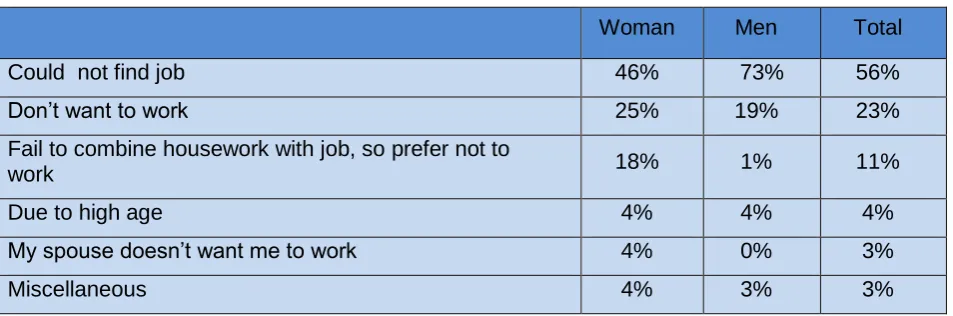
From the viewpoint of business are interesting some results of the research conducted by ACT in 2013 within the UN joint program “for promotion gender equality in Georgia”. On the one part, these results present what role women have in the family while adopting any decision on any purchase and, on the other, presents more concrete opinion on the condition existing in women employment in Georgia [2].
Table №1 unemployment reasons N=1257
Woman Men Total
Could not find job 46% 73% 56%
Don’t want to work 25% 19% 23%
Fail to combine housework with job, so prefer not to
work 18% 1% 11%
Due to high age 4% 4% 4%
My spouse doesn’t want me to work 4% 0% 3%
Miscellaneous 4% 3% 3%
Among the peoples, which are not employed at present, more than half is in search for job and it should be mentioned that among them men prevail women. Among unemployed women are such, which at present do not search for job due to different reasons (e.g. is a housewife, has no interest, is disabled, is a student, etc) and their share does not exceed 30%.
Majority of employed are professional workers (39%), this labor status is mostly spread among employed women.
In general, 48% of women and 39% of men have no personal income. 29% of the population has income from GEL 101 to 300. It should also be mentioned that for 36% of the population this sum is family income. For 30% of the population average family income fluctuates from GEL 399 to GEL 700. Unfortunately, 8% of the population lives in extreme poverty and its monthly income is less than GEL 100. It turns out that majority of women has no income. Almost 1/5 of women say that their husband/partner has more income than they have; equal income, in women’s words, is in 15% cases, but according to men, in 25%.
Table № 2
income of spouses N=1081
Woman Man Total
My spouse/partner has no income 6% 7% 1%
I have larger income 9% 25% 7%
We have approximately similar
income 5% 25% 0%
My spouse/partner has more
income 18% 7% 3%
I have no income 52% 24% 39%
Refuse to answer 0% 0% 0%
I don’t know 1% 2% 1%
Table 3
income of spouses N=1081
Woman Man Total
I manage entire money and give to my
spouse/partner proceeding From my views 5% 11% 8%
I manage entire money and give to my
spouse/partner Proceeding from his/her needs 9% 17% 13%
My spouse/partner manages entire money and gives
me a part of it proceeding from his/her views 9% 6% 8%
My spouse/partner manages entire money and gives
me a part of it proceeding from his/her views 15% 4% 10%
We unite entire money and take as much as each of
us 51% 53% 52%
We unite a part of money leave the rest to us 5% 5% 5%
We each manage our own money 6% 4% 5%
For such needs as food products, clothes, large purchases, rest/entertainment and children’s education, the final decision on expenses is mostly made jointly, though women have more autonomy in buying food products and clothes.
Attitudes and Evaluations of the Georgian Society to Employment of Women
Opinions on women’s employment are mostly conditioned by the views of the society, the model of behavior of man and woman within the family, considerations on the role and function of women in the family and the obligations and role of men. According to the Georgian tradition, a man is a head of the family and his obligation is to keep his family; a woman is a housewife and mother and her obligation is to obey her husband, to take care of the family and children. The attitudes mentioned above answer the question – how the society should be arranged? However, it is interesting to analyze why the society considers such arrangement true, i.e. answer to the question – why it should be so?
By analyzing the results of qualitative and quantitative researches conducted by ACT we can separate several arguments, by which the Georgian society answers the question put above:
1. Family hierarchy corresponds to the Georgian traditions
A great part of the population considers that such distribution of roles in the family corresponds to the Georgian tradition. The traditions are not doubted. Respectively, it is necessary that all should adjust their behavior to the traditions.
2. Care of Family is woman’s unconditional obligation/woman is irreplaceable in the family
3. It is natural for a woman to take care of her family
Consideration exists that to be a housewife and to bring up children is pleasant for a woman and in the family environment she feels happier. Without a family she cannot be happy and no success in the carrier can compensate her happiness received from care for the family. Care for the family is in the nature of a woman, it is organic for her.
4. Woman’s job should be simple and should not take much time
It is considered that a woman can have a job, but it does not impede her in taking full-value care of her gamily, husband and children, because woman’s primary obligation is to take care of her family. Respectively, the society considers only certain professions suitable for women (e.g. a teacher, a doctor, etc).
5. A man cannot want his wife to work
In some cases a man in the family cnnot want his wife to work. Accordingly, proceeding from the consideration that according to the Georgian tradition a woman should obey her husband and that a man is a main decision-maker in the family, a woman cannot be employed due to a simple reason that her husband wants this.
Conclusion
In relation to apprehension and understanding of gender, proceeding from its uniqueness, the Georgian culture cannot resemble any other culture. Besides, as our country is on the transitional stage of economic development, it possesses approaches in relations to gender, which are characteristic for both high developed countries with high level of education and the economically unsustainable countries.
In Georgia the traditional views on the gender roles are still firm: a woman’s function is to take care and bring up her children, to do housework, and the function of a man is to provide his family financially. Despite the fact that at present 30% of family breadwinners are women, the population considers this is not an ideal situation and in case of economic potentials a woman had better not to work or to have less busy job, the job :suitable for a woman”, A woman should obey her husband and concede to him a leader’s position on different arenas. Both recent and older researches show that Georgia is still masculine, patriarchal country, in which the men occupy domineering positions. As for various campaigns directed to actualization of women’s rights, their greater part talks the language which the wide circles of population cannot understand. That’s why the society shares the gender equality only at the level of declarations, and in thinking and actions the idea of equality failed to be perfectly reflected yet.
References
1. Antelava L. Culture and Gender. Tbilisi. 2011.
2. ACT Program within „Promotion to gender equality in Georgia“. Tbilisi, 2013. 3. Democracy and Gender Equality: The Role of UN; Discussion paper, 2013. 4. Kikonishvili G. Two Women. Jrnl. “Liberal”, 2013.
5. Lomaya N. Vulture, Gender, Religion. 2012. 6. Encyclopedia of Esthetics. Tbilisi, 2009. 7. Shengelia T. Global Business. Tbilisi, 2013.
8. Steven L. McShane & Mary Ann Von Glinow. Organizational Behavior. 5th edition.