Iran J Public Health, Vol. 48, No.8, Aug 2019, pp.1418-1427
Review Article
Cost Effectiveness
of Mobile versus Fixed Computed
Tomogra-phy and Magnetic Resonance Imaging
:
A Systematic Review
Marita MOHAMMADSHAHI
1, Minoo ALIPOURI SAKHA
1, Atefeh ESFANDIARI
2,
Maryam SHIRVANI
1, *Ali AKBARI SARI
11. Department of Health Management and Economics, School of Public Health, Tehran University of Medical Sciences, Tehran, Iran 2. Department of Health Policy, School of Medicine, Bushehr University of Medical Sciences, Bushehr, Iran
*Corresponding Author: Email: [email protected]
(Received 11 Oct 2018; accepted 13 Dec 2018)
Introduction
The Computed Tomography (CT or CAT scan) and Magnetic Resonance Imaging (MRI) are di-agnostic imaging modalities that produce slice cross-sectional images of various anatomical or-gans (1, 2). A CT scanner uses a narrow x-ray tube located directly opposite to a digital x-ray detector and rotates around a patient's body by a circular opening of a donut-shaped structure (1, 3). The MRI combines a powerful magnetic field with an advanced computer system. Because it
does not have the risk of radiation, it causes little harm compared to other imaging modalities that utilize x-ray technology like CT scan and radiog-raphy.
The use of mobile CT and MRI scanners have been increasing over time in many countries due to improvements in social, economic, and tech-nological factors. The mobile CT and MRI scan-ners can be placed on tyre or trailer to move within hospitals or from one area to another. The
Abstract
Background: Mobile technologies are widely used in healthcare. The purpose of this study was to compare the effectiveness and cost-effectiveness of fixed computed tomography (CT) and magnetic resonance imaging (MRI) with the mobile ones.
Methods: In this systematic review, PubMed, Cochrane Library, Scopus and CRD database were searched from 1995 to 2015. The data on safety and effectiveness of technologies were extracted from included studies. Be-cause the review showed no significant differences in the performance of mobile CT and MRI compared to the fixed ones, then a cost minimization approach was used to explore the cost-effectiveness of three scenarios.
Results: Twenty two articles were included in the review that showed no statistically significant differences in the performance of mobile MRI and CT scan compared to the fixed ones. The cost minimization approach showed that the third scenario based on purchasing a common mobile MRI and CT scan; and using it by two or more hospitals that are in rational distance from each other is associated with the lowest costs, so it is the most cost-effectiveness strategy.
Conclusion: The performance of Mobile CT and mobile MRI is comparable to the fixed ones; and using a combined mobile CT and MRI by two or three hospitals is the most cost-effective approach.
CT is one of the first technologies that availed in a movable form and the emergence of movable MRI is believed largely due to the success of the movable CT (4, 5). The indications of mobile scanners are similar to the fixed scanners; for ex-ample they can use for diagnostic purpose (to-mur, truma, Unexplained chronic headache and seizure(s) and etc.), staging of the diseases (can-cers, tumors, and etc.), screening and follow up the trend of diseases (6).
The diagnostic imaging services were formerly provided to individuals using the CT and MRI within the placement of the scanner. However, with the advancement of technology, the mobile modalities became closer to the patients. The demands for the mobile MRI and CT-Scan scan are mainly influenced by the costs and waiting list of the patients. In Canada, the purchasing of the mobile CT-Scan and MRI devices was attractive from the point of patients because it saves the costs of travel and about $ 118 per scan per pa-tient. The cost of the initial investment in the fixed MRI and CT-Scan was higher than that of the mobile scanners (7, 8). The installation and establishment of the fixed MRI and CT-scan re-quire the preparation of a building. In addition, specific requirements are needed for the design-ing of each room. Despite the mobile MRI and CT-Scan require less initial investment cost, pur-chasing them can be more expensive than renting from a private company. Although CT-scan and MRI technology have high executory costs these costs will be compensated with increased the re-sults, flexibility and other costs (especially indi-rect costs such as travel costs for patients that do not have access to these services) (9). Outcomes and effectiveness of mobile CT-Scan and MRI do not have differ from fixed CT-Scan and MRI. But in general, positive effects such as the reduc-tion staff workload, reducreduc-tion in the time of re-ceiving the services, reduction in the length of stay in the hospital, managing the patients more accurately and increased access to patients are more than negative effects (10-13).
CT-Scan and MRI machines are considered very valuable in diagnosis because they are noninva-sive. However special caution should be taken
when using them. Since in CT-scan (fixed or mo-bile) patient is exposed to radiation, attention to the required dose is necessary (14, 15). Moreover, as magnetic field attracts iron objects, in MRI, it may cause potential harm to patients and any-body standing in the direction of these objects. For caution, it is better to use MRI if necessary and with physicians prescription. Moreover, food and Drug Administration (FDA) confirmed the efficacy and safety of the mobile CT-Scan and MRI devices (14).
Since no study in this field has been done in Iran, this study aimed to compare fixed versus mobile CT and MRI scanners. The findings are believed to contribute to the decision in choosing the ap-propriate technology for use in the context of Iran.
Materials and Methods
The quality of each study was also assessed using
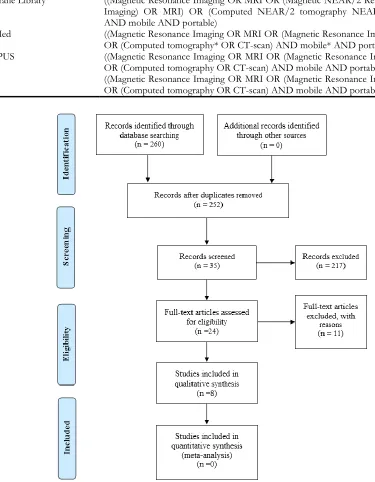
the Critical Appraisal Skills Program (CASP) cri- teria. Figure 1 shows the schematic presentation of the selection process of articles.
Table1: Search strategy of databases
Table :Search strategy Databases
Cochrane Library ((Magnetic Resonance Imaging OR MRI OR (Magnetic NEAR/2 Resonance NEAR/2
Imaging) OR MRI) OR (Computed NEAR/2 tomography NEAR/2 OR CT-scan AND mobile AND portable)
PubMed ((Magnetic Resonance Imaging OR MRI OR (Magnetic Resonance Imaging*) OR MRI)
OR (Computed tomography* OR CT-scan) AND mobile* AND portable*)
SCOPUS ((Magnetic Resonance Imaging OR MRI OR (Magnetic Resonance Imaging) OR MRI)
OR (Computed tomography OR CT-scan) AND mobile AND portable)
CRD ((Magnetic Resonance Imaging OR MRI OR (Magnetic Resonance Imaging) OR MRI)
OR (Computed tomography OR CT-scan) AND mobile AND portable)
Outcomes: An economic evaluation that focused on the effectiveness of the scanners. The sensitiv-ity, specificsensitiv-ity, quality of images (Pixel, Voxel) and accessibility to the scanners were outcomes of the study. The technologies were divided into those that were mobile between and within hos-pitals (also called portable scanners). Since the purpose of this study was to investigate mobile technology between hospitals, accordingly, eight (six on CT scan, one on MRI and the remaining one on both CT and MRI) studies in systematic review were eligible.
Cost data: The costs of the mobile and fixed CT
and MRI scanners included both the current and capital expenditures. The accurate cost estimates
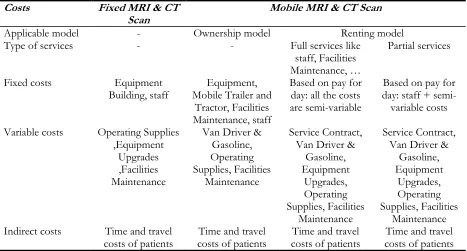
also consider other costs such as the costs of travel to receive the imaging services, costs of work absenteeism (both the patients and their family members), the cost of meals and accom-modation. The average cost of both the mobile and fixed scanners include the labor wages, con-sumption costs, operating costs including repair-ing and maintenance, overhead costs and the purchasing costs by considering the maximum use of the scanner efficiently over a full year as-suming the scanner works four shifts per day. The costs of both the mobile and fixed scanners from hospital perspective are summarized in Ta-ble 2.
Table 2: Fixed and variable costs for mobile and fixed MRI and CT Scan
Costs Fixed MRI & CT
Scan Mobile MRI & CT Scan
Applicable model - Ownership model Renting model
Type of services - - Full services like
staff, Facilities Maintenance, …
Partial services
Fixed costs Equipment
Building, staff Mobile Trailer and Equipment, Tractor, Facilities Maintenance, staff
Based on pay for day: all the costs are semi-variable
Based on pay for day: staff + semi-variable costs
Variable costs Operating Supplies ,Equipment
Upgrades ,Facilities Maintenance
Van Driver & Gasoline, Operating Supplies, Facilities
Maintenance
Service Contract, Van Driver &
Gasoline, Equipment
Upgrades, Operating Supplies, Facilities
Maintenance
Service Contract, Van Driver &
Gasoline, Equipment
Upgrades, Operating Supplies, Facilities
Maintenance Indirect costs Time and travel
costs of patients costs of patients Time and travel costs of patients Time and travel costs of patients Time and travel
The information was obtained through online conversations and phone calls to companies pro-ducing mobile MRI and CT scan, domestic and foreign companies, and the Department of Medi-cal Devices at the Ministry of Health and MediMedi-cal Education (MOHME) of Iran. The cost of re-pairing and maintenance services of the devices were obtained from the Engineering Unit of the MOHME and by calculating the estimated cost
151 of the Direct Tax Law of 1980, the deprecia-tion schedule for hospital equipment is set at 10 yr (16).
Economic evaluation: Because the review
showed no significant differences in the perfor-mance of mobile CT and MRI compared to the fixed ones, then a cost minimization approach was used to explore the cost-effectiveness. Thus, we designed different scenarios and in each sce-nario, three hospitals in three cities that were close to each other (max distance 75 km) and about 6,000 and 4800 patients use CT and MRI respectively each year. Costs related to a patient was calculated according to the lost working hours. It was based on the minimum basic salary of a worker (204 $) in Iran announced by the Ministry of Labor and Social Welfare (17). This study considered three scenarios. The first sce-nario was about purchasing and establishing one fixed MRI or CT machine in a hospital located in a city and serves as a referral hospital to other hospitals of two other cities located at about 75 km distance. Thus, the patients from the two other cities can use only this referral center for the imaging whenever they are requested to get the diagnostic service (Assuming a maximum 75 km distance to the central hospital and referring the patients with a relative). The second scenario was purchasing and establishing one fixed MRI or CT machine in the hospitals of the three cities that lacked these fixed devices (Assuming a max-imum 75 km distance and referring the patients with a relative). The third scenario was purchas-ing and establishpurchas-ing one mobile MRI or CT ma-chine in the hospitals of the three cities that lacked the fixed devices (Assuming a maximum 75 km distance and referring the patients with a relative). The three scenarios assumed that the technologies provided services to the referred patients and their relatives.
Sensitivity Analyses: According to the method
which used in cost-effectiveness analyses, the sensitivity analysis was done for the common costs for each scanner.
Safety: The safeties of the devices were analyzed
by reviewing the records of the final review, from observational studies and from the FDA site.
Results
The literature search yielded a total of 24 records that fulfilled the eligibility criteria (Table 1), of which 17 articles were on CT, six were on MRI and the remaining one was on both CT and MRI. Further, three of the studies were on CT and MRI Health Technology Assessment (HTA), four were systematic reviews, 14 clinical trial studies and the rest one was a comparative study of mobile and fixed CT and MRI. But only 8 studies reported on the mobile scanners (six on CT scan, one on MRI and the remaining one on both CT and MRI) (Table 3). In none of these records was a measure such as odds ratio, relative risk and probability reported for comparision the effectiveness of mobile versus fixed MRI and CT.
Outcomes: The findings from the interview of
Table 3: Studies of systematic review about the mobile scanners
Title Authors Year
A comparison of fixed and mobile CT and MRI scanners Janis Reeve, et al 1995
HTA of Magnetic Resonance Imaging Gillet Pierre and et.al 2006
Computed Tomography Scanners for Patients in Rural or Remote
Loca-tions: Clinical and Cost-Effectiveness CADTH (Canadian Agency for Drug and Technologies in
Health)
2014
Mobile computed tomography: prehospital diagnosis
and treatment of stroke Ebinger M, et al 2015
Evaluation of head examinations produced with a mobile CT unit Matson MB, et.al 1999
Diagnosis and treatment of patients with stroke in a mobile
stroke unit versus in hospital: a randomized controlled trial Walter Silke, et.al 2012
Mobile Computed Tomography Scanner for Head and Neck Imaging Tsang Kwai-fan Ice, et.al 2009
The Mobile Hospital Technology Industry: Focus on the
Computerized Tomography Scanner
Hartley D, Moscovice I. 1996
Besides, the studies were included in systematic reviews, examined the different outcomes and those with similar outcomes were based on quali-tative studies. In none of the studies odds ratio, relative risk, probability, etc. were reported. Thus, the overall interpretation of the outcomes and safety of the scanners was based on the qualita-tive outcomes and expert opinions.
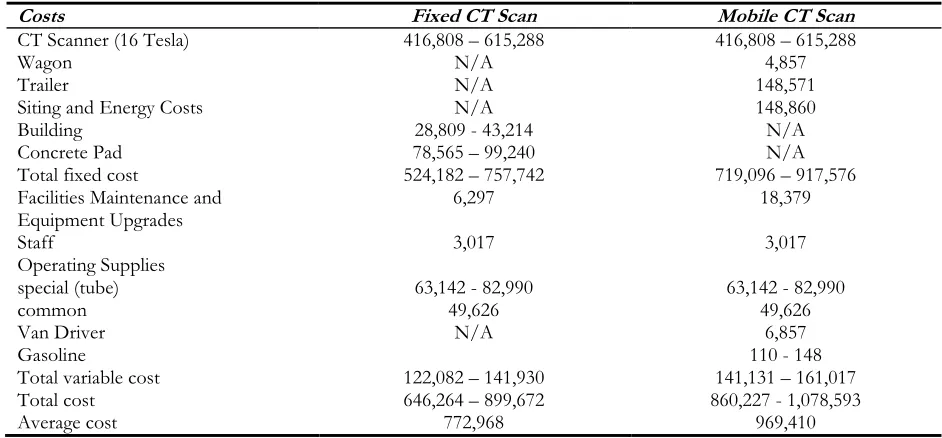
Costs: The estimated costs of the fixed and
mo-bile CT scanner, as well as the purchasing and
establishing costs of the fixed CT scanner, ranged from 524,182-757,742 $ (Table 4). The operating cost (provision, maintenance, staff, etc.) was about 122,082-141,930$ (assuming 25 patients per day). The fixed costs related to the purchas-ing and operatpurchas-ing of the mobile CT scanners were in the range of 719,096-917,576$. The an-nual administrative costs were estimated at 141,131-161,017 $ (assuming 25 patients per day).
Table 4: Fixed and mobile CT Scan costs
Costs Fixed CT Scan Mobile CT Scan
CT Scanner (16 Tesla) 416,808 – 615,288 416,808 – 615,288
Wagon N/A 4,857
Trailer N/A 148,571
Siting and Energy Costs N/A 148,860
Building 28,809 - 43,214 N/A
Concrete Pad 78,565 – 99,240 N/A
Total fixed cost 524,182 – 757,742 719,096 – 917,576
Facilities Maintenance and
Equipment Upgrades 6,297 18,379
Staff 3,017 3,017
Operating Supplies special (tube)
common 63,142 - 82,990 49,626 63,142 - 82,990 49,626
Van Driver
Gasoline N/A 110 - 148 6,857
Total variable cost 122,082 – 141,930 141,131 – 161,017
Total cost 646,264 – 899,672 860,227 - 1,078,593
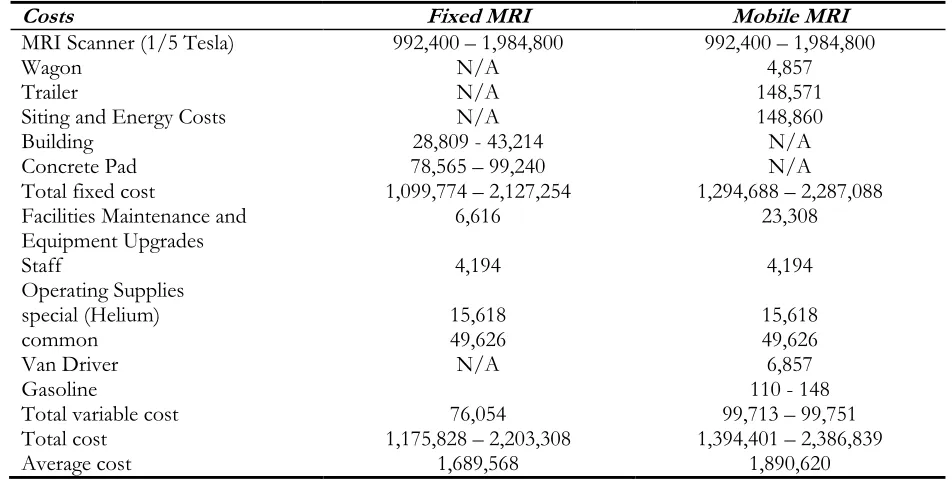
The fixed costs related to purchasing and estab-lishing of fixed MRI was about 1,099,774-2,127,254 $ and the administrative cost was around 76,054 dollars (Table 5).
The fixed costs of mobile MRI was in the range of 1,294,688-2,287,088 $ and the variable cost was about 99,713 – 99,751$.
Table 5: Fixed and mobile MRI costs
Costs Fixed MRI Mobile MRI
MRI Scanner (1/5 Tesla) 992,400 – 1,984,800 992,400 – 1,984,800
Wagon N/A 4,857
Trailer N/A 148,571
Siting and Energy Costs N/A 148,860
Building 28,809 - 43,214 N/A
Concrete Pad 78,565 – 99,240 N/A
Total fixed cost 1,099,774 – 2,127,254 1,294,688 – 2,287,088
Facilities Maintenance and
Equipment Upgrades 6,616 23,308
Staff 4,194 4,194
Operating Supplies special (Helium)
common 15,618 49,626 15,618 49,626
Van Driver
Gasoline N/A 110 - 148 6,857
Total variable cost 76,054 99,713 – 99,751
Total cost 1,175,828 – 2,203,308 1,394,401 – 2,386,839
Average cost 1,689,568 1,890,620
Economic evaluation: Based on the findings
from the interviews and review of the selected studies, especially the HTAs, technically the mo-bile MRI and CT scanners had same use as to that of the fixed ones. The cost-minimization analysis showed that the total cost of the CT scan in the first scenario was about 1,093,310$. The overall costs in the second were 2,368,144$, while in the third scenarios it was 557,614$. Among the three scenarios, the third scenario for purchasing and establishing one mobile CT scanner by all three cities that lacks fixed one had the lowest cost. The total costs of the MRI in the first, sec-ond and third scenarios were 3,130,951$, 8,688,109$ and 1,091,235$ respectively. In three hypothetical scenarios for MRI, the third scenario which is buying a mobile MRI scanner by the three hospitals had the lowest cost.
Safety: The CT-scanning is generally a
non-invasive procedure. However, the radiation (x-ray) from this technology has the potential to
might require injecting of a contrast material such as gadolinium into the bloodstream of the pa-tient. The contrast does not have iodine and does not create sensitivity or other problems, whilst patients with the history of kidney disease, kid-ney-transplant, and liver disease should inform the radiologist before they undergo the imaging. Unlike the CT scanner, risks from the MRI on pregnant women have not been reported. How-ever, the use of MRI should be limited to an es-sential item and the physician’s prescription (15). Prior to supplying the technology, the food and Drug Administration (FDA) confirmed that the efficacy of the mobile CT-Scan and MRI devices is similar to fixed ones (14). Since some patients may be concerned with closed spaces of mobile devices, such problems to be overcome by the presence of patient’s accompaniment or consult-ing with them. The trailers without changconsult-ing room, a bridge should be embedded into a hospi-tal for the convenience of patients. Generally, the safety of CT-Scan and MRI machines can be en-sured because no complications have been re-ported for their users.
Sensitivity analysis: Like cost-effectiveness
studies, it was not necessary to conduct sensitivi-ty analysis because sensitivisensitivi-ty analysis of the costs of the fixed and mobile CT-scan and MRI tech-nologies were only based on the costs which were common among mobile and fixed devices and were changing in a given range. The cost tables for the CT-scan and MRI devices showed no dif-ference between the fixed and variable costs of these technologies. Then, there was no given cost variable to impact on total costs and the selected scenario.
Discussion
Buying a mobile CT scan or MRI for hospitals could be economically affordable if purchasing fixed devices is not cost-effective because of the low volume of patients. There is evidence show-ing the mobile devices would result in cost savshow-ing of 385.60 $ per scan (8). Although the mobile and fixed CT-Scan and MRI devices are
techno-logically similar, this study identified some pros and cons of the mobile CT-Scan and MRI ma-chines.
The mobile devices have lower cost of initial in-vestment due to the cost sharing between several hospitals, and they required less time to set-up. In contrast, the fixed MRI or CT-Scanners needed the building of a unit or department. The mobile MRI and CT-Scanners can be useful when there is increased demand for scanning, and they can meet the hospitals demand in a short-term. How-ever, in the long-term such advantages will be lost. From the perspective of patients, some of the advantages of mobile CT-Scan or MRI are time and cost saving. One of the disadvantages of mobile devices is the difficulty of coordination between hospitals, for example, if two or more hospitals are faced with demand surplus simulta-neously, coordination between them will be very challenging. Additionally, devices are seldom close to hospitals so there would be no accessibil-ity in emergency situations.
mobile technology the amount of utilization may be increased.
Limitations: The systematic reviews and Health
Technology Assessment (HTA) studies were rare. Hence, randomized controlled trial (RCT) and controlled clinical trial (CCT) studies were in-cluded in the study.
Conclusion
Decision of policy makers and managers on pur-chasing a mobile CT-scan or MRI must not de-pend on the price solely; rather, they have to pay attention to all aspects like capacity of hospitals located near to each other for utilizing devices, population growth, pattern of diseases in the fu-ture and prices. Although the operating costs of mobile technology may be increased, these costs can be offset by the increasing in the visited pa-tients, prorating of costs, flexibility, and other costs (in particular indirect Costs of patients). At the same time, most literature proposes the mo-bile MRI and CT-Scan as a provisional solution until setting up the fixed ones.
Therefore, from efficiency aspect, the basic out-comes that lead to overweight mobile MRI and CT-Scan to fixed one are the rise in patient’s ac-cess to diagnostic services, acceleration in pa-tient’s management, and decrease in staff work-load, moreover according to economic evaluation (cost-minimization), purchasing and utilization of a common mobile CT-scan or MRI by three or more hospitals have priority over that of fixed ones. The only difference between the safety of mobile and fixed devices described above is the fear of enclosed space in portable devices that can be solved by consulting with patients and the presence of patient’s accompaniment in the scanning room. Therefore, policymakers can ac-cept decisions about purchasing mobile technol-ogy if buying a fixed technoltechnol-ogy do not have economic justification and hospitals are located in an appropriate distance from each other, oth-erwise, patient shortcoming can lead to induced demand by investors.
Ethical considerations
Ethical issues (Including plagiarism, informed consent, misconduct, data fabrication and/or fal-sification, double publication and/or submission, redundancy, etc.) have been completely observed by the authors.
Acknowledgements
This study was supported by National Institute of Health Research with contract number 241/M/9380. The funders had no contribution in data collection, analysis, design, manuscript preparation or ruling to publish.
Conflict of interest
The authors declare that there is no conflict of interests.
References
1. Murtagh J, Warburton RN, Foerster V, Lentle BC, Wood RJ, Mensinkai S, Husereau D (2006). CT and MRI for selected clinical disorders: a systematic review of economic evaluations [Technology report no 68]. Ottawa: Canadian Agency for Drugs and Technologies in Health.
2. Westbrook C,Talbot J (2018). MRI in practice. John Wiley & Sons.
3. [No authors listed] (1987). Technology on wheels: Evaluating the options. Health Technol, 1(6):231-8.
4. Fayad ZA, Fuster V, Nikolaou K, Becker C (2002). Computed tomography and magnetic resonance imaging for noninvasive coronary angiography and plaque imaging: current and potential future concepts.. Circulation, 106(15):2026-34.
5. National Imaging Associates, Inc (2016). NIA Clinical Guidelines for Medical Necessity Review. Magellan Healthcare,1-659.
7. Reeve J, Baladi JF (1995). A comparison of fixed and mobile CT and MRI scanners. . Canadian Coordinating Office for Health Technology Assessment. National Library of Canada. 8. Canadian Coordinating Office for Health
Technology Assessment (1994). Selected health technologies in Canada (Technology brief; Issue 5.3). Ottawa: Canadian Coordinating Office for Health Technology Assessment.
9. Butler WE, Piaggio CM, Constantinou C, et al (1998). A mobile computed tomographic scanner with intraoperative and intensive care unit applications. Neurosurgery, 42(6):1304-10. 10. Ebinger M, Fiebach JB, Audebert HJ (2015).
Mobile computed tomography: prehospital diagnosis and treatment of stroke. Curr Opin Neurol, 28(1):4-9.
11. Gunnarsson T, Theodorsson A, Karlsson P, et al (2000). Mobile computerized tomography scanning in the neurosurgery intensive care unit: increase in patient safety and reduction of staff workload. J Neurosurg, 93(3):432-6. 12. Walter S, Kostopoulos P, Haass A, et al (2012).
Diagnosis and treatment of patients with stroke in a mobile stroke unit versus in hospital: a randomised controlled trial. Lancet Neurol, 11(5):397-404.
13. Boulevard J B (2013). Patient Safety: Magnetic Resonance Imaging (MRI). Radiological Society of North America.
14. Mansori M. What is CT Scan and how is it work? (2012) IRAN: Iran ortoped; Available from: http://www.iranorthoped.ir/fa/news/1357 15. Kieso DE, Weygandt JJ, Warfield TD (2010).
Intermediate accounting: IFRS edition. 3rd ed. John Wiley & Sons, USA, pp.: 201-305.
16. [No authors listed] (2011). Law for the Fifth Development Plan of the Islamic Republic of Iran:
https://wipolex.wipo.int/en/legislation/detai ls/14565
17. Shawi M Al, Watson T, Carlson J, Anthony L, Thomas M (2013). CT Scan Services In The Rural Setting, The Clinical Need And Cost Effectiveness: The Katherine Hospital Experience (Australia). The Internet Journal of Surgery, 30(1):1-4.
18. Tsang K I, Cheung TI, Liu H (2009). Mobile Computed Tomography Scanner for Head and Neck Imaging. Hong Kong: society of critical care medicine.
19. Matson M, Jarosz J, Gallacher D, et al (1999). Evaluation of head examinations produced with a mobile CT unit. Br J Radiol, 72(859):631-6.
20. Hartley D, Moscovice I (1996). The mobile hospital technology industry: focus on the computerized tomography scanner. J Rural Health, 12(3):225-34.
21. Teichgräber UK, Pinkernelle J, Jürgensen J-S, Ricke J, Kaisers U (2003). Portable computed tomography performed on the intensive care unit. Intensive Care Med, 29(3):491-5.
22. Adelman AM, Daly MP (2005). Initial evaluation of the patient with suspected dementia. Am Fam Physician, 71(9):1745-50.