
8
‑
Substituted Pyrido[3,4
‑
d
]pyrimidin-4(3
H
)
‑
one Derivatives
As Potent, Cell Permeable, KDM4 (JMJD2) and KDM5 (JARID1)
Histone Lysine Demethylase Inhibitors
Vassilios Bavetsias,
*
,†Rachel M. Lanigan,
†Gian Filippo Ruda,
‡,§Butrus Atrash,
†Mark G. McLaughlin,
†Anthony Tumber,
‡,§N. Yi Mok,
†Yann-Va
ï
Le Bihan,
†Sally Dempster,
†Katherine J. Boxall,
†Fiona Jeganathan,
†Stephanie B. Hatch,
‡,§Pavel Savitsky,
‡Srikannathasan Velupillai,
‡Tobias Krojer,
‡Katherine S. England,
‡,§Jimmy Sejberg,
†Ching Thai,
†Adam Donovan,
†Akos Pal,
†Giuseppe Scozzafava,
‡,§James M. Bennett,
‡,§Akane Kawamura,
∥Catrine Johansson,
‡,⊥Aleksandra Szykowska,
‡Carina Gileadi,
‡Nicola A. Burgess-Brown,
‡Frank von Delft,
‡,#,∇Udo Oppermann,
‡,⊥Zoe Walters,
○Janet Shipley,
○Florence I. Raynaud,
†Susan M. Westaway,
◆Rab K. Prinjha,
◆Oleg Fedorov,
‡,§Rosemary Burke,
†Christopher J. Scho
fi
eld,
∥Isaac M. Westwood,
†Chas Bountra,
‡Susanne Mu
̈
ller,
‡,§Rob L. M. van Montfort,
†Paul E. Brennan,
*
,‡,§and Julian Blagg
*
,† †Cancer Research UK Cancer Therapeutics Unit, The Institute of Cancer Research, 15 Cotswold Road, London SM2 5NG, U.K.
‡Structural Genomics Consortium (SGC), University of Oxford, ORCRB Roosevelt Drive, Oxford OX3 7DQ, U.K.
§
Target Discovery Institute (TDI), Nu
ffi
eld Department of Medicine, University of Oxford, NDMRB Roosevelt Drive, Oxford OX3 7FZ, U.K.
∥
Chemistry Research Laboratory, University of Oxford, Mans
fi
eld Road, Oxford OX1 3TA, U.K.
⊥Botnar Research Centre, NIHR Oxford Biomedical Research Unit, Oxford OX3 7LD, U.K.
#
Diamond Light Source (DLS), Harwell Science and Innovation Campus, Didcot OX11 0DE, U.K.
∇
Department of Biochemistry, University of Johannesburg, Auckland Park 2006, South Africa
○
Divisions of Molecular Pathology and Cancer Therapeutics, The Institute of Cancer Research, London SM2 5NG, U.K.
◆Epinova Discovery Performance Unit, Medicines Research Centre, GlaxoSmithKline R&D, Stevenage SG1 2NY, U.K.
*
S Supporting InformationABSTRACT:
We report the discovery of
N
-substituted 4-(pyridin-2-yl)thiazole-2-amine derivatives and their subsequent optimization,
guided by structure-based design, to give 8-(1
H
-pyrazol-3-yl)pyrido[3,4-
d
]pyrimidin-4(3
H
)-ones, a series of potent JmjC histone
N
-methyl lysine demethylase (KDM) inhibitors which bind to Fe(II) in the active site. Substitution from C4 of the pyrazole moiety
allows access to the histone peptide substrate binding site; incorporation of a conformationally constrained 4-phenylpiperidine linker
gives derivatives such as
54j
and
54k
which demonstrate equipotent activity versus the KDM4 (JMJD2) and KDM5 (JARID1)
subfamily demethylases, selectivity over representative exemplars of the KDM2, KDM3, and KDM6 subfamilies, cellular permeability in
the Caco-2 assay, and, for
54k, inhibition of H3K9Me
3and H3K4Me
3demethylation in a cell-based assay.
Special Issue: Epigenetics
Received: October 18, 2015
Published: January 7, 2016
Article
pubs.acs.org/jmc
■
INTRODUCTION
Post-translational histone modi
fi
cations, which include lysine
or arginine methylation, play a pivotal role in maintaining
chromatin architecture and regulating transcription.
1Histone
lysine methylation is a reversible process; the removal of methyl
groups is catalyzed by two classes of histone lysine demethylases
(KDMs): the
fl
avin-dependent lysine speci
fi
c demethylase
(LSD/KDM1) family that demethylate mono- and dimethyl
lysine substrates, and the larger class of Fe(II) and 2-oxoglutarate
(2OG)-dependent enzymes which can additionally convert
trimethyl lysine substrates to their dimethyl forms.
2−4The
2OG-dependent KDMs belong to the Jumonji C (JmjC) domain
containing subfamily of such enzymes and have a catalytic
site wherein methylated lysine substrates can be oxidized to
hemiaminal intermediates, which subsequently decompose to
the corresponding demethylated lysine and formaldehyde.
2,4Human JmjC histone demethylases comprise
fi
ve
sub-families. The KDM4 (JMJD2) subfamily consists of six
mem-bers KDM4A
−
F;
KDM4E
and
KDM4F
are believed to be
pseudogenes although demethylase activity has been
demon-strated when KDM4E is ectopically expressed.
5,6KDM4A
−
C
contain PHD and Tudor domains as well as a single JmjC
domain that catalyzes demethylation of histone substrates
H3K9Me
3/Me
2, H3K36Me
3/Me
2, and H1.4K26Me
3.
1,5,7,8KDM4D is distinguished from KDM4A
−
C in terms of its
domains (it lacks both the PHD and Tudor domains), its
selec-tivity for demethylation of H3K9Me
3/Me
2over H3K36Me
3/
Me
2,
5,7and also its ability to demethylate both the dimethylated
and trimethylated forms of H1.4K26.
7,9Emerging evidence suggests that KDM4 subfamily members
play an important role in cancer initiation and progression;
various studies have shown overexpression of
KDM4A
−
C
in a
range of human malignancies.
5,7,10−12For example,
KDM4B
and
KDM4C
are reported to be overexpressed in breast cancer;
10,11KDM4B knockdown in ER-positive ZR-75-1 breast cancer cells
impaired growth in a human tumor xenograft model,
11and
KDM4B knockdown in human gastric cancer cells also
sup-pressed growth in a human tumor xenograft model.
12KDM4B
gene expression is high in rhabdomyosarcomas and has been
associated with poor prognosis in neuroblastoma.
13,14A recent
report demonstrates a role for KDM4A in site-speci
fi
c copy gain
of chromosomal domains (e.g., 1q12) and rereplication of
regions ampli
fi
ed in tumors;
15furthermore, a coding
single-nucleotide polymorphism (SNP) in
KDM4A
was shown to
associate with worse outcome in non-small cell lung cancer
patients and with increased sensitivity to mTOR inhibitors.
16,17The KDM5 subfamily are histone H3 lysine 4 (H3K4)
demethylases and have been implicated in cancer progression in
several tumor types.
18,19Along with members of the KDM4
family, KDM5B and KDM5C have been shown to play a
role in breast and prostate cancer, respectively. KDM5B has
been implicated in several subtypes of breast cancer,
20,21while
KDM5C has been shown to be an independent prognostic factor
in prostate cancer.
22JmjC KDM activity is also associated with
diseases other than cancer;
23for example, KDM6B/A (JMJD3/
UTX)-mediated demethylation of H3K27 has been reported
as a critical determinant of pro-in
fl
ammatory gene activation
in human primary macrophages.
24Thus, JmjC KDMs have
emerged as important therapeutic targets, particularly for the
treatment human malignancies.
7,23,25A range of small-molecule inhibitors of JmjC KDMs has
been reported, the majority of which are 2OG-competitive and
coordinate to Fe(II) in the catalytic site,
26−34for example,
compounds
1
−
3
32−34(
Figure 1
). Many of these early histone
demethylase modulators lack human 2OG oxygenase speci
fi
c-ity
32and possess a carboxylic acid moiety which may limit cell
permeability. As a result, such compounds are suboptimal
chemical tools with which to better understand the biological
role of speci
fi
c KDM4 subfamily enzymes in disease and normal
development, in particular, to study the importance of JmjC
domain KDM activity within the context of full length KDM4
proteins wherein the noncatalytic domains may play a role in
chromatin localization or sca
ff
olding functions. In an attempt
to overcome the poor cell permeability of inhibitors bearing a
carboxylic acid, corresponding ester prodrugs have been
investigated in some cases; for example, for the KDM6-selective
inhibitor
4
(GSK-J1,
Figure 1
) where the corresponding ethyl
ester prodrug found utility in a cellular context.
24Extensive interest in the KDM4/5 subfamilies in the
pro-gression of human cancers, and the well-de
fi
ned catalytic
mechanism for JmjC KDMs, prompted us to initiate a program
to identify histone KDM inhibitors, and in particular potent,
cell permeable, and selective inhibitors of the KDM4 subfamily
with which to further explore the potential of such compounds
as anticancer agents. Herein, we report the identi
fi
cation of a
4-(pyridin-2-yl)thiazol-2-amine series as KDM inhibitors from
a high throughput screening (HTS) campaign and their
sub-sequent structure-based optimization into potent, cell permeable
dual inhibitors of the KDM4 and KDM5 subfamilies.
■
CHEMISTRY
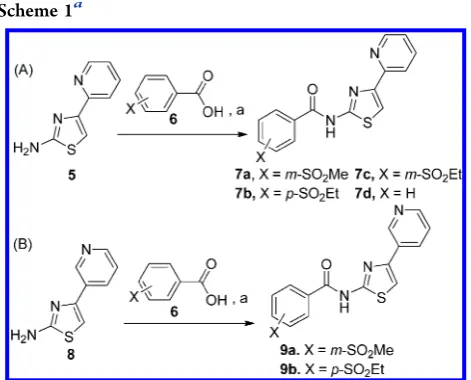
Synthesis of the HTS-derived series of
N
-(4-(pyridin-2-yl)thiazol-2-yl)benzamides
7a
−
d
(
Scheme 1
A,
Table 1
) was
achieved by EDCI/HOBt-mediated coupling of commercially
available benzoic acids
6
with 4-(pyridin-2-yl)thiazol-2-amine
(5). This procedure has recently been reported for the
preparation of 2-aminothiazole derivatives as antimycobacterial
and antiplasmodial agents.
354-(Pyridin-3-yl)thiazole derivatives
9a,b
(
Scheme 1
B,
Table 2
) were obtained from commercially
available 4-(pyridin-3-yl)thiazol-2-amine (8) by a procedure
analogous to that described for the synthesis of
7a
−
d.
Syntheses of 2-aminothiazoles
15
and
16
and
2-benzamido-thiazole
19
are shown in
Scheme 2
. Treatment of methyl
2-bromoisonicotinate (10) with stannane
11
under Pd-catalyzed
conditions gave methyl 2-(1-ethoxyvinyl)isonicotinate (12);
subsequent reaction with
N
-bromosuccinimide a
ff
orded
bro-mide
13. Thiazole ring formation to give the 2,4-disubstituted
thiazole
14
was e
ff
ected by reacting
13
with
N
-Boc-thiourea in
the presence of trimethylamine, and subsequent removal of the
protecting groups provided 2-aminothiazole derivative
15.
Treatment of 2,4-disubstituted thiazole
14
with ammonia in
methanol at 80
°
C followed by acid-mediated removal of the
N
-Boc protecting group provided the primary amide
16. Access
to 2-benzamidothiazole
19
was achieved by coupling of benzoyl
chloride with 2-aminothiazole
17
followed by ester hydrolysis
under alkaline conditions (
Scheme 2
).
Preparation of
22
followed an alternative approach whereby
the thiazole ring was introduced directly via a Stille
cross-coupling reaction (
Scheme 3
). Access to
24, a key intermediate
for the preparation of
25, was achieved by bromination of
23
followed by 2-methylthiazole ring formation in a manner
analogous to the preparation of
14
(
Scheme 3
).
2-Benzylaminomethylpyridine (30b) and
2-furanylmethyla-mino derivative (30a)
36were prepared from
pyridine-2,4-dicarboxylate (26) in a four-step sequence (
Scheme 4
).
Esteri
fi
cation of
26, followed by DIBAL-mediated selective
reduction of the carboxylic acid ester in the 2-position of
27
a
ff
orded aldehyde
28. Reductive amination of aldehyde
28
with
either benzylamine or 2-aminomethylfuran in the presence of
sodium triacetoxyborohydride led to ester derivatives
29a,b,
which were subsequently hydrolyzed to the corresponding
carboxylates
30a,b
with lithium hydroxide (
Scheme 4
).
8-Chloropyrido[3,4-
d
]pyrimidin-4(3
H
)-one (34), the key
intermediate for the synthesis of thiazole-C4 substituted
derivative
37, 2,4-disubstituted thiazole
40
and subsequent
SAR exploration (vide infra), was prepared in three steps from
methyl-3-amino-2-chloroisonicotinate (31) (
Scheme 5
). Ester
hydrolysis a
ff
orded
32
which was converted into the primary
amide
33
via the corresponding acid chloride; subsequent ring
formation was e
ff
ected upon treatment with triethyl
orthofor-mate (
Scheme 5
). A SEM-protecting group was introduced by
reacting
34
with SEM-Cl in the presence of potassium carbonate
to give protected pyridopyrimidinone
35. Bromide
39, a key
intermediate for the preparation of
40, was obtained from
34
in a manner analogous to that described for
13
(
Scheme 2
).
2-Aminothiazole formation to a
ff
ord
40
was achieved by reacting
Scheme 1
aaReagents and conditions: (a) EDCI, 1-hydroxybenzotriazole, CH 2Cl2
or CH2Cl2/DMF, room temp, 3.5−36 h, (7a = 33%, 7b = 25%, 7c= 40%,7d = 50%,9a= 28%,9b= 16%).
Table 1.
N
-Substituted 4-(Pyridin-2-yl)thiazole-2-amine Derivatives
baResults are from a single experiment.bResults are mean values of two independent determinations or mean (±SD) forn> 2 unless specified
39
with thiourea in the presence of Et
3N. Compound
37
was
prepared from
34
by a Stille cross-coupling reaction to introduce
the thiazole ring followed by removal of the SEM protecting
group under acidic conditions (
Scheme 5
).
8-Chloropyrido[3,4-
d
]pyrimidin-4(3
H
)-one (34) was also
employed for the synthesis of pyrazolyl derivatives
41a,b
by a
Suzuki cross-coupling reaction with (1
H
-pyrazol-3-yl)boronic
acid or ((
N
-methyl)pyrazol-3-yl)boronic acid pinacol ester,
respectively (
Scheme 6
).
Suzuki cross-coupling reaction of
34
with trimethylboroxine
a
ff
orded the C8-methyl derivative
42
which was oxidized to
4-oxo-3,4-dihydropyrido[3,4-
d
]pyrimidine-8-carbaldehyde (43);
subsequent reductive amination with the requisite primary or
secondary amines gave the 8-aminomethyl derivatives
44a
−
g
(
Scheme 7
,
Table 5
).
Compounds
52a
−
g
(
Table 6
),
53a
−
i
(
Table 7
), and
54a
−
n
(
Table 8
) were prepared either from primary alcohol
47
by
mesylate formation followed by S
N2 displacement or from
carboxaldehyde
48
by reductive amination (routes A and B,
respectively,
Scheme 8
). The pyrazole moiety at C8 of the
pyrido[3,4-
d
]pyrimidin-4(3
H
)-one sca
ff
old was introduced
using an S
NAr reaction on key intermediate
35. Subsequent
acidic TBS deprotection on intermediate
46
a
ff
orded the alcohol
47. Compound
59
(
Table 6
) bearing a longer linker at C4 of the
Table 2.
N
-Substituted 4-(Pyridin-3-yl)thiazole-2-amine Derivatives
aaResults are mean values of two independent determinations unless specified otherwise.
Scheme 2
aaReagents and conditions: (a) Pd(PPh
3)4, 1,4-dioxane, reflux, 18 h, 65%; (b)N-bromosuccinimide, 10% water in THF, room temp, 1 h, 61%;
(c)N-Boc-thiourea, Et3N, EtOH, reflux, 1 h, 56%; (d) (i) 4 M HCl in dioxane, room temp, 1 h, (ii) THF/H2O, NaOH, room temp, 1 h, 55%;
(e) (i) 7 M NH3in MeOH, 80°C, 18 h, (ii) 4 M HCl in dioxane, room temp, 1 h, 91%; (f) 4 M HCl in dioxane, room temp, 1 h, 83%; (g) benzoyl
pyrazole moiety was also prepared according to route A
described in
Scheme 8
.
■
RESULTS AND DISCUSSION
The discovery of chemical starting points for JmjC histone
KDM inhibition was based upon an HTS campaign of a 150k
compound collection tested at 30
μ
M versus human
recombinant KDM4B (amino acid residues 1
−
500 with an
N-terminal GST tag). The format of the HTS was the same
KDM4B AlphaScreen assay described in the Methods section;
this assay was also used to monitor the activity of compounds
reported herein. This screening campaign provided
N
-substituted
4-(pyridin-2-yl)thiazole-2-amine derivatives exempli
fi
ed by
7c
as
promising hits (
Scheme 1
,
Table 1
). The KDM4B inhibitory
activity of
7c
was con
fi
rmed with a resynthesized sample (IC
50=
10.9
μ
M) and triggered a medicinal chemistry program to identify
more potent, cell permeable inhibitors of the KDM4 subfamily.
The methylsulfonyl analogue
7a,
p
-SO
2Et isomer
7b, and
benzamido analogue
7d
displayed similar KDM4 inhibitory
activities to
7c
(
Table 1
); all four analogues (7a
−
d) were more
potent inhibitors of KDM4B relative to KDM5B by at least 3-fold
under the standard assay conditions (
Table 1
). However, the
commercially available fragment-like sca
ff
old
4-(pyridin-2-yl)-thiazol-2-amine (5) demonstrated very weak inhibition of
KDM4B (30% inhibition at 100
μ
M) and no activity against
KDM5B at 100
μ
M, indicating an important role for the primary
amine
N
-substituent.
Scheme 3
aaReagents and conditions: (a) Pd(PPh
3)4, Ag2O, DMF, 100°C, 1 h,
64%; (b) MeOH/H2O, NaOH, 1 h, 46%; (c) AcOH, 48% aqueous
HBr, Br2, 0 °C to room temp for 1 h, then 75 °C for 1.5 h, 38%;
(d) (i) thioacetamide, EtOH, Et3N, reflux, 1 h, (ii) EtOH, conc HCl
(2 drops), reflux, 20 min, 23%; (e) MeOH/H2O, 1 M NaOH, room
temp, 50 min, 45%.
Scheme 4
aaReagents and conditions: (a) PTSA, EtOH, 80°C, 79%; (b) DIBAL,
THF, PhMe,−78°C, 39%; (c) benzylamine or 2-aminomethylfuran, NaBH(OAc)3, AcOH, CH2Cl2, (29a= 99%,29b= 93%); (d) LiOH
(aq), MeCN, (30a= quant,30b= quant).
Scheme 5
aaReagents and conditions: (a) MeOH/H
2O, 1 M NaOH, room temp,
45 min, 77%; (b) (i) SOCl2, DMF, reflux, 2 h, (ii) ammonium
hydroxide, THF, room temp, 1.5 h, 89%; (c) CH(OEt)3, reflux
24 h, 82%; (d) SEM-Cl, K2CO3, DMF, 60 °C, 4 h, 84%; (e)
4-(tributylstannyl)thiazole, Pd(PPh3)4, Ag2O, DMF, 100°C, 2 h, 32%;
(f) THF, 6 M HCl, 50°C, 4 h, 94%; (g) Pd(PPh3)4, 1,4-dioxane,
reflux, 2 h, 64%; (h) 10% H2O in THF,N-bromosuccinimide, room
temp, 1 h, 72%; (i) thiourea, Et3N, EtOH, reflux, 1 h, 13%.
Scheme 6
aaReagents and conditions: (a) Pd(PPh
3)4, Na2CO3, DMA,
We set out to establish the binding mode of the
4-(pyridin-2-yl)thiazol-2-amine series to facilitate further medicinal chemistry
design. We postulated that the pyridine nitrogen in
7a
−
d
(
Table 1
) would be a major contributor to KDM4A/B binding
via coordination to the metal in the JmjC-domain catalytic site
analogous to the binding mode of previously reported
pyridine-based KDM inhibitors such as
1
−
4
(
Figure 1
).
24,32−34Consistent with this notion, and also with previous reports that
suggested a signi
fi
cant drop in potency for pyridin-3-yl
regioisomers of active compounds,
24the 4-(pyridin-3-yl)thiazole
derivatives
8,
9a, and
9b
were considerably less potent or
inactive relative to their pyridin-2-yl counterparts (
Tables 1
and
2
).
The commercially available phenyl analogue of
5, lacking the
pyridyl nitrogen (4-phenylthiazol-2-amine), was also inactive
against KDM4A and KDM4B at 100
μ
M compound
concen-tration (data not tabulated).
Attempts to elucidate the binding mode of
7a
or close
analogues by cocrystallization with KDM4A or by soaking of
apo-KDM4A crystals with
7a
were unsuccessful. Docking studies
of the fragment-like sca
ff
old
5
using the cocrystal structure of
2
in
KDM4A (PDB code 3PDQ)
33suggested that
5
could bind to the
active site metal through bidentate coordination of the pyridyl
and thiazolyl nitrogen atoms (
Figure 2
A,B). Furthermore, the
docked pose of
5
overlaid well with the binding mode of
the bipyridyl-based analogue
2-bound KDM4A cocrystal
structure (PDB code 3PDQ).
33This observation prompted
the introduction of a carboxylate moiety
para
to the pyridine
nitrogen in
5
to interact with K206 and Y132 (KDM4A
residue numbering) in a manner analogous to that observed for
the cosubstrate 2OG, NOG, and literature pyridyl-based
analogues
1
and
2.
32,33,37Pleasingly,
15
(
Table 3
) demonstrated
potent inhibition of KDM4A and KDM4B (IC
50= 0.200 and
0.083
μ
M respectively,
Table 3
), KDM5B (IC
50= 0.012
μ
M,
Table 3
) as well as KDM3A (IC
50= 0.057
μ
M) while inhibiting
KDM2A and KDM6B to a lesser extent (IC
50= 1.2 and 1.0
μ
M,
respectively). Interestingly, introduction of a carboxylate at the
equivalent position
para
to the pyridine nitrogen in the
N
-(thiazol-2-yl)benzamido derivative
7d
to give compound
19
(
Table 3
) resulted in demethylase activity similar to
7d
(KDM4B
IC
50= 17.0
μ
M,
Table 3
) consistent with the docking predictions
that binding of extended analogues at the C2 thiazole position
could be compromised due to the steric clash of the benzamido
substituent with the protein (
Figure 2
B).
Protein
−
ligand crystallographic analysis was mainly
per-formed using KDM4A which has a similar JmjC catalytic site
to that of KDM4B.
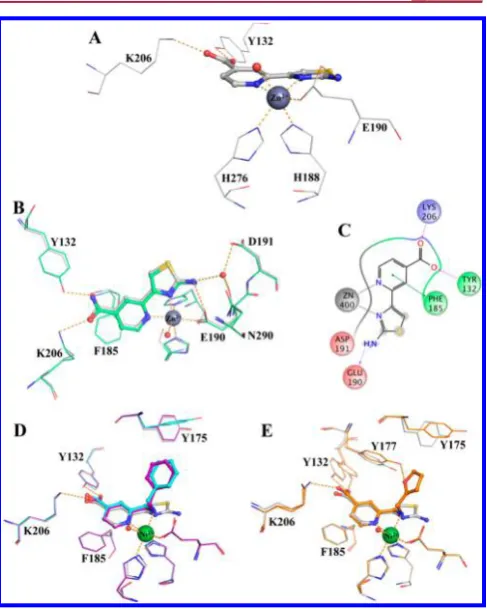
38A crystal structure of
15
bound to KDM4A
con
fi
rmed the proposed binding mode involving interactions of
Scheme 7
aaReagents and conditions: (a) Pd(PPh
3)4, K2CO3, trimethylboroxine,
DME, 90 °C, 1 h, 59%; (b) SeO2, 1,4-dioxane, 90 °C, 8 h, 14%;
(c) NaBH(OAc)3, R1R2NH, MeOH/CH2Cl2, room temp, 1−3 h,
12−55%.
Scheme 8
aaReagents and conditions: (a) Cs
2CO3, anhydrous MeCN, reflux, 18 h, 71%; (b) 1 M HCl, MeOH, 0°C, 5 min, 99%; (c) Dess−Martin periodinane,
anhydrous CH2Cl2, room temp; (d) (i) methanesulfonic anhydride, Et3N, anhydrous CH2Cl2, 0 °C, 15 min, workup, (ii) Cs2CO3, R1R2NH,
anhydrous DMF, 90°C, 15 h or Et3N, anhydrous DMF, 50°C, 15 h, 17−84%; (e) R1R2NH, anhydrous 1,2-dichloroethane, NaBH(OAc)3, room
temp, overnight, 24−69%; (f) 6 M HCl, THF, 50−60°C, 3 to 8 h or 4 M HCl in dioxane, dioxane/H2O, 50°C, 16−97%; (g) pyrazole, Cs2CO3,
the carboxylate moiety with K206 and Y132 and bidentate
coordination of both the pyridyl and thiazolyl nitrogens to the
metal. A deviation from coplanarity of the pyridyl and thiazolyl
aromatic ring systems (torsional angle = 17.4
°
) and a rotation of
the plane of the carboxylate relative to the plane of the pyridine
ring was also observed (28.6
°
,
Figure 3
A). These observations
are broadly consistent with the binding mode of an analogue
of the triazolopyridine
3
(
Figure 1
)
34and of aminomethyl
substituted pyridines
30a
36and
30b
(
Table 4
). The carboxylic
acid in
30b
interacts with K206 and Y132 of KDM4A and the
carboxylic acid in
30a
with corresponding residues of KDM4D;
furthermore, both ligands exhibit bidentate metal coordination
(
Figure 3
D,E). The aminomethyl substituent in both
30a
and
30b
is rotated away from the plane of the biaryl ring sca
ff
old in
15
to interact with Y175 in KDM4A and the equivalent residue in
KDM4D (Y179) (
Figure 3
D,E); additionally, the furan oxygen
of
30a
interacts with the hydroxyl moiety of Y181 in KDM4D
(equivalent residue Y177 in KDM4A) (
Figure 3
E).
The
15-bound KDM4A structure also revealed
π
-stacking
of the pyridyl ring with the side chain of residue F185, an
interaction of the thiazole C2-NH
2with E190, and interaction of
this exocyclic NH
2to both D191 and N290 via a mediating water
molecule (
Figure 3
B,C). Consistent with the latter observation,
the desamino analogue
22
was a less potent KDM4 inhibitor
compared to
15
(KDM4A IC
50= 0.90
μ
M, KDM4B IC
50=
0.35
μ
M;
Table 3
), and a further drop in potency was observed
with the thiazole C2-Me analogue
25
(KDM4A IC
50= 16.5
μ
M,
KDM4B IC
50= 2.3
μ
M;
Table 3
). Conversion of the carboxylic
acid in
15
to the corresponding primary amide
16
led to a
signi
fi
cant drop in KDM4A and KDM4B potency (500- and
400-fold, respectively), highlighting the importance of the
carboxylate
−
K206 ionic interaction for potent histone KDM
inhibition. A crystal structure of
16
bound to KDM4A showed a
very similar binding mode to that of
15. Interestingly, the primary
amide of
16
and the carboxylic acid of
15
overlay well, further
reinforcing the signi
fi
cant bene
fi
t of the carboxylate
−
K206
Figure 2.Overlay of a view from crystal structure of2(light-blueball-and-sticks) bound to KDM4A (displayed in gray lines or gray surface; PDB code 3PDQ)33 and a model of 5(magenta) docked into the protein structure from 3PDQ. (A) Interaction network. (B) Surface representation. Ni(II) shown in place of the active site Fe(II).
Table 3. 2-(2-Aminothiazol-4-yl)isonicotinic Acid Derivatives
baResults are from a single experiment.bResults are mean values of two independent determinations or mean (±SD) forn> 2 unless specified
otherwise.
Figure 3.Views from crystal structures of15,16, and30bbound to KDM4A and of30abound to KDM4D. (A) KDM4A-bound15(gray), showing a close-up view of ligand−metal coordination and interaction with Y132 and K206. (B) Overlay of KDM4A-bound15(gray) and16
(green). (C) 2D interaction map of15with key residues in KDM4A. (D) Overlay of KDM4A-bound15(gray) and30b(purple for chain A, cyan for chain B of the asymmetric unit). (E) Overlay of KDM4A-bound
Table 4. 2-(Aminomethyl)pyridine-4-carboxylate Derivatives
baResults are from a single experiment.bResults are mean values of two independent determinations or mean (±SD) forn> 2 unless specified
otherwise. Compounds tested as their lithium salts.
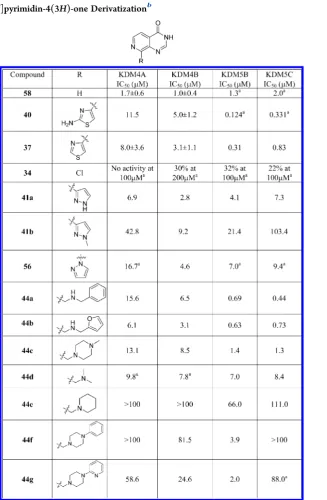
Table 5. C8-Pyrido[3,4-
d
]pyrimidin-4(3
H
)-one Derivatization
baResults are from a single experiment.bResults are mean values of two independent determinations or mean (±SD) forn> 2 unless specified
charge interaction (
Figure 3
B). Although the ionizable carboxylic
acid appeared bene
fi
cial for ligand a
ffi
nity, we considered it
a signi
fi
cant contributing factor to the observed poor cellular
permeability for
15
(Caco-2 A to B
fl
ux <0.8
×
10
−6cm/s).
Therefore, we focused on pyridine-4-carboxylic acid isosteres
with the potential to coordinate to the active site metal, make
strong interactions with K206/Y132 (KDM4A) and to be only
partially ionized at physiological pH to improve cellular
permeability while maintaining potent enzyme binding. Our
attention was drawn to the pyrido[3,4-
d
]pyrimidin-4(3
H
)-one
sca
ff
old (58,
Table 5
,
Figure 4
) kindly disclosed to us by GSK
39and also reported in the patent literature as a template for JmjC
KDM inhibition.
40The bicyclic aromatic sca
ff
old
58
is a highly
e
ffi
cient ligand for both KDM4 and KDM5 subfamily members
(KDM4B IC
50= 1.0
μ
M, LE = 0.76, and KDM5B IC
50= 1.3
μ
M,
LE = 0.75;
Table 5
) while a less potent inhibitor of KDM3A
(IC
50= 26.2
μ
M), KDM2A (29% inhibition at 100
μ
M), and
KDM6B (28% inhibition at 100
μ
M). Pleasingly,
58
also
dis-played high cellular permeability (Caco-2 A to B
fl
ux = 42.61
×
10
−6cm/s) with a measured p
K
afor the pyridopyrimidinone
amide moiety of 8.23.
41The
58-bound KDM4A structure demonstrates simultaneous
coordination of the pyrido[3,4-
d
]pyrimidin-4(3
H
)-one sca
ff
old
to the active site metal via the pyridine nitrogen (position 7) and
interaction of the pyrimidinone CONH moiety with K206/
Y132; in addition,
N
1 of
58
is positioned to interact with the side
chain of K241. This network of interactions is consistent with the
highly ligand e
ffi
cient inhibition pro
fi
le of
58
versus KDM4A
and KDM4B, which are very similar in their JmjC catalytic sites.
Superposition of the
15-bound and
58-bound KDM4A
structures (
Figure 4
A) suggested that the pyrido[3,4-
d
]-pyrimidin-4(3
H
)-one sca
ff
old
58
may provide a suitable
replacement for the pyridine-4-carboxylate, whereby
derivatiza-tion at the C8 posiderivatiza-tion of
58
could lead to bidentate metal
coordination and access to the histone peptide binding site (vide
infra). To test this hypothesis, the hybrid structures
37
and
40
were synthesized (
Scheme 5
,
Table 5
). Compound
40
displayed
lower KDM4B inhibitory activity (IC
50= 5.0
μ
M,
Table 5
)
compared to
15
and
58. A similar trend was observed with the
2-desamino analogue
37
(KDM4B IC
50= 3.1
μ
M,
Table 5
).
Compound
37
proved a more potent inhibitor of KDM3A
(IC
50= 0.89
μ
M) and KDM5B (IC
50= 0.31
μ
M;
Table 5
)
and showed weaker inhibition of KDM2A (59% inhibition at
100
μ
M) and KDM6B (31% inhibition at 100
μ
M), consistent
with the pro
fi
le of compound
15. Crystal structures of
40
and
37
bound to KDM4A show bidentate coordination to the metal as
well as the predicted interactions with K206/Y132 (
Figure 4
B).
However, interaction of K241 with
N
1 of the
pyridopyrimidi-none sca
ff
old is no longer observed for C8-substituted
pyridopyrimidinones
37
and
40, which may contribute to their
lower potency compared to
58
(
Figure 4
A,B). We postulate that
steric bulk of the thiazole C8 substituent in
37
and
40
hinders
interaction of the sca
ff
old with K241. Furthermore, we note that
metal coordination of the thiazole nitrogen in
37
and
40
may
result in suboptimal interactions of the pyridopyrimidinone
CONH moiety with K206/Y132 owing to the planar bicyclic
sca
ff
old which precludes the 28.6
°
dihedral angle between the
pyridine and carboxylate observed in our
15-bound KDM4A
structure (
Figures 3
A,
4
A,B). Interestingly, the torsion angles
between the planes of the pyridopyrimidinone and the thiazole
ring systems in
37
and
40
are similar to that observed between
the pyridine and the thiazole in
15
(4.7
°
and 7.2
°
di
ff
erence with
respect to
15, respectively), rendering the metal-coordination
geometry similar for
15,
37, and
40
(
Figure 4
B). Although
introduction of a C8-thiazole substituent led to a slight decrease
in KDM4A and KDM4B potency compared to
58, we envisaged
that potency for this class of compounds could be improved by
introducing favorable interactions with D135 and other residues
in the histone peptide binding site, a tactic previously reported
to yield potent JmjC histone demethylase modulators in the
bipyridyl sca
ff
old exempli
fi
ed by
2
(
Figure 2
A).
33Access to the
histone peptide binding pocket required derivatization through
a position equivalent to the sulfur atom in
37
(see
Figures 2
A,B
and
4
A,B) and necessitated the introduction of alternative
heterocyclic rings at the C8 position of the pyrido[3,4-
d
]pyrimidin-4(3
H
)-one sca
ff
old (
Table 5
).
We introduced a variety of
fi
ve-membered heterocycles at C8
of the pyrido[3,4-
d
]pyrimidin-4(3
H
)-one sca
ff
old
58, including
pyrazol-3-yl and pyrazol-1-yl moieties (41a
and
56, respectively,
Table 5
) which exhibited similar potency versus KDM4B and
KDM5B. We also investigated whether methylamino
substitu-ents at C8 could provide access to the pocket occupied by the
trimethylated lysine of the H3K9Me
3peptide substrate, as
previously described for
30a
and
30b
in the pyridine-4-carboxylic
acid series (
Table 4
;
Figure 3
D,E). Compounds
44a
and
44b
were both less potent inhibitors of KDM4B and KDM5B
compared to their pyridine-4-carboxylate counterparts
30b
and
30a, respectively (
Tables 4
,
5
). We con
fi
rmed the binding mode
of
44a
to KDM4D by cocrystal structure determination, which
proved consistent with that of the parent compound (compare
Figure 3
D,E and
Figure 4
C). Interestingly, both
aminomethyl-substituted pyridopyrimidinones
44a
and
44b
display a
preference for KDM5B/C inhibition over KDM4A/B. Tertiary
amine analogues
44c
−
g
were designed to rescue KDM4 potency
by maintaining bidentate metal chelation while also extending
into space occupied by the C8-thiazole of
37
or
40
and bene
fi
ting
from interactions with Y175 and Y177 in KDM4A (
Figure 4
).
At best, the tertiary aminomethyl compounds were comparable
in potency to simple C8-heterocyclic substituted derivatives
41a,b
and
56
(
Table 5
). Considering the data presented in
Table 5
, and cognizant of synthetic tractability, we focused our
Figure 4. Comparison of binding modes of15,37, 40, and 58 toKDM4A and44abound to KDM4D. (A) Overlay of KDM4A-bound15
(gray) and58(yellow). (B) Overlay of KDM4A-bound15(gray),37
(light-green), and 40 (orange). (C) Overlay of KDM4A-bound 15
e
ff
ort on elaboration of the pyrazol-1-yl analogue
56
by targeting
residues in the histone substrate binding site including D135
(KDM4A) (
Table 6
).
Substitution at the pyrazole-C4 position with a hydroxyethyl
group (57) was tolerated and resulted in a similar KDM4/5
inhibitory pro
fi
le to
56
(
Tables 5
and
6
). Introduction of a basic
nitrogen at the pyrazole-C4 substituent, exempli
fi
ed by
com-pounds
52a,
52b, and
52c, resulted in at least a 4-fold
improve-ment in KDM4A/B inhibitory activity (
Table 6
); notably, all
three compounds were more potent inhibitors of KDM5B/C
compared to KDM4A/B. Introduction of a
p
-
fl
uorobenzyl group
(52d), gave a more potent inhibitor of KDM4B, KDM5B,
and KDM5C (IC
50= 0.39, 0.042, and 0.078
μ
M, respectively,
Table 6
). Pleasingly,
52d
displayed a weaker inhibitory activity
against KDM2A (IC
50= 13.4
μ
M), KDM3A (IC
50= 13.9
μ
M),
and KDM6B (IC
50= 26.3
μ
M) relative to KDM4/5 subfamily
members. A crystal structure of
52d
bound to KDM4A revealed
that the compound bound in multiple conformations, with the
two most predominant binding modes depicted in
Figure 5
. In
conformation A, the pyrazole-C4 substituent adopts an extended
conformation with the
p
-
fl
uorobenzyl group oriented toward the
solvent accessible area; this induces movement of the side chain
of Y175 and displaces the nearby loop (residues 165
−
175).
However, no interaction between
52d
and the induced side chain
conformation of Y175 is observed (minimal distance of 4.7 Å
between a carbon of the Y175 aromatic ring and a carbon of
the
p
-
fl
uorophenyl group of
52d). In conformation B, the
p
-
fl
uorobenzyl group of the pyrazole-C4 substituent oriented
toward an asparagine/glutamine-rich pocket (residues 73, 84,
and 86,
Figure 5
). In conformation B, the basic nitrogen of the
pyrazole-C4 substituent is proximal to D135 with a minimum
interaction distance of 2.9 Å (distances between 2.9 and 3.2 Å
depending upon the chain in the asymmetric unit), slightly
shorter compared with the equivalent distance in conformation A
Table 6. 8-(1
H
-Pyrazol-1-yl)pyrido[3,4-
d
]pyrimidin-4(3
H
)-one Derivatives
baResults from a single experiment. n.d. = not determinedbResults (IC
50s) are mean values of two independent determinations or mean (±SD) for
(3.4
−
4.3 Å). Attempts to cocrystallize compounds presented in
this study with KDM5B proved more challenging relative to
KDM4A crystallography; however, we were successful in
resolv-ing a crystal structure of
52d
bound to KDM5B (
Figure 5
B),
which shows coordination of both the pyridyl and pyrazole
N
2 nitrogen to the active site metal and interaction of the
pyridopyrimidinone CONH moiety with K517/Y425
(equiv-alent to residues K206/Y132 in KDM4A). The electron density
of the
p
-
fl
uorobenzyl group in this crystal structure was poor,
precluding accurate positioning of this moiety. However, the
binding mode of the well-de
fi
ned ligand sca
ff
old to KDM5B
was similar to that observed in the structure of
52d
bound to
KDM4A.
Pleasingly,
52d
displayed cellular permeability (Caco-2 A to B
fl
ux = 9.98
×
10
−6cm/s,
Table 6
) and moderate HLM and MLM
stability (40% and 42% metabolized after a 30 min incubation,
respectively). Surprisingly, we found that
52d
had high in vivo
plasma clearance (iv clearance in mouse of 1640 mL/min/kg,
following a 6 mg/kg iv compound administration), which we
suspected may be due to aldehyde oxidase (AO)-mediated
metabolism.
42We subsequently identi
fi
ed the C2 position of the
pyrido[3,4-
d
]pyrimidin-4(3
H
)-one template as the major site of
AO-mediated metabolism.
43The 3,4-dichlorobenzyl analogue
52e
also demonstrated
cellular permeability (Caco-2 A to B
fl
ux = 21.21
×
10
−6cm/s,
Table 6
); however, attempts to gain additional KDM4A/B
a
ffi
nity by introduction of hydrogen bond interactions with
N86, Q73, or Q84 (52f
and
52g;
Figure 5
) were unsuccessful
(
Table 6
). Homologation of the pyrazole-C4 substituent by one
methylene unit (59) also failed to improve KDM4A or KDM4B
inhibition (
Table 6
).
The multiple ligand conformations observed in the
52d-bound
KDM4A structure suggested that no single binding mode was
favored and is consistent with multiple degrees of freedom in
the ligand conformation. Thus, we next attempted to constrain
the pyrazole-C4 substituent by introduction of a piperidine ring.
This approach led to the synthesis of
53a, a potent and cell
permeable (Caco-2 A to B
fl
ux = 6.86
×
10
−6cm/s) KDM4A and
KDM4B inhibitor (IC
50= 0.126 and 0.050
μ
M, respectively)
which also strongly inhibited KDM5B and KDM5C (IC
50=
0.014 and 0.023
μ
M, respectively;
Table 7
). This KDM4 and
KDM5 subfamily pro
fi
le di
ff
erentiates
53a
from
52d, which is
Figure 5.(A) Overlay of views from crystal structure of KDM4A−37(light-green) and −52d (two main conformations: dark-brown for conformation A and light-brown for conformation B). (B) Overlay of
52dbound to KDM4A (brown) and KDM5B (cyan), the indicated residue numbers correspond to KDM5B numbering. Zn (II) or Ni(II) are shown in place of the active site Fe (II).
Table 7. C8-Pyrido[3,4-
d
]pyrimidin-4(3
H
)-one Derivatization
aaResults (IC
approximately 9-fold more potent in inhibiting KDM5B
compared to KDM4B (
Table 6
). Pleasingly,
53a
maintained
selectivity for KDM4 and KDM5 subfamily inhibition versus
KDM2A (IC
50= 8.6
μ
M), KDM3A (IC
50= 4.8
μ
M), and
KDM6B (IC
50= 48.5
μ
M). The crystal structure of
53a
bound to
KDM4A con
fi
rmed a single binding mode in which the ligand
extends toward the histone peptide binding site similar to
conformation A of
52d
(
Figures 5
and
6
). The bulky pyrazole-C4
substituent of
53a
induces movement of the Y175 side chain
and the nearby loop (residues 165
−
175) as observed in
con-formation A of
52d. We also observed a hydrophobic interaction
between the piperidine ring of
53a
with the side chain of Y175
(3.5 Å between proximal piperidine carbon atoms and the
aromatic ring of Y175,
Figure 6
). Notably, the distance between
the piperidine nitrogen and the carboxylate of D135 is 4 Å, longer
than the equivalent distance observed in a crystal structure of
52d
(conformation B) bound to KDM4A (
Figures 5
and
6
).
Additionally, the
p
-chlorobenzyl group points toward the histone
peptide binding site and the solvent accessible area creating a
new hydrophobic interaction with V313 (3.9 Å between the
p
-chlorobenzyl of
53a
and the nearest side chain carbon of V313).
Considering these structural observations, including the single
observed conformation of the pyrazole-C4 substituent in
53a,
we further explored the hydrophobic interactions with V313
(
Table 7
). Replacement of
p
-Cl with H (53b), F (53c), CF
3(53d), or introduction of an additional
meta
substituent (53e
and
53g) resulted in a KDM4A/B and KDM5B/C inhibitory pro
fi
le
broadly similar to that of
53a
(
Table 7
). The
m
-methoxybenzyl
analogue (53f) was a less potent inhibitor of KDM4A relative to
53a
although KDM5B/C potency was maintained (
Table 7
).
Replacement of the
p
-chlorophenyl in
53a
with heterocyclic
moieties failed to improve KDM4A/B or KDM5B/C inhibitory
activities (compounds
53h
and
53i,
Table 7
).
In a further attempt to restrain conformational freedom in
the pyrazole side chain of
53a, we attached the
p
-chlorophenyl
moiety directly to the piperidine 4 position (54a); this tactic
broadly maintained KDM4A/B and KDM5B/C inhibitory
activities (KDM4B IC
50= 0.086
μ
M, KDM5B IC
50= 0.030
μ
M;
Table 8
). Notably,
54a
demonstrated selectivity for KDM4B and
KDM5B versus KDM2A (IC
50= 6.74
μ
M) and also displayed
cellular permeability (Caco-2 A to B
fl
ux = 2.66
×
10
−6cm/s,
Table 8
). Replacement of the
p
-Cl substituent in
54a
with F (54b),
OMe (54c), SO
2Me (54d), or CN (54e) resulted in a similar
KDM4A/B inhibitory pro
fi
le to that of
54a. Interestingly,
balanced inhibition of KDM4 and KDM5 subfamily members
was observed for
54a,
54b, and
54c
(
Table 8
). Analogue
54f
bearing an
o
-chlorophenyl substituent and the unsubstituted
phenyl derivative
54g
exhibited weaker KDM4A and KDM4B
inhibition compared to that of
54a
(
Table 8
). Heterocyclic
replacements for the
p
-chlorophenyl moiety in
54a
gave a similar
KDM4A/B and KDM5B/C inhibition pro
fi
le (see
54h
and
54i,
Table 8
). The thiophene derivative (54i) was a less potent
inhibitor of KDM3A (IC
50= 8.3
μ
M), KDM6B (25% inhibition at
100
μ
M), and KDM2A (IC
50= 2.4
μ
M). Moderate HLM and
MLM stability was observed for
54i
(49% and 62% metabolized
after a 30 min incubation, respectively), and cellular permeability
was maintained (Caco-2 A to B
fl
ux = 17.83
×
10
−6cm/s).
Notably, introduction of a 3,5-dichlorophenyl, compound
54j
gave the most potent inhibitor of KDM4 and KDM5 subfamily
members in this series, with KDM4A/B and KDM5B/C potencies
indicating a balanced inhibition pro
fi
le (KDM4A/B IC
50= 0.080
and 0.017
μ
M, KDM5B/C IC
50= 0.014 and 0.051
μ
M,
respectively,
Table 8
). Pleasingly,
54j
showed cellular permeability
(Caco-2 A to B
fl
ux = 6.34
×
10
−6cm/s) and a selective inhibition
pro
fi
le versus KDM3A (IC
50= 6.1
μ
M), KDM6B (4% inhibition at
100
μ
M), and KDM2A (IC
50= 2.4
μ
M). The
m
-Cl analogue
54k
displayed a similar pro
fi
le to that of
54j
(
Table 8
) and bene
fi
ted
from low MLM and HLM turnover (13% and 17% metabolized
respectively after a 30 min incubation). Compound
54k
also
displayed a selective inhibition pro
fi
le versus KDM2A (IC
50=
12.9
μ
M), KDM3A (IC
50= 5.3
μ
M), and KDM6B (15% inhibition
at 100
μ
M). Furthermore, pro
fi
ling of
54k
in a 50-kinase panel,
representative of the human kinome,
44at a concentration of 1
μ
M
revealed no signi
fi
cant kinase inhibitory activity (Supporting
Information,
Table S2
). Analogues
54l
−
n
also demonstrated a
broadly balanced KDM4B and KDM5B inhibition pro
fi
le and
showed good cellular permeability in the Caco-2 assay, reinforcing
the SAR trend in this 4-phenyl piperidine subseries (
Table 8
).
Cellular activity of
54k
was assessed in HeLa cells transiently
overexpressing wild-type (WT) KDM4A or KDM5B or the
respective mutants (MUT) lacking catalytic activity. Cells were
treated with the inhibitor, and changes in the global methylation
levels were quanti
fi
ed by high content immuno
fl
uorescence assay
after 24 h.
45Global hypomethylation was observed in cells
over-expressing either WT KDM4A or WT KDM5B as determined
by reduction in the levels of methyl
−
lysine antibody staining
(relative to cells overexpressing the corresponding MUT
demethylase or nontransfected cells). Treatment with
54k
resulted in a concentration-dependent increase of the respective
methyl mark (H3K9Me
3for KDM4A, H3K4Me
3for KDM5B) in
cells overexpressing WT demethylase. At high concentrations
of
54k
(>50
μ
M), H3K9Me
3levels approached those in HeLa
cells overexpressing MUT KDM4A, consistent with cell-based
inhibition of KDM4A demethylase activity; similarly, at high
concentrations of
54k, H3K4Me
3levels approached those in
HeLa cells overexpressing MUT KDM5B, consistent with
cell-based inhibition of KDM5B demethylase activity. Occasionally,
at the highest concentrations, an e
ff
ect on the methylation
mark was also observed in cells overexpressing MUT KDM,
pointing to inhibition of either the endogenous enzyme(s) or an
unspeci
fi
c e
ff
ect (Supporting Information,
Figure S1
).
In studies to assess the quality of promising analogues as
potential lead compounds, we noted chemical instability of
54j
and
54l
when left in air at room temperature for prolonged
periods; mass spectrometry analysis suggested an
oxidation-mediated degradation. However, compound
54j
was stable for
>8 weeks as solution in DMSO when stored under a nitrogen
atmosphere. These observations prompted us to resynthesize
54j
and study its stability as a solution in DMSO kept at room
temperature with no protection from air and also in solid form
kept at room temperature under a nitrogen atmosphere. LCMS
and NMR (solid sample) monitoring indicated no degradation
for up to 8 weeks. Given these observations, we recommend that,
Figure 6.Binding mode of53ain KDM4A. Zn(II) is shown in place ofas a precaution, compounds of this class are stored under a
nitrogen atmosphere.
Crystal structures of
54a
and
54j
bound to KDM4A showed
that both compounds adopt an extended conformation
con-sistent with that observed for
52d
and
53a
(
Figure 7
A). The
orientation and position of the piperidine ring in
54a
and
54j
is
perpendicular to the aromatic ring of Y175 in KDM4A and is
rotated by nearly 90
°
compared to the piperidine ring of
53a
(compare
Figures 6
and
7
A). The piperidine ring in
54a
or
54j
maintains hydrophobic interactions with the side chain of Y175
(distances of 3.5 and 3.1 Å between the nearest carbon atom of
the piperidine and the aromatic ring of Y175 for
54a
and
54j,
respectively). However, in the
54a- and
54j-bound structures,
the piperidine nitrogen resides at a minimum distance of 3.9 and
3.8 Å from the carboxylate of D135, respectively, which is
longer than the equivalent distance in the
52d
−
KDM4A
complex (conformation B). Notably, the
p
-chlorophenyl and
m
-dichlorophenyl groups of
54a
and
54j
both engage in
hydrophobic interactions with V313 of KDM4A, albeit with a
slightly di
ff
erent orientation of the aromatic ring (
Figure 7
). We
observe a closer interaction of one
m
-Cl of
54j
with the side chain
of V313 (distance of 3.5 Å,
Figure 7
B) compared to the aromatic
ring of
54a
(distance of 4 Å), potentially explaining the enhanced
KDM4A/B inhibition of
54j; indeed, this hydrophobic V313
Table 8. C8-Pyrido[3,4-
d
]pyrimidin-4(3
H
)-one Modi
fi
cations
baResults are from a single determination. n.d. = not determinedbResults (IC
50s) are mean values of two independent determinations or mean
interaction may contribute to the balanced KDM4 and KDM5
activity pro
fi
le of these compounds through enhancing KDM4
subfamily a
ffi
nity.
■
CONCLUSION
An HTS campaign versus the JmjC histone lysine demethylase
KDM4B resulted in the discovery of
N
-substituted
4-(pyridin-2-yl)thiazole-2-amine derivatives as promising hit compounds.
Comparison with previously reported pyridine-based JmjC
KDM inhibitors generated a binding mode hypothesis, and
subsequent incorporation of an appropriately positioned
carboxylic acid moiety led to the discovery of
15, a potent
inhibitor of the KDM3, KDM4, and KDM5 KDM subfamilies
but which lacked cellular permeability. A crystal structure of
15
bound to KDM4A con
fi
rmed the proposed binding mode
involving interactions of the carboxylate moiety with K206 and
Y132 as well as bidentate coordination of both the pyridyl and
thiazolyl nitrogens to the active site metal. Interestingly, the
corresponding primary amide
16
maintained this binding mode;
however, loss of the carboxylate
−
K206 interaction led to a
>400-fold reduction in potency, illustrating the dominance of this ionic
interaction in the buried KDM4 catalytic site. Replacement of the
pyridine-4-carboxylate sca
ff
old in
15
with the less acidic, bicyclic
pyrido[3,4-
d
]pyrimidin-4(3
H
)-one isostere
58
(p
K
a= 8.23) gave
cell-permeable KDM inhibitors with maintained a
ffi
nity,
presumably due to ionization of the weakly acidic sca
ff
old in
the KDM4 active site. A crystal structure of
58
bound to KDM4A
demonstrated simultaneous coordination to the active site metal
via the pyridine nitrogen, interaction with K206/Y132 via the
pyrimidinone CONH moiety, and interaction with the side chain
of K241 through
N
1 of the sca
ff
old. Subsequent structure-guided
optimization at C8 of the pyrido[3,4-
d
]pyrimidin-4(3
H
)-one
allowed extension into the histone peptide binding site by
virtue of a C8-pyrazole moiety. This tactic favored bidentate
coordination to the active site metal through both the pyridine
and pyrazole
N
2 nitrogen as well as concomitant additional
pyrazole substitution to gain bene
fi
cial interactions with
D135 and Y175 (KDM4A residue numbering) as exempli
fi
ed
by a crystal structure of
52d
bound in KDM4A. However, this
52d-bound crystal structure also revealed alternative bound
conformations of the
fl
exible pyrazole C4 substituent, suggesting
that conformational restriction may be required to further
bene
fi
t from interactions in the histone peptide binding site.
Incorporation of a rigidifying piperidine linker into pyrazole C4
substituent and subsequent positioning of a
meta
-substituted
phenyl ring at the piperidine 4-position, resulted in the discovery
of potent JmjC histone demethylase inhibitors such as
54j,
54k, and
54i. A crystal structure of
54j
bound in KDM4A
demonstrates a conserved bidentate binding mode of the
C8-pyrazolo-pyrido[3,4-
d
]pyrimidin-4(3
H
)-one sca
ff
old to the
active site metal and additional bene
fi
cial interactions of the
4-phenylpiperidine substituent with D135 and Y175 as well as a
further hydrophobic interaction with V313 of KDM4A (KDM4A
residue numbering), which we postulate is important to the
balanced KDM4 and KDM5 activity pro
fi
le of these compounds.
Importantly, incorporation of the conformationally constrained
4-phenylpiperidine in derivatives
54j
and
54k
results in selective
inhibition of the KDM4 and KDM5 subfamily demethylases
over representative exemplars of the KDM2, KDM3, and KDM6
subfamilies, cellular permeability in the Caco-2 assay, and, for
54k, we demonstrate inhibition of H3K9Me
3and H3K4Me
3demethylation in a cell-based assay. We propose that compounds
such as
54k
could be utilized for the study of KDM4/KDM5
subfamilies in a cellular context. As both KDM4 and KDM5
family members have been implicated in breast, prostate, and
other cancer contexts, such tool compounds may be particularly
useful in studying the merits of dual inhibition of these
family members in cell-based assays. In addition, the SARs and
the ligand
−
protein interactions presented in this study could
provide valuable leads for the further exploring the design and
synthesis of KDM4 or KDM5 subfamily selective compounds
with which to elucidate the role of the JmjC catalytic domain
activity of these subfamilies in human disease. We are continuing
our research toward the identi
fi
cation of potent, cell permeable,
and selective inhibitors of the KDM4 subfamily with which to
study the role of KDM4 enzyme function in cancer biology and
to further explore the potential of such compounds as anticancer
agents. We will report this work in future communications.
■
EXPERIMENTAL SECTION
KDM4A and KDM4B AlphaScreen Biochemical Assays.Protein production and purification: Baculovirus containing residues 1−500 of KDM4B with an N-terminal GST tag were generated according to Bac-to-Bac protocol. Following infection ofSf 9insect cells, protein was purified by GSH affinity chromatography followed by gel filtration (Superdex 200). Purification of KDM4A is described in the crystallo-graphy section. For the purpose of biochemical assays, the His tag was not removed.
Enzyme activity was measured using an AlphaScreen assay that monitored the demethylation of a biotinylated trimethylated H3K9 peptide using a H3K9 dimethyl specific antibody and appropriate donor and acceptors beads from PerkinElmer Life Sciences.46 For each compound, a 10 mM stock concentration in 100% DMSO was used. Compounds were dispensed using an ECHO 550 acoustic dispenser (Labcyte Inc., Sunnyvale, CA, USA) to generate 8 pt dilution curves directly into 384-well Proxiplates (no. 6008289, PerkinElmer, Waltham, MA, USA) to givefinal assay concentrations in the range 0.0005−100 μM in 2% (v/v) DMSO as appropriate. The enzyme reaction was performed in assay buffer which consisted of HEPES (50 mM, pH 7.5), BSA (0.1% w/v), sodium ascorbate (100μM), 2OG (2μM for KDM4B or 10μM for KDM4A), ammonium iron(II) sulfate hexahydrate (1μM), and Tween 20 (0.01% v/v). Compounds were preincubated for 10 min with 2.5μL enzyme N-terminal GST KDM4B prepared in-house (0.5 nMfinal concentration) or His tagged KDM4A prepared in-house (1.5 nMfinal concentration) before the addition of 2.5 μL of peptide (ARTKQTARK(Me3
)STGGKAPRKQLA-GGK-biotin, Genecust, 30 nMfinal concentration). The plate was sealed and centrifuged at 1000 rpm for 1 min before being left for 20 min at room temperature. The reaction was stopped with the addition of 2.5μL of EDTA (30 mMfinal concentration) before the addition of 2.5μL of AlphaScreen detection reagents (no. 6760606M, PerkinElmer) and antibody. The detection reagents containing IgG mouse acceptor beads, streptavidin donor beads (20 μg/mL final concentration), and an antidimethyl H3K9 antibody (no. Ab1220, 0.5 nMfinal concentration) were preincubated for 1 h in detection buffer containing HEPES



![Table 6. 8-(1H-Pyrazol-1-yl)pyrido[3,4-d]pyrimidin-4(3H)-one Derivativesb](https://thumb-us.123doks.com/thumbv2/123dok_us/8647564.1725930/10.625.159.466.76.539/table-h-pyrazol-yl-pyrido-pyrimidin-one-derivativesb.webp)
![Table 7. C8-Pyrido[3,4-d]pyrimidin-4(3H)-one Derivatizationa](https://thumb-us.123doks.com/thumbv2/123dok_us/8647564.1725930/11.625.159.466.404.744/table-c-pyrido-d-pyrimidin-h-one-derivatizationa.webp)
![Table 8. C8-Pyrido[3,4-d]pyrimidin-4(3H)-one Modificationsb](https://thumb-us.123doks.com/thumbv2/123dok_us/8647564.1725930/13.625.157.470.67.586/table-c-pyrido-d-pyrimidin-h-one-modicationsb.webp)

