Comprehensive Transcriptome Profiles of
Streptococcus mutans
UA159 Map Core
Streptococcal Competence Genes
R. Khan,aH. V. Rukke,a*H. Høvik,aH. A. Åmdal,aT. Chen,bD. A. Morrison,c F. C. Petersena
Department of Oral Biology, Faculty of Dentistry, University of Oslo, Oslo, Norwaya; The Forsyth Institute,
Cambridge, Massachusetts, USAb; Department of Biological Sciences, University of Illinois at Chicago, Chicago,
Illinois, USAc
*Present address: H. V. Rukke, Nordic Institute of Dental Materials (NIOM), Oslo, Norway.
ABSTRACT In Streptococcus mutans, an oral colonizer associated with dental car-ies, development of competence for natural genetic transformation is triggered by either of two types of peptide pheromones, competence-stimulating peptides (CSPs) (18 amino acids [aa]) or SigX-inducing peptides (XIPs) (7 aa). Competence induced by CSP is a late response to the pheromone that requires the response regulator ComE and the XIP-encoding genecomS. XIP binds to ComR to allow expression of the alternative sigma factor SigX and the effector genes it controls. While these reg-ulatory links are established, the precise set of effectors controlled by each regulator is poorly defined. To improve the definition of all three regulons, we used a high-resolution tiling array to map global changes in gene expression in the early and late phases of the CSP response. The early phase of the CSP response was limited to increased gene expression at four loci associated with bacteriocin production and immunity. In the late phase, upregulated regions expanded to a total of 29 loci, in-cludingcomSand genes required for DNA uptake and recombination. The results in-dicate that the entire late response to CSP depends on the expression ofcomSand that the immediate transcriptional response to CSP, mediated by ComE, is restricted to just four bacteriocin-related loci. Comparison of the new data with published transcriptome data permitted the identification of all of the operons in each regu-lon: 4 for ComE, 2 for ComR, and 21 for SigX. Finally, a core set of 27 panstreptococ-cal competence genes was identified within the SigX regulon by comparison of tran-scriptome data from diverse streptococcal species.
IMPORTANCE S. mutanshas the hard surfaces of the oral cavity as its natural hab-itat, where it depends on its ability to form biofilms in order to survive. The compre-hensive identification ofS. mutansregulons activated in response to peptide phero-mones provides an important basis for understanding howS. mutans can transition from individual to social behavior. Our study placed 27 of the 29 transcripts acti-vated during competence within three major regulons and revealed a core set of 27 panstreptococcal competence-activated genes within the SigX regulon.
KEYWORDS: CSP,Streptococcus, XIP, genetic competence, natural transformation systems, pheromone, quorum sensing
T
he acquisition of new genes through horizontal transfer among the prokaryotes plays an important role in ecological diversification and adaptation (1). The first evidence of such horizontal gene transfer was the recognition that virulence determi-nants can be transferred between pneumococci in infected mice, a phenomenon defined as natural transformation (2). Natural genetic transformation refers to the active uptake of exogenous DNA, followed by heritable incorporation of its geneticinforma-Received28 December 2015Accepted10
March 2016 Published12 April 2016
CitationKhan R, Rukke HV, Høvik H, Åmdal HA, Chen T, Morrison DA, Petersen FC. 2016. Comprehensive transcriptome profiles of
Streptococcus mutansUA159 map core streptococcal competence genes. mSystems
1(2):e00038-15. doi:10.1128/mSystems.00038-15.
EditorMargaret J. McFall-Ngai, University of Hawaii
Copyright© 2016 Khan et al. This is an open-access article distributed under the terms of
theCreative Commons Attribution 4.0
International license.
Address correspondence to F. C. Petersen, [email protected].
Definition of S. mutans regulons activated in response to competence pheromones reveals core competence streptococcal genes.
Molecular Biology and Physiology
crossmark
on September 8, 2020 by guest
http://msystems.asm.org/
tion, a capacity that is widespread but not universal in both Gram-positive and Gram-negative bacteria and in the archaea (3). In the Gram-positive genus Streptococ-cus, some members of theStreptococcus mitis,S. anginosus,S. salivarius, andS. mutans
groups are recognized as naturally transformable (4–6). Recently, competence was also reported inS. suisand members of theS. bovisgroup (7, 8). In the remaining members of the genus, the presence of regulatory and effector homologs of proteins involved in competence for natural transformation indicates that competence development may be a general trait of streptococci (9).
Competence in streptococci is often expressed as a transient developmental state in which bacteria exhibit a capacity for natural genetic transformation (10). The compe-tent state is triggered by autoinducing peptide pheromones, leading to increased expression of the alternative sigma factor SigX (also known as ComX), which is the master regulator of competence (11, 12). The genes differentially expressed during competence, reported as corresponding to 6% or more of the genome (13–15), include genes required for DNA uptake and recombination and genes required to scavenge DNA by killing other bacteria without causing self-damage. Some of the competence-specific genes are, however, not directly involved in these processes, indicating that the system may have evolved to control additional functions, such as adaptation to acid stress, biofilm formation, and virulence (16–20).
The streptococcal competence-inducing pheromones are unmodified linear pep-tides produced as propeppep-tides (21). Competence development is coordinated within a culture by a positive feedback loop linking pheromone production to the external concentration of the secreted mature peptide. The competence-stimulating peptides (CSPs), which belong to the double-glycine family of peptides (22), are sensed on the outside of cells upon binding to the ComD histidine kinase of the ComED two-component signal transduction system (TCSTS) (23, 24), whereas SigX-inducing pep-tides (XIPs) are sensed by ComR intracellular regulators of the Rgg family, upon internalization by the oligopeptide permease complex Opp (5, 6). The propeptides belong to either the double-glycine CSP family, as in theS. mitisgroup, or to a distinct class of peptides associated with Rgg regulators, as in the S. salivarius, S. mutans, pyogenic, andS. bovisgroups (25).
InS. mutans, a human oral colonizer associated with dental caries, the competence
regulatory network is somewhat more complex than the analogous networks in other streptococci. While theS. mutansnetwork shares with them the alternative sigma factor SigX, it employs two peptide pheromones, not one, in upstream circuits for coordina-tion of entry into the competent state. Furthermore, its regulatory behavior in rich media differs from that in chemically defined media (CDM). Although the reasons for such differences remain unclear, it is possible that the lack of peptides in the CDM used in different studies may be a relevant factor, since addition of assorted peptides to CDM eliminates the activity of XIP (26). Each peptide pheromone circuit in S. mutans
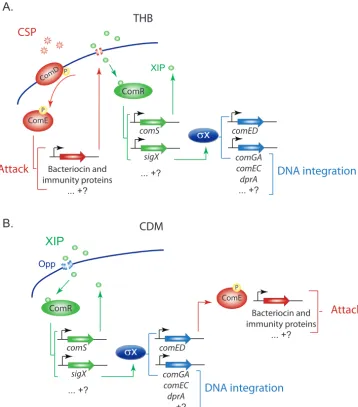
encompasses genes for peptide synthesis, processing, and secretion, a peptide receptor regulating the transcription of additional genes, and a set ofcis-acting sites targeted by the pheromone receptor to create a peptide-specific regulon (Fig. 1). In recent years, the links between these regulons have emerged as a set of reasonably well-defined interactions organized in a different order during competence development in the two classes of culture media (Fig. 1).
Assignment of genes to the ComE, ComR, and SigX regulons has been supported by analysis of shared sequence motifs at cis-acting sites and three types of evidence showing that (i) gene expression depends on a nearby regulon-specific promoter site, (ii) gene expression depends on the cognate regulator, or (iii) elevated expression of the gene can be driven by overexpression of the regulator. The supporting experimen-tal evidence focused principally on a limited subset of induced genes (see Table S1 in the supplemental material). Despite these extensive studies, some of the links drawn in Fig. 1 are still incompletely understood. For example, the suggestion that CipB poten-tiates XIP by creating pores in the membrane, allowing XIP internalization in Todd-Hewitt broth (THB) (but not CDM) (27) has not been directly tested. It also remains
on September 8, 2020 by guest
http://msystems.asm.org/
unknown whether CSP is the signal that binds to ComD to promote ComE phosphor-ylation and activation in CDM (26, 27). More broadly, it is unclear exactly which genes are in each regulon or how numerous additional inputs to competence regulation are effected.
With the broad pattern of these pathways of signal transduction outlined, it is a suitable time to refine the definition of the network by identifying genes and operons in each of the three known regulons more comprehensively, as well as by asking whether the genes that are upregulated specifically in competent cells are restricted to
THB
CSP
Attack
DNA integration
ComE P
Bacteriocin and immunity proteins
... +?
ComR
comS
sigX
comED
comGA comEC dprA ... +?
σx
XIP
... +? P
CDM
Attack
DNA integration
ComEP
Bacteriocin and immunity proteins
... +? ComR
comS
sigX
comED
comGA comEC dprA ... +?
σx
XIP
... +? Opp
A.
B.
ComD
FIG 1 Competence regulatory networks inS. mutans. Regulatory links are organized into two pheromone
response networks acting in peptide-rich media such as THB (A) or in peptide-free CDM (B). (A) In rich media, extracellular CSP induces the expression of bacteriocin and immunity proteins (red) through the ComED TCSTS pathway. Other genes are possibly induced by direct or indirect activation by phosphorylated ComE. The bacteriocins are thought to create pores that allow internalization of the competence pheromone XIP. XIP binds to ComR to activate the expression of at least two genes (green),comS(encoding XIP) andsigX(encoding the alternative sigma factor x). Induction of comScreates a positive feedback loop that increases the
production of XIP andx, whilexactivates the expression of genes (blue) involved in DNA integration (e.g.,
comGA,comEC, anddprA). (B) In peptide-free CDM, extracellular XIP is internalized via the Opp permease and
binds to ComR, activating the expression of at least two genes,comS(encoding XIP) andsigX. Induction of
comScreates a positive feedback loop, while elevatedxactivates the expression of genes involved in DNA
integration (e.g.,comGA,comEC, anddprA). Bacteriocin and immunity proteins are upregulated as a result of
comEDinduction byx. Uncertainties about the regulon assignment for the full range of genes that change
expression in response to the pheromones are represented by question marks, and genes upregulated but not exemplified are represented by ellipses.
on September 8, 2020 by guest
http://msystems.asm.org/
these three regulons. We report here six new transcriptome data sets obtained by the use of an improved tiling microarray that clearly distinguishes, on a genomic scale, the early responses to CSP from the late responses triggered by XIP. Detailed mapping of the transcriptomes allowed the comprehensive prediction or confirmation of start sites for the induced transcripts, enabling us to refine the assignment of transcripts to specific regulons and to identify new regulon members. The results also provide experimental evidence supporting early suggestions that upregulation of genes distal to competence regulator recognition sites often arises from readthrough past tran-scriptional terminators, accounting, in large part, for the wide intra- and interspecies variations in the number of genes assigned to the competence regulons. Finally, comparison of these data sets with existing competence transcriptome profiles in several other streptococcal species reveals a core set of streptococcal competence-specific genes.
RESULTS
Probe design and sampling strategy.Published transcriptome surveys provide
valu-able views into the breadth of streptococcal competence-specific genes; however, for most species, including the competence modelS. pneumoniae, transcriptome data for competence development have come mostly from early techniques of microarray analysis that have technical limitations, such as the use of probes that are often restricted to annotated open reading frames (ORFs), the use of probes with low spatial resolution, and the use of cDNA preparations that result in artifactual antisense signals.
In S. mutans, newer high-density tiling arrays and RNA-sequencing methods have
already been used in transcriptome surveys of the competence response, but none of them was designed specifically to distinguish the different regulons that are activated in response to CSP. The tiling array study was restricted to responses resulting from long exposure to CSP and lacked full coverage, including probes for thecomSgene (28), whereas in the RNA-sequencing study, short exposure to CSP was investigated in a medium that does not support activation of competence by CSP (27). Therefore, to capture a more complete picture of competence regulation inS. mutans, we chose a strategy of probe design and sample collection and preparation that would allow comprehensive mapping of transcripts in both the early and late phases of the CSP response under conditions in which CSP induces competence.
We employed six strategies to minimize confounding errors known to affect tran-scriptional profiling. (i) To improve the specificity of hybridization signals, we employed 385,000 overlapping 50-mer oligonucleotide tiling probes optimized for uniqueness,
Tm, and probe length, with a resolution of approximately 10 bp, as described previously (29). (ii) To minimize the artifactual “antisense” signals that arise during cDNA prepa-ration, RNA was instead directly chemically labeled (30). (iii) To maximize mRNA signals, the RNA was depleted of rRNA. (iv) To minimize loss of sRNAs and possible short transcripts coding for small peptides such as ComS and ComC, microRNA purification protocols were employed. (v) To minimize signals from irrelevant metabolic changes that might occur during the experiment, we limited cultures to the early log phase. (vi) Finally, we chose to use the mature CSP18 pheromone (31), instead of the precursor CSP-21 peptide used in previous transcriptome surveys (15, 28, 32), in order to minimize any response delay due to peptide processing steps (31, 33, 34).
RNA preparations were made from cultures of the wild type (WT) in the early and late stages of the response to CSP and from cultures of acomSmutant in the late stage. The most appropriate times to distinguish the early and late global responses during competence development were selected on the basis of measurements of growth, DNA incorporation dynamics, and expression of selected early and late genes after CSP supplementation of cultures in tryptone soya broth (TSB) (Fig. 2). TSB was chosen because this medium supports competence development stimulated by synthetic CSP, but endogenous competence development is absent or restricted to low levels and is independent ofcomC(35). During the first 120 min of incubation, cultures with and without CSP grew at equal rates and remained far from stationary phase. The culture
on September 8, 2020 by guest
http://msystems.asm.org/
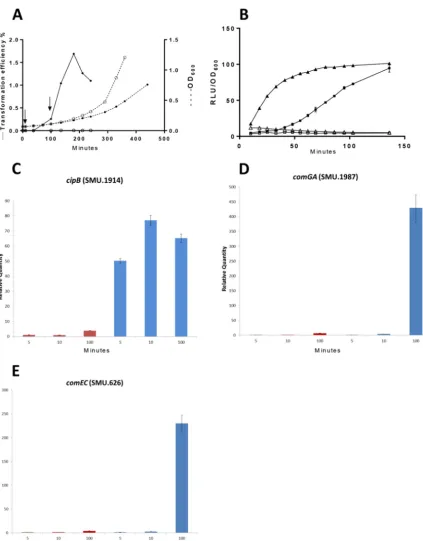
FIG 2 Effect of CSP18 on induction of competence and expression ofcipB,sigX,comGA, andcomECduring growth in TSB. (A) During growth ofS. mutansUA159 in the presence () or absence (Œ) of CSP, transformation efficiency (solid line) and OD600(broken line) were
determined at the times indicated. Exposure to pVA838 was for 20 min and was followed by further incubation with DNase I for 40 min before plating. Arrows show the times of sample harvesting for microarray analysis. (B) Luciferase reporters were used in parallel cultures to measure the effect of CSP on the expression ofcipB(nlmC, SMU.1914) (triangles) andsigX(squares). The strains were grown in the presence of 50 nM CSP (filled symbols) or without CSP (empty symbols). CSP was added attⴝ0. Relative light units (RLU) and OD600were
measured in a 96-well plate with a multidetection microplate reader (SynergyHT; BioTek). Expression levels are relative to the highest value of each reporter (100%). Error bars indicate standard deviations of triplicate assays. (C to E) Relative expression of selected early responsive genecipB(C) and late responsive genescomGAandcomEC(D and E). Real-time PCR data were normalized to the expression values of the respective genes in the WT strain at 5 min without CSP. Mean values and standard errors for three replicates at 5, 10, and 100 min without CSP (red bars) and with CSP (blue bars) are shown.
on September 8, 2020 by guest
http://msystems.asm.org/
treated with CSP became capable of rapid DNA uptake (Fig. 2A), while competence remained very low in the parallel culture without added CSP throughout 4 h. Trans-formation was first detected at 100 min after CSP addition, reached maximal levels at 3 h, and declined by 4 h. Using a gene fusion reporter, we found thatcipBexpression, used as an indicator of early gene expression, was strongly dependent on CSP and increased as an immediate response, replicating previous findings (33, 34). In contrast, expression of sigX (also CSP dependent) began only after a delay of approximately 50 min (Fig. 2B). Thus, (i) the strong dependence of both the early expression of bacteriocin genes and the late development of competence on CSP in TSB and (ii) the time difference between the two responses established optimal conditions for study of the temporally specific effects of CSP on the transcriptome. Because endogenous competence induction was absent within the first 3 h and CSP-induced DNA incorpo-ration was robust by approximately 2 h, at a time when growth had not been inhibited by CSP, we further evaluated the use of CSP exposure times of 10 and 100 min. Reverse transcription (RT)-PCR assays confirmed that the early and late transcriptional responses were activated at 10 and 100 min, respectively (Fig. 2C to E). Expression of the ComE-regulated gene SMU.1914 (cipB, nlmC) had already increased dramatically at 10 min compared with that in the culture without CSP, but there was only a slight increase in the expression of the SigX-dependent genescomGAandcomEC. By 100 min,
comGAandcomECexpression had increased by more than 200-fold, while expression
of SMU.1914 continued at an elevated level. Thus, 10 and 100 min were selected as the earliest suitable sampling times for studying the immediate and delayed transcriptional responses to CSP in the absence of any gross effect of CSP on the growth rate.
RNA was extracted from cultures under the six conditions selected (UA159 for 10 or 100 min and the comS mutant for 100 min, with and without CSP) in duplicate experiments and analyzed for strand-specific genome-wide gene expression as de-scribed in Materials and Methods. Inspection of the resulting profiles gives several indications that the sampling strategy yielded expression patterns of significantly improved quality. Using directly labeled RNA to exclude the artifactual antisense signals often observed with conventional cDNA preparations offered clear benefits, as it revealed that several of the genes previously classified as upregulated in response to CSP were indeed upregulated, but only in the antisense direction. We also observed mRNAs of short length in our preparations, including that for the CSP-encoding gene
comC(approximately 190 bp), indicating successful isolation of short transcripts. More-over, by carefully matching the CSP-treated and untreated samples in relation to the incubation time and culture density, we could clearly distinguish changes specific to CSP exposure from nonspecific changes occurring during growth. We found that in the control samples without CSP, the expression of 98 genes differed between cultures grown for 10 min and those grown for 100 min (see Table S2 in the supplemental material). None of the genes required for competence, such as those for DNA uptake and recombination, were identified in this group, indicating that the changes were not competence related. To determine whether this information would contribute to a better definition of the overall response to the CSP pheromone, we investigated whether genes previously defined as CSP induced include the group of genes identified here as nonspecific to the CSP response. In fact, 26 of the genes showing changes associated with growth were among genes previously defined as part of the CSP response (see Table S2) (15).
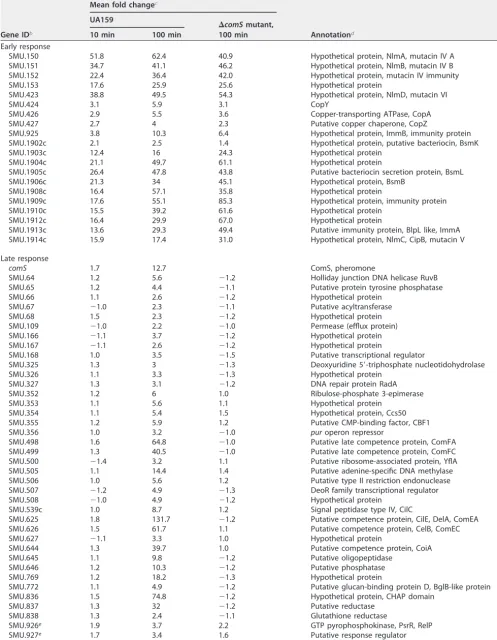
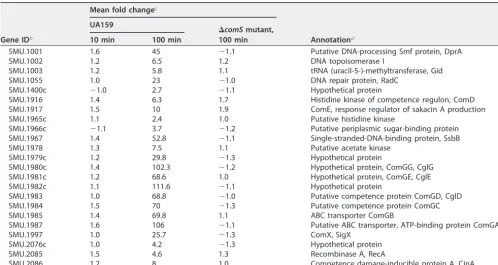
Among the 1,961 protein-encoding genes annotated in the UA159 genome se-quence, a subset of 83 were represented by a⬎2-fold expression increase during a 100-min CSP exposure (Table 1; see Table S3 in the supplemental material). Only five genes exhibited downregulation, but all in the low range between⫺2.1- and⫺2.3-fold changes. The CSP induction ratios were, in general, similar to those previously observed in a transcriptome survey examining a competent subfraction of theS. mutans popu-lation (28) and higher than in surveys using mixed popupopu-lations exposed to CSP for 120 min (see Fig. S1 in the supplemental material) (15, 28). Approximately 160 genes that were reported as differentially regulated in response to CSP in one of the
on September 8, 2020 by guest
http://msystems.asm.org/
TABLE 1 Global temporal profile of responses to CSP in TSBa
Gene IDb
Mean fold changec
Annotationd UA159
⌬comSmutant, 100 min
10 min 100 min
Early response
SMU.150 51.8 62.4 40.9 Hypothetical protein, NlmA, mutacin IV A
SMU.151 34.7 41.1 46.2 Hypothetical protein, NlmB, mutacin IV B
SMU.152 22.4 36.4 42.0 Hypothetical protein, mutacin IV immunity
SMU.153 17.6 25.9 25.6 Hypothetical protein
SMU.423 38.8 49.5 54.3 Hypothetical protein, NlmD, mutacin VI
SMU.424 3.1 5.9 3.1 CopY
SMU.426 2.9 5.5 3.6 Copper-transporting ATPase, CopA
SMU.427 2.7 4 2.3 Putative copper chaperone, CopZ
SMU.925 3.8 10.3 6.4 Hypothetical protein, ImmB, immunity protein
SMU.1902c 2.1 2.5 1.4 Hypothetical protein, putative bacteriocin, BsmK
SMU.1903c 12.4 16 24.3 Hypothetical protein
SMU.1904c 21.1 49.7 61.1 Hypothetical protein
SMU.1905c 26.4 47.8 43.8 Putative bacteriocin secretion protein, BsmL
SMU.1906c 21.3 34 45.1 Hypothetical protein, BsmB
SMU.1908c 16.4 57.1 35.8 Hypothetical protein
SMU.1909c 17.6 55.1 85.3 Hypothetical protein, immunity protein
SMU.1910c 15.5 39.2 61.6 Hypothetical protein
SMU.1912c 16.4 29.9 67.0 Hypothetical protein
SMU.1913c 13.6 29.3 49.4 Putative immunity protein, BlpL like, ImmA
SMU.1914c 15.9 17.4 31.0 Hypothetical protein, NlmC, CipB, mutacin V
Late response
comS 1.7 12.7 ComS, pheromone
SMU.64 1.2 5.6 ⫺1.2 Holliday junction DNA helicase RuvB
SMU.65 1.2 4.4 ⫺1.1 Putative protein tyrosine phosphatase
SMU.66 1.1 2.6 ⫺1.2 Hypothetical protein
SMU.67 ⫺1.0 2.3 ⫺1.1 Putative acyltransferase
SMU.68 1.5 2.3 ⫺1.2 Hypothetical protein
SMU.109 ⫺1.0 2.2 ⫺1.0 Permease (efflux protein)
SMU.166 ⫺1.1 3.7 ⫺1.2 Hypothetical protein
SMU.167 ⫺1.1 2.6 ⫺1.2 Hypothetical protein
SMU.168 1.0 3.5 ⫺1.5 Putative transcriptional regulator
SMU.325 1.3 3 ⫺1.3 Deoxyuridine 5=-triphosphate nucleotidohydrolase
SMU.326 1.1 3.3 ⫺1.3 Hypothetical protein
SMU.327 1.3 3.1 ⫺1.2 DNA repair protein RadA
SMU.352 1.2 6 1.0 Ribulose-phosphate 3-epimerase
SMU.353 1.1 5.6 1.1 Hypothetical protein
SMU.354 1.1 5.4 1.5 Hypothetical protein, Ccs50
SMU.355 1.2 5.9 1.2 Putative CMP-binding factor, CBF1
SMU.356 1.0 3.2 ⫺1.0 puroperon repressor
SMU.498 1.6 64.8 ⫺1.0 Putative late competence protein, ComFA
SMU.499 1.3 40.5 ⫺1.0 Putative late competence protein, ComFC
SMU.500 ⫺1.4 3.2 1.1 Putative ribosome-associated protein, YflA
SMU.505 1.1 14.4 1.4 Putative adenine-specific DNA methylase
SMU.506 1.0 5.6 1.2 Putative type II restriction endonuclease
SMU.507 ⫺1.2 4.9 ⫺1.3 DeoR family transcriptional regulator
SMU.508 ⫺1.0 4.9 ⫺1.2 Hypothetical protein
SMU.539c 1.0 8.7 1.2 Signal peptidase type IV, CilC
SMU.625 1.8 131.7 ⫺1.2 Putative competence protein, CilE, DelA, ComEA
SMU.626 1.5 61.7 1.1 Putative competence protein, CelB, ComEC
SMU.627 ⫺1.1 3.3 1.0 Hypothetical protein
SMU.644 1.3 39.7 1.0 Putative competence protein, CoiA
SMU.645 1.1 9.8 ⫺1.2 Putative oligopeptidase
SMU.646 1.2 10.3 ⫺1.2 Putative phosphatase
SMU.769 1.2 18.2 ⫺1.3 Hypothetical protein
SMU.772 1.1 4.9 ⫺1.2 Putative glucan-binding protein D, BglB-like protein
SMU.836 1.5 74.8 ⫺1.2 Hypothetical protein, CHAP domain
SMU.837 1.3 32 ⫺1.2 Putative reductase
SMU.838 1.3 2.4 ⫺1.1 Glutathione reductase
SMU.926e 1.9 3.7 2.2 GTP pyrophosphokinase, PsrR, RelP
SMU.927e 1.7 3.4 1.6 Putative response regulator
SMU.928e 1.5 2.7 1.7 Putative histidine kinase
(Continued on following page)
on September 8, 2020 by guest
http://msystems.asm.org/
mixed-population studies (15) were not confirmed in either this study or in the study using sorted competent cells (see Fig. S1B and Table S4 in the supplemental material). We conclude that such genes are unlikely to be reproducible parts of the late CSP response and may represent experimental error, indirect effects of competence, or metabolic changes unrelated to the response to CSP. This interpretation is strength-ened by the observation that the induction levels of most genes were uniformly higher in the present data and in the previous study using sorted cells and by the fact that the former transcriptome did not provide information on direction of transcripts and had a limited set of probes for each of the ORFs. Finally, the induced genes encoding bacteriocin and bacteriocin immunity proteins were generally induced at higher ratios here than in the previous studies using mixed or sorted populations of CSP-stimulated cells. This was particularly valuable in view of our aim to differentiate early and late responses associated with the activation of distinct regulons during the CSP response. A comparison of the expression levels of individual upregulated genes in samples treated with CSP for 10 and 100 min is shown in Table 1. The induced genes form two classes with different temporal patterns of expression; one class was induced at both times, and a second, larger, class was upregulated at 100 min but was not perceptibly affected at 10 min. For convenience in discussion, we designate the former early genes and the latter late genes. As they are likely to have different modes of regulation, transcriptionally active regions (TARs) in the two classes are described separately below. In the early phase of the CSP response, increases in expression were restricted to 20 genes in four distinct TARs. All five genes previously reported individually to be upregulated in the early phase of the CSP response (nlmAB,nlmD,
immB, andcipB), either by means of reporter constructions or by RT-PCR (18, 28, 36), were among the early upregulated genes (Fig. 3). The genes in the early induction class clustered in four chromosomal regions. One locus contains the genes for bacteriocin NlmAB and the cognate bacteriocin immunity protein SMU.152 (37), with transcription TABLE 1 (CONTINUED)
Gene IDb
Mean fold changec
Annotationd UA159
⌬comSmutant, 100 min
10 min 100 min
SMU.1001 1.6 45 ⫺1.1 Putative DNA-processing Smf protein, DprA
SMU.1002 1.2 6.5 1.2 DNA topoisomerase I
SMU.1003 1.2 5.8 1.1 tRNA (uracil-5-)-methyltransferase, Gid
SMU.1055 1.0 23 ⫺1.0 DNA repair protein, RadC
SMU.1400c ⫺1.0 2.7 ⫺1.1 Hypothetical protein
SMU.1916 1.4 6.3 1.7 Histidine kinase of competence regulon, ComD
SMU.1917 1.5 10 1.9 ComE, response regulator of sakacin A production
SMU.1965c 1.1 2.4 1.0 Putative histidine kinase
SMU.1966c ⫺1.1 3.7 ⫺1.2 Putative periplasmic sugar-binding protein
SMU.1967 1.4 52.8 ⫺1.1 Single-stranded-DNA-binding protein, SsbB
SMU.1978 1.3 7.5 1.1 Putative acetate kinase
SMU.1979c 1.2 29.8 ⫺1.3 Hypothetical protein
SMU.1980c 1.4 102.3 ⫺1.2 Hypothetical protein, ComGG, CglG
SMU.1981c 1.2 68.6 1.0 Hypothetical protein, ComGE, CglE
SMU.1982c 1.1 111.6 ⫺1.1 Hypothetical protein
SMU.1983 1.0 68.8 ⫺1.0 Putative competence protein ComGD, CglD
SMU.1984 1.5 70 ⫺1.3 Putative competence protein ComGC
SMU.1985 1.4 69.8 1.1 ABC transporter ComGB
SMU.1987 1.6 106 ⫺1.1 Putative ABC transporter, ATP-binding protein ComGA
SMU.1997 1.0 25.7 ⫺1.3 ComX, SigX
SMU.2076c 1.0 4.2 ⫺1.3 Hypothetical protein
SMU.2085 1.5 4.6 1.3 Recombinase A, RecA
SMU.2086 1.2 8 1.0 Competence damage-inducible protein A, CinA
aGenes upregulated in response to CSP under at least one of the conditions tested (mean change,⬎2-fold).
bS. mutansgene locus tag as in GenBank (S. mutansUA159, accession no.AE014133), except forcomS, which is not annotated in theS. mutansgenome.
cMean fold change in gene expression in two independent biological experiments comparing CSP-treated and untreated parallel cultures. dAnnotation as in GenBank (accession no.AE014133) plus common gene names used in the literature.
eTAR initiated by early gene SMU.925.
on September 8, 2020 by guest
http://msystems.asm.org/
C
omE-r
egulon
16 63 9 6 4 3 3 2 2 2
26 C o mR-r egulon E
comC comD comE bsmK 1904 bsmL bsmB 1908 1909 1910 1912 immA 1914
1903 1907 nlmC 1897 1898 1899 1900
cslAB
2 13 21 11 26 11 21 3 16 12 18 15 16 14 16 12 14 12 16 3 3 2 2 <2 2
nlmA nlmB
152 153 423 copY copA copZ immB relP 927 928 150 151
nlmD
39 9 3 3 3 4 4 <2 <2 <2
E E E
R
60 comR comS 63 ruvB 65 66 67 68
1997 sigX
R
5’ 5’ 5’
5’ 5’ 5’ Bacteriocins Immunity proteins Competence regulators
Induction in the anti-sense direction
Not induced Autolysis DNA transport DNA recombination DNA methylation Hypothetical proteins
109 166 167 168
325 326 radA 351 352 353 354 355 356 3 3 3 <2 6 6 5 6 3 3
comFA comFB 500
531 532 533 534 535 536 537 538 cilC
504 505 506 507 508 comEA comEC 627
coiA 645 646 769 770 771 gbpD lytF 837 838 dprA 1002 1003
1050 1051 1052 1053 1054 1055 1056 radC
1400 comC comD comE 1963 1964 1965 1966 ssbB ack GH GG GF GE GD GC GB 1987 comGA
2075 2076 2085 recA cinA
rl16 rs3 rl22 2023 2167 2166 1852 1853 691
X X X X X X X X X X X X X X X X X X X SigX -r egulon O thers
3 3 6 10
75 28 32 8 2,4
65 41 7 3
11 10 9 12 17 12 16 12 20 9 132 62 8 3
8 30 102 69 112 69 70 70 19 106
40 10 8 10 45 7 2,4 6
<2 2 2 ,4 4 11 53 93 100 35 64 64 23
5 8
18 10 11 4 11 2,3 5
<2 4
2,2 4 3 4
8 6 5 4 <2 3 3 2,2 2,4 2,3
3
14 6 5 5 5
X 5’ 5’ 5’ 5’ 5’ 5’ 5’
5’ 5’ 5’
5’ 5’ 5’ 5’ 5’ 5’ 5’ 5’ 5’ 5’ 5’ 5’
60 comR
5’ 3 X
pilC
on September 8, 2020 by guest
http://msystems.asm.org/
continuing past a predicted terminator and through SMU_153, encoding a hypothetical protein. The three intergenic sequences among these genes were also upregulated, suggesting that the four genes are part of a single transcript. Two TARs, encoding the bacteriocin NlmD (BsmC, SMU.423) and the ImmB immunity protein (SMU.925), appear to be essentially monocistronic, with readthrough past terminator elements into a total of six downstream neighboring genes (Fig. 3). FornlmD, the induction of the down-stream genes was already evident at 10 min, whereas for immB, the induction of downstream ORFs SMU.926 to SMU.928 was seen only at 100 min. Although they were late genes, they form a single TAR initiated at the early geneimmB, thus appearing to be part of the same regulon asimmBand other early genes, as discussed below. The fourth early upregulated region comprises a 13-kb island, including genes for four bacteriocins (BsmB, -L, and -K and CipB), two immunity proteins (ImmA and SMU.1909), five proteins of unknown function, and an unusually large proportion of apparent intergenic regions. Analysis of expression changes in the antisense direction reveals that a marginally upregulated region extends through SMU.1902 to SMU.1897, appar-ently as a result of transcriptional readthrough.
In the late phase of the response to CSP, a total of 83 genes organized into 29 TARs were upregulated.Comparative analysis of the RNA harvested from CSP-treated cells at 100 min to that isolated from parallel unCSP-treated controls reveals that the four TARs of the early CSP response comprising 20 genes continued to be upregulated at this time. The TAR initiated at immBwas extended to include three other genes (SMU.926 to SMU.928) at this time. In addition, 60 other genes organized in 22 TARs were induced in the sense direction and another three TARs were induced exclusively in the antisense direction by at least 2-fold (Table 1; Fig. 3). Among these, one TAR was initiated at the 3=end of the SMU.60 gene, upstream ofcomR, and extended to the start
ofcomR.Five others included regions of antisense transcription (initiated atcomS,cilC,
pilC,radC, andcomE), and at six loci, TARs (initiated at SMU.325, SMU.351, SMU.504,lytF,
comE, and ssbB) extended past terminators in the sense direction, as predicted by DOOR (38), to include downstream ORFs. The three TARs induced only in the antisense direction of the ORFs start at SMU.691, SMU.1853, and rl16. Over half of the TARs comprise genes upregulated by 10- to 132-fold.
Three of the late upregulated genes encode known regulators of competence-specific transcription inS. mutans(ComS, SigX, and ComED). Consistent with a positive feedback loop mediated by XIP (Fig. 1), there was strong induction of the XIP-encoding genecomSat 100 min. The TAR initiated atcomSis 8 kb long, comprising six other ORFs, one of them transcribed in the antisense direction (SMU.63). SigX, long known as part of the response to CSP in streptococci (11), is represented by a one-gene TAR upregulated by 16-fold. Finally, thecomEDgenes are among the late genes and are part of a TAR that extends in the 3=direction to include the transcription ofcomCin the antisense direction. No induction ofcomCin the sense direction was observed. Of the remaining 19 late-induced TARs initiated by genes transcribed in the sense direction, 12 include at least one gene known to be involved in competence; 4 encode proteins for DNA transport, 6 encode proteins for DNA recombination, 1 encodes a protein for DNA methylation, and 1 encodes a protein for autolysis (Fig. 3).
Deletion ofcomSabrogates the entire late response to CSP.ComR and ComS form a positive feedback circuit that enhances the synthesis of ComS and
concomi-FIG 3 Genetic organization of TARs assigned to ComE, ComR, and SigX regulons. Operons (gray boxes) and terminators (black pins) are indicated as
predicted by DOOR (38). The arrow borders of the genes in the ComE, ComR, and SigX regulons are red, green, and blue, respectively. The four TARs induced at 10 min in the WT and at 100 min in thecomSmutant belong to the ComE regulon and comprise genes encoding bacteriocins (red), bacteriocin immunity proteins (yellow), and hypothetical proteins (gray). The 25 TARs induced only in the WT at 100 min (late response) belong to the ComR regulon (2 TARs), the SigX regulon (21 TARs), or unassigned regulons (others; 2 TARs). These include genes with products acting in autolysis (red), DNA transport (sky blue), recombination (green), and DNA methylation (orange) and genes that encode hypothetical proteins (gray). Three late genes encode key regulatory elements in the CSP response pathway (dark blue), SigX, ComS (ComR activator), and ComED. Binding site consensus elements are indicated by pennants for ComE (E), ComR (R), and SigX (X). Genes upregulated in the antisense direction are black. The mean fold changes in the expression of ORFs (black numbers) and intergenic regions (red umbers) for the WT at 10 min (ComE regulon) and 100 min (ComR, SigX, and other regulons) are shown above the black arrows indicating the directions of the transcripts. The images shown were drawn with Easyfig (70).
on September 8, 2020 by guest
http://msystems.asm.org/
tantly upregulates sigX (6). Although only two copies of the complex ComR box recognition motif have been detected in the S. mutans genome, the inference that ComR acts only at those two sites has not been experimentally tested inS. mutans. To test this inference and investigate the place of ComS in the CSP response more thoroughly, transcriptome analysis of acomSdeletion mutant was performed in parallel with the analysis of WT UA159 described above (Table 1; see Tables S4 and S5 in the supplemental material). During CSP treatment of thecomSmutant for 100 min, none of the late-phase genes identified in the WT were upregulated, but the profile of expression seen at 10 min in the WT was closely recapitulated (Table 1). This pattern supports the inference made from previous studies of several late genes thatcomSis an integral link between the early response and all elements of the late response.
The single gene that was upregulated in thecomSculture but not in the 10-min WT sample was SMU.926. As shown in Fig. 3, SMU.926 most probably represents a read-through from the early gene SMU.925 (immB) rather than a distinct late-activated promoter. Similarly, the single gene upregulated in the 10-min sample but not upregu-lated in the ΔcomSmutant culture is SMU.1902c (bsmK). This had the lowest degree of upregulation (2.1-fold) among the early genes and is located at the 3=end of a long TAR extending from the early genecipB, which was induced by 16-fold, again indicating a possible readthrough past a cryptic terminator site. In fact, the transcripts at all four early loci extended across predicted terminators and operon borders, indicating read-through as a result of strong activation or incorrect terminator predictions.
Assignment of regulon members. For a comprehensive identification of the members of each of the three principal competence regulons, we combined informa-tion on the temporal responses to CSP and on the effect ofcomSdeletion described above with a thorough analysis of the transcriptome map in the vicinity of conserved sequences recognized by ComE, ComR, and SigX (Table 1; Fig. 3 to 5). We then compared this information with the transcriptome data from five previous surveys investigating competence inS. mutansto search for conserved responses (Fig. 6). Two of the transcriptomes compared long exposure times (120 min) of strain UA159 to CSP with nontreated samples (15, 28); the third transcriptome was also for strain UA159, but the comparison was between the WT and a CSP response-defectivecipBmutant also exposed to CSP for 120 min (32); the fourth one was for strain UA140 comparing the WT to anhdrRoverexpression strain that shows induction of late competence genes in the absence of CSP supplementation (39); and the fifth one used short (up to 30 min) exposure of UA159 to CSP or XIP in a defined medium in which CSP responses are not linked to competence (27).
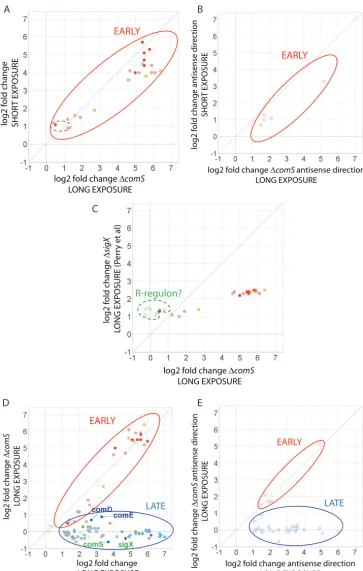
The ComE regulon. To delimit the ComE regulon, we first compared the tran-scriptome profiles of the early response of the WT to CSP and of the comSmutant exposed for 100 min to CSP, as illustrated in Fig. 4A and B. The expression pattern at 10 min is expected to reveal the immediate response of genes transcribed via ComE activation, before regulons dependent on ComR are upregulated, whereas data from the late response of a comS mutant, in which downstream regulons remain silent because of a lack of the linking XIP peptide, would potentially reveal direct targets of ComE with a slower response, as well as other downstream regulons independent of the ComR-ComS link. We found near identity between the early response in the WT and the late response in thecomSmutant. All four early-induced TARs initiated atnlmA,
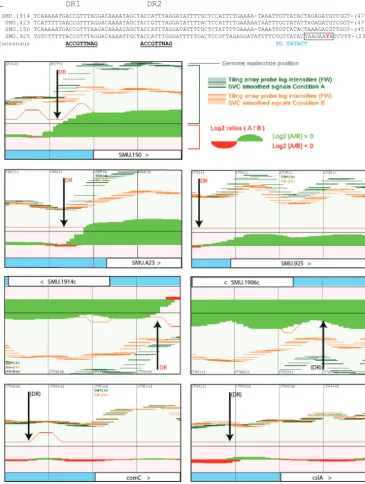
nlmD,immB, andcipBare preceded by the direct repeat (DR) identified previously as a putative ComE binding site required for CSP-dependent bacteriocin expression (18) and subsequently identified (40) as a tight binding site for purified ComE protein (Fig. 4 and 5). Other DR sites that bind purified ComE have been suggested to be functional, but they appeared to be nonfunctional under the conditions examined here, including the sites distal tobsmB(SMU.1906),comC(sense direction), andcslAB(Fig. 5A). The results indicate that all of the targets of ComE respond immediately to CSP and establish for the first time that ComE has no additional targets activated at late times independent of the ComR-ComS link.
on September 8, 2020 by guest
http://msystems.asm.org/
log2 fold change ΔcomS LONG EXPOSURE
log2 f
old change
SHOR
T EXPOSURE
EARLY
log2 fold change ΔcomS LONG EXPOSURE
log2 f
old change
Δ
sigX
LONG EXPOSURE (P
er
ry et al)
R-regulon?
log2 fold change antisense direction LONG EXPOSURE
log2 f
old change
Δ
co
m
S
an
tisense dir
ec
tion
LONG EXPOSURE
EARLY
LATE log2 fold change ΔcomS antisense direction
LONG EXPOSURE
log2 f
old change an
tisense dir
ec
tion
SHOR
T EXPOSURE
EARLY
A
B
C
D
E
log2 f
old change
Δ
comS
LONG EXPOSURE
log2 fold change LONG EXPOSURE
EARLY
LATE
FIG 4 Correlations between gene expression changes induced by short (10 min) or long (100 min) exposure
to CSP inS. mutansUA159 or by long exposure to CSP in thecomSmutant. Fold changes are shown as log2
values for all induced ORF sequences in theS. mutansUA159 genome (accession no.AE014133) and represent mean values for comparisons of CSP-treated and untreated samples from two independent biological experiments. (A) Correlation of ratios of short CSP exposure ofS. mutansUA159 to long CSP exposure of thecomSmutant. The same genes were upregulated under the two conditions, with two exceptions (inner dashed circle). These are grouped as early genes. (B) Same correlation as for panel A but for changes in antisense transcripts. (C) Correlation of ratios of long CSP exposure of the comSmutant to long CSP exposure of thesigXmutant in reference 15 reveals candidate genes for the ComR regulon (dashed circle). (D) Correlation of induction ratios of long CSP exposure ofS. mutansUA159 to thecomSmutant formed
(Continued)
on September 8, 2020 by guest
http://msystems.asm.org/
We further examined the conservation of the CSP response by comparing the set of genes within the induced TARs with genes within or in the vicinity of these regions showing changed expression in previous studies (Fig. 6). Although the one published transcriptome study evaluating the early CSP response (27) was conducted under conditions of culture in CDM that do not support induction of competence by CSP, it did identify 19 of the 23 genes within the ComE regulon, as determined here (Fig. 5). Notably, similar to our results, in that study, comEDandcomC expression was only slightly or not induced by CSP, a finding also corroborated by a previous transcriptome study using asigX mutant (15). Despite the methodological limitations of the latter study, including lack of information on the direction of the transcripts and low levels of induction by CSP, all of the 23 early genes induced in the sense direction in this study were identified among the induced genes reported there (Fig. 4C). We conclude that the UA159 genome contains only four TARs that are directly regulated by ComE, defining the ComE regulon. A total of 23 genes are transcribed in the sense direction, but direct experimentation is needed to assess the biological significance of distal genes or of the antisense transcripts in all four TARs, which are the source of the greatest variation among the different transcriptome studies.
The ComR regulon.Genes transcribed directly via activation of ComR in the CSP response can be identified from transcription differentials between asigXmutant and acomSmutant in the late phase of the CSP response. Both data sets would reflect upregulation of genes of the ComE regulon, which is an early response, but only the
sigX mutant would allow increased late expression of the transcripts of the ComR regulon. Although the information derived from a previous survey of gene expression in asigXmutant (15) did not address transcript polarity or intergenic sequences, we can nonetheless use the ORF expression information available there to uncover candidate members of the ComR regulon. The scatterplot in Fig. 4C compares the genes that were upregulated in the 100-min comS mutant culture in this study to those previously reported as upregulated in asigXmutant after a similar period of CSP exposure. The genes listed as upregulated in both transcriptomes represent the ComE regulon, as described above. The remaining seven genes, which were upregulated in the sigX
mutant but not in the comS mutant or within a 10-min CSP exposure, are thus candidates for the ComR regulon. Of these, we exclude three (SMU.2037, SMU.2038, and SMU.799c) that, although induced to low levels in the sigX mutant, were not upregulated in the late response of the WT in either of the transcriptomes here (see Table S6 in the supplemental material) or in two other previous transcriptomes (27, 28) and are not preceded by the ComR box inverted repeat (IR). The remaining candidate genes, SMU.63, SMU.64, SMU.65, and SMU.66, are contiguous withcomS, which was not itself represented in the microarray used for analysis of thesigX mutant. These four genes were also upregulated in the 100-min WT transcriptome, along with the down-stream genes SMU.67 and SMU.68, forming a single TAR withcomS. The present data reveal that SMU.63, immediately downstream ofcomSbut in the inverse orientation, was transcribed only from the noncoding strand, indicating strong readthrough past
comSand suggesting that the entire upregulated region downstream ofcomS repre-sents a single readthrough mRNA (Fig. 3). Examination of the transcription map for the WT at 100 min reveals that this TAR starts close to the ComR box IR that has been
Figure Legend Continued
two groups. Early genes, as in panel A, were induced in both transcriptomes, and late genes were those induced only in UA159 upon long CSP exposure. (E) Correlations as in panel D but for antisense transcripts. Early genes are defined as those induced by short CSP exposure in WT UA159 and by long CSP exposure in the
comSmutant (red borders), and late genes are defined as those that showed induction in the WT only upon long CSP exposure (green borders for putative genes of the ComR regulon and blue borders for the remaining genes). Circles corresponding to genes encoding upregulated bacteriocins are filled in red, circles correspond-ing to bacteriocin immunity proteins are filled in yellow, circles correspondcorrespond-ing to proteins involved in DNA uptake are filled in light blue, and circles corresponding to proteins involved in DNA recombination are filled in green. The points corresponding tocomE,comD,comS, andsigXare indicated by name (D; dark blue). Light-gray-filled circles correspond to other genes. Multiplot v.2 was used to draw the scatterplots (http://www.broadinstitute.org/cancer/software/genepattern/modules/docs/Multiplot/2).
on September 8, 2020 by guest
http://msystems.asm.org/
A.
DR1 DR2
SMU.1914 TCAAAAATGACCGTTTAGGACAAAATAGCTACCATTTAGGATATTTTGCTCCATTTTGAAAA-TAAATTGTTATACTAGAGATGTCGGT-(47)-ATG SMU.423 TCATTTTTAACCGTTTAGGACAAAATAGCTACCGTTTAGGATATTTTACTCCATTTTGAAAAATAATTTGCTATATTAGAGATGTCGGT-(47)-ATG SMU.150 TCAAAAATGACCGTTTAAGACAAAATAGCTACCATTTAGGATATTTTGCTCTATTTTGAAAA-TAAATTGTTATACTAAAGATGTTGGT-(45)-ATG
SMU.925 TGTCTTTTTACCGTTTAGGACAAAATTGCTACCATTTGGGATTTTTGACTCCGTTAGAGGATATTTTCTGTTATACTAAGAAT
Consensus ACCGTTNAG ACCGTTNAG TG TATACT ATG
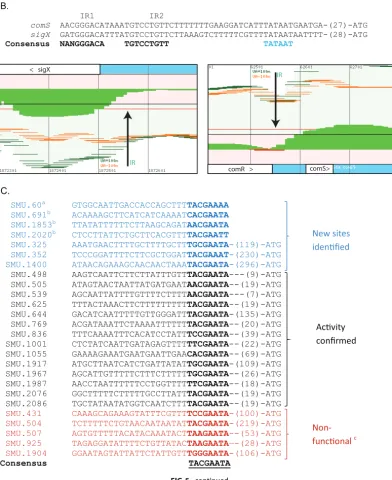
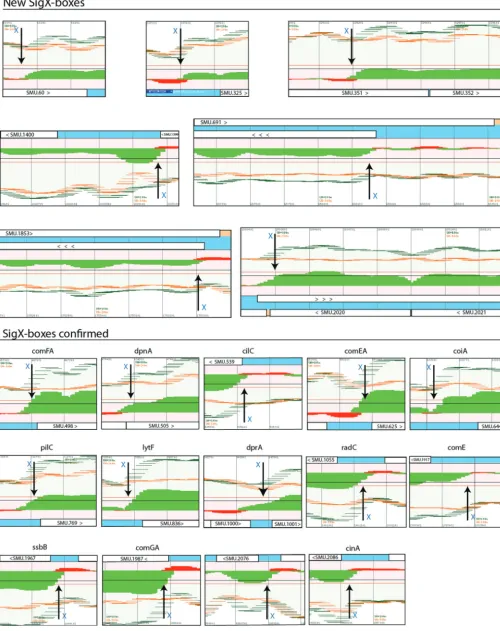
FIG 5 Putative regulatory sites at early and late CSP-induced loci. (A, top) Alignment of DNA sequences upstream
of clusters of early genes. The presumptive canonical promoterⴚ10 site is blue, bases corresponding to the DR consensus sequences are underlined, and the putative transcription start site is red (18). The previously suggested SigX box of SMU.925 is boxed (39). (A, bottom) Transcriptome map showing predicted ComE binding sites (15, 40). Vertical arrows show the ComE DR sites that appeared to be active (orange DR) and sites that did not appear as active (black DR). Conditions A and B are 10 min of CSP and 10 min of no CSP, respectively. (B, top) Alignment of DNA sequences upstream ofsigXandcomS. These are late CSP-induced loci upregulated by ComRS. The presumptive canonical promoterⴚ10 site is blue, and conserved IRs known as the ComR box are bold (6). (B, bottom) Transcriptome maps atcomSandsigX. Vertical arrows indicate the ComR IR sites (6). Conditions A and B are 100 min of CSP and 100 min of no CSP, respectively. Probe intensities for thecomSregion were above the threshold used in the visualizer program. (C, top) Alignment of DNA sequences with putative SigX boxes. The SigX boxes are in bold. Superscript letters: a, SigX box within SMU.60; b, induction in the antisense direction; c, putative SigX boxes (39) not confirmed in our transcriptome. (C, bottom) Transcriptome map showing locations of predicted SigX boxes. Vertical arrows show the sites of SigX boxes that appeared to be active. Conditions A and B are 100 min of CSP and 100 min of no CSP, respectively. Changes in gene expression are presented as log2
ratios (condition A/condition B), with ratios of>0 in green and ratios of<0 in red. The signal intensity of each probe (50-mer) is presented as a horizontal line in green for condition A and in orange for condition B.S. mutans
locus tags are as in the sequence with GenBank accession no.AE014133(>, transcript in the forward strand showing probe intensities above the locus tag boxes; <, transcript in the reverse strand showing probe intensities below the locus tag boxes). The vertical lines are separated by a distance of 100 bp. The complete maps are available athttp://bioinformatics.forsyth.org/mtd/datasetⴝRNAseq_smut_comS.
on September 8, 2020 by guest
http://msystems.asm.org/
described as the binding site for ComR (Fig. 5B) (41), further supporting a role for ComR in driving the transcription of this region.
The final member of the ComR regulon issigX, which was expressed as a late gene, but not in thecomSmutant (and was not probed in thesigXmutant). As forcomS, the transcription start site at sigX mapped to a ComR box IR motif (Fig. 5B), providing support for a direct regulatory role for ComR in the expression of bothcomSandsigX. A previous transcriptome study of CSP-induced competence inS. mutansreported a TAR extending downstream of sigXthat, given its position and the general variation observed in the expression of the 3=-terminal genes in several of the induced TARs in different transcriptomes, may represent a readthrough (Fig. 5). We conclude that just two TARs make up the ComR regulon, one initiated at comS but often extending downstream to encompass two to five additional genes and the second encompassing
sigX, with an occasional downstream readthrough.
comS> comR >
< sigX
IR
IR
B.
IR1 IR2 comS AACGGGACATAAATGTCCTGTTCTTTTTTTGAAGGATCATTTATAATGAATGA-(27)-ATG sigX GATGGGACATTTATGTCCTGTTCTTAAAGTCTTTTTCGTTTTATAATAATTTT-(28)-ATG
Consensus NANGGGACA TGTCCTGTT TATAAT
C.
SMU.60a GTGGCAATTGACCACCAGCTTTTACGAAAA SMU.691b ACAAAAGCTTCATCATCAAAATCACGAATA SMU.1853b TTATATTTTTTCTTAAGCAGATAACGAATA SMU.2020b CTCCTTATTCTGCTTCACGTTTTACGAATT
SMU.325 AAATGAACTTTTGCTTTTGCTTTGCGAATA-(119)-ATG SMU.352 TCCCGGATTTTCTTCGCTGGATTACGAAAT-(230)-ATG SMU.1400 ATAACAGAAAGCAACAACTAAATACGAATA-(296)-ATG
SMU.498 AAGTCAATTCTTCTTATTTGTTTACGAATA---(9)-ATG SMU.505 ATAGTAACTAATTATGATGAATAACGAATA--(19)-ATG SMU.539 AGCAATTATTTTGTTTTCTTTTAACGAATA---(7)-ATG SMU.625 TTTACTAAACTTCTTTTTTTTTTACGAATA--(19)-ATG SMU.644 GACATCAATTTTTGTTGGGATTTACGAATA-(135)-ATG SMU.769 ACGATAAATTCTAAAATTTTTTTACGAATA--(20)-ATG SMU.836 TTTCAAAATTTCACATCCTATTTCCGAATA--(39)-ATG SMU.1001 CTCTATCAATTGATAGAGTTTTTTCGAATA--(22)-ATG SMU.1055 GAAAAGAAATGAATGAATTGAACACGAATA--(69)-ATG SMU.1917 ATGCTTAATCATCTGATTATATTGCGAATA-(109)-ATG SMU.1967 AGCATTGTTTTTCTTTCTTTTTTGCGAATA--(26)-ATG SMU.1987 AACCTAATTTTTTCCTGGTTTTTTCGAATA--(18)-ATG SMU.2076 GGCTTTTTCTTTTTGCCTTATTTACGAATA--(19)-ATG SMU.2086 TGCTATAATATGGTCAATCTTTTACGAATA--(19)-ATG SMU.431 CAAAGCAGAAAGTATTTCGTTTTCCGAATA-(100)-ATG SMU.504 TCTTTTTCTGTAACAATAATATTACGAATA-(219)-ATG SMU.507 AGTGTTTTTACATACAAATACTTAAGAATA--(53)-ATG SMU.925 TAGAGGATATTTTCTGTTATACTAAGAATA—-(28)-ATG SMU.1904 GGAATAGTATTATTCTATTGTTTGGGAATA-(106)-ATG
Consensus TACGAATA
Non-funconalc
Acvity confirmed New sites idenfied
FIG 5 continued
on September 8, 2020 by guest
http://msystems.asm.org/
FIG 5 continued
on September 8, 2020 by guest
http://msystems.asm.org/
The sigX regulon. Because sigX is expressed late in the CSP response, genes restricted to late expression and not expressed in asigXorcomSmutant are candidates for the SigX regulon. The late class of genes is easily distinguished from the early class, as illustrated in the scatter plots in Fig. 4D and E. Discounting the genes belonging to the ComE and ComR regulons identified above (Fig. 4A to C), 23 TARs comprising a total of 78 ORFs transcribed in either the sense or the antisense direction are candidate members of the SigX regulon (Fig. 3, bottom). To distinguish direct from indirect regulation by SigX, we focused on the apparent presence of the highly conserved noncanonical ⫺10 promoter element recognized by SigX polymerase, the SigX box, near the start of these TARs. Twenty-one of the 23 candidate TARs are preceded by a SigX box, as illustrated in the transcriptome maps in Fig. 5C. Of these, 7 represent SigX boxes not previously described and the remaining 16 include mostly SigX boxes that have been predicted in previousS. mutansstudies and that were confirmed here by transcriptome mapping. Five other SigX boxes have been suggested in regions pre-ceding competence-induced genes (SMU.431, SMU.504, SMU.507, SMU.925, and SMU.1904) (39), but these boxes were not confirmed in our study. At least one gene in each of these TARs (those in the sense direction) has been previously reported as upregulated in transcriptome surveys of theS. mutansresponse to CSP (Fig. 6). In the
dut 326 radA 328 comF A
comFB 500
352 353 354 355 356 505 506 507 508 cilC 538 537 536 535 534 533 532 531 530 comEAcomEC 627 coiA645 646 647 769 770 771 gbpD lytF 837 838
1000dprA1002 1003 gtfC radC 1054 1053 1052 1051 1050 1400
comEcomD comCcipB immA 1912 1910 1909 1908 1907 bsmB bsmL 1904 1903 bsmK cslB 1899 1898 cslA
?
ssbB 1966 1965 1964 1963 351
108 109 166 167 168 1976 1975
1988comGAGB GC GD 1982 1981 1980 1979 ack 1977 cinArecA 2084 2083 2081 2080 2079 2078 207720762075
nlmAnlmB 152 153
Lemme et al2 Perry et al1
Okinaga et al5 Reck et al4(CSP) Dufour et al3
nlmDcopY copA copZ
(427) immBrelP 927 928 60 comRcomS63 ruvB 65 66 67 68
148 149 154 sigX 1996
Reck et al4(XIP)
?
Up-regulated sense direction Up-regulated anti-sense direction
Up-regulated late, possibly part of early transcript Up-regulated (direction not known)
Directional strategy, but anti-sense expression not described No change in expression
Values not reported Down-regulation
rl16 rs3 rl22 2023 2167 2166 2024 rl3 1853 1852
691 Lemme et al2
Perry et al1
Okinaga et al5 Dufour et al3
Reck et al4(XIP)
Lemme et al2 Perry et al1
Okinaga et al5 Dufour et al3
Reck et al4(XIP)
Lemme et al2 Perry et al1
Okinaga et al5 Dufour et al3
Reck et al4(XIP)
Activated TARs
Activated TARs
Activated TARs
Activated TARs
FIG 6 Comparison of gene expression maps from availableS. mutanscompetence transcriptome studies. The directions of the activated TARs (arrows)
fromS. mutansexposed for 100 min to CSP are indicated by arrows as follows: red, TARs of the ComE regulon; green, the ComR regulon; blue and black,
TARs of the SigX regulon with 5=ends starting in the sense and antisense directions, respectively. The genes proximal to the ComE DR are red, those proximal to the ComR indirect repeat are green, and those proximal to the SigX box are blue. Gene numbers are as in the sequence with GenBank accession no.AE014133. Gene expression data for corresponding regions are indicated for five transcriptome studies, as indicated at the left. The top row is UA159 (100 min). The transcriptomes in studies 1, 3, and 5 used traditional microarrays with probes limited to annotated ORFs (15, 32, 39). The transcriptome in study 2 used a tiling microarray covering most of theS. mutansgenome (28). Study 4 used RNA sequencing in the analysis of the response to CSP and XIP in CDM (27). The CSP response in this medium does not support activation of competence but is included for comparative analysis of early responses. The transcriptome for XIP in CDM used a 30-min exposure to XIP, which was probably too short to detect the full range of core genes regulated by SigX. ThecomSgene was not represented in the arrays for the transcriptomes in studies 1, 2, 3, and 5 (empty space).
on September 8, 2020 by guest
http://msystems.asm.org/
cases where there was some variation among the different transcriptomes regarding the set of genes that were induced within the SigX-controlled TAR regions, these usually involved genes in the 3=termini of the TARs. Only two TARs, one for SMU.109 (possibly initiated at SMU.108) and another extending from SMU.166 to SMU.168, were upregulated in multiple transcriptomes but lack an apparent upstream SigX box (Fig. 6). These two are thus the only candidates for indirect regulation by SigX. We conclude that the SigX regulon comprises 23 TARs, with conserved upregulation of genes toward the 5=ends of the TARs and a certain level of variation among different transcriptome surveys toward the set of genes activated in the 3=-terminal regions of the TARs.
A core sigX regulon. During their evolution from a common ancestor, the streptococci became specialized for survival in diverse hosts and diverse sugar-rich niches, diverging not only by accumulation of mutations but also by gains and losses of many genes and by extensive shuffling within the genome (42). Throughout this evolution, competence for genetic transformation has been a conserved trait depen-dent on the alternative sigma factor SigX and the SigX regulon (12). The maintenance of the SigX regulon amid pervasive genetic change provides a natural genus-wide survey that can be used to distinguish conserved from variable components of the regulon. To mine the data provided by this natural experiment, we compared the competence-specific transcriptome data sets that are available for six species, representing five of the six major groups of species in this genus. In Fig. 7, we display alignments of competence-specific TARs inS. mutanswith homologous regions that are upregulated in response to CSP inS. pneumoniae,S. gordonii, andS. sanguinisor by XIP inS. pyogenes
and S. thermophilus (9, 13, 14, 43–46). Since induction levels are apparently low in
S. pyogenes (9, 46) and transformation is observed only under particular biofilm
conditions (47), the absence of core induced genes in their transcriptomes was not used as evidence for the lack of a core response. However, induction ofS. pyogenes
genes within core regions strengthened the classification of genes into the SigX core response. Inspection of the alignments reveals a broad pattern of synteny adjacent to the SigX box motifs but also variation in both gene presence and the observed length of associated TARs. Overall, the streptococcal SigX regulons contain a minority of genes invariably subject to SigX regulation, organized into three groups, (i) core genes induced in more than four streptococcal species (dut,radA,ccs50,cbf1,comFA,comFC,
yfiA,cilC,comEA,comEC,coiA,pepB,pilC,dprA,radC,ssbB,comGAtocomGH,ack,cinA,
andrecA), (ii) core genes in the DpnII group of strains (dpnAanddpnB), and (iii) core genes that have a domain in common but are not necessarily orthologs (lytF in
S. mutans,S. gordonii, andS. sanguinisandcbpDinS. pneumoniae,S. thermophilus, and
S. pyogenes), which we define as the core SigX regulon. This information was used to
delineate a model of the transcriptional organization of theS. mutansresponse to CSP in peptide-rich medium (Fig. 8). A larger number of accessory genes found in SigX-dependent transcripts in some species but not in others are exemplified in Table S7 in the supplemental material. A notable feature of the core regulon is that core genes are usually at the 5=extremity of a TAR, which immediately suggests that transcription of the accessory genes may reflect variation in terminator presence and efficacy. Indeed, in no case that we are aware of has an accessory gene downstream of a core gene been shown to provide a function in transformation. Additional accessory SigX-dependent genes are found in TARs that lack any core gene, but these are few inS. mutans, as only 4 of 22 TARs initiated by genes transcribed in the sense direction are not induced in the other species (3=end of SMU.60,comED, SMU.1400, and possibly SMU.2076).
DISCUSSION
A common theme among the pathways controlling competence for genetic transfor-mation in the scores of species within the diverse genus streptococcus (12) is the use of the labile and dispensable alternative sigma factor SigX to drive the transcription of genes for DNA-processing functions. Our identification of a core of just 27 to 30 genes that are consistently placed under the control of SigX in representative streptococcal species draws attention to three classes of genes, (i) upstream regulators ofsigXand