R E S E A R C H A R T I C L E
Open Access
Evaluating the impact of an intensive education
workshop on evidence-informed decision making
knowledge, skills, and behaviours: a mixed
methods study
Jennifer Yost
*, Donna Ciliska and Maureen Dobbins
Abstract
Background:Health professionals require a unique set of knowledge and skills in order to meet increasing
expectations to use research evidence to inform practice and policy decisions. They need to be able to find, access, interpret, and apply the best available research evidence, along with information about patient preferences, clinical expertise, and the clinical context and resources, to such decisions. This study determined preferences for
continuing education following an intensive educational workshop and evaluated the impact of the workshop on evidence informed decision making (EIDM) knowledge, skills, and behaviours.
Methods:An explanatory mixed methods, longitudinal study design was implemented among a convenience sample of various health care professionals attending the workshop. EIDM knowledge, skills, and behaviours were quantitatively measured at baseline and six month follow-up, with EIDM knowledge and skills measured additionally immediately following the educational workshop (post-test measurement). To determine participants preferences for continuing education, data were collected using quantitative survey (post-test measurement) and qualitative (individual telephone interviews after six-month follow-up) methods.
Results:EIDM knowledge and skills increased significantly from baseline to immediately following the intervention [5.6, 95% CI (3.7, 7.4),P< 0.001] and from baseline to six-month follow-up [3.7, 95% CI (2.1, 5.3),P< 0.001], with a significant decrease from immediately following the intervention to six-month follow-up [−1.9, 95% CI (−3.5, -0.3), P0.018]. EIDM behaviours increased, but not significantly, from baseline to six-month follow-up [1.7, 95% CI (−0.3, 3.8),P0.095]. At baseline and six-month follow-up there was a weak, non-significant positive correlation between EIDM knowledge and skills and EIDM behaviours (r= 0.29,P0.069 andr= 0.24,P0.136, respectively). Over time there was a shift in preferences for timing and frequency of online continuing education strategies. Willingness to participate in continuing education, however, remained evident.
Conclusions:An intensive educational workshop shows promise for increasing EIDM knowledge and skills. Increasing EIDM knowledge and skills may promote the capacity of health professionals to use research evidence when making practice and policy decisions and, in turn, lead to positive patient outcomes.
Keywords:Knowledge translation, Educational workshop, Evidence informed decision making, Evidence based practice, Knowledge, Skills, Behaviours, Health professionals
* Correspondence:[email protected]
School of Nursing, McMaster University, Hamilton, Ontario, Canada
Background
Health professionals are increasingly expected to use re-search evidence in practice, program development, and policy decisions to improve client and system outcomes. This involves finding, accessing, and interpreting the best available research evidence and then adapting, implement-ing, and evaluating its impact. Simply put, the expectation is to put knowledge into action [1]. In order to put know-ledge into action, the knowknow-ledge and skills associated with evidence-informed decision making (EIDM) are necessary. Such knowledge and skills include: asking the question, searching for the best available evidence, assessing the qual-ity of the evidence through critical appraisal, interpreting the evidence, determining the relevance of the evidence to practice, program, and policy decisions, and acting on the evidence if and when appropriate [2].
EIDM knowledge and skills have been shown to be limited among health care professionals [3,4]. Several systematic reviews have examined the effectiveness of interventions to increase EIDM. Findings have sug-gested that active interventions result in small to moderate improvements in EIDM behaviours and patient outcomes. Such active interventions include reminders, educational outreach, opinion leaders, audit and feedback, as well as point-of-care computer reminders [5-19].
For the past several years, the Canadian Centre for Evidence-Based Nursing (http://ccebn.mcmaster.ca/), in the School of Nursing at McMaster University, has been offer-ing a week long intensive educational workshop aimed at increasing participants’knowledge, skill, and confidence to engage in EIDM. Although active strategies, such as this EIDM Workshop, are perceived as effective mechanisms for improving knowledge, limited evaluation of their impact on EIDM knowledge, skill, and behaviour has occurred [20]. If successful, such improvements in EIDM knowledge, skills, and behaviors have the potential to lead to the adop-tion of the most effective and cost-efficient intervenadop-tions to improve the health outcomes of individuals and communi-ties [21,22]. Therefore, the purpose of the study was to ad-dress the following research questions among health professionals involved in decision-making: 1) Does an in-tensive educational workshop increase EIDM knowledge and skills? 2) Does an intensive educational workshop in-crease EIDM behaviours? 3) Is there a relationship between EIDM knowledge and skills and EIDM behaviours before and after an intensive educational workshop? and 4) What are participants’ preferences for continuing education fol-lowing an intensive educational workshop to sustain EIDM knowledge, skills, and behaviours?
Methods
This study was approved by the by Hamilton Health Sciences/Faculty of Health Sciences Research Ethics Board.
Design and sample
An explanatory mixed methods, longitudinal study de-sign was used to evaluate the impact of an intensive educational workshop upon individuals’ability to engage in EIDM [23]. Quantitative methodology was used to de-termine if the intensive educational workshop increased EIDM knowledge, skills, and behaviours. Qualitative meth-odology was used to determine participants preferences for continuing education following an intensive educational workshop to sustain EIDM knowledge, skills, and behav-iours. These methodologies, including data collection, out-come measurement, and data analysis, will be described in further detail.
A convenience sample of attendees (n = 51) at the 2010 EIDM Workshop were invited to participate. Par-ticipants were recruited through information posted on CCEBN’s website, broadly distributed email an-nouncements, and personal contacts. Participation was not restricted and was open to individuals of all skills levels and professions.
EIDM workshop
knowledge and skills in searching for, accessing, and crit-ically appraising the relevance and quality of evidence in order to interpret, apply the evidence to decision mak-ing, and identify strategies to implement evidence-informed decisions in the local context.
Outcome measures
EIDM knowledge is conceptualized as learner’s retention of facts and concepts about the steps of EIDM, while EIDM skills represent the application of this knowledge [24,25]. A recent systematic review by Shaneyfelt and colleagues [24] identified multiple tools to evaluate the knowledge and skills associated with EIDM. The major-ity of these instruments, however, evaluate only the knowledge and skills for searching and critical appraisal in physician populations [25]. Among tools with accept-able validity and reliability [25], the Fresno Test/Adapted Fresno Test [26,27] and Berlin Questionnaire [28] assess the first four steps of EIDM (ask, search, appraise, and integrate). These assessments have focused on searching and appraisal of primary research evidence among med-ical students and occupational therapists [24,25,29].
To address this gap, the researchers developed a ques-tionnaire (EIDM Skills Tool) to measure EIDM know-ledge and skills. The EIDM Skills Tool was designed around scenarios with broad applicability and inclusive of all of the EIDM knowledge and skills. Within the Classification Rubric for Evidence Based Practice (EBP) Assessment Tools in Education (CREATE), the EIDM Skills Tool objectively assesses knowledge in all EIDM steps (asking the question, searching for the best avail-able evidence, assessing the evidence for quality through critical appraisal, interpreting the evidence, and deter-mining the relevance of the evidence to decisions) and skill in asking the question, assessing the evidence for quality through critical appraisal, and interpreting the evidence. [24]. Content validity was established with ex-perts in the field for this questionnaire which consists of 18 open-ended and multiple-choice format questions. Content of the questions includes the following: 1) one question on formulating questions using the PICO for-mat [P: patient(s) or population(s); I: intervention; C: comparison; O: outcome(s)]; 2) one question on search strategies associated with the 6S Pyramid [30]; 3) nine questions on the critical appraisal of therapy/interventions studies, including concealment, blinding, intention-to-treat analysis, effect size, and application of results; 4) seven questions on the critical appraisal of systematic reviews/ meta-analyses, including search strategy, quality assessment criteria, effect size, and application of results. Scoring for the EIDM Skills Tool was done with a marking key and consisted of summing responses to the items for a total score that ranged from 0 to 36.
The EBP Implementation Scale and EBP Implementa-tion in Public Health Scale were used to evaluate the degree to which participants engaged in behaviours asso-ciated with EIDM. Within the CREATE framework, both EBP Implementation Scales subjectively assesses behav-iours associated with all the steps of EIDM [24]. Permis-sion to use these scales was obtained from Melynk and Fineout-Overholt [31]. Both EBP Implementation Scales ask participants to respond to 18 items on a five-point scale (0 times, 1–3 times, 4–5 times, 6–7 times, ≥ 8 times) by indicating how often in the past eight weeks they performed a range of EIDM behaviours. On both of the scales, the 18-items ask the same question in the same order. The EBP Implementation in Public Health Scale, however, uses terminology consistent with public health. For example, the term such as “health care pro-viders”, “patients”, and “clinical practice”, are reflected respectively as “public health professionals”, “clients”, and “public health practice”on the EBP Implementation in Public Health Scale. Scoring for both EBP Implemen-tation Scales consists of summing responses for the 18 items for a total score than can range from 0 to 72 [31].
The EBP Implementation Scale has demonstrated ac-ceptable content and construct validity, as well as high internal consistency reliability and intra-scale correlation (Cronbach’sα0.96 and Spearman Brownr0.95, respect-ively) [31]. The researchers did conduct a pilot study to establish reliability for the EBP Implementation in Public Health scale. Due to a small sample size of target users in the pilot study, reliability measures were unable to be determined.
A secondary aim of this study was to determine partic-ipants’ preferences for continuing education following an intensive education workshop to sustain EIDM know-ledge, skills, and behaviours. Data on preferences for continuing education were collected using a quantitative questionnaire and individual semi-structured interviews. The quantitative questionnaire asked participants about their willingness to participate in continuing education and in different formats (i.e. face-to-face workshops, various online strategies). These questions were rated on a seven-point Likert scale ranging from ‘strongly dis-agree’ to ‘strongly agree’. Additional questions asked about preferences for the timing of continuing educa-tion. Interviews were conducted using the interview guide (Additional file 2).
Data collection
study. Participants subsequently completed a standard demographic form, along with the EIDM Skills Tool and EBP Implementation Scale or EBP Implementation in Public Health Scale. EIDM Workshop registrants who indicated that they worked in public health when regis-tering for the workshop completed the EBP Implemen-tation in Public Health Scale, all others completed the EBP Implementation Scale. This was considered the baseline measurement (May 2010).
On the last day of the EIDM Workshop (five days later), post-test measurement was conducted. Participants com-pleted the EIDM Skills Tool and the quantitative question-naire about continuing education preferences.
Six-months following the baseline measurement (November, 2010), participants completed the EIDM Skills Tool and EBP Implementation Scales. Whereas previous data collection was done via paper-and-pencil, participants completed the six-month follow-up online via a secure website. Telephone interviews were then conducted by one of the researchers (JY) follow-ing the six-month data collection usfollow-ing a standardized interview guide developed specifically for this study. Inter-views occurred at a time that was agreed upon in advance of the interview and lasted approximately 30 minutes.
Data analysis
Quantitative data was analysed using IBM SPSS Statistics 20. Descriptive statistics were performed on demographic data, EIDM knowledge and skills scores (collected via EIDM Skills Tool), EIDM behaviours (collected via EBP Im-plementation scales), and data on preferences for continu-ing education collected via quantitative questionnaire. To determine if there was a change in EIDM knowledge and skills from baseline to six-month follow up, repeated mea-sures analysis of variance (ANOVA) with post-hoc tests using Bonferroni correction was performed. The analysis included each participant’s total score on the EIDM Skills Tool as the dependent variable and determined differences across the three time points (baseline, post-test, six-month follow up). The proportion of EIDM knowledge and skills retained over time was also calculated using the following formula: (six-month follow-up measurement – baseline measurement) divided by (post-test measurement– base-line measurement). Pairedttests were performed to deter-mine if there was a change in EIDM behaviours. To determine if there was a relationship between EIDM know-ledge and skills and EIDM behaviours, Pearsons correlation was performed.
The proportion of EIDM knowledge and skills retained over time was analysed using data for only par-ticipants who completed the EIDM Skills Tool at all three time points (baseline, post-test, and six-month follow-up measurement). Retention scores of three par-ticipants representing outliers (> ± 100%) were further
excluded from the analysis. Missing data was then im-puted for all other analyses. For missing data at baseline the average score at baseline was imputed and for miss-ing data at post-test measurement and six-month follow-up, the last observation was carried forward. All analyses used the total score on the EIDM Skills Tool and/or EBP Implementation scales.
Interviews were audio-taped and transcribed verbatim. NVivo software was used to explore and code the qualita-tive data which was then grouped into themes. Quantitaqualita-tive and qualitative results were merged during interpretation. Themes identified during qualitative data analysis were compared with quantitative results to explain findings about continuing education preferences.
Results
Sample characteristics
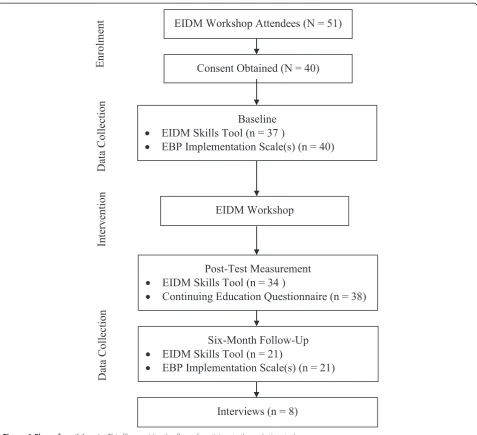
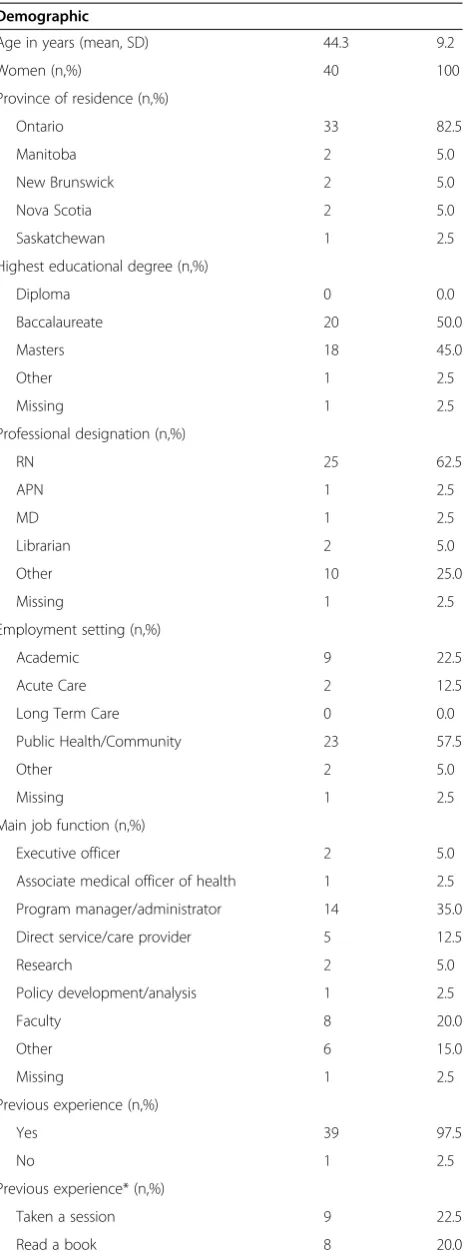
Of the 51 EIDM Workshop attendees, 40 attendees con-sented to participate in this study (Figure 1). Table 1 provides an overview of the demographic information for the participants, while Table 2 provides the response rate of the participants at each time point in the study for quantitative data collection. The majority of partici-pants were female, from Ontario, Canada, and worked in public health. There was however, representation from other provinces which is historically typical of the EIDM workshop. In addition to participants in public health, participants also included faculty from McMaster University or its partner sites (Conestoga College and Mohawk College), nurses, advanced practice nurses, and librarians.
Just over half of the participants reported having a baccalaureate degree as their highest degree, with ap-proximately 46% of participants having master’s degree. An overwhelming majority of the participants reported having previous experience with EIDM, however the degree of experience varied. Among participants, 30% reported taking an undergraduate course and 22.5% re-ported taking a graduate course that included EIDM, 12.5% reported taking a similar workshop about EIDM, and 7.5% reported participating in a journal club.
Change in EIDM knowledge and skills
There was a significant increase in EIDM knowledge and skills from baseline to post-test measurement and baseline to six-month follow-up. On average total EIDM knowledge and skills score increased by 5.6 points [95% CI (3.7 to 7.4), P< 0.001] from baseline to post-test measurement and by 3.7 points from baseline to six-month follow-up [95% CI (2.1 to 5.3),P< 0.001] (Tables 3 and 4). From post-test measurement to six-month follow-up there was, however, a significant decrease in EIDM knowledge and skills [−1.9, 95% CI (−3.5 to−0.3),
EIDM knowledge and skills retained over time for par-ticipants (n = 15) was 43.7% (range =−46.5% to 97.7%).
Change in EIDM behaviours
There was a non-significant increase in EIDM behav-iours from baseline to six-month follow-up. Scores on the EBP Implementation scales increased from 14.48 at baseline to 16.0 at post-test measurement [1.7, 95% CI (−0.3 to 3.8),P0.095] (Tables 3 and 4).
Relationship between EIDM knowledge and skills and EIDM behaviours
Results showed a non-significant, weak positive correl-ation between EIDM knowledge and skills and EIDM behaviours at baseline (r= 0.29, P 0.069) and six-month follow-up (r= 0.24,P0.136).
Preferences for continuing education
At the end of the EIDM workshop, 97% of the partici-pants completing the quantitative survey about prefer-ences for continuing education indicated that they would be interested in participating in continuing educa-tion following the workshop. Among those who partici-pated in the interviews conducted after the six-month follow-up quantitative data collection (n = 8), this will-ingness to participate in continuing education remained a theme among the majority of participants. Only one interviewee expressed that he/she, personally, would not benefit from continuing education.
In terms of content, there was some disconnect be-tween areas that participants indicated they wanted to better understand at the end of the workshop versus six-months after attending the workshop. At the end of the
workshop, participants wanted more review of all of the topics covered in the workshop; but at six months they wanted new content related to critical appraisal of other types of studies.
At the end of workshop and after six-months following the workshop, participants preferred one to two day workshops. At six months, respondents preferred that these workshops occur at their organization. In terms of online continuing education, strategies such as webcasts, online learning modules, and discussion boards were identified at both time points. Although spending one to two hours at a time for online strategies was identified at both time points, six-months following the workshop there was a much broader range in participants’ prefer-ences. Preferences varied depending on the time ex-pected for preparation and participation, as well as and the method of delivery of the content (i.e. didactic versus interactive). Half of the participants completing the quantitative survey at the end of the workshop indicated that they would participate about once per month; how-ever six-months afterwards participants were reporting longer intervals of six weeks to three months.
Interviews also explored perceived barriers and facili-tators to participating in continuing education. Reported barriers and facilitators varied by the delivery method, but common themes included time, geography, and rele-vance. Within the theme of time, participants indicated that their participation in sessions would be influenced by length of time for the sessions and the ability to com-mit to the time for the session due to workload and other commitments. In terms of geography, participants expressed that the location of face-to-face sessions or the time zone differences for online learning should be considered. Lastly, participants identified that the ses-sions would need to be relevant and support continued development of knowledge and skills required in func-tions associated with their employment, in order to participate.
Discussion
An increase in the EIDM knowledge and skills following an educational workshop in this study is consistent with findings of previous systematic reviews [16,32-34]. These
Table 1 Demographic and other characteristics
Demographic
Age in years (mean, SD) 44.3 9.2
Women (n,%) 40 100
Province of residence (n,%)
Ontario 33 82.5
Manitoba 2 5.0
New Brunswick 2 5.0
Nova Scotia 2 5.0
Saskatchewan 1 2.5
Highest educational degree (n,%)
Diploma 0 0.0
Baccalaureate 20 50.0
Masters 18 45.0
Other 1 2.5
Missing 1 2.5
Professional designation (n,%)
RN 25 62.5
APN 1 2.5
MD 1 2.5
Librarian 2 5.0
Other 10 25.0
Missing 1 2.5
Employment setting (n,%)
Academic 9 22.5
Acute Care 2 12.5
Long Term Care 0 0.0
Public Health/Community 23 57.5
Other 2 5.0
Missing 1 2.5
Main job function (n,%)
Executive officer 2 5.0
Associate medical officer of health 1 2.5
Program manager/administrator 14 35.0
Direct service/care provider 5 12.5
Research 2 5.0
Policy development/analysis 1 2.5
Faculty 8 20.0
Other 6 15.0
Missing 1 2.5
Previous experience (n,%)
Yes 39 97.5
No 1 2.5
Previous experience* (n,%)
Taken a session 9 22.5
Read a book 8 20.0
Table 1 Demographic and other characteristics (Continued)
Taken a workshop 5 12.5
Taken an undergraduate course 12 30.0
Taken a graduate course 9 22.5
Participated in a journal club 3 7.5
Taught as a tutor 5 12.5
reviews included educational workshops delivered as stand-alone workshops or as part of a multifaceted inter-vention in populations largely representative of medical students, interns, or residents. Although these reviews suggest that there is substantial evidence that knowledge improves following educational workshops, there is a lack of information about similar improvements in skills [32]. It remains challenging to apply the findings of this study to previous studies given the range of in-terventions to promote EIDM knowledge and skills and the numerous tools to measure EIDM knowledge and skills [25].
This study considered an intensive educational work-shop delivered to a broad range of professionals working within health care, including nurses, public health pro-fessionals, and librarians, and other studies with simi-lar populations and interventions support the finding that educational workshops promote EIDM knowledge [35-38]. Using similar designs Shuval and colleagues [37] and Awonuga and colleagues [35] found signifi-cant improvements in knowledge immediately after their workshops which were approximately one day in duration among primary care physicians and varied health professionals, respectively. A randomized con-trol trial by Forsetlund and colleagues [36] revealed that public health physicians who attended a one to five day workshop also had significant change in know-ledge about sources of information and EIDM con-cepts at the end of the workshop than participants who did not attend the workshops. In addition to evaluating knowledge, Taylor and colleagues [38] also evaluated critical appraisal skills relevant to systematic reviews following a half-day workshop among a varied group of health professionals. Although the intervention re-sulted in significant increase in knowledge, only skills in appraising the results of systematic reviews - and not the methodology or relevance/generalizability – improved significantly.
A positive retention of EIDM knowledge and skills over time was also demonstrated in this study. Despite a lack of studies conducted in comparable populations with a similar content focus, interventions, and out-comes, general educational research supports the finding in this study that approximately half of the EIDM know-ledge and skills originally learned was remembered by participants. A higher percentage relative to studies in general education, the percentage of knowledge retained in this study may be explained by active learning strat-egies used in the workshop, the significant increase in learning during the workshop reflected in the change from baseline to post-test measurement, and a relatively short retention interval of 6 months. What is not known, is the degree to which learning that occurred following the workshop may have also positively influenced the EIDM knowledge and skill retention of participants [39].
Despite a significant increase in EIDM knowledge and skills and a positive retention of EIDM knowledge and skills over time, this study did not demonstrate similar improvement in EIDM behaviours following an educa-tion workshop. Although this finding is consistent with those of the primary studies by Forsetlund and colleagues [35] and Taylor and colleagues [37], it is not consistent with those of recent systematic reviews which suggest that educational workshops result in small to moderate improvements in EIDM behaviours [8,9,33,40]. Similar to the evidence for changes in EIDM knowledge and skills, these recent systematic reviews also are largely representative of physician populations (including medical students, interns, and residents) and include comparisons of educational workshop interventions that may have been components of multi-faceted interventions.
As an intervention, the intensive educational work-shop delivered in this study was aimed primarily at over-coming a barrier to engaging in EIDM behaviours, lack of EIDM knowledge and skills. There are possible expla-nations for a lack of significant change in EIDM behav-iours. First, given the small sample size, insufficient power could have precluded finding a significant change
Table 2 Response rates at baseline, post-test, and six-month follow-up
Baseline n (%)
Post-test n (%)
Six-month follow-up n (%)
EIDM Knowledge/ Skills
37 (92.5%)
34 (85.0%)
21 (52.5%)
EIDM Behaviours 40 (100%) n/a 21 (52.5%)
Table 3 Total scores at baseline, post-test, and six-month follow-up [mean (SD)] (N = 40)
Baseline Post-test Six-month follow-up
EIDM Knowledge/Skills 9.5 (3.4) 15.1 (5.2) 13.2 (5.1)
EIDM Behaviours 14.5 (11.9) 16.2 (11.3)
Table 4 Mean differences in total scores over time (N = 40)
Mean difference
95% CI P
Baseline- to Post-Test
EIDM Knowledge/Skills 5.6 (3.7 to 7.4) < 0.001
Post-Test to Six-Month Follow-up
EIDM Knowledge/Skills −1.9 (−3.5 to−0.3) 0.018
Baseline to Six-Month Follow-up
EIDM Knowledge/Skills 3.7 (2.1 to 5.3) < 0.001
EIDM Behaviours 1.7 (−3.8 to 0.3) 0.095
in EIDM behaviours. In addition, it is also possible that participants over-reported engaging in EIDM behaviours at baseline. Although over-reporting may be a limitation of self-reported measures, in this study it is likely that through the week-long workshop participants gained insight as to what is entailed in the EIDM behaviours they were being asked about. For example, one of the questions on the EBP Implementation Scales asks partic-ipants how many times they have ‘critically appraised evidence from a research study.’At baseline participants may have perceived that they were engaged in ‘critically appraising’ research evidence, but as a result of the week-long workshop they gained a better understanding of the criteria for critical appraisal of various types of re-search evidence and how to apply this criteria. Similar observations of variations in perceptions have been re-ported by knowledge brokers working with similar types of decision makers as the participants in this study [41]. We also hypothesized that there would be a positive re-lationship between EIDM knowledge and skills and EIDM behaviours– the more knowledge and skills pro-fessionals have the more frequently they will engage in EIDM behaviours. Although a positive relationship was demonstrated, it was not statistically significant and the possible over-reporting of EIDM behaviours may also explain this finding.
The willingness to participate in continuing education was evident immediately following the week-long work-shop and remained evident after six-months following the workshop. Preferences for the time and frequency of online continuing education strategies appeared to shift during this timeframe. These findings are helpful for de-signing and implementing interventions to promote EIDM knowledge, skills, and behaviours.
Given the limitations, the generalizability of the find-ings of this study should be interpreted with a degree of caution. First, participants represent a small convenience sample. Furthermore, qualitative interviews were con-ducted with participants who agreed to be interviewed which precluded the ability for data collection to con-tinue until saturation occurred. Participants were also motivated and supported by their institution as they were attending a week-long intensive educational work-shop that was associated with a cost (either paid by themselves or their employer) and time away from work (for the most part, paid leave). Originally the researchers had intended to use possible attendees who were wait-listed for the workshop as a control group, but all at-tendees who expressed interest in the workshop were enrolled in the workshop. Although the absence of a control group could affect the change at post-test and six-month follow-up, it is much more of a serious threat to the assessment at the six-month follow-up. Without a control group, therefore, it is possible that the significant
increase in knowledge and skills from baseline to six-month follow-up could have been due to factors other than the EIDM workshop, such as receiving additional support following the EIDM workshop to promote EIDM knowledge and skills. For example, participants included faculty responsible for teaching students EIDM knowledge and skills and practitioners working at a local public health unit that provided and EIDM journal club for those attending the EIDM workshop. In addition, EIDM behaviours were measured using a tool with documented validity and reliability [31], but were self-reported and not objectively measured.
Conclusions
This study contributes to the evidence that short (one week) educational workshops promote the retention of EIDM knowledge and skills over time among a broad range of health professionals. The findings demonstrat-ing a non-significant change in EIDM behaviours, how-ever, are difficult to interpret. Future research is needed to determine if educational workshops, delivered as stand-alone workshops or as part of multifaceted inter-ventions that provide continuing education, are effective for sustaining EIDM knowledge and skills and promot-ing EIDM behaviours. When designpromot-ing and implement-ing future interventions to promote EIDM knowledge, skills, and behaviours, barriers and facilitators for con-tinuing education interventions should be considered. Sustaining EIDM knowledge and skills may, in turn, pro-mote the capacity of health professionals to engage in EIDM behaviours. Using research evidence when making practice and policy decisions can, in turn, lead to posi-tive patient outcomes.
Additional files
Additional file 1:EIDM Workshop Session Topic Areas, Aims, and Resources This file provides an overview of the topics, aims, and resources used to deliver the EIDM Workshop intervention.
Additional file 2:Interview guide.This file provides the Interview Guide that was used to conduct interviews with participants.
Abbreviations
ANOVA:Analysis of variance; CCEBN: Centre for Evidence Based Nursing; EBP: Evidence based practice; EIDM: Evidence-informed decision making; PICO: Population, intervention, comparison, outcome.
Competing interests
The authors declare that they have no competing interests.
Authors' contributions
Acknowledgements
The authors would like to acknowledge the Canadian Centre for Evidence Based Nursing which provided the in-kind funding for this study.
Received: 7 November 2012 Accepted: 8 January 2014 Published: 17 January 2014
References
1. Straus S, Tetroe J, Graham ID:Knowledge to action: what is it and what it isn’t. InKnowledge translation in health care: Moving from evidence to practice.Edited by Straus S, Tetroe J, Graham ID. Oxford, UK: Blackwell Publishing; 2009:3–6.
2. Ciliska D, Thomas H, Buffet C:An introduction to evidence-informed public health and a compendium of critical appraisal tools for public health practice.National Collaborating Centre for Methods and Tools2008. http://www.nccmt.ca/pubs/2008_07_CompendiumToolENG.pdf. 3. Dobbins M, Hanna S, Ciliska D, Manske S, Cameron R, Mercer SL, O’Mara L,
DeCorby K, Robeseon P:A randomized controlled trial evaluating the impact of knowledge translation and exchange strategies.Implement Sci2009,4:61. 4. LaPelle NR, Luckmann R, Simpson EH, Martin ER:Identifying strategies to improve access to credible and relevant information for public health professionals: a qualitative study.BMC Public Health2006,6:89–101. 5. Bero LA, Grilli R, Grimshaw JM, Harvey E, Oxman AD, Thomson MA:Closing
the gap between research and practice: an overview of systematic reviews of interventions to promote the implementation of research findings.Br Med J1998,317:465–468.
6. Boaz A, Baeza J, Fraser A, the European Implementation Score Collaborative Group:Effective implementation of research into practice: an overview of systematic reviews of the health literature. BMC Research Notes2011,4:212.
7. Flodgren G, Parmelli E, Doumit G, Gattellari M, O'Brien MA, Grimshaw J, Eccles MP:Local opinion leaders: effects on professional practice and health care outcomes.Cochrane Database Syst Rev2011,8.
8. Forsetlund L, Bjørndal A, Rashidian A, Jamtvedt G, O’Brien MA, Wolf FD, Odgaard-Jensen J, Oxman AD:Continuing education meetings and workshops: effects on professional practice and health care outcomes. Cochrane Database Syst Rev2009,2.
9. Grimshaw JM, Shirran L, Thomas R, Mowatt G, Fraser C, Bero L, Grilli R, Harvey E, Oxman A, O'Brien MA:Changing provider behavior: an overview of systematic reviews of interventions.Med Care2001,39(Suppl 2):II-2–II-45.
10. Grimshaw JM, Thomas RE, MacLennan G, Fraser C, Ramsay CR, Vale L, Whitty P, Eccles MP, Matowe L, Shirran L, Wensing M, Dijkstra R, Donaldson C: Effectiveness and efficiency of guideline dissemination and implementation strategies.Health Technol Assess2004,8:6. 11. Heselmans A, Van de Velde S, Donceel P, Aertgeerts B, Ramaekers D:
Effectiveness of electronic guideline-based implementation systems in ambulatory care settings: a systematic review.Implement Sci2009,4:182. 12. Jamtvedt G, Young JM, Kristoffersen DT, O’Brien MA, Oxman AD:Audit and feedback: effects on professional practice and health care outcomes. Cochrane Database Syst Rev2006,2.
13. O’Brien MA, Rogers S, Jamtvedt G, Oxman AD, Odgaard-Jensen J, Kristoffersen DT, Forsetlund L, Bainbridge D, Freemantle N, Davis D, Haynes RB, Harvey E:Educational outreach visits: effects on professional practice and health care outcomes.Cochrane Database Syst Rev2007,4. 14. Shojania KG, Jennings A, Mayhew A, Ramsay C, Eccles M, Grimshaw J:Effect of
point-of-care computer reminders on physician behaviour: a systematic review.Can Med Assoc J2010,182:5.
15. Squires JE, Hutchinson AM, Boström A, O’Rourke HM, Cobban SJ, Estabrooks CA: To what extent do nurses use research in clinical practice? A systematic review.Implement Sci2011,6:21.
16. Taylor R, Reeves B, Ewings P, Binns S, Keast J, Mears R:A systematic review of the effectiveness of critical appraisal skills training for clinicians.Med Educ2000,34:120–125.
17. Thomas LH, Cullum NA, McColl E, Rousseau N, Soutter J, Steen N:Effect of clinical guidelines in nursing, midwifery, and the therapies: a systematic review of evaluations.Qual Health Care1998,7:183–191.
18. Thomas LH, Cullum NA, McColl E, Rousseau N, Soutter J, Steen N:Guidelines in professions allied to medicine.Cochrane Database Syst Rev2009,1:. 19. Thompson DS, Estabrooks CA, Scott-Findlay S, Moore K, Wallin L:
Interven-tions aimed at increasing research use in nursing: a systematic review. Implement Sci2007,2:1.
20. Graham I, Logan J, Harrison MB, Straus SE, Tetroe J, Caswell W, Robinson N: Lost in knowledge translation: time for a map?J Contin Educ Health Prof 2006,26:13–24.
21. Lavis JN, Robertson D, Woodside JM, McLeod CB, Abelson J, Knowledge Transfer Study Group:How can research organizations more effectively transfer research knowledge to decision makers?Milbank Q2003,81:221–248. 22. National Collaborating Centre for Methods and Tools:Fact sheet: A model
for evidence-informed decision making in public health.http://www.nccmt.ca/ pubs/FactSheet_EIDM_EN_WEB.pdf.
23. Cresswell JW, Plano-Clark VL:Choosing a mixed methods study design. In Designing and conducting mixed methods research.Edited by Straus S, Tetroe J, Graham ID. Thousand Oaks, CA: Sage Publications; 2007:58–88.
24. Tilson JK, Kaplan SL, Harris JL, Hutchinson A, Ilic D, Niederman R, Potomkova J, Zwolsman SE:Sicily statement on classification and development of evidence-based practice learning assessment tools.BMC Med Educ2011,11:78. 25. Shaneyfelt T, Baum KD, Bell D, Feldstein D, Houston TK, Kaatz S, Whelan C,
Green M:Instruments for evaluating education in evidence-based practice: a systematic review.JAMA2006,296:1116–1127. 26. Ramos KD, Schafer S, Tracz SM:Validation of the Fresno test of
competence in evidence based medicine.BMJ2003,326:319–321. 27. McCluskey A, Bishop B:The Adapted Fresno Test of competence in
evidence-based practice.J Contin Educ Health Prof2009,29:119–126. 28. Fritsche L, Greenhalgh T, Falck-Ytter Y, Neumayer HH, Kunz R:Do short
courses in evidence based medicine improve knowledge and skills? Validation of Berlin questionnaire and before and after study of courses in evidence based medicine.Br Med J2002,325:1338–1341.
29. Lewis LK, Williams MT, Olds TS:Development and psychometric testing of an instrument to evaluate cognitive skills of evidence based practice in student health professionals.BMC Med Educ2011,11:77.
30. DiCenso A, Bayley L, Haynes RB:Accessing pre-appraised evidence: fine-tuning the 5S model into a 6S model.Evid Based Nurs2009,12:99–101.
31. Melynk B, Fineout-Overholt E, Mays MZ:The evidence-based practice beliefs and implementation scales: psychometric properties of two new instruments. Worldviews Evid Based Nurs2008,5:208–216.
32. Coomarasamy A, Taylor R, Khan K:A systematic review of postgraduate teaching in evidence-based medicine and critical appraisal.Med Teach 2003,25:77–81.
33. Flores-Mateo G, Argimon JM:Evidence based practice in postgraduate healthcare education: a systematic review.BMC Health Serv Res2007,26:119. 34. Horsley T, Hyde C, Santesso N, Parkes J, Milne R, Stewart R:Teaching critical
appraisal skills in healthcare settings.Cochrane Database Syst Rev2011,11:. 35. Awonuga AO, Dwarakanath LS, Johanson R, Hyde C, Taylor K, Khan S:
Critical appraisal workshops to promote evidence-based healthcare. J Obstet Gynaecol2000,20:10–14.
36. Forsetlund L, Bradley P, Forsen L, Nordheim L, Jamtvedt G, Bjørndal A: Randomised controlled trial of a theoretically grounded tailored intervention to diffuse evidence-based public health practice.BMC Med Educ2003,3:2.
37. Shuval K, Berkovits E, Netzer D, Hekselman I, Linn S, Brezis M, Reis S: Evaluating the impact of an evidence-based medicine educational intervention on primary care doctors' attitudes, knowledge and clinical behaviour: a controlled trial and before and after study.J Eval Clin Pract 2007,13:581–598.
38. Taylor RS, Reeves BC, Ewings PE, Taylor RJ:Critical appraisal skills training for health care professionals: a randomized controlled trial.BMC Med Educ2004,4:30.
39. Semb GB, Ellis JA:Knowledge taught in school: what is remembered.Rev Educ Res1994,64:253–286.
40. Horsley T, O'Neill J, McGowan J, Perrier L, Kane G, Campbell C: Interventions to improve question formulation in professional practice and self-directed learning.Cochrane Database Systematic Reviews2010,5:. 41. Robeson P, Dobbins M, DeCorby K:Life as a knowledge broker in public
health.Journal of the Canadian Health Libraries Association2008,29:79–82.
doi:10.1186/1472-6920-14-13
Cite this article as:Yostet al.:Evaluating the impact of an intensive education workshop on evidence-informed decision making knowledge, skills, and behaviours: a mixed methods study.BMC Medical Education