University of Pennsylvania
ScholarlyCommons
Publicly Accessible Penn Dissertations
1-1-2013
Distributed Algorithms for the Optimal Design of
Wireless Networks
Yichuan Hu
University of Pennsylvania, [email protected]
Follow this and additional works at:
http://repository.upenn.edu/edissertations
Part of the
Electrical and Electronics Commons
This paper is posted at ScholarlyCommons.http://repository.upenn.edu/edissertations/876 For more information, please [email protected].
Recommended Citation
Hu, Yichuan, "Distributed Algorithms for the Optimal Design of Wireless Networks" (2013).Publicly Accessible Penn Dissertations. 876.
Distributed Algorithms for the Optimal Design of Wireless Networks
Abstract
This thesis studies the problem of optimal design of wireless networks whose operating points such as powers,
routes and channel capacities are solutions for an optimization problem. Different from existing work that rely
on global channel state information (CSI), we focus on distributed algorithms for the optimal wireless
networks where terminals only have access to locally available CSI. To begin with, we study random access
channels where terminals acquire instantaneous local CSI but do not know the probability distribution of the
channel. We develop adaptive scheduling and power control algorithms and show that the proposed algorithm
almost surely maximizes a proportional fair utility while adhering to instantaneous and average power
constraints. Then, these results are extended to random access multihop wireless networks. In this case, the
associated optimization problem is neither convex nor amenable to distributed implementation, so a problem
approximation is introduced which allows us to decompose it into local subproblems in the dual domain. The
solution method based on stochastic subgradient descent leads to an architecture composed of layers and
layer interfaces. With limited amount of message passing among terminals and small computational cost, the
proposed algorithm converges almost surely in an ergodic sense. Next, we study the optimal transmission over
wireless channels with imperfect CSI available at the transmitter side. To reduce the likelihood of packet losses
due to the mismatch between channel estimates and actual channel values, a backoff function is introduced to
enforce the selection of more conservative coding modes. Joint determination of optimal power allocations
and backoff functions is a nonconvex stochastic optimization problem with infinitely many variables.
Exploiting the resulting equivalence between primal and dual problems, we show that optimal power
allocations and channel backoff functions are uniquely determined by optimal dual variables and develop
algorithms to find the optimal solution. Finally, we study the optimal design of wireless network from a game
theoretical perspective. In particular, we formulate the problem as a Bayesian game in which each terminal
maximizes the expected utility based on its belief about the network state. We show that optimal solutions for
two special cases, namely FDMA and RA, are equilibrium points of the game. Therefore, the proposed game
theoretic formulation can be regarded as general framework for optimal design of wireless networks.
Furthermore, cognitive access algorithms are developed to find solutions to the game approximately.
Degree Type
Dissertation
Degree Name
Doctor of Philosophy (PhD)
Graduate Group
Electrical & Systems Engineering
First Advisor
Roch Guerin
Keywords
DISTRIBUTED ALGORITHMS FOR THE OPTIMAL DESIGN OF
WIRELESS NETWORKS
Yichuan Hu
A DISSERTATION
in
Electrical and Systems Engineering
Presented to the Faculties of the University of Pennsylvania
in
Partial Fulfillment of the Requirements for the
Degree of Doctor of Philosophy
2013
Supervisor of Dissertation
Alejandro Ribeiro, Assistant Professor of Electrical and Systems Engineering
Graduate Group Chairperson
Saswati Sarkar, Professsor of Electrical and Systems Engineering
Dissertation Committee
Roch Guerin, Professsor of Computer Science and Engineering
ABSTRACT
DISTRIBUTED ALGORITHMS FOR THE OPTIMAL DESIGN OF WIRELESS NETWORKS
Yichuan Hu
Alejandro Ribeiro
This thesis studies the problem of optimal design of wireless networks whose operating
points such as powers, routes and channel capacities are solutions for an optimization problem.
Different from existing work that rely on global channel state information (CSI), we focus on
dis-tributed algorithms for the optimal wireless networks where terminals only have access to locally
available CSI. To begin with, we study random access channels where terminals acquire
instanta-neous local CSI but do not know the probability distribution of the channel. We develop adaptive
scheduling and power control algorithms and show that the proposed algorithm almost surely
maximizes a proportional fair utility while adhering to instantaneous and average power
con-straints. Then, these results are extended to random access multihop wireless networks. In this
case, the associated optimization problem is neither convex nor amenable to distributed
imple-mentation, so a problem approximation is introduced which allows us to decompose it into local
subproblems in the dual domain. The solution method based on stochastic subgradient descent
leads to an architecture composed of layers and layer interfaces. With limited amount of
mes-sage passing among terminals and small computational cost, the proposed algorithm converges
almost surely in an ergodic sense. Next, we study the optimal transmission over wireless
chan-nels with imperfect CSI available at the transmitter side. To reduce the likelihood of packet losses
due to the mismatch between channel estimates and actual channel values, a backoff function is
introduced to enforce the selection of more conservative coding modes. Joint determination of
optimal power allocations and backoff functions is a nonconvex stochastic optimization problem
problems, we show that optimal power allocations and channel backoff functions are uniquely
determined by optimal dual variables and develop algorithms to find the optimal solution.
Fi-nally, we study the optimal design of wireless network from a game theoretical perspective. In
particular, we formulate the problem as a Bayesian game in which each terminal maximizes the
expected utility based on its belief about the network state. We show that optimal solutions for
two special cases, namely FDMA and RA, are equilibrium points of the game. Therefore, the
proposed game theoretic formulation can be regarded as general framework for optimal design
of wireless networks. Furthermore, cognitive access algorithms are developed to find solutions
Contents
1 Introduction 1
1.1 Background . . . 2
1.1.1 Random access wireless channels . . . 2
1.1.2 Random access wireless networks . . . 4
1.2 Roadmap . . . 7
2 Distributed algorithms for optimal random access channels 10 2.1 Problem formulation . . . 13
2.2 Adaptive algorithms for optimal random access channels . . . 15
2.2.1 Problem decomposition and its dual . . . 15
2.2.2 Adaptive algorithms using stochastic subgradient descent . . . 18
2.2.3 Structure of the optimal primal solution . . . 25
2.3 Numerical results . . . 29
2.3.1 System with instantaneous power constraint . . . 30
2.3.2 System with average power constraint . . . 32
2.4 Summary . . . 35
2.5 Appendices . . . 37
3 Distributed algorithms for optimal random access networks 41
3.1 Problem formulation . . . 42
3.1.1 Optimal operating point . . . 42
3.1.2 Problem approximation . . . 43
3.2 Distributed stochastic learning algorithm . . . 44
3.2.1 Stochastic subgradient descent . . . 46
3.2.2 Network operation, layers, and layer interfaces . . . 51
3.2.3 Message passing . . . 54
3.2.4 Successive convex approximation . . . 56
3.3 Feasibility and optimality . . . 57
3.3.1 Proof of Theorem 3 . . . 59
3.4 Numerical results . . . 67
3.5 Summary . . . 71
3.6 Appendices . . . 72
3.6.1 Proof of Lemma 1 . . . 72
3.6.2 Proof of Lemma 3 . . . 75
4 Optimal wireless communications with imperfect CSI 77 4.1 Point-to-point channels . . . 80
4.1.1 Ergodic rate optimization . . . 82
4.1.2 Optimal power allocation and channel backoff functions . . . 84
4.1.3 Online learning algorithms . . . 86
4.2 Orthogonal frequency division multiplexing . . . 89
4.2.1 Optimal solution . . . 92
4.2.2 Online learning algorithms . . . 95
4.3.1 Optimal solution . . . 101
4.3.2 Online learning algorithms . . . 104
4.4 Numerical results . . . 107
4.4.1 Point-to-point channel . . . 107
4.4.2 Downlink OFDM channel . . . 110
4.4.3 Uplink RA channel . . . 113
4.5 Summary . . . 114
4.6 Appendices . . . 115
4.6.1 Proof of null duality gap of problem (4.7) . . . 115
5 Cognitive access algorithms for wireless communications 117 5.1 Cognitive access algorithm for multiple access channel . . . 118
5.1.1 Multiple access channel without power control . . . 121
5.1.2 Multiple access channel with power control . . . 130
5.2 Cognitive access algorithm for wireless networks . . . 136
5.3 Numerical results . . . 140
List of Tables
List of Figures
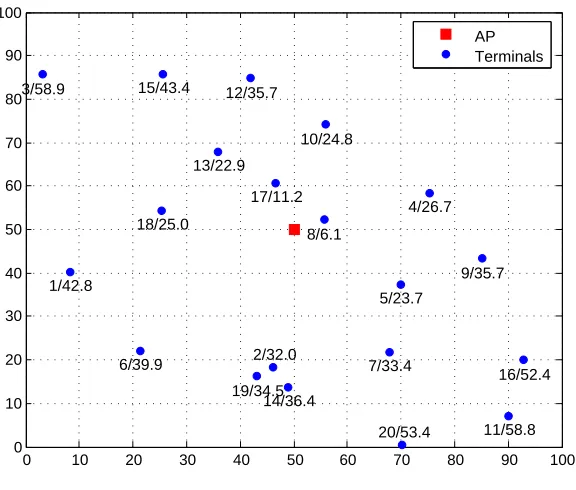
2.1 An example multiple access channel withn = 20nodes communicating with a
common access point (AP). Nodes are randomly placed in a 100 m×100 m square
and the AP is located at the center of the square. Nodes’ labels represent indexes
and distances to the AP. Subsequent numerical experiments use this realization of
the random placement. . . 29
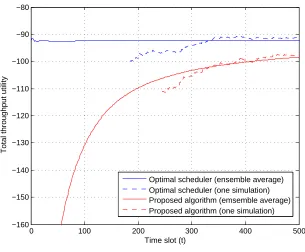
2.2 Convergence of the proposed algorithm to near optimal utility with instantaneous
power constrains but no average power constraints. Throughput utility of the
pro-posed adaptive algorithm and of the optimal offline scheduler are shown as
func-tions of time for one realization and for the ensemble average of realizafunc-tions. In
steady state the adaptive algorithm operates with minimal performance loss with
respect to the optimal offline scheduler. A utility gap smaller than 10 is achieved
in about 350 iterations. Power constraintpinst
i = 100mW, step size= 0.1, capacity
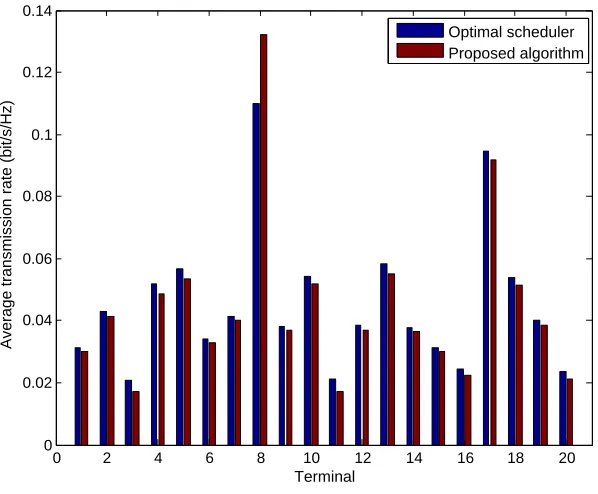
2.3 Average transmission rates (bits/s/Hz) in 500 time slots, i.e.,r¯i(500)as defined in
(2.40), for all terminals. The optimal offline scheduler and the proposed adaptive
algorithm yield similar close to optimal average rates. The variation in achieved
rates is commensurate with the variation in average signal to noise ratios (SNRs)
due to different distances to the access point. For the network in Fig.2.1 and the
pathloss and power parameters used here, average signal to noise ratios vary
be-tween 0.4 and 10. Instantaneous power constraintpinst
i = 100mW, step size= 0.1,
capacity achieving codes. . . 33
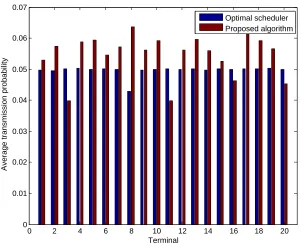
2.4 Average transmission probabilities in 500 time slots for all terminals. Offline and
adaptive optimal schedulers shown. Despite different channel conditions all
ter-minals transmit with a similar probability close to1/n = 0.05. This is consistent
with the use of a logarithmic, i.e., proportional fair, utility. Instantaneous power
constraintpinst
i = 100mW, step size= 0.1, capacity achieving codes. . . 34
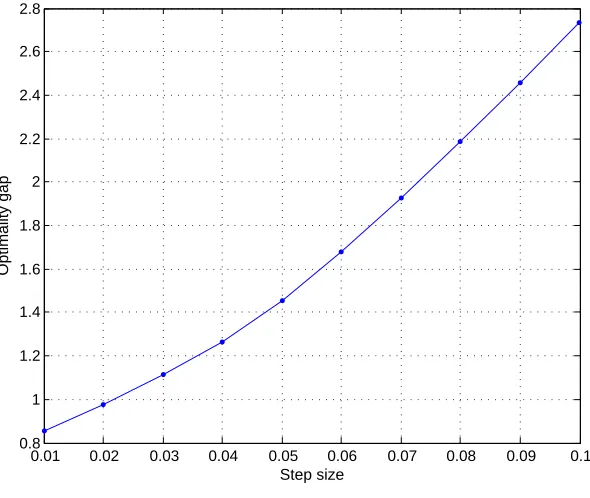
2.5 Steady state optimality gap between proposed adaptive algorithm and optimal
offline scheduler as a function of step size. Values ofbetween10−2and10−3
shown. As the step size decreases, the optimality gap decreases. The optimality
gap can be made arbitrarily small by reducing. Instantaneous power constraint
pinst
i = 100mW, capacity achieving codes. . . 35
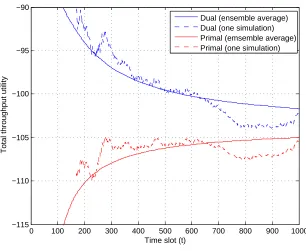
2.6 Primal and dual objectives when instantaneous and average power constraints
are in effect. One realization and ensemble average of realizations shown. As
time grows the duality gap decreases, eventually approaching a small positive
constant and implying near optimality of the achieved rates. Instantaneous power
constraintpinst
i = 100mW, average power constraintp
avg
i = 5mW, step size= 0.1,
adaptive modulation and coding withM = 4modes with ratesτ1= 1bits/s/Hz,
τ2= 2bits/s/Hz,τ3= 3bits/s/Hz, andτ4= 4bits/s/Hz and transitions at SNRs
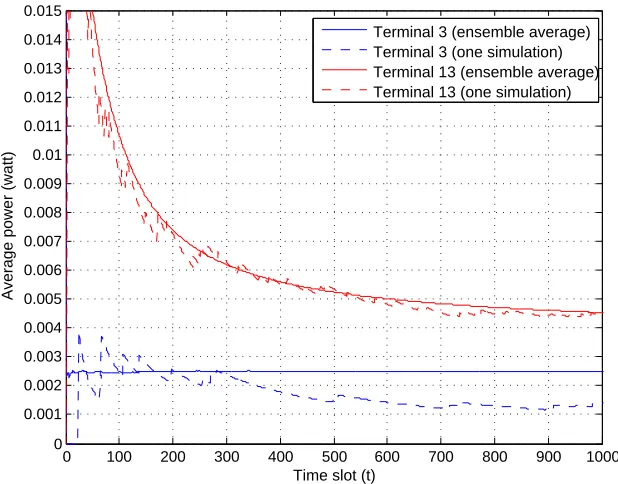
2.7 Average power consumption for terminals 3 and 13, i.e.,p¯3(t)andp¯13(t)as defined
in (2.41). Average power constraints pavgi = 5mW are satisfied as time grows. Powerp¯3(t)consumed by Terminal 3 is smaller than the allowed budgetpavg3 due
to unfavorable channel conditions. Terminal 13 adheres to its power budget after
approximately 600 iterations. Parameters as in Fig. 2.6 . . . 37
2.8 Instantaneous power allocationspi(t)for terminalsi= 3andi= 13plotted against
the channel realizationhi(t). Notice that the channel axes scales are different in (a)
and (b). In both cases, no power is allocated when channel realizations are bad.
Terminal 3 uses only the AMC mode with the lowest rateτ1= 1bits/s/Hz, while
Terminal 13 uses two modes with ratesτ2 = 2bits/s/Hz andτ3 = 3bits/s/Hz.
This happens because Terminal 13, being closer to the AP, has a better average
channel than Terminal 3. Parameters as in Fig. 2.6. . . 38
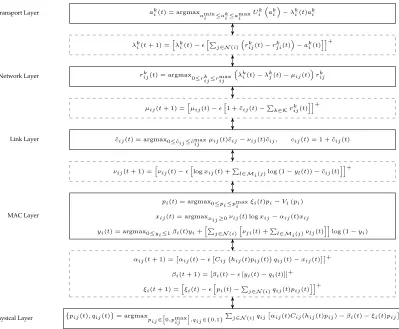
3.1 Layers and layer interfaces. The stochastic subgradient descent algorithm in terms
of layers and layer interfaces. Layers maintain primal variablesak
i(t),rkij(t),˜cij(t),
pij(t),qij(t)as well as auxiliary variablespi(t),xij(t), andyi(t)while multipliers
λk
i(t), µij(t), νij(t),αij(t), βi(t) andξi(t)are associated with interfaces between
adjacent layers. Primal variables can be easily computed based on multipliers
from interfaces to adjacent layers and dual variables are updated using
informa-tion from adjacent layers. . . 51
3.2 Queue dynamics. Terminal i operates by controlling queues in different layers
based on operating pointsak
i(t),rijk(t),cij(t),pij(t)andqij(t). In the transport layer
and the network layer, each flowkhas a queue. In the link layer and the physical
layer, each outgoing link(i, j)maintains a queue. In this particular example, there
are two flowsk1andk2 and there are two neighboring nodesj1andj2. Packets
3.3 Message passing. (a) Terminalibegins by transmitting dual variablesλk i(t)and
νij(t)to all neighbors j ∈ N(i). (b) It then computes and shares Pk∈N(i)νki(t)
with allj ∈ N(i). This information, along with locally available multipliers, is
then used to perform the primal iterations associated with all the layers in Fig.3.1.
(c) Terminalipasses primal variablesyi(t)andrijk(t)to all neighborsj∈ N(i). (d)
It then evaluates and broadcastsPk∈N(i)yk(t)toj ∈ N(i). Dual updates
associ-ated with the layer interfaces in Fig.3.1 are now performed using these and locally
accessible primal variables. We proceed to (a) for the next iteration. . . 54
3.4 Connectivity graph of a network with n = 15 terminals randomly placed in a
square with side L = 100meters. Terminals can communicate with neighbors
whose distances are within 30 meters. The numbers on each edge shows the
dis-tance (in meters) between two communicating terminals. . . 67
3.5 Feasibility. After about 500 steps, all constraints are satisfied in an ergodic sense
within 10−2 tolerance. The average rate constraint takes the longest time to be
satisfied. This is because the transmission rate on linkTi →Tj depends not only
on schedules and powers ofTi but also on those ofTj and neighbors ofTj. This
requires information to be received from, and propagated to, 2-hop neighbors. . . 69
3.6 (a) Optimality. As time grows, primal and dual objectives approach each other.
(b) Correlation between Q1(t)and Q6(t). At the beginning, there is significant
correlation betweenQ1(t)andQ6(t). But as time grows, the correlation vanishes
and becomes negligible. . . 70
4.1 Optimal power allocation functionP∗(ˆh)(left) and channel backoff functionB∗(ˆh)
(right) for single user point-to-point channel. Curves shown for channel state
in-formation (CSI) varianceσ2
e = 0.1,σ2e = 0.1, andσ2e = 0, corresponding to perfect
CSI. As CSI variance increases power allocation is more conservative for small
channel values. When the CSI variance is large, the backoff function selects codes
of a higher rate than what is dictated by the channel estimate. Channel coefficient
follows a complex Gaussian distributionCN(0,2), average power budgetP0= 1,
and channel conditional pdfmh|ˆhas in (4.9). . . 109
4.2 Convergence of average transmission rate (left) and average power consumption
(right) for Algorithm 2. Average transmission rate as a function of time is shown
for Algorithm 2 and cases in which only the backoff function is optimized –
mean-ing p(t) = P0 – or only the power allocation function is optimized – implying
b(t) = ˆh(t). Joint optimization yields substantial increase of average
communica-tion rate. Average power budgetP0= 1, constant step size= 0.01, and channel
estimation errorσ2
e = 0.1. . . 111
4.3 Rate (left) and power (right) convergence of Algorithm 3. Sum of average
trans-mission rates is shown for Algorithm 3 and two suboptimal solutions. One case
uses a backoff function with fixed outage probability 0.01 and the other case
op-timizes power allocation only – implyingbf
n(t) = ˆhfn(t). Joint optimization yields
substantial increase of average communication rate. Average power budgetP0 =
4, constant step size= 0.01, and channel estimation errorσ2
4.4 Rate (left) and power (right) convergence of Algorithm 4. Proportional fair
util-ity of average transmission rates is shown for Algorithm 4 and two suboptimal
solutions in which only the backoff function – meaningpn(t) = P0,n – or only
the power allocation function – implying bn(t) = ˆhn(t) – are optimized. Joint
optimization yields substantial increase of average communication rate. Average
power budgetP0,n= 1(right), constant step size= 0.01, and channel estimation
errorσ2
e = 0.1. . . 113
5.1 Comparison of the expected sum rate utility achieved by the optimal FDMA (ρ=
1), the optimal RA (ρ = 0) and the proposed algorithm (ρ ∈ {0,0.1,0.2,· · ·,1}).
The total number of terminals isn= 10. . . 141
5.2 The expected sum rate utility achieved by the proposed algorithm normalized by
that achieved by the optimal FDMA forn= 10andn= 50. The horizontal line is
1/e≈0.368. . . 142
5.3 The expected sum rate utility achieved by the proposed algorithm for differentρ.
For all cases, the expected utility increases as the total number of terminals grows. 143
5.4 Comparison of the average sum rate utility of the network achieved by the optimal
FDMA (ρ= 1), the RA (ρ= 0) and the proposed algorithm (ρ∈ {0,0.1,0.2,· · ·,1}).
Chapter 1
Introduction
Optimal design is emerging as the future paradigm for wireless networking. The fundamental
idea is to select operating points as solutions of optimization problems, which, inasmuch as
opti-mization criteria are properly chosen, yield the best possible network. Results in this field include
architectural insights, e.g., [9], and protocol design, e.g., [13, 22], but a drawback shared by most
of these works is that they rely on global channel state information (CSI); i.e., the optimal
vari-ables of a terminal depend on the channels between all pairs of terminals in the network. While
availability of global CSI is plausible in certain situations, it is unlikely to hold if time varying
fading channels are taken into account. In this case, distributed algorithms in which terminals
operate based on locally available CSI are more practical. The focus of this thesis is to develop
distributed algorithms for the optimal design of wireless networks.
When only local CSI is available, operating variables of each terminal are selected as functions
of local CSI. This further leads to the selection of random access as the natural medium access
choice. Indeed, if transmission decisions depend on local channels only and these channels are
random and independent for different terminals, transmission decisions can be viewed as
ran-dom and resultant link capacities as limited by collisions. In this chapter, we present an overview
1.1
Background
1.1.1
Random access wireless channels
Consider a multiple access channel withnterminals contending to communicate with a common
AP. Time is divided in slots identified by an indext. We assume a backlogged system, i.e., all
ter-minals always have packets to transmit in each time slot. The time-varying nonnegative channel
hi(t) ∈R+ between terminaliand the AP at timetis modeled as block fading – for this to be
true the length of a time slot has to be comparable to the coherence time of the channel. Channel
gainshi(t1)andhi(t2)of terminaliat different time slotst1 6=t2are assumed independent and
identically distributed (i.i.d.) with pdfmhi(·). Channel gainshi(t)andhj(t)of different terminals
i6=jare also assumed independent. Channels are assumed to have continuous pdf. This latter
assumption holds true for models used in practice, e.g., Rayleigh, Rician and Nakagami [14, Ch.
3]. We assume each terminal i has access to its channel gain hi(t) at each time slot t. While
there are various alternatives to obtain channel state information, the simplest would be for the
AP to send a beacon signal at the beginning of each time slot. This beacon signal would serve
the double purpose of providing a reference for channel estimation as well as a synchronization
signal.
Based on its channel statehi(t), nodeidecides whether to transmit or not in time slot tby
determining the value of a scheduling functionqi(t) := Qi(hi(t)) : R+ → {0,1}. Nodei
trans-mits in time slot tif qi(t) = 1 and remains silent ifqi(t) = 0. Notice that each terminal has a
different scheduling function and that schedulesqi(t)are determined based on the CSI of each
node independently of other terminals. Although each node has access to its local CSIhi(t), the
underlying pdfmhi(·)is unknown.
Besides channel access decisions, terminals also adapt transmission power to their channel
gains through a power control functionPi(hi(t)) :R+ →[0, pinsti ], wherepinsti ∈R+is a constant
adjusts its transmission powerPi(hi(t))in response tohi(t). Similar toqi(t), we definepi(t) :=
Pi(hi(t)), representing the power allocated to nodeiin time slott. If nodeitransmits in time
slott,pi(t)andhi(t)jointly determine the transmission rate through a functionCi(hi(t)pi(t)) :
R+ →R+. The exact form ofCi(hi(t)pi(t))depends on how the signal is modulated and coded
at the physical layer. Examples considered later in the thesis include capacity-achieving codes
and adaptive modulation and coding (AMC). With capacity-achieving codes,Ci(hi(t)pi(t))takes
the form
Ci(hi(t)pi(t)) =Blog
1 + hi(t)pi(t)
BN0
, (1.1)
whereBandN0are the channel bandwidth and the power spectral density of the channel noise,
respectively. With AMC, there areM transmission modes available. Themth mode affords
com-munication rateτmand is used when the signal to noise ratio (SNR)hi(t)pi(t)/BN0is between
ηmandηm+1. The rate function is therefore
Ci(hi(t)pi(t)) = M
X
m=1
τmI
ηm≤
hi(t)pi(t)
BN0
≤ηm+1
, (1.2)
whereI(·)denotes the indicator function. To keep the analysis general we do not restrict
Ci(hi(t)pi(t))to take either specific form. It is only assumed thatCi(hi(t)pi(t))is a nonnegative
increasing function of the product ofhi(t)andpi(t)that takes finite values for finite arguments.
These assumptions are satisfied by (1.1) and (1.2) and are likely to hold in practice.
Since terminals contend for channel access, transmission of terminaliin a time slottis
suc-cessful if and only ifqi(t) = 1and qj(t) = 0for all j 6= i. If the transmission of terminali is
successful, its transmission rate is determined byCi(hi(t)pi(t)). As as consequence, the
instanta-neous transmission rate for terminaliin time slottis
ri(t) =Ci(hi(t)pi(t))qi(t) n
Y
j=1,j6=i
[1−qj(t)]. (1.3)
be-havior ofri(t). This implies that system performance is determined by the ergodic limits
ri:= lim t→∞
1
t
t
X
u=1
ri(u)
= lim
t→∞
1
t
t
X
u=1
Ci(hi(u)pi(u))qi(u) n
Y
j=1,j6=i
[1−qj(u)]
. (1.4)
Assuming ergodicity of schedulesqi(t) = qi(hi(t))and power allocationspi(t) = pi(hi(t)), the
limitrican be written as a expected value over channel realizations,
ri=Eh
Qi(hi)Ci(hiPi(hi)) n
Y
j=1,j6=i
[1−Qj(hj)]
, (1.5)
where we have defined the vectorh = [h1,· · ·, hn]T grouping all channelshi. An important
observation here is that since terminals are required to make channel access and power control
decisions independently of each other,Qi(hi)andPi(hi)are independent ofQj(hj)andPj(hj)
for alli6=j. This allows us to rewriterias
ri=Ehi[Qi(hi)Ci(hiPi(hi))]
n
Y
j=1,j6=i
1−Ehj[Qj(hj)]
. (1.6)
In addition to instantaneous power constraintspi(t)≤pinsti , terminals adhere to average power
constraintspavgi ∈R+as in, e.g., [8]. This average power constraint restricts the long term average
of transmitted power that we either write as an ergodic limit or as an expectation over channel
realizations,
pi:= lim t→∞
1
t
t
X
u=1
qi(u)pi(u) =Ehi[Qi(hi)Pi(hi)]. (1.7)
1.1.2
Random access wireless networks
Consider an ad-hoc wireless network consisting ofJ terminals indexed asi= 1, . . . J. Network
connectivity is modeled as a graphG= (V,E)with verticesv∈ V :={1, . . . , J}representing theJ
terminals and edgese= (i, j)∈ Econnecting pairs of terminals that can communicate with each
other. Denote the neighborhood of terminaliasN(i) :={j|(i, j)∈ E}and define the interference
can interfere with a transmission fromi toj. The network supports a setK := {1, . . . , K} of
end-to-end flows through multihop transmission. The average rate at whichk-flow packets are
generated atiis denoted byak
i. Terminalitransmits these packets to neighboring terminals at
average ratesrk
ij and, consequently, receivesk-flow packets from neighbors at average ratesrjik.
To conserve flow, exogenous ratesak
i and endogenous ratesrkijat terminalimust satisfy
aki ≤
X
j∈N(i)
rkij−rjik
, for alli∈ V, andk∈ K. (1.8)
Further denote the capacity of the link fromi →j ascij. Since packets of different flowskare
transmitted fromitojat ratesrk
ij it must be
X
k∈K
rkij ≤cij, for all(i, j)∈ E. (1.9)
Unlike wireline networks wherecij are fixed, link capacities in wireless networks are dynamic.
Similar to what we did in Section 1.1.1, let time be divided into slots indexed by tand denote
the channel betweeniandjat timetashij(t). The channel is assumed to be block fading and
channel gainshij(t)of link(i, j)are assumed independent and identically distributed with
prob-ability distribution function (pdf)mhij(·). For reference, define the vector of terminalioutgoing
channels hi(t) := {hij(t)|j ∈ N(i)}and the vector of all channels h(t) := {hij(t)|(i, j) ∈ E}.
Denote their pdfs asmhi(·)andmh(·), respectively.
Based on the channel statehi(t)of his outgoing links, terminalidecides whether to transmit
or not on link(i, j)in time slot t by determining the value of a scheduling functionqij(t) :=
Qij(hi(t))∈ {0,1}. Ifqij(t) = 1, terminalitransmits on link(i, j)and remains silent otherwise.
Further defineqi(t) :=Qi(hi(t)) :=Pj∈N(i)Qij(hi(t))to indicate a transmission fromito any of
his neighbors. We restrictito communicate with, at most, one neighbor per time slot implying
that we must haveqi(t)∈ {0,1}. We emphasize thatqij(t) :=Qij(hi(t))depends on local
outgo-ing channels only and not on global CSI. Further note that terminals have access to instantaneous
local CSIhi(t)but underlying pdfsmhi(·)are unknown.
a power control functionpij(t) := Pij(hi(t))taking values in[0, pinstij ]. Here,pinstij represents the
maximum allowable instantaneous power on link(i, j). The average power consumed by
termi-naliis then given as the expected value over channel realizations of the sum ofPij(hi)over all
j ∈ N(i), i.e.,
pi≥Ehi
X
j∈N(i)
Pij(hi)Qij(hi)
, (1.10)
where we also relaxed the equality constraint to an inequality, which can be done without loss
of optimality. If terminal i transmits to node j in time slott, pij(t)and hij(t)determine the
transmission rate through a function Cij(hij(t)pij(t))whose form depends on modulation and
coding.
Due to contention, a transmission fromitojat timetsucceeds if a collision does not occur.
In turn, this happens if: (i) Terminali transmits toj, i.e., qij(t) = 1. (ii) Terminalj is silent,
i.e.,qj(t) = 0. (iii) No other neighbor ofj transmits, i.e. ql(t) = 0for alll ∈ N(j)andl 6= i.
Recalling the definition of interference neighborhoodMi(j)and that if a transmission occurs its
rate isCij(hij(t)pij(t))we express the instantaneous transmission rate fromitoj in time slott
ascij(t) :=cij(hi(t)) =Cij(hij(t)pij(t))qij(t)Ql∈Mi(j)[1−ql(t)]. Assuming an ergodic mode of
operation, the capacity of linki→jcan then be written as
cij=Eh
Cij(hijPij(hi))Qij(hi)
Y
l∈Mi(j)
[1−Ql(hl)]
. (1.11)
Because terminals are required to make channel access and power control decisions
indepen-dently of each other, Qij(hi)andPij(hi)are independent ofQlm(hl)andPlm(hl)for alli 6= l.
SinceQl(hl) :=Pm∈N(l)Qlm(hl(t))by definition, it follows thatQij(hi)is also independent of
Ql(hl)for alli6=l. This allows us to write the expectation of the product on the right hand side
of (1.11) as a product of expectations,
cij ≤Ehi
Cij
hijPij(hi)
Qij(hi)
Y
l∈Mi(j)
1−Ehl
Ql(hl)
where we also relaxed the equality constraint to an inequality, which can be done without loss of
optimality1.
The operating point of a wireless network is characterized by variables ak
i, rijk,cij, pi and
functions Pij(hi), Qij(hi). Besides (1.8)-(1.12), these variables are subject to certain box
con-straints. Admission variables, have lower and upper bounds due to application layer
require-ments, i.e.,amin
i ≤ aki ≤amaxi . Similarly, routing variables, link capacities, and terminal power
budgets cannot be negative and are also subject to given upper bounds, i.e., 0 ≤ rk
ij ≤ rijmax,
0 ≤ cij ≤ cmaxij , and0 ≤pi ≤ pmaxi . Furthermore, according to definition, Pij(hi)andQij(hi)
can only take values from[0, pinst
ij ]and{0,1}, respectively. For notational simplicity, we define
vectorsxi :=
pi, akij, rkij, cij :∀j ∈ N(i) andPi(hi) := {Pij(hi), Qij(hi) :∀j∈ N(i)}to group
all the variables related to terminaliand summarize these box constraints as{xi,Pi(hi)} ∈ Bi
with
Bi:=
xi,Pi(hi)
amini ≤aki ≤aimax, 0≤rkij ≤rijmax,
0≤cij ≤cmaxij , 0≤pi≤pmaxi , 0≤Pij(hi)≤pinstij ,
Qij(hi)∈ {0,1}, Qi(hi)∈ {0,1}
. (1.13)
1.2
Roadmap
Our first investigation focuses on random access channel where terminals contend for
commu-nicating with a the central AP. This models the physical layer of the wireless random access
network we shall study later on. We develop adaptive scheduling and power control algorithms
for random access in a multiple access channel where terminals acquire instantaneous channel
1If we have channel reciprocityh
ij(t) =hji(t), the derivation of (1.12) from (1.11) is no longer valid since power
control and channel access functions of neighboring nodes will have common arguments implying thatQij(hi)and
Qji(hj)would not be independent. The general methodology used here seems applicable but is beyond the scope of the
state information but do not know the probability distribution of the channel [16]. In each time
slot, terminals measure the channel to the common access point. Based on the observed
chan-nel value, they determine whether to transmit or not and, if they decide to do so, adjust their
transmitted power. We show that the proposed algorithm almost surely maximizes a
propor-tional fair utility while adhering to instantaneous and average power constraints. These results
are presented in Chapter 2.
We then generalize the algorithm proposed for random access channel to wireless multihop
networks where each node determines its operating point using its local CSI distributedly [17].
Since the associated optimization problem is neither convex nor amenable to distributed
imple-mentation, a problem approximation is introduced. This approximation is still not convex but it
has zero duality gap and can be solved and decomposed into local subproblems in the dual
do-main. The solution method is through a stochastic subgradient descent algorithm that operates
without knowledge of the fading’s probability distribution and leads to an architecture
com-posed of layers and layer interfaces. With limited amount of message passing among terminals
and small computational cost, we show that the proposed algorithm converges almost surely in
an ergodic sense. These results are presented in Chapter 3.
Both above proposed algorithms require terminals to adapt transmission parameters such as
power and rate to time-varying channel conditions to improve system’s overall performance.
Al-though accurate CSI is essential to achieve this goal, perfect CSI is rarely available in practice due
to estimation errors and, perhaps more fundamentally, to feedback delay. Our next topic is to
de-velop algorithms to handle imperfect CSI in the transmission over wireless channels [18]. In
par-ticular, we consider three types of wireless channels, namely single user point-to-point block
fad-ing channels [15], multiuser downlink orthogonal frequency division multiplexfad-ing (OFDM) [38],
and multiuser uplink random access (RA) [29], where the transmitter adapt transmitted power
and coding mode to imperfect channel estimates in order to maximize expected throughput
between channel estimates and actual channel values, a backoff function is further introduced to
enforce the selection of more conservative coding modes. Joint determination of optimal power
allocations and backoff functions is a nonconvex stochastic optimization problem with infinitely
many variables that despite its lack of convexity is part of a class of problems with null duality
gap. Exploiting the resulting equivalence between primal and dual problems, we show that
op-timal power allocations and channel backoff functions are uniquely determined by opop-timal dual
variables. This affords considerable simplification because the dual problem is convex and finite
dimensional. We further exploit this reduction in computational complexity to develop iterative
algorithms to find optimal operating points. These results are presented in Chapter 4.
So far the distributed algorithms we developed are based on local CSI only (either perfect
or imperfect). In practice, terminals may have knowledge about channels of neighboring nodes
in addition to local CSI. This motivates us to investigate wireless networks where each terminal
has a different belief about the global channel states and adapts its transmission policy to the
belief. In this setting, frequency division multiple access (FDMA) and channel aware random
access (RA) are two special cases where perfect global and local CSI are available, respectively.
To find solutions for general cases, we formulate the problem as a Bayesian game in which each
terminal maximizes the expected utility based on its belief. We show that optimal solutions for
both FDMA and RA are equilibrium points of the game. Therefore, the proposed game theoretic
formulation can be regarded as general framework for multiuser wireless communications.
Fur-thermore, we develop a cognitive access algorithm that solves the problem approximately. These
Chapter 2
Distributed algorithms for optimal
random access channels
In this chapter, we consider wireless random access channels in which terminals contend for
ac-cess to a common acac-cess point (AP) as introduced in Section 1.1.1. To exploit favorable channel
conditions terminals adapt their transmitted power and access decisions to the state of the
ran-dom fading channels linking them to the AP. The challenges in developing this adaptive scheme
are that terminals have access to their own channel state information (CSI) only, and that the
probability distribution function (pdf) of the fading channel is unknown. Our goal is to develop
a distributed learning algorithm to determine optimal transmitted power and channel access
decisions relying on local CSI only.
The idea of adapting medium access and power control to CSI has been extensively explored
in wireless communications. Early references dealing with power adaptation on the uplink of
multiuser systems focus on centralized power control schemes where the AP collects channel
states for all terminals to select the one to be scheduled. In, e.g., [19], the AP schedules the
have also been used for scheduling and resource allocation in broadcast downlink channels, see
e.g., [3, 11, 23]. Although these centralized schemes exploit multiuser diversity, they require
sig-nificant information exchange between terminals and the AP; a problem exacerbated when the
number of users is large. To avoid this overhead, recent work integrates channel adaptation into
random access protocols. Exploiting the idea of aligning schedules to good channel
opportuni-ties, [29] develops a distributed channel-aware Aloha protocol in which terminals transmit only
when their channel gains exceed pre-defined thresholds. This algorithm is shown to be
asymp-totically optimal in the sense that the only performance loss compared to a centralized scheme is
due to user contention.
Under simple collision models, it has been shown that distributed threshold-based schedulers
with properly designed thresholds maximize total throughput of a network with homogeneous
users and total logarithmic throughput in the case of heterogeneous users [50]. Similar
threshold-based decentralized adaptive random access schemes have been investigated for other types of
networks with different packet reception models, see e.g., [1, 6, 25, 27, 30, 46, 51]. To compute
the optimal thresholds, however, terminals are assumed to know the probability distribution of
their fading channels. This is a restrictive assumption because the channel fading distribution is
usually unknown and can only be estimated based on channel observations. Overcoming this
limitation motivates the development of adaptive algorithms to learn optimal operating points
based on local CSI [4, 37]. The work in [4] proposes a heuristic adaptive algorithm for
threshold-based schedulers in which the thresholds are tuned threshold-based on local channel realizations in a time
window. The work in [37] develops an online learning algorithm for transmission probability
and power control under rate constraints using game-theoretic approaches. However, neither [4]
nor [37] guarantees global optimality.
The contribution of this chapter is the development of an optimal distributed adaptive
algo-rithm for scheduling and power control given that terminals only have access to local CSI and
and decide whether to transmit or not. If they decide to transmit, they choose a power for their
communication attempt. As time progresses, power budgets are satisfied almost surely, while the
network almost surely maximizes a weighted proportional fair utility. We remark that terminals
operate independently without access to the channel state of other terminals and that the channel
pdf is unknown. The proposed algorithm can handle general non-convex, even discontinuous,
rate functions with manageable computational complexity. It is worth noting that under the
frame work of network utility maximization (NUM) algorithms for computing optimal channel
access probabilities in random access networks are developed (see e.g. [21]). However, neither
fading nor power adaptation is considered in these work.
The presentation begins by formulating optimal adaptive random access as a utility
max-imization problem whose objective is to maximize a weighted sum of throughput logarithms
(Section 2.1). The variables to be determined as a solution of this optimization problem are a
scheduling function that determines if a terminal should transmit or not based on its CSI, and
a power allocation function that maps a terminal CSI to its transmit power. It is important to
remark that: (i) because fading takes on a continuum of values, this optimization problem is
infinite-dimensional; (ii) the constraints modeling random access are non-convex; (iii) despite
the existence of these non-convex constraints optimization problems of this form are known to
have null duality gap [33]; and (iv) since the number of constraints turns out to be finite the
op-timization problem is finite-dimensional in the dual domain. A further complication is that the
original problem formulation yields solutions that require access to global CSI.
We start by overcoming the dependence on global CSI by introducing an equivalent
decompo-sition in per-terminal subproblems whereby nodes maximize local utilities (Section 2.2.A). While
this reformulation yields solutions that depend on local CSI only, attempting a solution in the
primal domain is difficult because the per-terminal subproblems inherit infinite dimensionality
and lack of convexity from the original problem formulation, as well as the need to have access to
a stochastic subgradient descent algorithm in the dual domain (Section 2.2.B). Based on channel
realizations in each time slot, the algorithm computes instantaneous values for the scheduling
and power allocation functions and updates Lagrangian multipliers in a direction that can be
proven to point towards the set of optimal dual variables in an average sense (Proposition 1).
Exploiting this fact we prove that the throughput utility achieved by the algorithm almost surely
converges to a value close to the optimal utility. The gap between the optimal and the achieved
utility can be made arbitrarily small by reducing a fixed step size (Theorem 1). The chapter closes
with a numerical evaluation of the proposed algorithm for a randomly generated heterogeneous
network (Section 2.3). To illustrate generality of the proposed approach we consider a system
with terminals employing capacity achieving codes (Section 2.3.1) and a more practical scenario
with nodes employing adaptive modulation and coding (Section 2.3.2). Concluding remarks are
presented in Section 2.4.
2.1
Problem formulation
Consider a random access channel as introduced in Section 1.1.1. With ratesri given as in (1.6),
our objective is to maximize a weighted proportional fair (WPF) utility defined as
U(r) =
n
X
i=1
wilog(ri), (2.1)
wherer= [r1,· · · , rn]T is the vector of rates andwi∈R+is the weight coefficient for terminali.
Settingwi=wjfor alli6=jin a homogenous system with all channels having the same pdf, the
WPF utility is equivalent to maximizing the sum of throughputs. In a heterogeneous network
where channel pdfs vary among users, maximizing U(r) yields solutions that are fair since it
prevents users from having very low transmission rates.
access is formulated as the following optimization problem
P = max U(r)
s.t. ri=Ehi[Qi(hi)Ci(hiPi(hi))]
n
Y
j=1,j6=i
1−Ehj[Qj(hj)]
,
Ehi[Qi(hi)Pi(hi)]≤p
avg
i ,
Qi(hi)∈ Q, Pi(hi)∈ Pi,∀i (2.2)
whereQis the set of functionsR+ → {0,1}taking values on{0,1}andPirepresents the set of
functionsR+→[0, pinst
i ]taking values on[0, pinsti ]. Notice that the joint optimization across users
required to solve (2.2) introducesfunctionaldependence between the actions of different
termi-nals. This is not incongruent with the requirement ofstatisticallyindependent schedules in each
time slot. In fact, the notationsQi(hi)andPi(hi)in (2.2) stipulates that terminals are required
to make channel access and power allocation decisions based on local CSI only. Consequently,
although problem (9) requires joint optimization across users, it restricts optimization to policies
that result in statistically independent operations.
The goal of this chapter is to develop an online algorithm to determine schedulesqi(t)and
power assignments pi(t)having statistics that solve the optimization problem in (2.2). The
al-gorithm is required to: (i) operate without knowledge of the channel distribution; and (ii) yield
functionsqi(t)andpi(t)that depend on the current and past values of the local channelhi(t)but
are independent of other terminal’s channelshj(t)forj6=i.
Remark 1. In order to allow terminals to know if their transmissions are successful or not, the AP provides feedback on whether the transmission attempt was successful or a collision detected. If a terminal transmits
a packet but detects a collision, it can reschedule the packet for retransmission in a subsequent time slot.
We remark that feedback does not introduce correlation between the transmission decisions of different
terminals. The provided feedback only tells terminals if they should retransmit previous packets or not, but
2.2
Adaptive algorithms for optimal random access channels
The stated goal is to devise scheduling and power control policies based on local CSI that are
globally optimal as per (2.2). These two objectives, i.e., global optimality while relying on local
CSI, seem to contradict each other. Becauseri depends not only onQi(hi)and Pi(hi)but on
Qj(hj)for allj 6=i, it seems that optimalQi(hi)andPi(hi)solving (2.2) might also be functions
of other terminals’ CSI. To see that this is not the case, we will show that it is possible to
decom-pose (2.2) in per terminal subproblems. After introducing this decomposition the complicating
fact that the channel pdf fhi(hi)is unknown remains. To overcome this complication, we will
introduce a stochastic subgradient descent algorithm in the dual domain that is optimal in an
ergodic sense.
2.2.1
Problem decomposition and its dual
Begin then by separating (2.2) in per terminal subproblems. To do so, we substitute (1.6) into
(2.1) and express the logarithm of a product as a sum of logarithms. As a result, the global utility
in (2.1) can be rewritten as
U(r) =
n
X
i=1
wi
logEhi[Qi(hi)Ci(hiPi(hi))] +
n
X
j=1,j6=i
log1−Ehj[Qj(hj)]
. (2.3)
Note that each summand in (2.3) only involves variables related to a particular node. Thus, we
can reorder summands in (2.3) to group all of the terms pertaining to nodei. Further defining
˜
wi:=Pnj=1,j6=iwi, we can rewrite (2.3) as
U(r) =
n
X
i=1
wilog [Ehi[Qi(hi)Ci(hiPi(hi))]] + ˜wilog [1−Ehi[Qi(hi)]]
:=
n
X
i=1
Ui, (2.4)
where we have defined the local utilities Ui. SinceUi only involves variables that are related
to terminal i, it can be regarded as a utility function for terminali. To maximizeU(r)for the
whole system it suffices to separately maximize Ui for each terminal i. Introducing auxiliary
the following per terminal subproblems
Pi = maxwilogxi+ ˜wilog(1−yi)
s.t. xi≤Ehi[Qi(hi)Ci(hiPi(hi))],
yi≥Ehi[Qi(hi)],
Ehi[Qi(hi)Pi(hi)]≤p
avg
i ,
xi≥0,0≤yi≤1, Qi(hi)∈ Q, Pi(hi)∈ Pi, (2.5)
where we relaxed the equality constraints to inequality ones which can be done without loss of
optimality. Finding optimal solutions of (2.5) for all terminalsi is equivalent to solving (2.2).
Different from (2.2), however, there is no coupling between variables of different terminals in
(2.5). This property leads naturally to optimalQi(hi)andPi(hi)that are independent of other
terminals’ CSI as required by problem definition. Alas, (2.5) inherits the complex structure of
(2.2).
As is the case with (2.2), solving (2.5) is difficult because: (i) The optimization space in (2.5)
includes functionsQi(hi)andPi(hi)that are defined onR+, implying that the dimension of the
problem is infinite. (ii) The rate functionCi(hiPi(hi))is in general non-concave with respect to
hiPi(hi), and may be even discontinuous as in (1.2). (iii) The constraints involve expected values
over random variableshiwhose pdfs are unknown.
An important observation is that the number of constraints in (2.5) is finite. This implies that
while there are infinite variables in the primal domain, there are a finite number of variables
in the dual domain. This observation suggests that (2.5) is more tractable in the dual space.
Introduce then Lagrange multipliersλi= [λi1, λi2, λi3]T associated with the first three inequality
constraints in (2.5); define vectorsxi := [xi, yi]T andPi(hi) := [Qi(hi), Pi(hi)]T; and write the
Lagragian of the optimization problem in (2.5) as
+λi2[yi−Ehi[Qi(hi)]] +λi3
pavgi −Ehi[Qi(hi)Pi(hi)]
=λi3pavgi + [wilogxi−λi1xi] + [ ˜wilog(1−yi) +λi2yi]
+Ehi[Qi(hi) [λi1Ci(hiPi(hi))−λi2−λi3Pi(hi)]]. (2.6)
where the second equality follows after reordering terms in the first equation. Notice that the
first term in the second equality in (2.6) depends onxionly, the second term onyiand the third
term onPi(hi)andQi(hi). This property is exploited later on. The dual function is then defined
as the maximum of the Lagrangian over the set of feasiblexiandPi(hi), i.e.,
gi(λi) := max Li(xi,Pi(hi),λi)
s.t. xi≥0,0≤yi≤1, Qi(hi)∈ Q, Pi(hi)∈ Pi. (2.7)
We now can write the dual problem as the minimum ofgi(λi)over positive dual variables, i.e.,
Di = min
λi≥0
gi(λi). (2.8)
In general, the optimal dual valueDi of (2.8) provides an upper bound for the optimal primal
valuePi of (2.5), i.e.,Di ≥ Pi. While the inequality is typically strict for non-convex problems,
for the problem in (2.5)Pi=Dias long as the fading distribution has no realization with positive
probability [33]. Notice that this is true despite the non-convex constraints present in (2.5). This
lack of duality gap implies that the finite dimensional convex dual problem is equivalent to the
infinite dimensional nonconvex primal problem. While this affords a substantial improvement
in computational tractability, it does not necessarily mean that solving the dual problem is easy
because evaluation of the dual function’s value requires maximization of the Lagrangian. In
particular, this maximization includes an expected value over the unknown channel distribution
fhi(hi). Still, convexity of the dual function allows the use of descent algorithms in the dual
domain because any local optimal solution is a global optimal solutionλ∗i = [λ∗
i1, λ∗i2, λ∗i3]T. This
property is exploited next to develop a stochastic subgradient descent algorithm that solves (2.8)
2.2.2
Adaptive algorithms using stochastic subgradient descent
Instead of directly finding optimal xi, yi, Qi(hi)and Pi(hi) for the primal problem (2.5), the
proposed algorithm exploits the lack of duality gap to use a stochastic subgradient descent in the
dual domain. Starting from given dual variablesλi(t), the algorithm computes instantaneous
primal variablesxi(t),yi(t),qi(t)andpi(t)based on channel realizationhi(t)in time slott, and
uses these values to update dual variables λi(t+ 1). Specifically, the algorithm starts finding
primal variables that optimize the summands of the Lagrangian in (2.6) (the operator[·]+denotes
projection in the positive orthant)
xi(t) = argmax xi≥0
{wilogxi−λi1(t)xi}=
wi
λi1(t)
, (2.9)
yi(t) = argmax
0≤yi≤1
{w˜ilog(1−yi) +λi2(t)yi}=
1− w˜i λi2(t)
+
, (2.10)
{qi(t), pi(t)}= argmax qi∈{0,1},pi∈[0,pinsti ]
{qi[λi1(t)Ci(hi(t)pi)−λi2(t)−λi3(t)pi]}, (2.11)
The maximization in (2.11) determines schedules and transmitted power associated with current
channel realizationhi(t). Sinceqi in (2.11) takes values on{0,1}the objective is either0when
qi = 0orλi1(t)Ci(hi(t)pi)−λi2(t)−λi3(t)piwhenqi = 1. Thus, to solve (2.11) we only need to
find the optimalpi(t)whenqi(t) = 1and see if the resulting objective is greater than 0. Thus, we
can rewrite (2.11) as
pi(t) = argmax pi∈[0,pinsti ]
{λi1(t)Ci(hi(t)pi)−λi2(t)−λi3(t)pi},
qi(t) =H
λi1(t)Ci(hi(t)pi(t))−λi2(t)−λi3(t)pi(t)
, (2.12)
whereH(a)denotes Heaviside’s step function withH(a) = 1fora >0andH(a) = 0otherwise.
Based onxi(t),yi(t),qi(t)andpi(t), define the stochastic subgradientsi(t)= [si1(t), si2(t),si3(t)]T
with components
si1(t) =qi(t)Ci(hi(t)pi(t))−xi(t), (2.13)
si3(t) =pavgi −qi(t)pi(t). (2.15)
The algorithm is completed with the introduction of a constant step sizeand a descent update
in the dual domain along the stochastic subgradientsi(t)
λil(t+ 1) = [λil(t)−sil(t)]+, forl= 1,2,3. (2.16)
Notice that computation of variables in (2.9)-(2.16) does not require information exchanges
be-tween terminals. This guaranteesQi(hi)andPi(hi)to be independent ofQj(hj)andPj(hj)for all
i6=jas required by problem formulation. The proposed algorithm is summarized in Algorithm
1.
To analyze convergence of (2.9)-(2.16) let us start by showing thatsi(t)is indeed a stochastic
subgradient of the dual function as stated in the following proposition.
Proposition 1. Givenλi(t), the expected value of the stochastic subgradientsi(t)is a subgradient of the
dual function in(2.7), i.e.,∀λi≥0,
Ehi
sTi(t)|λi(t)(λi(t)−λi)≥gi(λi(t))−gi(λi). (2.17)
In particular,
Ehi
sTi(t)|λi(t)(λi(t)−λ∗i)≥gi(λi(t))−Di≥0. (2.18)
Proof. See Appendix 2.5.1.
Proposition 1 states that the average of the stochastic subgradient si(t) is a subgradient of
the dual function. We can then think of an alternative algorithm by replacingEhi
si(t)
λi(t)
for
si(t)in the dual iteration step (2.16), which would amount to a subgradient descent algorithm for
the dual function. Since,Ehi
si(t)
λi(t)
points towardsλ∗– the angle betweenEhi
si(t)
λi(t)
andλi(t)−λ∗i is positive as indicated by (2.18) –, it is not difficult to prove thatλi(t)eventually
approachesλ∗i, e.g., [39, Ch. 2]. However, since we assume the pdf ofhiis unknown, the
subgra-dientEhi
si(t)
λi(t)
can only be approximated using past channel realizationshi(1), . . . , hi(t).
Algorithm 1:Adaptive scheduling and power control at terminali
1 Initialize Lagrangian multipliersλi(0);
2 fort= 0,1,2,· · · do
3 Compute primal variables as per (2.9), (2.10), and (2.12):
4 xi(t) =
wi
λi1(t);
5 yi(t) =
1− w˜i λi2(t)
+
;
6 pi(t) = argmax
pi∈[0,pinsti ]
{λi1(t)Ci(hi(t)pi)−λi2(t)−λi3(t)pi};
7 qi(t) =H
λi1(t)Ci(hi(t)pi(t))−λi2(t)−λi3(t)pi(t)
;
8 ifqi(t) = 1then
9 Transmit with powerpi(t);
10 end
11 Compute stochastic subgradients as per (2.13)-(2.15):
12 si1(t) =qi(t)Ci(hi(t)pi(t))−xi(t);
13 si2(t) =yi(t)−qi(t);
14 si3(t) =pavgi −qi(t)pi(t);
15 Update dual variables as per (2.16):
16 λil(t+ 1) = [λil(t)−sil(t)]+, forl= 1,2,3;
The computation of the stochastic subgradientsi(t), on the contrary, is simple because it only
depends on the current channel statehi(t). Furthermore, since si(t)points towards the set of
optimal dual variables λ∗i on average [cf. (2.18)] it is reasonable to expect the stochastic sub-gradient descent iterations in (2.16) to also approachλ∗i in some sense. This can be proved true and leveraged to prove almost sure convergence of primal iteratesxi(t),yi(t),pi(t)andqi(t)to
an optimal operating point in an ergodic sense [31]. Specifically, Theorem 1 of [31] assumes as
hypotheses that the second moment of the norm of the stochastic subgradientsi(t)is finite, i.e.,
Ehi
ksi(t)k2
λi(t)
≤Sˆ2
i, and that there exists a set of strictly feasible primal variables that
sat-isfy the constraints in (2.5) with strict inequality. If these hypotheses are true, primal iterates
of dual stochastic subgradient descent are almost surely feasible in an ergodic sense. For the
particular case of the problem in (2.5), [31, Theorem 1] implies that
lim t→∞ 1 t t X u=1
qi(u)pi(u)≤pavgi a.s., (2.19)
lim t→∞ 1 t t X u=1
xi(u)≤ lim t→∞ 1 t t X u=1
qi(u)Ci(hi(u)pi(u)) a.s., (2.20)
lim t→∞ 1 t t X u=1
yi(u)≥ lim t→∞ 1 t t X u=1
qi(u) a.s. (2.21)
It also follows from [31, Theorem 1] thatxi(t)and yi(t)yield ergodic utilities that are almost
surely withinSˆ2
i/2of optimal, i.e.,
Pi− lim
t→∞ 1 t t X u=1
[wilogxi(u) + ˜wilog(1−yi(u))]≤
Sˆ2
i
2 a.s. (2.22)
From (2.19) we can conclude that the ergodic limit of the power allocated by the proposed
algo-rithm satisfies the average power constraint. However, (2.22) does not imply that the scheduling
and power allocation variablespi(t)andqi(t)are optimal. The optimality claim in (2.22) is for the
auxiliary variablesxi(t)andyi(t)but the goal here is to claim optimality of the scheduling and
power allocation variablespi(t)andqi(t). To prove optimality of the algorithm, we need to show
that the ergodic transmission rateriof (1.4), achieved by allocationsqi(t)andpi(t)is optimal in
If the constraints in (2.5) were satisfied for all timest, i.e., if xi(t) ≤ qi(t)Ci(hi(t)pi(t))and
yi(t)≥qi(t), transforming (2.22) into an almost sure near optimality claim for the ergodic limit
riis a simple matter of substitution and algebraic manipulation. However, these inequalities do
not necessarily hold for all timest. They hold in an ergodic sense as stated in (2.20) and (2.21).
This subtle yet fundamental mismatch is addressed in the proof of the following theorem.
Theorem 1. Consider a random multiple access channel with n terminals using schedulesqi(t) and
power allocations pi(t) generated by the algorithm defined by (2.9)-(2.16) resulting in instantaneous
transmission rates ri(t)as given by(1.3)and ergodic rates ri as defined by (1.4). Define vectorr :=
[r1, . . . , rn]T, and letU(r)be the weighted proportional fair utility in(2.1). Assume that the second
mo-ment of the norm of the stochastic subgradientsi(t)with components as in(2.13)-(2.15)is finite1, i.e.,
Ehi
ksi(t)k2
λi(t)
≤Sˆ2
i, and that there exists a set of strictly feasible primal variables that satisfy the
constraints in(2.5)with strict inequality. Then, the average power constraint is almost surely satisfied
lim
t→∞
1
t
t
X
u=1
qi(u)pi(u)≤pavgi a.s., (2.23)
and the utility of the ergodic limit of the transmission rates almost surely converges to a value within
/2Pni=1Sˆ2
i of optimality,
P−U(r) :=P−
n
X
i=1
wilog lim t→∞
1
t
t
X
u=1
ri(u)
! ≤
2
n
X
i=1 ˆ
Si2. (2.24)
Proof. The hypotheses of Theorem 1 are chosen to satisfy the hypotheses guaranteeing
conver-gence of ergodic stochastic optimization algorithms [31, Theorem 1]. Thus, almost sure feasibility
and almost sure near optimality of iteratesxi(t),yi(t),pi(t)andqi(t)follows in the sense of
(2.19)-(2.22). To establish almost sure satisfaction of average power constraints as per (2.23) just notice
that this inequality coincides with the one in (2.19). To establish (2.24) start by rearranging terms
in (2.22) to conclude thatPi−Sˆi2/2 ≤limt→∞1t
Pt
u=1[wilogxi(u) + ˜wilog(1−yi(u))]. Due to
1The finite assumption of the second moment of the subgradients is necessary for the proof of almost sure near
continuity and concavity of the logarithm function we can further boundPi−Sˆi2/2as
Pi−
Sˆ2
i
2 ≤wilog
" lim t→∞ 1 t t X u=1
xi(u)
#
+ ˜wilog
"
1− lim
t→∞ 1 t t X u=1
yi(u)
#
. (2.25)
The limits in (2.25) are equal to the limits in the left hand sides of the inequalities in (2.20) and
(2.21). Thus, using this almost sure ergodic feasibility resultsPi−Sˆi2/2is bounded as
Pi−
Sˆ2
i
2 ≤wilog
" lim t→∞ 1 t t X u=1
qi(u)Ci(hi(u)pi(u))
#
+ ˜wilog
"
1− lim
t→∞ 1 t t X u=1
qi(u)
#
. (2.26)
Ergodicity, possibly restricted to an ergodic component, allows replacement of the ergodic limits
in (2.27) by the corresponding expected values, leading to the bound
Pi−
Sˆ2
i
2 ≤wilogEhi[Qi(hi)Ci(hiPi(hi))] + ˜wilogEhi[1−Qi(hi)]. (2.27)
Recall thatP=Pni=1Pi per definition, and consider the sum of the inequalities in (2.27) for all
terminalsiso as to write
P−
n
X
i=1
Sˆ2
i
2 ≤
n
X
i=1
wilogEhi[Qi(hi)Ci(hiPi(hi))] + ˜wilogEhi[1−Qi(hi)] ≤
n
X
i=1
wilog
Ehi[Qi(hi)Ci(hi(t)Pi(hi))]
n
Y
j=1,j6=i
Ehj[1−Qj(hj)]
, (2.28)
where the second inequality follows by using the definitionw˜i:=Pnj=1,j6=iwi, reordering terms
in the sum, and rewriting a sum of logarithms as the logarithm of a product.
The fundamental observation in this proof is that the scheduling functionQi(hi)and the
power allocation functionPi(hi)are independent of the correspondingQj(hj)andPj(hj)of other
terminals. This is not a coincidence, but the intended goal of reformulating (2.2) as (2.5). Using
this independence, the product of expectations in (2.28) can be written as single expectation over
the vector channelhto yield
P−
n
X
i=1
Sˆ2
i
2 ≤
n
X
i=1
wilog
Eh
Qi(hi)Ci(hiPi(hi)) n
Y
j=1,j6=i
(1−Qj(hj))
. (2.29)
expectation in (2.29) by an ergodic limit to yield
P−
n
X
i=1
Sˆ2
i
2 ≤
n
X
i=1
wilog
lim
t→∞
1
t
t
X
u=1
qi(u)Ci(hi(u)pi(u)) n
Y
j=1,j6=i
(1−qj(u))
:=U(r), (2.30)
where we have used the definitions of the ergodic rate in (1.4) and of the utility in (2.1). The result
in (2.24) follows after reordering terms in (2.30).
Theorem 1 states that the stochastic dual descent algorithm in (2.9)-(2.16) computes
sched-ulesqi(t)and power allocationspi(t)yielding ratesri(t)that are almost surely near optimal in
an ergodic sense [cf. (2.24)]. It also states thatpi(t)satisfies the average power constraint with
probability 1. Notice that the stochastic dual descent algorithm in (2.9)-(2.16) does not compute
the optimal scheduling and power control functions for each terminal. Rather, it draws schedules
qi(t)and power allocationspi(t)that are close to the optimal functions. This is not a drawback
because the latter property is sufficient for a practical implementation. Further note that the use
of constant step sizesendows the algorithm with adaptability to time-varying channel
distri-butions. This is important in practice because wireless channels are non-stationary due to user
mobility and environmental dynamics. The gap between U(r)and Pcan be made arbitrarily
small by reducing.
Remark 2. The desired optimal schedulesQ∗(h(t))and power allocationsP∗(h(t))as prescribed in Sec-tion 2.1 are funcSec-tions of the current channel realizaSec-tions only. The proposed online policy, however,
com-putes schedulesqi(t)and power allocationspi(t)based on the current channelhi(t)and dual variables
λi(t). In each time slot the iterative policy updatesλi(t)usingλi(t−1)and stochastic subgradientssi(t)
which depend onqi(t),pi(t)andhi(t). As a result, the dual variableλi(t)depends on all previous
chan-nel gains fromhi(0)up tohi(t). Sinceqi(t)andpi(t)are functions ofλi(t), they depend on all previous
channel gains as well. This is not a contradiction because as the algorithm progresses,λi(t)approaches
the optimal multiplierλ∗i, implying that the time-dependent variablesqi(t), pi(t)converge towards the
optimal policyP∗(h(t)), Q∗(h(t)). As a matter of fact,λ
i(t)does not converge toλ∗i, but to a
algorithm’s (arbitrarily small) optimality penalty as stated in Theorem 1.
2.2.3
Structure of the optimal primal solution
While the algorithm in (2.9)-(2.16) provides a method to find the optimal operating point for the
random multiple access channel, it does not provide intuition on the properties of this operating
point. This section studies structural properties of the optimal primal solution.
In convex optimization problems optimal primal variables are obtained as the Lagrangian
maximizers for optimal dual variables. The optimization problem in (2.5) is not convex. This
is not a hindrance because the recovery of optimal primals from optimal duals through
La-grangian maximization follows from the lack of duality gap, which is a property that (2.5) does
possess [33]. Let us then begin by showing that the optimal primal variablesx∗i = [x∗
i, y∗i]T and
P∗i(hi) = [Q∗i(hi), Pi∗(hi)]T of the primal problem in (2.5) can be obtained from the maximizers
of the LagrangianLi(xi,Pi(hi),λ∗i). From the definition of the dual function in (2.7), the optimal
dual value can be written as
Di=gi(λ∗i) = maxLi(xi,Pi(hi),λ∗i) (2.31)
s.t. xi ≥0,0≤yi≤1, Qi(hi)∈ Q, Pi(hi)∈ Pi.
Since the maximization in (2.31) is with respect to all primal variables satisfying the stated
con-straints and the optimal variablesx∗i andP∗i(hi)satisfy these constraints, it must be
Di≥ Li(x∗i,P∗i(hi),λ∗i). (2.32)
Consider now the explicit expression ofLi(x∗i,P∗i(hi),λ∗i)as it follows from the definition in (2.6)
Li(x∗i,P∗i(hi),λ∗i) = wilogx∗i + ˜wilog(1−y∗i) +λ∗i1[Ehi[Q ∗
i(hi)Ci(hiPi∗(hi))]−x∗i]
+λ∗i2[yi∗−Ehi[Q ∗
i(hi)]] +λ∗i3
pavgi −Ehi[Q ∗
i(hi)Pi∗(hi)]. (2.33)
Sincex∗i andP∗i(hi)are solutions of (2.5), they are feasible, i.e., they satisfy the inequalities in
(2.5). Thus, the terms Ehi[Q∗i(hi)Ci(hiPi∗(hi))]−x∗i ≥ 0, yi∗ −Ehi[Q∗i(hi)] ≥ 0, and p
avg