Role of
L-Carnitine in Apnea of Prematurity: A Randomized,
Controlled Trial
Jane O’Donnell, MD*; Neil N. Finer, MD*; Wade Rich, RCP*; Bruce A. Barshop, MD, PhD‡; and Keith J. Barrington, MD*
ABSTRACT. Objective. Carnitine is thought to be a conditionally essential biological cofactor for premature infants. A preliminary study suggested that carnitine could significantly reduce apnea of prematurity. The ob-jective of this study was to evaluate critically the role of carnitine in idiopathic apnea of prematurity and to de-termine whether the use of carnitine would facilitate discontinuation of mechanical ventilatory support, shorten the duration of ventilatory support, and reduce the amount of time that such infants are exposed to both mechanical ventilation and oxygen. We also wanted to determine the effects of supplemental carnitine on weight gain, time to regain birth weight, time to achieve full enteral feedings, and length of hospital stay.
Methods. A prospective, randomized, blinded trial was conducted on 44 preterm infants who were from the same neonatal intensive care unit and who were <32 weeks’ gestational age with a postnatal age <48 hours and a birth weight<1500 g and required total parenteral nutrition (TPN). Infants were randomized to receive car-nitine supplementation or placebo without crossover. Carnitine-supplemented infants received 30 mg/kg/d car-nitine in their TPN until the they were tolerating 120 mL/kg/d enteral feedings, and then they received 30 mg/ kg/d oral carnitine. The placebo group received TPN without supplemental carnitine; when they tolerated 120 mL/kg/d enteral feedings, they received an oral placebo. The 2 groups continued on their respective supplemental carnitine or placebo until 34 weeks’ adjusted age, at which time the study period was completed. Twelve-hour cardiorespiratorygrams to record heart rate, respira-tory impedance, and oxygen saturation, and a nasal ther-mistor to detect expiratory airflow were performed every 4 days on 3 occasions and at 30 and 34 weeks’ adjusted age. Plasma carnitine levels were measured at day 14.
Results. There were no significant differences be-tween the 2 groups in the occurrence of apnea as detected by cardiorespiratorygram or nursing observation. There were no significant differences between the groups in regard to total days on ventilator, days of nasal continu-ous positive airway pressure, time to regain birth weight, time to reach enteral feedings of 120 mL/kg/d, discharge weight, adjusted age at discharge, need for oxygen at 28 days’ and 36 weeks’ adjusted age, or length of stay. The plasma carnitine level was a median of 15.5 mol/L (range: 7.6 –30.5) for the placebo infants compared with a
median of 195.3mol/L (range: 71.7–343.6) for the carni-tine infants.
Conclusions. In this blinded, randomized, placebo-controlled study, we found that infants who received supplemental carnitine did not demonstrate any reduc-tion in apnea of prematurity, ventilator or nasal contin-uous positive airway pressure days, or the need for sup-plemental oxygen therapy. Although carnitine may be of significant nutritional benefit for very low birth weight infants, our study does not support its use to reduce apnea of prematurity or decrease dependence on me-chanical ventilation.Pediatrics 2002;109:622– 626; prema-turity, apnea, carnitine.
ABBREVIATIONS. TPN, total parenteral nutrition; CPAP, contin-uous positive airway pressure; CRG, cardiorespirogram.
W
ith increasing survival of extremely low birth weight infants, apnea of prematurity has become the most common recurring problem within the neonatal intensive care unit.l-Carnitine is synthesized from the amino acid l -lysine and is necessary for the transfer of fatty acids across the inner mitochondrial membrane for -oxi-dation metabolism and the subsequent production of adenosine triphosphate. Premature infants are par-ticularly prone to carnitine deficiency because the fetus receives carnitine by placental transport, the majority of which occurs during the third trimester.1 Deficiency of carnitine leads to a decrease in long-chain fatty acids that are available for -oxidation, resulting in an accumulation of long-chain fatty acids in the cytosol, a decrease in ketone production, and a decrease in energy production. Carnitine deficiency is associated with hypotonia, which may be second-ary to the inability of skeletal muscle to metabolize the fatty acids through -oxidation. The premature infant is at risk of developingl-carnitine deficiency because of the immaturity of thel-carnitine biosyn-thetic pathways, lack of sufficient placental trans-port, and lack of exogenous carnitine supplementa-tion.
Carnitine supplementation of preterm infants who receive total parenteral nutrition has been reported to improve carnitine concentrations and nitrogen balance2 and to improve triglyceride tolerance and overall growth.3,4Idiopathic apnea of prematurity is universal in infants of ⬍34 weeks’ gestation.5 Cur-rent therapy used to treat apnea of prematurity, pri-marily using methylxanthines, does not completely eradicate such apnea.6A preliminary study has
pur-From the Department of Pediatrics, Divisions of *Neonatology and ‡Bio-chemical Genetics, University of California, San Diego, San Diego, Califor-nia.
Received for publication May 7, 2001; accepted Sep 11, 2001.
ported to demonstrate that carnitine supplementa-tion of premature infants for 14 days was associated with a remarkable reduction of apnea of prematurity and the increased ability to wean such infants from mechanical ventilation.7 In addition, Iafolla et al8 described 2 siblings of an infant who died of pre-sumed sudden infant death syndrome. These sib-lings presented with infantile apnea and were be-lieved to have evidence of immature-oxidation and were treated with carnitine, which resulted in a res-olution of their infantile apnea.
In view of the above observations and that some nurseries have begun to use early carnitine to pre-vent apnea (D. Derleth, personal communication, September 1997), we believed that it was essential to perform a prospective, randomized, placebo-con-trolled trial of the role of carnitine in idiopathic ap-nea of prematurity. This study was designed to eval-uate critically the role of carnitine in idiopathic apnea of prematurity, as well as to determine whether the use of carnitine would facilitate discontinuation of mechanical ventilatory support, shorten the duration of the ventilatory support required, and reduce the amount of time that such infants are exposed to both mechanical ventilation and oxygen. In addition, we sought to determine whether carnitine supplementa-tion would improve growth, shorten the durasupplementa-tion of time to regain birth weight, and result in a shorter length of hospital stay.
METHODS
Infants were eligible for inclusion if they fulfilled the following criteria: 1) gestational age ⱕ32 weeks and born at the UCSD Medical Center; 2) birth weight⬍1500 g; 3) were placed on total parenteral nutrition (TPN); 4) had a postnatal age⬍48 hours; 5) were nonintubated on nasal continuous positive airway pressure (CPAP) or were intubated with rate⬍6 breaths per minute; 6) had no contraindication to enrollment including known current sepsis, known congenital malformation, chromosomal abnormalities, presence of significant intraventricular hemorrhage (grades III or IV), or periventricular leukomalacia determined before enroll-ment; and 7) parental or guardian signed consent. Once an infant had fulfilled the entry criteria, the supervising physician sent a copy of the consent form and orders for the study drug to the pharmacy. Randomization (by random number assignment) was done by the pharmacy. Crossover was not allowed, and infants who were assigned to placebo did not receive any carnitine added to their TPN or per oral. The supervising physician, patient, and all neonatal intensive care unit personnel remained blinded to the assigned treatment throughout the study.
The carnitine supplemented group receivedl-carnitine 30 mg/ kg/d (levocarnitine, 3-carboxy-2(R)-hydroxy-N,N,N-trimethyl-l -propanaminium; Carnitor, Sigma Chemical Co, St Louis, MO) as an additive to their standard TPN fluid. When tolerating 120 mL/kg/d enteral feedings, the TPN with supplemental carnitine was discontinued and the infants then received oral carnitine (Carnitor) 30 mg/kg/d administered by the bedside nurse as a routine medicine.
The dose of carnitine used in this study is approximately one third of the recommended dose for supplementation of carnitine in children with carnitine deficiencies such as those with fatty acid oxidation defects. We arrived at this dose after consideration of the doses used in previous studies, which used doses of up to 48 mg/kg/d.9
The placebo group received normal saline in an equivalent volume as if they were receiving 30 mg/kg/d carnitine added to their TPN. On tolerating 120 mL/kg/d enteral feedings, the TPN was discontinued and they received oral placebo 30 mg/kg/d (dextrose water in an equivalent volume as if they were receiving 30 mg/kg/d carnitine) administered by the bedside nurse as a routine medicine. All study infants remained on supplemental
carnitine or placebo until age adjusted 34 weeks’ gestation, at which time the study was complete and no additional supplemen-tation was provided.
In regard to nutritional support, all study infants were fed breast milk when available or premature infant formula when breast milk was not available. All study TPN achieved a maxi-mum of 3 g/kg/d protein and 3 g/kg/d lipid. All study patients achieved a maximum of 125 cal/kg/d as enteral and/or paren-teral nutrition.
All study infants had a blood sample (1 mL) drawn on study day 14 to evaluate plasma carnitine levels. (Carnitine assay was done by the UCSD biochemical genetics laboratory using a radio-active assay using carnitine acyl transferase with and without alkaline hydrolysis of esters with radioactivity of reaction mea-sured by scintillation counter; Beckman Co, Costa Mesa, CA).
Twelve-hour cardiorespirogram (CRG) recordings of heart rate, respiratory impedance, nasal thermistor airflow, and pulse oxim-etry (Eden Trace II and Eden Trace Analysis Software, Mallinkrodt Co, St Louis, MO) were performed every fourth day for 14 days beginning on the fourth day of life for infants who were not receiving mechanical ventilation, infants who were on CPAP, and infants who were receiving mechanical ventilation when their ventilator rate wasⱕ6 breaths per minute. Additional recordings were performed at 30 weeks’ and 34 weeks’ adjusted age, not coincident with the previous studies.
The recording system digitizes the analog signals at 4 samples per second and stores the information without filtering. During later analysis of the recordings, the computer program identifies potential events, and visual inspection of the traces was used to diagnose and classify the apneas. The recordings were analyzed for the presence of apneas, defined as absence of an expiratory airflow signal for⬎15 seconds when that period of absent signal was both preceded and followed by an adequate recording. When apnea was associated with either a fall in heart rate of 10% from the previous baseline or a fall in pulse oximeter saturation of 10 percentage points, significant apnea was diagnosed. Significant apneas were diagnosed as central, obstructive, or mixed depend-ing on the presence or absence of respiratory impedance move-ment as previously described.10Infants who were receiving
me-chanical ventilation or CPAP did not have the nasal thermistor recording during their study. The results of each 12-hour record-ing were compared with the nursrecord-ing documentation of each in-fant’s apnea as maintained by the normal nursing record during the corresponding time interval.
Infants were weighed daily, and the following clinical data were collected: time on mechanical ventilation and CPAP, time of oxygen exposure, time to achieve 120 mL/kg/d enteral feedings, time on TPN, length of stay, and weight and adjusted age at discharge. Weight gain as an outcome was assessed as time to regain birth weight and weight at discharge. Results were ana-lyzed for all infants who were extubated and who remained in the study until reaching enteral feedings of 120 mL/kg/d.
The primary hypothesis of the study was that the use of sup-plemental carnitine would result in a statistically significant de-crease in apnea of prematurity. From the results available from previous studies using carnitine and our own research on apnea of prematurity, we hypothesized that supplementation using carni-tine will reduce the incidence of apnea of prematurity fromⱖ0.3 apneas/hour to 0.1 apnea/hour; a difference of 1 standard devi-ation based on our previous study of neonatal apnea in the first week of life.5We proposed a total of 40 infants, 20 in each arm,
which would result in a power of 87% with an ␣ of 0.05 to determine whether carnitine would reduce significant apnea com-pared with placebo.
Secondary outcome measures evaluated the duration of me-chanical ventilation, the duration of oxygen exposure, the time to regain birth weight, the time to achieve 120 mL/kg/d enteral feeds, and length of hospital stay. Infants who were transferred to another neonatal facility before discharge home did not have their length of stay included in the analysis.
Statistical analysis of the 2 groups (carnitine and placebo) was done by Student ttest, Fisher exact test, and 2with P ⱕ.05
considered significant. Statistical analysis was done evaluating apnea by both computer-recorded events and nursing records.
by the institutional review boards at UCSD Medical Center and Children’s Hospital and Health Center.
RESULTS
Forty-four premature infants of ⬍1500 g birth weight and ⱕ32 weeks’ gestation were enrolled in the randomized, controlled trial between June 1998 and July 1999. During the enrollment period, 101 infants qualified for the study and 44 were success-fully consented, entered, and randomized (n ⫽ 23 carnitine supplement andn⫽21 placebo). Forty-one infants successfully completed the study (n ⫽ 21 carnitine supplement and n ⫽ 20 placebo). One in-fant in the carnitine group was inadvertently un-blinded by pharmacy error; the carnitine study drug was mislabeled as regular carnitine. Five infants were transferred to another facility not involved in the study after being extubated and achieving 120 mL/kg/d enteral feeds. Twin infants, both in the carnitine group, were withdrawn at the request of the mother. There was 1 death in the placebo group at 19 days of age while still on mechanical ventila-tion.
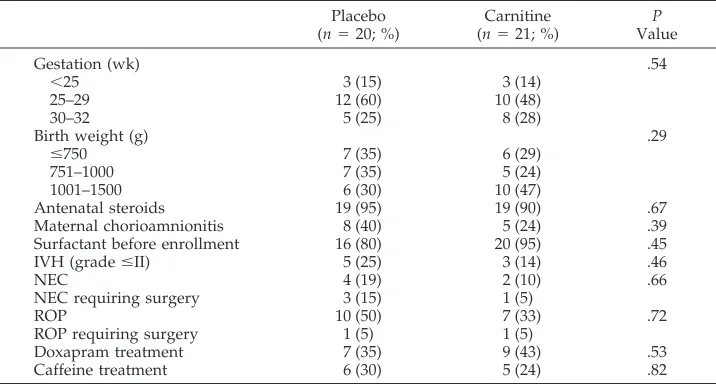
Demographic details by treatment allocation are shown in Table 1 for all infants who successfully completed the trial. There were no significant differ-ences in gestational age or birth weight between the 2 groups. Mean gestational age was 27.4 weeks for the placebo group and 27.8 weeks for the carnitine-supplemented group, and mean birth weight was 916.4 g for the placebo group and 1026.7 g for the carnitine-supplemented group. In addition, there were no significant differences in 1- or 5-minute Ap-gar scores between the 2 groups. Median 1- and 5-minute Apgar scores for the placebo group were 6 and 8, and median for the carnitine-supplemented group were 7 and 8. There were no significant dif-ferences between the 2 groups in any of the variables noted in Table 1.
All study infants received aminophylline treat-ment, and there were no statistical differences in the receipt of doxapram or caffeine.
The carnitine levels were significantly higher in the carnitine-treated infants (median: 195.3mol/L; range: 71.7–343.6 mol/L) compared with the pla-cebo infants (median: 15.5 mol/L; range: 7.6 –30.5 mol/L;P⬍.001). There was no overlap of carnitine levels, and the highest plasma carnitine level in the placebo group (30.5 mol/L) was less than half of the lowest plasma carnitine level in the carnitine-supplemented group (71.7 77 mol/L).
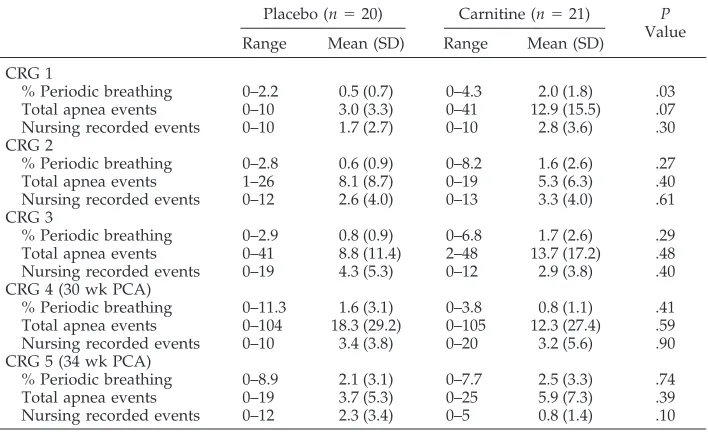
The analysis of the primary outcome, the effect of carnitine supplementation on apnea of prematurity, is shown in Table 2, which presents the CRG data on the study population by treatment allocation. Data represent all available CRG data on infants who suc-cessfully completed the trial and any CRG data avail-able on infants who were studied before their dis-charge from the trial as a result of transfer to another facility not involved in the trial. There was no signif-icant statistical difference between the study groups apart from an increase in periodic breathing on the first CRG in the carnitine-treated infants.
The analysis of secondary outcome parameters on the study population by treatment allocation is shown in Table 3 for all infants who successfully completed the trial. There was no significant statis-tical difference between the trial groups with respect to any of the secondary treatment outcomes evalu-ated.
DISCUSSION
There have been few properly controlled prospec-tive trials to evaluate the treatment of apnea of pre-maturity, only 2 of which had a placebo arm.10,11One of these demonstrated that even combined therapy with 2 agents did not completely eradicate signifi-cant apnea in very low birth weight infants.11Thus, apnea of prematurity remains a frequent and recur-ring clinical problem for the extremely low birth weight infant, and its persistence is often the reason for delay in discharge of such infants. Current ther-apy used to treat apnea of prematurity, primarily
TABLE 1. Demographic Data on Study Population by Treatment Allocation
Placebo (n⫽20; %)
Carnitine (n⫽21; %)
P
Value
Gestation (wk) .54
⬍25 3 (15) 3 (14)
25–29 12 (60) 10 (48)
30–32 5 (25) 8 (28)
Birth weight (g) .29
ⱕ750 7 (35) 6 (29)
751–1000 7 (35) 5 (24)
1001–1500 6 (30) 10 (47)
Antenatal steroids 19 (95) 19 (90) .67
Maternal chorioamnionitis 8 (40) 5 (24) .39
Surfactant before enrollment 16 (80) 20 (95) .45
IVH (gradeⱕII) 5 (25) 3 (14) .46
NEC 4 (19) 2 (10) .66
NEC requiring surgery 3 (15) 1 (5)
ROP 10 (50) 7 (33) .72
ROP requiring surgery 1 (5) 1 (5)
Doxapram treatment 7 (35) 9 (43) .53
Caffeine treatment 6 (30) 5 (24) .82
methylxanthines, does not completely eradicate ap-nea of prematurity.6 A previous preliminary report suggested that supplementation of premature infants with carnitine resulted in a statistically significant reduction in apnea of prematurity and the ability to wean such infants from mechanical ventilation.7
The current prospective, randomized, controlled trial was designed to evaluate the role of carnitine in apnea of prematurity, as well as to evaluate the role of carnitine in potentially improving other outcomes. The trial groups were well matched. There was an almost equal number of infants randomized into each trial group. In this trial, infants who received supplemental carnitine did not achieve any reduc-tion in apnea of prematurity whether assessed by CRG data or nursing recorded events. In fact, in the first CRG, carnitine-treated infants had an increase in periodic breathing. Supplemental carnitine did not reduce ventilator or CPAP days or the need for sup-plemental oxygen therapy or improve the infant’s ability to tolerate enteral feedings. Plasma carnitine levels were substantially higher in the supplemented infants.
The results of this trial do not support the use of supplemental carnitine for the reduction of idio-pathic apnea of prematurity. Whitfield et al12 com-pleted a similar study, and their preliminary findings indicated that carnitine supplementation did not sig-nificantly reduce apnea of prematurity. Their results, with respect to the response of apnea and the carni-tine levels in their carnicarni-tine-treated infants, are very similar to those observed in the current study.
A recent survey revealed that 28% of premature infants who received TPN are currently receiving additional carnitine in their TPN according to a study by Esteban-Cruciani et al.13Supplemental car-nitine may be of significant nutritional benefit.
Carnitine is essential in the developing fetus and is required for the development of appropriate hepatic ketone synthesis. Neonates are able to use ketones as an energy source for the developing brain.14 Carni-tine synthesis in the neonate is limited by low levels of ␥-butyrobetaine hydroxylase, and neonates are dependent on external sources of carnitine. Although carnitine is readily available in breast milk,15 the extremely low birth weight infant is usually not able TABLE 2. Analysis of Primary Outcome of CRG Data on Study Population by Treatment
Allo-cation
Placebo (n⫽20) Carnitine (n⫽21) P
Value
Range Mean (SD) Range Mean (SD)
CRG 1
% Periodic breathing 0–2.2 0.5 (0.7) 0–4.3 2.0 (1.8) .03
Total apnea events 0–10 3.0 (3.3) 0–41 12.9 (15.5) .07
Nursing recorded events 0–10 1.7 (2.7) 0–10 2.8 (3.6) .30
CRG 2
% Periodic breathing 0–2.8 0.6 (0.9) 0–8.2 1.6 (2.6) .27
Total apnea events 1–26 8.1 (8.7) 0–19 5.3 (6.3) .40
Nursing recorded events 0–12 2.6 (4.0) 0–13 3.3 (4.0) .61
CRG 3
% Periodic breathing 0–2.9 0.8 (0.9) 0–6.8 1.7 (2.6) .29
Total apnea events 0–41 8.8 (11.4) 2–48 13.7 (17.2) .48
Nursing recorded events 0–19 4.3 (5.3) 0–12 2.9 (3.8) .40
CRG 4 (30 wk PCA)
% Periodic breathing 0–11.3 1.6 (3.1) 0–3.8 0.8 (1.1) .41
Total apnea events 0–104 18.3 (29.2) 0–105 12.3 (27.4) .59
Nursing recorded events 0–10 3.4 (3.8) 0–20 3.2 (5.6) .90
CRG 5 (34 wk PCA)
% Periodic breathing 0–8.9 2.1 (3.1) 0–7.7 2.5 (3.3) .74
Total apnea events 0–19 3.7 (5.3) 0–25 5.9 (7.3) .39
Nursing recorded events 0–12 2.3 (3.4) 0–5 0.8 (1.4) .10
SD indicates standard deviation, PCA, postconceptional age.
TABLE 3. Analysis of Secondary Outcomes on Study Population by Treatment Allocation
Secondary Outcome
Placebo (n⫽20) Carnitine (n⫽21) P
Value
Median Range Median Range
Time on ventilator (d) 2 0–56 2 0–49 .84
Time on CPAP (d) 3 0–26 4 0–20 .98
Oxygen at 28 d (n; %) 10 (50%) 12 (57%) .45
Oxygen at 36 wk PCA (n; %)
6 (30%) 9 (43%) .34
Time to regain birth weight (d)*
12.7 (4.9) 3–25 12.0 (3.8) 4–19 .62
Time to full feeds (d) 24 10–114 20 5–129 .23
Time on TPN (d) 23 9–114 19 4–124 .22
Weight at discharge (g)* 2294 (546) 1735–3575 2264 (517) 1665–3230 .86
PCA at discharge (wk) 38 35–48 37 35–46 .57
Length of stay (d)* 81 (37) 36–160 75 (28) 40–135 .60
to tolerate an oral intake of adequate nutrition for at least 2 weeks and sometimes up to 30 to 40 days; thus, this source of carnitine is usually unavailable to the very premature infant. Although formulas are supplemented with carnitine, the bioavailability of such carnitine is not well established. However, the most recent controlled trial of carnitine supplemen-tation, which evaluated 86 preterm infants between 28 and 34 weeks’ gestational age, did not find any difference in growth rate as assessed by weight, length, skinfold thickness, head circumference, or number of episodes of hypoglycemia16between the carnitine and placebo infants. Another controlled trial of carnitine supplementation is by Bonner et al,17 who prospectively studied 43 very low birth weight infants in a blinded placebo controlled trial and randomized infants to carnitine 50mol/kg/d (approximately 8.05 mg/kg/d) in their hyperalimen-tation compared with placebo for what appears to have been a 2-week period. They reported that the carnitine groups tolerated more lipid than the control infants during the first 2 weeks of life and had sig-nificantly higher plasma carnitine levels and that their larger infants, from 1001 to 1500 g, had a sig-nificantly greater weight gain during this same pe-riod. Bonner et al did not report on the occurrence of apnea or any other outcomes after 2 weeks of life. We did not evaluate weight gain at 2 weeks, and we did not separately analyze our results by these weight groups. This group suggested that additional studies were required with higher doses, and, in fact, our study used doses that were 4-fold greater. We be-lieve that our continued administration of oral car-nitine, after full oral feedings were achieved, and the use of overall time to regain birth weight and weight at discharge are more informative of the potential clinical value of carnitine supplementation.
CONCLUSION
Although carnitine may be of significant nutri-tional benefit to premature infants receiving TPN, there are currently no definitive studies which have demonstrated an unequivocal benefit to added car-nitine for such infants. Our study did not find any benefit to supplementation with carnitine with re-spect to apnea of prematurity, length of ventilation, oxygen exposure or to secondary clinical parameters such as weight gain (time to regain birth weight and weight at discharge), feeding advancement (time to achieve full enteral feeds of 120 mL/kg/d), or length of hospital stay. At the present time, although there
may be theoretical benefits to the addition of carni-tine to parenteral alimentation, none have been es-tablished by prospective studies.
ACKNOWLEDGMENTS
This research was supported, in part, by Sigma Tau Pharma-ceuticals.
We thank Ed McFeeley, BS Pharm, for pharmacy coordination of distribution of the study drug and randomization of patients; Golde Dudell, MD, for coordination of the study at Children’s Hospital and Health Center; and Bonnie Holmes, MT, for super-vision of plasma carnitine level assays at the UCSD Biochemical Genetics Laboratory.
REFERENCES
1. Shenai JP, Borum PR. Tissue carnitine reserves of newborn infants.
Pediatr Res. 1984;18:679 – 682
2. Helms RA, Mauer EC, Hay WW, Christensen ML, Storm MC. Effect of intravenousl-carnitine on growth parameters and fat metabolism dur-ing parenteral nutrition in neonates.J Parenter Enteral Nutr. 1990;14: 448 – 453
3. Helms RA, Whitington PF, Mauer EC, Catarau EM, Christensen ML, Borum PR. Enhanced lipid utilization in infants receiving orall -carnitine during long-term parenteral nutrition. J Pediatr. 1986;109: 984 –988
4. Christensen ML, Helms RA, Mauer EC, Storm MC. Plasma carnitine concentration and lipid metabolism in infants receiving parenteral nu-trition.J Pediatr. 1989;115:794 –798
5. Barrington KJ, Finer NN. The natural history of the appearance of apnea of prematurity.Pediatr Res. 1991;29:372–375
6. Roberts RJ. Drug therapy in infants. In:Pharmacologic Principles and Clinical Experience.WB Saunders; 1984:119 –137
7. Iafolla AK, Roe CR. Carnitine deficiency in apnea of prematurity. Pedi-atr Res. 1995;37:309A
8. Iafolla AK, Browning IB, Roe CR. Familial infantile apnea and immature beta oxidation.Pediatr Pulmonol. 1995;20:167–171
9. Sulkers EJ, Lafeber HN, Degenhart HJ, et al. Effects of high carnitine supplementation on substrate utilization in low birth weight infants receiving total parenteral nutrition.Am J Clin Nutr. 1990;52:889 – 894 10. Gupta JM, Mercer HP, Koo WWK. Theophylline in treatment of apnea
of prematurity.Aus Paediatr J. 1981;17:290 –291
11. Peliowski A, Finer NN. A blinded randomized placebo-controlled trial to compare theophylline and doxapram for the treatment of apnea of prematurity.J Pediatr. 1990;116:648 – 653
12. Whitfield JM, Smith TL, Sollohub HM, Roe CR. Apnea andl-carnitine supplementation in very low birth weight infants: a randomized con-trolled trial.Pediatr Res. 2001;49:294A
13. Esteban-Cruciani NV, Gopalareddy VV, Singh D. Total parenteral nu-trition and carnitine supplementation practices in premature neonates: a national survey.Pediatr Res. 2001;49:398A
14. Giovannini M, Agostoni C, Salari PC. Is carnitine essential in children?
J Int Med Res. 1991;19:88 –102
15. Borum PR. Carnitine in neonatal nutrition. J Child Neurol. 1995; 10(suppl):2S25–2S31
16. Shortland GJ, Walter JH, Stroud C, Fleming PJ, Speidel BD, Marlow N. Randomized controlled trial ofl-carnitine as a nutritional supplement in preterm infants.Arch Dis Child. 1998;78:F185–F188
DOI: 10.1542/peds.109.4.622
2002;109;622
Pediatrics
Jane O'Donnell, Neil N. Finer, Wade Rich, Bruce A. Barshop and Keith J. Barrington
Role of l-Carnitine in Apnea of Prematurity: A Randomized, Controlled Trial
Services
Updated Information &
http://pediatrics.aappublications.org/content/109/4/622
including high resolution figures, can be found at:
References
http://pediatrics.aappublications.org/content/109/4/622#BIBL
This article cites 16 articles, 1 of which you can access for free at:
Subspecialty Collections
sub
http://www.aappublications.org/cgi/collection/fetus:newborn_infant_ Fetus/Newborn Infant
following collection(s):
This article, along with others on similar topics, appears in the
Permissions & Licensing
http://www.aappublications.org/site/misc/Permissions.xhtml
in its entirety can be found online at:
Information about reproducing this article in parts (figures, tables) or
Reprints
http://www.aappublications.org/site/misc/reprints.xhtml
DOI: 10.1542/peds.109.4.622
2002;109;622
Pediatrics
Jane O'Donnell, Neil N. Finer, Wade Rich, Bruce A. Barshop and Keith J. Barrington
Role of l-Carnitine in Apnea of Prematurity: A Randomized, Controlled Trial
http://pediatrics.aappublications.org/content/109/4/622
located on the World Wide Web at:
The online version of this article, along with updated information and services, is
by the American Academy of Pediatrics. All rights reserved. Print ISSN: 1073-0397.