©2014 JNAS Journal-2014-3-9/1043-1047 ISSN 2322-5149 ©2014 JNAS
A SURVEY ON DEVELOPING AND STABILIZING
INFRASTRUCTURE OF HEALTH, SAFETY AND
ENVIRONMENT MANAGEMENT SYSTEM IN
SOUTH PETROL INDUSTRY FROM HSE STAFFS'
VIEWPOINT
Kokab Ghorbani
1*, Mahnaz Nasrabadi
2and Abdolvahab Baghbaniyan
31- M.A student of Environ,mental Management(HSE),Department of Environment, Islamic Azad University, Science and Research Branch of Sistan and Baluchestan, Zahedan,Iran. 2- Ph.D, Department of Environmental Science Islamic Azad University, Science and Research
Branch of Sistan and Baluchestan, Zahedan ,Iran.
3- Ph.D, Department of Health, University of Medical Sciences, Zahedan, Iran
Corresponding author:
Kokab Ghorbani
ABSTRACT: Meanwhile HSE(Health, Safety And Environment) issue has become the main competition source in global level and focus on health, safety and environment is considered as organizations strategic goals and priorities, many economic institutions and agencies still are unfamiliar with HSE management in our country. So, this study deals with Development and stabilization of HSE management infrastructures in South petrol industry from HSE practitioners ‘view and aims at evaluating priorities, prerequisites and necessary sources to establish and develop HSE management system as well as its challenges and hindering. This is an exploratory – descriptive (applied) study, statistical population is HSE staffs in Iran national petrol company and digging company, petrol products Distribution Company of Ahvaz, Nezamieh, and Marun petrochemical company including 225 people as statistical sample. Questionnaires are used as a means to collect data. Examining research validity and reliability then its Chronbach’s alpha gained 0/925. According to research results these elements are effective to establish and to develop HSE management system: commitment and leadership – training – risk management and evaluation – management’s influence– knowledge interchange – motivating staffs to exchange information and knowledge – connecting with the whole beneficiaries and providing ultra-organizational supports from HSE staffs’ view. Ranking the elements was made via Friedman test indicating leadership and commitment as the first priority and knowledge interchange as the last one, while the others left in medial rank between them. It's worth noting that national politics reinforcement and ultra-organizational support are in second degree of importance; on the other hand not employing professional workforce in HSE and lack of a proper curriculum are HSE-MS fundamental challenges in examined statistical population needing to be removed.
Keywords: infrastructures, HSE management system, South petrol industry, HSE practitioners.
INTRODUCTION
1044
So, dealing with safety, health and environment categories changed into one of the business priorities in organizations. Utilization of a systematic and vast view has a special importance, then in health management, safety and environment system (HSE) responds to this important question.As a homogeneous management system, HSE management system provides a framework to enforce the rules and environmental, health and safety standards aimed at providing permanent improvements and sustainable development. (Azimi and Amir Nejad 2012).
HSE management system is a system trying to create a popular, healthy and joyful environment without disasters, losses and damages via an efficient arrangement and convergence of physical, fiscal and man forces such as buildings, states invest, money, facilities and accommodations and staffs.
For example the conducted research in Shell Petrol Company shows that HSE leads to standards and technology better acceptance by identifying and analyzing risks and removing them, so disaster occurrence rate is reduced tangibly. (Zijlker,2004).
Observing environment, safety and health issues besides eliminating parallel activities simultaneously ends in sustainable development, easiness and increase of exploitation because of economic and technical balance. (Taghdisi and Alizade 2008).
Most industries pay attention to HSE management programs on the basis of goals and believed in more profit gains for industry by these program.(Nijs Jan Duijm, 2008(.
However there are many problems in the way of this system stabilization and development in organization and industries, while its key elements can't be centered objectively and its operation would not be actualized as expected. (LIU Jing-Kai, 2008)
Managers' lack of proper fulfilment and lack of confidence on HSE issue along with other priorities such as production (manufacture) in organizations are main fundamental challenges for HSE management system. (Meeraj 2009). Absence of skilful experts to stabilize and develop this managerial system(Tehrani 2008) lack of holding HSE specialized training courses, serious obligation on contractors about taking OHSAS 18001، ISOO 14001 are other hindering on the way of HSE successful establishment.(Moazzen 2009).
However, this system is not yet established to be a necessary element and not known as it should be in different engineering activities.( Ghasemi Naghdi2009) since it's a newly- founded discussion in Iran, so it needs to provide new means, sources and infrastructures to simplify HSE nature and identity as any other new content. Creating required facilities need financial, scientific and man sources. Then it's necessary to use these facilities and sources in order to reduce costs. (Afshari, 2011). Hence evaluating existing conditions by relevant specialists and staffs seem essential, so south petrol industry and its HSE staffs were selected as our statistical population so that we can make use of their experiences to promote health, safety and environment management system and to recognize the pre-requisites, priorities and resources for establishing HSE management system.
MATERIALS AND METHODS
Present survey is a functional one. Regarding topic nature and research objectives, descriptive- exploratory method was used.
The research statistical population is HSE staffs in Iran national petrol company and digging company, Ahvaz petrol reservoir, Nezamieh, and Marun petrochemical company including 225 people and the whole ones were applied. Questionnaires were used as a means to collect data.at first, a researcher-made Questionnaire by defined indices in Leak ret spectrum was compiled having two parts: first part relates to respondents' demographic characteristics (such as age, gender, education stand, last educational tendency, job resume, employment status, income,. . .) and second part contains questions relating peoples' awareness and attitude about HSE management system that were gathered to access required information. Then Questionnaire was shown to some experts and specialists in HSE field for validity rating and removing possible faults. Its validity was calculated and questionnaire validity coefficient obtained 0.925 via Cronbach’s alpha.
Descriptive statistical methods and inferential statistics (t-test and Friedman) used for data analysis and examination (such as mean, standard deviation, percent computation)
1045
RESULTS AND DISCUSSION
To get the respondents ideas, we made some demographic questions and some other ones in eight types containing"commitment and leadership, training, risk management and assessment, management effectiveness, knowledge exchange culture, motivating information and knowledge exchange, communicating beneficiaries, national policies and ultra-organizational supports" and obtained results are as follow:
Table 1. Respondents' place of work
Company Percentage
Iran national digging company 75%
Petroleum products distribution company of Ahvaz Nezamieh 16%
Marun petrochemical company 9%
According to the research findings, most respondents were in national digging company and the least ones were in Marun petrochemical company containing 88% male and 12% female respondents.
Table 2. Research demographic findings
Row Research findings Percentage
1 HSE staffs graduated from irrelevant majors to HSE 55%
2 HSE staff claimed to have less or no awareness about HSE 40%
3 HSE staffs without any training course about it 17%
4 HSE staff claimed not to attend HSE management system training courses held by the company 45.7%
5 The staffs with no previous experience (back ground) about HSE management system 40%
6 HSE staffs claiming that HSE management system was not stabilized properly in their workplace 6%
7 HSE staffs believing that HSE management system is not dynamic essentially 29%
8 HSE staffs claiming that HSE management system events be considered built valuable 40%
9 HSE staff with a PhD degree put parent process recession recipients research participants) 0%
10 HSE staffs will wear reluctant about method of HSE management system and capitalization in their workplace 23%
Main part of participants' demographic information that can be effective in HSE management system development and stabilization is available in the above table.
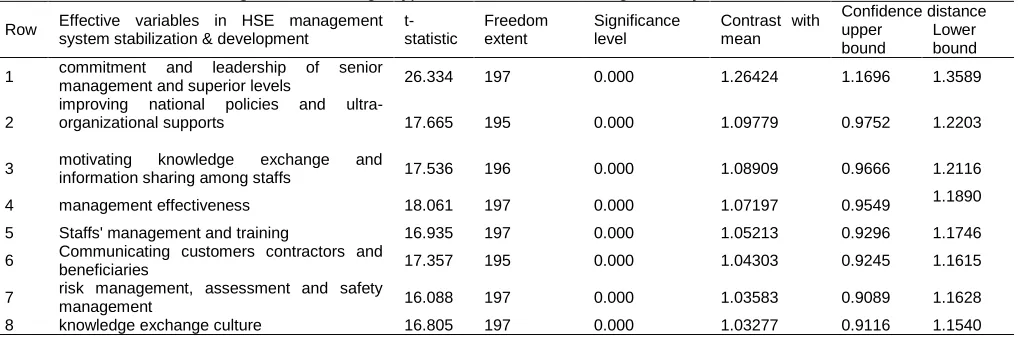
Table.3. Evaluating the effect of eight type variables in HSE management system stabilization via t-test
Row Effective variables in HSE management system stabilization & development t-statistic Freedom extent Significance level Contrast with mean
Confidence distance upper
bound
Lower bound
1 commitment and leadership of senior
management and superior levels 26.334 197 0.000 1.26424 1.1696 1.3589
2
improving national policies and
ultra-organizational supports 17.665 195 0.000 1.09779 0.9752 1.2203
3 motivating knowledge exchange and
information sharing among staffs 17.536 196 0.000 1.08909 0.9666 1.2116
4 management effectiveness 18.061 197 0.000 1.07197 0.9549 1.1890
5 Staffs' management and training 16.935 197 0.000 1.05213 0.9296 1.1746
6 Communicating customers contractors and
beneficiaries 17.357 195 0.000 1.04303 0.9245 1.1615
7 risk management, assessment and safety
management 16.088 197 0.000 1.03583 0.9089 1.1628
8 knowledge exchange culture 16.805 197 0.000 1.03277 0.9116 1.1540
1046
Table 4. Arrangingpriorities of influential factors on stabilizing and developing HSE management system via Friedman testRow Effective variables on establishment and development of HSE management system ranking mean
1 commitment and leadership of superior levels or senior management 4.91
2 boosting national policies and ultra-organizational supports 4.80
3 motivating knowledge exchange and sharing information, among staffs 4.59
4 Management effectiveness 4.43
5 Training and management of the staffs 4.36
6 Communicating customers, contractors and beneficiaries 4.35
7 Risk management, assessment safety management 4.28
8 Knowledge exchange culture 4.27
As shown in the above table, "commitment and leadership" is the most important factor in respondents' viewpoint, but knowledge exchange culture is the least important one as well.
Discussion and conclusion:
Research results show that HSE management system establishment and development not only are necessary, but are crucial also for organizations within the global competition field. According to the research evaluations illustrated in table.3, all indices (commitment and leadership, – training – risk management and assessment – management effectiveness – knowledge exchange culture – motivating information and knowledge exchange – communicating beneficiaries – national policies and ultra-organizational supports) influence HSE management system stabilization and development.
These factors are both considered as prerequisites for this system stabilization. "Leadership and commitment" has the first priority with the most importance. Meeraj (2009) conducted another research,concluded the same priority order, but "knowledge exchange culture" has a 0/001 difference with "risk management and assessment" and gets the last priority.rest of variables placed at amongst of these two, shown in the table Cindy Lee said the sending the sending ascendingly.
HSE staffs ideas were used for ranking priorities of this system stabilization via Friedman test. "boosting national policies and other organizational and governmental supports" is in the second degree of importance, while it proceeds "motivating knowledge exchange and sharing information" in ranking, that is the 3rd index confirming the importance of national instructions and rules and emphasizes government indirect support for this system development and stabilization in organizations.
As Shawn in table.2 40% of respondents expressed little or no awareness or having no specific idea about it. Since they are central operators of this managerial system, so this problem can be one of the main challenges of HSE management system that maybe it's due to their irrelevant majors withHSE subject.
Despite that knowledge and skillfulness is important for organizations, (Lashkari 2010) yet 55% of the HSE staffs participated in this study, had been graduated from irrelevant majors; it confirms Tehrani's studies in 1387 believing that non-specialists were employed in HSE departments within Iranian industries while 40% of the research respondents claimed having no background in the field of HSE: it seems these people must be working in services like firefighting or lack of related experts led in their employment. At last it's possible also that little attention was paid to mastery of HSEin this organization. Obviously these shortcomings end in low quality and exploitation. The subject is now a main challenge and difficulty in operating the managerial system as well.
On the other hand, although training is the main way of transferring information and knowledge for organizations, , only 54/3% of respondents yet declared attending company training courses and workshops about HSE management system.
In another question, 17% of respondents declared not passing any training courses about HSE management system(voluntarily or compulsorily). This matter also can be improper for lack of an appropriate training systems available for all forces or lackof observation (look out), by the way, training system faults are considered another problem in the field of HSE,confirming Moazzen's findings in 1388. It seems neglecting knowledge management is another worry whereas71% of respondents verified dynamics of HSE management system in their workplace. 29% of them believe that this system doesn't have enough dynamism,Zamani believed that it may be caused by knowledge management and information transfer weakpoints.
1047
next to this one, national rules and policies, governmental supports which are another main source according to participants viewpointOperational advices
1) changing HSE management system into an advantage (a wealth). We can improve its importance and worthiness for example by defining a proper position in organization chart for HSE unit and dedicating priority to safety, health and environmental issues through the whole tasks such as reporting during organization general meetings, (carrying on toolbox meetings) for all people and providing a proper ground for elevator speeches about HSE.
2) You can draw attention to safety, health and environment altogether and similarly by stabilizing HSE management system, because paying too much attention to one of them can make us neglect another one. 3) We can strengthen transcend leadership through regular participation in HSEE meetings allocating required sources, repeated observations on job(occupational) milieu, attending in safety discussions, focusing on individuals safety behaviors in their job periodical evaluation.
4) And just because chair must be formalized via clarifying organization HSE policies and making them recognizable, assigning all people and workers to participate training courses about good safety manners and methods.
5) Regarding individuals' skills is another necessary feature applied in a good culture. In order to use managerial systems for risks control and hazards, evaluating related processes, great facilities are devoted that these systems would be performed by individuals with a key role on safety, since they influence choosing methods and the way of operating them; so one should be essentially careful about employing these people in terms of their skills and experiences.
6) Creating HSE central legal committees (Corporate HSE committee) to handle primary stabilization of HSE, customizing and pursuing them within the organization all levels and operational sections related to organization is another essential tasks.
7) Holding regular meetings for all HSE managers (HSE managers meetings) in all levels along with operational organizations to report (inform) and share HSE topics is also another essential action.
8) Reinforcing people in order to focus on HSE topics, while working: for example, let workers be free to cutoff electricity or process to work safely. Provide them with essential means (such as equipment, apparatus and tools) to have a safe condition for work, they must learn necessary instructions about related activities and have enough time for each task.
9) Establishing training courses during the process of working in regard to HSE subject, is also a useful action so-called (on – the –job training ) or HSE – OJT that are suitable for the employed forces in HSE units and for workers on the basis of their present activities.
Always be careful about the concept and sense of vulnerability, for example warn seriously about the results of damages, fire and etc. caused by the unsafe actions and conditions consistently, always care for reported dangerous situations (Anomaly reports) and near-misses, and adapt working status with standards before start working.
REFERENCES
Afshari A, Husseini N and Mokhtari M. 2011. Training necessity and customizing HSE in decorative and visage rock mines in Iran, Available at: http//www.Stoneassoc_Ir.Com
Azimi S and Amir nejad R. 2012. HSE training for all people, third edition, FadakIsatis publication, Tehran. Feshki M. 2013. an introduction on HSE, Available at: http// masoudhse.blogfa.com
LIU JK. 2008. Study on HSE-MS establishment based on management practice, Journal of Safety Science and Technology. Meeraj F. 2009. HSE management system, sustainable development center, third national Congress of safety engineering and
HSE management, Sanati Sharif University, Tehran.
Moazzen S. 2009. evaluating and analyzing effective factors on HSE function(opera.tion) level promotion of petrol industry contractors and coming challenges, second national conference of health, safety and environment, Tehran.
Nijs JD. 2008. Management of health, safety and environment in process industry.
Taghdisi M and Alizade S. 2008. HSE coordinated management system, first edition, Reihan publication, Tehran.
Tehrani R. 2008. Challenges of HSE management systemstabilization, first international conference for situation of industrial safety, professional health and environment in organizations, Esfahan.
Zamani BE and Husseini ghand Yarmohammadi P. 2007. studying infrastructures of knowledge management stabilization in Esfahan university in scientific board view point, educational sciences magazine, first year, second volume, pp 49-66. Zijlker V. 2004.The role of HSE management system, Historical Perspective and links with human behavior, HSE and SD manager