~ 323 ~ WWJMRD 2017; 3(8): 323-327
www.wwjmrd.com International Journal Peer Reviewed Journal Refereed Journal Indexed Journal UGC Approved Journal Impact Factor MJIF: 4.25 e-ISSN: 2454-6615
Shyna Grover
M.Tech (Student)/PG Scholar Department of Computer Science and Engineering GZS Campus College of EngineeringAnd Technology (MRSPTU), Bathinda, Punjab, India
Prof. Dinesh Kumar Professor
Department of Computer Science and Engineering GZS Campus College of Engineering And Technology (MRSPTU), Bathinda,Punjab, India
Correspondence: Shyna Grover
M.Tech (Student)/PG Scholar Department of Computer Science and Engineering GZS Campus College of EngineeringAnd Technology (MRSPTU), Bathinda, Punjab, India
Efficient Energy Based Reliable Protocol for Real
Time and Non
-
Real Time Data Transmission in
Multicast Streaming in MANET
Shyna Grover
Abstract
While communication they use buffer at the intermediate node. Such that frequently asked data can be send from intermediate node as non-real time data. If buffer is about to fill, intermediate node sends signal to the sender node, it will slow down the transmission of data. Overall the data can be of two types one is real time data and another is non real time data. Real time data will be sent directly from the source node, and non-real time data will be sent from the intermediate node.The weighted value of the incoming data packets is determined by the priority manager and accordingly the data priority is assigned. The calculation of the cumulative weight is calculated based on no. of hops, deadline and waiting time. Trust factor is established so that those paths can be selected which has higher trust factor. The technique has been compared to the previous research on different parameters like end to end delay, packet delivery, latency, packet reliability rate, packet stability rate etc. such that all the parameters has shown the improvement with different percentages. Packet delivery has improved by 22.44%, end to end delay has improved by 55.47%, and latency has improved by 27.49%. Itself.
Keywords: MANET, Buffer Management Protocol,Real Time Data, Non Real Time Data
Introduction What is MANET?
Mobile ad hoc network (MANET) is a collection of mobile nodes connected with wireless links. Deployment of MANET does not require any fixed existing infrastructure or any centralized administrator. There is no need of any static infrastructure or base station for communication. As all the nodes in a MANET are wireless in nature, they are free to move randomly. MANET can be implemented in different application areas ranging from military battle field to disaster management. It can be implemented wherever it is not feasible to establish a physical infrastructure. However, MANETs have some limitations also such as unreliable communication medium, dynamic topology, limited bandwidth, battery power and lifetime etc. Multicast Routing is also a challenging task in a MANET.
What is Buffer?
Buffer is defined as any kind of space which helps to store data temporarily that is being moved from source and destination. Buffers are mainly used in conjunction with Input/ Output Devices. The main purpose of buffer is to act as holding area which store data for some amount of time.
What is Multicasting?
Multicast is defined as a communication between senders and receivers. The communication between nodes can be one to one and one to many nodes. This is very beneficial in routing because we can send large amount of data from source to destination.
Buffer Management Protocol
~ 324 ~
this buffer space is divided into two parts: Real time and Non-Real time.
Real Time: if the requested video data are directly send from source to destination then that data is called real time data of traffic.
Non-Real Time: if the frequently requested video data are send from intermediate nodes to destination then that data is called non-real time data or traffic.
After that real time and non-real time data are placed into respective partitions and cumulative weight of received packets are calculated according to their distance, number of hops and waiting time. Based on that estimated cumulative weight transmission priorities are assigned.
Buffer space is dynamically adapted based on number of multicast receivers.
Releted Work
[1]Kavitha Subramaniam(2016) et al: In Mobile Ad-hoc Networks(MANET) multicast streaming is handled by various buffer management techniques since it involves real-time data. From source to destination, the video data can be buffered in all the intermediate nodes. Buffer management protocols are used to manage and streaming of data in multicast group. After receiving the packets at destination, they are divided into two groups: real-time and non-real time and then are placed in queues respectively.
Cumulative weights of the packets in real-time buffer are calculated and then transmission priorities are assigned.
The buffer space is adapted according to the number of nodes present in source and destination. This buffer management protocol increases the packet delivery ratio and reduces the latency and energy consumption.
[2] S. Gopinath(2015) et al: Mobile Ad-hoc networks
(MANET) is a infrastructure less network which results in less packet forwarding ratio and large amount of overhead.
Residual Energy based Reliable Multicast Routing Protocol
(RERMR) is a protocol which helps in high packet forwarding ratio. Trustworthy path is chosen among all available paths and data packets are forwarded on that path.
The best path is chosen based on high residual energy. This protocol will increase the network stability rate and reliability rate.
Algorithm
1. Initially when a multicast tree is developed, at every intermediate node, a buffer is created.
2. The buffer space is divided into two divisions: real time (RT) and non-real time (NRT) buffer space.
3. When an incoming data arrives at an intermediate node, the classifier classifies into either real time or non-real time traffic.
4. The buffer space is adjusted by the Queue size manager by borrow or push out technique.
5. When the RT buffer space is full and there exists a free space in the NRT buffer space, then the RT buffer space temporarily borrows some free space from the NRT buffer space so as to avoid discarding the incoming RT traffic.
6. When the entire buffer is full, then the push out process is followed when a new data arrives.
7. The weighted value of the incoming data packets is determined by the priority manager and accordingly the data priority is assigned. The calculation of the cumulative weight is calculated based on no. of hops, deadline and waiting time.
8. Trust factor is established so that those paths can be selected which has higher trust factor.
9. For Energy efficiency route will be selected which has lowest number of hops out of many routes.
10. When the partition is full and if a new packet arrives for RT, then as the used space for NRT is still larger than the threshold, NRT will push out lower-priority packets at the tail, thus generating space for RT to borrow.
Flowchart
Simulation Parameters
Latency: Latency is defined as extra amount of time required by a node to send data from source to destination. For any multicast communication latency should be less.
Latency=Received time-Sent time
~ 325 ~
End to End Delay: This is the average of total summation of time taken by each packet to reach from source node to destination. The average is calculated by dividing with the total number of received Packets
Simulation Configurations
Simulation Parameters
COVERAGE AREA 800m x 641m
PROTOCOLS AODV
NUMBER OF NODES 100
SIMULATION TIME 100 seconds
TRANSMISSION RANGE 250m
MOBILITY MODEL RANDOM walk
Model
LOAD 1000 Bytes
MOBILITY
SPEED(variable) (4)Seconds
TRAFFIC TYPE CBR,UDP,FTP,
TCP
PACKET SIZE 1000 Bytes
PAUSE TIME 10 ms
Results and Anlysis a. Latency
Fig.4.1: Latency
This xgraph shows that the latency of real with buffer and without buffer. The red color shows the latency of base technique and green shows the latency for proposed technique. The latency in current research is low compared to the previous research.
Comparative Graph for average latency
Fig. 4.2: latency graph
This graph shows the latency comparison of both base and proposed technique. In proposed it is clearly shown that the
latency is less than the base latency. There is an improvement of around 27.49%.
b. End to End delay
Fig 4.3: End to end delay
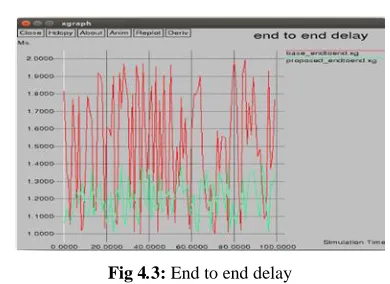
This xgraph shows end to end delay comparison of both base research and proposed research. Red line shows the base end to end delay and green line shows the proposed end to end delay. Proposed end to end delay is tremendously less than the base end to end delay.
Graph for comparing average end to end delay
Fig. 4.4: Average end to end delay
This graph shows the comparison of end to end delay for both base research and proposed research. Proposed research has improved end to end delay. The result has improved by around 20.44%.
c. Packet Delivery
1.511747
6 1.096101
3
~ 326 ~
Fig 4.5: Packet Delivery.
This figure shows the packet delivery for previous and new research. Red line shows the packet delivery for base research and green line shows the packet delivery for proposed. In case of proposed the packet, delivery has improved.
Graph for packet Delivery
Fig 4.6: Packet Delivery
This graph shows the packet delivery for both the scenario. Such that proposed system has improved the packet delivery ratio. The result has improved around 55.89%.
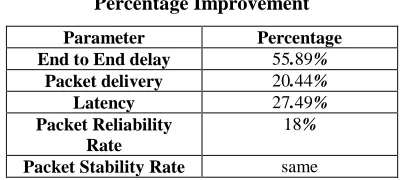
Percentage Improvement
Parameter Percentage
End to End delay 55.89%
Packet delivery 20.44%
Latency 27.49%
Packet Reliability Rate
18%
Packet Stability Rate same
Values shows the all the factors have improved with different percentages. So real time with buffer management in MANET is suitable for multicast streaming of large data.
Conclusion
MANET with real time data transfer by using buffer management at the node level is most suitable technique. Buffer management is to meet the requirement to match the fast sender and slow receiver. Sender and receiver speed can be handshake using buffer at the source and the relay node. So that extra data can be stored at these respective nodes. The technique has been compared to the previous research on different parameters like end to end delay, packet delivery, latency, packet reliability rate, packet stability rate etc. such that all the parameters has shown the improvement with different percentages. Packet delivery has improved by 22.44%,end to end delay has improved by 55.47%, and latency has improved by 27.49%. Itself. On the whole, we can say buffer management for real time data transfer is suitable technique. In future, this technique can be tested on other routing protocols. So that global best technique can be identified. Various performance parameters can also be tested in those scenarios.
Refernces
1. Kavitha Subramaniam, LathaTamilselvan,” Efficient Buffer Management Protocol for Multicast Streaming in MANET”, Procedia Computer Science 92 (2016) 222 – 232.
2. Rolando Menchaca-Mendeza, _, J.J. Garcia-Luna
-Aceves,” Hydra: Efficient multicast routing in MANETs using sender-initiated multicast meshes”, Pervasive and Mobile Computing 6 (2010) 144_157. 3. N. Sah, N. R. Prakash, and D. Bagai,” Analysis of
Multicast Routing Protocols Using Quality of Service”,International Journal of Signal Processing Systems Vol. 3, No. 2, December 2015.
4. S. Gopinatha, N. Nagarajanb,” Energy based reliable multicast routing protocol for packetforwarding in MANET”, Journal of Applied Research and Technology 13 (2015) 374-381.
5. Alireza SajediNasab, Vali Derhamia, Leyli
Mohammad Khanlib, Ali Mohammad ZarehaBidokia,” Energy-aware multicast routing in manet based on particle swarm Optimization”, Procedia Technology 1 (2012)434 – 438.
6. Jun Huang a, Yanbing Liu,” MOEAQ: A QoS-Aware Multicast Routing algorithm for MANET”. Expert Systems with Applications 37 (2010) 1391–1399 7. Elizabeth M. Royer, University of California, Santa
Barbara Chai- KeongToh, Georgia Institute of Technology “A Review of CurrentRouting Protocols for Ad Hoc Mobile Wireless Networks,” IEEE personal communications, April 2007.
8. GagandeepKaur CSE Department, T. Hamsapriya CSE Department, “A new Energy Efficient Queue based multipath load balancing in Ad hoc Network ”, International conference of computer communication and informatics (ICCCI 2014).
9. I. F. Akyildiz, W.-Y. Lee, M. C. Vuran, and S. Mohanty, “Next generation/ dynamic spectrum access/cognitive radio wireless networks: A survey,” Comput. Netw., vol. 50, pp. 2127–2159, May 2006. 10. JiaUddin Md. RabiulZasad2010 “Study and
Performance Comparison of MANET Routing
Protocols” (IJCSE) International Journal on Computer Science and Engineering Vol. 06.
11. J. Mitola, “On Routing Protocols in Cognitive Radio Ad Hoc Networks,” Ph.D. dissertation, KTH Royal Inst. of Technol., Stockholm, Sweden, 2000.
12. Kaoutar Ourouss1, Najib Naja1, and AbdellahJamali, Mobility Based Investigation of Load Balancing and Energy Efficiency of MANets Routing Protocols”, 978-1-4673-8224-3/15 IEEE.
13. Kapang Lego 2003 et. Al “Comparative Study of Adhoc Routing Protocol AODV, DSR and DSDV in Mobile Adhoc network” Indian Journal of Computer Science and Engineering Vol. 1 No. 4 364-371, 14. Kemal AkkayaFebruary 2003. “A survey on routing
protocols for wireless sensor networks” University of Maryland, USA,
15. Mukesh Kumar 2010, et. al. “Comparative Analysis of CBRP, DSR, AODV Routing Protocol in MANET”
(IJCSE) International Journal on Computer Science and Engineering Vol. 02, No. 09, 2853- 2858.
16. Neha Sharma, GovindPatidar,” Improved Congestion Control Mechanism usingModified Hybrid TCP in Mobile Ad-hoc Networks”, DOI 10.1109/CICT.2016.68,IEEE.
303.7905 455
688.84
PACKET DELIVERY FOR BASE
~ 327 ~
17. “On-demand routing protocols for cognitive radio ad hoc networks,” FCC, Nov. 2002, FCC Doc. ET Docket No. 02-135.
18. P. Mohapatra, L. Jian and C. Gui July-December 2010
“QoS in mobile ad hoc networks” IEEE Wireless Communications Magazine, vol. 10, no. 3, June 2003, pg no 44-52.
19. Prof. VirenderRanga “Performance evaluation of aodv, dsr, dsdv mobile adhoc protocols on different scenarios: an analytical review” National Institute of Technology.
20. Razan Al-Ani “Simulation and Performance Analysis Evaluation for Variant MANET Routing Protocols” International Journal of Advancements in Computing Technology, Volume 3, Number 1, February 2011. 21. S. A. Ade1& P.A.Tijare2 “Performance Comparison
of AODV, DSDV, OLSR and DSR Routing Protocols in Mobile Ad Hoc Networks” International Journal of information Technology and Knowledge Management. 22. SaumyaYadav, Dayashankar Singh,A Survey on
Congestion Control Mechanism in Multi-hop Wireless Network”, 978-9-3805-4421-2/16 IEEE.
23. S. Haykin, “Cognitive radio: Brain-empowered wireless communications,” IEEE J. Sel. Areas Commun., vol. 23, no. 2, pp. 201–220, Feb.2005. 24. “Spectrum Aware Mesh Routing inCognitive Radio
Networks: Notice of proposed rulemaking and order,” FCC, Dec. 2003, FCC Doc. ET Docket No. 03-108. 25. V.Ramesh et al “Performance Comparison and
Analysis of DSDV and AODV for MANET” (IJCSE) International Journal on Computer Science and Engineering Vol. 02, No. 02, 2010, Pg.no 183-188. 26. VikasKawadia, Ph.D2003“Protocols and architecture
for wireless ad hoc networks”, University of Illinois at Urbana-Champaign.
27. [27] Wei Liu, Member, IEEE, Chi Zhang, Student Member, IEEE, Guoliang Yao, Member, IEEE, and Yuguang Fang, Fellow, IEEE, “DELAR: A Device
-Energy-Load Aware Relaying Framework for Heterogeneous Mobile Ad Hoc Networks”, IEEE
JOURNAL ON SELECTED AREAS IN
COMMUNICATIONS, VOL. 29, NO. 8,
SEPTEMBER 2011.
28. Yinfei Pan “Design Routing Protocol Performance Comparison in NS2: AODV comparing to DSR as Example”, Department of Computer Science SUNY Binghamton.
29. Unghee Lee 2012 “A Proactive Routing Protocol for Multi-Channel Wireless Ad-hoc Networks”, Virginia Polytechnic Institute and State University.