
A GENETIC ALGORITHM APPROACH
FOR SOLVING THE TRIM LOSS
OPTIMIZATION PROBLEM IN PAPER
MANUFACTURING INDUSTRIES
BINITHA S*
Department of Computer Science, Pondicherry University, Puducherry, 605014India†
Dr. S.SIVA SATHYA
Department of Computer Science, Pondicherry University, Puducherry,605014, India§
Abstract:
Minimizing the trim loss is one of the most common issues arising in the paper manufacturing industries and recently has been considered as one among the important research topics in industrial engineering. In the trim loss optimization problem, the machine will turn up with jumbos of constant size over which it is required to satisfy rolls of variable size and variable quantity as per customer requirement. Hence an optimal cutting plan has to be made so as to minimize the wastage or trim loss. This paper addresses the trim loss optimization problem by having a genetic algorithm approach. Numerical examples illustrate the efficiency and practicality of the proposed method. The objective is to produce a set of paper rolls from jumbo such that the trim loss is minimized. This can be considered as a cost minimization or as a profit maximization problem.
Keywords: Cutting Stock problem; trim loss optimization; Genetic Algorithm
1. Introduction
2. Related Works
Most of the problems related to the Cutting Stock Problem have been known to be NP-Complete. It is very complicated and difficult in terms of the calculation theory. Different variants of the problem are known in this context, ie, with different width stocks, stocks cut in different dimensions (2D cutting stock), (1,5 Cutting Stock) etc. This has been an earliest problem in operational research and hence numerous research works has been available in literature for the assortment as well as for trim loss optimization problem. These approaches can be categorized into two: the mathematical programming and heuristics. The former is computationally expensive even though optimal solutions can be found.
The first work in this area is the linear programming based procedure which may be traced back to the column generation procedure proposed by Gilmore and Gomory (1961, 1963). Another is sequence heuristic procedure (SHP), described by Haessler (1971) and later a hybrid solution procedure which is a combination of the LP based procedure and SHP was formulated by Haessler et al., in 1991.
Recently meta-heuristic procedures have also been applied to 1D-CSP. Shahin and Salem in 2004 proposed a genetic algorithm model for solving 1D-CSP.A new evolution algorithm (EP), which is similar to GA but uses only mutation operator as searching operation, was applied by Liang etal.(2002). A general particle swarm optimization based on SA algorithm (SA-GPSO) for the solution to multi-specification one-dimensional cutting stock problem was proposed by Xianjun Shen ,Yuanxiang Li ; Zhifeng Dai ; Bojin Zheng (2006). Ducatelle and levine (2003) provide a solution using the Ant Colony metaheuristics. In 2008 a selective mutation based evolutionary programming for solving Cutting Stock Problem was proposed by Chiong, R. ,Yang Yaw Chang ; Pui Chang Chai ; Ai Leong Wong . A Hybrid Multi-chromosome Genetic Algorithm for the Cutting Stock Problem was done by Jin Peng , Zhang Shu Chu (2010).
3. Problem Formulation and Representation
An instance of the trim loss optimization can be stated formally as, T= (J, R, q), where J is the length of the stock (jumbo), R is a vector of length n, R= (r1,r2,…r n). It represents the rolls size to be cut from stock. Q is the vector of length that represents the order quantity (demand). Q= (q1, q2, …, qn).and n is the number of items. The basic goal in solving the CSP is to minimize the trim loss. The output for the problem is the minimum number of jumbos, N, required to satisfy the customer demand with the cutting patterns, {C1,C2…..CN}, such that each pattern Cj represent the cutting pattern of a jumbo and Cj= (c1j,c2j….cmj) must satisfy with in a jumbo size, i.e.
1
*
m
k
cij xij
J
(1)for all k=1, 2,… m,
for all xij=0, 1…. Minimum (int (J/cij), qi)
Where cij is the ith unique element (roll) in jth jumbo.
xij is the number of instances of unique roll size that can be occurred in jumbo j. J is fixed Jumbo size,
qi is the quantity of ith roll size
m is the no of rolls that can be cut per jumbo
Table 1: Customer order details
ROLL SIZE (R) QUANTITY (Q)
5 5
3 4
2 4
C1 C2 …. C5
10 C11 C21 C31
Trim loss= 10-(5+2+2) =1
(C1, C2... C5) represents the jumbos required and c11, c21,c31 represents the rolls that can be cut from jumbo 1. 4. Proposed solution using Genetic Algorithm
Genetic algorithm is a promising stochastic optimization technique in the artificial intelligence realm, which is based on the metaphor of biological evolution and Darwin’s theory of Survival of the Fittest. It has been a successful algorithm for solving hard and complex optimization problems and can be an alternative to the deterministic methods, when the latter fails if the problem space is large and poorly defined. The solution to the trim loss optimization problem using genetic algorithm is explained below.
4.1 Steps in Genetic Algorithm
Initialization: First step involves choosing a proper encoding for the problem so as to initialize the population. In this, each chromosome is segmented with a combination of multiple jumbos each of size not exceeding J. Here variable length chromosome is employed. Length of a gene set (1 jumbo) in each chromosome can be 5x+3y+2z<=10, (as per Eq. (1))
Where x can be 0, 1 or 2 (min( 10/5,5) y can be 0, 1, 2or 3 (min(10/3,4) z can be 0, 1,2,3,4 (min(10/2,4) Generalized to:
If roll sizes being a, b, c and corresponding requirement is d, e, f. Jumbo size as J, then maximum count (qty) in single jumbo for rolls represented as x,y,z can be:
Min (int (J/a), d) = x (0 to x) Min (int (J/b), e) = y (0 to y) Min (int (J/c), f) = z (0 to z) Chromosomes Structure
1) 5 5/5 3 2/5 3 2/3 3 2 2/5 can be represented using delimiter 0
5 5 0 5 3 2 0 5 3 2 0 3 3 2 2 0 5 0
Length=5, For first allele (5 5), x=2, y=0, z=0
Trim loss=10-(5*2+3*0+2*0) = 0 Second allele (5 3 2), x=1, y=1, z=1
Trim loss= 10-(5*1+3*1+2*1) = 0 Similarly compute for the entire chromosome.
Fitness Evaluation:
Fitness function will quantify the optimality of the solution. Here the fitness of the individual is depended on two factors: The average trim lost per jumbo and secondly, the number of jumbos fully or partially wasted to the total number of jumbos required. So it can be formulated as:
Fitness function, 1
1
(
(
) ( )
m n
k i
J
sumofallrolls
w
f
J
n
The objective hence is to minimize altogether trim loss/fitness function Where J is Jumbo size,
n is no: of jumbos in one chromosome m is the no of rolls per jumbo
w is the number of jumbos wasted. Smaller value of F implies better solution.
Selection: Best chromosomes (solutions) are selected based on the fitness value for crossover and mutation. Employed Roulette wheel selection and Tournament Selection
Crossover: Primary operator in GA. Based on the fitness function, the algorithm chooses two parents .Apply the cross over operator to generate new offspring/solutions from the best selected parents.
Crossover Strategies: Two point / one point crossover
Mutation: In order to impart immediate diversity into the population mutation operator is employed. Better mutation operator promises that GA won’t stuck into a local minima.
Termination: Stop GA when the required number of generation is run or the optimal solution has been found.
5. Results and Statistics
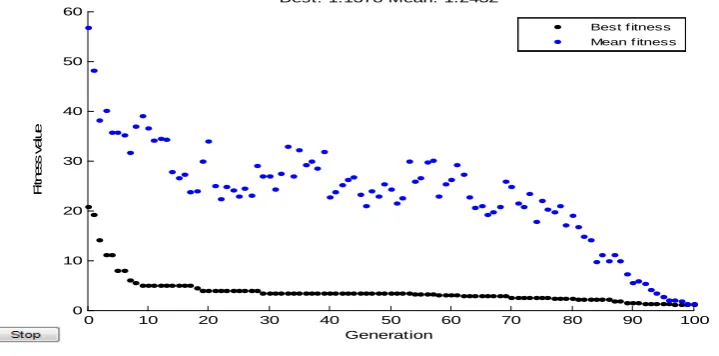
Simulated the algorithm using the optimization tool available in Matlab (gatool). Feed the input through a script file. Set the parameters accordingly prior running the algorithm. Figure 1 shows the plot for best fitness.
0 10 20 30 40 50 60 70 80 90 100
0 10 20 30 40 50 60
Generation
F
it
n
e
ss va
lu
e
Best: 1.1378 Mean: 1.2432
Best f itness Mean f itness
Optimal Cutting Patterns
The graphical representation of the optimal cutting patterns obtained for the best individual is shown in figure.
Fig. 2: Graphically generated optimal cutting patterns using MATLAB for the output generated by GA as [5 3 2 0 3 5 0 3 2 5 0 2 3 5 0 2 5 0]. (Red color represents trim lost and green as trim utilized)
Number of Jumbos Required =5 Total trim loss=5
The algorithm has been simulated for various values of jumbo size and different roll size and requirements. The data set includes both real and integer values. For each case GA was run for 10 times and best value in each case is considered. Table 2 shows input with different values of jumbos and variable customer requirements (roll size and quantity). The objective function value, number of generations, total number of jumbos required and the total trim loss in each case is written as the output. The experimental results show that GA is a better option particularly even if the problem size is large, the converging time is tolerable.
Table 2: Simulation results with different dataset
EXP.
NO:
JUMBO
SIZE
(J)
ROLL
SIZE
(R)
QUANTITY
(Q)
GENERATIONS OBJECTIVE
FUNCTION
VALUE
TOTAL
JUMBOS
REQUIRED(N)
TOTAL
TRIM
LOSS
1 170 37.5 3 100 1.923 5 157
51.5 2
34.0 4
49.25 4
28.75 5
2 210 89.0 8 100 4.3169 12 526
79.3 6
90.5 5
60.25 5
3 350 110 1 100 1.0428
2
190
50 1
70 1
65 1
80 1
95 1
40 1
4 150 25.75 5 100 1.9649 4 144.75
15.0 3
10.25 6
30 2
40 4
5 190.5 32 8 100 3.1469 7 218.5
46 4
28 2
53 3
92 5
6 500 250 4 100 1.92 10 660
110 4
190 5
90 5
200 3
300 3
7 80 15 2 100 2.05 8 91
9 5
32 4
12 4
26 3
18 5
7 10
8 129 43 10 100 4.45 15 325
62 9
27 6
16 7
33 4
54 4
9 185.5 35.75 8 100 2.99 10 420.15
63.25 5
52.15 4
45.50 5
25.25 5
10 650 210 4 100 3.22 9 860
325 3
165 2
130 5
150 6
125 7
6. Conclusion
The trim loss optimization is a classical problem in operations research that has been addressed in this paper using genetic algorithm with variable length chromosome. Enhancements to the problem include adding more constraints that include variable jumbo size, variable order parameters, applying GA for different dimensions of the problem etc.
References
[1] Back, T. 1996: Evolutionary algorithms in theory and practice. Oxford University Press.
[2] P.C. Gilmore and R.E. Gomory, A linear programming approach to the cutting stock problem part 1, Operations Research (1961), 849–859.
[3] Yingyu Huo , Kejing He ; Rengui Zhang ; Yong Zhong ,MHA: A mixed heuristic algorithm for the cutting stock problem ,Informationand Automation, 2009. ICIA '09. International Conference ,On Page(s): 460 – 465
[4] Xianjun Shen ,Yuanxiang Li ; Zhifeng Dai ; Bojin Zheng , General Particle Swarm Optimization Based on Simulated Annealing for ---Multi-Specification One-dimensional Cutting Stock Problem,Computational Intelligence and Security, 2006 International Conference on … Volume: 1, On Page(s): 461 – 464
[5] Jin Peng , Zhang Shu Chu ,A hybrid ant colony algorithm for the Cutting Stock Problem ,Future Information Technology and ….Management Engineering (FITME), 2010 International Conference ,Volume: 2, On Page(s): 32 – 35
[6] Deep, K. ,Chauhan, P. ; Bansal, J.C. ,Solving nonconvex trim loss problem using an efficient hybrid Particle Swarm ….Optimization,Nature & Biologically Inspired Computing, 2009. NaBIC 2009. World Congress ,On Page(s): 1608 – 1611
[7] Qi Yue , Xiao-Juan Liu ,The Application of genetic algorithm for the panel cutting stock ,Computer Science and Information ….Technology (ICCSIT), 2010 3rd IEEE International Conference ,Volume: 4, On Page(s): 169 – 173
[8] Zhi-Yan Zhao,Yuan-Rui Zhan ,An Online Layout Algorithm for the One-Dimensional Cutting Problems ,Machine Learning and ….Cybernetics, 2006 International Conference , On Page(s): 2560 – 2564
[9] Goulimis, C, Optimisation and management control in the paper industry,Plant Optimisation for Profit (Integrated Operations ….Management and Control), IEE Colloquium on (Digest No.1993/019),On Page(s): 3/1 - 3/2
[10] Vachtsevanos, G. ,Mahmood, W. ; Wang, P. Combined cutting stock and assignment optimization based on genetic algorithms ,Emerging Technologies and Factory Automation, 1999. Proceedings. ETFA '99. 1999 7th IEEE International Conference ,Volume: 1, …..On Page(s): 775 - 784 vol.1
[11] Dagli, C.H. ,Hajakbari, A. ,Simulated annealing approach for solving stock cutting problem,Systems, Man and Cybernetics, 1990. Conference Proceedings., IEEE International Conference On Page(s): 221 – 223
[12] Jinbo Zhang ,Yuanxiang Li ; Yiwei Yang ; Jun Li ,A practical evolutionary algorithm of one dimensional stock cutting problem ,Intelligent Control and Automation, 2000. Proceedings of the 3rd World Congress ,Volume: 5, On Page(s): 3729 - 3732 vol.5 [13] Cao Shukun ,Zhao Fang ; Ai Changsheng ; Dong Ke ,Optimization System Design for One- Dimensional Cutting-Stock Problem
,Knowledge Acquisition and Modeling Workshop, 2008. KAM Workshop 2008. IEEE International Symposium Page(s): 877 – 880 [14] Chiong, R. ,Yang Yaw Chang ; Pui Chang Chai ; Ai Leong Wong ,A selective mutation based evolutionary programming for solving
Cutting Stock Problem without contiguity ,Evolutionary Computation, 2008. CEC 2008. (IEEE World Congress on Computational Intelligence). IEEE Congress on Date of Conference: 1-6 June 2008,On Page(s): 1671 – 1677
[15] Jiang, J.Q. ,Xing, X.L. ; Yang, X.W. ; Liang, Y.C. A hybrid algorithm based on PSO and genetic operation and its applications for cutting stock problem,Machine Learning and Cybernetics, 2004. Proceedings of 2004 International Conference on Volume: 4, On Page(s): 2198 - 2201 vol.4
[16] de Armas, J. ,de La Laguna, La Laguna, Spain Miranda, G. ; Two encoding schemes for a multi-objective Cutting Stock Problem ,Evolutionary Computation (CEC), 2011 IEEE Congress June 2011,pg 529 – 536
[17] Jin Peng Zhang Shu Chu ,A Hybrid Multi-chromosome Genetic Algorithm for the Cutting Stock Problem,,Information Management, Innovation Management and Industrial Engineering (ICIII), 2010 International Conference on Date of Conference: 26-28 Nov. 2010 , Volume: 1, On Page(s): 508 – 511
[18] Bin Yang Chunyang Li ; Lan Huang ; Ying Tan ; Chunguang Zhou Solving One-dimensional Cutting-Stock Problem Based on Ant [19] Colony Optimization , INC, IMS and IDC, 2009. NCM '09. Fifth International Joint Conference ,1188 – 1191

![Fig. 2: Graphically generated optimal cutting patterns using MATLAB for the output generated by GA as [5 3 2 0 3 5 0 3 2 5 0 2 3 5 0 2 5 0]](https://thumb-us.123doks.com/thumbv2/123dok_us/9655299.1493339/5.595.67.469.544.770/graphically-generated-optimal-cutting-patterns-matlab-output-generated.webp)
