Using technology to enhance
and encourage dance-based
exercise
Alethea Blacklera,∗, Shital Desaib, Levi Swanna, Marianella Chamorro-Koca, Gene Moylea, Mikaela Stephensc
aQueensland University of Technology, Australia
bAGE-WELL, Inclusive Media and Design Centre - Ryerson University - Ted Rogers School of Management,
Canada1
cBolton Clarke, Australia ∗Corresponding author.
E-mail address:[email protected](A. Blackler). 1www.imdc.ca.
Abstract
This study investigated the role of Self-Service Technologies (SSTs) in dance-based
exercise in order to begin exploring the motivations behind the use (or not) of SSTs
by ordinary men and women in this context. The research approach employed
interviews to gain insights into participants’use of SSTs and their exercise practices,
in order to start establishing ways in which dance can be re/incorporated into people’s
lives through the design of appropriate SSTs. Findings from this study highlight the
significant opportunity to further explore how the properties of music and dance can be integrated into the design of new SSTs. Literature suggests dance could be a
beneficial exercise format for many people and self-service technology abounds for exercise but is often not used consistently. Our interviews asked participants about
dance-based exercise and SSTs for exercise and showed that there is an opportunity
to design SSTs to help people access dance-based exercise. SSTs should help people
learn dance, build confidence, and dance alone or with others. SSTs could facilitate movement and increase engagement with physical activity whilst addressing issues
around logistics, confidence and dance knowledge and experience. Keywords: Public health, Computer science
Revised:
19 December 2018
Accepted:
7 February 2019
Cite as: Alethea Blackler, Shital Desai, Levi Swann, Marianella Chamorro-Koc, Gene Moyle,
Mikaela Stephens.Using technology to enhance and encourage dance-based exercise.
Heliyon 5 (2019) e01241.
1. Introduction
Music and dance are an important part of the human experience. Many people
engage in these activities in a social and recreational capacity. Less known and
less understood, however, is that dance can also be an effective form of exercise (Angioi et al., 2009; Domene et al., 2014; Flores, 1995). Regular exercise can
improve physical and cognitive function and psychological well-being, and
dance-related exercise can provide similarly positive effects on physical and mental health (Angioi et al., 2009).
Despite access to extensive knowledge and information to promote health and
well-being, health problems are pervasive in society. A contributing factor to these health
problems is the increasing prevalence of inactivity in the workplace and in
recrea-tional activities (Martin et al., 2015; Ng and Popkin, 2012; Vandewater et al.,
2004). In efforts to address these problems and re-engage people with physical ac-tivity, an increasing number of self-service technologies (SSTs) have been
devel-oped. SSTs are services that the customer generates and interacts with in
replacement of a traditional face-to-face service (Curran and Meuter, 2005). Popular
SSTs forfitness include apps for mobile devices and wearable devices such as Fitbit, Garmin, Apple Watch, and Polar heart rate monitors. These apps and devices aim to
encourage healthy behaviour by prompting physical activity and monitoring
prog-ress toward wellness goals.
Although the potential benefit of SSTs forfitness is large, they often fail to achieve their aims. The effectiveness offitness trackers has been found to be dependent on the goals set by users and their motivation to engage with the device and associated
website or application (Wang, 2014;Delgado, 2014). However, apps are a crowded
market, many are not downloaded, and others are downloaded and abandoned after
only a short period; according to a global study of more than 300 mobile apps and
300 million user profiles, only 25% of apps in all categories are used again after the
first day and fewer than 10% continue use beyond seven days. Mobile gaming apps fare slightly better with nearly 40% used beyond thefirst day (Greenan, 2016). Given these circumstances, the purpose of this research was to investigate how dance as an
engaging type of exercise can encourage the effective use of SSTs to help people achieve theirfitness goals.
2. Background
This section contains a thorough exploration of the issues that can be brought
together to create a greater understanding of how emerging self-service technologies
then explains the benefits of dance andfinally details the small amount of existing research on SSTs applied to dance-related exercise.
2.1. Engagement
The notion of engagement has been explored in several activities and domains.
These include education and learning environments (Douglas and Hargadon,
2000; Strean, 2011; Williams and Germain, 2008), interactions with technology
and the Internet (Lehmann et al., 2012),fitness and sport (Gao, 2012; Stalnacke Larsson, 2013), social interaction and team building (Mueller et al., 2003) and
video-games (Boyle et al., 2012;Marquez Segura et al., 2013). Because of the diversity of
these different activities and domains, it can be difficult to establish a clear definition of engagement.O’Brien and Toms (2008)defined engagement as:
...a quality of user experiences with technology that is characterized by
chal-lenge, aesthetic and sensory appeal, feedback, novelty, interactivity, perceived
control and time, awareness, motivation, interest, and affect.(p.949).
While it is certainly possible to identify a number of properties of engagement that
are consistent in most domains, the effects of these properties have also been shown to vary among contexts (O’Brien and Toms, 2008). To facilitate a detailed
under-standing of engagement, this section will discuss some of the key properties of
engagement, as well as explore how these properties may differ in relation to context. The properties of engagement can be classified as either psychological factors or technological factors (Turner, 2014). Psychological factors are concerned with the
internal forces that affect engagement. These forces are generally unique to an indi-vidual and include concepts such as presence, intrinsic motivation, feelings,
knowl-edge, interests, attention, and willingness to follow rules and participate. In contrast,
technological factors describe external forces that affect engagement. These factors are typically concerned with those from other people, the environment, and relevant
activities. However, it should be noted that psychological factors that are internal to a
person also have some moderating influence. For example, motivation and personal interest can impact on how external forces are perceived (O’Brien and Toms, 2008).
O’Brien and Toms’(2008)model of engagement shows a process containingfive potential stages of engagement with online technologies: the point of engagement,
period of engagement, disengagement, re-engagement and non-engagement. These
stages are important for contextualising the concepts associated with engagement
and form an effective way to discuss the technological properties of engagement. The point of engagement is associated with motivation and goals (O’Brien and
Toms, 2008; Turner, 2014), where engagement is facilitated by experiences that
a person may engage in an activity because it provides some type of progression
to-wards a higher goal, such as participating in a training program required for a
pro-motion at work, or to avoid an undesirable outcome, such as punishment (Ryan and
Deci, 2000). Alternatively, a person may engage due to intrinsic motivation - defined as the willingness to engage for one’s own sake. Intrinsic motivation describes the
outcome of several psychological properties. Some of these are enjoyment (Gao,
2012;Ryan and Deci, 2000), fun (Strean, 2011), personal improvement and mastery
(O’Brien and Toms, 2008), autonomy and control (Domene et al., 2014).
Other common external forces of engagement at the point of engagement can be
broadly defined as concepts intended to attract and capture attention (O’Brien and Toms, 2008; Turner, 2014). In learning environments, such attractors have been
identified as fun, novelty and humour (Strean, 2011; Williams and Germain, 2008). Video gamers commented on specific stimuli such as trailers or advertising as types of attractors. These elements provide exposure to information such as
game-play, story and graphics, which all contributed to excitement and anticipation about
the game (O’Brien and Toms, 2008). Similar concepts are described in web and
other digital products, with aesthetics and graphics having a substantial impact on
engagement (Boyle et al., 2012).
Following the point of engagement is ‘the period of engagement’ (O’Brien and
Toms, 2008). This stage describes the period of continued or sustained engagement
during an activity and is commonly associated with the concept of immersion. The
exact properties that facilitate immersive and sustained experiences of engagement
differ among contexts. In the task of reading, immersion is associated with familiar-ity and the possession of relevant schemas to facilitate effective interpretation of the text (Douglas and Hargadon, 2000). Similarly, for online web applications,
engage-ment is facilitated by experiences that are easily understood and do not result in
confusion or frustration (O’Brien and Toms, 2008). Unlike these two examples,
im-mersion in video games is associated with experiences that are positively
chal-lenging and test the user’s skill. However, it is also important that users believe
they have the requisite skill, or can obtain the requisite skill, to meet the challenges
of a particular situation (Bianchi-Berthouze, 2013;O’Brien and Toms, 2008). These
types of positive feelings - previous successes, adequacy and accomplishment are
also important in exercise andfitness domains, and social situations (Yee, 2006;
Gao, 2012;Ryan and Deci, 2000).
Disengagement occurs when a person decides to stop an activity or when external
factors force them to stop. Disengagement may occur if a website is too difficult to use (O’Brien and Toms, 2008), a text is too complicated or unfamiliar
(Douglas and Hargadon, 2000), or a videogame too difficult or not difficult enough (Bianchi-Berthouze, 2013;O’Brien and Toms, 2008). In relation to internal factors
(2000)found that receiving positive feedback enhanced intrinsic motivation, while
negative feedback resulted in diminished intrinsic motivation. These effects have also been found to be mediated by perceived confidence, where negative feedback had less of an impact on people with higher perceived confidence (Vallerand and Reid, 1984inRyan and Deci, 2000).
Just as it is possible to become disengaged, it is also possible to become re-engaged.
The factors contributing to re-engagement are similar to those at the point of
engage-ment. However, an important additional facilitator of re-engagement is positive past
experience. In the context of video games,O’Brien and Toms (2008)associate
pos-itive past experience with situations such as replaying a videogame because it had an
enjoyable story, or simply because it was associated with a positive memory.
Posi-tive past experience can also be considered in terms of previous successes and
fail-ures or mastery experiences (Gao, 2012).Ryan and Deci (2000) state that people
generally want to engage in activities that make them feel adequate, capable, eff ec-tive, and in control. Gao (2012) found that when playing fitness-focused video-games, those with successful mastery experiences and positive past experience
demonstrated significantly higher intrinsic and extrinsic motivation. In comparison, if a person has had a bad experience or has failed in the past, s/he may believe s/he
lacks the relevant skills and will be reluctant to re-engage with an activity or
situation.
The final stage of engagement identified by O’Brien and Toms (2008) is ‘ non-engagement’. As hard as designers or providers may try and as encouraging as
the context might be, some people may not be engaged at all. A key factor of
non-engagement is amotivation, which refers to a lack of intention and absence of
motivation (Gao, 2012; Ryan and Deci, 2000). Amotivation can be linked to
some of the properties described above, such as repeated negative feedback or
nega-tive past experience. If an activity is perceived to have no benefit a person may choose not to participate in it (Williams and Germain, 2008), or amotivation might
simply arise from having preferable options.O’Brien and Toms (2008)describe this
situation in reference to online experiences, where a person may choose not to
engage in online shopping because they have the alternative to shop at a physical
store.
This section has provided some consideration for the focus of this research, which is
to explore how we can increase engagement with SSTs to increase individual’s
levels of physical activity. Dance has enormous potential for facilitating movement
as it embodies many of the properties that facilitate effective engagement e including minimal skill requirements coupled with opportunities for mastery of skill
(Flores, 1995), self-regulation of activity and autonomy (Ryan et al., 2009;Domene
et al., 2016), social interaction (Keyani et al., 2005), and enjoyment or fun (Domene
research community for its potential to engage individuals in physical activity
(Domene et al., 2014,2016).
2.2. Bene
fi
ts of dance
Much of the literature investigating dance and its effects on cognitive function and physical health has focused on dance as a form of‘therapy’for the elderly or unwell,
or on the existing professional dance community. A distinct lack of research has
investigated dance in the‘general community’(Campion and Levita, 2014; Cota
et al., 2015;Kloos et al., 2013).
Of the research that has investigated dance as a viable form of exercise, results
gener-ally show that it provides many of the same benefits as traditional exercise. In a study investigating salsa dance for exercise, it was found that more than half the time spent
dancing could be classified as moderate-to-vigorous physical activity (Domene et al., 2016). Similarly, an earlier study by the same researchers showed that over a
two-hour period of dancing, two thirds was classified as‘active time’and yielded just under 10,000 steps for both men and women. 10,000 steps per day is considered
a reasonable total for adults to successfully reach the recommended amount of
phys-ical activity (Domene et al., 2014). Another study (Flores, 1995) investigating the
potential of dance as a type of exercise for high school students showed similarly
positive results. Results showed significant decreases in BMI and heart rate in girls who participated in a dance program when compared to girls in the control group,
who participated in standard physical education classes (Flores, 1995).
Beyond physical health benefits, participation in dance activities is also beneficial to mental health and well-being.Domene et al. (2016)recorded physiological
experi-ences during Zumba and Salsa dance activities using a wrist-worn accelerometer and
captured psychological experiences using a Likert-style questionnaire. Zumba
fitness rated higher than Salsa dance in terms of energy expenditure and step count. Participants also reported substantial improvements in positive-well-being and
psy-chological distress when performing Zumba. However, participants reported the
highest reduction in psychological stress and depression when performed partnered
Salsa dancing (Domene et al., 2016). In another study, significant enhancements to mood and self-assessment of physical appearance and emotional experience was
achieved after participating in a 60-minute aerobic dance activity (McInman and
Berger, 1993). Engagement in dance has also resulted in improved attitudes toward
physical activity, as demonstrated by the girls who participated inFlores’s (1995)
dance program described earlier. Similarly, in a study byWagener et al. (2012),
improved attitudes toward physical activity that developed after of participating in
dance-based exergaming were shown to increase the likelihood to continue
As a non-traditional type of exercise, dance is an attractive option for groups of
peo-ple who face challenges when it comes to participating in exercise. For exampeo-ple,
older people can require that exercise programs and technologies are designed to
their own usability and engagement criteria so that they will be appropriately
moti-vated to participate.Cruz-Ferreira et al. (2015)evaluated the effects that a regular integration of creative dance had on the physical fitness and‘life satisfaction’on 57 women aged 65e80, over the course of 25 weeks. Results showed that they
had increased physicalfitness and life satisfaction compared to the control group, and suggested that dance-based exercise can be accepted by an older demographic
(Cruz-Ferreira et al., 2015). Dance-based exercise programs have also been
success-ful in engaging young children with exercise. For example, when children were
engaged in dance activity twice a week, although teachers reported that it was
some-times a struggle to get the children moving, children were found to be more focused,
less agitated, and appeared to be more calm and ready to learn (Parnell, 2015). The
next section explores how music might contribute to the benefits of dance described in this section.
2.3. Music
The outcomes of positive experience, enhanced mood, and improved feelings of
well-being discussed in the previous section demonstrate the potential of dance
for facilitating engagement in physical activity. Much of this potential relates to
the properties of dance connecting with the sensual, emotional and spatiotemporal
experiences that are instrumental for engagement. For instance, sensual experience
is associated with visual, auditory and interactive components of an activity;
emotional experience is associated with affective experiences such as fun and enjoy-ment, and also relates to physiological responses such as heart rate and ‘goose
bumps’; and, spatiotemporal experience pertains to the time and space of an
experi-ence, such as perception of time, internal states and external environments (O’Brien
and Toms, 2008). In the context of dance, these aspects of human experience are
explored in the theory of music, mood and movement. This theory is based on the
premise that music, mood and movement are closely intertwined, with each element
having a profound effect on the other, thus affecting the different aspects of human experience (Murrock and Higgins, 2009).
Music is the central element of the music, mood and movement theory due to its
abil-ity to alter mood states and facilitate movement.Murrock and Higgins (2009)state
that music produces psychological and physiological responses. This connection
be-tween music and movement is attributed to the spatiotemporal characteristics that are
shared by music and physical motion. Similarities in terms of speed, rhythm, and
smoothness engage the same brain circuits, particularly those involved in
also extends to mood. When humans physically move to a beat (even simply
bobbing the head), the auditory and motor areas of the brain synchronise to produce
brain waves which parallel a powerful emotion of enjoyment (Fan, 2013).
Murrock and Higgins (2009, p. 6)state that“the psychological response of altered
mood and the physiological response of movement to music promotes the initiation
and maintenance of physical activity leading to improved health.”Not only does
mu-sic facilitate movement, it maintains movement and has a substantial effect on pro-longing the stage of engagement in physical activity. Incorporating music intofitness programs is believed to improve athletes’adherence to their program (Karageorghis
et al., 2012); music has the capacity to increase time to exhaustion by around 18%
when used during physical activity (Terry et al., 2012), and it can also reduce
perceived effort, which gives credence to the emerging popularity of exercise-to-music classes such as Zumba.
2.4. Integrating dance and self service technologies
The benefits of dance, and its relationship to physiological and psychological well-being, have been clearly illustrated. Dance has been shown to elicit physiological
response, emotional arousal, and positive affect. In the context of health and well-being, music and dance offer potential for enhancing engagement. These combined factors present a significant opportunity to explore how the properties of music and movement can be integrated into the design of SSTs with the purpose of increasing
engagement with physical activity.
Integration of dance, music and technology is not an entirely new idea. Many apps
and other digital media have been designed to enhance engagement and encourage
physical activity. A common strategy used for digital media to enhance engagement
with physical activity is the use of‘gamification’. Gamification is defined as the addi-tion of game-like elements, such as incentives or rewards for specific behaviours or achievements (Lister et al., 2014). An exercise activity with the addition of gamifi ca-tion elements is known as an‘exergame’. In the case of mobile phone apps, the
addi-tion of game elements to enhance engagement in exercise is often based on including
a reward and achievement system such as receiving points for reaching afitness goal (Bogost, 2005). Other apps use novel methods such as adding story elements to
enhance physical activity. An example of this is the app Zombie Run (Six to Start
and Alderman, 2015), which provides a narrative in which the runner is a character
escaping from zombies. The game works in any location and provides various cues
that enhance physical activity, as runners have to speed up to escape zombies.
Beyond achievements and rewards, exergames can also be highly interactive, with
the exercise activity directly integrated into the game. This strategy is used in
many games available on the Sony Playstation, Microsoft Xbox and Nintendo
specialised input device that is able to measure body movement and apply it in the
game. Games that use these technologies are becoming increasingly popular, with
effective integrations of workout programs ranging from moderate to intensive (Bronner et al., 2016). One of the most well-known exergames is Dance Dance
Rev-olution (DDR). DDR requires participants to follow onscreen dance instructions,
which are input into an interactive pad by performing real dance and foot
move-ments. These interactions involve full body movement and are enhanced by the
use of energetic music and visuals (Gao, 2012).
Since DDR, there has been a host of similar games released including Just Dance
(Ubisoft, 2015), Singstar Dance (SCEA, 2015), and Dance Central (Harmonix,
2015). It is believed that interactive dance games provide an engaging environment
to facilitate similar cognitive and emotional benefits, as well as physical benefits that are associated with body movement (Bianchi-Berthouze, 2013). However, some
studies (e.g.Gao, 2012;Gao et al., 2013) have suggested that although interactive
dance games effectively enhance motivation for physical exercise, they are not quite able to replace traditional types of physical exercise. Likely their greatest strength is
in motivating those with sedentary‘gaming’lifestyles (Bronner et al., 2016).
Exergames, predominantly DDR, have been the focus of several studies investigating
their viability as platforms for exercise and promoting well-being.Kloos et al. (2013)
investigated the potential of dance exergames in therapy for people living with
Hun-tington’s disease. Participants used the DDR game two days per week for six weeks,
and showed significant reductions in need for physical support for walking. Partici-pants also stated that they enjoyed playing the game and wanted to continue playing
after the study completion. Another study using DDR has explored the effect dance-based exercise can have upon severely overweight children (Mealey et al., 2010).
Their study measured the energy expenditure and enjoyment recorded by 20 children
using various exercise aids. Results showed no significant difference in energy expenditure between the different methods of activity, however, the enjoyment rat-ings differed significantly. DDR was rated at the highest level of enjoyment, followed by an in-home walking video, with a treadmill placing last.
It has been shown through several studies of dance-based exergames that players rate
enjoyment during exergames more highly compared to traditional forms of exercise
such as cycling or walking. The technology must be engaging and challenging for
the participant, so that they feel motivated to return and discouraged from cutting
corners with the input devices (Bronner et al., 2016). The physical exertion during
even 30 minutes of dance-based exergames is well above the average for‘standard
physical activity’and can be a viable option to keep people moving and healthy.
Dance exergames promote a fun and competitive platform for participants, however,
they battle the image that they are purely game based, and not consistently used as a
2.5. Summary of literature
Currently, the literature appears to have multiple gaps in the area of SSTs for
dance-based exercise, including integration into studies of both males and females of
various ages, and partnered and non-partnered dance exercise. Research has only
just begun to explore this phenomenon, with many studies only analysing
short-term effects on fitness and mood. There is little to no literature on the effects dance-related exercise can have long term. Most of the studies assessing the eff ec-tiveness of exergames on wellness and health focus only on energy expenditure in
children and young adults (Bronner et al., 2016), with some focus on older people
with particular health conditions (e.g.Kloos et al., 2013). There is also a distinct
lack of research on repeat engagement with these dance-based exergames, with a
trend instead focussing upon one-off sessions and/or set time periods. Finally, only exergames have been investigated in this space, with other types of SSTs
(e.g. personal devices such as fitbits, watches and phones) not so far supporting dance-specific exercise programs beyond step counting. Despite these shortfalls, the extant literature has consistently shown that dance-basedfitness facilitates en-ergy expenditure comparable to traditional exercise methods, as well as a high level
of enjoyment by participants.
3. Design
Thus, instead of implementing another intervention, this research study aimed to
explore people’s attitudes to engagement or potential engagement with
dance-based exercise facilitated through SSTs by focussing on the following two research
questions:
RQ1 What is the role of dance in people’s wellbeing?
RQ2 What are the attributes of engagement, disengagement, sustained
engage-ment, and reengagement with SSTs in the context of dance-based exercise?
4. Method
Eleven participants were recruited through a university email list, and through
Face-book. The research was approved by the QUT University Human Research Ethics
Committee (UHREC) and people who expressed their interest in participating
were provided with the approved Participant Information and Consent Forms. No
incentives were offered to the participants.
We made an effort to recruit“ordinary men and women”(Bakardjieva and Smith, 2001) rather than self-tracking enthusiasts in the Quantified Self community (so-called QSers), who seek self-knowledge through self-tracking variables such as heart
personal data (QS Institute, 2016). Ordinary people are likely a much more realistic
representation of what most people are really doing with their SSTs (Didziokaite_
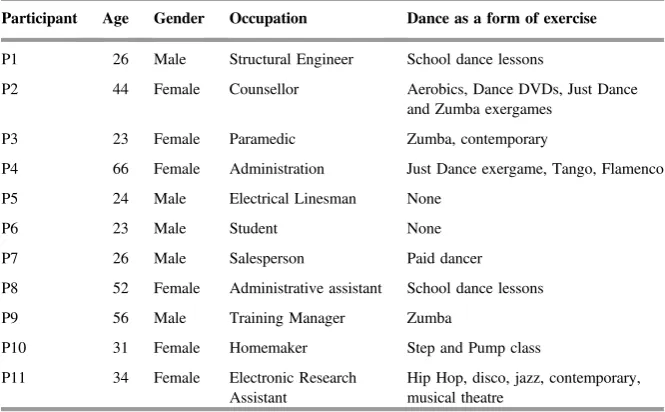
et al., 2017). A participant overview is provided inTable 1.
A semi-structured interview technique was selected, using broad, open-ended
questions designed to draw out participants’experiences and values in the context
of dance (Appendix A). The same questions were used for each participant,
how-ever, the order that questions were asked was changed depending on the answers
given by the participant. This was done at the discretion of the interviewer to
main-tain a constantflow of discussion, and to enable a comfortable interview environ-ment for the participant. Interviews were conducted at a preferred location
identified by each participant. Locations ranged from public libraries to university conference rooms. The interviews were conducted one-on-one, and were audio
recorded.
5. Analysis
The audio recordings of interviews were transcribed and coded using Atlas.ti. This
software is ideal for text-based coding as it allowsflexible use of almost any coding scheme but also facilitates basic quantification of dataee.g. the co-occurrences and frequencies that we calculated in this study. In this case the ability to find co-occurrences in the data was the most important function of the software.
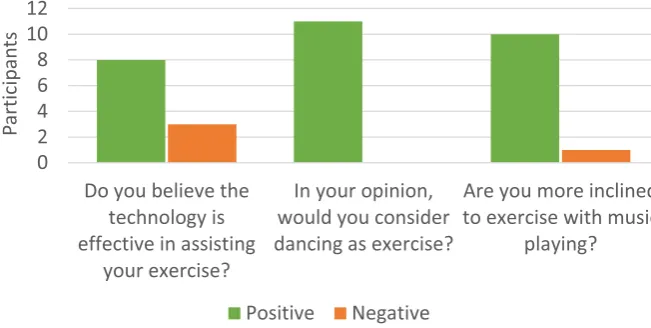
Firstly, four key interview questions were coded and quantified for positive or nega-tive responses, which are given below. The numbers further help us explain
partic-ipants’responses to other questions, as discussed in the results.
Table 1.Participant demographics.
Participant Age Gender Occupation Dance as a form of exercise
P1 26 Male Structural Engineer School dance lessons
P2 44 Female Counsellor Aerobics, Dance DVDs, Just Dance and Zumba exergames
P3 23 Female Paramedic Zumba, contemporary
P4 66 Female Administration Just Dance exergame, Tango, Flamenco
P5 24 Male Electrical Linesman None
P6 23 Male Student None
P7 26 Male Salesperson Paid dancer
P8 52 Female Administrative assistant School dance lessons
P9 56 Male Training Manager Zumba
P10 31 Female Homemaker Step and Pump class
P11 34 Female Electronic Research Assistant
1. Do you believe technology is effective in assisting your exercise? 2. Would you consider dancing as exercise?
3. Are you more inclined to exercise with music playing?
4. Would you prefer to dance alone or with a partner?
Then,O’Brien and Toms’(2008)model of users’engagement with technology was
used to develop the coding scheme (Table 2). Engagement, disengagement, and
sus-tained engagement with SSTs, and dance formed the themes for this study. The
at-tributes for each of these themes were derived from the interview transcripts. Initial
analysis of the data did not reveal information on participants’re-engagement with
SSTs, exercise and/or dance. Thus, re-engagement was not included as a theme in
the coding.
Finally, the coded data were queried for the two research questions using the
co-occurrence query tool in Atlas.ti. To find an answer to RQ1, the co-occurrence tool in Atlas.ti was run on the themes Point of Engagement with Dance and
Engage-ment with Exercise, resulting in the sub-theme Point of EngageEngage-ment with Dance as a
form of Exercise. Similarly, sub-themes were created for Sustained Engagement
with Dance as a form of Exercise, and Disengagement from Dance as a form of
Ex-ercise. RQ2 was answered by running the co-occurrence tool in Atlas.ti on the
sub-theme Point of Engagement with dance as a form of Exercise and the sub-theme
Engage-ment with SSTs, resulting in a sub-theme Point of EngageEngage-ment with SSTs for
Dance-based Exercise. Similarly, sub-themes were created for Sustained Engagement with
SSTs for Dance-based Exercise, and Disengagement with SSTs for Dance-based
Exercise.
Table 2.Themes identified for coding interview transcripts (based on O’Brien and Toms’engagement framework).
Themes Description
Point of Engagement with SSTs Initiation and introduction of use of SSTs
Disengagement with SSTs Complete discontinuation of the use of SSTs
Sustained engagement with SSTs Continuous use of SSTs without disruptions or breaks
Point of Engagement with Dance Initiation and introduction of some of form of dance
Disengagement with Dance Complete discontinuation of dance
Sustained engagement with Dance Continuous involvement with some form of dancing without disruptions or breaks
Point of Engagement with Exercise Initiation and introduction of some of form of exercise
Disengagement with Exercise Complete discontinuation of exercise
6. Results
The occupation and age of each of the participants is shown inTable 1, along with
the dance forms that they had engaged in at some point in time, and it can be seen
that the participants had no expertise in technology-related design and development
and no professional dance training. Thus, participants did not necessarily appreciate
all the possible roles that technology could play in exercise, and especially in
dance-based exercise. As such, participant responses pertaining to the use of SSTs were
generally limited to their previous experience of counting steps, heart rate and other
measures, tracking progress and providing feedback. SSTs used by the participants
in exercise (with and without dance) were apps, DVDs, Fitbits, heart rate monitors,
and controller apps (the term controller apps refers to games and apps for gaming
consoles such as Xbox and PlayStation). Generally, the researcher had to explain
the concept of SSTs to the participants at the point in the interview at which they
werefirst mentioned.Fig. 1shows positive or negative responses to key questions 1e3. All participants believed dance is exercise, eight believed SSTs were effective in assisting them to exercise, and ten would be more inclined to exercise with music
playing (the other participant preferred to watch news on the TV while exercising).
In addition, when asked if they would prefer to dance alone or with a partner (key
question 4) only one said she would prefer to dance alone and that was due to her
feeling that her husband was a bad dancer. One would prefer a group context where
the whole group is working towards something, and one replied a bit of both. The
other eight would all prefer to dance with a partner, as they did not want to be alone
on the dancefloor, felt dancing alone was weird or dancing with a partner was more fun or sociable. However, one of the eight mentioned that to dance with a partner, the
partner had to be a capable dancer.
6.1. Engaging with dance-based exercise
The attributes that were revealed from the analysis as contributing to engagement,
sustained engagement, and dis-engagement from dance-based exercise are
summar-ised inTable 3and discussed below.
The co-occurrence tool when applied to the two themes Engagement with Dance and
Engagement with Exercise resulted in three attributes for engagement with dance as a
form of exercise: intrinsic motivation, extrinsic motivation and enjoying the music or
music style. Participants introduced some form of dance (shown inTable 2) in their
exercise regime because of intrinsic motivation to remain physically and mentally
fit, and for personal wellbeing. All eleven participants believed that dance is a form of exercise (Fig. 1) and can contribute to an exercise regime that is fun to engage in.
They believed dance could provide energetic full body exercise and is good forfitness.
And um, you know I think you use your core strength a lot.. (P4)
.the exercise is pretty good when you dance.(P5)
They also claimed that dance offered a means towards improving mental wellness.
... it’s an exercise [but] also good for your mind.. (P4)
.But not only, um, for physical, but also mental, emotional, I’ve.with my experience, I’ve seen, including myself, come out of the shell through movement,
and dance and stufflike that.(P11)
Participant P4 said that dance offered a way to vent out frustrations and anger in everyday life and stated she felt very good after the dance session.
.. you’re stamping on thefloor.getting angry with thefloor.. (P4)
Extrinsic motivation came in the form of other peoples’opinions, suggestions, and
reviews. Two participants got involved with dance-based exercise because someone
(roommate, family members, school-based instructor) introduced them to it.
Table 3. Attributes contributing to engagement, sustained engagement and
disengagement with dance as a form of exercise.
Attributes for point of engagement with dance-based exercise
Intrinsic Motivation Extrinsic Motivation
Enjoying the music or particular music style
Attributes for sustained engagement with dance-based exercise
Fun
Skill, experience, and confidence in dancing Social setting
Attributes for dis-engagement from dance-based exercise
Lack of skill, experience, and confidence in dancing
Well, Ifirst came across it when I was, um, with my nieces and nephew, and it
was basically something that we were doing together as a family that we were
doing over the Christmas holidays and we had a lot of fun doing that. (P2)
I probably did aerobics a bit in high school. (P2)
All eleven participants said that music took their mind offthe negative experiences of exercising such as feeling tired and feeling pain and thus they would at the least
try out any form of exercise associated with music.
Well, it helps you relax and makes you feel ... It takes your mind offthe pain of
what you’re doing.(P9)
Ten participants said that music played an important role in their exercise regime and
they listened to music while exercising (Fig. 1). Eight participants took to dancing as
an exercise because of positive experiences with the music associated with the type
of dance. For example, one participant enjoyed aerobics when it was set to music in
comparison to an older form of aerobics.
So, like back in ... when I was in my forties ... when I started going to exercise
classes like aerobics in my early thirties, mid-thirties, they were very like star
jump, star jump, run around the room which I didn’t enjoy but when music
or dance orientated aerobics came in, I really enjoyed it. (P4)
Another participant suggested that the type of music played determined whether the
experience of dancing and exercising was good or not.
.probably the fact that it was Latin, so the music was fantastic.(P2)
The co-occurrence tool applied to Sustained engagement with Dance and Sustained
engagement with exercise resulted in three attributes for sustained engagement with
dance as a form of exercise: fun; skill, experience and confidence in dancing; and social setting. Six Participants stayed with dance-based exercise because they just
enjoyed it. Four participants remained engaged with dance-based exercise because
they had the skill or/and experience with dancing. Participant P4 had learned
Fla-menco and various other forms of dance and at the time of the study was enrolled
in a Tango class. The skill and experience made her feel confident about her skills. Participant P8 had picked up dance at school and, although not currently engaged,
was keen to learn more dance styles/take up dance-based exercise because she
thought she was good at it.
At school, many moons ago.I was very good at it. Received an award for a
dance performance.P8
.Um, because I think it’s a good form of exercise because you’re using your whole body. (P8)
Four participants suggested that the social aspect was critical for staying on track
with their exercise regime. They claimed that the social setting facilitated motivation
and fun in their exercise routine which made them stick to their routine on a regular
basis.
Ahhh, it was uh ... it was like being motivated, yes and having the whole ... so
many people in the building, all of us doing it together... (P4)
Four participants suggested that it did not matter what type of dance they were
engaging in as long as they were doing it with their friends.
Silly dancing, I suppose, [laughs] yeah I like, just social dancing (P5)
The co-occurrence tool applied to dis-engagement with Dance and dis-engagement
with exercise resulted in three attributes for dis-engagement with dance as a form of
exercise: Lack of experience, skill and confidence in dancing; problems with social settings; logistics of attending dance classes. One participant reported disengaging
from dance-based exercise due to injury/health related issues. The perception with
dance as a form of exercise is that it requires skill and learning. If either or both
are not facilitated, people could disengage from the dance-based exercise due to
lack of confidence resulting in lack of motivation. One participant did say that she did not feel confident about her dancing skills.
I am shockingly bad at it...not graceful at all. (P2)
Lack of skill in dancing becomes more prominent in social settings, and could make
people feel embarrassed to dance in front of others.
Like I said I am not very coordinated,*laughs*, so going to classes and stufflike
that I don’t like doing that, because I get self-conscious and feel stupid.(P2)
Dancing in a social setting could bring other challenges. Different people have different preferences regarding who to dance with, type of music played during the exercise, age groups of people in the social setting and so on. Participant P5
had found a group of women of her age to exercise with.
.it’s mostly women my age, or fifties, couple of younger ones.. (P4)
However, she found the women very noisy and chatty. She could not hear the music
that was being played. She remained engaged for a while because the exercise was
giving her a good workout, but left the group after one month.
case of participant P4, could result in disengagement with the dance-based exercise.
Participant 2 preferred to dance with her husband but her husband is not interested in
dance. This resulted in her giving up dance-based exercise and talking up walking
instead as a form of exercise so that she could do it with her husband. This indicates
that in a social setting, people may want to look at a form of exercise that allows
them to spend more time with their family/friends.
Two participants disengaged from their dance-based exercise due to logistical issues
posed by location and timing of group dance settings and the cost associated with
dance-based exercise. Both the participants believed that they needed to go to a class
to participate in a dance-based exercise as they needed professional help to do the
routines properly. Thus, the logistical issue is tied to the fact that some people
believe that dance requires skill and learning and that it is something that cannot
be done on their own.
...Convenience is a big thing for me.. So, if it was there and it was not so
expensive I would consider it (P3)
6.2. Engaging with SSTs in the context of dance-based exercise
Participants used SSTs such as apps, controller apps with gaming consoles, DVDs,
monitors and trackers, and pedometers with the prime objective of keepingfit and healthy. The interpretation of most participants when asked about SSTs was that
we were asking about apps. Most apps available in the market are meant for tracking
progress and thus the participants’understanding of SSTs was that they are
technol-ogy based gadgets that help monitor and track progress during an exercise regime.
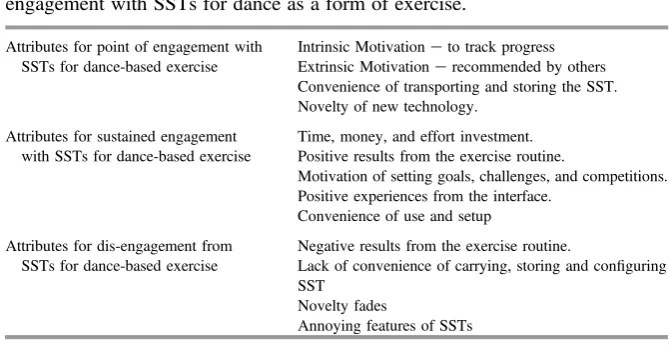
Thus, the participants were probed with questions to reflect on their potential use of SSTs in exercise. The attributes contributing to engagement, sustained
engage-ment and dis-engageengage-ment with SSTs for dance as a form of exercise are summarised
inTable 4and discussed below.
The co-occurrence tool, when applied to the three themes Engagement with Dance,
Engagement with exercise, and Engagement with SSTs revealed four attributes for
engagement with SSTs for dance as a form of exercise: intrinsic motivation; extrinsic
motivation; convenience of transport and storage; and novelty of new technologies.
One of the reasons for people to engage with SSTs for dance-based exercise was
because someone (e.g. children in the family, roommates) introduced them to it.
Another reason was to track and monitor the progress in a graphical and visual
format. One participant suggested he started using apps to view his progress in
the form of pretty graphs and statistics.
Convenience was another factor that encouraged participants to use SSTs as they
could just carry a device to track progress and view their status.
.I used to have a notepad to write everything down on.but I like to see how I was doing without having to likeflip through all the pages.(P1)
Novelty of new technology and features is another attribute that engages people with
SSTs.
Just bought a new phone, so it was an initial craze kind of.(P5)
The co-occurrence tool when applied to the three themes: Sustained engagement
with Dance, Sustained engagement with exercise and Sustained engagement with
SSTs resulted infive attributes for Sustained engagement with SSTs for dance as a form of exercise: investment of time, money and effort; positive results from the exercise; motivation of setting goals, challenges and competitions; positive
experi-ences from the interface; convenience of use and set-up.
Effort and time required to configure and set up any new SST (such as installing a new app) can result in people preferring to continue using a SST that they have
already engaged with. Three participants suggested that they continued using the
SSTs (sustained engagement) because it was technically painful to switch between
technologies.
Um, I guess switching from like one app to another is pretty painful, you
basi-cally have to start again.(P1)
People tend to continue using a technology once they have invested time, space, and
money in it. Using a new SST could also mean losing tracked and monitored data.
However, this sustained engagement could persist only if people can derive positive
Table 4.Attributes contributing to engagement, sustained engagement, and
dis-engagement with SSTs for dance as a form of exercise.
Attributes for point of engagement with SSTs for dance-based exercise
Intrinsic Motivationeto track progress Extrinsic Motivationerecommended by others Convenience of transporting and storing the SST. Novelty of new technology.
Attributes for sustained engagement with SSTs for dance-based exercise
Time, money, and effort investment. Positive results from the exercise routine.
Motivation of setting goals, challenges, and competitions. Positive experiences from the interface.
Convenience of use and setup
Attributes for dis-engagement from SSTs for dance-based exercise
Negative results from the exercise routine.
Lack of convenience of carrying, storing and configuring SST
Novelty fades
results from the exercise. Participant P2 associated the successful positive outcome
of the exercise regime with the use of SSTs for tracking and monitoring.
.I was gettingfit doing it.. (P2)
The next attribute is the feasibility of SSTs in allowing users to set goals and
moti-vating users through challenges and competitions to be incorporated in the exercise
routine. Participants continued using apps because they allowed them to set goals,
and they were rewarded when the set goals were achieved.
just so it sets some, like, goals for me. And so it sets some benchmarks.(P3)
if you get so many steps there’s a reward at the end.(P9)
This attribute is linked to the attribute of positive outcomes from the exercise routine.
If the SST can challenge and motivate the user to keep exercising, this should in turn
result in positive outcomes, rewards, and thus sustained use of the SST. On the other
hand, if the goals are not met and the user is not rewarded, the user may dis-engage.
A well-designed interface generates positive experiences during the use of SSTs,
which can help users to remain engaged with the SST. Positive experiences with
SSTs as stated by participants were experiences associated with their interactions
with the SST interfaces.
Like you are not kind of having to dig around in crappy interfaces and that kind
of stuff.(P1)
Convenience in terms of where SSTs can be used and effort required to setup the device before use was an important attribute to three participants. One participant
preferred easy setup mechanisms such that it is convenient to use at any time.
.I don’t like going anywhere when I exercise. It has to be a spur of the moment,
’I could exercise now’, alright let’s exercise. It has to be right there. When I have the moment, when I can be bothered, it has to be really flexible and
completely under my control.I don’t want to rely on anyone else. (P10)
Participants also expressed their preference towards SSTs which require less manual
intervention and are automatic.
I don’t have to do anything, really. It’s all done for you.(P7)
The co-occurrence tool when applied to the three themes: Dis-engagement with
Dance, Dis-engagement with exercise and Dis-engagement with SSTs revealed
four attributes for dis-engagement from SSTs for dance as a form of exercise. These
were; negative results from the exercise regime, lack of convenience in storing,
Lack of convenience in terms of space occupied by the SST, space required for the
use of the SST and the setup configuration required before use (such as in gaming consoles) could result in disengagement. This was evident in the case of participant
P2 who found setting up the Wii for using Just Dance cumbersome and had storage
issues with the Wiifit.
.it was a bit of a pain.having [to] boot the Wii up and drag the steppy thing out and all that kind of stuff.(P2)
Four participants stopped using SSTs because of negative results reported by the
SSTs. Participant P2, for example, stopped using an app because it consistently
re-ported lack of progress in terms of reaching number of steps.
.It changed the little icon to make you look fat. That got too depressing.(P2)
People engaging with SSTs due to the novelty of technology and/or brand could stop
using them as the novelty fades, which could also be exacerbated by the other
attri-butes of disengagement discussed above.
.in the short term yes because it was something that was a bit of a fad but it was not something that I.found was maintainable.(P2)
Another attribute that concerned two participants was an annoying feature, in both
cases the narration and voice of the narrator in the SST.
I don’t think I did not enjoy anything in SSTs. Maybe the voice (laughs)
actual-ly.It drives my husband insane, the voice. (P11)
Yeah and um, but it annoyed me because I didn’t like, you know ... be doing the
exercise and this voice go. Oh that’s good ... You know that’s good. And I just
go shut up and it put me off. (P4)
7. Discussion
Generally, ourfindings confirmed the model of engagement proposed by O’Brien and Toms, with attributes found within the point of engagement, sustained
engage-ment and dis-engageengage-ment. This framework was a useful and appropriate approach to
interrogating our data. Our results suggest that dance is perceived as an important
form of experience for physical, as well as mental and emotional, wellbeing.
How-ever, for people to take up dance as a form of exercise, learning and development of
dance skills might be required. Developing these skills is important to instill confi -dence, which in turn is required for sustained engagement with the exercise regime.
People generally want to engage in activities that make them feel adequate, capable,
designing SSTs to facilitate these experiences should increase engagement. For
example, because learning of dance steps is important for people who have no prior
experience of dance, SSTs should facilitate that learning.
The social aspect is important in many forms of exercise, particularly dance
(Domene et al., 2016), and our results support this perspective, with people clearly
preferring to dance with a partner or in a formal class setting. People are more likely
to adhere to their exercise regime and goals if they exercise in a group (Beauchamp
et al., 2007). However, people may prefer to exercise alone when it comes to
dance-based exercise if they do not have skills, experience, and/or confidence to dance in front of others (Palo-Bengtsson et al., 1998). Researchers have also suggested that a
greater proportion of older people prefer to exercise alone with some instruction
rather than within group or class-based settings (Wilcox et al., 1999). Thus,
prefer-ence to exercise in a social setting could depend on age and further investigation in
this direction is required. SSTs could allow users to participate in a social setup, not
simply sharing steps or status on social media but participating in a ritual with others
or learning to dance with a partner. However, they should also allow theflexibility of dancing alone.
Music was highlighted as a facilitator of dance-based exercise within this study. All
participants agreed that music gets them to take their mind offthe effort of exer-cising, with ten of the eleven participants listening to music while exercising. Music
has been shown to trigger movement (Murrock and Higgins, 2009) and should be
essential for dance-based exercise. Consideration of suitable music styles and
op-tions for users to select preferred music are some direcop-tions to be explored in the
design and development of SSTs for danced-based exercise.
Literature has shown that disengagement may occur if a website is too difficult to use (O’Brien and Toms, 2008), or a text is too complicated or unfamiliar (Douglas and
Hargadon, 2000). Similarly, our study showed that poor usability could contribute
to disengagement. Previous research has also shown that features unrelated to the
core function of a device, including set-up and maintenance routines as well as
over-featured interfaces and un-needed functions, can cause negative responses in
users (Blackler et al., 2016; Rust et al., 2006), and that ordinary men and women
do not use all the complex features that are offered by current self-tracking apps (Didziokaite et al., 2017_ ). Results from a study offive popular dance-based exergames showed that games that had a higher usability rating and increased energy expenditure
reflected highest on engagement scores and were thus more likely to be used again (Bronner et al., 2015). Our study showed that easy to use interfaces helped to keep
people engaged, confirming these previousfindings and highlighting the importance of careful feature inclusion and design in order to maximise engagement.
for well-designed products to stand out in this marketplace, leveraging their usability
as a point of difference and to build loyalty. However, at the end of the day, partic-ipants wanted the exercise regime to show results, and that was a major factor in
them staying engaged with it and with the associated SST.Ryan and Deci (2000)
found that receiving positive feedback enhanced intrinsic motivation, while negative
performance feedback resulted in diminished intrinsic motivation, and ourfindings have borne this out.
Our results suggest that SSTs for dance-based exercise should be simple to use,
al-ways available, and require minimal set-up routines. Users should be able to
partic-ipate in an exercise regime anytime and anywhere as per their convenience.
Logistical problems were a major reason for disengagement and SSTs have the
po-tential to overcome these problems almost completely (e.g. users can set their own
time and place, involve who they like and pay out less money over time).
SSTs could offer greater scope than purely progress tracking devices. People believe that dancing requires skill and training, which is something SSTs can play an
impor-tant role in providing. SSTs could, for example, provide training for certain dance
steps or help partners to learn how to dance together. Careful design of products
and services which facilitate realistic goal setting and maintain engagement with
dance-based exercise can assist to make this happenefor example, through
struc-turing of weekly targets related to learning dance steps and/or prompts to practice
what has been learnt to-date, subtle reminders about posture and movement during
complex dance moves, or through pushing interesting new music and dances to the
system periodically. These sorts of features may be far more attractive and useful to
ordinary men and women than the kinds of extras offered by many fitness apps (heart-rate, sleep tracking, calorie counts, etc).
Overall, our findings show that SSTs have a role in facilitating movement and increased engagement with physical activities if they facilitate dance based exercise
that also supports people’s confidence, dance knowledge and positive experiences.
8. Conclusion
This study has shown that dance can be a form of enjoyable exercise, and that there is
appetite for SSTs for dance-based exercise. SSTs can play an important role in
dance-based exercise, however their role needs to go above and beyond simple
tracking. The study has revealed that people’s engagement with dance as a form
of exercise as well as use of related SSTs is governed by positive results or feedback
from both the exercise regime and the SSTs. The role of SSTs should thus primarily
be facilitating dance and exercise rather than just reporting and tracking.Domene
et al. (2016)explain how adherence to a dance exercise regime is likely maintained
facilitates a self-regulated experience, and provides connectedness with others. SSTs
need to provide learning and feedback, be able to eliminate logistical problems by
adapting to the environment in which the dancing is performed, and facilitate the
so-cial side of dance as well as allowing for solo or collaborative remote dance
expe-riences. They can facilitate all of this if we design them appropriately. Our future
work in this area includes investigating how different types or groups of people may engage differently with SSTs for exercise, how innovative SSTs can be used to increase physical activity in young children, and the place of dance in facilitating
this.
Declarations
Author contribution statement
Alethea Blackler: Conceived and designed the experiments; Analyzed and
inter-preted the data; Contributed reagents, materials, analysis tools or data; Wrote the
paper.
Shital Desai: Analyzed and interpreted the data; Contributed reagents, materials,
analysis tools or data; Wrote the paper.
Levi Swann: Analyzed and interpreted the data; Wrote the paper.
Marianella Chamorro-Koc: Conceived and designed the experiments; Contributed
reagents, materials, analysis tools or data.
Gene Moyle: Conceived and designed the experiments; Wrote the paper.
Mikaela Stephens: Performed the experiments; Analyzed and interpreted the data;
Wrote the paper.
Funding statement
This research did not receive any specific grant from funding agencies in the public, commercial, or not-for-profit sectors.
Competing interest statement
The authors declare no conflict of interest.
Additional information
Supplementary content related to this article has been published online athttps://doi.
References
Angioi, M., Metsios, G., Koutedakis, Y., Wyon, M.A., 2009. Fitness in
contempo-rary dance: a systematic review. Int. J. Sports Med. 30 (7), 475e484.
Bakardjieva, M., Smith, R., 2001. The internet in everyday life: computer
networking from the standpoint of the domestic user. New Media Soc. 3 (1),
67e83.
Beauchamp, M.R., Carron, A.V., McCutcheon, S., Harper, O., 2007. Older adults’
preferences for exercising alone versus in groups: considering contextual
congru-ence. Ann. Behav. Med. 33 (2), 200e206.
Bianchi-Berthouze, N., 2013. Understanding the role of body movement in player
engagement. Hum. Comput. Interact. 28 (1), 40e75.
Blackler, A.L., Gomez, R.E., Popovic, V., Thompson, H., 2016. Life is too short to
RTFM : how users relate to documentation and excess features in consumer
prod-ucts. Interact. Comput. 28 (1), 27e46.
Bogost, I., 2005. The rhetoric of exergaming. In: Proceedings of the Digital Arts
and Cultures (DAC) Conference, Copenhagen, Denmark available at: http://
bogost.com/writing/the_rhetoric_of_exergaming/.
Boyle, E., Connolly, T., Hainey, T., Boyle, J., 2012. Engagement in digital
enter-tainment games: a systematic review. Comput. Hum. Behav. 28 (3), 771e780.
Bronner, S., Pinsker, R., Noah, A., 2015. Physiological and psychophysiological
responses in experienced players while playing different dance exer-games.
Com-put. Hum. Behav. 51 (Part A), 34e41.
Bronner, S., Pinsker, R., Naik, R., Noah, A., 2016. Physiological and
psychophys-iological responses to an exer-game training protocol. J. Sci. Med. Sport 19 (3),
267e271.
Campion, M., Levita, L., 2014. Enhancing positive affect and divergent thinking
abilities: play some music and dance. J. Posit. Psychol. 9 (2), 137e145.
Cota, T., Ishitani, L., Vieira, N., 2015. Mobile game design for the elderly: a study
with focus on the motivation to play. Comput. Hum. Behav. 51, 96e105.
Cruz-Ferreira, A., Marmeleira, J., Formigo, A., Gomes, D., Fernandes, J., 2015.
Creative dance improves physical fitness and life satisfaction in older women.
Res. Aging 37 (8), 837e855.
Curran, J.M., Meuter, M.L., 2005. Self-service technology adoption: comparing
Delgado, M., 2014. How fit is that Fitbit? Retrieved September 27, 2015, from.
http://berkeleysciencereview.com/fit-fitbit/.
Didziokaite, G., Saukko, P., Grei_ ffenhagen, C., 2017. The mundane experience of
everyday calorie trackers: beyond the metaphor of Quantified Self. New Media Soc.
20 (4), 1470e1487.
Domene, P., Moir, H., Pummell, E., Easton, C., 2014. Physiological and perceptual
responses to Latin partnered social dance. Hum. Mov. Sci. 37, 32e41.
Domene, P., Moir, H., Pummell, E., Easton, C., 2016. Salsa dance and Zumba
fitness: acute responses during community-based classes. J. Sport Health Sci. 5 (2), 190e196.
Douglas, Y., Hargadon, A., 2000. The pleasure principle: immersion, engagement,
flow. Proceedings of the Eleventh ACM on Hypertext and Hypermedia, pp. 153e160.
Fan, S., 2013. The Ancient Marriage between Music, Movement and Mood.
Scien-tific American. Retrieved from. https://blogs.scientifi camerican.com/mind-guest-blog/the-ancient-marriage-between-music-movement-and-mood/.
Flores, R., 1995. Dance for health: improvingfitness in African American and His-panic adolescents. Publ. Health Rep. 110 (2), 189. available at:https://www.ncbi.
nlm.nih.gov/pmc/articles/PMC1382101/.
Gao, Z., 2012. Motivated but not active: the dilemmas of incorporating interactive
dance into gym class. J. Phys. Activ. Health 9 (6), 794e800.
Gao, Z., Zhang, T., Stodden, D., 2013. Children’s physical activity levels and
psy-chological correlates in interactive dance versus aerobic dance. J. Sport Health Sci.
2 (3), 146e151.
Greenan, Todd, 2016. App User Retention: Less than 25% of New App Users
Re-turn the Day after First Use (Here’s what to Do about it). Braze Magazine available
at.https://www.braze.com/blog/app-customer-retention-spring-2016-report/.
Harmonix, 2015. Dance Central. Retrieved June 6, 2017, from. http://www.
harmonixmusic.com/games/dance-central/.
Karageorghis, C., Terry, P., Lane, A., Bishop, D., Priest, D., 2012. The BASES
Expert Statement on use of music in exercise. J. Sports Sci. 30 (9), 953e956.
Keyani, P., Hsieh, G., Mutlu, B., Easterday, M., Forlizzi, J., 2005. DanceAlong:
supporting positive social exchange and exercise for the elderly through dance.
In: CHI’05 Extended Abstracts on Human Factors in Computing Systems,
Kloos, A., Fritz, N., Kostyk, S., Young, G., Kegelmeyer, D., 2013. Video game
play (Dance Dance Revolution) as a potential exercise therapy in Huntington’s
dis-ease: a controlled clinical trial. Clin. Rehabil. 27 (11), 972e982.
Lehmann, J., Lalmas, M., Yom-Tov, E., Dupret, G., 2012. Models of user
engage-ment. In: International Conference on User Modeling, Adaptation, and
Personaliza-tion, pp. 164e175.
Lister, C., West, J., Cannon, B., Sax, T., Brodegard, D., 2014. Just a fad? Gamifi
-cation in health andfitness apps. JMIR Serious Games 2 (2), e9.
Marquez Segura, E., Waern, A., Moen, J., Johansson, C., 2013. The design space of
body games: technological, physical, and social design. In: Proceedings of the
SIG-CHI Conference on Human Factors in Computing Systems, pp. 3365e3374.
Martin, M., Melnyk, J., Zimmerman, R., 2015. Fitness apps: motivating students to
move: editor: brian Mosier. J. Phys. Educ. Recreat. Dance 86 (6), 50e54.
McInman, A., Berger, B., 1993. Self-concept and mood changes associated with
aerobic dance. Aust. J. Psychol. 45 (3), 134e140.
Mealey, L., Jakicic, J.M., Marcus, Mealey, A.D, 2010. The Effect of Dance Dance
Revolution on energy expenditure and enjoyment in severely overweight children
compared to alternative forms of activity. J. Strength Condit Res. 24 (1).
Mueller, F., Agamanolis, S., Picard, R., 2003. Exertion interfaces: sports over a
dis-tance for social bonding and fun. In: Proceedings of the SIGCHI Conference on
Hu-man Factors in Computing Systems, pp. 561e568.
Murrock, C., Higgins, P., 2009. The theory of music, mood and movement to
improve health outcomes. J. Adv. Nurs. 65 (10), 2249e2257.
Ng, S.W., Popkin, B., 2012. Time use and physical activity: a shift away from
movement across the globe. Obes. Rev. 13 (8), 659e680.
O’Brien, H., Toms, E., 2008. What is user engagement? A conceptual framework
for defining user engagement with technology. J. Am. Soc. Inf. Sci. Technol. 59 (6),
938e955.
Palo-Bengtsson, L., Winblad, B., Ekman, S.-L., 1998. Social dancing: a way to
sup-port intellectual, emotional and motor functions in persons with dementia. J.
Psy-chiatr. Ment. Health Nurs. 5 (6), 545e554.
Parnell, E.C., 2015. Spark more dancing: getting past the limitations of dance in
school-wide fitness programs. Phys. Health Educ. J. 81 (1), 28ff. available at:
https://search.proquest.com/docview/1704438161.
Rust, R., Thompson, D., Hamilton, R., 2006. Defeating feature fatigue. Harv. Bus.
Rev. 84 (2), 98e107 available at:https://hbr.org/2006/02/defeating-feature-fatigue.
Ryan, R., Deci, E., 2000. Self-determination theory and the facilitation of intrinsic
motivation, social development, and well-being. Am. Psychol. 55 (1), 68.
Ryan, R., Williams, G., Patrick, H., Deci, E., 2009. Self-determination theory and
physical activity: the dynamics of motivation in development and wellness.
Hellen-ic J. Psychol. 6 (2), 107e124 available at:http://selfdeterminationtheory.org/SDT/
documents/2009_RyanWilliamsPatrickDeci_HJOP.pdf.
SCEA, 2015. SingStar Dance. Retrieved from.https://www.playstation.com/en-us/
games/singstar-dance-ps3/.
Six to Start, Alderman, N., 2015. Zombies Run. Retrieved June 6, 2017, from.
https://zombiesrungame.com/.
Stalnacke Larsson, R., 2013. Motivations in Sports and Fitness Gamification: A Study to Understand what Motivates the Users of Sports and Fitness Gamification Services. Univeristy of Umea available at: http://umu.diva-portal.org/smash/get/
diva2:654720/FULLTEXT01.pdf.
Strean, W., 2011. Creating student engagement? HMM: teaching and learning with
humor, music, and movement. Creativ. Educ. 2 (3), 189e192.
Terry, P.C., Karageorghis, C.I., Saha, A.M., D’Auria, S., 2012. Effects of
synchro-nous music on treadmill running among elite triathletes. J. Sci. Med. Sport 15 (1),
52e57.
Turner, P., 2014. Thefigure and ground of engagement. AI Soc. 29 (1), 33e43.
Ubisoft, 2015. Just Dance. Retrieved from.https://www.ubisoft.com/en-AU/game/
just-dance-2015/.
Vallerand, R., Reid, G., 1984. On the causal effects of perceived competence on
intrinsic motivation: a test of cognitive evaluation theory. J. Sport Psychol. 6 (1),
94e102.
Vandewater, E., Shim, M., Caplovitz, A., 2004. Linking obesity and activity level
with children’s television and video game use. J. Adolesc. 27 (1), 71e85.
Wagener, T., Fedele, D., Mignogna, M., Hester, C., Gillaspy, S., 2012.
Psycholog-ical effects of dance-based group exergaming in obese adolescents. Pediatr. Obes. 7
(5), e68ee74.
Wang, J., 2014. A Wearable Sensor (Fitbit One) and Text-Messaging to Promote
Physical Activity and Participants’ Level of Engagement (A Randomized
Wilcox, S., King, A.C., Brassington, G.S., Ahn, D.K., 1999. Physical activity
pref-erences of middle-aged and older adults: a community analysis. J. Aging Phys.
Ac-tiv 7 (4), 386e399.
Williams, N., Germain, J., 2008. Fitness in disguise. J. Phys. Educ. Recreat. Dance
79 (7), 35e56.
Yee, N., 2006. Motivations for play in online games. Cyberpsychol. Behav. 9 (6),