MOVING MULTI TARGET DETECTION
USING COSTAS SIGNAL
MANMADHARAO.G*
Assoc Professor, Dept. of E.C.E, GMR Institute of Technology, Rajam, Andhrapradesh – 532127, India,
RAJARAJESWARI.K
Professor, Dept of E.C.E, A.U College of Engineering, Andhra University, Visakhapatnam, Andhrapradesh, India,
Abstract:
In modern times, radar is used in a wide variety of applications including defense, air traffic control, meteorology, and even mapping. Radio Detection and Ranging (RADAR) involves the interpretation of a signal to determine characteristics of targets. With the unavoidable presence of various types of interference, signal processing is naturally an important part of any radar system. In this paper, we used a series of 8 bit costas sequence [2], each pulse having a length of 5 microseconds. The interpulse period was 200 microseconds and the radar return receive window started 20 microseconds after pulse transmission and ended 170 microseconds later. The radar system sampling rate and carrier frequency were 10MHz (2x over sampling) and 5GHz respectively. The noise was Gaussian and had a standard deviation of 2 relative to the signal amplitude. With these parameters detectable targets lay in between 3.7 km to 29.0 km away, and moved with a speed under 53 m/s.
Keywords: costas, Burst sampling, Matched filter, FFT, Gaussian noise, SNR.
1. Introduction
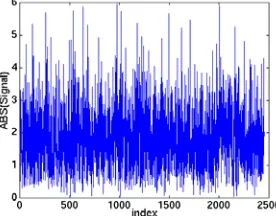
The basic idea behind radar is to send out a signal and analyze the return signal[1],[4],[5]. If the signal hits something, it will be reflected back to the antenna. The delay between the time that the signal was sent out and the time that it is received can be used to determine the object's distance. If the object happens to be moving, the reflected signal will have a different frequency from the one that was sent out as shown in Fig.1. The difference between these frequencies is referred to as a Doppler shift [3]. A common example of Doppler shift is that of a train whistle. As the train approaches, an observer hears a higher pitch than the actual pitch of the whistle. Conversely, as the train moves away, an observer hears a lower pitch than the actual pitch of the whistle. The difference in the pitches heard by the observer is due to the Doppler shift. In radar applications, Doppler shift can be used to determine the velocity of an object.
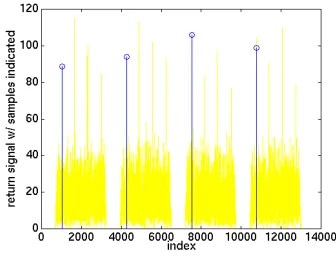
It turns out that the proper filter to use on the signal is a "matched filter" to the original signal. A matched filter is the original signal flipped about the origin on the time axis and then conjugated. Convolving the return signal with the matched filter like this basically amplifies the bursts in the clutter and noise so that the SNR (signal to noise ratio) is large. The return signal after it has been matched filtered is as shown in Fig. 2. The four peaks in each burst in this example are obvious, and we would want to consider all of these four peaks as targets. To get the ranges, it is necessary to know the time that elapsed between sending the burst and receiving the return burst. It should be clear that it took the signal half of that time
to get to the object. With this in mind, the distance to the object can be determined by multiplying the time to get to the object by the speed of the burst ( light speed=3x10^8m/s ).Velocity is determined by means
Fig. 2: Burst sampling for the first of 4 targets
signal bursts. This shift in frequency is known as the "Doppler shift". Since the change in frequency within a single burst is virtually impossible to measure unless the object is moving with a velocity that is a substantial fraction of the speed of light, the change in frequency is not determined from one burst but rather the change in the frequency from burst to burst over the entire output signal. From this Doppler shift in frequency, the velocity of each target can be found by multiplying by a scaling factor that is dependent upon the carrier frequency of the radar signal and the inter-pulse period of the bursts.
2. Development;
We began the task of designing a radar signal processor. First, the type of waveform to be used in the system had to be chosen. An impulse would be optimum for range resolution, but, aside from being impractical, it would also fail to yield any range rate
resolution. A complex exponential, on the other hand, would yield optimum range rate resolution while leaving a great deal of ambiguity in the range resolution. A compromise between the two was needed. A good test of potential waveforms is to examine the nature of the ambiguity function. The ambiguity function is essentially an autocorrelation of a waveform with a delayed and/or phase-shifted version of itself. Plotting this function versus delay and phase shift yields a convenient visual gauge of a waveform's potential performance in a radar system. In Linear frequency modulation the volume of ambiguity function was concentrated in a slowly decaying diagonal ridge This may be considered an advantage when Doppler resolution is not expected from a single pulse but it exhibits relatively high autocorrelation sidelobes and hence some form of amplitude weighting was necessary to reshape the spectrum and thus reduce the autocorrelation sidelobes. To achieve this, costas chirp[2] is used and also this signal offers acceptable resolution in range and in range rate. A program[4], was written to generate a costas frequency coding signal for a given time-bandwidth product (TW) and oversampling factor (p). Thus the output was essentially a continuous-time chirp sampled at a rate of p*W. A complex envelope of a Costas signal whose hoping sequence is
a
a
1,
a
2,....
a
M
generated as shown in Fig.3 using equation(1).
M m b m bt
m
t
u
Nt
t
u
1)
1
(
(
1
)
(
---- (1)where
elsewhere
t
t
t
f
j
t
u
m m b0
0
),
2
exp(
)
(
b m mt
a
f
After becoming familiar with the characteristics of the Costas, we worked on range processing. In order to get good range resolution, a high signal-to-noise ratio is needed. Thus, large time-bandwidth chirps were used to increase the energy initially in the signal. This alone is not enough to make target detection possible. Some filtering of the signal must also be done. By examining the equation for the SNR,[4],[5] it is clear that to maximize SNR, the numerator must be maximized. The Cauchy-Schwartz inequality defines the upper bound of the numerator. The equality holds if the filter is the conjugate of the output signal with a reversed time axis. This type of filter is referred to as a matched filter and results in the optimum SNR. Another property of the matched filter is that it compresses the pulse into a narrow peak. As a result, radar systems using matched filtering are often referred to as pulse-compression radar.
Some chirps were generated and white Gaussian noise was added to test our ability to detect and resolve a target in noise. The matched filter results in a large peak in the time domain at the point where the entire pulse has returned. The location of the output peak from the matched filter is used to calculate the range by the following formula:
range = (peak location - length of chirp)*(c / 2) / (p*W)
The length of the chirp must be subtracted from the peak location in order to get the delay from the time the signal was sent out until the time the return signal was received since the peak location indicates the time at which the entire signal has been received, not the time at which it first started to arrive.
Once the accuracy of this algorithm was confirmed, modifications were made in order to handle multiple targets. This requires the ability to locate multiple peaks in the filtered signal. For this, the matlab program[2] was used. Given a signal, a threshold, and a maximum number of peaks, pkpicker returns two vectors, one containing the peak values and the other containing the corresponding indices of the peaks. After experimenting with the threshold, it was determined that a threshold of 0.6 times the length of the chirp would be adequate. The length of the chirp is equal to the maximum peak in an autocorrelation of a chirp and so corresponds to the energy of a target in the absence of interference such as noise and clutter. The factor of 0.6 was found through trial and error to be the largest factor that would not result in a failure to detect a target. Experiments with multiple targets also gave us some notion of the degree of resolution that could be obtained with multiple targets (i.e, how close could targets be before they could no longer be resolved separately). Having established an accurate target detection and range finding algorithm, we were ready to attempt range rate processing. Unless the target is moving at an extremely high speed relative to the speed of light, the Doppler shift will be small and very difficult to detect from one pulse. The solution to this problem is to transmit a burst waveform containing repeated pulses. Initially, for simplicity, boxcars were used as the pulse so that some insight into how the parameters of the pulse affect the Doppler shift might be gained. It was determined that the inter pulse period affected the width of the main lobe of the FFT, the height of the main lobe was related to the number of pulses, and the magnitude of the side lobes depended upon the pulse length. Next, measurement of the Doppler shift from samples of the bursts was attempted. This allows range rate processing with significantly less data and thus faster computation. The sampling was done as follows. Range processing is done with the first burst alone since the additional bursts do not provide any extra range information. For each of the targets detected, each filtered burst is sampled at the location corresponding to the peak location of that target. The Doppler shift for each target is then measured from the peak location of the FFT [7] of the corresponding sampled waveform. Range rate is then determined by the following formula: (fd / fc)*(c / 2)
Next, costas chirps were used as pulses and our ability to detect Doppler shifts of these waveforms was tested. Finally, a complete range and range rate analysis was performed. Once we were satisfied with the performance of this algorithm, it was time to try and analyze a signal that was not arbitrarily generated.
3. Implementation of Radar Signal Processor
The final goal of our project was the implementation of a radar signal processor in Matlab[3],[6], that would take a noisy return signal containing bursts reflected from several targets, and accurately determine the distance and velocity of those targets. The signal waveform used was a series of costas chirps. In addition, the radar processor had to take into account several parameters/restrictions that real world radar systems have to deal with. These are the starting time and length of the receive window, the inter pulse period, and the center/carrier frequency of the radar.
The radar system that we modeled has a single antenna for sending and receiving the radar signal, and cannot transmit and receive at the same time. The system alternates modes, first sending a pulse out, and then waiting for returns to come back. Since there is no simple way of determining when a returning pulse was transmitted, the system assumes that any returning pulse was transmitted just before the start of the current receive window. The receive window's starting and ending points determine how far away detectable targets can be. Furthermore, a pulse that was sent out must return completely before the receive window ends to ensure detection. Thus the range of the system is determined by the pulse duration, start of receive window, and end of receive window. Targets outside of this range will not be detected since the radar system is in transmit mode, or will be seen as a closer target since their signal returns will return in a later receive window, in effect resulting in distance aliasing. The range processing ability of the radar system is given by the following expressions:
Distance to target=(time when start of pulse returns) * c /2
( window start time ) * c / 2 <= distance <= (window end time - pulse duration ) * c / 2
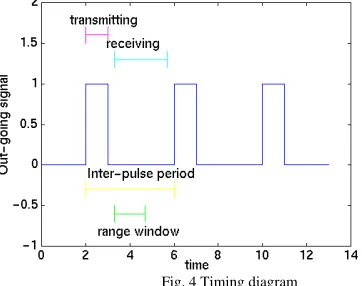
where c is the speed of light and times are measured relative to when the pulse was transmitted. The Fig.4 indicates the timing diagram shows how the transmission window and receive window are positioned in time.
Fig. 4 Timing diagram
The limits on the range of detectable velocities are determined primarily by two factors, the interburst period and the carrier frequency of the radar. In order to determine the velocity of a target, the Doppler shift of its radar return must be calculated. To reduce the amount of computation needed, a single sample is taken from a target's return signal in receive window. such that they are separated in time by the interburst period. The FFT of the samples is calculated, and from the location of the peak in the FFT, the Doppler shift is determined. Since velocity determination involves decimating the original signal, velocity aliasing occurs, limiting the range of velocities that are detectable in both the negative and positive directions. Since the Doppler shift is proportional to the carrier frequency of the radar signal, the carrier frequency also effects how large velocities may be before aliasing occurs. The velocity processing ability of the radar system is given by the following expressions: velocity of target = (FFT frequency of peak)*c / (4*pi*interburst period*carrier frequency)
| velocity | <= c / (4 * interburst period*carrier frequency).
distances to targets in kilometers as a vector, the signal gains for each target as a vector (which we kept as one always), and the velocities of each target in meters per second as a vector. The function returned a matrix containing all the detected signals during a particular receive window in a particular column. The returns from each target were positioned according to distance and modified according to velocity. Targets outside the receive window were cut off appropriately with no provision for distance aliasing.
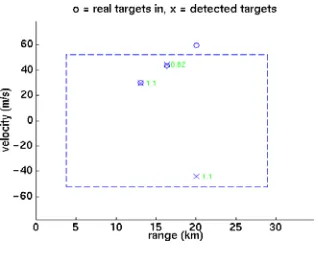
On top of the basic radar signal processor we added a small graphical user interface which allows the user to input up to 20 targets on a distance-velocity plane. The radar processor then displays detected targets with X's on the same graph. It also displays numbers next to each target which indicate how high the peak is relative to a isolated target in a noiseless environment. This allows the user to determine which targets are likely to be caused by noise.
4. Results
Analyzing the performance of the radar signal
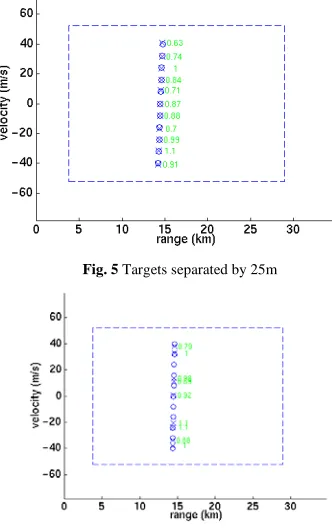
processor in a systematic manner is in general a difficult task. There are multiple variables to deal with even without the addition of the random noise. However, there are certain important performance characteristics that must be discussed. These include accuracy of distance and velocity determination, multiple target resolution, velocity aliasing, and effects of noise level. We also realized that there are a number of tradeoffs involved in choosing radar parameters. The inter burst period determines how long a receive window is possible, so it limits the range of the radar system. However, a large inter burst period lowers the range of velocity determination. Also a larger carrier frequency lowers the range of measurement since aliasing will occur at lower velocities. However, it improves the resolution of the system since it maps smaller velocities to larger Doppler shifts. Therefore there is a trade off between velocity resolution and velocity range determination. There is also a tradeoff involved in choosing the duration of the signal pulse. A larger pulse, raises the signal to noise ratio after filtering, but it reduces the ability to resolve close targets. For our simulations we used a series of 8 costas chirps, each pulse having a length of 5microseconds and a bandwidth of 5MHz. The inter pulse period was 200 microseconds and the radar return receive window started 20 microseconds after pulse transmission and ended 170 microseconds later. The radar system sampling rate and carrier frequency were 10MHz (2x oversampling) and 5GHz respectively. The noise was Gaussian and had a standard deviation of 2 relative to the signal amplitude. With these parameters detectable targets lay in between 3.7 km to 29.0 km away, and moved with a speed under 53 m/s. Fig. 5 and Fig. 6 shows the targets separated by 25m and 10m respectively
Velocity aliasing occurs when the speed of a target exceeds the maximum detectable velocity is shown in Fig. 7 is a target configuration with velocity aliasing, and the FFT's used to determine velocity. Note that the peak for one the targets flip to the opposite side.
Fig. 5 Targets separated by 25m
Fig. 7 Velocity aliasing
5. Conclusion
Attempting to analyze the performance of the radar system, it was determined that the most obvious flaw in the range/velocity determination within the bounds was a problem distinguishing between targets that are very close together. After varying the spacing between a set of targets, it was noticed that there is considerable error in the performance of the radar system processor when the targets get within fifty meters of one another. Outside of fifty meters, the error was small enough and infrequent enough that it could be blamed on the random noise. Shown are plots of the program output for targets 25 and 10 meters apart. As the spacing decreases, the processor begins to merge many of the targets into one, thereby only picking out part of them, and also giving some ghost targets.
6. References
[1] Golomb. S.W. and Taylor., “Construction and properties of Costas Arrays”, Proceedings IEEE, Volume 72, No.9 September 1984, PP 1143-1163.
[2] Levenon.N and Mozeson, E. “Modified costas Signal”, IEEE Transactions onm Aerospace and Electronic systems”, Vol.40, No.3, July2004, pp946-953.
[3] Rajeswari.K.R. “Sequences for Range Resolution RADAR” Ph.D Thesis, Dept. Of ECE, College of Engg., AndhraUniversity, Visakhapatnam-1991.
[4] Sudhakar.K. and RajaRajeswari K., “Performance Analysis of matched and post compression filters in the presence of AWGN”, international conference on systematics, Cybermatics and informaticsICSCI-06, Hyderabad.
[5] Aleksa.J.Zejak,Igor.S.Simic,Bojan.M.Zinc, Zoran Dobrosavljevic and Andirja Petrovic, “ SNR Sensitivity of Marched and mismatched RADAR Compression filters” IEEE RADAR Conference, 1998
[6] Manmadha Rao.G, Raja Rajeswari - RADAR target detection using LFM chirp- Proceedings of the international conference on systematics, Cybermatics and informaticsICSCI-09,Hyderabad.
[7] J. H. McClellan and R. J. Purdy. Application of digital signal processing to radar.
[8] C. Sidney Burrus...[et al.], Computer-Based Exercises for Signal Processing Using MATLAB, Prentice Hall, Englewood Cliffs, NJ, 1994.
[9] Rihaczek, August W., Principles of High-resolution Radar, New York, McGraw-Hill,1969. [10] J Palm III, Matlab 7.4, Tata McGraw- Hill
Mr.G.M.Rao received his B.E. degree in Electronics and Communication Engineering and M.E in Electronic Instrumentation from College of Engineering; Andhra University in 1998 and 2003 respectively. He is working for his Ph.D as a part-time research Scholar at Andhra University. He worked in different industries for 9 years. He is in teaching profession for more than 8 years. Presently he is working as Associate Professor in the Department of Electronics and Communication Engineering, GMR Institute of Technology, Rajam, Srikakulam, India. He has published a pulse and digital circuits book with pearson Education in 2010.