aerospace
Article
Nano-Sized and Mechanically Activated Composites:
Perspectives for Enhanced Mass Burning Rate in
Aluminized Solid Fuels for Hybrid Rocket Propulsion
Christian Paravan
Space Propulsion Laboratory (SPLab), Aerospace Science and Technology Department, Politecnico di Milano, 34, via La Masa, 20156 Milan, Italy; [email protected]; Tel.:+39-02-2399-8068
Received: 31 May 2019; Accepted: 18 November 2019; Published: 25 November 2019
Abstract: This work provides a lab-scale investigation of the ballistics of solid fuel formulations based on hydroxyl-terminated polybutadiene and loaded with Al-based energetic additives. Tested metal-based fillers span from micron- to nano-sized powders and include oxidizer-containing fuel-rich composites. The latter are obtained by chemical and mechanical processes providing reduced diffusion distance between Al and the oxidizing species source. A thorough pre-burning characterization of the additives is performed. The combustion behaviors of the tested formulations are analyzed considering the solid fuel regression rate and the mass burning rate as the main parameters of interest. A non-metallized formulation is taken as baseline for the relative grading of the tested fuels. Instantaneous and time-average regression rate data are determined by an optical time-resolved technique. The ballistic responses of the fuels are analyzed together with high-speed visualizations of the regressing surface. The fuel formulation loaded with 10 wt.% nano-sized aluminum (ALEX-100) shows a mass burning rate enhancement over the baseline of 55%±11% for an oxygen mass flux of 325±20 kg/(m2·s), but this performance increase nearly disappears as combustion proceeds. Captured high-speed images of the regressing surface show the critical issue of aggregation affecting the ALEX-100-loaded formulation and hindering the metal combustion. The oxidizer-containing composite additives promote metal ignition and (partial) burning in the oxidizer-lean region of the reacting boundary layer. Fuels loaded with 10 wt.% fluoropolymer-coated nano-Al show mass burning rate enhancement over the baseline>40% for oxygen mass flux in the range 325 to 155 kg/(m2·s). The regression rate data of the fuel composition loaded with nano-sized Al-ammonium perchlorate composite show similar results. In these formulations, the oxidizer content in the fuel grain is<2 wt.%, but it plays a key role in performance enhancement thanks to the reduced metal–oxidizer diffusion distance. Formulations loaded with mechanically activated ALEX-100–polytetrafluoroethylene composites show mass burning rate increases up to 140%±20% with metal mass fractions of 30%. This performance is achieved with the fluoropolymer mass fraction in the additive of 45%.
Keywords: nano-sized aluminum; micron-sized aluminum; fluoropolymer; mechanically activated aluminum; coated aluminum; fuel-rich composite powder; aluminum aggregation; aluminum agglomeration; regression rate; mass burning rate
1. Introduction
Hybrid rocket engines (HREs) feature a diffusion-limited combustion process between the atomized liquid (or gaseous) oxidizer and the pyrolyzed/vaporized solid fuel. The turbulent boundary layer combustion is ruled by convective heat transfer, with therfshowing relatively strong dependence on G [1–5]. In the complex boundary layer combustion mechanism, oxidizer-lean conditions are encountered in the region extending from the regressing surface to the flame. Conventional
Aerospace2019,6, 127 2 of 33
polymer-based solid fuels feature relatively slowrf, in turn yielding low thrust levels with simple grain geometries (i.e., cylindrical grains with single central port perforation). This issue can be partially overcome by multi-port grains enabling increasedm. f thanks to the enlarged burning surface area. Such a solution requires complex implementation, with possible system dry mass increases and structural integrity issues [6]. Liquefying fuels show faster regression rates than conventional polymeric formulations thanks to the entrainment of melted fuel droplets [7,8]. On the other hand, liquefying fuels such as paraffin wax feature weak mechanical properties and are unsuitable for effective exploitation in operating systems. Different studies are currently ongoing to obtain reinforced fuel grains combining ballistic and mechanical properties. Paraffin wax blending with reinforcing polymers is a strategy to achieve this purpose [9–14]. The improved mechanical properties of the blended formulations are accompanied by increased viscosity of the melted phase; this lessens the entrainment mass transfer, thus decreasingrf and
.
mf. In spite of differences in the combustion mechanism of polymeric and liquefying fuels, both kinds of formulations can achieve increased ballistic performance thanks to the use of metal-based energetic additives [15–19].
Metal-based energetic additives aim at providing enhanced flame temperatures and/or increased radiation heat transfer to promote faster rf of the solid fuel grain and increased
.
mf. Moreover, augmented radiation heat transfer reduces therf(G)dependence, enabling solid fuel ballistic response tailoring [20]. Aluminum is an attractive candidate as an energetic filler, thanks to its oxidation enthalpy [21] and its commercial availability at different dispersity levels (from micron-sized particles to the nanoscale), enabling its use as it is, or as an ingredient for composite additives [22–24].
Conventional Al powders feature micron-sized spherical particles [25]. TheµAl is typically air-passivated, thus showing a core–shell particle structure with the metal core surrounded by an amorphous Al2O3layer [26–28]. The micrometric size, together with the particle morphology and the specific surface area (SSA)<1 m2/g, yieldsµAl high metal content (typically>95 wt.%), relatively low reactivity, and inherent safety (i.e., high ignition temperature, reduced dispersion in air, and limited aging influence) [28–31]. The reactivity ofµAl can be enhanced by reducing the particle size down to the nanoscale [32–35] and by activation processes [23,24,36–39]. Nano-sized Al is characterized by SSA ~10 m2/g (or higher, depending on the average powder particle size and size distribution). These powders show marked reactivity at temperatures lying below the Al melting point (933 K) [17,34,35,40]. Nano-sized Al is typically passivated by air, although special chemicals may be used to shield the metal from the external environment [34,35,40]. With respect toµAl, air-passivated nAl exhibits reduced CAl and increased sensitivity to storage conditions [28]. Due to the reduced size, the nAl powders feature cold-cohesion phenomena. Clusters of particles exhibit SSA reduction with respect to the single particles. Thus, special manufacturing procedures are typically implemented to disperse nAl in energetic compositions [41–43]. Moreover, the use of nano-sized particles is complicated by their effects on propellant/fuel slurry rheology [25,44], and stricter safety requirements than the micron-sized counterpart. Activated Al powders typically feature reactivity tailoring of the starting material by chemical, mechanical, and mechano-chemical methods [22–24]. Activation techniques modify the powder surface characteristics (such as SSA and/or composition), and/or the particle morphology, size, and composition [22–24,36–38,45–48]. In particular, activation processes enable the creation of composite additives such as dual-metal [38,48] or metal–oxidizer compositions [45,48], offering wide possibilities for additive reactivity tailoring. Focusing on mechanical activation (i.e., ball milling), it is worth noting that the additives produced from micron-sized granules typically feature flake shape. For this particle morphology, thickness is the only nanoscale dimension, while complex surface texture (typically providing increased SSA with respect to conventionalµAl) is usually achieved. Thanks to this, these materials offer increased reactivity while reducing the issues related to the difficult handling of nano-sized materials [48]. The creation of composite additives eases the propellant/fuel manufacturing, enabling the use of a single (dual) ingredient, instead of adding/handling different materials.
in the combustion chamber/nozzle walls [17–22]. All these issues are of particular relevance in HRE combustion due to the diffusion-limited mechanism and the relatively low combustion efficiency of these systems. The mitigation of the low combustion efficiency requires specific implementations such as mixing chambers and/or the design of energetic additives featuring tailored composition and reactivity to lessen the detrimental effects related to metal combustion.
Current open literature includes several experimental studies on therfbehavior of metallized solid fuels for hybrid rocket propulsion [15–17,22,49–56]. In these works, differences in additive characterization approaches, experimental operating conditions, and data reduction techniques possibly yield difficult interpretations of the effects of the investigated materials when comparing different studies.
This work investigates the effects of different Al-based energetic additives on the ballistic response of polymer-based fuels for hybrid rocket propulsion. The objectives of this work are (i) evaluating therf andm. fenhancement offered by innovative Al-based additives, and (ii) analyzing the surface phenomena occurring during the combustion of metallized formulations to link the additive composition effects to the solid fuel ballistic response. Hydroxyl-terminated polybutadiene (HTPB) is considered as a binder in the solid fuel formulations, in light of its suitable mechanical properties [42], making it an interesting candidate for the lab-scale study, as well as for possible applications requiring high volumetric efficiency pursued by high filler loads. The information gained by insight into the burning behavior of polymer-based fuels can provide useful suggestions for the development of energetic additives suitable for paraffin-based fuels reinforced by blending with thermoplastic polymers, in which the entrainment reduction due to the increased melt layer viscosity could be compensated for by using energetic fillers. The investigated additives range from conventionalµAl to nAl, and the test matrix includes mechanical-activated powders. The tested nAl powders feature different passivation layers and are either uncoated or coated. Investigated mechanical-activated powders are based onµAl and nAl. Composite powders are fuel-rich formulations including ammonium perchlorate (AP), a copolymer of vinylidene fluoride and hexafluoropropylene (VFHFP) [57], and polytetrafluoroethylene (PTFE) as oxidizers. Composite additives are produced by chemical methods (i.e., particle coating) and mechanical activation. Both approaches aim at reducing the diffusion distances between the AP/fluoropolymer and the metal fuel particles. The composites are formulated to deliver the oxidizing species close to the metal fuel during the combustion. The pursued effects are a prompter Al ignition and combustion in the oxidizer-lean region close to the gasifying fuel surface. The proposed strategy differs from mixed fuel approaches previously presented in the open literature [58,59]. In the current work, the oxidizer is localized in the composite additive, and fluoropolymers are selected as oxidizers due to their relatively high thermal stability joined with reactivity in the presence of metals such as Al. In general, the oxidizer-loaded solid fuels possibly imply a loss of some of the HRE peculiarities such as faintrfdependence on thepc(in turn simplifying throttling operations and granting combustion tolerance to grain cracks), stop–restart capability, and reduced environmental impact. The current work focuses on the combustion behavior of metallized solid fuels, and on the analysis of the surface phenomena involved in this process; therefore, the abovementioned effects are not considered in this study. On the other hand, it is worth noting that the operating flexibility of HREs is not lost in the presence of solid fuel grains embedding oxidizing substances, unless the resulting formulation is burnt above its pressure deflagration limit (PDL). The latter is the lowest pressure a solid propellant/mixed hybrid can exhibit self-sustained combustion at. If a mixed hybrid is burning atpc < PDL, the combustion can be stopped and restarted without differences from what occurs in an equivalent fuel composition with no oxidizer load [59].
The work starts with pre-burning characterization of the investigated materials, and then focuses on the burning behavior of the HTPB-based fuels. The ballistic responses of the fuel formulations are characterized by time-resolvedrfand
.
Aerospace2019,6, 127 4 of 33
This work aims at providing a detailed view of the combustion process of aluminized fuel formulations. Pre-burning characterization of the metal additives is analyzed together with time-resolved ballistics of the loaded fuels. In the open literature, solid fuel combustion behavior is typically evaluated by time- and space-averaged data reduction techniques based on pre- and post-firing measurements of relevant parameters. The time-resolved technique forrfand
.
mf tracks the combustion evolution from ignition to the final condition, providing the fuel ballistic response over a range ofGoxwith a single test. High-speed visualizations of the burning surface phenomena offer detailed insight into the effects of the metal additives on the fuel combustion behavior, and they enable evaluating the impact of aggregation/agglomeration phenomena on the combustion of Al-based additives. These effects are not widely investigated for solid fuel formulations. The combination of ballistic analyses and surface visualizations contributes to clarifying the reasons for some contrasting results observed in the open literature for the combustion of aluminized fuels, in particular when nAl formulations are considered.
2. Background
A background of the current work is hereby presented considering open literature studies focused on (i) the fundamentals of the solid fuel combustion process, (ii) the influence of metal additives on the solid fuel ballistics, and (iii) a discussion of Al aggregation and agglomeration phenomena (with particular emphasis on solid fuel formulations).
2.1. Fundamentals of Solid Fuel Combustion Process
In hybrid rockets, the flame has a diffusive nature, and it is set in the boundary layer generated by the oxidizer flow over the grain surface. Fundamentals of the HRE combustion mechanism were reviewed by Chiaverini [4] and Marquardt and Majdalani [5]. A survey on solid fuel thermal decomposition (a phenomenon playing a central role in HRE combustion) was given by Lengellé[60]. The behavior of non-metallized polymeric fuel formulations is dominated by convective heat transfer, and it is subject to heat transfer blockage due to mass blowing from the surface [1–3]. Under these conditions, theoretical modeling of the combustion mechanism yields rf(G) = ar·Gnr (or rf(Gox) = ar·Goxnr), withnr=0.8 [1–3]. Experimental investigations typically yieldrf(G)power law approximations withnrin the range 0.6 to 0.8 [4]. Radiation heat transfer plays a role as convective phenomena are lessened [4,20,61,62]. The effects of radiation are due to gas radiation (playing a minor role), to soot, and (if present) to radiating metal particles [1–5,20,61–63]. Under the influence of radiation heat transfer,rfmay exhibitpcdependence [4,20], and therf(G)power law approximation showsnr<0.8 [1–5,20,61–63]. Liquefying fuels show a regression rate dependence onGsimilar to the polymeric formulations, although theirrf exhibits percentage increases of 300–400% with respect to reference HTPB [7,8]. This enhanced performance is achieved thanks to an instability of the melt fuel layer formed at the regressing surface. If this layer features low viscosity and reduced surface tension, its interaction with the oxidizer stream yields the formation of waves from which melt fuel droplets are detached [7,8]. Therefore, in liquefying fuels the overallrfis the sum of the vaporization and of the entrainment contributions. The latter does not affect the convective heat transfer blockage; moreover, the entrained mass flow rate does not require vaporization enthalpy absorption at the regressing surface [7,8]. Current liquefying fuels offer low mechanical properties. Typical mechanical properties reinforcement techniques yield a reduction of the entrainment effect due to the augmented viscosity of the melted fuel layer [10–14,19]. Recent efforts proposed innovative reinforcing strategies exerting minor effects on the liquid phase viscosity such as self-disintegrating structures [64], as well as the use of three-dimensional (3D) printed cellular structures [65,66].
2.2. Regression Rate Performance and Metal Additives
For both polymer- and paraffin-based fuel formulations, augmented or tailored,rfperformance is typically pursued by loading the fuel grains with energetic additives such as oxidizer, metal, and hydride powders. A comprehensive review of the early steps of this approach was given by Risha et al. in [15]. First studies on the combustion of metal-loaded fuels investigated the effects of micron-sized additives (such as Al and Mg). In these analyses, the achievedrfenhancements were mainly due to the augmented radiation heat transfer caused by the presence of metal particles, the effect on the flame temperature being limited by the high ignition temperatures, and relatively long burning times of these conventional additives [15,20,61,62]. Different analyses showed thatµAl exerts no marked influence on therfby particle sizes in the range of 30 to 250µm [15,20,61,62]. Thanks to their enhanced reactivity over the micron-sized counterpart, nanometric additives disclose new opportunities for solid fuel performance enhancement. In general, the lower ignition temperatures and the shorter combustion times of nano-sized particles should promote increasedrf[15–18,40,41,50–54], as well as relatively high combustion efficiencies [55]. On the other hand, the open literature shows contrasting results for fuel formulations loaded with nAl. The ballistic responses of HTPB-based fuels doped with different nano-sized ingredients was extensively investigated by Risha et al. [50–52]. In these studies, rfvariations were observed for different sets of formulations featuring similar compositions [50–52]. These effects were probably due to different manufacturing procedures (without/with fuel slurry sonication). Results for HTPB+13 wt.% nAl (air-passivated, nominal size 100–150 nm, SSA=13 m2/g), exhibited arfenhancement over the HTPB baseline of 105% (Gox=112 kg/(m2·s)) [52]. In the same dataset, formulations loaded with Viton-A-coated nAl andµAl showed anrfincrease (relative to the baseline) of 123% and 142%, respectively [52]. Experimental evidences suggest an easier ignition and a more complete combustion of the fluoropolymer coated powder with respect to the other tested additives. The data presented in References [55,56] show moderate (if any)rfenhancement for nAl-loaded formulations. In the work of Thomas et al. [56], the absence of marked effects of the nAl on the solid fuel ballistic response of HTPB-based fuels was probably due to the limited additive mass fraction (5 wt.%). In a recent study, Connell et al. reported a maximumrfincrease of 20% over a non-metallized baseline for HTPB+10 wt.% nAl [72]. In the same study, results on innovative Ti–Al–B nanopowders were presented. These new additives showedrfeffects similar to the aforementioned nAl, but with a reducedGoxsensitivity [72]. The ballistic response of a paraffin-based fuel formulation loaded with micron-sized Al flakes (with nano-metric thickness) was presented in Reference [18]. The metallized fuel promoted anrfenhancement over a pure paraffin formulation, although slight differences in operating conditions prevented a precise relative grading. Galfetti et al. reported significant performance benefits achieved by the use of nAl (nominal sizes of 50 nm and 100 nm) in entrainment-producing fuels tested in a lab-scale slab burner [19]. The solid fuelrfincrease over an HTPB baseline was 186% for pure solid wax fuel, while it reached 210% for nAl-doped compositions.
Fuel formulations loaded with AP producerfincreases over an HTPB-baseline up to 300% for a solid oxidizer mass fraction of 25 wt.% [59]. Reference [73] discussed the characteristics and the performance of a solid fuel formulation with 80 wt.% PTFE+20 wt.% B that is considered for specific hybrid propulsion applications.
Aerospace2019,6, 127 6 of 33
2.3. Aluminized Solid Fuel Formulations: Aggregation and Agglomeration
Aluminum combustion under solid/hybrid rocket motor conditions implies the presence of condensed combustion products (CCPs) [75–78]. Condensed products feature different compositions, morphologies, and sizes, depending on their genesis conditions (i.e., solid propellant/fuel composition details and operating conditions). Following the nomenclature introduced in Reference [77], CCPs include (i) smoke-oxide particles (SOP), and (ii) agglomerates. The SOP consist of fine particles (<1µm) formed by condensation of gaseous reaction products and combustion of non-agglomerated particles [77]. Agglomerates are composed by Al and Al2O3(with the eventual presence of binder decomposition products). Agglomerates feature enlarged size with respect to the original Al powder particles loaded in the solid propellant/fuel grain. This size growth is caused by aggregation of single particles at the burning propellant surface/subsurface, and by the coalescence of agglomerates (possibly followed by particle breakup during expansion) [79]. A larger agglomerate particle size and mass fraction results in higher performance losses due to incomplete combustion and two-phase flow [17]. Experimental and numerical studies on the Al combustion in solid propellant formulations were discussed in References [75–83].
The burning behavior of HTPB-based formulations doped with high mass fractions ofµAl was presented in Reference [61]. In this study by Strand et al., 7 kg/(m2·s)≤ Gox≤ 35 kg/(m2·s), and the investigated fuel featured 30 wt.% Al powder and 30 wt.% coal (added to the formulation to segregate the metal particles). Experimental results showed a layered combustion. The formation of an HTPB–coal melt containing Al was observed. Filigrees/flakes protruded from the regressing surface to the reaction zone, and large-size particles (~1 mm) were ejected by the regressing surface. During motor firings on different lab-scale set-ups, Risha et al. noted differentrfperformance from similar aluminized formulations loaded with Al flakes with nanometric thickness [15]. SEM images of extinguished fuel grains showed the more abundant Al melt layer accumulation at the regressing surface of the larger motor and causing the lowerrf. Observation of aggregation and incipient agglomeration of µAl- and nAl-loaded fuels and mixed hybrid compositions were reported in References [17,84] where high-speed and high-magnification visualizations were performed. The captured high-speed images showed localized particle aggregation phenomena affecting the investigated fuels that were tested under lowGox(10 kg/(m2·s)) with the use of 60 wt.% O2+40 wt.% N2as oxidizer.
3. Investigated Materials
3.1. Aluminum and Al-Based Powders
Table 1.Investigated powders: nomenclature, description, and production details (LE: low energy; HE: high energy; MA: mechanical activation; PTFE: polytetrafluoroethylene; ALEX: aluminum exploded).
Powder Id. Powder Description
and Notes
Particle Surface Composition
Producer and References
µAl15 Air-passivatedµAl with nominal size of 15µm
Al2O3 AMG Alpoco (UK) [25]
µAl7.5 Air-passivatedµAl with nominal size of 7.5µm ALEX-100 Air-passivated nAl with
nominal size of 100 nm
Al2O3
Advanced Powder Technology LLC (Tomsk,
Russia) [40,54] ALEX-50 Air-passivated nAl with
nominal size of 50 nm
ALEX-100B
ALEX-100 coated with 0.2 wt.% pyrocatechol (C6H6O2)
C6H6O2
L-ALEX-100 Stearic acid coated
ALEX-100 C17H35COOH
VF-ALEX-100F
Fluorotelomer alcohol-derived ester-coated ALEX-100 (coating solvent removed
by filtration) Vinylidene
fluoride–hexafluoropropylene (70:30) copolymer
(VFHFP)+ester VF-ALEX-50E
Fluorotelomer alcohol-derived ester-coated ALEX-50 (coating solvent removed by evaporation)
AP15-ALEX-100B
AP (15 wt.%)+ ALEX-100B (85 wt.%), ALEX-100B clustered and coated by AP (solvent removal by evaporation)
Al2O3+C6H6O2+
NH4ClO4 SPLab
LE-µAl15 Low-energy MA,µAl15
Al2O3+(C2F4)n (MAprocedure) [SPLab 23,24] LE-µAl15-T10
Low-energy MA,µA15 (90 wt.%)+PTFE (10 wt.%)
LE-µAl15-T30
Low-energy MA,µAl15 (70 wt.%)+PTFE (30 wt.%)
LE-µAl7.5-T30
Low-energy MA,µAl7.5 (70 wt.%)+PTFE (30 wt.%)
HE-µAl15-T45
High-energy MA,µAl15 (55 wt.%)+PTFE (45 wt.%)
HE-ALEX-50-T45
High-energy MA, ALEX-50 (55 wt.%)+ PTFE (45 wt.%)
Table 2.Tflfor Al reaction with different fluoropolymers and ammonium perchlorate (AP) as a function
of the oxidizer mass fraction in the composite (NASA Chemical Equilibrium with Applications (CEA) software,pc=1.0 MPa).
Oxidizer Density, kg/m3 10 wt.% 15 wt.% 30 wt.% 45 wt.%
AP 1950 1754 K 2327 K 2656 K 3524 K
VFHFP 1800 933.6 K 1304 K 1752 K 1975 K
Aerospace2019,6, 127 8 of 33
Air-passivated ALEX powders with nominal sizes of 100 nm and 50 nm were considered in the study. The nominal coating mass fraction was 10% for all the coated powders but AP15-ALEX-100B (see Table1). Production details for the starting nAl powders and for the variants coated by stearic acid and fluoropolymer are reported elsewhere [40]. The AP15-ALEX-100B was produced by dispersing nAl in an acetone solution of AP. The ingredients were mixed during ultrasound irradiation of the bath. Solvent was gradually removed by evaporation at 318 K. Powders were dried for 72 h in an oven at 333 K before grinding. Activated powders were produced by low-energy (LE) and high-energy (HE) mechanical activation (MA) processes, both developed at SPLab. Details on the former process are provided in dedicated works [24,48], while the latter procedure is undergoing patenting. Mechanical activation enables the coupling of different materials, removing some of the limitations of other techniques, such as the chemical compatibility required for efficient coating.
3.2. Tested Formulations
Tested fuel formulations are reported in Table3. Relative ballistic grading was performed considering a non-metallized HTPB baseline (for formulation details, see Reference [63]). The investigated compositions were all produced at lab-scale level. Formulations F2 to F7 featured a 10 wt.% load of Al powders, and they were produced by a special manufacturing procedure aiming at inter-particle cold-cohesion mitigation (i.e., ultrasound irradiation [41–43]). The solid fuel compositions from F8 to F14 featured the same metal molar content as F2, and they were prepared without special procedures for the additive dispersion in the matrix. The effects of the addition to the HTPB binder of PTFE and of (separated) Al and PTFE powders were investigated using F15 and F16. High-energy mechanical milling was used to produce the additives tested in the fuel formulations with the highest metal mass fractions (F17 to F19), which were designed to explore the possibility of significantly augmentedm. f using high loads of Al-based composites with PTFE. Fuels F16 to F18 were formulated granting the same HTPB to PTFE ratio as the F15. Actual fuel densities were evaluated by a high-precision balance measuring sample dry weight and buoyancy. For all the tested fuel formulations, the difference between the actual density and the theoretical maximum density (TMD) was lower than 3%.
Table 3. Tested fuel formulations: nomenclature, composition, and details. ID: identifier; HTPB: hydroxyl-terminated polybutadiene; TMD: theoretical maximum density.
Solid Fuel ID HTPB, wt.% Energetic Additive ID, wt.% TMD, kg/m3 Notes
F1 100 - 920 Relative grading baseline
F2 90.0 µAl15, 10.0 980
-F3 90.0 µAl7.5, 10.0 980
-F4 88.0 ALEX-100, 10.0 992 Formulation includes 2 wt.%CB,
additive dispersion by ultrasound irradiation during mixing F5 88.0 L-ALEX-100, 10.0 992
F6 88.0 VF-ALEX-100F, 10.0 992 F7 88.0 VF-ALEX-50E, 10.0 992
F8 88.7 ALEX-100B, 11.3 906
Formulation Al content is equimolar toF2,no additive dispersion by ultrasound irradiation during mixing F9 87.4 AP 1.9%+ALEX-100B 10.7%a 999
F10 87.4 AP15-ALEX-100B, 12.6 999 F11 89.9 LE-µAl15, 10.1 980 F12 89.0 LE-µAl15-T10, 11.0 986 F13 85.5 LE-µAl15-T30, 14.5 986 F14 84.9 LE-µAl7.5-T30, 15.1 1006
F15 65.0 PTFE, 35.0 1150 Evaluation of HTPB+PTFE ballistics
F16 45.5
PTFE, 24.5
1389
Evaluation of the effects of HTPB+ PTFE on nAl combustion (no
mechanical activation) ALEX-50, 30.0
F17 45.5 HE-µAl15-T45, 54.5 1389 HE activation effects evaluation with
respect to LE, increased PTFE content F18 45.5 HE-ALEX-50-T45, 54.5 1389
F19 30.0 HE-ALEX-50-T45, 70.0 1630
4. Experimental Methods
4.1. Aluminum and Aluminum-Based Additives Pre-Burning Characterization
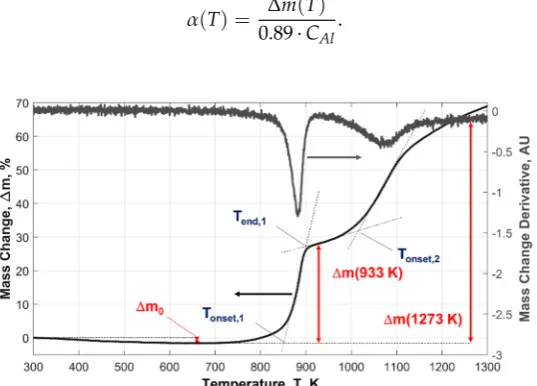
The pre-burning characterization of the metal additives included particle size distribution (PSD) by laser diffraction (Malvern Mastersizer 2000 with dry/liquid dispersion unit for micron- and nano-sized particles, respectively), SSA determination by N2adsorption/desorption, scanning electron microscopy (SEM), transmission electron microscopy (TEM), and transmission energy dispersion (TED) imaging. TheCAl of the powders was determined by Al+H2O reaction in a basic solution (10 wt.% NaOH) The reactivity of the powders was investigated by slow heating rate thermogravimetry (TG). The TG relative grading of the additives was performed in air, at 10 K/min, considering the reactivity parameters identified by Ilyin et al. [34]. The reactivity data evaluated on the TG trace are illustrated in Figure1. The Al→Al2O3conversion factor was evaluated as follows:
α(T) = ∆m(T)
0.89·CAl. (1)
Aerospace 2019, 6, x FOR PEER REVIEW 9 of 33
4. Experimental Methods
4.1. Aluminum and Aluminum-Based Additives Pre-Burning Characterization
The pre-burning characterization of the metal additives included particle size distribution (PSD) by laser diffraction (Malvern Mastersizer 2000 with dry/liquid dispersion unit for micron- and nano-sized particles, respectively), SSA determination by N2 adsorption/desorption, scanning electron
microscopy (SEM), transmission electron microscopy (TEM), and transmission energy dispersion (TED) imaging. The CAl of the powders was determined by Al + H2O reaction in a basic solution (10
wt.% NaOH) The reactivity of the powders was investigated by slow heating rate thermogravimetry (TG). The TG relative grading of the additives was performed in air, at 10 K/min, considering the reactivity parameters identified by Ilyin et al. [34]. The reactivity data evaluated on the TG trace are illustrated in Figure 1. The Al → Al2O3 conversion factor was evaluated as follows:
Al C T m T ⋅ Δ = 89 . 0 ) ( ) (
α . (1)
Figure 1. Reactivity parameters for thermogravimetry (TG) analysis [34]. The determination of onset and end points was performed based on the differential TG (DTG) curve. Percent mass change was evaluated with respect to the initial mass of the specimen.
4.2. Burning Behavior Investigation
4.2.1. Lab-Scale Two-Dimensional (2D) Radial Micro-Burner
The SPLab research team designed and developed a 2D radial burner for the relative ballistic grading of solid fuel formulations at the lab-scale level. Cylindrical-shaped fuel grains with a length of 30 mm, outer case diameter of 20 mm, and central port diameter (D0) of 4 mm are typically tested. The SPLab facility features peculiar characteristics such as the visualization of the burning specimen head-end, and a quasi-steady pc during the combustion [63]. In the 2D radial burner, the pc(t) is
monitored by a piezo-resistive pressure transducer and controlled by a pressure regulator commanding exhaust electro-valves. These servo-actuators are opened/closed depending on the sensed pressure difference between actual and threshold values. The latter was selected for the test (and it could be easily changed between different runs, if needed). The 𝑚 (𝑡) was monitored and controlled by a digital flowmeter. The 𝑚 (𝑡) and the pc(t) could be controlled independently.
Oxidizer injection was performed by standard (non-swirled) flow. Tested strand ignition was achieved by a primer charge whose combustion was initiated by a laser beam impinging on it. A scheme of the experimental set-up is shown in Figure 2, while its peculiarities were discussed elsewhere [63]. In the current study, gaseous oxygen (GOX) was taken as the oxidizer, and combustion tests were performed with 𝑚 of 5 g/s and 6 g/s (the two operating conditions were identified as A and B, respectively), with pc = 1.0 MPa.
Figure 1.Reactivity parameters for thermogravimetry (TG) analysis [34]. The determination of onset and end points was performed based on the differential TG (DTG) curve. Percent mass change was evaluated with respect to the initial mass of the specimen.
4.2. Burning Behavior Investigation
4.2.1. Lab-Scale Two-Dimensional (2D) Radial Micro-Burner
AerospaceAerospace 2019,2019, 66, 127, x FOR PEER REVIEW 10 of 33 10 of 33
Figure 2. Lab-scale two-dimensional (2D) radial burner scheme.
4.2.2. Time-Resolved Regression Rate
An optical, time-resolved technique for rf measurement was developed and validated at SPLab
[16,53,63]. The time-resolved rf was evaluated by central port diameter sampling during the
combustion (see Figure 3). Regression surface tracking started from the frame when the head-end central port diameter became visible (after primer charge ignition). Data sampling extended until the end of the combustion (depending on visualization quality). Diameter sampling was performed with the maximum possible frequency (5–20 Hz under the investigated conditions, with higher frequencies in the earlier phases of the burning process). During the combustion, central port diameter was sampled along different radial directions (depending on combustion uniformity). The local diameters were averaged to provide 𝐷. This diameter was considered uniform for the whole specimen length. The 𝐷 (𝑡 ) was a discrete information in time, which was successively fitted to achieve a continuous 𝐷(𝑡), as shown in Equation (2).
𝐷(𝑡) − 𝐷 = 𝑎 ⋅ (𝑡 − 𝑡 ) , 𝑡 ≥ 𝑡 > 𝑡 = 0. (2)
In time-resolved techniques, the function describing the diameter evolution in time was valid starting from tign. The latter parameter was ad hoc defined as the one enabling the maximization of the data fitting (R2) of the
0 )
(t D
D − based on aD and nD (Equation (2)). In the implemented technique,
the tign values were in agreement with convective ignition time estimated by open literature models,
as discussed in References [53,63]. The ballistic data of a fuel formulation tested under the selected conditions were determined starting from Equation (2) [63]. The time derivative of the D(t)−D0 provided the rf(t), while the Gox(t) could be determined from the diameter history once the operating condition (and, in particular, 𝑚 ) was defined [63]. The rf(Gox) history in time was approximated by
a power law as follows:
𝑟 (𝐺 ) = 𝑎 𝐺 (𝑡), 𝑡 ≥ 𝑡 > 𝑡 . (3)
The rf(t) and the 𝐷(𝑡) were used to evaluate the mass burning rate.
𝑚 (𝑡) = 𝜌 [𝜋𝐷(𝑡)𝐿 ]𝑟 (𝑡), 𝑡 ≥ 𝑡 > 𝑡 . (4)
Time-resolved data could be used to determine the time-averaged ballistics of the investigated formulation [63]. In particular, the time-averaged values of the 𝑟 and of the 𝐺 were evaluated as follows:
〈𝑟 (𝑡)〉 = 𝑟 (𝑡) 𝑑𝑡, 𝑡 ≥ 𝑡 ≥ 𝑡 > 𝑡 . (5)
〈𝐺 (𝑡)〉 = 𝐺 (𝑡) 𝑑𝑡, 𝑡 ≥ 𝑡 ≥ 𝑡 > 𝑡 . (6)
Figure 2.Lab-scale two-dimensional (2D) radial burner scheme.
4.2.2. Time-Resolved Regression Rate
An optical, time-resolved technique forrfmeasurement was developed and validated at SPLab [16, 53,63]. The time-resolvedrfwas evaluated by central port diameter sampling during the combustion (see Figure3). Regression surface tracking started from the frame when the head-end central port diameter became visible (after primer charge ignition). Data sampling extended until the end of the combustion (depending on visualization quality). Diameter sampling was performed with the maximum possible frequency (5–20 Hz under the investigated conditions, with higher frequencies in the earlier phases of the burning process). During the combustion, central port diameter was sampled along different radial directions (depending on combustion uniformity). The local diameters were averaged to provideDi. This diameter was considered uniform for the whole specimen length. The Di(ti)was a discrete information in time, which was successively fitted to achieve a continuousD(t), as shown in Equation (2).
D(t)−D0=aD·(t−t0)nD, t≥t
ign>t0=0. (2)
Aerospace 2019, 6, x FOR PEER REVIEW 11 of 33
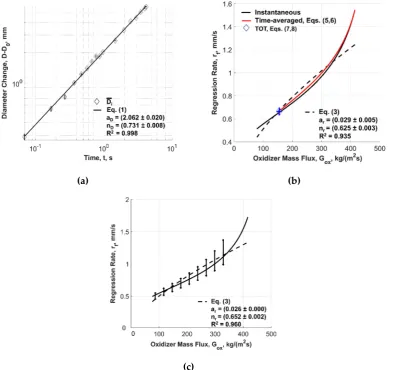
As extensively discussed in References [16,63], Equations (5) and (6) can be used to compare the overall time-averaged data derived from Equation (2) to thickness over time (TOT) results of a test. The typical experimental output obtained by this data reduction technique is shown in Figure 4, where time-resolved instantaneous and time-averaged data for a HTPB-GOX run are reported and compared with the corresponding TOT-based 𝑟 and Gox, which were defined as follows:
〈𝑟 〉 = 12𝐷 𝑡𝑡𝑒𝑛𝑑−𝐷 𝑡𝑖𝑔𝑛
𝑒𝑛𝑑−𝑡𝑖𝑔𝑛
,
𝑡 > 𝑡 > 𝑡 . (7)〈𝐺 〉 =
𝐷 𝑡𝑒𝑛𝑑 𝐷 𝑡𝑖𝑔𝑛 , 𝑡 > 𝑡 > 𝑡 . (8)
Equations (5) and (6) and the TOT data typically show percent differences of less than 5% (see References [16,63] for details). Under the investigated conditions, the time-averaged and the instantaneous data featured minor differences at a given oxidizer mass flux (see Figure 4).
For a given experimental condition (𝐷 , 𝑚 , and pc), single tests for the same fuel formulation
yielded the definition of ensemble average curves, enabling the relative grading of the different compositions [16,63]. Ensemble average curves were completed by error bars considering the data dispersion of the performed combustion tests. Single-test diameter histories resulting from the application of Equation (2) were fitted together in the ensemble curve of the same kind. The resulting
𝐷(𝑡) − 𝐷 was then used to determine the relevant ballistic parameters. Thus, following the same
logical steps performed on a single test, rf(Gox) and 𝑚 (𝐺 ) could be evaluated. The uncertainties on the ensemble average curve were evaluated by considering confidence intervals with 95% accuracy. A minimum of three tests were considered for error bar definition.
(a) tign (b) tign + 1 s (c) tign + 2 s
Figure 3. Typical head-end visualization of a combustion run in the 2D radial burner (F3-GOX, pc =
1.0 MPa): (a) sample ignition, (b,c) central port diameter enlargement in time due to solid fuel
regression (the initial port diameter (𝐷) is highlighted by the white circle).
Figure 3.Typical head-end visualization of a combustion run in the 2D radial burner (F3-GOX,pc=1.0
MPa): (a) sample ignition, (b,c) central port diameter enlargement in time due to solid fuel regression (the initial port diameter (D0) is highlighted by the white circle).
provided therf(t), while theGox(t)could be determined from the diameter history once the operating condition (and, in particular,m.ox) was defined [63]. Therf(Gox)history in time was approximated by a power law as follows:
rf(Gox) =arGnoxr(t), t≥tign>t0. (3)
Therf(t)and theD(t)were used to evaluate the mass burning rate.
.
mf(t) =ρf h
πD(t)Lf i
rf(t), t≥tign>t0. (4)
Time-resolved data could be used to determine the time-averaged ballistics of the investigated formulation [63]. In particular, the time-averaged values of therf and of theGoxwere evaluated as follows:
hrf(t)i= 1 t−tign
Z t
tign
rf(t)dt,tend ≥t≥tign>t0. (5)
hGox(t)i= 1 t−tign
Z t
tign
Gox(t)dt, tend≥t≥tign>t0. (6)
As extensively discussed in References [16,63], Equations (5) and (6) can be used to compare the overall time-averaged data derived from Equation (2) to thickness over time (TOT) results of a test. The typical experimental output obtained by this data reduction technique is shown in Figure4, where time-resolved instantaneous and time-averaged data for a HTPB-GOX run are reported and compared with the corresponding TOT-basedrf andGox, which were defined as follows:
hrfiTOT= 1 2
D(tend)−D
tign
tend−tign
, tend>tign>t0. (7)
hGoxiTOT= 4 . mox
π
"
D(tend)+D(tign) 2
#2, tend >tign>t0 (8)
Equations (5) and (6) and the TOT data typically show percent differences of less than 5% (see References [16,63] for details). Under the investigated conditions, the time-averaged and the instantaneous data featured minor differences at a given oxidizer mass flux (see Figure4).
For a given experimental condition (D0, m.ox, andpc), single tests for the same fuel formulation yielded the definition of ensemble average curves, enabling the relative grading of the different compositions [16,63]. Ensemble average curves were completed by error bars considering the data dispersion of the performed combustion tests. Single-test diameter histories resulting from the application of Equation (2) were fitted together in the ensemble curve of the same kind. The resulting D(t)−D0was then used to determine the relevant ballistic parameters. Thus, following the same logical steps performed on a single test,rf(Gox)and
.
Aerospace2019,6, 127 12 of 33
Aerospace 2019, 6, x FOR PEER REVIEW 12 of 33
(a) (b)
(c)
Figure 4. Time-resolved regression rate determination (HTPB-GOX, 𝑝 = 1.0 MPa, 𝑚 = 6 g/s): (a)
sampled diameter interpolation in time (Equation (1)), (b) instantaneous 𝑟 (𝐺 ) with its power law
approximation (Equation (3)), time-averaged history (Equations (5) and (6)), and thickness over time
(TOT)data, (c) ensemble average data with error bars.
4.2.3. Lab-Scale Micro-Slab Motor
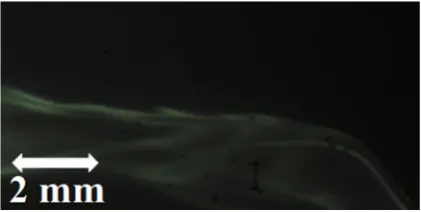
Combustion surface visualizations were performed in a windowed micro-slab burner [17,84]. The implemented set-up featured the same general layout as the radial burner shown in Figure 2. Burning fuel strand images were captured by side-window. Recorded images showed the solid fuel slab and the flame zone. A typical combustion frame is shown in Figure 5. The burning strands had a length of 15 mm and a square cross section of 3 × 3 mm. The ignition of the samples was achieved by a non-aluminized propellant primer charge (in turn ignited by a hot wire). The facility enabled the exploration of different pc by changing the throat area of the implemented nozzle. The burning surface visualization runs were intended to provide qualitative insight into the phenomena involved in the combustion of metallized fuel formulations, while no detailed quantitative information could be captured by these tests. The visualizations were performed in GOX, with pc = 0.4 MPa, and 145
kg/(m2∙s) ≤Gox ≤ 160 kg/(m2∙s). The frame rate of the captured videos was in the range 5000–10,000
frames per second (fps), depending on the investigated fuel rf and observable phenomena.
Figure 4. Time-resolved regression rate determination (HTPB-GOX,pc=1.0 MPa,
.
mox=6 g/s): (a)
sampled diameter interpolation in time (Equation (1)), (b) instantaneousrf(Gox)with its power law
approximation (Equation (3)), time-averaged history (Equations (5) and (6)), and thickness over time (TOT) data, (c) ensemble average data with error bars.
4.2.3. Lab-Scale Micro-Slab Motor
Aerospace 2019, 6, x FOR PEER REVIEW 13 of 33
Figure 5. Combustion visualization with slab configuration (F1-GOX, pc = 0.4 MPa). The oxidizer flows
from right to left. Note the diffusion flame over the solid fuel grain.
5. Experimental Results and Discussion
5.1. Additives Pre-Burning Characterization
The PSD, SSA, and CAl data for the tested additives are reported in Table 4. Selected SEM and TED images of the additives are shown in Figure 6. Slow heating rate reactivity parameters from the TG tests are reported in the Table 5. In this work, the implemented LE and HEactivation procedures aimed at reducing the diffusion distance between the PTFE and the Al. When considering metal-loaded fuel formulations for hybrid rocket applications, the pursued effects of additives are increased
rf and 𝑚 . The achievement of enhanced ballistic performance requires materials with fast reactivity,
while additive metal content exerts limited effects on performance (particularly when O2 is used as
oxidizer) [25].
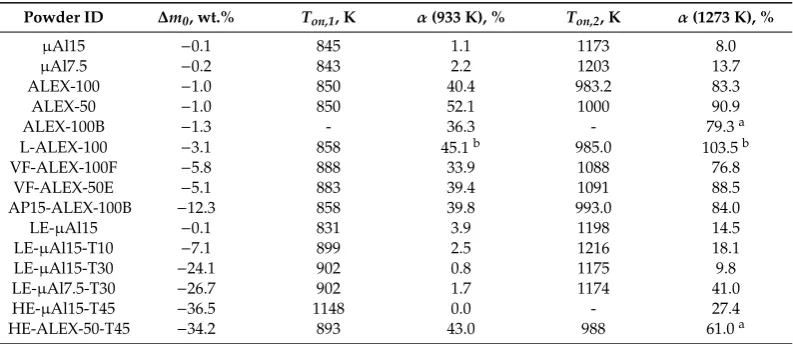
The μAl15 featured spherical/spheroid particles, with (apparent) smooth texture (see Figure 6a). The PSD data reported in Table 4 show a monomodal distribution of the measured diameters. The powder showed a limited reactivity under slow heating rates (α(933 K) = 1.1%, α(1273 K) = 8%) due to the low SSA. The μAl7.5 featured a small volumetric fraction of sub-micrometric particles (~2%), as testified by the low D(0.1) reported in Table 4. The TG reactivity of the powder was similar to the
one of the coarser counterpart (see Table 5). In spite of theSSA difference (see Table 4), ALEX-100 and ALEX-50 exhibited similar Ton,1. ALEX-50 showed the highest α(933 K) and α(1273 K) in the dataset. The pyrocatechol-coated powder showed no marked SSA and reactivity differences with respect to the ALEX-100 (see Tables 4 and 5). This was due to the reduced coating mass fraction (0.2 wt.%), limiting coating-related effects such as particle clustering. Other coated powders featured higher SSA reduction (i.e., particle size increase) due to coating gluing of originally separated particles and because of cluster coverage by coating deposition. The AP15-ALEX-100B showed micron-sized particles that were clusters of the original ALEX-100B glued and (at least partially) covered by AP. Fluoropolymer coating reduced the reactivity of the powders at slow heating rates, yielding increased Ton,1and lowered α(1273 K). This was probably induced by carbonaceous residuals from coating degradation that partially shielded the particles from oxidation. The effect was lowered for VF-ALEX-50E, which was prepared from a powder featuring higher reactivity than the 100-nm counterpart. In spite of the composition differences between the hydrocarbon coating and the AP composite, AP15-ALEX-100B and the L-ALEX-100 showed nearly the same reactivity as the original powders, due to the degradation behavior of their surface layers featuring vaporization/sublimation for temperatures <670 K.
Figure 5.Combustion visualization with slab configuration (F1-GOX,pc=0.4 MPa). The oxidizer flows
from right to left. Note the diffusion flame over the solid fuel grain.
5. Experimental Results and Discussion
5.1. Additives Pre-Burning Characterization
The PSD, SSA, andCAldata for the tested additives are reported in Table4. Selected SEM and TED images of the additives are shown in Figure6. Slow heating rate reactivity parameters from the TG tests are reported in the Table5. In this work, the implemented LE and HE activation procedures aimed at reducing the diffusion distance between the PTFE and the Al. When considering metal-loaded fuel formulations for hybrid rocket applications, the pursued effects of additives are increasedrf andm. f. The achievement of enhanced ballistic performance requires materials with fast reactivity, while additive metal content exerts limited effects on performance (particularly when O2is used as oxidizer) [25].
Table 4.Particle size distribution (PSD), specific surface area (SSA), andCAldata for the tested additives,
AP, and PTFE.
Powder ID D43,µm D(0.1),µm D(0.5),µm D(0.9),µm SSA, m2/g CAl, wt.%
µAl15 19.8 10.0 17.9 32.3 <0.1 99.5±0.4
µAl7.5 6.6 2.99 6.08 11.0 <0.1 95.3±0.2
ALEX-100 0.138 0.105 0.135 0.176 11.8±0.4 89.0±5.0
ALEX-50 - - - - 15.5±0.1 86.3±4.1
ALEX-100B 0.141 0.104 0.138 0.182 11.3±0.1 88.0±1.5
L-ALEX-100 - - - - 9.1±0.3 70.3±4.3a
VF-ALEX-100F - - - - 6.9±0.2 78.3±4.4
VF-ALEX-50E - - - - 10.9±0.3 78.4±4.4
AP15-ALEX-100B 6.73 0.42 1.66 16.0 - 76.0±1.3
LE-µAl15 123 15.9 90.8 284 <1.0 98.2±0.1
LE-µAl15-T10 28.4 12.0 25.1 49.5 <1.0 90.5±0.1
LE-µAl15-T30 31.2 5.46 21.7 59.4 <1.0 68.6±0.6
LE-µAl7.5-T30 13.5 2.67 8.13 29.2 <1.0 65.8±0.4
HE-µAl15-T45 52.2 4.05 22.6 141 1.5±0.1 53.7±1.2
HE-ALEX-50-T45 85.2 3.41 41.7 237 5.9±0.1 47.3±1.7
AP 10.2 0.68 5.74 26.4 -
-PTFE 7.24 0.36 0.88 8.28 -
-aActive metal content underestimation due to side-effects in the Al+H
AerospaceAerospace 2019,2019, 66, 127, x FOR PEER REVIEW 15 of 33 14 of 33
(a) (b)
(c) (d)
(e) (f)
(g) (h)
Figure 6. Electron microscopy images of the investigated powders: (a) SEM of μAl15, (b) SEM of
ALEX-100, (c) transmission energy dispersion (TED) of VF-ALEX-100F, (d) SEM of LE-μAl15, (e) SEM
of LE-μAl15-T10, (f) SEM of LE-μAl15-T30, (g) SEM of HE-μAl15-T45, and (h) SEM of
HE-ALEX-50-T45.
The non-isothermal oxidation of LE-μAl15 showed an anticipated Ton,1 and higher α(933 K) and α(1273 K) than the original micron-sized powder. Activated powders derived from μAl15 showed irregular shape and texture (Figures 6e,f). PTFE friction and wearing properties were the likely explanation for the size reduction of these powders with respect to LE-μAl15 (see Table 4) [88]. The
Figure 6. Electron microscopy images of the investigated powders: (a) SEM ofµAl15, (b) SEM of ALEX-100, (c) transmission energy dispersion (TED) of VF-ALEX-100F, (d) SEM of LE-µAl15, (e) SEM of LE-µAl15-T10, (f) SEM of LE-µAl15-T30, (g) SEM of HE-µAl15-T45, and (h) SEM of HE-ALEX-50-T45.
testified by the lowD(0.1)reported in Table4. The TG reactivity of the powder was similar to the one of the coarser counterpart (see Table5). In spite of the SSA difference (see Table4), ALEX-100 and ALEX-50 exhibited similarTon,1. ALEX-50 showed the highestα(933 K) andα(1273 K) in the dataset. The pyrocatechol-coated powder showed no marked SSA and reactivity differences with respect to the ALEX-100 (see Tables4and5). This was due to the reduced coating mass fraction (0.2 wt.%), limiting coating-related effects such as particle clustering. Other coated powders featured higher SSA reduction (i.e., particle size increase) due to coating gluing of originally separated particles and because of cluster coverage by coating deposition. The AP15-ALEX-100B showed micron-sized particles that were clusters of the original ALEX-100B glued and (at least partially) covered by AP. Fluoropolymer coating reduced the reactivity of the powders at slow heating rates, yielding increasedTon,1 and loweredα(1273 K). This was probably induced by carbonaceous residuals from coating degradation that partially shielded the particles from oxidation. The effect was lowered for VF-ALEX-50E, which was prepared from a powder featuring higher reactivity than the 100-nm counterpart. In spite of the composition differences between the hydrocarbon coating and the AP composite, AP15-ALEX-100B and the L-ALEX-100 showed nearly the same reactivity as the original powders, due to the degradation behavior of their surface layers featuring vaporization/sublimation for temperatures<670 K.
Table 5.Powder reactivity: slow heating rate thermogravimetric (TG) data (air, 10 K/min, 0.1 MPa).
Powder ID ∆m0, wt.% Ton,1, K α(933 K), % Ton,2, K α(1273 K), %
µAl15 −0.1 845 1.1 1173 8.0
µAl7.5 −0.2 843 2.2 1203 13.7
ALEX-100 −1.0 850 40.4 983.2 83.3
ALEX-50 −1.0 850 52.1 1000 90.9
ALEX-100B −1.3 - 36.3 - 79.3a
L-ALEX-100 −3.1 858 45.1b 985.0 103.5b
VF-ALEX-100F −5.8 888 33.9 1088 76.8
VF-ALEX-50E −5.1 883 39.4 1091 88.5
AP15-ALEX-100B −12.3 858 39.8 993.0 84.0
LE-µAl15 −0.1 831 3.9 1198 14.5
LE-µAl15-T10 −7.1 899 2.5 1216 18.1
LE-µAl15-T30 −24.1 902 0.8 1175 9.8
LE-µAl7.5-T30 −26.7 902 1.7 1174 41.0
HE-µAl15-T45 −36.5 1148 0.0 - 27.4
HE-ALEX-50-T45 −34.2 893 43.0 988 61.0a
aLimiting temperature of 1223 K.bActive metal content underestimation due to side-effects in the Al+H 2O reaction [40].
Aerospace2019,6, 127 16 of 33
occurred at higher temperatures with respect toµAl15 and LE-Al15. Under the investigated conditions, LE-µAl7.5-T30 was the LE-activated composite featuring the highestα(T). This result was probably due to the reduced particle size of the initial powder, in turn yielding a final product with reducedD43and D0.5with respect to otherµAl15-based composites. Both HE-activated composites featured increased SSA with respect to the LE-activated powders, as shown in Table4. HE-µAl15-T45 showed particles with rough texture and irregular shape (see Figure6g). The HE-ALEX-50-T45 SSA reduction with respect to the original ALEX was due to the creation of nAl+PTFE granules with a complex structure but increased size (see Figure6h). Data for Al→Al2O3conversion of the two powders showedα(1273 K)=27.5% for theµAl15-based composite, andα(1223 K)=61.0% for HE-ALEX-50-T45.
5.2. Burning Behavior
5.2.1. Time-Resolved Regression Rate
Relative ballistic grading results are reported in Figures7and8and Table6. All the ballistic data were defined by ensemble average curves summarizing, at least four tests per formulation. All the fuels but F3, F8–F10, and F15–F19 were tested withm.ox. =5 g/s; thus, their performance was evaluated taking F1A as baseline. For the tests withm.ox=6 g/s, F1B was considered as the reference for the relative grading. Data reported in Table6feature relatively lowR2due to the typical trend captured by time-resolved approaches, as originally reported by Evans et al. [18] (see Figure4b,c). The time-averaged data of Figure8were evaluated using Equations (5) and (6) athGoxi=(250±15) kg/(mAerospace 2·s). The latter value was selected since it was common to all the tested formulations.2019, 6, x FOR PEER REVIEW 17 of 33
(a)
(b)
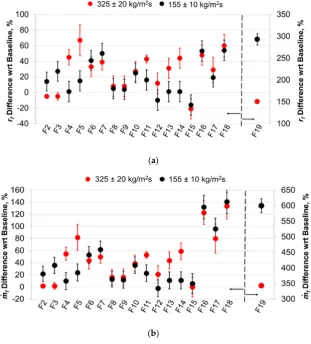
Figure 7. Relative ballistic grading of the tested fuel formulations (GOX, pc = 1.0 MPa, time-resolved instantaneous data): (a) rf and (b) 𝒎𝒇 differences with respect to the baseline.
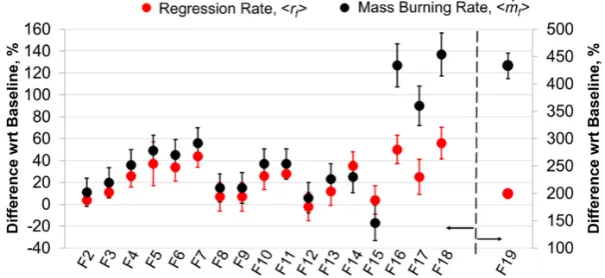
Figure 8. Relative ballistic grading of the tested formulations (GOX, pc = 1.0 MPa, time-averaged data) for 〈𝑮𝒐𝒙〉 = (250 ± 15) kg/(m2∙s): 〈𝒓𝒇〉 and 〈𝒎𝒇〉 differences with respect to the baseline.
Figure 7.Relative ballistic grading of the tested fuel formulations (GOX,pc=1.0 MPa, time-resolved
instantaneous data): (a)rfand (b)
.
Aerospace2019,6, 127 17 of 33
(a)
(b)
Figure 7. Relative ballistic grading of the tested fuel formulations (GOX, pc = 1.0 MPa, time-resolved instantaneous data): (a) rf and (b) 𝒎𝒇 differences with respect to the baseline.
Figure 8. Relative ballistic grading of the tested formulations (GOX, pc = 1.0 MPa, time-averaged data) for 〈𝑮𝒐𝒙〉 = (250 ± 15) kg/(m2∙s): 〈𝒓𝒇〉 and 〈𝒎𝒇〉 differences with respect to the baseline.
Figure 8.Relative ballistic grading of the tested formulations (GOX,pc=1.0 MPa, time-averaged data)
forhGoxi=(250±15) kg/(m2·s):hrfiandhm.fidifferences with respect to the baseline.
Table 6. Power law approximation of time-resolved rf(Gox) (Equation (3)) for the investigated
formulations (F1A and F1B were used as baselines for the relative grading withm.oxof 5 g/s and 6 g/s
respectively).
Solid Fuel rf(Gox)Power Law Approximation (Equation (3))
ID ar nr R2
F1A 0.018±0.001 0.680±0.003 0.88
F1B 0.026±0.000 0.652±0.002 0.96
F2 0.059±0.001 0.477±0.001 0.95
F3 0.064±0.001 0.494±0.001 0.90
F4 0.005±0.001 0.959±0.022 0.85
F5 0.007±0.001 0.905±0.012 0.96
F6 0.052±0.003 0.535±0.010 0.91
F7 0.041±0.003 0.595±0.014 0.85
F8 0.017±0.000 0.630±0.002 0.95
F9 0.016±0.000 0.643±0.002 0.92
F10 0.019±0.000 0.747±0.002 0.91
F11 0.006±0.000 0.902±0.003 0.93
F12 0.006±0.000 0.908±0.002 0.95
F13 0.006±0.000 0.897±0.002 0.95
F14 0.006±0.000 0.954±0.002 0.96
F15 0.065±0.000 0.491±0.001 0.94
F16 0.011±0.000 0.869±0.002 0.94
F17 0.012±0.002 0.815±0.003 0.88
F18 0.021±0.002 0.769±0.002 0.95
F19 1.969±0.002 0.053±0.000 0.88
In spite of the (minor) differences in the operating conditions, solid fuel formulations loaded with µAl (F2 and F3) featured similar ballistic responses (see Figures7and8). Therf(Gox)of F3 is shown in Figure9a. Fuels loaded withµAl exhibited no significant performance enhancement over the baseline forGox>200 kg/(m2·s). This reflected the relatively low TG reactivity of these additives (see Table5), yielding limited heat transfer enhancement for high oxidizer mass fluxes (long burning/reaction time). Faintrfand
.
mf increases were achieved forGox=155 kg/(m2·s), thanks to the radiation heat transfer that mitigated the effects of convective heat transfer decrease (as testified by thenr~0.5 in Table6).
The F4 showed markedrfand .
Aerospace2019,6, 127 18 of 33
shows images captured during F4 combustion. In the earlier phases of the combustion, small and bright slivers detached from the regressing surface and from the strand head-end (Figure10a,b). As the burning proceeded (Figure10c,d), the formation of a surface crust layer was observed at the head-end (but likely also on the regressing surface). The creation of this surface layer was not observed in µAl-loaded fuels (see Figure3). A more detailed discussion of this phenomenon is given in Section5.2, where Al aggregationAerospace 2019, 6, x FOR PEER REVIEW /agglomeration phenomena are discussed. 18 of 33
(a) (b)
Figure 9. Time-resolved rf(Gox) in GOX with pc = 1.0 MPa: (a) F3 and (b) F18.
The F4 showed marked rf and 𝑚 increases over the baseline for relatively high Gox (see Figure
7). This performance was quickly lost as the convection decreased, as testified by the rf(Gox) power
law approximation reported in Table 6, and by the low Gox data of Figure 7. The time-averaged data
of Figure 8 captured this effect, as testified by 〈𝑟 〉 = 26% ± 10%, in turn yielding 〈𝑚 〉 = 36% ± 14%. In the high-Gox region, the augmented flame temperature obtained thanks to ALEX-100 combustion
increased the convective heat transfer, and the emitting particles enhanced the radiation contribution. Figure 10 shows images captured during F4combustion. In the earlier phases of the combustion, small and bright slivers detached from the regressing surface and from the strand head-end (Figures 10a,b). As the burning proceeded (Figures 10c,d), the formation of a surface crust layer was observed at the head-end (but likely also on the regressing surface). The creation of this surface layer was not observed in μAl-loaded fuels (see Figure 3). A more detailed discussion of this phenomenon is given in Section 5.2, where Al aggregation/agglomeration phenomena are discussed.
Interestingly, the nAl-loaded formulation manufactured without additive dispersion techniques (F8) showed no performance enhancement over the corresponding baseline probably due to the metal particle clustering inhibiting Al combustion (see Figures 7 and 8). The F5 showed rf performance and
Gox sensitivity similar toF4, as testified by the data reported in Figure 7 (note the relatively high error
bars for Gox = 325 kg/(m2∙s)) and Table 6. The stearic acid coating exerted no marked influence on the
powder characteristics (Table 4) and reactivity (Table 5); this surface treatment was implemented mainly for storage purposes. The solid fuel formulations F6 and F7exhibited a limited rf dependence on Gox (see Table 6), while providing interesting instantaneous and time-averaged 𝑚 . In particular,
these formulations featured a nearly uniform 𝑚 enhancement over the baseline for the whole investigated Gox range. This suggests that, at high heating rates, the metal reaction with fluoropolymer decomposition products may enhance the metal combustion performance close to/at the regressing surface in both high- and low-Gox regimes. Such an effect was not observed at slow
heating rate (see Table 5). Data reported in Figure 7showed that, for Gox = 155 kg/(m2∙s), the average 𝑚 increase over the baseline of F6 and F7 were 53% ± 14% and 62% ± 14%, respectively, with marked differences with respect to theALEX-loaded fuel.
Figure 9.Time-resolvedrf(Gox)in GOX withpc=1.0 MPa: (a) F3 and (b) F18.
Aerospace 2019, 6, x FOR PEER REVIEW 19 of 33
Table 6. Power law approximation of time-resolved rf(Gox) (Equation (3)) for the investigated
formulations (F1A and F1B were used as baselines for the relative grading with 𝑚 of 5 g/s and 6
g/s respectively).
Solid Fuel rf(Gox) Power Law Approximation (Equation (3))
ID ar nr R2
F1A 0.018 ± 0.001 0.680 ± 0.003 0.88 F1B 0.026 ± 0.000 0.652 ± 0.002 0.96 F2 0.059 ± 0.001 0.477 ± 0.001 0.95 F3 0.064 ± 0.001 0.494 ± 0.001 0.90 F4 0.005 ± 0.001 0.959 ± 0.022 0.85 F5 0.007 ± 0.001 0.905 ± 0.012 0.96 F6 0.052 ± 0.003 0.535 ± 0.010 0.91 F7 0.041 ± 0.003 0.595 ± 0.014 0.85 F8 0.017 ± 0.000 0.630 ± 0.002 0.95 F9 0.016 ± 0.000 0.643 ± 0.002 0.92 F10 0.019 ± 0.000 0.747 ± 0.002 0.91 F11 0.006 ± 0.000 0.902 ± 0.003 0.93 F12 0.006 ± 0.000 0.908 ± 0.002 0.95 F13 0.006 ± 0.000 0.897 ± 0.002 0.95 F14 0.006 ± 0.000 0.954 ± 0.002 0.96 F15 0.065 ± 0.000 0.491 ± 0.001 0.94 F16 0.011 ± 0.000 0.869 ± 0.002 0.94 F17 0.012 ± 0.002 0.815 ± 0.003 0.88 F18 0.021 ± 0.002 0.769 ± 0.002 0.95 F19 1.969 ± 0.002 0.053 ± 0.000 0.88
(a)Gox = 265 ± 16 kg/(m2∙s) (b) Gox = 230 ± 14 kg/(m2∙s)
(c)Gox = 165 ± 10 kg/(m2∙s) (d)Gox = 125 ± 8 kg/(m2∙s)
Figure 10. Head-end visualization of F4 burning in GOX at pc= 1.0 MPa: (a,b) bright slivers detached
from the regressing surface and from the visible strand end, (c,d) a surface crust layer is formed. Note
that no fuel fragments and condensed combustion products are released from the sample toward the end of the combustion.
Figure 10.Head-end visualization of F4 burning in GOX atpc=1.0 MPa: (a,b) bright slivers detached
from the regressing surface and from the visible strand end, (c,d) a surface crust layer is formed. Note that no fuel fragments and condensed combustion products are released from the sample toward the end of the combustion.
high error bars forGox =325 kg/(m2·s)) and Table6. The stearic acid coating exerted no marked influence on the powder characteristics (Table4) and reactivity (Table5); this surface treatment was implemented mainly for storage purposes. The solid fuel formulations F6 and F7 exhibited a limitedrf dependence onGox(see Table6), while providing interesting instantaneous and time-averaged
. mf. In particular, these formulations featured a nearly uniformm.f enhancement over the baseline for the whole investigatedGoxrange. This suggests that, at high heating rates, the metal reaction with fluoropolymer decomposition products may enhance the metal combustion performance close to/at the regressing surface in both high- and low-Goxregimes. Such an effect was not observed at slow heating rate (see Table5). Data reported in Figure7showed that, forGox=155 kg/(m2·s), the average
.
mf increase over the baseline of F6 and F7 were 53%±14% and 62%±14%, respectively, with marked differences with respect to the ALEX-loaded fuel.
The ballistic responses of fuel formulations loaded with VF-ALEX showed similarities with the burning behavior of F10. The AP-ALEX-100B-loaded formulation featured an averagem. f increase over the baseline of ~37% over the whole investigatedGoxrange (see Figure7). TheAPcontent in the solid fuel was ~2 wt.%; however, locating it in the composite powder enabled a maximization of the oxidizer impact formulation ballistic response. This was testified by the fact that F9 (same nominal composition of F10, but with AP and nAl that were added separately) showed no significant performance enhancement over the baseline (see Figures7and8). The performance difference between F10 and the VF-ALEX-100-loaded fuel was partially due to the higher SSA and reduced particle size of the latter, promoting the additive reactivity at fast heating rates and compensating for the higher flame temperature of Al+AP (see Table2).
Data for F11 burning withGox=325 kg/(m2·s) showed that the .
mf enhancement ofµAl15 was improved by the LE mechanical activation (see Figures7and8). Similarly to F4, F11 showed reduced rfand
.
mf performance asGoxdecreased. The TG analyses suggested a slightly improved reactivity of LE-µAl15 with respect to the startingµAl (seeα(933 K) andα(1273 K) in Table5), although the SSA of the powders featured no significant differences. The morphology of LE-µAl15 was the likely reason for the augmented reactivity of the powder at the high heating rates encountered in the combustion process. In addition to this, the irregular shape of particles of LE-µAl15 may augment the gasifying surface roughness when protruding from the regressing fuel grain. As an effect, the increased surface roughness may have played a minor role in therfenhancement of F11.
The ballistic effects of the fuels loaded with Al+PTFE composites obtained from LE mechanical activation showed no differences forGox=155 kg/(m2·s). On the other hand, forGox=325 kg/(m2·s), the ballistic response of F14 exhibited arfincrease over the baseline of 44%±13%. This corresponded to anm.f enhancement of 59%±15%. In Figure7, the uncertainty interval of F14 data at highGoxpartially overlapped those of F12 and F13. In spite of this, it should be noted that the averagerfand
.
mf increases over the baseline of the fuels loaded with PTFE–µAl composites from LE activation showed higher values as the fluoropolymer content was risen and the particle size of the starting Al was reduced (see Tables4and5and Figure7). Under the investigated conditions, the presence of a particle fraction of sub-micrometric size probably played a key role in the effectiveness of the activation process ofµAl7.5, compensating for the lubricant effect of the PTFE.
The use of an HE process enabled the production of Al+PTFE composites by more intense activation stresses. These, in turn, permitted higher fluoropolymer mass fractions in the composites than the LE procedure. Under the investigated conditions, the solid fuels loaded with additives produced by HE mechanical activation featured the highest m. f performance enhancements (see Figures7and8). F15 showed no significantm. f enhancement over the baseline, since the exploitation of PTFE as the oxidizer required the presence of additional metal ingredients (acting as fluorine scavengers [10,24,87]). Formulations in which the Al–PTFE reaction was exploited showed enhanced ballistic performance over non-loaded HTPB in terms of bothrfand
.