Indian J. Plant Physioi., Vol. XXX, No.3, pp. 261.265, 1987
EFFICIENCY OF PHOSPHORUS UTILISATION IN GROUNDNUT (ARACHIS HYPOGAEA L.)
.Ii.. SIVA SANKAR*. P.R. REDDY**, K. BALAKR1SHNA REDDY AND G. GOPAL SINGH
Department of Plant Physiology, A.P. Agricultural University. College of Agriculture, Rajendranagar, Hyderabad-503 030
SUMMARY
Efficiency of P utilization was studied in three groundnut cultivars viz., MK-374, M·13 (the Virginia types) and J·ll (the Spanish type). Ranking of cultivan in terms of efficieney of P utilization varied according to the de6nition used. Dry matter yield of shoot and root was highest with cv. MK-374 at a given amount of applied P. Shoot dry matter production at a constant shoot P concentra tion and P uptake per unit root dry weight were also maximum in cv. MK·374, , Spanish cultivar J·11 accumulated greater total dry matter per unit P uptake
compared to the Virginia types·-cvs. MK·374 and M·O.
INTRODUCTION
Groundnut is grown mostly as a rainfed crop in India, in light loamy or 'Sandy soils which are frequently deficient in both Nand P. The level of phosphorus available in the soil is critical for early crop growth. Inadequate levels are known to reduce root growth and proliferation (Siva Sankar et al., 1981). Gcnotypic -differences were also observed in groundnut with regard to total dry matter production, pod yield and P uptake (Reddy et aI., 1980). Blair and Cordero {I978) showed differences in P utilization in three annual pasture legumes and -defined what is meant by an efficient species. Following the same analogy, a study was undertaken to evaluate the efficiency of phosphorus utilization in groundnut using four definitions viz., (i) ability to produce dry matter with a given amount of applied P (Godwin and Wilson, 1977); (ii) Total dry matter produced in relation to unit P uptake; (iii) Shoot dry matter yield at constant shoot P concentration and (iv) P uptake per unit root dry weight.
MATERIALS AND METHODS
Groundnut plants were raised in pots each containing 12 kg. of sandy loam soil having an available phospborus of 9.18 kg'fha. Three groundnut cultivars viz., M·13 and MK-374 (the Virginia types) and J·ll (the Spanish type) were tested with
·Divi~:ion of Plant Physiology APAU-Regional Agricultural Research Station. Naddyal·518 SO]
A.P,
262 A. SIVA SANKAR ET AL.
four levels of pbospborus (0, 30, 60 and 90 kg. P20s/ha,) applied in the form of
su~rpbospbate. Nitrogen and Potassium were applied @ 20 and 40 kg/ha .. resPectivelY~ Fertilizers were mixed with the soil throughly before filling the pots. Five kernels were sown in each pot and the crop was thinned later to two seedlings. per pot. The plants were harvested at 30 and 75 days and dried in hot air oven
at 80~C for 48 h()UfS for dry matter determination. Phosphorus content of plant
samples were determined following method described by Jackson (1958).
RESULTS AND DISCUSSION
Ranling of cultivars in terms of efficiency of P utilization varied ~ccordiDg
to the definition of efliciency used. Varieties differed significantly with regard to dry matter production i.e., shoot and root (P> 0.05) at higher P application at 30 and 75 days aftet sowing (Fig. I). MK-374 out yielded M-13 an J-11 at all levels of applied P at 30 days. However, the differences between cvs. MK·l74 and and M-ll were not ,~ignificant at 75 days. Thus in terms of dry matter produced with ~,given ,amount of applied P MK-l74 and M-13 (the Virginia typeS) were better compared to the Spanish cultivar J-ll. These differences could be either due. to the deep root system in the s~il or greater surface area of roots as evident from greater root length and volume with Virginia cultivars, M-13 and TMV-JO over cvs. Gangapuri, and J-ll, the Valencia and Spanish types' respectively (Siva San kar
et al., 1981).
SHOOT ROOT
70
~:pft.~p
z1d
~
~ 0 ..._ - < - -_ __ o..._~_ __ g
g 30 deya
: 12 3
!:~ :~
O'-:O:o.-""""30=---=80r--=:to OL.O--:30=-~eo"""""eo"""
APPLIED 1\0s (Kg/'" )
Fig. 1 : Effect or soil applied phosphorus on dry matter production in: groundnut cultivars
PHOSPHORUS UTILIZATION IN GROUNDNUT 263
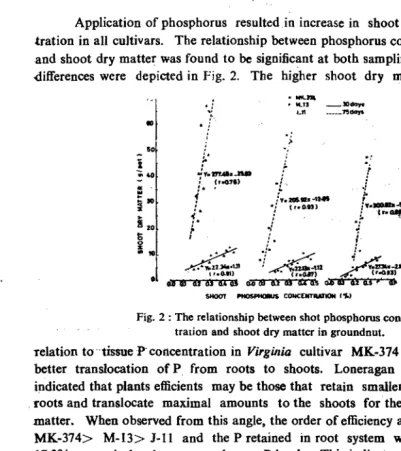
Application of phosphorus resulted.in increase in shoot and root P concen tration in all cultivars. The relationship between phosphorus content (%) of shoot and shoot dry matter was found to be significant at both samplings and the varietal (fifferences were depicted in Fig. 2. The higher shoot dry m~fter production in
_30oIoyo
.
"""-
"'3 >..11_____1'lI"""
~I
so
-
i-;;'40
"
f
·,L .,
;,...."*"
!
t ,.0..).;
.
,.
Fig. 2 : The relationship between shot phosphorus concen tration and shoot dry matter in groundnut.
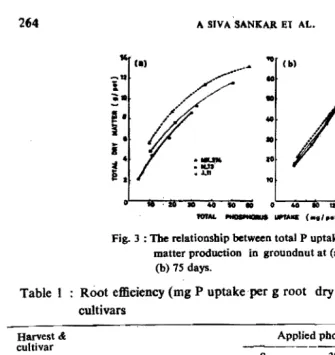
Telation to ~~tissueP'concentration in Virginia cultivar MK-374 may be a result of better translocation of P from roots to shoots. Loneragan and Asher (1967) indicated tbat plants efficients may be those that retain smaller amo unts of P in . Toots and translocate maximal amounts to the shoots for the production of dry matter. When observed from this angle, the order of efficiency at 75 days was cvs. MK-374> M-I3> J-ll and the P retained in root system was ILl, 14.4 and 17.3% respective1y when meaned over P levels. This indicates that Virginia types (evs. MK-374 and M-13) have a better translocation system rather than simply an absorption system. When efficiency was considered in terms of total dry matter production in relation to total P uptake, cultivars showed differences at 30 days and not at 75 days (Fig. 3 a, b). At 30 days cv. 1-11 sbowed greater efficien:)y in absorbing phosphorus and produced more dry matter (0.456 g) per unit P uptake <COmpared to cvs. MK-374 and M-J3 (0.330 g and 0.364 g respectively).
264 A SIVA SANKAlt HI AL.
(b) ./
-tt 10
'a) '10
.
"
..
-
•
!.
..
i
•
•
i
to
:t 4
i
I 1040 10 10 0 40 10 120 _ _ w
- ...,. _ C••, ••,)
Fig. 3 : The relationship between total P uptak and total dry matter production in groundnut at (a) 30 dayS and
(b) 75 days.
Table I Root efficiency (mg P uptake per g root dry weight) of three groundnut ' cultivars
Harvest & Applied phosphorus (kg. p.O.'ha)
cultivar
0 30 60 90
30 days
cv. MK·374 ]1.20 17.49 19.57 26.60
cv. M·J3 9.60 12.17 14.78 19.52
cv. J·ll 9.80 13.37 16.89 20.52
75 days
cv. MK·374 15.79 24.43 25.42 27.68
cv. M·13 12.18 16.51 21.52 22.77
cv. J-Il 14.94 21.64 23.71 25.71
L.S.D. (0.05) 30 days 3.58 75 days 4.23
The present study demonstrates that ranking of cultivars in terms of P efficiency can vary according to the definition of criterion used. Keeping in view the agronomic definition as well as root efficiency. the Virginia type MK-374 is the most efficient cultivar in absorbing and utilizing P for its growth.
REFERENCES
Barber, S.A. (1978). Soil.plant interactions in the pbosphorus nutrition of plants p.591-616. lit F.B. Khasawnah and E.C. Samples (ed.) The role of phosphorus in agriculture•.
Soil. Sci. Soc. Am. Madison, Wis.
Blair, G.J. and Cordero, S. (1978). The phosphorus efficiency of three annual legumes. Plant'
and Soil, 50 : 387·398.
265
PHOSPHORUS VTILJZA TION IN GROUNDNUT·
Jackson. M.L. (1958). Soil chemical analysis. Pub. Constable and Co. Ltd., London.
Johnson, C.M..· Slour, P.R. Bro~, T.C.~ ,Qu:Uoot, A.B. (1957). Comparative cbIorine requirements of different plant species. Pltmt and Soil, 8: 337-353.
Loncragan, J.F. and Asher, C.J. (1967). Response of plants to Phosphate concentration in solution culture. U. Rate of phospbate absorption and its relation to growth.
SfJll. Sd..,I03 : 311-18.
Reddy, P.R., Subba Rao, I.V. and Rao. L,M. (1980). Grormdnut Physiology, Progress Report-I~
APAU, Hyderabad, p. 101-104.
Siva Sankar, A., Subba. Rao, I.V. and Reddy, P.R. (1981). InOucncc of seed size and phosphorus levels on root production and phosphorus uptake in groundnut (Arachis hypogaea L.;
Legume Research, 4; 81-85.
Siva Sanm. A.s Reddy, P.R. and Gopal Singh, B. (1984 a). Effects of phosphorus on N., fixation in groundnut (Archis hypogaea L.). Indian J. Plant Physiol., rt : 307·308. Siva Sankar. A., Reddy, P.R. and Subba Rao, I.V. (1984 b) Nodulation and nitrogen fixation in