United Kingdom Vol. IV, Issue 11, November 2016
Licensed under Creative Common Page 541
http://ijecm.co.uk/
ISSN 2348 0386
BASEL III: MAIN ISSUES FOR GCC BANKS
Mohammad Alsharif
Business School, Taibah University, Saudi Arabia & PhD Candidate at Putra Business School, Malaysia
[email protected]; [email protected]
Annuar Md Nassir
Faculty of Economics and Management, Universiti Putra Malaysia
Fakarudin Kamarudin
Faculty of Economics and Management, Universiti Putra Malaysia
M. A. Zariyawati
Faculty of Economics and Management, Universiti Putra Malaysia
Abstract
The last global crisis caused banks to incur massive write downs of billions of U.S dollars that
had an adverse impact on the global economy. This led to the introduction of the Basel III
accord in 2010. Basel III represents the most stringent form of regulatory restrictions that have
ever been introduced. These new requirements are expected to restrict banks’ activities and as a result will affect banks’ performance. Therefore, this paper will shed light on possible impacts
of this new accord on GCC countries, which are developing countries that depend on oil
production and are exposure to a high systematic risk due to oil prices fluctuation. The GCC
banking industry is a dual banking system that contains conventional and Islamic banks and
their banking industry is considered the largest in the Middle East region. Therefore, this paper
will discuss the possible impacts of the new Basel accord on GCC Islamic and conventional
banks. However, we observed different behaviors among GCC banks in response to Basel III
Licensed under Creative Common Page 542
banks have decreased their regulatory capital ratios. More, this paper will provide a historical
background and the key elements of the three Basel regulations, and also, provide recent key
features of GCC banking industry.
Keywords: Banking, Basel I, Basel II, Basel III, GCC, Bank regulation
INTRODUCTION
The financial institutions play an important role in the modern economy, because they facilitate the flow of funds in the economy. This is because, they protect the average household saver from monitoring cost, liquidity cost and market price fluctuation, which will encourage the average household saver to make indirect investment rather than save its money in the form of cash (Saunders & Cornett, 2011).
Originally, the banking industry worked as a full-service industry, providing directly and indirectly all financial services beside its traditional role of taking deposits and making loans. The economic collapse in 1930 led to the separation of some of these activities due to the conflict of interests between commercial banking, securities activities and investment banking when they were performing under the same corporation umbrella(Hull, 2010). However, after 1960s, the global financial deregulation system was introduced and this allowed banks to establish holding companies again as capital control lowered, Euromarkets established and the volume of international transactions increased (Genschel & Plümper, 1997). At the end of the 20st century, regulatory barriers, technological revolutions, and financial innovations allowed a full set of financial services could again be offered by a single financial services firm under the umbrella of the financial services holding company(Saunders & Cornett, 2011). Due to these vast changes and competitive environments, attention to banks’ risk becomes increasingly important (Greuning & Bratanovic, 2009).
Licensed under Creative Common Page 543
Basically, the administrative unit of BCBS is located at the city of Basel and its main function is to provide recommendations relating to banking regulations and laws to financial entities in order to enhance the financial stability by improving supervisory activities and the quality of banking supervision worldwide.
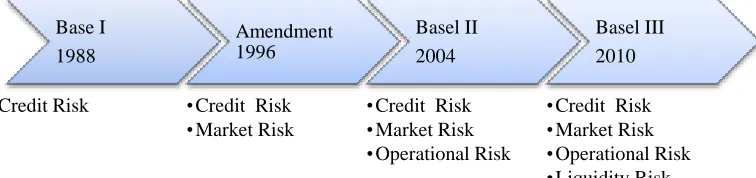
However, the G10 countries in 1975 have started regular meetings and in 1988, they came up with the first accord, which is called the Basel capital accord or Basel I accord. This accord puts forward the initial steps in evaluating the soundness of the international banks and this Basel accord has pushed up capital requirements not only in the BIS member states, but also in non-member states(Genschel & Plümper, 1997). This first accord was followed by ongoing changes due to the emerge of new instruments with complex risk profile that increase the volatility of financial markets and due to the widespread financial crisis, for example, in Asia in 1997 and in Eastern Europe in 1998, that were led to the introduction of Basel II accord in June 2004 (Greuning & Bratanovic, 2009).Due to the share nature of the global financial market, moreover, in 2009, the BCBS expanded its membership to include 27 jurisdictions, which are Belgium, Argentina, Australia, Canada, France, China, Brazil, Germany, India, Hong Kong, Japan, Indonesia, Italy, Korea, Luxembourg, the Netherlands, Mexico, Russia, Singapore, Saudi Arabia, South Africa, Sweden, Spain, Turkey, Switzerland, United Kingdom, and the United states(BCBS, 2013a).However, the last financial crisis, started in 2007, increases the importance for a fundamental strengthening of Basel II framework as during the crisis banks were highly levered and illiquid resulted in a failure of largest banks such as Lehman Brothers, and this causes the BCBS to announce the introduction of the new accord Basel III in December 2010 that strengthens the capital adequacy requirements and establishes new liquidity requirements (BCBS, 2013a). Next, we will provide a history of each accord and summarize the key problems with each accord. Figure 1 shows the risks involved in the three Basel accords and their proposed years.
Figure 1.The three Basel accords risks and accords establishment years
Source: BCBS (2013a)
Base I 1988 •Credit Risk
Amendment 1996
•Credit Risk •Market Risk
Basel II 2004 •Credit Risk •Market Risk •Operational Risk
Licensed under Creative Common Page 544 Basel I
Bankers and regulators all over the world have been concerned about the credit risk and banks’ solvency, and this concern reached the top level, when Mexico in 1982 defaults on their debt obligations (Genschel & Plümper, 1997). Later on, the formal framework for banks’ capital structure was evolved in 1988 with the introduction of the “International Convergence of Capital Measurement and Capital Standards”, popularly known as Basel I, issued by the Basel Committee on Banking Supervision (BCBS) and under this accord, G10 banks were required to hold a minimum capital ratio that must be met by the end of year 1992 (BCBS, 1988). Following Basel I, banks were required to maintain a minimum capital adequacy ratio of 8% against total risk-weighted assets (RWA) based on their credit risk exposure, which is the risk of a counterparty being default. Thus,
𝑇ℎ𝑒𝐶𝑎𝑝𝑖𝑡𝑎𝑙𝐴𝑑𝑒𝑞𝑢𝑎𝑐𝑦𝑅𝑎𝑡𝑖𝑜 = 𝑇𝑜𝑡𝑎𝑙𝐶𝑎𝑝𝑖𝑡𝑎𝑙 (𝑇𝑖𝑒𝑟𝐼 + 𝑇𝑖𝑒𝑟𝐼𝐼)
𝐶𝑟𝑒𝑑𝑖𝑠𝑡𝑅𝑖𝑠𝑘𝑊𝑒𝑖𝑔ℎ𝑡𝑒𝑑𝐴𝑠𝑠𝑒𝑡𝑠 (𝑅𝑊𝐴)≥ 8% (1)
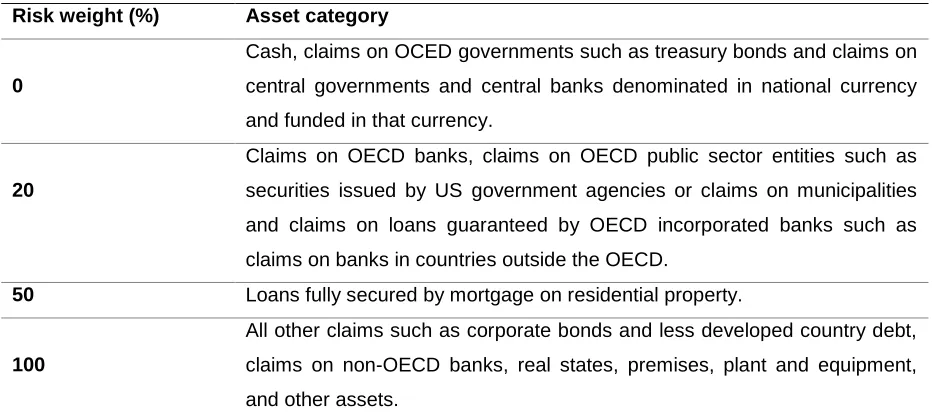
This particular accord established four critical categories of risks pertaining to assets. The categories were ranked as follows 0%, 20%, 50%, and 100% (see Table 1). Here, Basel I suggested a portfolio approach to credit risk by assigning an appropriate risk weight against each asset(Hasan, 2002).
Table 1. Risk weights categories for on-balance sheet items under Basel I accord
Risk weight (%) Asset category
0
Cash, claims on OCED governments such as treasury bonds and claims on central governments and central banks denominated in national currency and funded in that currency.
20
Claims on OECD banks, claims on OECD public sector entities such as securities issued by US government agencies or claims on municipalities and claims on loans guaranteed by OECD incorporated banks such as claims on banks in countries outside the OECD.
50 Loans fully secured by mortgage on residential property.
100
All other claims such as corporate bonds and less developed country debt, claims on non-OECD banks, real states, premises, plant and equipment, and other assets.
Licensed under Creative Common Page 545
More, these risk categories are also applied to off-balance sheet items (e.g. banks guarantee letters, sale and repurchase agreements, note issuance facilities and over the counter derivatives) after they convert to a credit equivalent amount based on conversion factors (BCBS, 1988). However, the conversion for off-balance sheet items is straightforward expect for derivative contracts as it depends on the current exposure, maturity of the contract and the commodity underlying this contract (see Table 2). However, the capital components include Tier I (paid-up share capital and disclosed reserves) and Tier 2 (undisclosed reserves, asset revaluation reserves, general provisions, preferred shares and subordinated debts); more, the Tier II supplementary capital cannot exceed 100% of total Tier I core capital (BCBS, 1988). In other words, Tier II capital to RWA has an upper limit of 4%.
Table 2. The add-on factors as a percentage of principal for derivatives
Source: Hull (2010)
Subsequently, in 1996 amendment was proposed by the committee to build up additional capital requirements to meet the market risk, which is the risk of securities market price fluctuation. The Basel committee suggested that banks maintain capital funds against market risk by following either the standardized measurement approach (SMA) or the internal measurement approach (IMA) to meet the unforeseen losses arising out of market risks(BCBS, 2005). Further, although the first Basel accord was signed only by theG10 countries plus two more nations, more than 100countries across the globe have made these norms mandatory in their domestic banking systems (Jayadev, 2013).
Nevertheless, economists and other research proponents have criticized Basel I and have argued that it was an incorrect response to an existing financial problem. Consequently, there was an increasing financial crisis on member states owing to the fact that the accord made use of arbitrary risk categories as well as arbitrary weights, which had no statistical significance to check default rates; strangely enough, the accord perceived that all assets within a given category had equal probability of risks, for example, all loans by a bank to a corporation have a risk weight of 100%, whether the corporate has AAA credit rating or B credit rating(Hull, Remaining
maturity (years)
Interest rate Exchange rate and gold
Equity Precious metals except gold
Other commodities
<1 0.0 1.0 6.0 7.0 10.0
1 to 5 0.5 5.0 8.0 7.0 12.0
Licensed under Creative Common Page 546 2010). Consequently, it reduces banks incentive to enhance their loan portfolio quality (Hasan, 2002). The accord, also, gave a substantial preference to government securities and claimed that banks had to avoid holding any form of capital against them. As a result, although the accord had been adopted by more than 100 nations, it failed to achieve its main goal of establishment. In summary, Basel I had the following pitfalls: inadequate credit risk differentiation and a static measure that does not recognize portfolio diversification effects(Hull, 2010).
Owing to the above shortcomings of Basel I, the committee thought it wise to adopt another accord, which will align policies on the regulation of capital requirements more effectively, while taking into account the underlying risks surrounding the operation of most banks. It was also aimed at improving capital adequacy calculations in banks.
Basel II
It was proposed in June 2004 and was meant to overcome the drawbacks of Basel I (e.g the capital adequacy requirements become more risk sensitive, see Table 3) to strengthen the stability and soundness of the international banking system(BCBS, 2004). Under this accord, there are three pillars were introduced and they are minimum capital requirements, supervisory review, and market discipline. Under pillar I, banks are required to hold capital against its exposure to credit risk, market risk and new operational risk, which is the risk of conducting business resulted from people and system, or external events (BCBS, 2004). Thus,
𝐵𝑎𝑠𝑒𝑙𝑙𝐼𝐼𝐶𝑎𝑝𝑖𝑡𝑎𝑙𝑅𝑎𝑡𝑖𝑜 = 𝑇𝑜𝑡𝑎𝑙𝐶𝑎𝑝𝑖𝑡𝑎𝑙 𝑇𝑖𝑒𝑟𝐼 + 𝑇𝑖𝑒𝑟𝐼𝐼
𝐶𝑟𝑒𝑑𝑖𝑡𝑅𝑊𝐴 + 𝑀𝑎𝑟𝑘𝑒𝑡𝑅𝑊𝐴 + 𝑜𝑝𝑒𝑟𝑎𝑡𝑖𝑜𝑛𝑎𝑙𝑅𝑊𝐴 ≥ 8% 2
Table 3. Risk weights as a percent of principal for exposures to countries, banks and corporations with different ratings under Basel II standardized approach Rating AAA to
AA-
A+ to A- BBB+ to BBB-
BB+ to BB-
B+ to B- Below B- Unrated
Country 0% 20% 50% 100% 100% 150% 100%
Banks 20% 50% 50% 100% 100% 150% 50%
Corporate 20% 50% 100% 100% 150% 150% 100%
Source: Hull (2010)
Licensed under Creative Common Page 547
discretion in how they implement the rules, but with overall consistency(BCBS, 2004). In addition, Pillar III requires banks to disclose more information regarding the way they allocate their capital and their risk exposure to strengthen market discipline(BCBS, 2004). The Basel II provided, also, more advanced methods in calculating the capital adequacy requirements beside the straightforward standardized approach such as Internal Rating Based Approach (IRB) and Advanced Internal Rating Based Approach (A-IRB) that rely more on the internal ratings rather than on the external ratings from rating agencies to allow greater use of internal banks’ risk assessment to encourage banks to develop and use better risk management techniques, and these last two approaches also consider the diversification of assets portfolio(BCBS, 2004; Hull, 2010).
In particular, the main emphasis of this accord was to establish a very comprehensive capital regulation framework based on sophisticated quantification models. This allowed banks to utilize their internal models for risk measurement in order to determine their capital requirements. However, this approach seemed very expensive to implement in banks and required large data(Atkinson & Blundell-Wignall, 2010). The European Parliament approved all the three Basel II approaches for all European Union (EU) banks in2005 and formally, adopted the agreement in 2006; further, the EU implemented the standardized approach as early as 2007 and the advanced approaches by 2008, while in US, the rules apply only to the 19 largest, internationally active banks, who have consolidated total assets of $ 250 billion or more or with consolidated total on-balance sheet foreign exposure of $ 10 billion or more (Jayadev, 2013).
However, banks incurred high costs in the implementation of this accord due to its design complexity and high quality data requirements (Härle et al., 2010) and in Europe, the cost of Basel II implementation was estimated to exceed USD $15 million (Hai, Minhaj, & Ahmed, 2007). Additionally, the most critical problem of Basel II Accord is its pro-cyclical process. This process ensures that in case of any economic boom, were markets willing to invest more capital, banks in that country required less capital in order for them to cover their risks; however, in the event of an economic recession, were markets wary of supplying additional capital, banks will need significantly more capital in order for them to cover their risks exposure(Hai et al., 2007). The third critical issue was that Basel II did not consider liquidity risk as part of capital regulation. According to Dietrich, Hess, & Wanzenried(2014),“unsustainable
funding structure during the recent crisis have proven a more immediate threat to the survival of
Licensed under Creative Common Page 548 Fifthly, under market risk, banks were required to maintain a lower capital against their trading book (includes liquid assets held for trading purposes) exposure assuming that these could be liquidated, whereas banks were reducing their capital requirements by shifting their exposures from their banking book (includes long-term illiquid assets) to their trading book (Hull, 2010).
The sixth issue was the absence of any explicit regulation to control banks’ leverage activities. Basel II assumed implicitly that its risk based capital requirement would mitigate the risk of excessive leverage; unfortunately, excessive leverage of banks was one of the main causes of the last financial crisis (Jayadev, 2013). Lastly, one of the basic objectives of establishing Basel II was to enhance competitive equality among banks (BCBS, 2004). Conversely, small banks became losers as a result of Basel II, because large institutions that adopted A-IBR approach were able to reduce their capital requirements, while under the standardized approach, the capital requirements were higher for small banks as the last approach does not account for portfolio diversification (Lall, 2010). This increases the cost of small banks and reduces their profits, and as a result their market share, which made them subject to takeovers from large banks (Lall, 2010). Therefore, the first two accords have failed to meet the Basel committee main objective, which is to enhance the stability and the soundness of the international banking industry. In this regard, after the last global crisis, there was a need for the establishment of the third Basel accords.
Basel III
The last global crisis caused banks to incur massive write downs of over USD 2.8 trillion as of Jan 2010 (Teply, 2010) and many European large banks’ losses were absorbed by governments supports(Flannery & Giacomini, 2015). Thus, after the global financial crisis started in 2007, the G20 group called for a tighter regulatory supervision on the financial institutions and for a critical review of the Basel II accord. This led to the introduction of the Basel III in Dec 2010.The Basel III committee increased the level of the core capital (Tier I) requirements from 4% to 6% and increased its main components the common equity Tier I (CET I) from 2% to 4.5% (BCBS, 2013a).Further, one unique aspect with this accord from Basel IIis the “Capital Conservation Buffer” requirement that encourages banks to build up a capital buffer of 2.5 % comprises of CET I(in addition to the 4.5%) that can be used in downturns (BCBS, 2013a) and more constraints will be imposed on banks earning distribution to rebuild this capital buffer (e.g. reducing dividends, share repayment and staff bonuses), when it is below the threshold limit 2.5% (BCBS, 2011).
Licensed under Creative Common Page 549
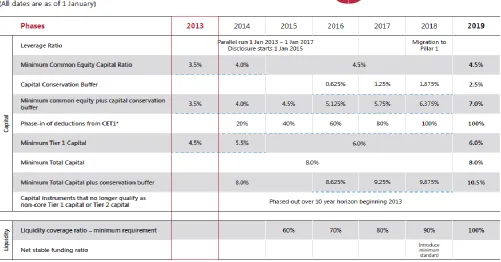
minimum 9.5%) in case of high probability of systematic risk (BCBS, 2011).Further, the committee proposed a minimum leverage ratio, a non-risk sensitive monitor, that will limit the risk of banks being default in case the risk adjusted assets value was not accurate (Dermine, 2015). Moreover, the Basel committee is trying to strength the liquidity risk management due to the liquidity disruption during the last financial crisis of 2007–2009 (Hong, Huang, & Wu, 2013). Thus, the Basel III committee proposed new liquidity requirements, which are liquidity coverage ratio (LCR)that intended to provide enough cash to cover funding needs over a 30-day period of stressand net stable funding ratio (NSFR) to address mismatches in maturities over the entire balance sheet (BCBS, 2013b, 2014).However, the Basel III will be implemented gradually over a period of time between Jan 2013 to Jan 2019. Ultimately, the accord deals with the quality and quantity of capital and assets held by banks and the full implementation of the accord is expected to take place by January 1stof the year 2019 (see Figure 2).
Figure 2. Basel III implementation phase
Licensed under Creative Common Page 550 increase, especially for CET I, in banks’ capital from the earlier 8% total regulatory capital (Tier I +Tier II) and from the earlier minimum CET I of 2% under Basel II accord. In addition, beside the significant increase in capital in relation to the amount and type, the Basel III introduced new liquidity requirements and minimum leverage ratio that will restrict banks’ activities and as a result will affect banks’ performance (Jayadev, 2013). More, the new liquidity requirements will force banks to rely more on stable funds such as equity and encourage banks to hold high quality liquid assets (King, 2013). Therefore, recent studies on banks regulation have tried to estimate the impact of this new regulations on banks’ performance.
RECENT LITERATURE ON BASEL III
With regards to the economy benefits and the financial stability of Basel III,Allen, Chan, Milne, & Thomas(2012) argue that in long run the economic cost of having a safer financial system will be lower as the safer financial system will enhance the economic activity. Yan, Hall, &Turner (2012)claim that a 1% increase in capital ratio will reduce the probability of crisis by 3.21% and a 100% NSFR will reduce the crisis probability by 2.04% in UK. In addition, Yan et al. (2012)promote for tighter capital requirements and argue that the optimal common equity ratio is 10%, which is higher than the 7% proposed by Basel III committee. They argue that under this capital level (equity 10%), the net temporary economic benefit and permanent economic benefit will be 1.28% and 35.48% of pre-crisis GDP respectively. Moreover, Dietrich et al. (2014) argue that the capital structure has an impact on the bank resilience in long run, whereas the funding structure has a significant immediate impact on the bank resilience during the financial crisis. Thus, the new liquidity requirements will result in more financial stability. According to Yan et al. (2012), the 100% NSFR will result in temporary economic benefit and permanent economic benefit of 0.35% and 14.32% of pre-crisis GDP respectively in UK.
Nevertheless, Yan et al. (2012)acknowledge that their study has some limitations, as it did not consider all possible cost arising from the implementation of Basel III due to difficulties in quantifying them. Dietrich et al. (2014), more, point out that 60% of their sample of Western European banks (256 banks) did not meet the NSFR and they require USD 3.05 trillion of new equity, which represents 4.1 times of their current equity, to fill up the liquidity gap. Further, Härle et al.(2010) assert that European and US banks will need capital equivalent to 60% of their current outstanding of Tier I and they will need liquid assets equivalent to 50% of their current outstanding of liquid assets. Härle et al.(2010), also, argue that the initial implementation of Basel III will cost European banks between €45 million and €70 million.
Licensed under Creative Common Page 551
year-end 2009 values. Furthermore, Allen et al. (2012) assert that the liquidity requirements will force banks to hold more liquid assets (such as government securities), which will affect the liquidity management of banks and their customers. This will shrink the credit availability to riskier borrowers such as small businesses that play an important role in the economy (Allen et al., 2012). Thus, these changes could disrupt the supply of credit to the economy, which could make the cure worsen than the disease (Allen et al., 2012). In addition, the new Basel III capital and liquidity requirements could result in a decrease of 20% in the cross-border banking lending from developed economies to emerging economies, which depend on such funding (Figuet, Humblot, & Lahet, 2015).Thus, most recent studies were expecting an adverse impact from the implementation of the new Basel III accord.
GCC BANKING INDUSTRY
The GCC refers to the Gulf Cooperation Council countries, which consists of the following countries: Bahrain, Kuwait, Oman, Qatar, Saudi Arabia and the United Arab Emirates and it is established in the 25th May 1981 (GCC, 2016). The financial sector in GCC countries is more developed in comparison with the Middle East and North Africa countries, MENA (Khediri, Charfeddine, & Youssef, 2015) as it was subject to extensive reforms in the last decade such as the removal of interest rate controls, the strengthening of banking regulations and supervision, and the compliance with Basel accords for capital adequacy(Maghyereh & Awartani, 2014a). They also have adopted policies that tend to increase the liberalization of the financial sector and to attract investments to the financial sector in order to strengthen the banks’ soundness in the region (Maghyereh & Awartani, 2014a). Additionally, since the GCC foundation in 1981, the GCC countries have also adopted extensive reforms in order to harmonize banking regulations, supervision practices, and complying with Basel II accord in order to achieve a full economic and financial integration (Maghyereh & Awartani, 2012). These harmonizing reforms have increased the homogeneity of GCC banking industry and enhanced GCC banks’ efficiency (Maghyereh & Awartani, 2012).
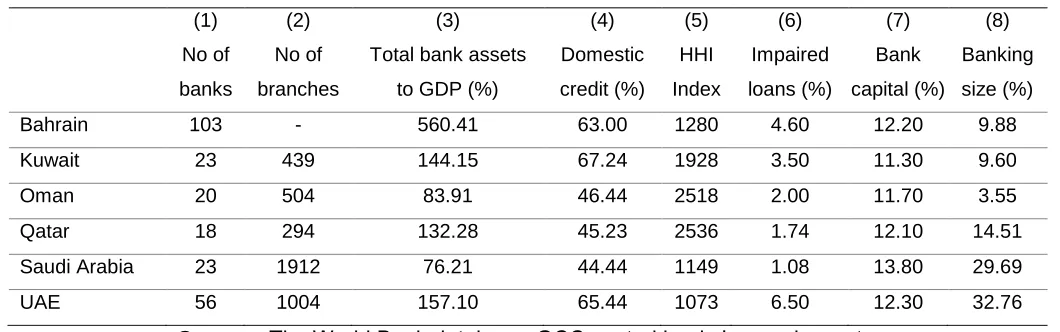
Licensed under Creative Common Page 552 Moreover, regarding the depth of the banking market, as measured by the total banks’ assets to GDP, the GCC banking industry is very large and significant. The Bahrain banking industry size is almost six times larger than its GDP, while UAE, Kuwait and Qatar banking industries are approximately one and half larger than their own GDP. With respect to Saudi Arabia and Oman, the banking industry accounts for 76% and 84% of their GDP respectively. In addition, GCC private sector depends mainly on banks as source of funds with an average of 55.3 % across GCC countries.
Further, the GCC banking market is concentrated, which means the market dominated by small number of large banks. The HHI index, which is a measure of market concentration, shows that the UAE and Saudi Arabia have the lowest concentration index with 1073 and 1149 respectively, whereas Qatar and Oman have the highest concentration index with 2536 and 2518 respectively. This means UAE and Saudi Arabia banking industry are more competitive than Qatar and Oman banking markets. However, Bahrain and Kuwait have a concentration index of 1280 and 1928 respectively. Thus, the GCC banking industry is characterized as a concentrated and less competitive market because the banking industry is considered to be competitive if HHI is less than 1000, moderately concentrated if the HHI lies between 1000 and 1800, and very concentrated if HHI is more than 1800(Karasneh & Bolbol, 2008).
Table 4. GCC banking sector indicators 2014
Sources: The World Bank database; GCC central banks’ annual reports;
and the authors’ estimates
Notes: The table reports (1) the number of banks (include all licensed banks), (2) the number of branches, (3) total assets (as a percentage of GDP), (4) domestic credit to the private sector (as a percentage of GDP), (5) Herfindahl–Hirschman Index (HHI) is a measure of market concentration calculated as the sum of squared assets market shares, (6) the percentage of nonperforming loans to total loans, (7) the percentage of bank capital to total assets, and (8) country banks’ assets to total GCC banks’ assets. (1) No of banks (2) No of branches (3) Total bank assets
to GDP (%)
(4) Domestic credit (%) (5) HHI Index (6) Impaired loans (%) (7) Bank capital (%) (8) Banking size (%)
Bahrain 103 - 560.41 63.00 1280 4.60 12.20 9.88
Kuwait 23 439 144.15 67.24 1928 3.50 11.30 9.60
Oman 20 504 83.91 46.44 2518 2.00 11.70 3.55
Qatar 18 294 132.28 45.23 2536 1.74 12.10 14.51
Saudi Arabia 23 1912 76.21 44.44 1149 1.08 13.80 29.69
Licensed under Creative Common Page 553
With regard to credit risk and capital, Saudi Arabia, Qatar and Oman have the lowest non-performing loan ratios 1.08%, 1.74% and 2% respectively, whereas UAE, Bahrain and Kuwait have the highest ratios 6.5%, 4.6% and 3.5% respectively. This indicates that Saudi Arabia has the lowest credit risk and UAE has the highest credit risk. Moreover, the GCC banks are well capitalized with an average of 12.23%. It is noticed that Saudi Arabia banks are the best well capitalized with a ratio of 13.8% and they face the lowest credit risk in comparison with other GCC banks. Finally, with regard to the banking industry size of each country relative to the total GCC banking industry, UAE and Saudi Arabia has the largest share with assets share of 32.76% and 29.69% respectively. In contrast, Oman banking assets share is by far the smallest with 3.55%. However, Qatar, Bahrain and Kuwait have a comparable assets share of 14.51%, 9.88% and 9.6% respectively.
From previous analysis, it is obvious that the banking industry plays a critical role in the GCC economy. According to Staub, da Silva e Souza, & Tabak(2010), the banking industry plays a crucial role in financial development in emerging markets because the stock and bond markets are still underdevelopment. However, even though the GCC banks are well capitalized, its future stability is uncertain due to the high inflation and rapid credit growth (Naïmy, 2009). This means highly capitalized banks can be subject to insolvency and Bank Islam Malaysia Berhad (BIMB), for example, became insolvent in 2006 regardless of having a high CAR of 31% in 2004 (Chong & Liu, 2009). Moreover, higher capital requirements will have more severe impacts on emerging countries as alternative financing channels to the banking industry are generally weak (Concetta Chiuri, Ferri, & Majnoni, 2002).
Licensed under Creative Common Page 554 GCC Islamic Banking Industry
The GCC Islamic banking assets account for 38.22% of total global Islamic banks assets with value of 564.2 USD billion, and the GCC Islamic finance industry (Banking, Sukuk, Islamic funds and Takaful) accounts for 37.6% of total global Islamic industry followed by MENA and Asia, which account for 34.4% and 22.4% respectively (IFSB, 2015).
Table 5 shows the market share of Islamic banks across GCC banking industries. More, in Saudi Arabia, Islamic banks account for 51% of the banking market, while in Oman only account for1%. This is not surprising as the first Islamic bank in Oman was established in 2012 and the number of Islamic banks in Oman is only two, which are Bank Nizwa in 2012 and Al Izz Islamic bank in 2013. Further, Islamic banks in Kuwait account for 38%, where in Qatar, UAE and Bahrain account for 26%, 18% and 16% respectively. Thus, Islamic banks have a significant share in the GCC banking industry, especially in Saudi Arabia, that cannot be neglected.
Table 5. GCC conventional and Islamic banks market share at end of 2014
Market share as % of total banks' assets
Conventional Banks Islamic Banks
Bahrain 84 16
Kuwait 62 38
Oman 99 1
Qatar 75 26
Saudi Arabia 49 51
UAE 82 18
Sources: Basu, Prasad, & Rodriguez(2015); and GCC central banks’ annual reports
Licensed under Creative Common Page 555
profit-loss sharing agreements (Ibrahim & Mirakhor, 2014). This represents another reason of way we should include the Islamic banks in our analysis.
GCC Banks Capital Structure Adjustments
The introduction of the 1988 Basel I accord has reignited the debate on the effectiveness of banks’ regulatory capital (Fiordelisi, Marques-Ibanez, & Molyneux, 2011). However, as mentioned, Tier I ratio is a risk-based capital ratio that represents the highest quality capital that can fully absorb losses in event of crisis and it mainly consists of common equity Tier I (CET I) such as common share, common share premium, retained earnings and reserves (BCBS, 2011). The new Basel III agreement increases the Tier I ratio from 4% to 6% as a minimum requirement in all times and the CET I from 2% to 4.5% as a minimum requirement in all times (BCBS, 2011). Thus, the total Tier I ratio is 6%, which consists of 4.5% CET I and 1.5% additional Tier I capital. More, Basel III requires banks to build up a capital conservation buffer of 2.5% of CET I; hence, the total minimum CET I is 7% (4.5% + 2.5%) and the minimum total regulatory capital(Tier I + Tier II) is 10.5%. These ratios are calculated based on the risk adjusted weighted assets value (RWA) and they are covered three types of risk, which are credit risk, market risk and operational risk. In addition, beside the increase in capital in relation to the amount and type, the Basel III introduced new liquidity requirements and minimum leverage ratio that will restrict the banking activities and as a result will affect banks’ performance (Jayadev, 2013). These new requirements increase the complexity of bank’s management as they restrict bank’s activities such as assets allocation, planning and risk strategies (Schmaltz, Pokutta, Heidorn, & Andrae, 2014).
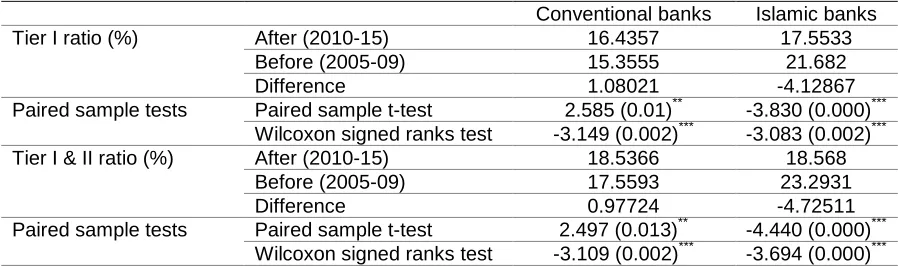
Licensed under Creative Common Page 556 perform the paired sample tests, as a robust check, by constructing randomly equal samples from before and after the Basel III announcement and the results are the same that there is a significant difference (see Table 7 in the Appendix).
These results show that the reaction of banks to Basel III announcement is significantly different between GCC Islamic and conventional banks. While, the conventional banks starts increasing their regulatory capital ratios, the Islamic banks starts reducing their regulatory capital ratios after Basle III announcement. These results are consistent with recent literature, which state that Islamic banks are well capitalized and have better assets quality (Al-Hares, AbuGhazaleh, & El-Galfy, 2013; Beck, Demirgüç-Kunt, & Merrouche, 2013; Khediri et al., 2015). In addition, the new Basel requirements will cause a shift in banks’ strategies from debt-base funding to equity-base funding (Allen et al., 2012; Dietrich et al., 2014) and this is in favor of Islamic banks (Alam, 2012; Boumediene, 2011). In contrast, conventional banks have increased their regulatory capital since the last financial crisis, where large banks regulatory capital is increased by 3.5 percentage point change and small banks regulatory capital is increased by 1.6 percentage point change over the period 2009-2012 (Cohen & Scatigna, 2016).
Table 6. GCC conventional and Islamic banks capital adequacy ratios before and after the Basel III introduction in 2010
Conventional banks Islamic banks Tier I ratio (%) After (2010-15) 16.5112 18.5633
Before (2005-09) 15.3555 21.6820
Difference 1.1557 -3.1187
Tests t-test 2.775 (0.006)*** -2.870 (0.005)***
Mann-Whitney test -3.497 (0.000)*** -2.719(0.007)*** Kolmogorov-Smirnov test 2.171 (0.000)*** 1.574 (0.014)** Tier I & II ratio (%) After (2010-15) 18.8206 19.8907
Before (2005-09) 17.5593 23.2931
Difference 1.2613 -3.4024
Tests t-test 3.050 (0.002)*** -3.212 (0.002)***
Mann-Whitney test -3.907 (0.000)*** -2.934 (0.003)*** Kolmogorov– Smirnov test 1.958 (0.001)*** 1.701 (0.006)***
Licensed under Creative Common Page 557
However, banking industry is categorized as the most levered industry and thus, any attempts to increase the capital base are expected to impede banks’ efficiency (Berger & Bonaccorsi di Patti, 2006). However, Islamic banks, which is a model that initially relies on equity capital as a main source of funds, are expected to be in better position regarding the higher capital requirements. Yet, due to the increase in competition between Islamic and conventional banks in GCC in last years (Maghyereh & Awartani, 2014b) and due to the higher systematic risk because of oil prices fluctuation (CNN Money, 2015; Reuters, 2014), the new higher capital requirements may increase the cost of funds for both banks. Further, Islamic banks are not allowed, based on Sharia laws, to use derivative contracts that are available to conventional banks for hedging purposes that may reduce the capital requirements under Basel guidelines (Turk & Sarieddine, 2007). This represents a competitive disadvantage for Islamic banks. Nonetheless, the results on the impact of higher regulatory capital on banks’ performance are still mixed and inconclusive in the literature, and this impact is still subject to more empirical investigation (Ayadi, Naceur, Casu, & Quinn, 2016; Barth, Lin, Ma, Seade, & Song, 2013; Pessarossi & Weill, 2015).
Liquidity Requirements Challenges for GCC Islamic Banks
The new liquidity requirements will force banks to rely more on stable funds such as equity and encourage banks to hold high quality liquid assets (BCBS, 2013b, 2014; King, 2013). In addition, the new liquidity requirements are expected to decrease banks’ profitability (King, 2013) as higher liquid assets are associated with lower returns because of lower liquidity premiums, and are expected to reduce the supply of funds to riskier borrowers such as small and medium companies that play an important role in the economy development (Allen et al., 2012).
Licensed under Creative Common Page 558 According to Aziz (2010), who is the governor of the Central Bank of Malaysia, “the impact of
the proposed Basel requirement to maintain sufficient cushion of high quality liquid assets
needs to be carefully considered, as the infrastructure and tools for liquidity risk management by
Islamic banks is still in its infancy in many jurisdictions. A very narrow definition of liquid assets
that is currently proposed may exacerbate liquidity risks in many Islamic financial markets in
which Islamic banks compete with conventional counterparts for the limited stock of Sharia-
compliant government securities. This will certainly increase compliance cost and render the
market illiquid when the demand exceeds supply, placing Islamic financial institutions at a
disadvantage”. Moreover, the secretary-general of the Islamic Financial Services Board (IFSB)
in his speech regarding the implication of the Basel III accord on Islamic banks on June 2014 states that the IFSB is concerned from the lack of Sharia-compliant securities and their active trading markets, and the lack of reliable Sharia-compliant deposit scheme, which are impeding the performance and competitiveness of Islamic banks versus conventional banks (PwC, 2014). Thus, the new liquidity requirements are considered as a competitive disadvantage for Islamic banks due to its imperfect market conditions. However, because of the rapid increase of interests on Islamic banking due to their resistance to the last global financial crisis (Beck et al., 2013), it becomes interestingly important to examine the impact of the Basel III on Islamic and conventional banks’ performance.
CONCLUSION
In conclusion, this paper outlined the three Basel accords and their main elements. The first two accords, Basel I and II, had failed to achieve the stability in the banking industry. Because of this, the BCBS proposed the Basel III accord in 2010. More, Basel III is the most comprehensive and stringent accord that covers a wide range of risks. However, this accord is introduced in time where the World economy was not recovered yet from the last financial crisis. Thus, this accord is expected to impede banking development and economic growth as it requires banks to hold higher level of equity capital and higher level of liquid quality assets. These requirements, also, are expected to increase the complexity of banks’ management as they will impose more restrictions on banks’ activities.
Licensed under Creative Common Page 559
capital, GCC Islamic banks have significantly decreased their regulatory capital. Moreover, the new liquidity requirement are expected to intensify the liquidity management problems in Islamic banks due to the lack of Sharia-compliant money markets instruments.
However, the expectations of the influence of the new Basel III are still ambiguous on Islamic and conventional banks. Thus, the policy makers in GCC countries should be aware about the challenges of the structural adjustments needed and its consequences across the banking industry as misunderstanding these issues would result in a real danger that could threaten the stability of the economy (Allen et al., 2012). Therefore, more investigations are needed in order to design the right policies that insure the financial stability in the GCC region.
SCOPE FOR FURTHER STUDIES
We recommend further studies to investigate other dual banking systems such as the MENA countries and the South East Asia countries in order to compare and assess the Islamic and conventional banks behaviors to Basel III across these countries. Ultimately, more analysis are needed in order to understand the impact of Basel III requirements on Islamic and conventional banks performance as the expected impacts of higher capital and liquidity requirements in the literature are still mixed and inconclusive.
ACKNOWLEDGMENT
This paper was presented at the WEI International Academic Conference at Harvard University, USA, Aug 1-3, 2016. Authors thank the participants for their comments.
APPENDIX
Table 7 .Paired sample tests for GCC conventional and Islamic banks capital adequacy ratios before and after the Basel III introduction in 2010
Conventional banks Islamic banks Tier I ratio (%) After (2010-15) 16.4357 17.5533
Before (2005-09) 15.3555 21.682
Difference 1.08021 -4.12867
Paired sample tests Paired sample t-test 2.585 (0.01)** -3.830 (0.000)*** Wilcoxon signed ranks test -3.149 (0.002)*** -3.083 (0.002)*** Tier I & II ratio (%) After (2010-15) 18.5366 18.568
Before (2005-09) 17.5593 23.2931
Difference 0.97724 -4.72511
Licensed under Creative Common Page 560 REFERENCES
Abdul Karim, M., Hassan, M. K., Hassan, T., & Mohamad, S. (2014). Capital adequacy and lending and deposit behaviors of conventional and Islamic banks. Pacific Basin Finance Journal, 28, 58–75.
Abdul-Rahman, A., Abdul Latif, R., Muda, R., & Abdullah, M. A. (2014). Failure and potential of profit-loss sharing contracts: A perspective of New Institutional, Economic (NIE) Theory. Pacific Basin Finance Journal, 28, 136–151. http://doi.org/10.1016/j.pacfin.2014.01.004
Alam, N. (2012). The impact of regulatory and supervisory structures on bank risk and efficiency: Evidence from dual banking system. Asian Journal of Finance & Accounting, 4(1).
Al-Hares, O., AbuGhazaleh, N. M., & El-Galfy, A. M. (2013). Financial performance and compliance with Basel III capital standards: conventional vs. Islamic banks. The Journal of Applied Business Research, 29(4).
Allen, B., Chan, K. K., Milne, A., & Thomas, S. (2012). Basel III: Is the cure worse than the disease? International Review of Financial Analysis, 25, 159–166. http://doi.org/10.1016/j.irfa.2012.08.004
Atkinson, P., & Blundell-Wignall, A. (2010). Thinking beyond Basel III. OECD Journal: Financial Market Trends, 2010, 9–33. http://doi.org/10.1787/fmt-2010-5km7k9tpcjmn
Ayadi, R., Naceur, S. Ben, Casu, B., & Quinn, B. (2016). Does Basel compliance matter for bank performance? Journal of Financial Stability, 23, 15–32. http://doi.org/10.1016/j.jfs.2015.12.007
Aziz, Z. A. (2010). Zeti Akhtar Aziz: The changing landscape of financial regulation – implications for Islamic finance. Retrieved from http://www.bis.org/review/r100511b.pdf
Barth, J. R., Lin, C., Ma, Y., Seade, J., & Song, F. M. (2013). Do bank regulation, supervision and monitoring enhance or impede bank efficiency? Journal of Banking and Finance, 37(8), 2879–2892. http://doi.org/10.1016/j.jbankfin.2013.04.030
Basu, R., Prasad, A., & Rodriguez, S. (2015). Monetary Operations and Islamic Banking in the GCC; Challenges and Options. IMF Working Paper. Retrieved from https://ideas.repec.org/p/imf/imfwpa/15-234.html
BCBS. (1988). International convergence of capital measurement and capital standards. Basel Committee on Banking Supervision. Retrieved from http://www.bis.org/publ/bcbs04a.htm
BCBS. (2004). Basel II: International Convergence of Capital Measurement and Capital Standards: a Revised Framework. Basel Committee on Banking Supervision. Retrieved from http://www.bis.org/publ/bcbs107.htm
BCBS. (2005). Amendment to the capital accord to incorporate market risks. Basel Committee on Banking Supervision. Retrieved from http://www.bis.org/publ/bcbs119.htm
BCBS. (2011). Basel III: A global regulatory framework for more resilient banks and banking systems. Basel Committee on Banking Supervision. Retrieved from http://www.bis.org/publ/bcbs189.pdf
BCBS. (2013a). A brief history of the Basel Committee. Basel Committee on Banking Supervision. Retrieved from http://www.bis.org/bcbs/history.pdf[accessed 17 Aug 2013]
BCBS. (2013b). Basel III: The Liquidity Coverage Ratio and liquidity risk monitoring tools. BaselCommittee on Banking Supervision.
BCBS. (2014). Basel III: The Net Stable Funding Ratio. Basel Committee on Banking Supervision. Retrieved from http://www.bis.org/publ/bcbs271.pdf
BCBS. (2015). Basel III implementation assessment of the Kingdom of Saudi Arabia. Basel Committee on Banking Supervision. Retrieved from http://www.bis.org/press/p150930.htm
Licensed under Creative Common Page 561
Berger, A. N., & Bonaccorsi di Patti, E. (2006). Capital structure and firm performance: A new approach to testing agency theory and an application to the banking industry. Journal of Banking & Finance, 30(4), 1065–1102. http://doi.org/10.1016/j.jbankfin.2005.05.015
Boumediene, A. (2011). Basel III: Relevance for Islamic Banks. SSRN Electronic Journal. http://doi.org/10.2139/ssrn.1852205
Chong, B., & Liu, M. (2009). Islamic banking: Interest-free or interest-based? Pacific-Basin Finance Journal, 17, 125–144.
CNN Money. (2015). Saudi Arabia to run out of cash in less than 5 years. Retrieved October 30, 2015, from http://money.cnn.com/2015/10/25/investing/oil-prices-saudi-arabia-cash-opec-middle-east/
Cohen, B. H., & Scatigna, M. (2016). Banks and capital requirements: Channels of adjustment. Journal of Banking & Finance, 69, S56–S69. http://doi.org/10.1016/j.jbankfin.2015.09.022
Concetta Chiuri, M., Ferri, G., & Majnoni, G. (2002). The macroeconomic impact of bank capital requirements in emerging economies: Past evidence to assess the future. Journal of Banking & Finance, 26(5), 881–904. http://doi.org/10.1016/S0378-4266(01)00267-9
Dermine, J. (2015). Basel III leverage ratio requirement and the probability of bank runs. Journal of Banking & Finance, 53, 266–277. http://doi.org/10.1016/j.jbankfin.2014.12.007
Diemers, D., Gassmann, P., & Khalil, J. K. (2014). Basel III: A silver lining for Middle East banks. Strategy& Formerly Booz & Company. Retrieved from http://www.strategyand.pwc.com/global/home/what-we-think/reports-white-papers/article-display/silver-lining-middle-east-banks
Dietrich, A., Hess, K., & Wanzenried, G. (2014). The good and bad news about the new liquidity rules of Basel III in Western European countries. Journal of Banking and Finance, 44(1), 13–25. http://doi.org/10.1016/j.jbankfin.2014.03.041
Figuet, J.-M., Humblot, T., & Lahet, D. (2015). Cross-border banking claims on emerging countries: The Basel III Banking Reforms in a push and pull framework. Journal of International Financial Markets, Institutions and Money, 34, 294–310.
http://doi.org/10.1016/j.intfin.2014.11.016
Fiordelisi, F., Marques-Ibanez, D., & Molyneux, P. (2011). Efficiency and risk in European banking. Journal of Banking and Finance, 35(5), 1315–1326. http://doi.org/10.1016/j.jbankfin.2010.10.005
Flannery, M. J., & Giacomini, E. (2015). Maintaining adequate bank capital: An empirical analysis of the supervision of European banks. Journal of Banking & Finance, 59, 236–249. http://doi.org/10.1016/j.jbankfin.2015.06.008
GCC. (2016). THE COOPERATION COUNCIL FOR THE ARAB STATES OF THE GULF. Retrieved May 15, 2016, from https://www.gcc-sg.org/eng/index895b.html?action=Sec-Show&ID=3
Genschel, P., & Plümper, T. (1997). Regulatory competition and international co-operation. Journal of European Public Policy, 4(4), 626–642. http://doi.org/10.1080/135017697344109
Greuning, H. van, & Bratanovic, S. B. (2009). Analyzing Banking Risk: A Framework for Assessing Corporate Governance and Risk Management (3rd ed.). The International Bank for Reconstruction and Development. http://doi.org/10.1596/978-0-8213-7728-4
Ha, R. R., & Ha, J. C. (2012). Integrative Statistics for the Social and Behavioral Sciences. SAGE.
Hai, S., Minhaj, S., & Ahmed, R. (2007). Implementation of Basel II: Issues, Challenges and Implications
for Developing Countries. Retrieved from
https://www.researchgate.net/publication/241714783_Implementation_of_Basel_II_Issues_Challenges_a nd_Implications_for_Developing_Countries
Licensed under Creative Common Page 562 Hasan, M. (2002). The Significance of Basel 1 and Basel 2 for the future of the banking industry with special emphasis on credit Information. Central Bank of Jordan, Credit Alliance/Information Alliance Regional.
Hesse, H., Jobst, A. A., & Sole, J. (2008). Trends and challenges in Islamic finance. World Economics,
9(2). Retrieved from
http://citeseerx.ist.psu.edu/viewdoc/download?doi=10.1.1.611.278&rep=rep1&type=pdf
Hong, H., Huang, J. J.-Z., & Wu, D. (2013). The Information Content of Basel III Liquidity Risk Measures. Journal of Financial Stability, 15(September), 91–111. http://doi.org/10.1016/j.jfs.2014.09.003
Hull, J. C. (2010). Risk Management and Financial Institutions (2nd ed.). Pearson Education. Retrieved from http://www.pearsonhighered.com/educator/academic/product/1,,0136102956,00.html
Ibrahim, M. H., & Mirakhor, A. (2014). Islamic finance: An overview. Pacific Basin Finance Journal, 28, 2– 6. http://doi.org/10.1016/j.pacfin.2014.02.002
IFSB. (2015). Islamic Financial Services Industry Stability Report. Islamic Financial Services Board. Retrieved from http://www.ifsb.org/sec03.php
Issac, J. (2015). GCC banks to issue $43 billion of Basel III compliant debt. Banking and Finance. Retrieved from http://www.khaleejtimes.com/business/banking-finance/gcc-banks-to-issue-43-billion-of-basel-iii-compliant-debt
Jayadev, M. (2013). Basel III implementation: Issues and challenges for Indian banks. IIMB Management Review, 25(2), 115–130. http://doi.org/10.1016/j.iimb.2013.03.010
Karasneh, I., & Bolbol, A. (2008). Corporate governance, concentration, and economic growth in the GCC banking sector. Savings and Development. Retrieved from http://www.jstor.org/stable/25830967
Khan, M. M., & Bhatti, M. I. (2008). Development in Islamic banking: a financial risk-allocation approach.
The Journal of Risk Finance. Retrieved from
http://www.emeraldinsight.com/doi/pdf/10.1108/15265940810842401
Khediri, K. Ben, Charfeddine, L., & Youssef, S. Ben. (2015). Islamic versus conventional banks in the GCC countries: A comparative study using classification techniques. Research in International Business and Finance, 33, 75–98. http://doi.org/10.1016/j.ribaf.2014.07.002
King, M. R. (2013). The Basel III Net Stable Funding Ratio and bank net interest margins. Journal of Banking and Finance, 37(11), 4144–4156. http://doi.org/10.1016/j.jbankfin.2013.07.017
Lall, R. (2010). Reforming global banking rules: Back to the future?DIIS Working Paper 2010:16. Copenhagen: Danish Institute for International Studies (DIIS). Retrieved from http://www.econstor.eu/handle/10419/44661
Levine, R., Loayza, N., & Beck, T. (2000). Financial intermediation and growth: Causality and causes. Journal of Monetary Economics, 46, 31–77.
Maghyereh, A. I., & Awartani, B. (2012). Financial integration of GCC banking markets: A non-parametric bootstrap DEA estimation approach. Research in International Business and Finance, 26(2), 181–195. http://doi.org/10.1016/j.ribaf.2011.10.001
Maghyereh, A. I., & Awartani, B. (2014a). Bank distress prediction: Empirical evidence from the Gulf Cooperation Council countries. Research in International Business and Finance, 30, 126–147. http://doi.org/10.1016/j.ribaf.2013.07.001
Maghyereh, A. I., & Awartani, B. (2014b). The influence of competition on the financial stability of banks in the GCC countries. In Multinational Finance Society Twenty-First Annual Conference.
Naïmy, V. Y. (2009). Liquidity Planning Between Theory And Practice: An Overall Examination Of The GCC Banks During The Crisis Du Jour. Journal of Business Case Studies, 5(6), 1–12.
Licensed under Creative Common Page 563
Pessarossi, P., & Weill, L. (2015). Do capital requirements affect cost efficiency? Evidence from China. Journal of Financial Stability, 19, 119–127. http://doi.org/10.1016/j.jfs.2014.11.002
PwC. (2014). Being better informed FS regulatory , accounting and audit bulletin. PwC FS Regulatory Centre of Excellence.
Reuters. (2014). Gulf states need to reform spending as oil price slips: Kuwait. Retrieved October 23, 2015, from http://www.reuters.com/article/2014/10/25/us-kuwait-finmin-idUSKCN0IE0AH20141025 Saunders, A., & Cornett, M. M. (2011). Financial Institutions Management: A Risk Management Approach (7th ed.). MacGraw-Hill.
Schmaltz, C., Pokutta, S., Heidorn, T., & Andrae, S. (2014). How to make regulators and shareholders happy under Basel III. Journal of Banking and Finance, 46(1), 311–325. http://doi.org/10.1016/j.jbankfin.2014.05.031
Shimizu, K. (2015). Adjusting denominators of capital ratios: Evidence from Japanese banks. Journal of Financial Stability, 19, 60–68. http://doi.org/10.1016/j.jfs.2015.05.005
Staub, R. B., da Silva e Souza, G., & Tabak, B. M. (2010). Evolution of bank efficiency in Brazil: A DEA approach. European Journal of Operational Research, 202(1), 204–213. http://doi.org/10.1016/j.ejor.2009.04.025
Teply, P. (2010). The Key Challenges of the New Bank Regulations. International Journal of Social, Behavioral, Educational, Economic, Business and Industrial Engineering, 4(2), 1300–1303.
Turk, R., & Sarieddine, Y. (2007). Challenges in Implementing Capital Adequacy Guidelines: A Case Study of an Islamic Bank. Journal of Banking Regulation, 9(1), 46–59.