IJSRR, 8(1) Jan. – Mar., 2019 Page 2836
Research article Available online www.ijsrr.org
ISSN: 2279–0543
International Journal of Scientific Research and Reviews
Viscoelastic Displacements of Two Welded Half-Spaces Caused by a
Dipole Source
Verma N.
1*and Singh K.
21, 2
Department of Mathematics, Guru Jambheshwar University of Science and Technology, Hisar-125001, India. Email: [email protected]
ABSTRACT
The correspondence principle of linear viscoelasticity is used to derive the displacement fields of an elastic half-space overlying a viscoelastic half-space caused by a dipole source, assuming the medium to be elastic in dilatation and Kelvin, Maxwell or SLS (Standard linear solid) type viscoelastic in distortion. The results are valid for arbitrary values of the relaxation time and a change in the rigidity of the two half-spaces. The variation of the viscoelastic displacements with the epicentral distance as well as with the different relaxation time are studied and shown graphically.
KEYWORDS:
Viscoelastic, Dipole, Maxwell, Kelvin model.
*Corresponding author
Nishu Verma
Department of Mathematics,
Guru Jambheshwar University of Science and Technology Hisar-125001, India.
IJSRR, 8(1) Jan. – Mar., 2019 Page 2837
INTRODUCTION
The Papkovich-Neuber displacement potential functions for an arbitrary point force acting in an infinite medium consisting of two welded elastic half-spaces obtained by Rongved1. Heaton and Heaton2 obtained the deformation field produced by point force and force couples embedded in two Poissonian half-space by using Papkovich-Neuber displacement potential functions. Rosenman and Singh3 applied the correspondence principle of linear viscoelasticity to derive the quasi-static displacement field in a Maxwellian viscoelastic half-space. The correspondence principle of linear viscoelasticity has been extensively used by many authors (e.g.4-8) to calculate the quasi-static deformation of a viscoelastic half-space by a point or extended sources. The Galerkin vector approach has been used by Singh and Singh9 to obtain the displacement field due to various seismic sources in a homogeneous, isotropic, perfectly elastic half-space and then the correspondence principle of linear viscoelasticity is used to obtain the quasi-static displacement, stains, and stresses. Singh and Singh10 gave a simple procedure to obtain the quasi-static field in a viscoelastic half-space. The displacement and stress fields due to a point displacement dislocation located at an arbitrary point of a two- phase medium consisting of two homogeneous, isotropic, perfectly elastic half-spaces in welded contact have been obtained by Kumari et al.11. Four axially symmetric sources, namely, a vertical force, a vertical dipole, a tensile dislocation on a horizontal fault and a compensated linear vector dipole (CLVD) in an elastic half-space were considered by Singh et al.12 to model the ground deformation in volcanic areas. The displacement and strain fields due to these four sources are compared with the corresponding fields due to a center of dilatation. The deformation fields due to five axially symmetric sources, namely, a vertical force, a vertical dipole, a center of dilatation, a tensile dislocation on a horizontal fault and a compensated linear vector dipole (CLVD) in two welded elastic half-spaces obtained by Singh et al.13.
Some materials usually have elastic as well as viscous property, therefore a theoretical study of viscoelasticity is an important subject in applied mechanics. A Viscoelastic medium has been used by many authors in various branches of science and technology particularly in geophysics and seismology.
IJSRR, 8(1) Jan. – Mar., 2019 Page 2838
THEORY
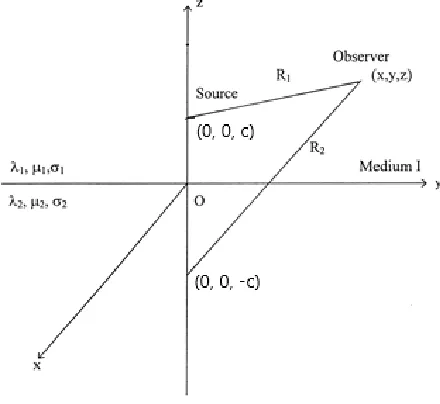
Consider a two-phase medium consisting of a homogeneous, isotropic, perfectly elastic half-space (z0, Medium-1) with the elastic constants 1,1,1 in welded contact with other homogeneous, isotropic, viscoelastic half-space (z0, Medium-2) with the elastic constants2,2,2.
Let the point source of unit magnitude Fo is located at the point (0, 0, c) in Medium-1.
Fig. 1. Geometry of a point source in two welded half-spaces
The solution will be given in terms of the Papkovich- Neuber displacement potentials which derive the displacement through the relation
i k k i
i x
u ( 1) ( ),
2 (1)
Where xi (x,y,z) is the position vector, - shear modulus, 34 where is the Poisson’s Ratio.
In case of nobody forces, the potentials i and must be harmonic: .
0 2 2
2
2
x y z
The Papkovich- Neuber displacement potentials for a dipole in the x, y, and z-directions have been used by Kumari et al.11 in equation (1) to obtain the elastic solutions in an elastic half-space overlying elastic half-space.
IJSRR, 8(1) Jan. – Mar., 2019 Page 2839
elastic half-space overlying the homogenous, isotropic, viscoelastic half-space. For this, we consider2 ,2 , and1and1as constants.
Following are the various combinations of elastic moduli andwhich occur in the expressions of elastic displacements:
, 1 3 a J
1 3 4 5
1 1
5 1
4 , , ,
1 , 1 J and J J and a where J J
are auxiliary functions.
We have derived these auxiliary functions by considering the material is elastic in dilatation and viscoelastic in distortion for the three viscoelastic models, namely, a Kelvin Model, a Maxwell Model, and a Standard Linear Solid Model. It is assumed that the time t>0 and the source time function is the Heaviside step function H (t).
DISPLACEMENT FIELD
Displacement components for the dipole (11) in the x-direction (horizontal dipole
(HD))
Following are the displacement components for the horizontal dipole:
4 2 2 2 2 2 2 4 2 5 1 1 4 1 1 3 1 1 2 4 2 2 4 2 2 2 3 2 2 4 2 4 2 2 4 1 3 1 7 2 1 3 1 2 5 2 1 3 1 4 1 2 1 3 2 1 4 1 5 1 2 3 1 1 1 1 0 ) 1 ( 2 3 2 ) ( ˆ 1 ) ( ˆ 4 ) ( ˆ 1 2 3 3 3 3 ) ( ˆ 2 ) ( ˆ 1 1 ) ( ˆ 1 3 1 ) ( ˆ 1 6 1 ) ( ˆ 2 3 2 1 ) ( ˆ 2 3 2 ) 1 ( 4 ˆ R R x R x R R t J t J t J a R R x R R x R x R R R R c z t J t J a R t J a cz ox R t J a cz t J x R t J R x R x F tuHDx
4 2 2 2 2 2 2 4 2 5 1 1 4 1 1 3 1 1 2 4 2 2 4 2 2 2 3 2 2 4 2 4 2 2 4 1 3 1 7 2 1 3 1 2 5 2 1 3 1 4 1 2 1 3 2 4 1 5 1 2 3 1 1 1 0 ) 1 ( 2 1 2 ) ( ˆ 1 ) ( ˆ 4 ) ( ˆ 1 2 3 3 1 1 ) ( ˆ 2 ) ( ˆ 1 1 ) ( ˆ 1 3 1 ) ( ˆ 1 2 1 ) ( ˆ 2 3 1 ) ( ˆ 2 3 1 ) 1 ( 4 ˆ R R x R x R R t J t J t J a R R x R R x R x R R R R c z t J t J a R t J a cz ox R t J a cz t J x R t J R x R y F tuHDy
IJSRR, 8(1) Jan. – Mar., 2019 Page 2840
4 2 2 2 2 2 4 2 5 1 3 1 1 7 2 1 3 1 2 5 2 1 2 1 3 1 3 2 3 1 5 1 2 3 1 1 1 0 ) 1 ( 1 2 ) ( ˆ ) ( ˆ 1 1 ) ( ˆ 1 3 2 1 ) ( ˆ 1 3 1 ) ( ˆ 1 3 1 ) 1 ( 4 ˆ R R x R x R R t J t J a R t J a c z cz ox R c z cz c z x t J a R t J a c z R x R c z F tuHDz
3 1 2 2 1 2 2 3 1 5 4 3 2 3 1 2 3 2 1 2 3 1 2 3 1 3 2 1 4 1 3 4 5 5 1 4 2 3 1 4 0 ) 2 ( 2 3 2 ) ( ˆ 1 ) ( ˆ 4 ) ( ˆ 2 3 3 3 3 1 ) ( ˆ 2 ) ( ˆ 1 ) ( ˆ 2 ) ( ˆ 1 ) ( ˆ 6 1 ) ( ˆ 1 2 4 ˆ R R x R x R R t J t J t J R R x R R x R x R R R R t J t J c t J t J z R t J x R t J x F t uHDx
3 1 2 2 1 2 2 3 1 5 4 3 2 3 1 2 3 2 1 2 3 1 2 3 1 3 2 1 4 1 3 4 5 5 1 2 3 1 4 0 ) 2 ( 2 1 2 ) ( ˆ 1 ) ( ˆ 4 ) ( ˆ 2 3 3 1 1 1 ) ( ˆ 2 ) ( ˆ 1 ) ( ˆ 2 ) ( ˆ 3 1 1 ) ( ˆ 2 4 ˆ R R x R x R R t J t J t J R R x R R x R x R R R R t J t J c t J t J z R x R t J y F t uHDy
3 1 2 2 1 2 3 1 5 3 5 1 2 3 1 1 3 5 0 ) 2 ( 2 1 2 ) ( ˆ ) ( ˆ 3 1 ) ( ˆ ) ( ˆ 4 ˆ R R x R x R R t J t J R x R t J c t J z F tuHDz
Displacement components for the dipole (22) in the y-direction
The corresponding displacement components for the dipole in the y-direction (dipole (22)) at point (0, 0, c) of an elastic half-space in welded contact with another viscoelastic half-space can be obtained from the corresponding expressions for dipole (11) on interchanging x and y.
Displacement components for the dipole (33) in the z-direction (vertical dipole (VD))
Following are the displacement components for the vertical dipole:
7 2 1 3 1 2 5 2 1 2 2 1 3 1 3 2 5 1 1 3 1 1 5 1 2 3 1 1 1 0 ) 1 ( 1 ) ( ˆ 1 3 2 2 1 ) ( ˆ 1 3 2 2 ) ( ˆ 1 ) ( ˆ 1 2 3 1 ) 1 ( 4 ˆ R t J a cz c z o R c z z c z t J a R t J t J a R c z R x F tuVDx
IJSRR, 8(1) Jan. – Mar., 2019 Page 2841
7 2 1 3 1 3 5 2 1 2 1 3 1 3 2 1 5 1 3 1 1 1 1 3 1 5 1 2 3 1 1 1 1 0 ) 1 ( 1 ) ( ˆ 1 3 4 2 1 ) ( ˆ 1 3 2 2 ) ( ˆ ) ( ˆ 1 1 ) ( ˆ 1 4 3 2 ) 1 ( 4 ˆ R t J a cz c z o R c z c z z c z t J a R t J t J a c z z c z t J a R c z R c z F t uVDz
5 1 1 3 5 3 1 5 1 3 1 0 ) 2 ( ) ( ˆ ) ( ˆ 3 2 ) ( ˆ ) ( ˆ 2 4 ˆ R t J c t J z c z R t J t J x F t uVDx
5 1 2 3 1 1 3 5 3 1 5 1 3 1 0 ) 2 ( 3 1 ) ( ˆ ) ( ˆ 2 ) ( ˆ ) ( ˆ 2 4 ˆ R c z R t J c t J z R t J t J c z F t uVDz
For u(1)y and u(2)y we interchange x and y in u(1)x and u(2)xrespectively.
Where u(1)x,u(1)y,u(1)zare the displacements in medium-1, and u(2)x,u(2)y,u(2)zare the displacements for the dipole in medium-2.
In above relations
1 1 2 2 2 1
1 3 4 , 3 4 ,
m
m m B m m A 1 1 , 1 1 , ) 1 )( 1 ( ) 1 ( 2 , 1 1 1 m m T m m S
2 2
2
122 2 1 2 2 2
1 x y z c ,R x y z c
R ,R3 R1zc,R4 R2zc.
Expressions forJˆ3
t ,Jˆ4
t and Jˆ5
t for three viscoelastic models are given below:For Kelvin Model
1 ,ˆ 3 3 aT
e J t J
T e J t J 1 1 ˆ 44 ,
k T
e J t J 1 1 ˆ 5
5 where 1
1
,t t
t
T is
IJSRR, 8(1) Jan. – Mar., 2019 Page 2842
For Maxwell Model
1 1 ,ˆ
3 3
T
a a
e a J
t
J
T
e J
t
J 1
1
1 1
ˆ
1 4
4
,
T
k k
e k
J t
J 1
1
1 1
ˆ
1 5
5
where 2
2
,t t
t
T is the relaxation time.
For Standard Linear Solid Model
1 ,2 1
ˆ 2
2 3
3
T
a a
e a J
t
J
2 2
1 4
4 1
1
1 2 1 ˆ
T
e J
t
J
,
2 2
1 5
5 1
1
1 2 1 ˆ
T k
k
e k
J t
J
where 2
2
,t t
t
T is the relaxation time.
RESULTS AND DISCUSSION
To show the variation of elastic and viscoelastic displacements with the epicentral distance we assume that
2 ,
2 1
r y x
and define the dimensionless displacements as
, ,
4
(1) , (1) , (1)
, 00
u u u z
F c U
U
Ux y z x y z
, ,
, 04
) 2 ( ) 2 ( ) 2 ( 0
u u u z
F c
z y x
For graphical representation, we assume thatz0,m2, 2and 1T 3.
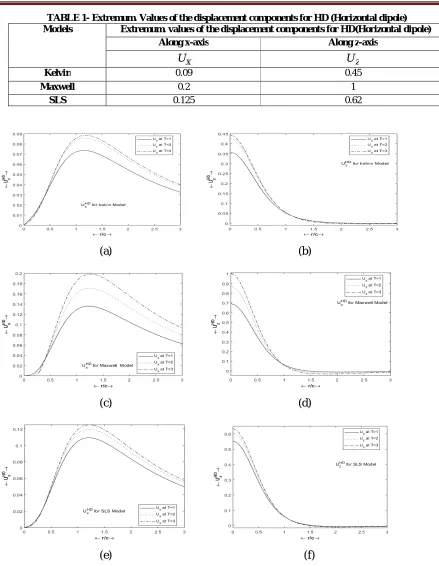
Fig.2 shows the effect of the relaxation time on the displacement components of the horizontal dipole for the three viscoelastic models, namely, Kelvin, Maxwell, and Standard Linear Solid model. The values of displacementUx and Uzalong x-axis and z-axis increases with the increase of relaxation time. Graphical representation of displacement components for the three models is the same except for their maximum and minimum values.
IJSRR, 8(1) Jan. – Mar., 2019 Page 2843 TABLE 1- Extremum. Values of the displacement components for HD (Horizontal dipole) Models Extremum. values of the displacement components for HD(Horizontal dipole)
Along x-axis Along z-axis
x
U Uz
Kelvin 0.09 0.45
Maxwell 0.2 1
SLS 0.125 0.62
(a) (b)
(c) (d)
(e) (f)
Fig 2. Effect of the relaxation time 1T3 on the viscoelastic displacement field of the horizontal dipole at the interface z 0,m2. (a, c, e) Horizontal displacementUxfor Kelvin Model, Maxwell Model, and SLS Model respectively, (b, d, e) Vertical displacement Uz for Kelvin Model, Maxwell Model, and SLS Model respectively
with the epicentral distance
IJSRR, 8(1) Jan. – Mar., 2019 Page 2844
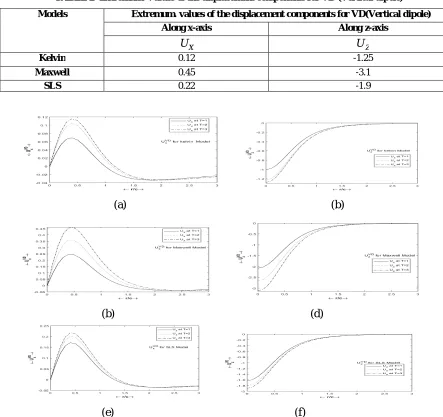
Fig.3 shows the effect of the relaxation time on the displacement components of the vertical dipole for the three viscoelastic models namely, Kelvin, Maxwell, and Standard Linear Solid model. The numerical values of displacementUx and Uzalong x-axis and z-axis increases with the increase of relaxation time. Graphical representation of displacement components for the three models is the same except for their maximum and minimum values.
Numerically displacement components assume the maximum value in case of Maxwell and minimum in case of Kelvin for a particular value of time for all the displacements components as shown in table 2.
TABLE 2- Extremum. Values of the displacement components for VD (Vertical dipole)
Models Extremum. values of the displacement components for VD(Vertical dipole)
Along x-axis Along z-axis
x
U Uz
Kelvin 0.12 -1.25
Maxwell 0.45 -3.1
SLS 0.22 -1.9
(a) (b)
(b) (d)
(e) (f)
Fig 3. Effect of the relaxation time 1T 3 on the viscoelastic displacement field of the vertical dipole at the interface z0,m2. (a, c, e) Horizontal displacementUxfor Kelvin Model, Maxwell Model, and SLS Model respectively, (b, d, e) Vertical displacement Uz for Kelvin Model, Maxwell Model, and SLS Model respectively
with the epicentral distance
IJSRR, 8(1) Jan. – Mar., 2019 Page 2845
CONCLUSION
The explicit expressions for the displacements in an elastic half-space overlying viscoelastic half-spaces due to the dipole source have been obtained. The results are also compared graphically for three viscoelastic models, namely, a Kelvin Model, a Maxwell Model, and a Standard linear solid Model (SLS). Graphical representations reveal that numerically the displacement components assume the maximum values in case of Maxwell Model and minimum values are obtained in case of Kelvin Model. Two welded half-spaces have the same elastic properties atm1. At T 0 all the viscoelastic results are same as an elastic solution obtained by Kumari et al. (1992). This study may have possible applications in the field of geophysics and seismology.
ACKNOWLEDGEMENTS
One of the authors Ms. Nishu Verma is grateful to the University Grants Commission, New Delhi for financial support.
REFERENCES
1. Rongved L. Force interior to one of two-joined semi-infinite solid, In proceeding 2nd Midwestern Conference Solid Mechanics ed. Bogdanoff, J.L., Purdue University- Indiana Res. Ser. 1955; 129: 1-13.
2. Heaton TH, Heaton RE. Static deformation from point forces and point force couples located in welded elastic Poissonian half-spaces: Implication for seismic moment tensors. Bull. Seismol. Soc. Am. 1989; 79: 813-841.
3. Rosenman M, Singh SJ. Stress relaxation in a semi-infinite viscoelastic Earth Model. Bull. Seismol. Soc. Am. 1973b; 63: 2145-2154.
4. Rundle JB, Jackson DD. A three dimensional viscoelastic model of a strike-slip fault. Geophys. J. R. astr. Soc. 1977; 49: 575-591.
5. Rundle JB. Viscoelastic crustal deformation by finite quasi-static sources. J. Geophys. Res. 1978; 83: 5937-5945.
6. Matsu’ura M, Tanimoto T, Iwasaki T. Quasi-static displacements due to faulting in layered half-space with an intervenient viscoelastic layer. J. Phys. Earth. 1981; 29: 23-54.
7. Iwasaki T. Quasi-static deformation due to a dislocation source in a Maxwellian viscoelastic Earth model. J. Phys. Earth. 1985; 33: 21-43.
8. Iwasaki T. Displacements, strains, and stress within a viscoelastic half-space due to a rectangular fault. J. Phys. Earth. 1986; 34: 371-396.
IJSRR, 8(1) Jan. – Mar., 2019 Page 2846
10. Singh K, Singh SJ. A simple procedure for obtaining the quasi-static displacements, strains, and stresses in a viscoelastic half-space. Bull. Seismol. Soc. Am. 1990; 80: 488-492.
11. Kumari G, Singh SJ, Singh K. Static deformation of two welded elastic half-spaces caused by point dislocation source. Phys. Earth Planet. Int. 1992; 73: 53-76.
12. Singh SJ, Kumari G, Singh, K. Modelling of crustal deformation in volcanic areas. Nat. Acad. Sci. Letters. 1998; 21: 165-175.