Drowsiness Detection Of Bus Driver Fatigue
Based On Robust Visual Analysis Of Eye State
Rahul Sharma, Er. Brahmjeet Singh, Dr. Sandeep Singla
Abstract: When a driver falls asleep, then the driver loses control over the vehicle, an action which often results in a crash with either another vehicle or any object. In order to prevent these devastating accidents, there is an approach which is developed, in this system the state of drowsiness of a driver is monitored. This work proposed computer vision based smart drowsiness system in which properties of eye pixels from video frames tells the status of the eye of a driver. The camera can be placed in the intersection part of the front mirror on a side of the vehicle from which continuous video acquisition can be adopted to give real time value of the stage of drowsiness of a driver. The system used face and eye localization method which is carried out on a frame. Then eye patches are extracted from number of frames which resembled closed and open eyes. Then feature extraction is carried out in statistic features, discrete wavelet transform (DWT) and local binary pattern (LBP) features has been extracted which varies according to intensity of the pixels in the eye patches. Then machine learning is adopted to train number of classifiers based on closed and open eye patches. Finally testing is carried out which tells a particular frame eye localized patch, if it is in state of drowsy or not. Four different classifiers are used to evaluate the performance of the proposed real time drowsiness detection system named as SVM, k-nearest neighbor, decision tree and artificial neural networks which are tested on three different types of feature extraction methods. Out of all, LBP based feature extraction and SVM and kNN based classification gives approx. 97% accuracy in true classification of eye patches
Index Terms: Driver Drowsiness, LBP, WLD, Face & Eye Detection.
—————————— ——————————
1
INTRODUCTION
Fatigue, drowsiness and sleepiness are often used synonymously in driving state description. Involving multiple human factors, it is multidimensional in nature that researchers have found difficult to define over past decades. Despite the ambiguity surrounding fatigue, it is a critical factor for driving safety. Studies have shown that fatigue is one of the leading contributing factors in traffic accidents worldwide. It is particularly critical for occupational drivers, such as drivers of buses and heavy trucks, due to the fact that they may have to work over a prolonged duration of the driving task, during the peak drowsiness periods.
1.1 FEATURES USED IN DROWSINESS DETECTION
One solution to this serious problem is the design of an intelligent vehicle capable of predicting driver drowsiness and preventing drowsy driving. One of the major methods for detecting the driver's drowsiness is the percentage of eyelid closure over time over the pupil (PERCLOS). Physiological tests such as electroencephalogram (EEG), electrocardiogram (ECG), eye closure capture, facial features, or driving performance (such as steering, lane departure etc.) are used to detect drowsiness. While driving if drowsiness is observed, audible sound vibrations, or warning messages on a display are generally used to alert the driver to focus on driving or to take rest. Such techniques allow the drowsy driver to prevent drowsiness-related collisions in a moment, but by being just aware of it, it is difficult to get rid of drowsiness. As we noted in the literature review, most of the approaches need a lot of equipment that can not be applied in real life.
Furthermore, most of the methods that rely on camera input to detect opening and closing eyelids should not be tested as they can be applied in real time as most scholars take pictures as the camera is positioned in front of the driver's road view. As for the clear view, the camera can not be mounted on the front mirror. Second, most papers have drawbacks when there is high luminance caused by sunlight as well as bad weather conditions during dim light
2
LITERATURE
SURVEY
Cheng et. al. [25] presented a nonintrusive drowsiness recognition method using eye tracking and image processing. To address the problems caused by changes in illumination and driver posture, a robust eye detection algorithm is introduced. Six measurements are measured with eyelid closure percentage, total closure length, and blink rate, average eye-opening level, opening eye velocity, and closing eye velocity. Such measures are combined using the Fisher’s linear discriminate functions using a step-by-step approach to reduce correlations and extract an independent index. Results in driving simulator experiments with six participants show the efficacy of this video-based drowsiness recognition process, which provided 86 percent accuracy. Zoroofi et. al. [16] presented a new module for automatic driver drowsiness detection based on visual information and Artificial Intelligence. The objective of this system is to locate, track and assess both the face and eyes of the driver in order to calculate a drowsiness index to avoid accidents. Haar-like features and AdaBoost classifiers perform both face and eye detection. They propose a new approach, which is a combination of detection and object tracking, to achieve better accuracy in face tracking. The proposed method of face tracking also has the ability to self-correct. Local Binary Pattern (LBP) is used to extract eye characteristics after the eye region is found. An SVM classifier was trained to perform eye status analysis using these features. A drowsy individual was filmed while his EEG signals were taken to evaluate the efficiency of the proposed method. In this video, they are able to track the face with a 100% accuracy and detect eye blinking with a 98.4% accuracy. They can also calculate face orientation and tilt using eye position, which is a valuable
__________________________________
• Rahul sharma is currently pursuing masters degree program in Highway and Transportation engineering in RIMT University, Mandi Gobindgarh, Punjab, India.
• Er. Brahamjeet Singh is Assistant Professor in Highway and Transportation engineering in RIMT University, Mandi Gobindgarh, Punjab, India.
3834
knowledge for a driver concentration They can finally make a decision about driver's drowsiness and distraction. Experimental result show high accuracy in each section making this system effective for the detection of driver drowsiness.
3 METHODOLOGY
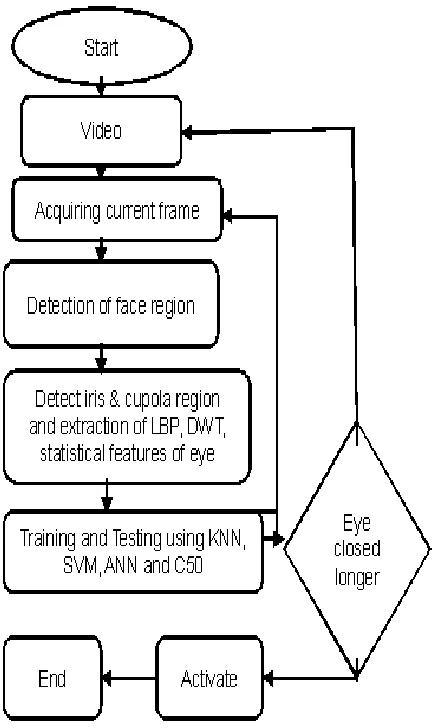
Every drowsiness detection system has several main modules such as face and eye detection, tracking, etc. In a new algorithm for detecting iris, pupil based on color information will be explored. This algorithm could analyze eye state and make decision about level of fatigue. Searches eye region in whole image with this assumption that sclera is always brighter than iris and hence by accounting texture features i.e. LBP or transformation features i.e. DWT etc. a classifier can be trained and tested which can describe the current status of eye. Different classifiers i.e. KNN, SVM, ANN, Decision tree etc. can be explored.
Figure 1: Block diagram for drowsiness system
4 PROPOSED WORK
Figure 2: system module
5 RESULTS AND DISCUSSIONS
5.1 Results
Given an image feature set, different classifiers are used to classify the images into two condition i.e drowsiness and non-drowsiness. Contourlet transform and its WLD has been used as an efficient feature extractor which gives more accuracy as compared to simple LBP. The Local Binary Pattern (LBP) operator is an operator that describes the surroundings of a pixel by generating a bit code from the binary derivatives of a pixel. The operator is usually applied to gray scale images and derivative of the intensities. The problem of variations to rotations in LBP arises due to the fixed arrangement of weights but when we use contourlet transform and web local descriptors of its coefficients, more effective features has been generated. We have used four classifiers artificial neural network, K-nearest neighbor, support vector machine and decision trees. The classifiers have been trained by training data is now tested that how much they learn to identify drowsiness image this is done by giving testing data to the classifiers. The outputs are calculated for all the images present in the testing data and compared with the tag values to evaluate the performance of each classifier respectively. The performance evaluation of the proposed method and comparison with existed methods has been displayed through images as well as tables. The results for each step have been shown as under.
Figure 3: A screen shot of extracted eye patches from the video
Input open-eye patch
Figure 4: Input patch having open eye in it
LBP implementation for open-eye patch
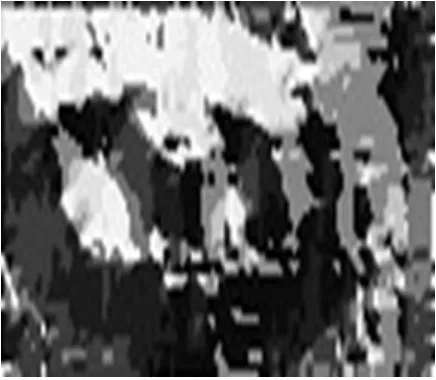
Figure 5: LBP image of the eye patch
Input closed-eye patch
Figure 6: Input patch having closed eye in it
LBP implementation for closed-eye patch
Figure 7: LBP image of closed eye
5.2 Biodiversity Classification Matrix
3836
―yes‖ (or ―positive‖), when it is in fact ―no‖ (or ―negative‖). A false negative is when the outcome is incorrectly classified as negative when it is in fact positive. True positives and true negatives are obviously correct classifications.
Figure 8: Confusion matrix for two class classifier
5.3 Classification Accuracy
We use MATLAB software to verify the algorithm. MATLAB is a high-performance language for a technical computing. It combines computation, visualization, and programming in an easy-to-use environment where problems and solutions are expressed in familiar mathematical notation. The information which is required for further processing on the captured frame may be degraded due to fluctuations of light or proper
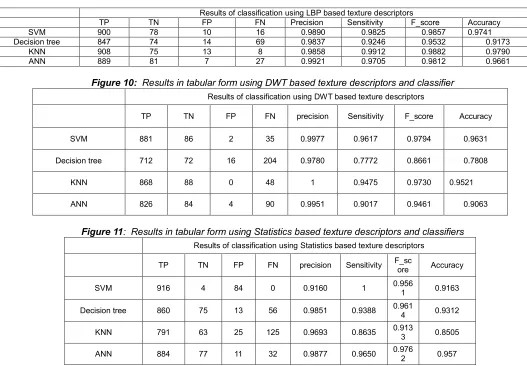
illumination problem, & the same image capture by camera is known as raw image. Eye patches have been extracted from whole dataset and feature extraction has been carried out using LBP and RLBP texture algorithms. After that classifiers has been used to classify the dataset into two categories i.e. drowsiness or not.The classification accuracy is the extent to which the classifier is able to correctly classify the exemplars and is summarized in the form of confusion matrix to the test data. This is defined as the ratio of the number of correctly classified patterns (TP and TN) to the total number of patterns (species) classified.
The formulas
Precision =
( ) (5.1)
Recall =
( ) (5.2)
F_Measurement =
( ) (5.3)
Accuracy =
(5.4)
Figure 9: Results in tabular form using LBP based texture descriptors and classifiers
Figure 10: Results in tabular form using DWT based texture descriptors and classifier
Results of classification using DWT based texture descriptors
TP TN FP FN precision Sensitivity F_score Accuracy
SVM 881 86 2 35 0.9977 0.9617 0.9794 0.9631
Decision tree 712 72 16 204 0.9780 0.7772 0.8661 0.7808
KNN 868 88 0 48 1 0.9475 0.9730 0.9521
ANN 826 84 4 90 0.9951 0.9017 0.9461 0.9063
Figure 11: Results in tabular form using Statistics based texture descriptors and classifiers
Results of classification using Statistics based texture descriptors
TP TN FP FN precision Sensitivity F_score Accuracy
SVM 916 4 84 0 0.9160 1 0.9561 0.9163
Decision tree 860 75 13 56 0.9851 0.9388 0.9614 0.9312
KNN 791 63 25 125 0.9693 0.8635 0.9133 0.8505
ANN 884 77 11 32 0.9877 0.9650 0.9762 0.957
Actual class
Predicated Class
YES NO
YES TP FN
NO FP TN
Results of classification using LBP based texture descriptors
TP TN FP FN Precision Sensitivity F_score Accuracy
SVM 900 78 10 16 0.9890 0.9825 0.9857 0.9741
Decision tree 847 74 14 69 0.9837 0.9246 0.9532 0.9173
KNN 908 75 13 8 0.9858 0.9912 0.9882 0.9790
Figure 12: Precision using different classifiers and feature extraction methods
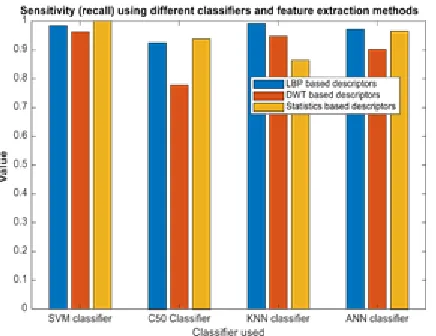
The above Figure shows the results of Precision obtained for all the classifiers based on LBP, DWT, and Statistics based descriptors. It can be seen that all the classifier obtained higher precision value for extracting the features of images. It can be observed that the LBP and DWT based descriptors shows the effective results in terms of Precision. Figure 13 shows the result of sensitivity for different classifier and methods of feature extraction. Here, the LBP based descriptor shows the highest sensitivity results as compared to the results of other descriptors which show that it is better than other descriptors because high values of sensitivity mean the correctness of the classifier’s output and correctness in predicting the results from image.
Figure 13: Sensitivity value using different classifiers and
feature extraction methods
Figure 14: F-score value using different classifiers and feature
extraction methods
Figure 14 shows the results of F-score measure based on feature extraction methods for all the classifiers. The value of F-score measure is assumed to be good if it is closer to 1 and it can be seen from the figure 5.8 that all the classifiers outperforms for the different descriptors. But the LBP based descriptor’s F-score is higher as compared to other two descriptors.
Figure 15: Accuracy value using different classifiers and
feature extraction methods
3838
6 CONCLUSION
The never-ending history of traffic accidents all over the world is due to deterioration of driver’s vigilance level. Drivers with lack of vigilance level suffers from a marked decline in their perception, recognition and vehicle controllable ability, therefore pose a serious danger to their own lives and lives of other people. For this reason, developing systems that monitors the driver’s level of drowsiness and alerting the driver of any insecure driving condition is essential. Vehicle accidents are more common if the driving is inadequate. This happens when the driver is drowsy or if he/she is alcoholic. This work proposed computer vision based smart drowsiness system in which properties of eye pixels from video frames tells the status of the eye of a driver. The camera can be placed in the intersection part of the front mirror on a side of the vehicle from which continuous video acquisition can be adopted to give real time value of the stage of drowsiness of a driver. The system used face and eye localization method which is carried out on a frame. Then eye patches are extracted from number of frames which resembled closed and open eyes. Then feature extraction is carried out in statistic features, discrete wavelet transform (DWT) and local binary pattern (LBP) features has been extracted which varies according to intensity of the pixels in the eye patches. Then machine learning is adopted to train number of classifiers based on closed and open eye patches. Finally testing is carried out which tells a particular frame eye localized patch, if it is in state of drowsy or not. Four different classifiers are used to evaluate the performance of the proposed real time drowsiness detection system named as SVM, k-nearest neighbor, decision tree and artificial neural networks which are tested on three different types of feature extraction methods. Out of all, LBP based feature extraction and SVM and kNN based classification gives approx. 97% accuracy in true classification of eye patches
REFERENCES
[1]. Arnin, J., Anopas, D., Horapong, M., Triponyuwasi,
P., Yamsa-ard, T., Iampetch, S., & Wongsawat, Y.
(2013). Wireless-based portable EEG-EOG
monitoring for real time drowsiness detection. In 2013 35th Annual International Conference of the IEEE Engineering in Medicine and Biology Society (EMBC) (pp. 4977-4980). IEEE
[2]. Bradski, G. (2000). The Open CV Library. Dr. Bobb's Journal of Software Tools.
[3]. Chieh, T. C., Mustafa, M. M., Hussain, A., Hendi, S.
F., & Majlis, B. Y. (2005, November). Development of vehicle driver drowsiness detection system using electrooculogram (EOG). In 2005 1st International Conference on Computers, Communications, & Signal Processing with Special Track on Biomedical Engineering (pp. 165-168). IEEE.
[4]. Çimen S. and Bolat B. (2016). Diagnosis of Parkinson's disease by using ANN. International Conference on Global Trends in Signal Processing, Information Computing and Communication (ICGTSPICC), Jalgaon, India, pp. 119-121.
[5]. Emam, A. (2015). Intelligent drowsy eye detection
using image mining. Information Systems
Frontiers, 17(4), 947-960.
[6]. Freund, Y., Schapire, R., & Abe, N. (1999). A short introduction to boosting. Journal-Japanese Society For Artificial Intelligence, 14(771-780), 1612.
[7]. García, F., de la Escalera, A., & Armingol, J. M. (2014). Driver monitoring based on low-cost 3-D
sensors. IEEE Transactions on Intelligent
Transportation Systems, 15(4), 1855-1860.
[8]. Hachisuka, S. (2013, July). Human and
vehicle-driver drowsiness detection by facial expression. In 2013 International Conference on Biometrics and Kansei Engineering (pp. 320-326). IEEE.
[9]. Hakimi, F., & Zanjan, I. M. H. (2015). Image-splicing forgery detection based on improved lbp and k-nearest neighbors algorithm. Electronics Information & Planning, 3(0304-9876), 7.
[10]. Kim, D., Han, H., Cho, S., & Chong, U. (2012). Detection of drowsiness with eyes open using EEG-based power spectrum analysis. In 2012 7th
International forum on strategic technology
(IFOST) (pp. 1-4). IEEE.
[11]. Mäenpää, T., & Pietikäinen, M. (2004). Classification
with color and texture: jointly or separately?. Pattern recognition, 37(8), 1629-1640.
[12]. Mbouna, R. O., Kong, S. G., & Chun, M. G. (2013).
Visual analysis of eye state and head pose for driver alertness monitoring. IEEE transactions on intelligent transportation systems, 14(3), 1462-1469.
[13]. Murata, K., Fujita, E., Kojima, S., Maeda, S., Ogura,
Y., Kamei, T., ... & Suzuki, N. (2010). Noninvasive biological sensor system for detection of drunk driving. IEEE transactions on information technology in biomedicine, 15(1), 19-25.
[14]. Pietikäinen, M., Hadid, A., Zhao, G., & Ahonen, T.
(2011). Computer vision using local binary
patterns (Vol. 40). Springer Science & Business Media.
[15]. Pritchett, S., Zilberg, E., Xu, Z. M., Karrar, M., Burton, D., & Lal, S. (2011, November). Comparing accuracy of two algorithms for detecting driver drowsiness—Single source (EEG) and hybrid (EEG
and body movement). In 7th International
Conference on Broadband Communications and Biomedical Applications (pp. 179-184). IEEE.
[16]. Sabet, M., Zoroofi, R. A., Sadeghniiat-Haghighi, K., &
Sabbaghian, M. (2012). A new system for driver drowsiness and distraction detection. In 20th Iranian
Conference on Electrical Engineering
(ICEE2012) (pp. 1247-1251). IEEE.
[17]. Sefia, A. M., & Selvi, J. A. G. (2016). Driver State Analysis And Drowsiness Detection Using Image Processing. Published in: International Journal of Scientific Engineering and Applied Science (IJSEAS)–Volume-2, Issue-6.
[18]. Shen, L., & Bai, L. (2004). AdaBoost Gabor feature
selection for classification. In Proc. of Image and Vision Computing NewZealand (pp. 77-83).
[19]. Shewale A.N., Chaudhari P. (2014). Real Time Driver Drowsiness Detection system. International Journal of Advanced Research in Electrical, Electronics and Instrumentation Engineering, 3(12).
Man, and Cybernetics-Part A: Systems and Humans, 38(5), 1085-1092.
[21]. Takahashi, I., Takaishi, T., & Yokoyama, K. (2013).
Overcoming drowsiness by inducing
cardiorespiratory phase synchronization. IEEE
Transactions on Intelligent Transportation
Systems, 15(3), 982-991.
[22]. Tasaki, M., Sakai, M., Watanabe, M., Wang, H., &
Wei, D. (2010, June). Evaluation of drowsiness during driving using electrocardiogram-a driving simulation study. In 2010 10th IEEE International
Conference on Computer and Information
Technology (pp. 1480-1485). IEEE.
[23]. Tsuchida, A., Bhuiyan, M. S., & Oguri, K. (2009). Estimation of drowsiness level based on eyelid closure and heart rate variability. In 2009 Annual International Conference of the IEEE Engineering in Medicine and Biology Society (pp. 2543-2546). IEEE.
[24]. Yang, D., & Xia, J. (2009). Face tracking based on camshift algorithm and motion prediction. In 2009 International Workshop on Intelligent Systems and Applications (pp. 1-4). IEEE.
[25]. Zhang, W., Cheng, B., & Lin, Y. (2012). Driver
drowsiness recognition based on computer vision
technology. Tsinghua Science and
Technology, 17(3), 354-362.
[26]. Zilberg, E., Xu, Z. M., Burton, D., Karrar, M., & Lal,
S. (2007). Methodology and initial analysis results for development of non-invasive and hybrid driver
drowsiness detection systems. In The 2nd