Research Article
Available online www.ijsrr.org
ISSN: 2279–0543
International Journal of Scientific Research and Reviews
Isolation of Lactic Acid Bacteria from Curd Sample and Screening for
Probiotic Properties
Lad Vrutika
*, Saha Shraddha, Vashi Sonal and Dumasiya Yashoda
C G Bhakta Institute of Biotechnology, Uka Tarsadia University, Maliba Campus, Bardoli Mahuva Road, Tarsadi, 394350, Dist Surat, (Gujarat) India.
Email:[email protected].(M)-91-7567432162
ABSTRACT
Probiotics consist of health promoting viable microorganisms, which helps by improving the
intestinal microbial balance. The aim of the present study was to isolate and characterize different
lactic acid bacteria with probiotic properties from the curd sample. Total twelve different lactic acid
bacteria were isolated. Best probiotic Lactobacilli strain was selected by bile tolerance test, acid
tolerant test, NaCl tolerance test, catalase activity and antibiotic resistance assay. All strains gave
negative results for catalase test. Among all strains, only one strain LAB6 was able to survive up to
4% bile salt, pH value 2 and 3, salt tolerance up to 5% and also resistant to selected antibiotics. In
conclusion, the present study showed that isolated organism LAB6 can be used as potential probiotic
lactic acid bacteria.
KEYWORDS:
Acid tolerance, Antibiotic resistance, Bile salt tolerance, Lactic acid bacteria,Probiotics.
*Corresponding author
Vrutika Lad
C G Bhakta Institute of Biotechnology,
Uka Tarsadia University, Maliba Campus,
Bardoli Mahuva Road, Tarsadi, 394350,
INTRODUCTION:
Probiotic term was derived from Greek words Pro (favour) and bios (life). Probiotics are
defined as live microbial feed supplements that improve the health of human beings by its valuable
secondary products1. LAB have been receiving considerable attention as “probiotics” because of
their innate ability to exert antagonistic activity against, non-pathogenic and spoilage organisms2. By
acknowledging curd’s suitability as dietary agent of providing probiotics to intestine, the current
study was designed to analyze some local curd variety for isolation of LAB equipped with probiotic
action3.
Probiotics have been administered to animals in order to prevent infectious illness,
reinforcing the barrier function of the intestinal flora or increasing the immune system4. The stability
of the GIT microflora effectively limits the capacity of invading microorganisms, including
pathogens, to colonise the gut, giving rise to what has been termed ‘colonisation resistance’5. The
organisms must be able to survive the unfavorable environment of GIT, which benefits resistance to
acid and bile6.Probiotics should be resistant to specific conditions of GIT, like it should be resistant
for more than 4 hours to proteolytic enzymes, low pH values (1.8-3.2) prevailing in the stomach and
to bile concentration, pancreatic juices and mucus which are the part of small intestine. Lactobacilli
are catalase negative organism. Furthermore, bacterial strains to be used in probiotics are supposed to
be resistant to antibiotics, lactic acid, hydrogen peroxide, bacteriocins, etc.7, 8. Probiotics are
competing for adhesion to the intestinal brush border epithelium surface. Adherent non-pathogenic
bacteria (probiotics) can prevent attachment and subsequent entry of pathogenic enteroinvasive
bacteria into the epithelial cells5. Lactobacilli seem to adhere to gut wall with extracellular substance
containing polysaccharides, protein, lipid lipotechoic acids. The objective of this study was to isolate
lactic acid bacteria from native curd samples and representative isolates investigated for probiotic
properties.
MATERIALS AND METHODS:
Isolation of Lactic acid bacteria from curd sample
Lactic acid bacteria were isolated from curd sample. The curd samples were suspended
appropriately and diluted in sterile saline and spread plated into selective medium: De Mann, Rogosa
Bile salt tolerance
Fresh culture of microorganisms was inoculated in MRS broth supplemented with 1.5% and
2.0% (w/v) bile salts (Oxgall, HiMedia, India) followed by incubation at 37°C. Aliquots were plated
on MRS agar at 37°C for 24 hours. Bile tolerance was assessed in terms of viable colony counts after
the aforesaid incubation at 37°C10.
Acid tolerance (pH)
Acid tolerance was determined using method described by11. The overnight grown culture
was used to inoculate MRS broth (v/v). 0.1ml culture was inoculated into 9.9 ml of sterile broth of
pH such as 2 and 3. The pH of broth was adjusted with 1N HCl. Inoculated broths were incubated at
37°C for 24 hr. The results were recorded and tabulated in terms of presence and absence of growth.
NaCl tolerance
For the determination of NaCl tolerance of isolated Lactobacillus, 6 test tubes containing
MRS broth were adjusted with different concentrations (0.5, 1, 2, 3, 4 and 5%) of NaCl. After
sterilization, each test tube was inoculated with 1% (v/v) fresh overnight culture of Lactobacillus and
incubated at 37°C for 24 hrs. After 24hrs of incubation, their growth was determined12.
Catalase test
The catalase activity of these isolates was detected by resuspending the culture in a 3%
solution of hydrogen peroxide. Catalase is an enzyme that converts hydrogen peroxide into water and
oxygen. If the bubbles appear it means that this test gives positive result13.
Antibiotics resistance
Lactic acid bacteria strains were assessed their antibiotic resistance by disc diffusion method
using antibiotics discs. 1 ml of actively growing cultures was mixed with 10 ml of soft nutrient agar
and poured into the base agar plate. After solidification, the antibiotic discs were placed on the
solidified agar surface, and the plates were left over for 30 minutes at 4°C for diffusion of antibiotics
and then anaerobically incubated at 37°C for 48 hrs14. Resistance was defined according to the disc
diffusion method by using antibiotic discs of Chloramphenicol, Penicillin, Ampicillin, Amoxyclav,
Cefotaxime, Co-Trimoxazole, Gentamycin, Tobramycin, Ceftriaxone, Ciprofloxacin, Tetracycline,
Gentamycin, Linezolid, Streptomycin, Vancomycin, Clindamycin, Erythromycin, Aztreonam,
inhibition was measured in millimeters and evaluated for resistance or susceptibility using the
comparative standard method.
RESULT AND DISCUSSION:
Isolation of Lactic acid bacteria from curd sample
All samples harboured large number of bacteria as milk is an excellent media for growth and
proliferation of bacteria. In present work, by direct method of isolation, twelve presumptive LABs
were isolated on MRS media from curd sample. All isolated lactic acid bacteria named as LAB1,
LAB2, LAB3, LAB4, LAB5, LAB6, LAB7, LAB8, LAB9, LAB10, LAB11 and LAB12. The
morphological characteristics were also investigated and showed that most of the isolates were Gram
positive rod. All isolates were catalase negative. Lactic acid bacteria (LAB) are a group of
Gram-positive, non-spore forming, cocci or rod shaped, catalase-negative and fastidious organisms
frequently isolated from milk and dairy products15.
Acid tolerance
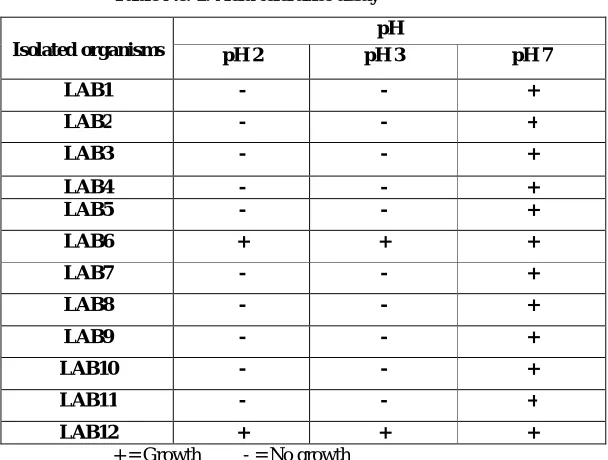
Table No. 1: Acid tolerance assay
Isolated organisms
pH
pH 2 pH 3 pH 7
LAB1 - - +
LAB2 - - +
LAB3 - - +
LAB4 - - +
LAB5 - - +
LAB6 + + +
LAB7 - - +
LAB8 - - +
LAB9 - - +
LAB10 - - +
LAB11 - - +
LAB12 + + +
+ = Growth - = No growth
The tolerance to acidity seems to be an important trait of probiotic strains. Generally, growth
and fermentation of lactobacilli create an acidic condition and they are resistant to acidic
conditions16, 17. The survival at low pH is important if intended to use in gastrointestinal tract for
health improvement. The results of acid tolerance are shown in table no 1. Determination of acid
pH 2 but their growth was lower as compare to growth at pH 7. It indicates that these isolates are
resistance to broad pH range and able to survive at low pH and can be used in probiotic applications.
Bile salt tolerance
The probiotic microorganisms proved to exhibit an excellent quality of bile tolerance. Bile
acids are amphipathic molecules with antimicrobial potential that act as a detergent and interfere
with biological membranes18. Among five isolates, only LAB 6 isolate could grow in the range of
0.5% to 4% concentration of bile salt. Another isolates LAB7, LAB 10 and LAB 11 could able to
grow up to 3% bile salt. While LAB12 isolate could able to grow up to 2%. Acidity, presence of bile
salts, and pancreatic enzymes in the gastrointestinal tract (GIT) are some of the major stresses that an
orally taken probiotic encountered in the GIT. It is essential that a potential probiotic strain is able to
tolerate these stress conditions in order to survive in the GIT19.
Table No. 2: Bile salt tolerance assay.
Isolated Org. Time Hrs. 0.5% 1% 2% 3% 4%
LAB6 24hr + + + + +
LAB7 24hr + + + + -
LAB10 24hr + + + + -
LAB11 24hr + + + + -
LAB12 24hr + + + - -
- = No growth occur, + = Growth occur.
NaCl Tolerance
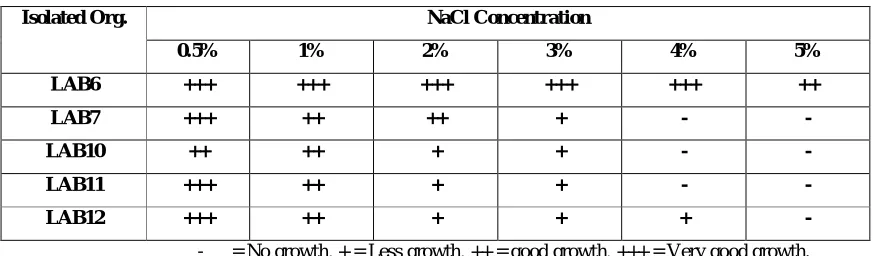
Table No. 3: NaCl tolerance assay
Isolated Org. NaCl Concentration
0.5% 1% 2% 3% 4% 5%
LAB6 +++ +++ +++ +++ +++ ++
LAB7 +++ ++ ++ + - -
LAB10 ++ ++ + + - -
LAB11 +++ ++ + + - -
LAB12 +++ ++ + + + -
- = No growth, + = Less growth, ++ = good growth, +++ = Very good growth.
The result of NaCl tolerance presented in Table no.3. Determination of NaCl tolerance of
Lactic Acid Bacteria was investigated for NaCl tolerance upto 0.5% -5% in MRS broth. After 24 hrs,
isolates, Only LAB6 isolate could grow up to high salt concentration of 5%. Although the growth of
LAB12 was recorded less but this isolate could grow up to 4% NaCl. Isolates LAB7, LAB10 and
LAB11 could grow up to 3% NaCl.
Antibiotic resistance
Resistance was defined according to the standard Kirby-Bauer disc diffusion method by using
antibiotic discs of Chloramphenicol, Penicillin, Ampicillin, Amoxyclav, Cefotaxime,
Co-Trimoxazole, Gentamycin, Tobramycin, Ceftriaxone, Ciprofloxacin, Tetracycline, Gentamycin,
Linezolid, Streptomycin, Vancomycin, Clindamycin, Erythromycin, Aztreonam, Cefpodoxime,
Cefpodoxime/Clavulanic acid, Ceftazidime, Cefotaxime. The diameter of zone of inhibition was
measured in millimetres. Among two isolates, results showed that isolate LAB6 was resistant to
above mentioned antibiotics. Isolated organism LAB12 was resistant to above mentioned antibiotics
except CPD-Cefpodoxime and CCL- Cefpodoxime/Clavulanic acid. It indicates that isolate LAB6
was able to applicable as probiotics.
CONCLUSION:
Among 12 isolates, isolate LAB6 from curd sample gave catalase test negative, grown at pH
2 and 3, able to tolerate bile salt concentration up to 4% and NaCl concentration up to 5%. LAB6
isolate was also resistant to all antibiotics tested above. So, LAB6 isolate was considered to be
suitable for probiotic applications.
REFERENCES:
1. Chang YH, Kim JK, Kim HJ, Kim WY, Kim YB and Park YH. Selection of a potential
probiotic Lactobacillus strain and subsequent in vivo studies, Antonie Van Leeuwenhoek,
2001; 80: 93-199.
2. Gilliland SE and Speck ML. Inhibition of psychotropic bacteria by Lactobacilli and
Pediococci in non-fermented refrigerated foods. J of Food Science. 1975; 40: 903-905.
3. Chowdhury T and Islam S. Isolation, Identification and Determination of Probiotic potential
of Lactic Acid Bacteria from Local Curd. International Journal of Scientific and Engineering
Research. 2016; 7(4): 263-267.
4. Pascual M, Garriga M, Morfort J. Los probióticos en la alimentación animal, Eurocarne.
1994; 46-53.
5. Guarner F and Malagelada JR. Gut flora in health and disease, Lancet. 2003; 512-519.
7. Gorbach SL and Goldin BR. Lactobacillus acidophilus United States Patent. 1991; 1(5): 32,
399.
8. Hoyos G. Aplicación de la biotecnología en la producción animal: La experiencia mexicana
de una década. Memorias del 1er Simposio Mexicano sobre Probióticos. Junio 18-20. Ciudad
Universitaria México, D.F.1997; 131-148
9. Dave RI and Shah NP. Evaluation of media for selective enumeration of Steptococcus
thermophilus, Lactobacillus delbrueckii spp. Bulgaricus, Lactibacillus acidophilus and
Bifidobacterium spp. J. Dairy Sci. 1996; 79: 1529-1536.
10. Kaushik JK, Kumar A, Duary RK,MohantyAK,Grover S, et al. Functional and Probiotic
Attributes of an Indigenous Isolate of Lactobacillus plantarm. PLoS ONE. 2009; 4(12):
80-99.
11. Yeong-Soo P, Ji-Young Lee, Yong-Suk K and Dong-Hwa S. Isolation and Characterization
of Lactic Acid Bacteria from Feces of Newborn Baby and from Dongchimi. Journal of
Agricultural and Food Chemistry. 2002; 50(9): 2531-2536.
12. Neysens P, Messens W and Vuyst LD. Effect of sodium chloride on growth and bacteriocin
production by Lactobacillus amylovorus DCE 471. Int. J. Food Microbiol. 2003; 88: 29-39.
13. Patel AK, Ahire JJ, Pawar SP, Chaudhari BL and Chincholkar SB. Comparative accounts of
probiotic characteristics of Bacillus spp. isolated from food wastes. Food Research
International. 2009; 42: 505–510.
14. Felten A, Barreau C, Bizet C, Lagrange PH and Philippon A. Lactobacillus species
identification, H2O2 production and antibiotic resistance and correlation with human clinical
status. J. Clin. Microbial. 1999; 37(3): 729-733.
15. Patil MM, Pal A, Anand T and Ramana KV. Isolation and Characterization of Lactic acid
bacteria from curd and cucumber. Indian J Biotechnol. 2010; 9: 166-172.
16. Sheehan VM, Sleator RD, Hill C and Fitzgerald GF. Improving gastric transit,
gastrointestinal persistence and therapeutic efficacy of the probiotic strain Bifidobacterium
breve UCC2003. Microbiology. 2007; 153: 3563-3571.
17. Belkacem B, Meriem M and Mebrouk K. Probiotic Potential of Thermotolerants Lactobacilli
Isolated from Chicken Gastrointestinal Digestive and Their Use as Poultry Feed. World Appl.
Sci. 2009; 7: 951-957.
18. Majidzadeh HR, Kermanshahi H, Sankian M, Nassiri MR, Heravi A, Moussavi L, Roozbeh
N and Varasteh AR. Screening of lactobacilli bacteria isolated from gastrointestinal tract of
broiler chickens for their use as probiotic. AFR J MICROBIAL RES. 2011; 5(14):
19. Dong ZJ, Zhang B, Lee H, Li GD and Chen J. “A Bile Salt Hydrolase Gene of Lactobacillus
Plantarum BBE with High Cholesterol-Removing Activity”. European Food Research and