Review article
Available online www.ijsrr.org
ISSN: 2279–0543
International Journal of Scientific Research and Reviews
Voting Based Reliable Route Selection Protocol in MANET
Patil Pragnya Ashok
*and Manjunath
Harish
CMR University Bangalore, India Email;[email protected]
ABSTRACT
Cognitive radio is important property of intelligent radio which helps in changing its transmission parameters based on the environment in which they are present. It was introduced long back but the development in this field is still going on. Routing in this field started recently. Its two main properties are considered in our paper: sensing and sharing. This property will allow to use the vacant portion and dynamically programmed. Based on this knowledge new routing protocol is introduced Voting Based Reliable Route Selection Protocol (VBRRS). It selects the reliable path during transmission of packet. Efficient packet delivery ratio and maximum throughput was seen in NS2 simulator.
KEYWORDS:
Cognitive radio, spectrum sharing, spectrum sensing, Reliable route.*Corresponding author
Pragnya Ashok Patil
INTRODUCTION
Ad-hoc network is a wireless interface formed by mobile nodes without any central
administration to send packet data. Nodes act as source, destination and routes in the network. The
nodes of ad hoc network are considered to mobile where they can move freely. The nodes in the ad
hoc network can suddenly disappear from one place, or come up in another so they are considered as
dynamic environment. And Routing in such dynamic network is a most challenging task because of
the mobility of nodes. As the nodes move randomly in the network it was a biggest issue for
designing routing protocol. If a path was considered at some time will not be same after some period
of time.
The applications of Ad hoc networks are, meetings or conventions in which persons wish to
quickly share information, search-and-rescue operations in emergency, and rugged surface of data
acquisition operation. Table-driven routing protocol sand On-Demand routing protocols are two
categories of ad-hoc routing protocols. Table driven routing protocols, contains the routing
information of all nodes up-to-date. Destination-Sequenced Distance-Vector (DSDV) and
Temporally Ordered Routing Algorithm (TORA) are table driven routing protocols. In On-Demand
routing protocols, whenever a source has the data and if it is ready to send that then only paths are
established on Demand of source. Examples of On-Demand routing protocol are Dynamic Source
Routing (DSR) and Ad-Hoc On-Demand Distance Vector Routing (AODV). In our paper we are
studying AODV protocol and comparing AODV protocol with our Voting-Based Reliable route
selection protocol with respect to packet delivery ratio and end to end delay.
Cognitive radio that can be modified and designed progressively which can change its
transmission parameters based on the interaction in which it participates described by (Rayan
Abdelazeem Habboub Suliman1 et al., 2018)1. Its transceiver, which is designed to get the best use
for wireless channels in its vicinity. The cognitive radio automatically detects channels, which are
available in wireless spectrum, then according to that environment change its transmission range.
Figure 1 shows the spectrum hole representation where empty spaces are called spectrum holes or
white spaces and already occupied spaces are called spectrum in use. From the definition we observe
of the cognitive radio have two main characteristics which are as defined as follows: Cognitive
capability: Cognitive capability refers to the ability of the radio technology to capture or sense the
information from its radio environment. Re-configurability: The cognitive capability gives
information on spectrum whereas by dynamically programming we canre-configure the radio
Hence a routing protocol that selects a reliable route or path during the transmission of packet is
needed. Therefore we propose a protocol that performs this main function in the transmission of
packet through the network. We study and analyze the ad-hoc on demand vector routing protocol
(AODV) and compare with our proposed protocol voting based reliable route selection protocol
(VBRRS).
RELATED WORK
The concept of cognitive radio as a solution to the problem of spectrum resource utilization.
Radio etiquette consists of a set of RF bands, protocols, air interfaces also spatial and temporal
patterns which helps to moderate the use of the radio spectrum proposed by (J.I.Mitola and G.Q.
Maguire et al., 1999)2.Cognitive radio is extension of software radio with radio-domain model-based
reasoning about such etiquettes. Concluding cognitive radio improves the performance of personal
services via a radio knowledge familiar language.
Figure1.Spectrum hole representation
The author described that for wireless network the simple and best routing protocol is
Epidemic routing (Flooding) by (Pendharkar Nivedita Arvind kumar et al., 2014)3.In Epidemic
routing protocol the nodes transmit whatever data or information they have to all the neighbors who
does not have that information. Thus it was a big disadvantage as it exerts stress on the data
transmission and also on storage capacity of node devices present in the network.
In further survey, the author describes the exact definition of cognitive radio network and
also its advantages, characteristic highlights and the limiting elements of the current CR MAC
routing protocols by (Le The Dung, Beongku et al., 2014)4. They said that CR take care of the issue
of spectrum short age by making proficient and opportunistic use of band frequencies which is
allocated for only reserved/licensed users of the network.
done by (A.S. Caciapuoti, M.et al., 2012)5. He proposed the challenges of finding the shortest path in
cognitive radio networks and suggested solutions. Cognitive ad-hoc networks are can be
characterized into two primary classes: and local/neighborhood spectrum knowledge and full
spectrum/range knowledge.
As CR perform over a single range channel in its network, therefore the addressing of
spectrum allocation is not done in previous paper. SEARCH routing protocol sends RREQ packets
which is same to GPSR proposed by (Nitin Manjhi et al., 2012)6. The sink makes the combination of
routes and then to each link a channel is assigned so that delay between them is minimized.
In GPSR GPS device are used for location by (B.Karp, H.T. Kung, et al., 2000)7, In GPSR, a
forwarders ends a notification to the node in neighbor who is close to the sink and which is in the
area of its forwarding. GPSR can prompt a dead end/lock, where no hopeful can be found in the
sending the message. When such a case occurs, the message is bypassed around the deadlock until
achieving a hub that has at least one applicants
In many papers on the Cognitive Radio where introduced, but all the papers mainly spoke on
issues of physical and medium access, and also said about problem in finding the route cognitive
networks. So this paper addressed one of theissue by assessing the feasibility of reactive routing for
such networks.
The ad-hoc network is gathering the bundle of mobile nodes with cooperation of nodes and
without any central management system or existing infrastructure introduced by (C.E.Perkins, et al.,
1999)8. AODV is a novel algorithm for the operation of such ad-hoc networks. In this technique
nodes store only the routes which are needed, they reduce memory, quick response to breakage is
done.
The author said that the topology of a cognitive radio network depends on the behavior of
both licensed (primary) and unlicensed (secondary) users. But by the activity of licensed users the
network connectivity between the nodes could be impaired. This it affected the design of routing
protocols in cognitive network. For this issue author designed a different routing protocol named
Gymkhana, which has the information of the degree of connectivity for possible paths which leads
tosink. The convention courses the information through the ways that stay away from arrange zones
that don't ensure steady and high availability.
When observed at the node level the performance of mobile ad-hoc wireless networks is more
sensitive as there is a connection caused by node movement was described by (L.T. Dung, et al.,
1999)9. Thus, to make powerful versatile mobile ad-hoc networks against mobility of node, path
established should be stable and route should be selected adaptively based on instantaneous network
in portable specially appointed systems by adaptively choosing most stable steering ways and ideal
directing.
Introduction that without any existing network infrastructure the protocol can self-organizing
and self-configuring is by (D.Johnson,D.Maltz et al., 2001)10. The DSR protocol has two main
mechanisms finding the route/route discovery and maintaining the route, which work together to
allow nodes to discover and maintain Source routes to arbitrary destinations in the ad hoc network.
Multi-hop wireless ad hoc networks.
DESIGN OF VBRRS
The algorithm used in the present paper is Euclidean distance algorithm. One of the major
problem is how to minimize the link failure due to the random fluctuation of nodes in MANET, for
this reliable path which is stable. The path which is built up for a satisfactory period for transmission
is called stable route/path. Keeping this in mind the new method was introduced for routing in
MANET for stability. While designing our protocol we did two sections. In first section route to
destination is calculated by using use signal strength metric, if we are unable to find the route from
signal strength metric then the second section is considered where it works on minimum hop count
method as AODV and find the path which has signal strength of RREQ packet is predefined
threshold value from this we can increase the network lifetime as well as performance of complete
network.
Calculation of RSSI
(d) =
Where,
Power received at a distance d,
Transmission signal power
Transmitted gain
Receiver gain
Transmitted antenna gain
Receiver antenna gain
d Distance from the transmitter
L Path loss
The principle-preferred standpoint of this procedure or method is by selecting the efficient path to
the sink node we can increase the lifetime of the system.
SEQUENCE DIAGRAM
Figure 2. Block diagram of VBRRS
Our VBRRS routing protocol sequence diagram is shown in figure 2 at the first it start with the
network initialization after network is setup the source and the destination node to be set. Where
source is the node, which send data in the network. Destination is the node which receives the data
from the source node. The step after this is calculating distance from source node to destination node
through all the nodes and selecting the shortest distance. The next step a condition where source
node will send a route request to its intermediate nodes if it is less then retry threshold the route
selection is done based on RSSI method or else route selection is doneby min hop count. When the
path to the destination is setup packet forwarding takes place.
RESULT AND DISCUSSION
We simulate VBRRS using NS2.34. Under Linux Ubuntu platform, In this section, we
present the simulation results and show the improved performance in delay, throughput and PDR
parameters, and also VBRRS requires less rerouting and leads to less control over head as it avoid
unreliable mobile nodes from the route. So in large network VBRRS performance is better than
AODV.
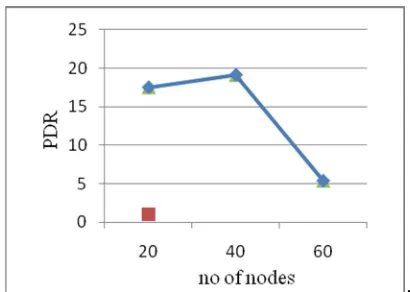
We have studied and analyzed AODV protocol. Experiments where conducted to compare
packet delivery ratio (PDR), Delay and Throughput for different values of number of nodes. Figure 3
shows PDR decreases as the number of nodes in the network increases. When number of nodes
increases the total number of packets sent is greater than the number of packets received therefore
.
Figure 3. Packet Delivery Ratio Vs. no of nodes
Figure 4. Delay vs. no of nodes
Figure 4 shows Delay Vs. number of nodes. When number of nodes are more the delay
between them also increases. Figure 5 shows Throughput Vs. number of nodes.
CONCLUSION
In this paper we have introduced a Voting Based Reliable Route Selection Protocol for
MANET. We efficiently conclude that our routing protocol is better AODV in providing efficient
PDR, throughput and delay. Specifically, VBRRS selects the reliable route while data packet
transmission.VBRRS requires less rerouting and leads to less control overhead as it avoid unreliable
mobile nodes from the route. So in huge network VBRRS performance is better than AODV. By the
simulation results we conclude PDR decreases as number of nodes increases.
REFERENCES
1. Review Paper on Cognitive Radio Networks byRayan AbdelazeemHabboub Suliman1,
Khalid Hamid Bilal2 and Ibrahim Elemam, 1000252 Journal of Electrical &Electronic
Systems J Electra Electron Syst 7: 252. doi: 10.4172/2332-0796.1000252Copyright:©
2018; 7(1).
2. J.I.Mitola and G.Q. Maguire, “Cognitive radio: making software radiomore personal,”
IEEE Personal Communication, 1999; 6(4): 13-19.
3. Pendharkar Nivedita Arvind kumar and Anurag Paliwal, “SINR and RSSI Based
Optimized AODV Routing Protocol for MANET using Cross Layer Interaction”, June
2014; 3(6).
4. Le The Dung, Beongku An “A Stability-based Spectrum-aware Routing Protocol in
Mobile Cognitive Radio Ad-hoc Networks,” International Symposium on Computer,
Consumer and Control, 2014.
5. A.S. Caciapuoti, M. Caleffi, and L. Paura, “Reactive routing formobile cognitive radio ad
hoc networks,” Ad Hoc Networks, Jul. 2012;10(5):803-815.
6. Nitin Manjhi and Nilesh Patel, “Signal Strength Based Route Selection in MANETs”,
IEEE, July 2012;3(7).
7. B.Karp, H.T. Kung, “GPSR: greedy perimeter stateless routing forwireless networks,”
Proc. of ACM MobiCom, Aug. 2000; 243-254.
8. C.E.Perkins and E. M. Royer, “Ad-hoc on-demand distance vectorrouting,” Proc. of 2nd
IEEE Workshop on Mobile Computing Systemand Application (WMCSA’99), Feb.
1999;90-100.
9. L.T. Dung, S. H. Ha, and B. An, “A Practical Adaptive Scheme for Enhancing Network
Stability in Mobile Ad-Hoc Wireless Networks,”Lecture Notes in Computer Science
10.D. Johnson, D. Maltz, and J. Broch “DSR: The Dynamic Source Routing Protocol for
Multi-Hop Wireless Ad Hoc Networks,” ch Addison-Wesley, 2001;5:139-172
11.M.Casena, F. Cuimo, and E. Ekici, “Routing in cognitive radio networks: Challenges and
solutions,” Ad Hoc Networks, May 2011;9(3):228-248.
12.A. Abbagnale and F. Cuomo, “Gymkhana: a Connectivity-Based Routing Scheme for
Cognitive Radio Ad Hoc Networks,” Proc. Of IEEE INFOCOM ’ Mar. 2010;10:1-5,
International Journal of wireless & Mobile Network (IJWMN) November 2010.
13.S. Haykin, J.H. Reed, G.Y. Li, and M. Shafi, “Scanning the issue,” Proceedings of the
IEEE, 2009;77(5):784-786.
14.C.Cormio and K.R. Chowdhury, “A survey on MAC protocols forcognitive radio
networks,” Ad Hoc Networks, Sep. 2009;7(7):1315-1329.
15.R.Chowdhury and M.D. Felice, “Search: A routing protocol formobile cognitive radio
ad-hoc networks,” Computer Communications, Dec. 2009;32(18):1983-1997
16.JiwonPark; Moh, S.; Ilyong Chung; , "A multipath AODV routing protocol in mobile ad
hoc networks with SINR-based route selection," Wireless Communication Systems. 2008.
ISWCS '08. IEEE International Symposium, vol., no., pp.682-686, 21-24 Oct.
2008doi:10.1109/ISWCS.2008.4726143.
17.San-Yuan Wang; Jia-Yu Liu; Chun-Chien Huang; Mao-Yuan Kao; Yi-Ho Li; , "Signal
strength-based routing protocol for mobile ad hoc networks," Advanced Information
Networking and Applications, 2005. AINA 2005. 19th International Conference on, 2,