Licensed under Creative Common Page 416
http://ijecm.co.uk/
ISSN 2348 0386
THE EFFECT OF THE PARTICIPATORY BUDGETS
ON THE MANAGERIAL PERFORMANCE
Nuri Annisa Fitri
Faculty of Economics, Sriwijaya University, Palembang, Indonesia
Azwardi
Faculty of Economics, Sriwijaya University, Palembang, Indonesia
Tertiarto Wahyudi
Faculty of Economics, Sriwijaya University, Palembang, Indonesia
Abstract
The aims of this study is to obtain empirical evidence about the effect of the Participatory
Budgets on Managerial Performance through Organizational Commitment as an Intervening
Variable and Job Relevant Information as a Moderation Variable. This research was conducted
on 67 respondents who had accountability burdened with budget targets at banking companies
in Palembang city. The method of data analysis used is simple regression analysis, the path
analysis method and the moderated regression analysis. The result of the study reveals that
participatory budget has a positive and significant effect on the managerial performance. The
result of path analysis also shows that participatory budget has a positive and significant effect
on the organizational commitment. The result of Sobel Test shows that the organizational
commitment variable is able to mediate the effect of the participatory budget on the managerial
performance. The result of the Moderated Regression Analysis test shows that job relevant
information variable is able to moderate the effect of the participatory budget on the managerial
performance. This study supports the theory of goal setting theory in which goal setting can
improve individual performance.
Keywords: Participatory Budget, Organizational Commitment, Job Relevant Information,
Licensed under Creative Common Page 417
INTRODUCTION
The success of a company also shows the performance of the company’s management.
Managerial performance is the work quality and quantity achieved by an employee in carrying
out their duties in accordance with the responsibilities given to him (Apriansyah dkk, 2014).
Muljono (2009) stated that this budget activity could be a tool for measuring managerial
performance. When a company's budget target has been set, success or failure of the
achievement of the budget target becomes a measuring tool for assessing one's performance.
Banking is one of the service companies whose activities can not be separated from the budget
target, the budget is contained in the Budget Work Plan.
If someone wants to achieve budget targets to produce high managerial performance,
then the person must have an organizational commitment attitude. Puspitasari et al., (2017)
stated that when a goal is designed, then someone involved in setting goals will live up to the
goals set, so that they have a sense of responsibility to achieve them. If the Budget Work Plan
is a planned goal, then the Budget Work Plan can influence the managerial performance
demanded to realize the Budget Work Plan. The reality in the field, viewed from the working
results of the managers which regard unrealized budget targets shows that the commitment has
not been embedded in each manager.
A manager in achieving the company's budget targets is expected to have a number of
job relevant information. Job Relevant Information useful for decision considerations that
ultimately impact on decision-making. The availability of JRI (job relevant information) will help
managers to make and choose the right decisions in order to expedite their business to achieve
budget targets. So that later it will have an impact on managerial performance (Apriansyah et
al., 2014).However, what occurs in the field, based on the preliminary studies conducted by the
author, and also according to the information obtained from several sources such as an article
published by Tribunsumsel newspaper written by (Rohekan, 2017) and an article on web page
written by (Wahyudi, 2017) which state that there is banking company in Palembang which
closed one of its offices because the bank was not able to achieve the company's budget target
which indicates that the bank is not able to compete with other banking companies.
The closure of one of company branch can result in a smaller opportunity for the
company to grow. If the company is still unable to maintain its office, the company will disappear
over time because it is unable to compete with the other companies. This is very important for
the superior to know this condition in which they are required to be able to read and analyze the
condition and carefully determine the target of the Budget Work Plan. Harefa (2008) says that if
the budget target is too high, it will result in mental pressure for all those responsible in
Licensed under Creative Common Page 418 challenge and it will be difficult for the company to develop because the target is very easy to
achieve. The process of determining the budget can affect managerial performance, because it
is needed to achieve these goals, this is in accordance with the goal setting theory.
This study is conducted in banking companies for a reason that, the banking industry is
a dynamic business activity viewed from the process of bank business activities. The main
target of banking companies, of course, to determine how "big fund" is needed. Because almost
banking activities can not ignore the source of funds that can be obtained (Muljono, 2009) and
the managers of financial services sector are regularly involved in financial and accounting
issues. Their better understanding of accounting can result in greater acceptance of accounting
control compared to that of the manager of non-financial sector. As a result, their reaction to the
participatory budget is better than non-financial sector managers (Lau & Tan, 1998).
LITERATURE REVIEW
Goal Setting Theory
The goal setting theory was originally proposed by Edwin Locke in the late 1960s. Goal setting
has three mechanisms in motivating individuals to improve performance. Firstly, individuals
have sufficient knowledge and ability to reach (or approach) goals. Secondly, the individual
accepts and remains committed to the goal. Thirdly, individuals have feedback that shows
progress in relation to goals (Locke et al., 1981).
Participatory budget in this study can increase acceptance of goals and make
employees have a commitment to goals. The employees will be committed if they feel
themselves as part of the creation of the goals. Job relevant information arises from the
participatory budgeting, as it is then that important information input is revealed and can be the
basis for making important decisions that will impact on the outcome of one's performance.
Previous Studies
Participatory budgets is a joint decision-making process by two or more parties in which the
decision will have a future impact on those who make it (Dharmanegara, 2010).Participatory
budgets provides an opportunity for subordinates to interact and communicate with their
superiors. It can even influence the target budget they want to achieve. Successful budgets
reflect individual success. The higher the participation in the budgeting process, the higher the
managerial performance can be achieved (Lina, 2015).The results of the study by Halim &
Devie (2013), Tapatfeto (2013), Lina (2015), Wijaya & Lucyanda (2010) and Sulastiningsih &
Licensed under Creative Common Page 419 The managers who participate in budgeting will have the feeling that they have a stake in the
company so they can develop a good budget in accordance with the needs of the organization
in the future and override personal interests (Setyarini & Susty, 2014). This is based on the idea
that when a participatory purpose or standard is approved, the employees will internalize the
goals or standards set, and employees also have a sense of personal responsibility to achieve
them because they are involved in the preparation.
The studies by Othman & Haryanti (2012), Setyarini & Susty (2014) state that
Participatory Budget influences Organizational Commitment.
Participatory budgets allows to increase one's organizational commitment. If a person's
commitment so stronger to his organization, they will strive harder to achieve organizational
goals as planned, this can certainly improve managerial performance (Putri & Putra, 2015).The
studies by Dianawati (2009), Setyarini & Susty (2014) and Putri & Putra (2015) show that
budgetary participation has an effect on managerial performance through organizational
commitment as intervening variable.
Job Relevant Information is information that can assist the managers in choosing the
best course of actions through better efforts (Apriansyah et al., 2014). When subordinates or
budget implementers participate in budget formation, it will result in the disclosure of private
information they have (Merchant, 1981), (Chow et al., 1988) as well as (Nouri & Parker, 1998).
In addition, budget participation allows the managers to interact with their superiors to clarify the
company's strategic goals, the conditions of the work environment they often face, and other
issues that to success impact on their work. In addition, the high use of job relevant information
can lead to increased performance and low use of job relevant information can lead to a
decrease in performance (Halim & Devie, 2013).The studies by Himawan & Ika (2010),
Rahmawaty & Mutia (2011) shows that job relevant information can moderate the effect of
budget participation on managerial performance.
Hypothesis Development
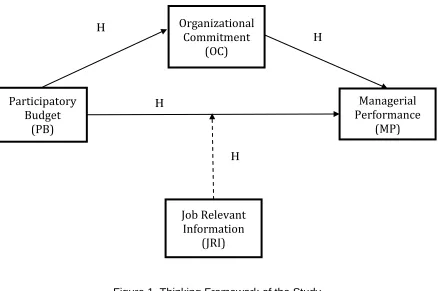
H1: Participatory budget has positive effect on managerial performance
H2: Participatory budgets has positive effect on organizational commitment
H3: Participatory budget has positive effect managerial performance through organizational
commitment as an intervening variable
H4: Participatory budget has positive effect on managerial performance moderated by Job
Licensed under Creative Common Page 420 Figure 1. Thinking Framework of the Study
Notes:
: The effect of PB and MP. Mediating effect of PB, OC and MP : Moderating effect of PB, JRI and MP
METHODOLOGY
Indicator of Research Variables
Participatory budgets measured using instruments Milani and developed by (Sulastiningsih &
Ambarwati, 2015) and (Oluwalope & Sunday, 2017).The indicators used are (1) Participation in
budget preparation, (2) Satisfaction felt in budget preparation, (3) Need to give an opinion, (4)
Willingness in giving an opinion, (5) The magnitude of the influence on the determination of the
final budget, and (6) Frequency of the boss asking for opinions when the budget is prepared.
Organizational Commitment measured using instruments Meyer and Allen in (Wibowo, 2015)
and developed by (Oluwalope & Sunday, 2017). The indicators used are (1) Affective
Commitment, (2) Continuance Commitment, and (3) Normative Commitment.
Job Relevant Information measured using instruments Kren (1992) which is developed
by Rahmawaty & Mutia (2011). The indicators used are (1) Understanding of Work, (2)
Information Sufficiency, and (3) Strategic Information. Managerial performance measured using
theory Drucker in a book written by Wibowo (2016) states that the criteria in evaluating how well
Participatory
Budget
(PB)
Job Relevant
Information
(JRI)
Organizational
Commitment
(OC)
Managerial
Performance
(MP)
H
1
H
2
H
3
Licensed under Creative Common Page 421 managers perform their work, or managerial performance can be evaluated into measurement
of efficiency and effectiveness. The indicators used are efficiency and effectiveness.
Population and Sample
This study used a survey method. The data used in this study were primary data. The primary
data were obtained directly from the respondents who became the samples of the study. Data
gathering was conducted by distributing questionnaires containing several structured
statements to the respondents, namely the parties who had accountability burdened with budget
targets at banking companies in Palembang.
Questionnaires filled by banks’ employees that satisfy the criteria needed in this study,
such as Branch manager, deputy branch manager business, consumer and commercial funding
unit head, commercial small and medium and micro lending head, mortgage and consumer
lending unit head, deputy branch manager supporting, sub branch head dan cash office head,
regional manager, business manager, funding manager, business cost.
The distribution of the questionnaires lasted for 38 (thirty eight) days from April 18 to
May 25, 2018. 87 questionnaires distributed to the respondents, but only 81 questionnaires
were returned and 6 questionnaires were not returned. Not all of the 81 returned questionnaires
can be processed, because there are 14 questionnaires filled by banks’ employees that do not
satisfy the criteria needed in this study, such as account officers of micro credit program,
administrative executor of micro credit program, bank teller and customer service. So, the total
number of qualified questionnaires of this study is 67.
Analytical Method
In accordance with the path diagram structure created, the dependent variable in this study is
managerial performance (Y). The independent variable in this study is participatory budget (X).
The intervening variable in this study is organizational commitment (Z1). The moderator variable
in this study is job relevant information (Z2).
Hypothesis 1 (H1) was tested using simple regression analysis. The structural equation in this
study is as follow:
MP =α + βPB ...(1)
Hypothesis 2 (H2) and hypothesis 3 (H3) was tested using path analysisand to test the effect
of mediation used sobel test. The structural equation in this study is as follow:
OC =α + β1PB + e1 ...(2)
Licensed under Creative Common Page 422 Hypothesis 4 (H4) was tested using MRA (Moderating Regression Analysis), with the pure
moderator method, which is testing done by making interaction regression, but the moderator
variable does not function as an independent variable. The structural equation in this study is as
follow:
MP = α + β4PB + β5 (PB * JRI) + e3 ...(4)
Information:
MP = Managerial Performance
PB = Participatory Budget
OC = Organizational Commitment
JRI = Job Relevant Information
PB * JRI = Interaction of Participatory Budget and JRI
α = Constants β1β2β3β4β5 = Coefficient
e = error
RESULTS AND DISCUSSION
The method of data analysis used is simple regression analysis, the path analysis and to test
the effect of mediation used sobel test and the moderated regression analysis. Testing of
hypothesis in this study by using SPSS20.
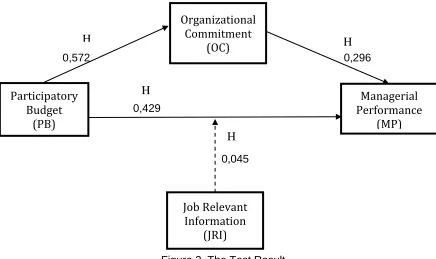
0,572 0,296
0,429
0,045
Figure 2. The Test Result
Participatory
Budget
(PB)
Job Relevant
Information
(JRI)
Organizational
Commitment
(OC)
Managerial
Performance
(MP)
H
1
H
2
H
3
Licensed under Creative Common Page 423
The Effect of Participatory Budget on the Managerial Performance
The results of testing of the first hypothesis show that participatory budget has positive and
significant effect on managerial performance. The regression model meets linearity criteria. The
correlation output value is 0.530 and the Sig. = 0.000, which means < significant criteria 0.05, so
that the results of this study accept the first hypothesis (H1). The results of this study are also in
line with goal setting theory in which the basic concept of this theory is to explain the formation
of a plan for the performance. The banking superiors are expected in the future to further
enhance the existing forms of participatory budget, so that the form of participation will be
carried out evenly. Equitable participation provides an opportunity for all parties to argue. It is
possible that the opinions that have not been heard can be a complement to the achievement of
the Budget Work Plan’s target which has not reached one hundred percent. The result of this
study are consistent with the research of Halim & Devie (2013), Tapatfeto (2013), Lina (2015),
Wijaya & Lucyanda (2010) and Sulastiningsih & Ambarwati (2015) show that budgetary
participation influences managerial performance.
The Effect of Participatory Budget on the Organizational Commitment
The results of testing of the second hypothesis show that participatory budget has positive and
significant effect on organizational commitment. This can be seen standardized beta value in
the second equation of 0.572 and the Sig. = 0.000, which means < significant criteria 0.05. The
coefficient value of unstandardized beta of 0.572 is the path or p2 path value. So that the results
of this study accept the second hypothesis (H2). The results of this study are also in line with
the goal setting theory namely individuals have sufficient knowledge and ability to reach (or
approach) goals and then the individual accepts and remains committed to the goals.
Participatory budgets can lead to the commitment of the managers to achieve organizational
goals. This condition will encourage the involved managers to take responsibility and be
committed to get the agreed budgets target. If a person's commitment so stronger to his
organization, they were prepared to accept the duties or responsibilities that the company
imposed on them. Those tasks or obligations are not considered as a burden by them, but as
an obligation and is a form of dedication to the company. The result of this study are consistent
with the research of Othman & Haryanti (2012), Setyarini & Susty (2014)show that participatory
budget influences organizational commitment.
The Effect of Participatory Budget on the Managerial Performance through
Organizational Commitment
The results of testing of the third hypothesis show that participatory budgets has positive and
Licensed under Creative Common Page 424 variable. This can be seen standardized beta value in the third equation reveal the
unstandardized beta value for the participatory budget of 0.429 and the organizational
commitment of 0.296 and all of them are significant at 0.001 and 0.002, which means <
significant criteria 0.05. The value of the unstandardized beta of participatory budget 0.429,
which is the path value of p1 path and the unstandardized beta value of the organizational
commitment of 0.296 is the path value of path p3. So that the results of this study accept the
third hypothesis (H3).The results of this study are also in line with goal setting theory in which
there are three mechanisms in motivating individuals to improve their performance, that
individuals should have sufficient knowledge and ability to achieve (or approach) the goals and
then the individuals accept and remain committed to the goals. Participatory budgeting can
foster organizational commitment in a person. Organizational commitment stipulates the values
and goals of the organization. If there is a strong commitment to the organization, then he will
increasingly strive to achieve organizational goals. This can indeed improve managerial
performance. The result of this study are consistent with the research of Dianawati (2009),
Setyarini & Susty (2014) and Putri & Putra (2015) show that budgetary participation has an
effect on managerial performance through organizational commitment as intervening variable.
The Effect of Participatory Budget on Managerial Performance Moderated by Job
Relevant Information
The results of testing of the forth hypothesis show that participatory budgets has positive and
significant effect on managerial performance moderated by Job Relevant Information. This can
be seen that the interaction variable gives a coefficient of 0.045 and is a significance at 0.000,
which means < significant criteria 0.05. Job relevant information variable is pure moderator. So
that the results of this study accept the forth hypothesis (H4). The participatory budget process
not only provides an opportunity for the subordinates to argue about the budget but it can also
provide job relevant information, that is the information about the task that was not previously
known by their superior. The information is in the form of any constraints that may often occur or
experienced by the subordinates that makes the process of achieving the Budget Work Plan’s
targets obstructed or may not be achieved at all. The superiors upon knowing the obstacles that
their subordinates face, should immediately take appropriate actions to help their subordinates
so that the actions chosen by the subordinates will help them in the process of achieving the
Budget Work Plan’s targets. All actions resulting from the disclosure of information that was
initially private or only known by the subordinates can ultimately change a person's
performance, because the private information is revealed and understood by all levels of the
Licensed under Creative Common Page 425 or be provided with a solution. If the choice of the solution is right, it will have an impact on the
performance that will be produced. The result of this study are consistent with the research of
Himawan & Ika (2010), Rahmawaty & Mutia (2011) shows that job relevant information can
moderate the effect of budget participation on managerial performance.
CONCLUSIONS
Based on the results of the study, the following conclusions are drawn: The Participatory Budget
has a positive and significant effect on the Managerial Performance. This implies that a
participative budget will enable the parties who have responsibility for achieving the budget
targets to improve their working achievement. The Participatory Budget has a positive and
significant effect on the Organizational Commitment. The Organizational Commitment is able to
mediate Participatory Budget and the Managerial Performance is significant. This implies that
participation in the budget preparation, especially in this study, can improve the acceptance of
goals and committed to the goals employees. The employees will be committed if they feel
themselves as a part of the creation of these goals. The Job Relevant Information can moderate
the effect of Participatory Budget on the Managerial Performance. This implies that the
preparation of the budget to achieve better results, with the availability of job relevant
information on the results of the Budget Work Plan's target achievement will be perceived by
every rank.
The limitations of this study and the suggestions for further study are as follows: firstly,
the objects of this study were limited to four banking companies only. Future researchers are
expected to add more research objects or compare the types of the companies, such as
banking with manufacturing companies. Secondly, the variables used in this study were limited
to several variables only, namely organizational commitment and job relevant information. The
future researchers are expected to add more variables that can affect the participatory budget
on the managerial performance, such as job related stress that describes the level of stress or
the amount of work pressure felt by those who have responsibility in achieving the RKA target
which will affect the results of the performance to be achieve
REFERENCES
Apriansyah, G., Zirman, & Rusli. (2014). Pengaruh Partisipasi Anggaran, Komitmen Organisasi, Kepuasan Kerja, Job Relevant Information dan Budaya Organisasi Terhadap Kinerja Manajerial pada Perhotelan di Provinsi Riau. Jom Fekon, 1(2), 1–22.
Chow, C. W., Cooper, J. C., & Waller, W. S. (1988). Participative Budgeting: Effects of a Truth-Inducing Pay Scheme and Information Asymmetry on Slack and Performance. The Accounting Review, 63(1), 111–122. https://doi.org/10.2307/247682
Licensed under Creative Common Page 426 Dianawati, E. (2009). Pengaruh Partisipasi Penyusunan Anggaran Terhadap Kinerja Manajerial: Komitmen Organisasi dan Job Related Stress sebagai Variabel Intervening. Jurnal Ekonomi Modernisasi, 5(1), 1–18.
Halim, R. N., & Devie. (2013). Pengaruh Budgeting Participation Terhadap Managerial Performance pada Sektor Jasa di Surabaya. Business Accounting Review, 1(2), 82–94.
Harefa, K. (2008). Analisis pengaruh partisipasi dalam penyusunan anggaran terhadap kinerja manajerial dengan komunikasi sebagai variabel moderating pada PT. Bank Negara Indonesia, TBK di Medan, 1–83.
Himawan, A. K., & Ika S, A. (2010). Pengaruh Komitmen Organisasi, Gaya Kepemimpinan dan Job Relevant Information (JRI) terhadap Hubungan Antara Partisipasi Anggaran dan Kinerja Manajerial (Studi Empiris pada BPR di Kota Semarang). AKSES: Jurnal Ekonomi Dan Bisnis, 5(9), 65–79.
Kren, L. (1992). Budgetary Participation and Managerial Performance : The Impact of Information and Environmental Volatility. The Accounting Review, 67(3), 511–526.
Lau, C. M. L., & Tan, J. J. (1998). The Impact of Budget Emphasis, Participation and Task Difficulty on Managerial Performance: A Cross-Cutural Study of The Financial Services Sector. Management Accounting Research, 9(1), 163–183. https://doi.org/10.1108/09513579710166712
Lina. (2015). Partisipasi Penyusunan Anggaran, Psychological Capital, dan Kinerja Manajerial. Jurnal Manajemen Teknologi, 14(3), 301–320.
Locke, E. A., Shaw, K. N., Saari, L. M., & Latham, G. P. (1981). Goal Setting and Task Performance. Psychological Bulletin, 90(1), 125–152. https://doi.org/10.1037/0033-2909.90.1.125
Merchant, K. A. (1981). The Design of the Corporate Budgeting System: Influences on Managerial Behavior and Performance. The Accounting Review, 56(4), 813–829.
Muljono, T. P. (2009). Bank Budgeting Profit Planning & Control (satu). Yogyakarta: BPFE Yogyakarta.
Nouri, H., & Parker, R. J. (1998). The Relationship Between Budget Participation And Job Performance: The Roles of Budget Adequacy and Organizational Commitment. Accounting, Organizations and Society, 23(6), 467–483. https://doi.org/10.1016/S0361-3682(97)00036-6
Oluwalope, A. A., & Sunday, O. (2017). Impact of Budgetary Participation and Organizational Commitment on Managerial Performance in Nigeria. Accounting and Finance Research, 6(3), 48–55.
Othman, R., & Haryanti, I. (2012). Budgetary Participation: How It Affects Performance and Commitment. Accountancy Business and the Public Interest, 1(1), 53–73.
Puspitasari, D. S., Djamhuri, A., & Subekti, I. (2017). Anggaran Partisipatif, Senjangan Anggaran, Kinerja Aparatur Pemerintah dan Tata Kelola Pemerintahan (Studi pada Pemerintah Daerah Kabupaten Malang). Jurnal Ilmiah Administrasi Publik, 3(1), 70–76.
Putri, N. P. M. S., & Putra, I. N. W. A. (2015). Pengaruh Partisipasi Penganggaran pada Kinerja Manajerial. E-Jurnal Akuntansi Universitas Udayana, 12(2), 435–451.
Rahmawaty, & Mutia, E. (2011). Pegaruh Job Relevant Information Terhadap Hubungan Antara Partisipasi Penganggaran Dengan Kinerja Manajer. E- Mabis, 12(3), 480–488.
Rohekan, A. B. (2017, March). Bank DKI Tutup Kantor Cabang di Palembang, Ini Alasannya. Koran Tribun Sumsel, p. 8.
Setyarini, M. N., & Susty, A. (2014). Pengaruh Partisipasi Anggaran Terhadap Kinerja Manajerial dengan Komitmen Organisasi sebagai Variabel Intervening pada Bank Perkreditan Rakyat. Modus, 26(1), 63–76. https://doi.org/10.1017/CBO9781107415324.004
Sulastiningsih, & Ambarwati, L. (2015). Pengaruh Partisipasi Penyusunan Anggaran Terhadap Kinerja Pegawai Studi Kasus pada PT BPR Shinta Daya. Jurnal Riset Manajemen, 2(1), 26–34.
Tapatfeto, J. D. (2013). Analisis Komitmen Tujuan dan Partisipasi Penyusunan Anggaran Terhadap Kinerja Manajerial. Jurnal Akuntansi Multiparadigma, 4(3), 495–507.
Wahyudi, I. (2017). Danamon Tutup Dua Kantor Cabang di Palembang.
Wibowo. (2015). Perilaku Dalam Organisasi (kedua). Jakarta: PT RajaGrafindo Persada.
Wibowo. (2016). Manajemen Kinerja (kelima). Jakarta: PT RajaGrafindo Persada.
Licensed under Creative Common Page 427
APPENDIX
Questionnaire
Respondent's Biodata
1. Name :___________________________
2. Gender : Male
Female
3. Age :_____________________________
4. Position :_____________________________
Instructions
Please choose the tendency of the most appropriate answer from the statement below, by giving a sign (√) in the column between 1 to 5. The explanation is as follows:
5 = Strongly Agree; 4 = Agree; 3 = Indifferent; 2 = Disagree; 1 = Strongly disagree
No. STATEMENT 1 2 3 4 5
PARTICIPATORY BUDGET
1 I am involved in the company's budget work plan 2 I have responsibilities regarding budget targets in the
company's budget work plan
3 I always agree with the results of setting the budget target given to me
4 I feel that the budget target that is imposed on me is in accordance with my ability
5 I have always been involved during discussions about budget targets by the leadership of the company 6 I often give opinions about budget targets before the
company leader asks for an opinion
7 My opinion is always considered in setting budget targets 8 The company leadership always gives me the
opportunity to think about budget targeting Organizational Commitment
9 I am very fortunate to have chosen this company as my place of career
10 I want to have a career in this company forever
11 I have no intention of leaving the company where I work, even though there is a better workplace
12 I feel working here is a necessity
13 Many things in my life will be disrupted if I decide to leave this company both now and later
Licensed under Creative Common Page 428 15 The organization where I worked really inspired me to
achieve the performance target
16 I am always ready to accept the duties and responsibilities that are charged to me in order to achieve the goals of this company
17 I will always work in accordance with applicable company rules
18 I will always be loyal to the company where I work Job Relevant Information
19 I always understand what is needed so that my work can run well
20 I have enough information to make optimal decisions to achieve my performance goals
21 I was able to obtain the strategic information needed to evaluate important decision alternatives
22 I always look for the right information to support the decision that I will make
23 I have new information / ideas related to the progress and development of the company
Managerial Performance
24 I always have good ideas / ideas that have an impact on the smooth running of my work
25 I always succeed in getting customers that are in accordance with the wishes of the company
26 I have always managed to retain customers that have been obtained
27 I always managed to establish good relations with customers
28 I always managed to establish good relations with fellow workers in the organization
29 I am always able to overcome and anticipate problems related to my work
30 I always achieve the budget target in accordance with the provisions of the company's budget work plan 31 I succeeded in achieving the company's budget target in
accordance with the appointed time
32 I always get appreciation for the results of my work 33 I managed to manage operational costs in accordance