Licensed under Creative Common Page 997
http://ijecm.co.uk/
ISSN 2348 0386
MODERATING EFFECT OF INFORMATION TECHNOLOGY
UTILIZATION ON THE RELATIONSHIP BETWEEN CONFLICT
HANDLING AND CUSTOMER SATISFACTION
Charles Bosire Nyameino
Moi University School of Business and Economics Nairobi, Kenya [email protected]
Ronald Bonuke
Moi University School of Business and Economics Nairobi, Kenya
Thomas Kimeli Cheruiyot
Moi University School of Business and Economics Nairobi, Kenya
Abstract
Hospitality industry and tourism sector has grown and developed in Kenya, contributing to
economy on employment and revenue. Conflict handling and relationship marketing practices that
is important in service industry. The aim of this study was to determine the moderating effect of
information technology communication (ICT) utilization on the relationship between conflict
handling and customer satisfaction by classified hotels. Descriptive research design was adopted
for this study. The target population was 6067 customers at classified star hotels in Nairobi Kenya
and a sample size of 375 was obtained using proportionate sampling. Data was collected using a 5
Likert-scale questionnaire. Data was analyzed using multiple regression analysis. Analysis
revealed that conflict handling (β= -.290, p-value = 0.772) as a relationship marketing practice did
not have a statistically significant effect on customer satisfaction. Results explain 11.9% of variance
above and beyond the variance by Conflict Handling scores. H02 was rejected because β≠0 and
p-value is less than α. The study concluded that conflict handling has no significant effect on
customer satisfaction in classified star hotels. The study recommended the need to learn on how to
influence customers to be loyal and willingness to discuss problems with customers openly.
Licensed under Creative Common Page 998 INTRODUCTION
The hospitality industry combines hotel and tourism industries globally, regionally and locally and it has been expanding rapidly. This is due to admirable and pleasant tourist sites as well as the proliferation of businesses and the strategic location of Kenya making her a regional centre for conferences. The increased visitations by foreigners and investors have paved way for the enormous expansion and growth of the hospitality industry in Kenya. Classified star hotels provide services such as reservation, telecommunication, front office, restaurant and accommodation for customers or guests. In order to enhance and improve the provision of these services, especially front office and accommodation, hotels in Kenya have had to embrace efficient and effective customer relationship management (CRM) techniques through information and communication technologies (ICTs) in order to satisfy and retain customers. Izquierdo et al. (2005) indicated that relationship marketing includes all activities directed towards the establishment, development and maintenance of exchange relationships.
Customer satisfaction is very important in today’s business world. Customer satisfaction is essential to long-term business success, thus customer satisfaction has been regarded a fundamental determinant of long-term business success. Anders et al. (2005) defined customer satisfaction as customer’s overall evaluation of all measure’s to date. This satisfaction has positive influences on retaining customers among different variety of services and products they experience and they shall spread by word of mouth or through referral. Ingrid (2004) defined satisfaction as a feeling which results from a process of evaluating what was received against that expected, the purchase decision itself and/or the fulfilment of needs/want. Satisfaction refers to achieving the things hotel customers want and expect.
Examining the impact of relationship marketing strategy on customer loyalty as (Ndubisi, 2005) established that conflict handling has a significant effect and predict a good proportion of the variance in customer loyalty. Conflict refers to the level of disagreement between both parties acting in an exchange which can be perceived in a relationship. It reduces the possibility of creating and maintaining a long-term relationship (Amin et al., 2011). In this case conflict handling could be termed as the Hotel’s ability to minimize the negative consequences of manifested and potential conflicts. Conflict-handling includes the Hotel’s ability to avoid potential conflicts, to solve manifested conflicts before they create problems, and to discuss
Licensed under Creative Common Page 999
disappointed customers to complain and empower employees to remedy the situation at the time and place of its occurrence to build or contribute on achieve higher revenues and greater profits (Kotler & Keller, 2006).
Mornay et al. (2012) measured the influence of conflict handling on customer loyalty. The results showed that conflict handling is a critical factor in building customer loyalty. Therefore, services sector firms should accommodate customer needs, and should tailor their products to meet the requirements of their respective customer groups. They should also be flexible in their relationships with customers. Hotels can identify the needs of different customers and satisfy them through customer segmentation. Products can then be developed that address the needs of the target market and solve conflict handling issues.
Previous studies have not looked into the ICT utilization and its effect on the relationship between conflict handling and customer satisfaction in the hospitality industry. The study therefore sought to bridge this gap by investigating moderating effect of ICT utilization in the relationship between conflict handling as a relationship marketing practice and customer satisfaction in classified star hotels in Nairobi Kenya.
METHODOLOGY
The study was done in classified star hotels in Nairobi Kenya. Descriptive research design was adopted for this study. The target population was 6067 customers at classified star hotels in Nairobi Kenya. A sample size of 375 was obtained using proportionate sampling from classified star hotels. The study used primary data, the questionnaire was adopted from Ndubisi and Wah (2005) then divided into 2 sections/ categories general information and the following variables customer satisfaction, commitment strategy, communication strategy, conflict handling and service quality.
Licensed under Creative Common Page 1000
The following regression model was used in data analysis. Y1 = α+ β1X1+ ε(DirectRelationship)….……… (1)
Y2 = α+ β1X1+ β2 (X1M) +ε (ModeratedRelationship)………… (2)
Where,
Y= Customer satisfaction X1= Conflict Handling
M= Information communication technology utilization α = Constant
β1, β2 = Coefficients for corresponding variables
ε = Error term
ANALYSIS & RESULTS
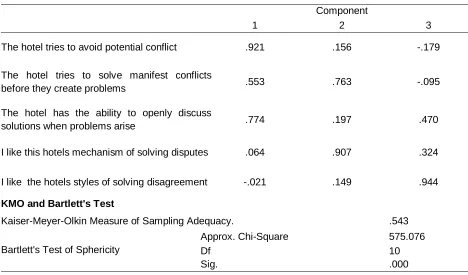
The results show that 5 items for conflict handling are sorted and clustered into three components. The results of principal component analysis indicate that there are three factors whose Eigenvalues exceed 1.0. The Eigenvalue of a factor represents the amount of total variance explained by that factor.
For conflict handling, the first factor has Eigenvalue of 2.531 and the second factor has Eigenvalue of 1.256 and the third factor had Eigenvalue of 0.721. The three factors identified for the independent variable ‘conflict handling’ explain 90.137% of the total variance. The first factor explained 50.612% of the total variance and the second factor explained 25.113% while the third factor explained 14.411% of the total variance. The percentage of variance combines for succeeding items to make up 100% variance.
The results also show the extracted sum of square loading for the factors. The values are calculated on the basis of the common variance, which is smaller than the total variance incorporating 90.137% of the variance. Rotated sum of square loadings depict the distribution of the variance after varimax rotation. Varimax rotation tries to maximize the variance of each of the factors, so the total amount of variance accounted for is redistributed over the extracted factors. Principal component analysis with varimax rotation is widely adopted as a reliable method of factor analysis.
Licensed under Creative Common Page 1001
Table 1. Rotated Component Matrix for Conflict Handling
Component
1 2 3
The hotel tries to avoid potential conflict .921 .156 -.179
The hotel tries to solve manifest conflicts
before they create problems .553 .763 -.095
The hotel has the ability to openly discuss
solutions when problems arise .774 .197 .470
I like this hotels mechanism of solving disputes .064 .907 .324
I like the hotels styles of solving disagreement -.021 .149 .944
KMO and Bartlett's Test
Kaiser-Meyer-Olkin Measure of Sampling Adequacy. .543
Bartlett's Test of Sphericity
Approx. Chi-Square 575.076
Df 10
Sig. .000
Extraction Method: Principal Component Analysis. Rotation Method: Varimax with Kaiser Normalization. a. Rotation converged in 5 iterations.
First factor exhibited heavy loadings for three items that consisted of the hotel tries to avoid potential conflict (0.921), the hotel tries to solve manifest conflicts before they create problems (0.553), and the hotel has the ability to openly discuss solutions when problems arise (0.774). This factor can be called ‘conflict management’ as the factor loadings are heavy on items related to conflict management. The second factor loads heavily on two items which consists of the hotel tries to solve manifest conflicts before they create problems (0.763), and I like this hotels mechanism of solving disputes (0.907). This factor can be called ‘dispute resolution’ because items that the factor heavily loads on are related to resolving disputes. The third factor loads heavily on two items which consists of the hotel has the ability to openly discuss solutions when problems arise (0.470), and I like the hotels styles of solving disagreement (0.944). This factor can be called ‘fairness’ as factor loadings were heavy on items demonstrating fairness.
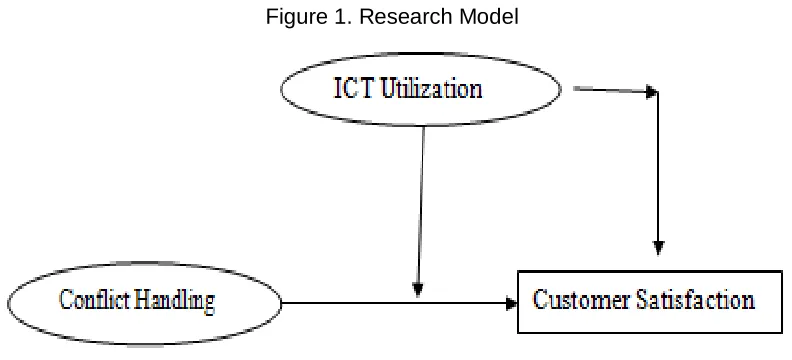
Conceptual Model key Effects on Hypotheses
Licensed under Creative Common Page 1002 H01: Conflict handling strategy has no significant effect on customer satisfaction in classified
star hotels in Nairobi-Kenya
H02 ICT does not significantly affect the relationship between Conflict handling and Customer
Satisfaction in classified star hotels in Nairobi-Kenya
Figure 1. Research Model
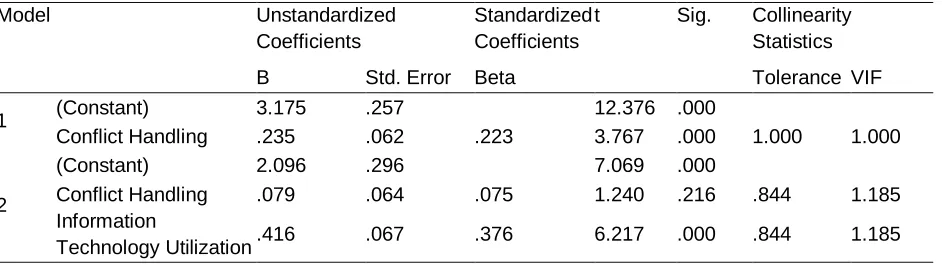
Using moderated multiple regression analysis, the moderating effect of the variable Information Technology Utilization was analyzed by interpreting the R2 change in the models obtained from the model summaries and the regression coefficients for the product term obtained from model summaries. Variance-inflation factor (VIF) and tolerance were used to test for multicollinearity among the predictor variables. Multicollinearity statistics show that the tolerance indicator for Conflict Handling, Information Technology Utilization, and Conflict Handling*Information Technology Utilization were all greater than 0.1 and their VIF values were less than 10. These results indicate that no multicollinearity problem occurred.
Licensed under Creative Common Page 1003
Table 2. Model Summary results of moderating effect Conflict Handling and Customer Satisfaction
Model R R Square
Adjusted R Square
Std. Error of the
Estimate
Change Statistics
Durbin-Watson R Square
Change
F Change df1 df2 Sig. F Change
1 .223a .050 .046 .60717 .050 14.187 1 270 .000
2 .411b .169 .163 .56881 .119 38.647 1 269 .000 1.755
a. Predictors: (Constant), Conflict Handling
b. Predictors: (Constant), Conflict Handling, Information Technology Utilization c. Dependent Variable: Customer Satisfaction
Table 3. Coefficients results of moderating effect of Conflict Handling and Customer Satisfaction
Model Unstandardized
Coefficients
Standardized Coefficients
t Sig. Collinearity Statistics
B Std. Error Beta Tolerance VIF
1 (Constant) 3.175 .257 12.376 .000
Conflict Handling .235 .062 .223 3.767 .000 1.000 1.000
2
(Constant) 2.096 .296 7.069 .000
Conflict Handling .079 .064 .075 1.240 .216 .844 1.185
Information
Technology Utilization .416 .067 .376 6.217 .000 .844 1.185
a. Dependent Variable: Customer Satisfaction
The study established that Conflict Handling (β= -.290, p-value = 0.772) as a relationship marketing practice did not have a statistically significant effect on customer satisfaction. Thus, it can be concluded that the study failed to reject H02: Conflict handling has no significant effect
on customer satisfaction in classified star hotels in Nairobi-Kenya since p-value was greater than α. These results show that a positive unit change in conflict handling will result into a negative change in customer satisfaction. However, this relationship is not statistically significant. The important factors for conflict handling include conflict management, dispute resolution and fairness in dealing with customer complaints.
CONCLUSION AND THE IMPLICATIONS
Licensed under Creative Common Page 1004 RECOMMENDATIONS
The manner in which conflicts are handled will influence customer loyalty directly and will depend on their prior satisfaction with the relationship, the magnitude of the investment in the relationship, and the alternatives that the parties have.
Social
The study recommends that hotel managers need to learn on how to influence Customers to be loyal depending on how they handles customer complaints and other conflicts satisfactorily. It is therefore important that effective conflict-resolution mechanisms are not only in place, but are proactive, so as to pre-empt potential sources of conflict and address them before problems manifest. Hotels must be willing to discuss problems with customers openly.
Managerial
The study recommends that proper, appropriate and timely conflicts are handled will influence customer loyalty directly and will depend on their prior satisfaction with the relationship, the magnitude of the investment in the relationship, and the alternatives that the parties have. Managers will learn to handle complaints with urgency and respect, customers will see no reason to trust, commit to, or communicate with the hotels services once they have established for adequate and effective problem-solving.
Policy
The study provides to hotel managers, the government of Kenya and other stakeholders in hotel industry with current and updated data in formulating appropriate policies and coming up with solutions to emerging issues in the sector on matters of communication and customer satisfaction. This study will help all stakeholders to formulate more rational strategies aimed at attracting and retaining customers, this research contributes to a better appreciation and understanding of communication and customer satisfaction related factors.
Research
Licensed under Creative Common Page 1005 REFERENCES
Amin, G., Almani, M., Pournaserani, A & Mousavian, S.J. (2011). Relationship Marketing: A new approach to marketing in the third millennium. Australian Journal of Basic and Applied Sciences 5(5), pp. 787 -799.
Anders, Gustafsson Johnson Michael D.,& Roos Inger, (2005). The Effects of Customer Satisfaction, Relationship Commitment Dimensions, and Triggers on Customer Retention’, American Marketing Association, 1547-7185
Izquierdo, C. and Cilla´n, J. and Gutie´rrez, S. (2005). The impact of customer relationship marketing on the firm performance: a Spanish case, Journal of Services Marketing Vol19, No.4, pp.234–244
Kotler, P. & Keller, K.L. (2006). Marketing Management 12th edition. New Jersey: Pearson Prentice Hall. Mornay Roberts, Lauren Strachan, Leon Du Plessis, (2012). The influence of trust of trust, commitment, and conflict handling on customer loyalty. Journal of Economic & Financial Sciences, 6(1), pp 195-216
Ndubisi, N.O. (2005). Relationship marketing and customer loyalty, Marketing Intelligence & Planning Vol. 25 No. 1, 2007.
Ndubisi, N.O. (2007). Relationship marketing and customer loyalty. Marketing Intelligence & Planning,
25(1), pp. 98-106.
Sauers, A.C. (2008). Effective customer relationship management. New York: Cambria Press.
APPENDICES
Conflict Handling Scale
Conflict handling 1 2 3 4 5
The hotel tries to avoid potential conflict
The hotel tries to solve manifest conflicts before they create problems
The hotel has the ability to openly discuss solutions when problems arise
I like this hotels mechanism of solving disputes
I like the hotels styles of solving disagreement
Total Variance Explained: Conflict Handling
Compon ent
Initial Eigenvalues Extraction Sums of Squared Loadings
Rotation Sums of Squared Loadings
Total % of
Variance
Cumulativ e %
Total % of
Variance
Cumulativ e %
Total % of
Variance
Cumulativ e %
1 2.531 50.612 50.612 2.531 50.612 50.612 1.758 35.162 35.162
2 1.256 25.113 75.726 1.256 25.113 75.726 1.491 29.822 64.984
3 .721 14.411 90.137 .721 14.411 90.137 1.258 25.153 90.137
4 .323 6.457 96.594