R E S E A R C H A R T I C L E
Open Access
Blended learning for postgraduates; an
interactive experience
Mirjam Westerlaken
1, Ingrid Christiaans-Dingelhoff
2, Renée M. Filius
3, Bas de Vries
4, Martine de Bruijne
5and
Marjel van Dam
6*Abstract
Background:Blended learning has the potential to stimulate effective learning and to facilitate high quality education. For postgraduate health professionals, blended learning is relatively new. For this group we developed, implemented and evaluated two blended learning modules in a master program on quality and safety in patient care. Aiming for a better preparation compared to traditional textbook homework, the course provided not only web lectures and reading, but also interactive assignments and collaborative learning. Additional goal was saving time for the teachers resulting in a potential cost savings.
Method:The experiences of 21 postgraduate health professionals were evaluated with two voluntary and anonymous questionnaires beginning of 2017 with a special focus on the added value of online interaction, underexposed in previous research.
Results: This evaluation shows that online modules are regarded as being an effective preparation for face-to-face meetings for postgraduate health professionals. Added value of social interactive online preparation was perceived from collaborating and interacting with each other. Both the interaction between the students, and the e-moderator and teachers were well received.
Conclusions:Based on the results of this study, we suggest that blended learning may indeed increase the level of education and stimulate effective learning for postgraduate health care professionals. The professionals experienced added value of social interactive online preparation from collaborating and interacting with each other. We consider better aligning of the online and face-to-face components as one of the highest priorities.
Keywords:Social interactive learning, Postgraduate education, Health professionals, Blended learning, Deep learning
Background
Blended learning is the integration of an online and face-to-face learning experience. In the last decades, blended learning has been getting more and more im-portance in academic education [1]. It not only shifts the education from teacher-centered to student-centered, but also has the potential to increase interaction be-tween students and teachers, leading to improved learn-ing [2]. Online learnlearn-ing as a preparation for face-to-face educational meetings has many advantages: nowadays it is easily accessible at any place and any time, students can learn at their own pace and start and follow the
course as desired. In addition blended learning contrib-utes to students’ motivation and satisfaction [3] and stimulates a feeling of autonomy and responsibility [4]. After the development and implementation it can be de-ployed frequently for multiple target groups, which is beneficial from a financial point of view as well.
Also for health professionals, blended learning has the potential to improve clinical competencies [5]. Liu et al. compared the effectiveness of blended learning to trad-itional face-to-face and fully online education for health professions. They cautiously concluded that blended learning contributes more effectively to knowledge aqcuisition than face-to-face and fully online education [6]. Main reasons seems to be that participants can re-view educational materials whenever and wherever they want [7] and that a feeling of loneliness or lost of
© The Author(s). 2019Open AccessThis article is distributed under the terms of the Creative Commons Attribution 4.0 International License (http://creativecommons.org/licenses/by/4.0/), which permits unrestricted use, distribution, and reproduction in any medium, provided you give appropriate credit to the original author(s) and the source, provide a link to the Creative Commons license, and indicate if changes were made. The Creative Commons Public Domain Dedication waiver (http://creativecommons.org/publicdomain/zero/1.0/) applies to the data made available in this article, unless otherwise stated. * Correspondence:[email protected]
6Intensive Care Center and Center for Research and Development of
Education, University Medical Center Utrecht, Heidelberglaan 100, 3584 CX Utrecht, The Netherlands
interest in subject matter is being prevented by also meeting face-to-face [8]. One blended approach that is often used is the ‘Flipped classroom’ concept in which face-to-face teacher instructions are replaced with indi-vidual or group homework activities [9]. A recent meta-analysis on the ‘Flipped classroom’ concept in health professionals showed improved student learning com-pared with traditional teaching methods [10].
Blended learning for postgraduate health professionals is relatively new as well as the focus on social interactive component of online learning. The added value of the social interactive component in blended approaches is of great importance to facilitate effective and deep learning [8, 11]. Also, the social constructivist theory emphasizes the importance of social interaction between students to students and teachers in order to stimulate effective learning [12]. Participants should be given opportunity to construct and gain knowledge by using active learning methods and exchanging views. Social interaction and collaborative learning online stimulate the development of critical thinking skills, the co-creation of knowledge and meaning, reflection and transformative learning [13]. More knowledge about the benefits and challenges of social interaction online within a blended program, could optimize online interaction for postgraduate health professionals.
Research question
This paper describes the introduction and evaluation of a blended learning approach for educating health profes-sionals. The design and exploitation of our program is founded on the social constructivist theory, emphasizing the importance of social interaction in order to stimulate effective learning. Therefore, we will reflect on the question:What is the added value of online social inter-action in blended approaches for postgraduate health professionals?
The blended approach invites students to interact and discuss the learning content not only 2 days a month during the face-to-face meetings but also during the modules online. As interaction is often considered as a prerequisite for deep learning [14] we expected the learning effect for students to increase. Because partici-pants study parts of the learning content already online and through social interaction among peers with little support from teachers, it was expected that face-to-face teaching time for faculty would diminish.
Method
This article describes the evaluation of the implementa-tion of a newly developed blended learning concept for postgraduates. We describe the development, implemen-tation and evaluation of blended learning for postgradu-ates and the added value of social interaction.
Development
The Netherlands Federation of University Medical Centers or NFU, representing eight cooperating University Medical Centers in The Netherlands offers a master program for health care professionals “Quality and safety in patient care”. The multidisciplinary group of 21 postgraduates con-sisted of 7 men and 14 women, aged 28 to 58 years, with different backgrounds: ten nurses, eight medical doctors, one pharmacist, one paramedic and one policy officer. All health professionals are directly or closely involved in patient care and combine a fulltime job with this master program.
The NFU master program originally has the same clas-sical structure as many other educational programs in higher education: individual passive homework activities, mainly reading articles, followed by face-to-face meet-ings with lectures and extensive interaction. The rede-signed blended model with a focus on social interaction online intended to increase effective learning for post academic health professionals working in hospitals by replacing passive homework activities like reading arti-cles with interactive online learning activities. An add-itional goal would be diminishing the teaching time for teachers by replacing some face-to-face elements through online learning activities with a lot of peer to peer interaction.
In the fall of 2016 two blended modules for postgradu-ate health professionals on patient safety in hospitals have been developed and implemented according to the social constructivist theory. In both modules the import-ance of a safe culture, risk awareness and behavior within health care were accentuated. The first module offered an introduction to crew resource management and the incident analysis in theory and practice. The sec-ond module offered an introduction in scientific re-search on patient safety and the legal consequences of a patient safety incident.
Implementation
and 1 poll. The second module consisted of 3 web lec-tures, 6 video’s, 13 reading activities, 6 quizzes, 5 discus-sion forums, 3 peer review assignment, 4 wiki’s and 3 polls. More information about the structure of the on-line modules can be found in Additional file1.
The online components were offered through the vir-tual learning environment, a Moodle-based platform, and contained asynchronous activities. The online activ-ities opened to all participants at the same time and closed after 2 weeks the same way. During these weeks participants could complete the online activities in their own pace. Both weeks one topic was addressed, and at the end of the weeks students were asked to pose remaining questions online. The 2 weeks of online prep-aration were followed by 2 days of face-to-face educa-tion. During these days, the remaining questions posed online were discussed. In addition time was spent to practice what was learned online with real patients situa-tions, for example disclosure procedures.
Since faculty plays an important role in facilitating and stimulating interaction between participants during online education [15], the online activities were taught by an e-moderator (with a MSc in Educational Sciences) and four content experts from the NFU (one teacher per week, two for each module). The e-moderator had initial contact with students, was online every day to check for questions, sent friendly reminders and weekly updates, resolved prac-tical and technical issues and contacted teachers about content-related questions. The teachers provided feed-back, answered content-related questions and provoked discussions by asking relevant questions. All for the pur-pose of effective and higher order learning [16].
Evaluation
To explore students’experiences, both blended modules were evaluated with an online questionnaire about the online learning activities and a questionnaire on the face-to-face component. Each participant received a questionnaire after completing a module.
In the questionnaire concerning the online compo-nents participants were asked to rate the learning mate-rials, the supervision of faculty and the interaction with peers. The questionnaire contained five rating questions regarding the collaborative activities, five rating tions regarding the e-moderator and four rating ques-tions regarding the teachers. The quesques-tions regarding the collaborative activities focused on the quality and frequency of the contributions, the availability of an ex-pert, the encouragement to contribute actively and the use of a discussion forum as a tool for learning. The questions regarding the e-moderator focused on the quality of the messages and help, the encouragement, the speed of response and the need for an e-moderator. The questions regarding the teachers focused on the
amount and quality of feedback, the content expertise and the speed of response. An example question for each topic is stated in Table1.
For all rating questions, a 5-point Likert scale, from 1 (lowest) to 5 (highest), was used. At the end of all three topics participants could give suggestions in open-ended questions. Additionally 4 open ended questions were asked concerning expectations, what participants specif-ically liked, technical problems encountered and sugges-tions for improvement.
The questionnaire used for evaluating the experiences has been developed previously and has not been published elsewhere. An English language version is available as Additional file2. From previous data from 2016 a reliabil-ity analysis was performed in SPSS 23.0 for Mac OS. This analysis showed that the questionnaire had a high reliabil-ity: Cronbach’s alpha of the constructs‘collaborative activ-ities’, ‘e-moderator’ and ‘teacher’ were respectively .837 (n= 423, five items), .886 (n= 415, five items) and .871 (n= 414, five items). To extend the value of the evaluation results, from 2017 one item,‘The speed of the response of the teacher’, has been added to the questionnaire. This has not negatively influenced the reliabilty of the construct ‘teacher’. Cronbach’s alpha of the constructs‘collaborative activities’,‘e-moderator’and ‘teachers’for this study were respectively .610 (n= 32, five items), .792 (n= 32, five items) and .869 (n= 32, four items).
The questionnaire concerning the face-to-face meeting invited the students to give comments or suggestions on the face-to-face components anonymously and voluntarily and the purpose of the questionnaires and how the results would be analysed was explained. The questionnaires con-cerning the online and offline components were completed by 16 and 15 students, respectively. The data from both questionnaires were analysed and reported in two evalu-ation reports. In The Netherlands evaluevalu-ation questionnaires regarding newly introduced educational programs are not submitted to ethical approval by Institutional Review Boards. The purpose of the evaluation questionnaires was explained to the participants. Their participation was an-onymous and voluntary. The obtained data were not trace-able to participants.
Results
Results of this study indicate that blended learning with interactive learning methods may increase the perceived learning results and overall satisfaction. The participants rated the online modules overall 7.6 median on a scale from 1 to 10, with range 7–9 for the first online module and range 6–9 for the second online module.
responders and ‘too heavy’ by two responders. The learning environment, the usability and speed, were marked 7.5 median on a scale from 1 to 10.
The collaborative activities
Participants were moderately positive about the inter-action with peers and faculty online. Table 2 shows the scores students assessed the discussion forum with. These scores are similar to other online courses offered by Elevate in 2017 [17].
On the question if students have any suggestions re-garding the discussion forum, ten students commented with a positive remark about the value of discussion forum, e.g.
“I like this way of learning together.”
“Valuable to discuss with each other.”
Also ten students commented with a negative comment about the value of the discussion forums. Three disad-vantages mentioned are the amount of comments which was experienced as overwhelming by some participants, some technical limitations, and the obligatory character of the discussion forums.“I think the discussion forum was a nice feature, but might have been used too often. Especially when it required commenting on another participant's post, this could actually be a limitation in the‘freedom of learning’.”
“The concept is super, but two big disadvantages: too
many participants, overwhelming amount of messages.
(…) And I missed a parent tree, (…), but did not find
it easy to categorise discussion around assignment.”
The interaction with the e-moderator
Regarding supervision online, students’ assessment of the e-moderator is stated in Table3.
Students appreciated that support was available when-ever they had questions or experienced problems. Also the weekly updates were appreciated. In total, ten posi-tive remarks about the moderator were made.
“I really liked the emails as a reminder.”
“It was nice that there is someone to answer possible
questions or uncertainties, and that she is proactive.”
Five students commented with a negative comment on the interaction with the e-moderator. Especially in the first module some participants thought that the mes-sages of the moderator were a little strict.“I think that
it’s good that you kept your finger on the pulse. I just felt like I was treated a little childish when I had to explain in the first week during my vacation why I had not logged in yet. We are all adults and it is our own responsibility.”
The interaction with the teachers
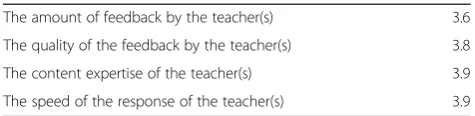
The quantitative results regarding the teachers are shown in Table4.
Participants liked that they had interaction with their teachers before the face-to-face meeting. Three students gave a positive comment regarding the teachers, for example:
“I liked that they reacted on the topics. There is
already contact before the face-to-face meeting, for me
that really is of added value.”
Two participants disliked that the teacher did not react on all comments, and that they found it sometimes hard to find teacher’s feedback.“I wonder why the teachers
sometimes replied and sometimes not. For me it seemed that replies were posted randomly. I would
choose one approach so that it’s clear for all students
when suggestions from teachers can be expected.”
Table 1Example questions regarding the collaborative activities, e-moderator and teachers
The collaborative activities How do you rate the quality of the contributions to the discussion forums?
The e-moderator How do you rate the encouragement from the e-moderator?
The teachers How do you rate the quality of the feedback by the teachers?
Table 2Students’assessment of the discussion forums on a scale from 1, lowest, to 5, highest (mean score)
The quality of the contributions to the discussion forum 3.8
The frequency of contributions to the discussion forum 3.4
The availability of an expert that added comments to the discussion forum 3.7
The encouragement to actively contribute to the discussion forum (if needed) 3.5
The value of online social interaction in general
All participants answered the questions “What did you specifically like about this online component?”Nine out of 16 participants mentioned that they mostly liked the interaction with peers and faculty. Participants commen-ted that they liked to interact and preferred learning to-gether above the individual passive readings which was their homework for the other modules. They mentioned that interacting with peers and teachers online was beneficial for their learning process.
“More guidance and interaction than when you’re
reading alone. It feels less like doing it‘on your own’.
And it’s possible to give and get feedback from peers
immediately.”
“It’s great to see that peers add new stuff. Therefore,
this had added value above preparation alone.”
“I liked seeing the progress of my peers. Normally
you’re struggling as a student‘on your own’to finish your homework and now it felt like we were doing it as a group.”
“I learned a lot from the activities about my own
research. Reading feedback from my peers was useful
and gave me new ideas.”
The alignment between the online and offline component
According to participants the quality of alignment dif-fered per module. When asked for comments or sugges-tions, three students commented that the alignment could have been better.
“I learned a lot from reading literature and completing
the online learning activities. Unfortunately, the
face-to-face meetings didn’t align. This did not meet my
expectations: at the end of the e-learning you could
ask questions and mention subjects you’d like to learn
more about or deepen, but this wasn’t referred to.”
“I think that the e-learning was a pleasant way to
prepare for the face-to-face meetings. (...) Blended learning aims to deepen the content during the
face-to-face meetings. I think this didn’t work out very well
during the two modules.”
“The alignment between the online and face-to-face
component can be more tight.”
For one presentation of the face-to-face component, teachers activated participants’ prior knowledge by dir-ectly referring to the questions students asked at the end of the online preparation, which was much appreciated.
Discussion
The added value of social interaction in blended approaches
This paper intended to evaluate the added value of social interaction in blended approaches for postgraduate health professionals. Overall, the results of this study suggest that, according to students, blended learning consisting of online preparation and face-to-face meet-ings is an effective educational strategy for postgraduate students. This was a highly motivated group of post-graduate students, who take ownership of their learning while combining a fulltime job with this master pro-gram. That is one of the reasons a flexible preparation of the online courses is well-received.
According to the students the online learning activities are a better preparation for the face-to-face meetings compared to the traditional, more passive homework. Students valued the social interactions through collab-orative preparation online, but also the practical applica-tion of the online learning activities. These findings confirm our expectations that online social interaction stimulates students’ motivation more than traditional homework. Participants preferred to have discussions in smaller groups with a less obligatory character. Brindley, Walti and Blaschke [18] showed that smaller groups, consisting of four to six students, contribute to the ef-fectiveness of collaborative learning, while Uijl et al. [11] confirmed that in higher education, obligatory discus-sions do not contribute to more effective interaction than non-obligatory discussions. Our recommendation is to include small groups with non-obligatory discus-sions in the online learning activities.
Important limitations of this evaluation are the small sample size, the lack of a control group, only one e-mod-erator and a small number of teachers. Consequently, our Table 3Students’assessment of the e-moderator on a scale
from 1, lowest, to 5, highest (mean score)
The quality of the messages from the e-moderator 3.7
The encouragement from the e-moderator 3.5
The quality of the help by the e-moderator 3.8
The speed of the response of the e-moderator 4.1
The need for an e-moderator 3.4
Table 4Students’assessment of the teachers on a scale from 1, lowest, to 5, highest (mean score)
The amount of feedback by the teacher(s) 3.6
The quality of the feedback by the teacher(s) 3.8
The content expertise of the teacher(s) 3.9
experience is not immediately generalizable. Also the questionnaire is confined, but validated and all items are discussed in theResultsection. Another limitation of this project is that the evaluated group of mixed health profes-sionals has a high level of ambition, combining a fulltime job with this master program. However, we do consider the results generalizable to other postgraduate students who choose consciously for their professional develop-ment. The absence of structural evaluation of the experi-ences of the teachers is also a limitation. Informally, the new program was assessed with the teachers after the face-to-face meetings by two of the authors (MvD and MdB). All of them agreed that developing and implement-ing a new blended learnimplement-ing course is time-consumimplement-ing. This has been shown by other authors as well, e.g. Alebaikan et al. [19], Filius et al. [20] and Kenney et al. [21]. It did not, against expectations, diminish the time needed for face-to-face meetings as Garrison and Vaughan [10] stated in their book. On the one hand, this had to do with the social interaction of the group: participants value their two-days of face-to-face education very highly. On the other hand, according to teachers, the newly, mostly online acquired knowledge of the participants, took the level of education to a higher standard. Participants gave more input which led to more meaningful interaction. The teachers could focus more on application of the ac-quired knowledge by the students rather than explaining it. In the presence of real patients, available during the face-to-face meetings, this may contribute even more to professional development of postgraduates [22]. Similar to Stockwell et al. [23] this indicates that blended learning could lead to deep learning skills as students are aiming for understanding as apposed to surface learning where they are aiming to memorize or reproduce material for a test [24,25].
Teaching experiences
Teaching a blended course differs from traditional face-to-face teaching in a way that it is challenging to move from the structured learning methods approach to a more open and deepening face-to-face discussion. That corresponds with the participants’ comments that the alignment between the online and face-to-face compo-nents could be improved. Teaching blended requires a different approach for teachers. Other studies have con-firmed this result as well [19–21, 26, 27]. Teachers should get support and education on how to adapt their teaching style to a blended approach. Including educa-tional experts in the development and implementation of a blended learning program can help to align better. One practical suggestion for teachers is to activate par-ticipants’ prior knowledge, which will contribute to ef-fective learning [12, 22] and deep learning [25, 28]. When asking participants to pose remaining questions
online and to share topics they would like to discuss fur-ther, it is crucial that these items are addressed during the face-to-face meeting in order to activate prior know-ledge and keep students motivated.
Conclusion
Based on the results of this study, we suggest that blended learning may indeed increase the level of educa-tion and stimulate effective learning for postgraduate health care professionals. The professionals experienced added value of social interactive online preparation from collaborating and interacting with each other. It is rec-ommended to facilitate social interaction online with small discussion groups.
Both the interaction between the students and the e-moderator and teachers were well received. Better align-ing the online and face-to-face components we consider as one of the highest priorities developing blended learn-ing programs. The development and implementation of blended learning in this master program did not dimin-ish the need for face-to-face meetings. For better align-ing the online and face-to-face components, teachers should get support how to adapt their teaching style to a blended approach.
Additional files
Additional file 1: Table S1.Design of the learning activities of the first
online module.Table S2.Design of the learning activities of the second
online module. (DOCX 17 kb)
Additional file 2:English version of the evaluation questionnaire. (DOCX 17 kb)
Abbreviations
BV:Bas de Vries; ICD: Ingrid Christiaans-Dingelhoff; MdB: Martine de Bruijne;
MvD: Marjel van Dam; MW: Mirjam Westerlaken; NFU: Netherlands Federation of University Medical Centers; RF: Renée Filius
Acknowledgements
We thank all the health professionals who participated in this study, the NFU who made this study possible and Elevate Health. Without their support this work would not have been possible.
Authors’contributions
MW participated in the design and the analysis of the study, collected the data and has drafted and finalized the manuscript. ICD and BV reviewed the draft of the manuscript. RF created the first version of the evaluation questionnaire of the online activities and contributed to the draft and final version of the manuscript. MdB and MvD participated in the design and analysis of the study, collected the data and reviewed the draft of the manuscript. All authors have read and approved the final manuscript.
Funding
The project was financially supported by the NFU and Elevate Health.
Availability of data and materials
Ethics approval and consent to participate
Participants voluntarily filled in anonymous evaluation questionnaires, based on which this article was written. In The Netherlands evaluation
questionnaires regarding newly introduced educational programs are not submitted to ethical approval by Institutional Review Boards.
Consent for publication
Not applicable.
Competing interests
The authors declare that they have no competing interests.
Author details
1
Elevate Health, Utrecht, The Netherlands.2Amstel Academy, VU University Medical Center, Amsterdam, The Netherlands.3Head of Education Affairs, Utrecht University, Utrecht, The Netherlands.4Department Quality of Care and Patient Safety, University Medical Center Utrecht, Utrecht, The Netherlands.5Department of Public and Occupational Health, Amsterdam Public Health Research Institute, VU University Medical Center, Amsterdam, The Netherlands.6Intensive Care Center and Center for Research and Development of Education, University Medical Center Utrecht, Heidelberglaan 100, 3584 CX Utrecht, The Netherlands.
Received: 22 May 2018 Accepted: 18 July 2019
References
1. Kanuka H, Garrison DR. Cognitive presence in online learning. JCHE. 2004;15:
21–39.
2. Hake RR. Interactive-engagement versus traditional methods: a six
thousand-student survey of mechanic test data for introductory physics
courses. Am J Phys. 1998;66:64–74.
3. López-Pérez MV, Pérez-López MC, Rodríguez-Ariza L. Blended learning in
higher education: students’perceptions and their relation to outcomes.
Comput Educ. 2011;56:818–26.
4. Smyth S, Houghton C, Cooney A, Casey D. Students’experiences of
blended learning across a range of postgraduate programmes. Nurse Educ
Today. 2012;32:464–8.
5. Rowe M, Frantz J, Bozalek V. The role of blended learning in the clinical
education of healthcare students: a systematic review. Med Teach. 2012;34:
216–21.
6. Liu Q, Peng W, Zhang F, Hu R, Li Y, Yan W. The effectiveness of blended
learning in Health professionals: systematic review and meta-analysis. J Med Internet Res. 2016;18:e2.
7. Makhdoom N, Khoshhal KI, Algaidi S, Heissam K, Zolaly MA.‘Blended
learning’as an effective teaching and learning strategy in clinical medicine:
a comparative cross-sectional University-based study. J Taibah Univ Sci.
2013;8:12–7.
8. So H, Brush TA. Student perceptions of collaborative leaning, social
presence and satisfaction in a blended learning environment: relationships
and critical factors. Comput Educ. 2008;51:318–36.
9. Hew KF, Lo CK. Flipped classroom improves student learning in health
professions education: a meta-analysis. BMC Med Educ. 2018;18:38.
10. Garrison DR, Vaughan ND. Blended learning in higher education: framework,
principles, and guidelines. San Francisco: Wiley; 2008.
11. Uijl S, Filius R, Ten Cate O. Student interaction in small private online
courses. Med Sci Educ. 2017;27:237–42.
12. Bandura A. Social learning theory. New York: General Learning Press; 1977.
13. Palloff RM, Pratt K. Collaborating online: learning together in community.
San Francisco: Jossey-Bass; 2005.
14. Cleveland-Innes MF, Emes C. Social and academic interaction in higher
education contexts and the effect on deap learning. NASPA J. 2005;42:241–62.
15. Salmon G. E-tivities: the key to active online learning. New York: Routledge; 2013.
16. Salmon G. E-moderating: the key to teaching and learning online. New
York: Routledge; 2004.
17. Elevate Health. Biannual evaluation report. 2017. Obtainable through
18. Brindley JE, Walti C, Blaschke LM. Creating effective collaborative learning
groups in an online environment: IRRODL; 2009.http://www.irrodl.org/
index.php/irrodl/article/view/675/1271. Accessed 5 Oct 2017
19. Alebaikan R, Troudi S. Blended learning in Saudi universities: challenges and
perspectives. RLT. 2010;18:49–59.
20. Filius RM, De Kleijn RAM, Uijl SG, Prins FJ, Van Rijen HVM. Challenges
concerning deep learning in SPOCs. TEL. 2018;10:111–27.
21. Kenney J, Newcombe E. Adopting a blended learning approach:
challenges encountered and lessons learned in an action research
study. JALN. 2011;15:45–57.
22. Spencer J. ABC of learning and teaching in medicine. Learning and
teaching in the clinical environment. BMJ. 2003;326:591–4.
23. Stockwell BR, Stockwell MS, Cennamo M, Jiang E. Blended learning
improves science education. Cell. 2015;162:993–36.
24. Aharony N. The use of deep and surface learning strategies among
students learning English as a foreign language in an internet environment.
Br J Educ Psychol. 2006;76:851–66.
25. Biggs J. What the student does: teaching for enhanced learning. HERD.
1999;18:57–75.
26. Lotrecchiano GR, McDonald PL, Lyons L, Long T, Zajicek-Farber M. Blended
learning: strengths, challenges, and lessons learned in an interprofessional
training program. MCH. 2013;17:1725–34.
27. Napier NP, Dekhane S, Smith S. Transitioning to blended learning:
understanding student and faculty perceptions. JALN. 2011;15:20–32.
28. Marton F, Saljo R. Approaches to learning. In: Marton F, Hounsell D,
Entwistle NJ, editors. The experience of learning: implications for teaching and studying in higher education. 1st ed. Edinburgh: Scottish Academic
Press; 1997. p. 39–58.
Publisher’s Note