Sensitive and powerful single-cell RNA sequencing
using mcSCRB-seq
Johannes W. Bagnoli
1
, Christoph Ziegenhain
1,2
, Aleksandar Janjic
1
, Lucas E. Wange
1
, Beate Vieth
1
,
Swati Parekh
1,3
, Johanna Geuder
1
, Ines Hellmann
1
& Wolfgang Enard
1
Single-cell RNA sequencing (scRNA-seq) has emerged as a central genome-wide method to
characterize cellular identities and processes. Consequently, improving its sensitivity,
fl
ex-ibility, and cost-ef
fi
ciency can advance many research questions. Among the
fl
exible
plate-based methods, single-cell RNA barcoding and sequencing (SCRB-seq) is highly sensitive and
ef
fi
cient. Here, we systematically evaluate experimental conditions of this protocol and
fi
nd
that adding polyethylene glycol considerably increases sensitivity by enhancing cDNA
synthesis. Furthermore, using Terra polymerase increases ef
fi
ciency due to a more even
cDNA ampli
fi
cation that requires less sequencing of libraries. We combined these and other
improvements to develop a scRNA-seq library protocol we call molecular crowding SCRB-seq
(mcSCRB-seq), which we show to be one of the most sensitive, ef
fi
cient, and
fl
exible
scRNA-seq methods to date.
DOI: 10.1038/s41467-018-05347-6
OPEN
1Anthropology & Human Genomics, Department of Biology II, Ludwig-Maximilians-University, Großhaderner Straße 2, 82152 Martinsried, Germany. 2Present address: Department of Cell & Molecular Biology, Karolinska Institutet, 171 77 Stockholm, Sweden.3Present address: Max Planck Institute for Biology of Ageing, 50931 Cologne, Germany. These authors contributed equally: Johannes W. Bagnoli, Christoph Ziegenhain, Aleksandar Janjic. Correspondence and requests for materials should be addressed to W.E. (email:[email protected])
123456789
W
hole
transcriptome
single-cell
RNA
sequencing
(scRNA-seq) is a transformative tool with wide
applicability to biological and biomedical questions
1,2.
Recently, many scRNA-seq protocols have been developed to
overcome the challenge of isolating, reverse transcribing, and
amplifying the small amounts of mRNA in single cells to generate
high-throughput sequencing libraries
3,4. However, as there is no
optimal, one-size-
fi
ts all protocol, various inherent strengths and
trade-offs exist
5–7. Among
fl
exible, plate-based methods,
single-cell RNA barcoding and sequencing (SCRB-seq)
8is one of the
most powerful and cost-ef
fi
cient
6, as it combines good sensitivity,
the use of unique molecular identi
fi
ers (UMIs) to remove
ampli
fi
cation bias and early cell barcodes to reduce costs. Here,
we systematically optimize the sensitivity and ef
fi
ciency of
SCRB-seq and generate molecular crowding SCRB-SCRB-seq (mcSCRB-SCRB-seq),
one of the most powerful and cost-ef
fi
cient plate-based methods
to date (Fig.
1
a).
Results
Systematic optimization of SCRB-seq
. We started to test
improvements to SCRB-seq by optimizing the cDNA yield and
quality generated from universal human reference RNA (UHRR)
9in a standardized SCRB-seq assay (see Supplementary Fig.
1
a and
Methods). By including the barcoded oligo-dT primers in the
lysis buffer, we increased cDNA yield by 10% and avoid a
time-consuming pipetting step during the critical phase of the protocol
(Supplementary Fig.
1
b). Next, we compared the performance of
nine Moloney murine leukemia virus (MMLV) reverse
tran-scriptase (RT) enzymes that have the necessary
template-switching properties. Especially at input amounts below 100 pg,
Maxima H- (Thermo Fisher) performed best closely followed by
SmartScribe (Clontech) (Supplementary Fig.
1
c). In order to
reduce the costs of the reaction, we showed that cDNA yield and
quality is not measurably affected when we reduced the enzyme
(Maxima H-) by 20%, reduced the oligo-dT primer by 80%, or
used the cheaper unblocked template-switching oligo
(Supple-mentary Fig.
2
). Next, we evaluated the effect of MgCl
2, betaine
and trehalose, as these led to the increased sensitivity of the
Smart-seq2 protocol
10. Since both Smart-seq2 and SCRB-seq
generate cDNA by oligo-dT priming, template switching, and
PCR ampli
fi
cation, we were surprised that these additives
decreased cDNA yield for SCRB-seq (Supplementary Fig.
3
a).
Apparently, the interactions between enzymes and buffer
condi-tions are complex and optimizacondi-tions cannot be easily transferred
from one protocol to another.
Molecular crowding signi
fi
cantly increases sensitivity
. An
additive that has not yet been explored for scRNA-seq protocols
is polyethylene glycol (PEG 8000). It makes ligation reactions
more ef
fi
cient
11and is thought to increase enzymatic reaction
rates by mimicking (macro)molecular crowding, i.e., by reducing
the effective reaction volume
12. As small reaction volumes can
increase the sensitivity of scRNA-seq protocols
5,13, we tested
whether PEG 8000 can also increase the cDNA yield of SCRB-seq.
Indeed, we observed that PEG 8000 increased cDNA yield in a
concentration-dependent manner up to tenfold (Supplementary
Fig.
3
b). However, at higher PEG concentrations, unspeci
fi
c DNA
fragments accumulated in reactions without RNA
(Supplemen-tary Fig.
3
d) and therefore we chose 7.5% PEG 8000 as an optimal
concentration balancing yield and speci
fi
city (Supplementary
60
b
c
a
0% PEG 7.5% PEG Cell isolation 10bp 6bp Lysis TTTTT TTTTT AAAA AAAA AAAA Molecular crowding reverse transcription PCR amplification Pooling AAAA Proteinase k PEG8000 TTTT [UMI] [BC] [PCR] TTTT [UMI] [BC] [PCR] 40 20 cDNA yield (ng) 0 0 8000 7000 6000 5000 4000 3000 40 30 50 10 20 # detected genes UHRR input (pg) Protocol variantsSoumillon Ziegenhain SmartScribe Molecular crowding
Fig. 1mcSCRB-seq workflow and the effect of molecular crowding.aOverview of the mcSCRB-seq protocol workflow. Single cells are isolated via FACS in multiwell plates containing lysis buffer, barcoded oligo-dT primers, and Proteinase K. Reverse transcription and template switching are carried out in the presence of 7.5% PEG 8000 to induce molecular crowding conditions. After pooling the barcoded cDNA with magnetic SPRI beads, PCR amplification using Terra polymerase is performed.bcDNA yield dependent on the absence (gray) or presence (blue) of 7.5% PEG 8000 during reverse transcription and template switching. Shown are three independent reactions for each input concentration of total standardized RNA (UHRR) and the resulting linear modelfit.cNumber of genes detected (>=1 exonic read) per replicate in RNA-seq libraries, generated from 10 pg of UHRR using four protocol variants (see Supplementary Table1) at a sequencing depth of one million raw reads. Each dot represents a replicate (n=8) and each box represents the median and
first and third quartiles per method with the whiskers indicating the most extreme data point, which is no more than 1.5 times the length of the box away from the box
Fig.
3
c). With the addition of PEG 8000, yield increased
sub-stantially, making it possible to detect RNA inputs under 1 pg
(Fig.
1
b).
To test whether these increases in cDNA yield indeed
correspond to increases in sensitivity, we generated and
sequenced 32 RNA-seq libraries from 10 pg of total RNA
(UHRR) using eight replicates for each of the following four
SCRB-seq protocol variants (Supplementary Tables
1
,
2
): the
original SCRB-seq protocol
8(
“
Soumillon
”
; with Maxima H- as
RT and Advantage2 as PCR enzyme), the slightly adapted
protocol benchmarked in Ziegenhain et al.
6(
“
Ziegenhain
”
; with
Maxima H- and KAPA), the same protocol with SmartScribe as
the RT enzyme (
“
SmartScribe
”
) and our optimized protocol
(
“
molecular crowding
”
; with Maxima H-, KAPA, 7.5% PEG, 80%
less oligo-dT, and 20% less Maxima H-). As expected, the
molecular crowding protocol yielded the most cDNA, while
variant
“
Soumillon
”
yielded the least, con
fi
rming our systematic
optimization (Supplementary Fig.
4
a). After sequencing, we
processed data using
zUMIs
14and downsampled each of the 32
libraries to one million reads per sample, which has been
suggested to correspond to reasonable saturation for single-cell
RNA-seq experiments
5,6. Of the 32 libraries, 31 passed quality
control with a median of 71% of the reads mapping to exons
(range: 50
–
77%), 12% to introns (9
–
15%), 13% to intergenic
regions (10
–
31%), and 4% (3
–
7%) to no region in the human
genome (Supplementary Fig.
4
b). Of note, we observe that a
higher proportion of reads are mapping to intergenic regions for
the
“
molecular crowding
”
condition (Supplementary Fig.
4
b). As
UHRR is provided as DNAse-digested RNA, these reads are likely
derived from endogenous transcripts, but why their proportion is
increased in the molecular crowding protocol is unclear. In any
case, we assessed the sensitivity of the protocols by the number of
detected genes per cell (>
=
1 exonic read), representing a
conservative estimate for the molecular crowding protocol with
its higher fraction of intergenic reads (Fig.
1
c). This sensitivity
measure correlates fairly well with cDNA yield (Supplementary
Fig.
4
a). Hence, it shows that Maxima H- is indeed more sensitive
than SmartScribe (5542 detected genes per sample in
“
Ziegen-hain
”
vs. 3805 in
“
SmartScribe
”
,
p
=
3 × 10
–5, Welch two sample
t
-test) and that the molecular crowding protocol is the most
sensitive one (7898 vs. 5542 detected genes,
p
=
7 × 10
–7, Welch
two sample
t
-test). In summary, we can show that our optimized
SCRB-seq protocol, in particular due to the addition of PEG 8000,
increases the sensitivity compared to previous protocol variants at
reduced costs.
Terra retains more complexity during cDNA ampli
fi
cation
.
Next, we aimed to increase the ef
fi
ciency of this protocol by
optimizing the cDNA ampli
fi
cation step. Depending on the
number of cycles, reaction conditions, and polymerases,
sub-stantial noise and bias is introduced when the small amounts of
cDNA molecules are ampli
fi
ed by PCR
15,16. While UMIs allow
for the correction of these effects computationally, scRNA-seq
methods that have less ampli
fi
cation bias require fewer reads to
obtain the same number of UMIs and hence are more
ef
fi
cient
6,17. As a
fi
rst step, we evaluated 12 polymerases for
cDNA yield and found KAPA, SeqAmp, and Terra to perform
best (Supplementary Fig.
5
a). We disregarded SeqAmp because of
a decreased median length of the ampli
fi
ed cDNA molecules
(Supplementary Fig.
5
b) as well as the higher cost of the enzyme
and continued to compare the ampli
fi
cation bias of KAPA and
Terra polymerases. To this end, we sorted 64 single mouse
embryonic stem cells (mESCs) and generated cDNA using our
optimized molecular crowding protocol. Two pools of cDNA
from 32 cells were ampli
fi
ed with KAPA or Terra polymerase (18
cycles) and used to generate libraries. After sequencing and
downsampling each transcriptome to one million raw reads
14, we
found that ampli
fi
cation using Terra yielded twice as much
library complexity (UMIs) than when using KAPA
(Supple-mentary Fig.
5
c). This is in agreement with a recent study that
optimized the scRNA-seq protocol Quartz-seq2, which also found
Terra to retain a higher library complexity
17. In addition to
choosing Terra for cDNA ampli
fi
cation, we also reduced the
number of cycles from 19 in the original SCRB-seq protocol to 14,
as fewer cycles are expected to decrease ampli
fi
cation bias
fur-ther
15and 14 cycles still generated suf
fi
cient amounts of cDNA
(~1.6
–
2.4 ng/µl) from mouse ESCs to prepare libraries with
Nextera XT (~0.8 ng needed). Depending on the investigated
cells, which may have a lower or higher RNA content than ESCs,
the cycle number might need to be adapted to generate enough
cDNA while avoiding overcycling.
With the
fi
nal improved version of the molecular crowding
protocol (mcSCRB-seq), we tested to what extent
cross-contamination occurs. For example, chimeric PCR products
may occur following the pooling of cDNA
18and we assessed
whether this might potentially be in
fl
uenced by PEG that is
present during cDNA synthesis before pooling. To this end, we
sorted 96 cells of a mixture of mESCs and human-induced
pluripotent stem cells, synthesized cDNA according to the
mcSCRB-seq protocol with and without the addition of PEG
and generated libraries for each of the two conditions. After
mapping the sequenced reads to the joint human and mouse
reference genomes, each barcode/well could be clearly classi
fi
ed
into human or mouse cells, indicating that no doublets were
sorted into wells, as may be expected for a
fl
uorescence-activated
cell sorting (FACS)-based cell isolation (Supplementary Fig.
6
a).
Importantly, the median number of reads mapping best to the
wrong species is less than 2000 per cell (<0.4% of all reads or
<1.5% of uniquely mapped reads). This is not in
fl
uenced by the
addition of PEG, as may be expected, since PEG is only present
during cDNA generation (Supplementary Fig.
6
b; two-sided
t
-test,
p
value
=
0.81). In summary, we developed an optimized
protocol, mcSCRB-seq, that has higher sensitivity, a less biased
ampli
fi
cation and little crosstalk of reads across cells.
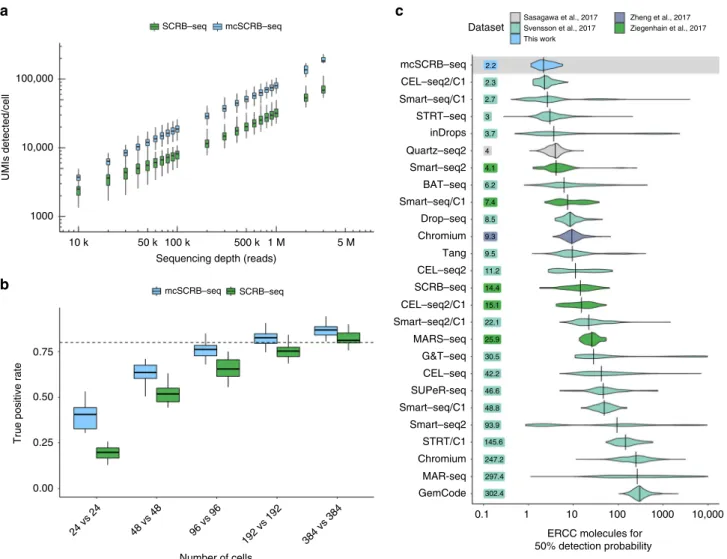
mcseq increases sensitivity 2.5-fold more than
SCRB-seq
. To directly compare the entire mcSCRB-seq protocol to the
previously benchmarked SCRB-seq protocol used in Ziegenhain
et al.
6(Supplementary Table
2
), we sorted for each method 48
and 96 single mESCs from one culture into plates, and added
ERCC spike-ins
19. Following sequencing, we
fi
ltered cells to
discard doublets/dividing cells, broken cells, and failed libraries
(see Methods). The remaining 249 high-quality libraries all show
a similar mapping distribution with ~50% of reads falling into
exonic regions (Supplementary Fig.
7
). When plotting the
num-ber of detected endogenous mRNAs (UMIs) against sequencing
depth, mcSCRB-seq clearly outperforms SCRB-seq and detects
2.5 times as many UMIs per cell at depths above 200,000 reads
(Fig.
2
a and Supplementary Fig.
8
a). At two million reads,
mcSCRB-seq detected a median of 102,282 UMIs per cell and a
median of 34,760 ERCC molecules, representing 48.9% of all
spiked in ERCC molecules (Supplementary Fig.
8
b). Assuming
that the ef
fi
ciency of detecting ERCC molecules is representative
of the ef
fi
ciency to detect endogenous mRNAs, the median
content per mESC is 227,467 molecules (Supplementary Fig.
8
c
and
8
d), which is very similar to previous estimates using mESCs
and STRT-seq, a 5
′
tagged UMI-based scRNA-seq protocol
20. As
expected, the higher number of UMIs in mcSCRB-seq also results
in a higher number of detected genes. For instance, at 500,000
reads, mcSCRB-seq detected 50,969 UMIs that corresponded to
5866 different genes, 1000 more than SCRB-seq (Supplementary
Fig.
9
). Congruent with the above comparison of Terra and
KAPA polymerase, mcSCRB-seq showed a less noisy and
less-biased ampli
fi
cation (Supplementary Fig.
10
). Furthermore,
expression levels differed much less between the two batches of
mcSCRB-seq libraries, indicating that it could be more robust
than SCRB-seq (Supplementary Fig.
11
a). In contrast to
fi
ndings
for other protocols
21, neither mcSCRB-seq nor SCRB-seq showed
GC content or transcript length-dependent expression levels
(Supplementary Fig.
11
b, c).
Decisively, we
fi
nd by using power simulations
6,22that
mcSCRB-seq requires approximately half as many cells as
SCRB-seq to detect differentially expressed genes between two
groups of cells (Fig.
2
b and Supplementary Fig.
11
d). Hence, the
higher sensitivity and lower noise of mcSCRB-seq compared to
SCRB-seq, as measured in parallelly processed cells, indeed
matters for quantifying gene expression levels and can be
quanti
fi
ed as a doubling of cost-ef
fi
ciency. Furthermore, we have
reduced the reagent costs from about 1.70
€
per cell for
SCRB-seq
6to less than 0.54
€
for mcSCRB-seq (Supplementary Fig.
12
a
and Supplementary Table
3
). Together, this makes mcSCRB-seq
sixfold more cost-ef
fi
cient than SCRB-seq. Moreover, owing to an
optimized work
fl
ow, we could reduce the library preparation time
to one working day with minimal hands-on time (Supplementary
Fig.
12
b and Supplementary Table
4
). As SCRB-seq was already
one of the most cost-ef
fi
cient protocols in our recent
bench-marking study
6, this likely makes mcSCRB-seq the most
cost-ef
fi
cient plate-based method available.
Benchmarking by ERCCs
. The widespread use of ERCC
spike-ins also allows us to estimate and compare the absolute sensitivity
across many scRNA-seq protocols using published data
5. As in
Svensson et al.
5, we used a binomial logistic regression to estimate
the number of ERCC transcripts that are needed on average to
reach a 50% detection probability (Supplementary Fig.
13
a).
6.2 42.2 11.2 2.3 15.1 247.2 9.3 8.5 302.4 30.5 3.7 297.4 25.9 2.2 4 14.4 4.1 93.9 2.7 7.4 48.8 22.1 145.6 3 46.6 9.5 GemCode MAR-seq Chromium STRT/C1 Smart–seq2 Smart–seq/C1 SUPeR-seq CEL–seq G&T–seq MARS–seq Smart–seq2/C1 CEL–seq2/C1 SCRB–seq CEL–seq2 Tang Chromium Drop–seq Smart–seq/C1 BAT–seq Smart–seq2 Quartz–seq2 inDrops STRT–seq Smart–seq/C1 CEL–seq2/C1 mcSCRB–seq 0.1 1 10 100 1000 10,000 ERCC molecules for
50% detection probability Dataset Sasagawa et al., 2017 Svensson et al., 2017 This work Zheng et al., 2017 Ziegenhain et al., 2017
c
a
b
1000 10,000 100,000 10 k 50 k 100 k 500 k 1 M 5 M UMIs detected/cell SCRB–seq mcSCRB–seqSequencing depth (reads)
0.00 0.25 0.50 0.75 24 vs 24 48 vs 48 96 vs 96 192 vs 192 384 vs 384 Number of cells
True positive rate
mcSCRB–seq SCRB–seq
Fig. 2Comparison of mcSCRB-seq to SCRB-seq and other protocols.aNumber of UMIs detected in libraries generated from 249 single mESCs using SCRB-seq or mcSCRB-seq when downsampled to different numbers of raw sequence reads. Each box represents the median andfirst and third quartiles per cell, sequencing depth and method. Whiskers indicate the most extreme data point that is no more than 1.5 times the length of the box away from the box.bThe true positive rate of mcSCRB-seq and SCRB-seq estimated by power simulations using the powsimR package22. The empirical mean–variance
distribution of the 10,904 genes that were detected in at least 10 cells in either mcSCRB-seq or SCRB-seq (500,000 reads) was used to simulate read counts when 10% of the genes are differentially expressed. Boxplots represent the median andfirst and third quartiles of 25 simulations with whiskers indicating the most extreme data point hat is no more than 1.5 times the length of the box away from the box. The dashed line indicates a true positive rate of 0.8. The matching plot for the false discovery rate is shown in Supplementary Fig.11d.cSensitivity of mcSCRB-seq and other protocols, calculated as the number of ERCC molecules needed to reach a 50% detection probability as calculated in Svensson et al5. Per-cell distributions are shown using violin plots
mcSCRB-seq reached this threshold with 2.2 molecules, when
ERCCs are sequenced to saturation (Supplementary Fig.
13
b).
When comparing this to a total of 26 estimates for 20 different
protocols obtained from two major protocol comparisons
5,6as
well as additional relevant protocols
17,23, mcSCRB-seq has the
highest sensitivity among all protocols compared to date (Fig.
2
c).
It should be noted that the data show large amounts of variation
within protocols, even for well-established, sensitive methods like
Smart-seq2. This is the case, especially in Svensson et al.
5, because
the data were generated from many varying cell types sequenced
in numerous labs. Similarly, mcSCRB-seq sensitivity estimates
could be variable across labs and conditions. Nevertheless, the
average ERCC detection ef
fi
ciency is the most representative
measure to compare sensitivities across many protocols.
mcSCRB-seq detects biological differences in complex tissues
.
Finally, we applied mcSCRB-seq to peripheral blood
mono-nuclear cells (PBMCs), a complex cell population with low
mRNA amounts, to test whether it is ef
fi
cient in recapitulating
biological differences. We obtained PBMCs from one healthy
donor, FACS-sorted cells in four 96-well plates and prepared
libraries using mcSCRB-seq with a more stringent lysis condition
(see Methods; Fig.
3
a). We sequenced ~203 million reads for the
resulting pool, of which ~189 million passed
fi
ltering criteria in
the
zUMIs
pipeline (see Methods). Next, we
fi
ltered low-quality
cells (<50,000 raw reads or mapping rates <75%; Supplementary
Fig.
14
a), leaving 349 high-quality cells for further analysis
(Supplementary Fig.
14
b). Using the Seurat package
24, we
clus-tered the expression data and obtained
fi
ve clusters that could be
easily attributed to expected cell types: B cells, Monocytes, NK
cells, and T cells (Fig.
3
b). Rare cell types, such as dendritic cells
or megakaryocytes that are known to occur in PBMCs at
fre-quencies of ~0.5
–
1%, could not be detected, as expected from the
low power to cluster 2
–
3 cells. For the detected cell types, known
marker gene expression
fi
ts closely to previously described
results
23(Fig.
3
c, d). Overall, we show that mcSCRB-seq is a
powerful tool to highlight biological differences, already when a
low number of cells are sequenced.
Discussion
In this work, we developed mcSCRB-seq, a scRNA-seq protocol
utilizing molecular crowding. Based on benchmarking data
gen-erated from mouse ES cells, we show that mcSCRB-seq
con-siderably increases sensitivity and decreases ampli
fi
cation bias
due to the addition of PEG 8000 and the use of Terra polymerase,
respectively. Furthermore, it shows no indication of bias for GC
content and transcript lengths, and has low levels of crosstalk
between cell barcodes, which has been seen especially in
droplet-based RNA-seq approaches
23,25. Compared to the previous
SCRB-seq protocol, mcSCRB-seq increases the power to quantify
gene expression twofold. Additionally, optimized reagents and
work
fl
ows reduce costs by a factor of three. Qualitatively, we
validate our protocol by sequencing PBMCs, a complex mixture
of different cell types. We show that mcSCRB-seq can identify the
different subpopulations and marker gene expression correctly
and distinctively detect the major cell types present in the
population.
In this context, we found that it was necessary to use different
lysis conditions for the PBMCs than for mESCs. In our
experi-ence, some cell types may require a more stringent lysis buffer to
stabilize mRNA, which might be a result of internal RNAses and/
or lower RNA content. Therefore, we also provide an alternative
lysis strategy for mcSCRB-seq to deal with more dif
fi
cult cell
types or samples.
Taken together, mcSCRB-seq is
—
to the best of our knowledge
—
not only the most sensitive protocol when benchmarked using
ERCCs, it is also the most cost-ef
fi
cient and
fl
exible plate-based
protocol currently available, and could be a valuable
methodo-logical addition to many laboratories, in particular as it requires
no specialized equipment and reagents.
Methods
cDNA yield assay. For all optimization experiments, universal human reference RNA (UHRR; Agilent) was utilized to exclude biological variability. Unless otherwise noted, 1 ng of UHRR was used as input per replicate. Additionally, Proteinase K digestion and desiccation were not necessary prior to reverse tran-scription. In order to accommodate all the reagents, the total volume for reverse transcription was increased to 10 µl. All concentrations were kept the same, with the exception that we added the same total amount of reverse transcriptase (25 U), thus lowering the concentration from 12.5 to 2.5 U/µl. After reverse transcription, no pooling was performed, rather preamplification was done per replicate. For each sample, we measured the cDNA concentration using the Quant-iT PicoGreen dsDNA Assay Kit (Thermo Fisher).
Comparison of reverse transcriptases. Nine reverse transcriptases, Maxima H-(Thermo Fisher), SMARTScribe (Clontech), Revert Aid H-(Thermo Fisher), Enz-Script (Biozym), ProtoEnz-Script II (New England Biolabs), Superscript II (Thermo Fisher), GoScript (Promega), Revert UP II (Biozym), and M-MLV Point Mutant (Promega), were compared to determine which enzyme yielded the most cDNA. Several dilutions ranging from 1 to 1000 pg of universal human reference RNA (UHRR; Agilent) were used as input for the RT reactions.
RT reactions containedfinal concentrations of 1 × M-MuLV reaction buffer (NEB), 1 mM dNTPs (Thermo Fisher), 1 µM E3V6NEXT barcoded oligo-dT primer (IDT), and 1 µM E5V6NEXT template-switching oligo (IDT). For reverse transcriptases with unknown buffer conditions, the provided proprietary buffers were used. Reverse transcriptases were added for afinal amount of 25 U per reaction.
All reactions were amplified using 25 PCR cycles to be able to detect low inputs. Comparison of template-switching oligos (TSO). Unblocked (IDT) and blocked (Eurogentec) template-switching oligonucleotides were compared to determine yield when reverse transcribing 10 pg UHRR and primer-dimer formation without UHRR input. Reaction conditions for RT and PCR were as described above. Effect of reaction enhancers. In order to improve the efficiency of the RT, we tested the addition of reaction enhancers, including MgCl2, betaine, trehalose, and polyethylene glycol (PEG 8000). Thefinal reaction volume of 10 µl was maintained by adjusting the volume of H2O.
For this, we added increasing concentrations of MgCl2(3, 6, 9, and 12 mM; Sigma-Aldrich) in the RT buffer in the presence or absence of 1 M betaine Aldrich). Furthermore, the addition of 1 M betaine and 0.6 M trehalose (Sigma-Aldrich) was compared to the standard RT protocol. Lastly, increasing concentrations of PEG 8000 (0, 3, 6, 9, 12, and 15% W/V) were also tested. Comparison of PCR DNA polymerases. The following 12 DNA polymerases were evaluated in preamplification: KAPA HiFi HotStart (KAPA Biosystems), SeqAmp (Clontech), Terra direct (Clontech), Platinum SuperFi (Thermo Fisher), Precisor (Biocat), Advantage2 (Clontech), AccuPrime Taq (Invitrogen), Phusion Flash (Thermo Fisher), AccuStart (QuantaBio), PicoMaxx (Agilent), FideliTaq (Affy-metrix), and Q5 (New England Biolabs). For each enzyme, at least three replicates of 1 ng UHRR were reverse transcribed using the optimized molecular crowding reverse transcription in 10 µl reactions. Optimal concentrations for dNTPs, reac-tion buffer, stabilizers, and enzyme were determined using the manufacturer’s recommendations. For all amplification reactions, we used the original SCRB-seq PCR cycling conditions8.
Cell culture of mouse embryonic stem cells. J126and JM827mouse embryonic
stem cells (mESCs) were provided by the Leonhardt lab (LMU Munich) and ori-ginally provided by Kerry Tucker (Ruprecht-Karls-University,Heidelberg) and by the European Mouse Mutant Cell repository (JM8A3;www.eummcr.org), respec-tively. They were used for the comparison of KAPA vs. Terra PCR amplification (Supplementary Fig.5c) and the comparison of SCRB-seq and mcSCRB-seq, respectively. Both were cultured under feeder-free conditions on gelatine-coated dishes in high-glucose Dulbecco’s modified Eagle’s medium (Thermo Fisher) supplemented with 15% fetal bovine serum (FBS, Thermo Fisher), 100 U/ml penicillin, 100μg/ml streptomycin (Thermo Fisher), 2 mML-glutamine (Thermo Fisher), 1 × MEM non-essential amino acids (NEAA, Thermo Fisher), 0.1 mMβ -mercaptoethanol (Thermo Fisher), 1000 U/ml recombinant mouse LIF (Merck Millipore) and 2i (1μM PD032591 and 3μM CHIR99021 (Sigma-Aldrich)). mESCs were routinely passaged using 0.25% trypsin (Thermo Fisher).
mESC cultures were confirmed to be free of mycoplasma contamination by a PCR-based test28.
Cell culture of human-induced pluripotent stem cells. Human-induced plur-ipotent stem cells were generated using standard techniques from renal epi-thelial cells obtained from a healthy donor with written informed consent in accordance with the ethical standards of the responsible committee on human experimentation (216–08, Ethikkommission LMU München) and with the
current (2013) version of the Declaration of Helsinki. hiPSCs were cultured under feeder-free conditions on Geltrex (Thermo Fisher)-coated dishes in StemFit medium (Ajinomoto) supplemented with 100 ng/ml recombinant human basic FGF (Peprotech) and 100 U/ml penicillin, 100μg/ml streptomycin (Thermo Fisher). Cells were routinely passaged using 0.5 mM EDTA. Whenever cells were dissociated into single cells using 0.5 × TrypLE Select (Thermo Fisher), the culture medium was supplemented with 10 µM Rho-associated kinase (ROCK) inhibitor Y27632 (BIOZOL) to prevent apoptosis. NK cell markers T cell markers Monocyte markers B cell markers Monocyte subclustering LYZ PSAP CD3E CD3D TRAC CCR7 GNLY NKG7 GZMA GZMB –15 ––105 0 5 10 –15 ––105 0 5 10 15 10 –50 5 10 FCN1 CD14 FCGR3A –15 ––10 5 0 5 10
CD79A MS4A1 HLA–DRA CD74
–10 0 10 –10 0 10 –15 ––10 5 0 5 10 –10 0 10 –10 0 10 tSNE 1 tSNE 2 –15 –10 –5 0 5 10 –10 0 10
B cells CD14+ Monocytes FCGR3A+ Monocytes NK cells T cells tSNE 1 tSNE 2 B cell markers Monocyte markers NK cell markers T cell markers 0 1 2 3 4 B cells CD14+ Monocytes FCGR3A+ Monocytes NK cells T cells B cells CD14+ Monocytes FCGR3A+ Monocytes NK cells T cells B cells CD14+ Monocytes FCGR3A+ Monocytes NK cells T cells B cells CD14+ Monocytes FCGR3A+ Monocytes NK cells T cells Log expression Human PBMCs 4 × 96 cells mcSCRB-seq
a
b
c
d
Fig. 3mcSCRB-seq distinguishes cell types of peripheral blood mononuclear cells.aPBMCs were obtained from a healthy male donor and FACS sorted into four 96-well plates. Using the mcSCRB-seq protocol, sequencing libraries were generated.btSNE projection of PBMC cells (n=349) that were grouped intofive clusters using the Seurat package24. Colors denote cluster identity.ctSNE projection of PBMC cells (n=349) where each cell is colored according
to its expression level of various marker genes for the indicated cell types. Expression levels were log-normalized using the Seurat package.dMarker gene expression fromcwas summarized as the mean log-normalized expression level per cell. B-cell markers:CD79A,CD74,MS4A1,HLA-DRA; Monocyte markers:LYZ,PSAP,FCN1,CD14,FCGR3A; NK-cell markers:GNLY,NKG7,GZMA,GZMB; T-cell markers:CD3E,CD3D,TRAC,CCR7
hiPSC cultures were confirmed to be free of mycoplasma contamination by a PCR-based test28.
SCRB-seq cDNA synthesis. Cells were dissociated using trypsin and resuspended in 100 µl of RNAprotect Cell Reagent (Qiagen) per 100,000 cells. Directly prior to FACS sorting, the cell suspension was diluted with PBS (Gibco). Single cells were sorted into 96-well DNA LoBind plates (Eppendorf) containing lysis buffer using a Sony SH800 sorter (Sony Biotechnology; 100 µm chip) in“Single Cell (3 Drops)”
purity. Lysis buffer consisted of a 1:500 dilution of Phusion HF buffer (New England Biolabs). After sorting, plates were spun down and frozen at−80 °C. Libraries were prepared as previously described6,8. Briefly, proteins were digested
with Proteinase K (Ambion) followed by desiccation to inactivate Proteinase K and reduce the reaction volume. RNA was then reverse transcribed in a 2 µl reaction at 42 °C for 90 min. Unincorporated barcode primers were digested using Exonu-clease I (Thermo Fisher). cDNA was pooled using the Clean & Concentrator-5 kit (Zymo Research) and PCR amplified with the KAPA HiFi HotStart polymerase (KAPA Biosystems) in 50 µl reaction volumes.
mcSCRB-seq cDNA synthesis. A full step-by-step protocol for mcSCRB-seq has been deposited in the protocols.io repository29. Briefly, cells were dissociated using
trypsin and resuspended in PBS. Single cells (“3 drops”purity mode) were sorted into 96-well DNA LoBind plates (Eppendorf) containing 5 µl lysis buffer using a Sony SH800 sorter (Sony Biotechnology; 100 µm chip). Lysis buffer consisted of a 1:500 dilution of Phusion HF buffer (New England Biolabs), 1.25 µg/µl Proteinase K (Clontech), and 0.4 µM barcoded oligo-dT primer (E3V6NEXT, IDT). After sorting, plates were immediately spun down and frozen at−80 °C. For libraries containing ERCCs, 0.1 µl of 1:80,000 dilution of ERCC spike-in Mix 1 was used.
Before library preparation, proteins were digested by incubation at 50 °C for 10 min. Proteinase K was then heat inactivated for 10 min at 80 °C. Next, 5 µl reverse transcription master mix consisting of 20 units Maxima H- enzyme (Thermo Fisher), 2 × Maxima H- Buffer (Thermo Fisher), 2 mM each dNTPs (Thermo Fisher), 4 µM template-switching oligo (IDT), and 15% PEG 8000 (Sigma-Aldrich) was dispensed per well. cDNA synthesis and template switching was performed for 90 min at 42 °C. Barcoded cDNA was then pooled in 2 ml DNA LoBind tubes (Eppendorf) and cleaned up using SPRI beads. Purified cDNA was eluted in 17 µl and residual primers digested with Exonuclease I (Thermo Fisher) for 20 min at 37 °C. After heat inactivation for 10 min at 80 °C, 30 µl PCR master mix consisting of 1.25 U Terra direct polymerase (Clontech) 1.66 × Terra direct buffer and 0.33 µM SINGV6 primer (IDT) was added. PCR was cycled as given: 3 min at 98 °C for initial denaturation followed by 15 cycles of 15 s at 98 °C, 30 s at 65 °C, 4 min at 68 °C. Final elongation was performed for 10 min at 72 °C. Library preparation. Following preamplification, all samples were purified using SPRI beads at a ratio of 1:0.8 with afinal elution in 10 µl of H2O (Invitrogen). The cDNA was then quantified using the Quant-iT PicoGreen dsDNA Assay Kit (Thermo Fisher). Size distributions were checked on high-sensitivity DNA chips (Agilent Bioanalyzer). Samples passing the quantity and quality controls were used to construct Nextera XT libraries from 0.8 ng of preamplified cDNA.
During library PCR, 3′ends were enriched with a custom P5 primer (P5NEXTPT5, IDT). Libraries were pooled and size-selected using 2% E-Gel Agarose EX Gels (Life Technologies), cut out in the range of 300–800 bp, and extracted using the MinElute Kit (Qiagen) according to manufacturer’s recommendations.
Sequencing. Libraries were paired-end sequenced on high outputflow cells of an Illumina HiSeq 1500 instrument. Sixteen bases were sequenced with thefirst read to obtain cellular and molecular barcodes and 50 bases were sequenced in the second read into the cDNA fragment. When several libraries were multiplexed on sequencing lanes, an additional 8 base i7 barcode read was done.
Primary data processing. All raw fastq data were processed using zUMIs together with STAR to efficiently generate expression profiles for barcoded UMI data14,30.
For UHRR experiments, we mapped to the human reference genome (hg38) while mouse cells were mapped to the mouse genome (mm10) concatenated with the ERCC reference. Gene annotations were obtained from Ensembl (GRCh38.84 or GRCm38.75). Downsampling tofixed numbers of raw sequencing reads per cell were performed using the“-d”option in zUMIs.
Filtering of scRNA-seq libraries. After initial data processing, wefiltered cells by excluding doublets and identifying failed libraries. For doublet identification, we plotted distributions of total numbers of detected UMIs per cell, where doublets were readily identifiable as multiples of the major peak.
In order to discard broken cells and failed libraries, spearman rank correlations of expression values were constructed in an all-to-all matrix. We then plotted the distribution of“nearest-neighbor”correlations, i.e., the highest observed correlation value per cell. Here, low-quality libraries had visibly lower correlations than average cells.
Species-mixing experiment. Mouse ES cells (JM8) and human iPS cells were mixed and sorted into a 96-well plate containing lysis buffer as described for mcSCRB-seq using a Sony SH800 sorter (Sony Biotechnology; 100 µm chip). cDNA was synthesized according to the mcSCRB-seq protocol (see above), but without addition of PEG 8000 for half of the plate. Wells containing or lacking PEG were pooled and amplified separately. Sequencing and primary data analysis was per-formed as described above with the following changes: cDNA reads were mapped against a combined reference genome (hg38 and mm10) and only reads with unique alignments were considered for expression profiling.
Complex tissue analysis. PBMCs were obtained from a healthy male donor with written informed consent in accordance with the ethical standards of the responsible committee on human experimentation (216–08, Ethikkommission LMU München) and with the current (2013) version of the Declaration of Helsinki. Cells were sorted into 96-well plates containing 5 µl lysis buffer using a Sony SH800 sorter (Sony Biotechnology; 100 µm chip). Lysis buffer consisted of 5 M Guanidine hydrochloride (Sigma-Aldrich), 1% 2-mercaptoethanol (Sigma-Aldrich) and a 1:500 dilution of Phusion HF buffer (New England Biolabs). Before library preparation, each well was cleaned up using SPRI beads and resuspended in a mix of 5 µl reverse transcription master mix (see above) and 4 µl ddH2O. After the addition of 1 µl 2 µM barcoded oligo-dT primer (E3V6NEXT, IDT), cDNA was synthesized according to the mcSCRB-seq protocol (see above). Pooling was per-formed by adding SPRI bead buffer. Sequencing and primary data analysis was performed as described above using the human reference genome (hg38). We retained only high-quality cells with at least 50,000 reads and a mapping rate above 75%. Furthermore, we discarded potential doublets that contained more than 40,000 UMIs and 5000 genes. Next, we used Seurat24to perform normalization
(LogNormalize) and scaling. We selected the most variable genes using the
“FindVariableGenes”command (1108 genes). Next, we performed dimensionality reduction with PCA and selected components with significant variance using the
“JackStraw”algorithm. Statistically significant components were used for shared nearest-neighbor clustering (FindClusters) and tSNE visualization (RunTSNE). Log-normalized expression values were used to plot marker genes.
Estimation of cellular mRNA content. For the estimation of cellular mRNA content in mESCs, we utilized the known total amount of ERCC spike-in molecules added per cell. First, we calculated a detection efficiency as the fraction of detected ERCC molecules by dividing UMI counts to total spiked ERCC molecule counts. Next, dividing the total number of detected cellular UMI counts by the detection efficiency yields the number of estimated total mRNA molecules per cell. ERCC analysis. In order to estimate sensitivity from ERCC spike-in data, we modeled the probability of detection in relation to the number of spiked molecules. An ERCC transcript was considered detected from 1 UMI. For each cell, wefitted a binomial logistic regression model to the detection of ERCC genes given their input molecule numbers. Using the MASS R-package, we determined the molecule number necessary for 50% detection probability.
For public data from Svensson et al.5, we used their published molecular
abundances calculated using the same logistic regression model obtained from Supplementary Table2(https://www.nature.com/nmeth/journal/v14/n4/extref/ nmeth.4220-S3.csv). For Quartz-seq217, we obtained expression values for ERCCs
from Gene Expression Omnibus (GEO; GSE99866), sample GSM2656466; for Chromium23we obtained expression tables from the 10 × Genomics webpage
(https://support.10xgenomics.com/single-cell-gene-expression/datasets/1.1.0/ercc) and for SCRB-seq, Smart-seq2, CEL-seq2/C1, MARS-seq and Smart-seq/C16, we
obtained count tables from GEO (GSE75790). For these methods, we calculated molecular detection limits given their published ERCC dilution factors. Power simulations. For power simulation studies, we used the powsimR pack-age22. Parameter estimation of the negative binomial distribution was done using
scran normalized counts at 500,000 raw reads per cell31. Next, we simulated
two-group comparisons with 10% differentially expressed genes. Log2 fold-changes were drawn from a normal distribution with a mean of 0 and a standard deviation of 1.5. In each of the 25 simulation iterations, we draw equal sample sizes of 24, 48, 96, 192 and 384 cells per group and test for differential expression using ROTS32
and scran normalization31.
Batch effect analysis. In order to detect genes differing between batches of one scRNA-seq protocol, data were normalized using scran31. Next, we tested for
differentially expressed genes using limma-voom33,34. Genes were labeled as
sig-nificantly differentially expressed between batches with Benjamini–Hochberg adjustedpvalues <0.01.
Code availability. Analysis code to reproduce major analyses can be found at
https://github.com/cziegenhain/Bagnoli_2017.
Data availability. RNA-seq data generated here are available at GEO under accessionGSE103568.
Further data including cDNA yield of optimization experiments is available on GitHub (https://github.com/cziegenhain/Bagnoli_2017). A detailed step-by-step protocol for mcSCRB-seq has been submitted to the protocols.io repository (mcSCRB-seq protocol 2018). All other data available from the authors upon reasonable request.
Received: 22 December 2017 Accepted: 26 June 2018
References
1. Shapiro, E., Biezuner, T. & Linnarsson, S. Single-cell sequencing-based technologies will revolutionize whole-organism science.Nat. Rev. Genet.14, 618–630 (2013).
2. Tanay, A. & Regev, A. Scaling single-cell genomics from phenomenology to mechanism.Nature541, 331–338 (2017).
3. Kolodziejczyk, A. A., Kim, J. K., Svensson, V., Marioni, J. C. & Teichmann, S. A. The technology and biology of single-cell RNA sequencing.Mol. Cell58, 610–620 (2015).
4. Ziegenhain, C., Vieth, B., Parekh, S., Hellmann, I. & Enard, W. Quantitative single-cell transcriptomics.Brief. Funct. Genomicshttps://doi.org/10.1093/ bfgp/ely009(2018).
5. Svensson, V. et al. Power analysis of single-cell RNA-sequencing experiments.
Nat. Methods14, 381–387 (2017).
6. Ziegenhain, C. et al. Comparative analysis of single-cell RNA sequencing methods.Mol. Cell65, 631–643.e4 (2017).
7. Menon, V. Clustering single cells: a review of approaches on high-and low-depth single-cell RNA-seq data.Brief. Funct. Genomicshttps://doi.org/ 10.1093/bfgp/ely001(2018).
8. Soumillon, M., Cacchiarelli, D., Semrau, S., van Oudenaarden, A. & Mikkelsen, T. S. Characterization of directed differentiation by high-throughput single-cell RNA-Seq. Preprint athttps://doi.org/10.1101/003236
(2014).
9. SEQC/MAQC-III Consortium. A comprehensive assessment of RNA-seq accuracy, reproducibility and information content by the Sequencing Quality Control Consortium.Nat. Biotechnol.32, 903–914 (2014).
10. Picelli, S. et al. Smart-seq2 for sensitive full-length transcriptome profiling in single cells.Nat. Methods10, 1096–1098 (2013).
11. Zimmerman, S. B. & Pheiffer, B. H. Macromolecular crowding allows blunt-end ligation by DNA ligases from rat liver orEscherichia coli.Proc. Natl Acad. Sci. USA80, 5852–5856 (1983).
12. Rivas, G. & Minton, A. P. Macromolecular crowding in vitro, in vivo, and in between.Trends Biochem. Sci.41, 970–981 (2016).
13. Hashimshony, T. et al. CEL-Seq2: sensitive highly-multiplexed single-cell RNA-Seq.Genome Biol.17, 77 (2016).
14. Parekh, S., Ziegenhain, C., Vieth, B., Enard, W. & Hellmann, I. zUMIs - a fast andflexible pipeline to process RNA sequencing data with UMIs.Gigascience
7, giy059 (2018).
15. Parekh, S., Ziegenhain, C., Vieth, B., Enard, W. & Hellmann, I. The impact of amplification on differential expression analyses by RNA-seq.Sci. Rep.6, 25533 (2016).
16. Quail, M. A. et al. Optimal enzymes for amplifying sequencing libraries.Nat. Methods9, 10–11 (2012).
17. Sasagawa, Y. et al. Quartz-Seq2: a high-throughput single-cell RNA-sequencing method that effectively uses limited sequence reads.Genome Biol.
19, 29 (2018).
18. Dixit, A. Correcting chimeric crosstalk in single cell RNA-seq experiments. Preprint athttps://doi.org/10.1101/093237(2016).
19. Baker, S. C. et al. The external RNA controls consortium: a progress report.
Nat. Methods2, 731–734 (2005).
20. Islam, S. et al. Quantitative single-cell RNA-seq with unique molecular identifiers.Nat. Methods11, 163–166 (2014).
21. Phipson, B., Zappia, L. & Oshlack, A. Gene length and detection bias in single cell RNA sequencing protocols.F1000Res.6, 595 (2017).
22. Vieth, B., Ziegenhain, C., Parekh, S., Enard, W. & Hellmann, I. powsimR: power analysis for bulk and single cell RNA-seq experiments.Bioinformatics
33, 3486–3488 (2017).
23. Zheng, G. X. Y. et al. Massively parallel digital transcriptional profiling of single cells.Nat. Commun.8, 14049 (2017).
24. Butler, A., Hoffman, P., Smibert, P., Papalexi, E. & Satija, R. Integrating single-cell transcriptomic data across different conditions, technologies, and species.
Nat. Biotechnol.36, 411–420 (2018).
25. Young, M. D. & Behjati, S. SoupX removes ambient RNA contamination from droplet based single cell RNA sequencing data. Preprint athttps://doi.org/ 10.1101/303727(2018).
26. Li, E., Bestor, T. H. & Jaenisch, R. Targeted mutation of the DNA methyltransferase gene results in embryonic lethality.Cell69, 915–926 (1992). 27. Pettitt, S. J. et al. Agouti C57BL/6N embryonic stem cells for mouse genetic
resources.Nat. Methods6, 493–495 (2009).
28. Young, L., Sung, J., Stacey, G. & Masters, J. R. Detection of mycoplasma in cell cultures.Nat. Protoc.5, 929–934 (2010).
29. Bagnoli, J., Ziegenhain, C., Janjic, A., Wange, L. E. & Vieth, B. mcSCRB-seq protocol.protocols.iohttps://doi.org/10.17504/protocols.io.nrkdd4w(2018). 30. Dobin, A. et al. STAR: ultrafast universal RNA-seq aligner.Bioinformatics29,
15–21 (2013).
31. Lun, A. T. L., Bach, K. & Marioni, J. C. Pooling across cells to normalize single-cell RNA sequencing data with many zero counts.Genome Biol.17, 75 (2016).
32. Seyednasrollah, F., Rantanen, K., Jaakkola, P. & Elo, L. L. ROTS: reproducible RNA-seq biomarker detector—prognostic markers for clear cell renal cell cancer.Nucleic Acids Res.44, e1 (2015).
33. Ritchie, M. E. et al. limma powers differential expression analyses for RNA-sequencing and microarray studies.Nucleic Acids Res.43, e47 (2015). 34. Law, C. W., Chen, Y., Shi, W. & Smyth, G. K. voom: Precision weights unlock
linear model analysis tools for RNA-seq read counts.Genome Biol.15, R29 (2014).
Acknowledgements
We thank Ines Bliesener for expert technical assistance. We are grateful to Magali Soumillon and Tarjei Mikkelsen for providing the original SCRB-seq protocol and to Stefan Krebs and Helmut Blum for sequencing. We would like to thank Elena Winheim for the PBMC sample. This work was supported by the Deutsche
For-schungsgemeinschaft (DFG) through LMUexcellent and the SFB1243 (Subproject A14/ A15).
Author contributions
C.Z. and W.E. conceived the study. J.W.B., C.Z., A.J. and L.E.W. performed experiments and prepared sequencing libraries. J.G. and J.W.B. cultured mouse ES and human iPS cells. Sequencing data were processed by S.P. and C.Z. J.W.B., C.Z., A.J. and B.V. ana-lyzed the data. J.W.B., C.Z., A.J., I.H. and W.E. wrote the manuscript.
Additional information
Supplementary Informationaccompanies this paper at https://doi.org/10.1038/s41467-018-05347-6.
Competing interests:The authors declare no competing interests.
Reprints and permissioninformation is available online athttp://npg.nature.com/ reprintsandpermissions/
Publisher's note:Springer Nature remains neutral with regard to jurisdictional claims in published maps and institutional affiliations.
Open Access This article is licensed under a Creative Commons Attribution 4.0 International License, which permits use, sharing, adaptation, distribution and reproduction in any medium or format, as long as you give appropriate credit to the original author(s) and the source, provide a link to the Creative Commons license, and indicate if changes were made. The images or other third party material in this article are included in the article’s Creative Commons license, unless indicated otherwise in a credit line to the material. If material is not included in the article’s Creative Commons license and your intended use is not permitted by statutory regulation or exceeds the permitted use, you will need to obtain permission directly from the copyright holder. To view a copy of this license, visithttp://creativecommons.org/ licenses/by/4.0/.