PMSG Based Wind Power System with
Effective Power Generation
Manpreet Kour1, Vikramjeet Singh2
M.Tech Student, Dept. of Electrical Engineering, Sri SAI College of Engineering, Pathankot, India1 Assistant Professor, Dept. of Electrical Engineering, Sri SAI College of Engineering, Pathankot, India2
ABSTRACT:Several renewable sources have been through a good development in the last decades. Therefore, their
combination would apparently provide a good uninterruptible power system. Hybrid power systems are designed for the generation and use of electrical power. They are independent of a large, centralized electricity grid and incorporate more than one type of power source. Research work is carried out to simulate power system with wind energy using MATLAB SIMULINK software. Experiment is carried out and wind power generator is simulated with various wind speed parameters and electrical parameters such as voltage, current, and power are computed. The simulated results shows the system works satisfactorily providing high electrical parameters
KEYWORDS: Wind energy, PMSG, Power.
I.INTRODUCTION
Power source is one of the essential factors for the development of human societies. It is one of the fundamental necessities for every day’s life which makes our daily living more convenient. The shortage of fossil fuel and their unstable prices increase the demand of renewable energy that become viable alternative energy sources for electrical power production in remote area [1]. That’s why the design of hybrid power system has received considerable attention. It may constitute economical solution in many applications, and provide more reliable supply of electricity through the combination of several energy sources. More than two billion people in small villages in many developing countries, grid based electricity service has not yet reached. In many areas, grid extension is not possible due to dispersed populations, rugged terrain, or both [2]. Thus lack of grid based electricity service and grid extension problem gives rise to the use of small off-grid standalone renewable energy systems. Thus this system becomes an important option for narrowing the electricity gap in rural parts of the developing world as the progress in grid extension remains slower than population growth [3-5]. These small-scale energy systems contribute to life quality in remote areas in developing countries, even though they generate relatively less power. In such cases, the electrification by hybrid energy system is the best option. In general, a hybrid system might contain AC diesel generators, DC diesel generators, an AC distribution system, a DC distribution system, loads, renewable power sources (wind turbines, or photovoltaic power sources), energy storage, power converters, rotary converters, coupled diesel systems, dump loads, load management options, or a supervisory control system [6].
A wind power generator converts the wind kinetic energy into mechanical energy. Wind turbines can be separated into two types depending upon the axis of rotation. Horizontal axis turbines are more common used and vertical axis are less frequently used. These systems can also be classified by the location in which they are located such as onshore, offshore, and aerial. Rural area with high altitude requires hybrid power systems are very essential. Since some of these rural communities suffer conventional electricity supply systems, the supply of these communities with alternative solar energy will be of great economic and technological values [7-8].
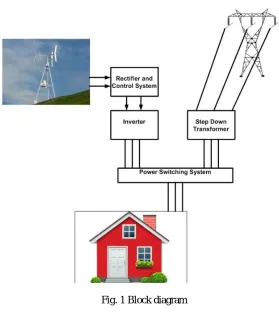
Fig. 1 Block diagram
II. LITERATURE SURVEY
Muljadi and McKenna (2002) analysed a power system network that consisted of two types of power generation: wind turbine generation and diesel generation. The power quality and the interaction of diesel generation, the wind turbine, and the local load were the subjects of investigation.The purpose of this paper is to show the impact of the wind power plant on the entire system [9].
Dekker et al. (2012) described recently hybrid power systems (HPSs) consisting of integrated operation of two or more different types of energy sources and storage devices are being deployed for rural electrification or electrification of remote areas in many countries across the world. This paper reports on the investigating economic feasibility of a PV/diesel HPS in various climatic zones within South Africa [10]
Sharma and Bhatti (2013) presented the automatic reactive power control of isolated wind–diesel hybrid power systems having a permanent-magnet induction generator for a wind energy conversion system and a synchronous generator for a diesel generator set. This paper also shows the dynamic performance of the hybrid system with and without change in input wind power plus 1% step increase in reactive power load [11].
III. METHODOLOGY
Research work is carried out simulate wind generator. Various components used in this simulation are Pitch angle controller, wind turbine model, drive train and Permanent Magnet Synchronous generator (PMSG). The Permanent Magnet Synchronous Machine block operates in either generator or motor mode. The mode of operation is dictated by the sign of the mechanical torque (positive for motor mode, negative for generator mode). The electrical and mechanical parts of the machine are each represented by a second-order state-space model.
The output power of the turbine is given by the following equation:
Where,
Pm = Mechanical output power of the turbine (W)
cp = Performance coefficient of the turbine
ρ = Air density (kg/m3) A = Turbine swept area (m2) vwind = Wind speed (m/s)
λ = Tip speed ratio of the blade tip speed to wind speed β = Blade pitch angle (deg)
Fig. 2 Block diagram of wind generating system.
IV. RESULT AND DISCUSSION
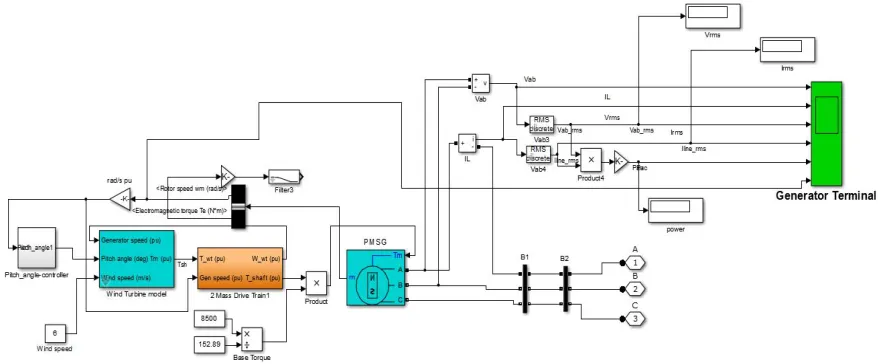
In this part of research work wind generator is designed shown in Fig. 3 and various output parameters are plotted with respect to wind speed. Table 1 shows various values of power, RMS voltage and RMS current with respect to various wind speed. It can be seen from the table that with the increase in the wind speed, the voltage and current increases and thus the power increases. Hence the efficiency of wind generator increases. Fig. 3 represents a wind generator model simulated in MATLAB SIMULINK.
Table 1 shows various values of power, RMS voltage and RMS current with respect to various wind speed. It can be seen from the table that with the increase in the wind speed, the voltage and current increases and thus the power increases. Hence the efficiency of wind generator increases.
Table 1 Electrical parameters with respect to wind speed.
Wind speed (m/sec) Power (W) Vrms (V) Irms (A)
5 1129 169.1 3.854
6 1316 184.6 4.115
7 1701 210.3 4.669
8 2361 252.4 5.624
9 3061 282.5 6.254
10 3739 302.9 7.128
11 5045 352.9 8.255
12 6047 384.1 9.089
13 7160 420.8 9.824
14 8795 466.1 10.9
15 11180 529.8 12.18
16 12890 566.3 13.14
17 15340 624.6 14.18
18 17400 660.9 15.2
19 20620 714.9 16.65
20 23200 756.7 17.7
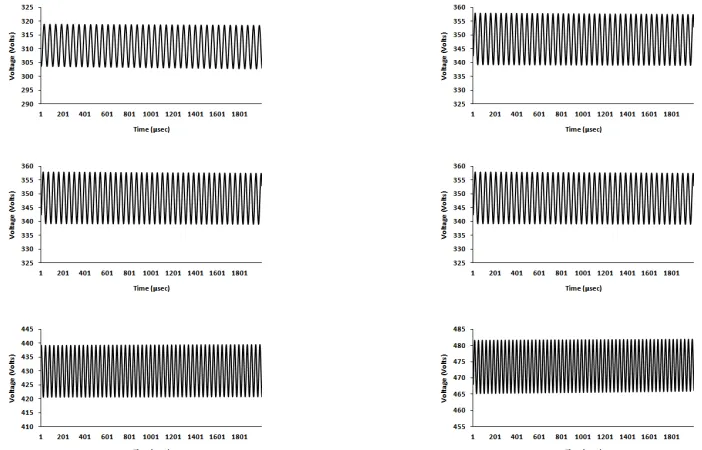
Figure 4 (a)-(f) shows the plots of voltage with respect to time at wind speed ranging from 8 to 13 m/sec. As it is seen with the increase in speed voltage also increases.
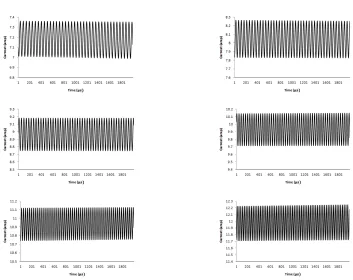
Fig 5 (a)-(f) Current Vs Time plots at wind speed ranging from 8 to 13 m/sec
V.CONCLUSION
The research work is carried out to simulate the performance of wind power generator system. An experiments has been performed using Simulink to designed and simulate wind power system. Various electrical parameters such as RMS voltage, RMS current and power has been computed with respect to different wind speeds. It is seen that at low speed, unstable low voltage, current and power are obtained. As the wind speed parameters is increased the corresponding values of electrical parameters also increases. The minimum values of RMS voltage, RMS current and power is 169.1V, 3.854A and 1129W at 5m/sec respectively and the maximum values of RMS voltage, RMS current and power is 756.7V, 17.7A and 23,200 W at 20 m/sec respectively.
REFERENCES
[1] D. Saheb-Koussa , M. Haddadi and M. Belhamel, “Economic and technical study of a hybrid system (wind–photovoltaic–diesel) for rural electrification in Algeria”, J Applied Energy, vol. 86, pp. 1024- 1030, 2009.
[2] S. Ashok, “Hybrid Energy System,” NITC Research Review, vol. 3, 2009.
[3] Muluktla S. Sharma, Introduction to Electrical Engineering. Oxford University Press, 2001.
[4] Zheng, Ming, Graham T. Reader, and J. Gary Hawley. "Diesel engine exhaust gas recirculation––a review on advanced and novel concepts." Energy conversion and management, vol. 45, pp. 883-900, 2004.
[5] Apoorva Kkanthwal and Aman Ganesh, “Hybrid Wind-Diesel Generation System”, J Applied Engineering Research,vol. 7,2012.
[6] Eduard Muljadi, and H. Edward McKenna, “Power Quality Issues in a Hybrid Power System” IEEE transactions on industry applications, vol.38, 2002.
[7] Hidouri, Noureddine, Taoufik Mhamdi, Samah Hammadi, and Lassâad Sbita. "A New hybrid photovoltaic-diesel system control scheme for an isolated load,” International Journal of Research and Reviews in Applied Sciences, vol. 9, pp. 270-281, 2011.
[8] Niharika Varshney, M. P. Sharma, and D. K. Khato, “Optimal Design of Mini Grid for Hybrid Energy System”, International Journal of Emerging Technology and Advanced Engineering, vol. 3, 2013.
[9] J. Hetzer, D.C. Yu and Kalu Bhattarai, “An Economic Dispatch Model Incorporating Wind Power”, IEEE Transactions On Energy Conversion, Vol. 23, 2008.
[10] J. Dekker, M. Nthontho, S. Chowdhury and S.P. Chowdhury, “Economic analysis of PV/diesel hybrid power systems in different climatic zones of South Africa”, Electrical Power and Energy Systems, vol.40, pp.104-112., 2012.