A Study on Solid Waste Collection
Systems
B.Chandrasekharan, DR.C.Parthasarathy, K. Divakar Chowdary, G. Jayadeep, K.Puneeth,
Research Scholar, ECE, SCSVMV University, India
Asst. Professor, IT, SCSVMV University, India
IV ECE Student, ECE, SCSVMV University, India
IV ECE Student, ECE, SCSVMV University, India
IV ECE Student, ECE, Y S R Engineering college, India
ABSTRACT: This paper provides a literature review of current state-of-the-art systems analysis techniques for urban solid waste collection and identifies four intrinsic deficiencies of the existing studies over different types of cities. As a demonstration, a multi constrained and multi compartment routing problem is modeled with roll-on roll-off scheduling strategies in a two-stage decision-making process to exhibit the highest complexity of its kind in practical implementation. The constraints of time windows, intermediate facilities, multi shifts, and split deliveries make an ideal combination of all essential complexities in modeling practices. To overcome the relevant challenges, a unified heuristic algorithm is proposed for addressing node routing and roll-on roll-off routing problems. The proposed heuristic algorithm that concatenates initialization and improvement phases solves the models with numerical efficiency to search for the most cost effective and environmentally benign solutions. Results indicate that differentiated collection increases opportunities to pursue the best routing strategies with sustainable implications through sensitivity analysis at the expense of higher collection costs. The analysis concludes with the perspectives of a smart and green waste collection system designed to create a more sustainable waste management systems in the future.
KEYWORDS: Multi compartment, multi constrained, roll-on roll-off scheduling, systems analysis, waste collection, waste separation.
I. INTRODUCTION
RBAN solid waste generation increases with rapid urbanization and population growth. To improve resilience, municipalities need to promote waste prevention and recycling at the local scale rather than relying heavily on regional waste treatment and disposal facilities. However, using a combination of waste separation and differentiated collection complicates the current schemes of waste collection because more types of bins and containers are needed at collection nodes, and vehicles must deal with various types of waste streams. To improve collection efficiency, cost-effectiveness, and sustainability, the systems analysis of waste collection strategies has grown in importance yet has become more complicated. Increasing attention has been paid to optimization of waste collection schemes since the early 1970s [7], including fine tuning waste allocation with the aid of vehicle routing strategies. Several reviews provided comprehensive coverage of various waste collection vehicle routing problems (VRPs) [10] and optimization models for better waste management [12]. These previous studies involved various decision-making factors covering economy, technology, society, environment, and even ecology. However, they neither addressed regional differences nor involved the local complexity of waste collection with an ideal combination of different modeling practices over different scales. Few studies addressed the coordination of holistic waste collection processes with regard to waste separation and recycling for promoting sustainability. Additionally, the current integration of system analysis methods and informatics is mostly at a basic level. Hence, the existing methods often cannot be immediately applied to manage waste collection VRPs with different types of constraints for sustainability concerns facing both developing and developed countries. The global trend indicates that increasing efforts will be needed to integrate system analysis methods with various informatics, such as global positioning system (GPS), geographic information system (GIS), and radio-frequency identification (RFID), leading to utilization of Internet-of-things for smart and green waste management strategies in the future [26]. This paper provides a thorough literature review of the optimization schemes for waste collection and vehicle routing, followed by a demonstration of a representative two-stage waste collection system to show the highest complexity of its kind over all current urban solid waste collection
schemes. This system shows that all contemporary advancements of existing optimization strategies can be well coordinated to provide smart and green solutions. The novelty of this paper is the inclusion of multiple constraints in node routing and multi compartment vehicle routing with roll-on roll-off routing schemes. The routing efficiency is compared in great depth between co-collection and separate collection. This type of routing scheme allows split deliveries for not only collection nodes but also for each of the waste streams to improve routing efficiency. This paper finally elucidates the modern views of smart and green urban solid waste collection systems with respect to future perspectives.
II. LITERATURE REVIEW
Waste collection systems analyses have been the focus of almost 80 core articles, whose spectrum can be classified into five categories including: 1) optimal location for sitting the collection nodes; 2) simultaneous node and arc routing problems; 3) roll-on roll-off routing problems; 4) planning with the aid of informatics technologies.
A. Optimal Location for Sitting the Collection Nodes Determining optimal locations for the collection nodes, such as bins, containers, and transfer stations, is often tied to cost effectiveness and access convenience. Selecting too many collection nodes would increase the collection cost, whereas selecting too few would reduce service quality [8]. A smart waste collection system should address the optimal number of collection nodes and their locations. Integer programming models are usually used for optimizing the selection of collection nodes (see Table I). These models aim to minimize the collection costs and maximize the access convenience and can be also enhanced by GIS if the existing and candidate nodes are positioned by GIS maps [2], [11], [13].
B. Simultaneous Node and Arc Routing Problems
The routing and scheduling of waste collection are generally modeled as VRPs (see Table II), which aim to minimize the total travel distance without violating any constraints. As noted in the literature [35], [44], the waste collection VRPs in the U.S. include node routing problems for commercial waste, arc routing problems for household waste, and roll-on roll-off problems for the transport of large containers. Among them, the node routing problem is the focus of most VRP studies. When the collection demand of each node is much less than the vehicle capacity, a vehicle can visit many nodes along the arcs of the road network. This scenario leads to an arc routing problem, in which the vehicle must visit all nodes along an arc once this arc is visited. The node and arc routing problems have a modeling framework in common; the subtle difference is that the demand for waste collection belongs to nodes in node routing but to arcs in arc routing. However, the arc routing Problem can be transformed into a node routing problem per se
TABLE II
SUMMARY OF EXISTING STUDIES ON THE SIMULTANEOUS NODE AND ARC ROUTING PROBLEMS
Earlier studies often modeled residential and commercial waste collection systems as capacitated VRPs without considering many real-life constraints. They allowed a customer (i.e., a collection point) to be visited periodically and allowed the vehicle no more than one trip per day. Angelelli and Speranza [37] did not even consider waste collection as a VRP in case a vehicle has more than one collection route per day. This kind of simplification is no longer reasonable given the advancement of operation research theories, computational capacity, and current complexity associated with modern urban solid waste collection systems. To approximate a more accurate and representative reality, recent studies [35], [39], [41], [43] in this century largely involved multiple realistic constraints such as time windows, lunch breaks, intermediate facilities, multiple shifts, and stochastic demands.
In principle, the optimal or near-optimal solutions for the waste collection VRPs can be obtained by mathematical programming techniques or heuristic algorithms, and solutions can be integrated into a GIS environment for visual decision support [53]. Although mathematical programming techniques can lead to exact solutions or credible bounds, heuristic algorithms are preferred because they can obtain appropriate solutions reasonably quickly. These heuristic algorithms include classical heuristics and meta heuristics. Classical heuristics are often applied to help initialize a near-optimal solution and aid in a local search, and meta heuristics are used for global improvement. Classical heuristics for the capacitated VRP can be modified to manage constraints such as time windows [56] and lunch breaks [39]. For intermediate facilities or multi compartments,
C. Roll-on Roll-Off Routing Problem
The roll-on roll-off routing problem is defined by the inclusion of large containers required to collect waste in rotation. This type of problem is a special variant of the regular waste collection VRPs because each truck (or tractor) is limited to carrying a single large container at a time. This problem is also called the 1-skip collection problem in the literature [6]. If the demand of each customer is an integral multiple of the vehicle capacity, it also can be considered as a roll-on roll-off VRP (RRVRP), which is less complicated than the node and arc routing problem but more complicated than the transport problem. This kind of waste collection VRP was solved by combining multiple bounding methods with heuristic methods (see Table III).
D. Planning With the Aid of Informatics Technologies
TABLE III
SUMMARY OF EXISTING STUDIES ON PLANNING WITH THE AID OF INFORMATICS
III. MODELING FOR THE TWO-STAGE WASTE COLLECTION SYSTEM WITH HIGHEST COMPLEXITY
The two-stage waste collection system has been widely applied in many Chinese cities such as Beijing, Guangzhou, and Shenzhen, and while more representative than the single-stage collection system, it complicates the modeling practices. These waste collection systems do not currently differentiate waste streams but will be reformed soon in view of waste separation initiatives proposed over the past several years. The following modeling practice demonstrates the complexity of a multi constrained and multi compartment roll-on roll-off waste collection system. The modeling analysis assumes that the amounts of each waste stream at each collection point are the same every day.
A. Undifferentiated Waste Collection
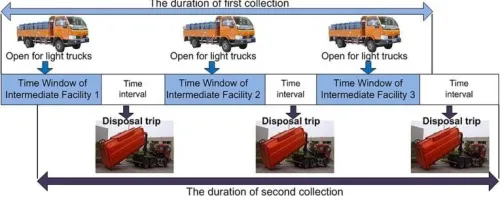
1) Daily Waste Collection: The two-stage waste collection system (see Fig. 2) employs two types of vehicle, each of which initiates and terminates its work at the same depot. The start time of the second collection is later than that of the first collection, and the vehicles are required to have two working shifts per day. In the first stage, a light truck collects filled bins from collection point to collection point and when fully loaded will visit the nearest open transfer station to transfers the waste into large containers. Each transfer station has one to several large containers. The empty light truck then starts another collection trip and finally ends its working shift at the depot. During the second stage, hook-lift trucks transport filled containers from the transfer station to a treatment plant or disposal site. Every hook-lift truck is restricted to delivering one container at a time. A trip that delivers the empty container back to its original location of the transfer station is referred to as a round-trip mode, and a trip that delivers the empty container to another transfer station is referred to as exchange-trip mode. The exchange-trip mode is more efficient than the round-trip mode but needs unified management and deployment. For modeling convenience, the undifferentiated collection of a light truck is denoted by FC1 (i.e., first collection mode 1), whereas round-trip and exchange-trip are denoted by SC1 (i.e., second collection mode 1) and SC2 (i.e., second collection mode 2), respectively.
off, creating a time window complication for the first collection stage. It is important that the time windows of a container are determined by the routing and scheduling of hook-lift trucks. To simplify the problem, the roll-on roll-off routing problem is solved before the time windows of each container are obtained. Subsequently, a transfer station with multiple disposal trips is decomposed into multiple intermediate facilities for the node routing problem, each with a fixed time window. For example, if a transfer station has two containers, each of which has three disposal trips, this transfer station would be decomposed into six intermediate facilities. In other words, if a container has three disposal trips, it has three mapped intermediate facilities, whose Facilities mapped from the same container.
B. Differentiated Collection
1) Daily Waste Collection: The current waste separation plan in China often classifies solid waste as four waste streams, including organic, recyclable, toxic, and residual. However, collection firms only address two waste streams during the daily operation because the amount of toxic waste is small, and because the scavengers and scrap dealers sort the recyclable materials before collection. When the two-stage waste collection system is tied to differentiated collection operations, bins and containers are allocated to collect two waste streams at fixed locations. The working processes of second collection are not changed because what the hook-lift truck needs to do is to transport a filled container to a suitable treatment plant or disposal site. The light truck has two alternatives: separately collecting a single stream as an un partitioned vehicle, or co-collecting various streams as a multi compartmented vehicle. The light truck can be used as
a multi compartmented vehicle because waste streams on board are segregated by bins. Note that the total capacity of a vehicle is fixed, but the capacity of a certain compartment is variable (see Fig. 4). Co-collection and separate collection schemes are denoted by FC2 (i.e., first collection mode 2) and FC3 (i.e., first collection mode 3) in the modeling practice, respectively.
2) Modeling Analysis: When the two-stage collection system is reorganized to include the differentiated options for two waste streams in the daily operation, a few minor changes must be implemented in the modeling analysis. For the second collection, a suitable treatment plant for handling a particular waste type is added to the roll-on roll-off routing problems; however, models of SC1 and SC2 need not be changed if the treatment plants can manage different types of waste streams. For the first collection, however, separate collection (FC3) requires using two models to optimize the two types of waste stream, each of which is similar to undifferentiated collection (FC1). Whereas co-collection (FC2) uses one model to optimize both types of waste stream, the FC2 model is different from FC1 in terms of vehicle capacity limitation and supply–demand balance constraints.
IV. SOLUTION PROCEDURE WITH THE HEURISTIC ALGORITHM
Heuristic algorithms have been proposed to obtain vehicle routing and scheduling for the waste collection VRP models with highest complexity. The proposed algorithms have a unified framework to obtain solutions for both collection stages. The unified framework concatenates two steps to approximate the optimal solution of this multi constrained and multi compartment roll-on and roll-off waste collection issue (MCMCRORO algorithm). The initialization step constructs an initial feasible solution and the improvement step then combines local search and TS to
achieve the alleged best solution. A solution is composed of multiple vehicle routes, each of which may be partitioned into multiple elementary routes by intermediate facilities. In the unified framework, each waste collection VRP involves three kinds of vertices: the depot, customers, and intermediate facilities. The difference in the solution between two collection stages in sequence is the number of customer on an elementary route.
A. Initial Solution
The proposed method for the initial feasible solution (Algorithm 1 in Table IV) is inspired by the tentative insertion methods used in [40] and [41]. Each vehicle located at the current vertex r keeps searching for the nearest customer u in the un routed customer set U. Customer u will be visited if and only if its nearest feasible intermediate facility F(u) exists. The feasibility of F(u) means that time and capacity constraints are not violated in the travel, including visiting
u, unloading at F(u), and returning to the depot. Note that F(u) consists of two unloading facilities for handling two
waste streams in a co-collection system. If the vehicle has ample time and capacity after visiting u, the procedure will decide whether it needs to visit another un routed customer; otherwise, the vehicle goes to F(u) for unloading. If it is time to change shifts, the vehicle should return to the depot.
TABLE IV
ALGORITHM 1—THE GENERAL STRUCTURE OF SOLUTION INITIALIZATION
Algorithm 1 uses two methods to obtain the nearest customer u and associated F(u). For a roll-on roll-off routing problem with a small number of vertices, the solution procedure scans over U to find an appropriate u. Because each iteration requires multiple sub cycles to check all the intermediate facilities for each un routed customer, this method could become hugely time consuming if the number of vertices is large. For a node routing problem with many vertices, the solution procedure generates the visiting sequence of customers by efficient algorithms for the traveling salesman problem (TSP), such as GENI [68], and then inserts appropriate intermediate facilities into the TSP tour. This substitute method can save computational time because it omits much of the meaningless scanning and sub cycles; however, the substitute method could decrease the quality of the solution.
B. Local Search
1) Two Kinds of 2-opt∗Operations: The 2-opt∗ operation decomposes each vehicle route into two strings by
removing one arc. This method was shown to be effective in reducing the vehicle number [35]. This study uses two kinds of 2-opt∗schemes. The 2-opt∗_1 deletes arcs (j,F(j)) and (w,F(w)) before the intermediate facility or facilities,
and the 2-opt∗_2 deletes arcs (F(j),l) and (F(w),x) after the intermediate facility or facilities. After deletion, inter-route
arcs are built to generate new vehicle routes.
2) Two Kinds of CROSS Operations: The CROSS operation is a more computationally expensive generalization of the 2-opt∗moves and decomposes each vehicle route into three strings by removing two arcs. This study uses two kinds of
CROSS schemes: CROSS_1 exchanges two groups of consecutive customers between two vehicle routes, and CROSS_2 exchanges two elementary routes.
V. RESULTS AND DISCUSSION
The MCMC-RORO algorithm is coded and complied in a MATLAB 7.8 environment. The program is run on a computer with 3.2-GHz processor (Intel Core 2 Duo E5800) and 2-GB memory. The Luohu district of Shenzhen in China was selected for the purpose of demonstration.
A. Real-life ExampleThe study area in the Luohu district of Shenzhen, China is an ideal case to elucidate the complexity of an urban solid waste collection system. Its two-stage waste collection scheme involves 3 treatment plants, 43 transfer stations, and numerous collection points. The system uses two kinds of collection vehicles to collect 1130 tons of waste per day.
Light truck can carry 18 bins (about 2 tons) at most, whereas the hook-lift truck can carry about 10 tons of waste in one container per trip. The waste collection business is divided into various sections. The northwestern section covering about 3 km2 was chosen for modeling analysis to solve the node routing problem. This section involves 9 transfer stations and 80 collection points, aiming to collect 118.6 tons of waste per day. All the containers associated with 9 transfer stations would have 18 disposal trips in total per day; therefore, there are 80 customers and 18 intermediate facilities in the node routing problem per se. In more detail, the total customer demand is 1244 bins, the average demand per customer is 15.6 bins, and the demands for two waste streams are 753 and 491 bins when using differentiated collection.
The light trucks work during the period between 4:00 and 20:00 and change shifts at the period from 12:00 to 13:00. The working duration of hook-lift trucks is 2 h later than the light trucks. The time windows in the node routing problem are obtained by solving the roll-on roll-off routing problem with regard to the prescribed coordination systematically. TW1 generated in SC1 is about 116 min narrower than TW2 generated in SC2. TW0 assumes that the intermediate facilities remain open. The travel times and distances among locations can be acquired from a GIS database.
B. Results of the Node Routing Problems
The values of model parameters are determined by preliminary tests based on the literature [40], [69]. The maximum number of iteration is set equal to 800, which guarantees both the calculation accuracy and relatively low computational time. The CROSS move operation was found superior to other move operations.
After the preliminary tests, the heuristic algorithm is run to obtain the results (see Table V). The improvement rates of TS over the initial solutions prove the effectiveness of TS. The zero improvement of TS in the case of TW1 reveals that the narrow time windows handicap optimization. The results show that the optimization process approximated by the MCMCRORO algorithm has an immense advantage over other empirical scheduling counterparts. Most important, the results provide invaluable insight into implementation of differentiated waste collection. Table X reveals that differentiated collection increases the collection costs, and routing costs show that FC3 may outperform FC2. Although it seems that FC3 uses one more vehicle, the extra vehicle only serves a few customers and can be laid off by adjusting the route capacity or the length of work duration. In addition, the weakness of the narrow time windows (TW1) is particularly conspicuous in FC2, as evidenced by the difference in unit cost
CROSS_1 move operation. We speculate that the temporal distribution of time windows acutely affects further improvement of the routing cost as well as the average width of time windows.
2) Route Capacity N∗: The results in Table X are computed when the route capacity N∗is set equal to 20.
Although the collection efficiency is raised by 66.7% in comparison with the empirical scheduling counterpart when N∗= 20, each vehicle has more than 100 min of free time after completing 20 elementary routes. Hence, the
impact of N∗on routing costs is assessed. Increasing the value of N∗is seemingly beneficial (see Fig. 7), but the
effect is irregular and not always useful; therefore, the value of N∗remains the same.
VI. SMART AND GREEN URBAN SOLID WASTE COLLECTION SYSTEMS: FUTURE PERSPECTIVES
The VRP models and heuristic algorithms contribute to the green solution with shorter traveling distances, fewer vehicle numbers, and reduced environmental impacts. These models and algorithms can aid in the waste collection performance if integrated with information techniques such as RFID, GPS, and GIS, techniques known to promote the planning of waste collection and contribute to a smart waste collection systems. Such green goals are not difficult to achieve because information systems for waste collection have already been developed in big cities such as Shenzhen [70]; however, these systems have only basic-level integration, such as tracking vehicles by GPS. If a few technical barriers can be improved these methods can enhance the efficiency and cost-effectiveness of the whole waste collection process with less environmental impact.
1) Identification and Tracking: Different waste streams stored in different bins can be identified and traced by RFID, and different waste types can be distinguished by image sensing. The RFID tag communicates with RFID readers, image sensor nodes, and even smart phones. The attributes of a bin attached with a RFID tag are pulled from the remote database through querying the unique identification code of the tag. Moreover, RFID, GPS, Wi-Fi, and other sensor nodes can be combined as a trilateration-based real-time location system, which can provide positioning for not only collection vehicles but also indoor and outdoor collection points. With the aid of RFID and real-time location, the waste flow can be finely and more efficiently controlled from spatial and temporal perspectives.
networks extend the ubiquitous sensor nodes for various applications. They are mostly bidirectional, enabling the transmission of data and the reception of instruction, and mostly wireless, enabling the spatial distribution of autonomous sensor nodes. Sensor networks can be integrated with other kinds of wireless mesh networks, such as a Wi-Fi based medium-range network, to reduce the complexity and cost for a large-scale and self-adaptive smart application.
3) Smart and Green Waste Collection Strategies: Future information systems may help perform smart and green waste collection across the whole process (see Fig. 9). In such a system, RFID tags are attached to bins and containers, RFID readers and GPS are equipped to vehicles, and weighing scales are distributed at transfer stations. All the elements can communicate with each other through sensor networks with the aid of centralized and/or decentralized servers to gather information in real time and dynamically run the proposed MCMC-RORO or similar algorithms. The optimized routing and scheduling strategies can be sent to vehicles with instructions via the smart phone and other terminals. The performance of vehicles and other equipment linked to these communication networks can be monitored and analyzed at all times, and the improvement strategies can be continually generated and reported back to the crew members and mission-control staff. The decision makers, public agencies, collection firms, crew members, and other stakeholders may interactively participate in such sustainable solid waste management plans through these smart and green waste collection systems. For more details about how to perform
the integration of system analysis models and information technologies, please refer to the literature [26].
VII. CONCLUSION
smart and green urban waste collection system. Such futuristic delineation may benefit various simulation and optimization schemes with varying realistic constraints for sustainable solid waste management across heterogeneous, fast growing urban environments.
REFERENCES
[1] L. De Meulemeester, G. Laporte, F. Louveaux, and F. Semet, “Optimal sequencing of skip collections and deliveries,” J. Oper. Res. Soc., vol. 48, no. 1, pp. 57–64, Jan. 1997.
[2] N.-B. Chang and Y. T. Lin, “Optimal siting of transfer station locations in a metropolitan solid waste management system,” J. Environ. Sci. Health A, vol. 32, no. 8, pp. 2379–2401, 1997.
[3] L. Bodin, A. Mingozzi, R. Baldacci, and M. Ball, “The rollon-rolloff vehicle routing problem,” Transp. Sci., vol. 34, no. 3, pp. 271–288, Aug. 2000.
[4] J. Wy and B.-I. Kim, “A hybrid metaheuristic approach for the roll-on roll off vehicle routing problem,” Compute. Oper. Res., vol. 40, no. 8, pp. 1947–1952, Aug. 2013.
[5] N. B. Chang and Y. L. Wei, “Siting recycling drop-off stations in urban area by genetic algorithm-based fuzzy multi objective nonlinear integer programming modeling,” Fuzzy Sets Syst., vol. 114, no. 1, pp. 133–149, Aug. 2000.
[6] C. Archetti and M. G. Speranza, “Vehicle routing in the 1-skip collection problem,” J. Oper. Res. Soc., vol. 55, no. 7, pp. 717–727, Jul. 2004. [7] E. J. Beltrami and L. D. Bodin, “Networks and vehicle routing for municipal waste collection,” Networks, vol. 4, no. 1, pp. 65–94, 1974. [8] J. J. Kao and T. I. Lin, “Shortest service location model for planning waste pickup locations,” J. Air Waste Manage. Assoc., vol. 52, no. 5, pp.
585–592, May 2002.
[9] J. Wy, B.-I. Kim, and S. Kim, “The rollon-rolloff waste collection vehicle routing problem with time windows,” Eur. J. Oper. Res., vol. 224, no. 3, pp. 466–476, Feb. 1, 2013.
[10] J. Beliën, L. De Boeck, and J. Van Ackere, “Municipal solid waste collection and management problems: A literature review,” Transp. Sci., vol. 48, no. 1, pp. 78–102, Feb. 2014.
[11] R. Vijay, A. Gautam, A. Kalamdhad, A. Gupta, and S. Devotta, “GISbased locational analysis of collection bins in municipal solid waste management systems,” J. Environ. Eng. Sci., vol. 7, no. 1, pp. 39–43, Jan. 2008.
[12] G. Ghiani, D. Lagana, E. Manni, R. Musmanno, and D. Vigo, “Operations research in solid waste management: A survey of strategic and tactical issues,” Comput. Oper. Res., vol. 44, pp. 22–32, Apr. 2014.
[13] L. Tralhão, J. Coutinho-Rodrigues, and L. Alcada-Almeida, “A multi objective modeling approach to locate multi-compartment containers for urban-sorted waste,” Waste Manage., vol. 30, no. 12, pp. 2418–2429, Dec. 2010.
[14] R. Baldacci, L. Bodin, and A. Mingozzi, “The multiple disposal facilities and multiple inventory locations rollon-rolloff vehicle routing problem,” Comput. Oper. Res., vol. 33, no. 9, pp. 2667–2702, Sep. 2006.
[15] M. K. Ghose, A. K. Dikshit, and S. K. Sharma, “A GIS based transportation model for solid waste disposal—A case study on Asansol municipality,” Waste Manage., vol. 26, no. 11, pp. 1287–1293, 2006.
[16] C. A. Arribas, C. A. Blazquez, and A. Lamas, “Urban solid waste collection system using mathematical modelling and tools of geographic information systems,” Waste Manage. Res., vol. 28, no. 4, pp. 355–363, Apr. 2010.
[17] N. M. Jovicic et al., “Route optimization to increase energy efficiency and reduce fuel consumption of communal vehicles,” Thermal Science, vol. 14, pp. S67–S78, 2010.
[18] B. Zang, Y.-M. Luo, H.-Y. Zhang, G.-X. Li, and F. Zhang, “Optimization for MSW logistics of new Xicheng and new Dongcheng districts in Beijing based on maximum capacity of transfer stations,” J. Mater. Cycles Waste Manage., vol. 15, no. 4, pp. 449–460, Oct. 2013.
[19] Z. Zsigraiova, G. Tavares, V. Semiao, and M. D. Carvalho, “Integrated waste-to-energy conversion and waste transportation within island communities,” Energy, vol. 34, no. 5, pp. 623–635, May 2009.
[20] G. Tavares, Z. Zsigraiova, V. Semiao, and M. G. Carvalho, “Optimisation of MSW collection routes for minimum fuel consumption using 3D GIS modelling,” Waste Manage., vol. 29, no. 3, pp. 1176–1185, Mar. 2009.
[21] K. A. Filipiak, L. Abdel-Malek, H. Hsin-Neng, and J. N. Meegoda, “Optimization of municipal solid waste collection system: Case study,”
Practice Periodical Hazardous, Toxic Radioactive Waste Manage., vol. 13, no. 3, pp. 210–216, 2009.
[22] A. Z. Alagoez and G. Kocasoy, “Improvement and modification of the routing system for the health-care waste collection and transportation in Istanbul,” Waste Manage., vol. 28, no. 8, pp. 1461–1471, 2008.
[23] E. de Oliveira Simonetto and D. Borenstein, “A decision support system for the operational planning of solid waste collection,” Waste Manage., vol. 27, no. 10, pp. 1286–1297, 2007.