International Journal of Research (IJR)
e-ISSN: 2348-6848, p- ISSN: 2348-795X Volume 2, Issue 07, July 2015Available at http://internationaljournalofresearch.org
Implementation of UART with BIST and LFSR Technique in FPGA
1. G.Vennala Venika & 2. J B. Rajeshwar
1. M.Tech Chaitanya institute of technology and science, Warangal, T.S India.
2.M.Tech Associate Professor, Chaitanya institute of technology and science, Warangal, T.S India.
Abstract –
Asynchronous serial communication is
usually implemented by Universal
Asynchronous Receiver Transmitter (UART), mostly used for short distance, low speed, low cost data exchange between processor and peripherals. UART allows full duplex serial communication link, and is used in data communication and control system. There is a need for realizing the UART function in a single or a very few chips. Further, design systems without full testability are open to the increased possibility of product failures and missed market opportunities. Also, there is a need to ensure the data transfer is error proof. This paper targets the introduction of Built-in self test (BIST) and Status register to UART, to overcome the above two constraints of testability and data integrity. The 8-bit UART with status register and BIST module is coded in Verilog HDL and synthesized and simulated using Xilinx XST and ISim version 14.4 and realized on FPGA. The results indicate that this model eliminates the need for higher end, expensive testers and thereby it can reduce the development time and cost.
Index Terms – UART; BIST; Error check;
Status register; LFSR
INTRODUCTION:
International Journal of Research (IJR)
e-ISSN: 2348-6848, p- ISSN: 2348-795X Volume 2, Issue 07, July 2015Available at http://internationaljournalofresearch.org
transmitted. The Start Bit is used to alert the peripheral receiver that a word of data is about to be sent, and to force the clock in the receiver into synchronization with the clock in the transmitter. After the Start Bit, the individual data bits of the word are sent, with the Least Significant Bit (LSB) being sent first. Each bit is transmitted for exactly the same amount of time as all of the other bits, and the receiver samples at the wire at approximately halfway through the period assigned to each bit to determine if the bit is a 1 or a 0. When the entire data word has been sent, the transmitter adds a Parity Bit that the transmitter generates. The Parity Bit may be used by the receiver to perform simple error checking. Then at least one Stop Bit is sent by the transmitter. When the receiver has received all of the bits in the frame, it automatically discards the Start, Parity and Stop bits. If another word is ready for transmission, the Start bit for the new word can be sent as soon as the Stop bit for the previous word has been sent. Asynchronous data are “self synchronizing” if there are no data to transmit, the transmission line is held idle. In actual applications, usually only a few key features of UART are needed. Specific interface chip will cause waste of resources and increased cost [2]. Particularly in the field of electronic design, SoC technology is recently becoming increasingly mature. This situation results in the requirement of realizing the whole system function in a single or a very few chips. Integration of only core functions into a FPGA chip to achieve compact, stable and reliable data transmission avoids waste of resources and decrease cost. Manufacturing processes are extremely complex, inducing
manufacturers to consider testability as a requirement to assure the reliability and the functionality of each of their designed circuits [3], [7]. Testing of integrated circuits (ICs) is important to ensure a high level of quality in product functionality in both
commercially and privately produced
products. In the modern System-on-a-Chip (SoC) design, many cores are integrated into a single chip. Some of them are embedded, and cannot be accessed directly from the outside of the chip. Such SoC designs make the test of these embedded cores a great challenge. As ICs grow in gate counts, it is no longer true that most gate nodes are directly accessible by one of the pins on the package. This makes testing of internal nodes more difficult as they could neither no longer be easily controlled by signal from an input pin (controllability) nor easily observed at an output pin (observe ability). Hence Internal Diagnostic Capabilities are to be introduced to test the embedded cores. In this paper, internal diagnostic capabilities are built into UART by the introduction of Built-In-Self-Test (BIST) [3] and error simulation of data at receiver for any data corruption and thereby setting status flags [1]. The UART with status register and BIST module is coded in Virology HDL and simulated using
Xilinx tool ISESIM. The complete
International Journal of Research (IJR)
e-ISSN: 2348-6848, p- ISSN: 2348-795X Volume 2, Issue 07, July 2015Available at http://internationaljournalofresearch.org
II. BIST TECHNIQUE
VLSI testing problems like Test generation problems, input combinatorial problems, gate to I/O pin ratio problems are discussed [3] and this motivated designers to identify reliable test methods in solving these difficulties. An insertion of special test circuitry on the VLSI circuit that allows efficient test coverage is the answer to the matter. This has been addressed by the need for design for testability (DFT) and hence the need for BIST. This is to specify test as one of the system functions and thus becomes self-test. BIST is an on-chip test logic that is utilized to test the functional logic of a chip, by itself. With the rapid increase in the design complexity, BIST has become a major design consideration in DFT methods and is becoming increasingly important in today‟s state of the art SoCs. A properly designed BIST is able to offset the cost of added test hardware while at the same time ensuring the
reliability, testability and reduces
maintenance cost. BIST solution consists of a Test Pattern Generator (TPG), the circuit to be tested, a way to analyze the results, and a way to compress those results for simplicity and handling. Fig. 1 shows a BIST module composition. Generic BIST architecture components [7] are; Circuit under Test (CUT): This is the portion of the circuit tested in BIST mode. It can be sequential, combinational or a memory. It is delimited by their Primary Input (PI) and Primary Output (PO). Test Pattern Generator (TPG): It generates the test patterns for the CUT. It is a dedicated circuit or a microprocessor. The patterns may be generated in pseudorandom or deterministically. Normally, the pattern
generator generates exhaustive input test patterns to the CUT to ensure the high fault coverage. For example, a CUT with 10 inputs will require 1024 test patterns. Test Response Analysis (TRA): It analyses the value sequence on PO and compares it with the expected output.
International Journal of Research (IJR)
e-ISSN: 2348-6848, p- ISSN: 2348-795X Volume 2, Issue 07, July 2015Available at http://internationaljournalofresearch.org
generation method [6]. In this project, LFSR is used for test pattern generation.
III. PROPOSED UART
ARCHITECTURE WITH BIST
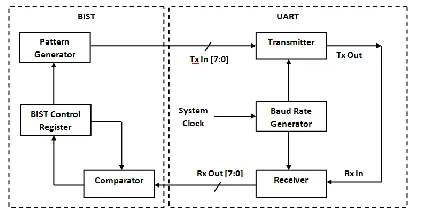
The architecture proposes an 8-bit UART which operates at a baud rate of 9600 bps with a status register to monitor the correctness of every received data byte and enhance the testability of circuit by the introduction of BIST module. The hardware architecture of the 8-bit UART with Status register, incorporated with BIST module is explained in the following sections. The proposed model has two major modules viz. UART and BIST. Further in the UART, we have transmitter, receiver, and baud rate generator. Baud rate generator works at 50 MHz and further reduced as required for the operations in transmitter and receiver to achieve baud rate of 9600 bps. BIST has a control register, pattern generator and a comparator, as shown in fig. 2
UART Transmitter
The transmitter accepts parallel data from peripheral/processor, makes the frame of the data and transmits the data in serial form on the Transmitter Output (TXOUT) terminal (fig. 3). The baud rate generator output will be the clock for UART transmitter.
Data is loaded from the parallel inputs TXIN0-TXIN7 into the Transmitter FIFO by applying logic high on the WR (Write) input. FIFO is 16-byte register. If FIFO is full, it sends FIFO Full (FF) signal to peripheral as When FIFO contains some data, it will send the signal to Transmitter Hold Register (THR), which is an 8-bit register. At the same time, if THR is empty it will send the signal to FIFO, which indicates that THR is ready to receive data from FIFO. If Transmitter Shift Register (TSR) is empty, it will send the signal to THR and it indicates that TSR is ready to receive data from THR. TSR is an 11-bit register in which framing process occurs. In frame, start bit, parity bit and one stop bit will be added as shown in fig. 6. Now data is transmitted from TSR to TXOUT serially. Fig. 5 is the flowchart explaining transmission of serial data from FIFO to transmitter output.
UART Receiver The received serial data is
International Journal of Research (IJR)
e-ISSN: 2348-6848, p- ISSN: 2348-795X Volume 2, Issue 07, July 2015Available at http://internationaljournalofresearch.org
Whenever it goes low sampling and logic block will take 4 samples of that bit and if all four are same it indicates the start of a frame. After that remaining bits are sampled in the same way and all the bits are send to Receiver Shift Register (RSR) one by one where the entire frame is stored. RSR is a 12 bit shift register
w if the Receiver Hold Register (RHR) is empty it sends signal to RSR so that only the data bits from RSR goes to RHR which is an 8 bit register. The remaining bits in the RSR are used by the error logic block. Then, if receiver FIFO is empty it send the signal to RHR so that the data bits goes to FIFO. When RD signal is asserted the data is available in parallel form on the RXOUT0-RXOUT7 pins. The status register is implemented with flags for error logic operations performed on the received data. The error logic block handles 4 types of errors: Parity error (PE), Frame error (FE), Overrun error (OE), Break error (BE). If the received parity does not match with the parity generated from data bits, PE bit will be set which indicates that parity error occurred. If receiver fails to detect correct stop bit or when 4 samples do not match frame error occurs and FE bit is set. If the receiver FIFO is full and other data arrives at, RHR overrun error occurs and OE bit is set. If the RXIN pin is held low for long time than the frame
time then there is a break in received data and break error occurs and BE bit is set.
International Journal of Research (IJR)
e-ISSN: 2348-6848, p- ISSN: 2348-795X Volume 2, Issue 07, July 2015Available at http://internationaljournalofresearch.org
The receiver will extract the data from frames received and loads to receiver FIFO. During this the status register flags will be set according to the error check. Then the Tx FIFO is compared with Rx FIFO to verify the transmitted data and received data are same. If FIFOs are with same data then BIST pass and Bit-0 of BIST control register is set to „1‟, else „0‟. 8-bit BIST control register is defined as below. The register helps in identifying the operation in which BIST failure occurred.
CONCLUSION :
The architecture of UART that support 8-bit data word length at 9600 bps baud rate for serial transmission of data with the addition of status register for detecting errors in data transfer and BIST which allows to test the circuit itself, is introduced. Working of UART has been tested using Xilinx ISE simulator, which is implemented on FPGA. With error checking status register, we can detect the different types of errors occurred during communication and hence correct them. With the implementation of BIST, expensive tester requirements and testing procedures starting from circuit or logic level to field level testing are minimized. The LFSR replaces the function of the external tester features such as a test pattern generator by automatically generating pseudo random patterns to give good fault coverage to the UART module. Although the additional BIST circuit increases the hardware overhead and design time, it eliminates the need to acquire high-end testers. The reduction of the test cost helps in the reduction of overall production cost.
REFERENCES
[1] Naresh, Vatsalkumar and Vikaskumar Patel, “VHDL Implementation of UART
with Status Register”, in the proceedings of
International Conference on Communication
Systems and Network Technologies, IEEE
Computer Society, 11-13th May 2012, DOI:
10.1109/CSNT.2012.164, pp.750-754.
[2] Fang Yi-yuan and Chen Xue-jun, “Design
and Simulation of UART Serial
Communication Module Based on VHDL”,
in the proceedings of 3rd International
Workshop on Intelligent Systems and
Applications (ISA), IEEE, May 2011, DOI:
10.1109/ISA.2011.5873448, pp.1-4.
[3] Mohd Yamani Idna Idris, Mashkuri Yaacob and Zaidi Razak, “A VHDL Implementation of UART Design with BIST
Capability”, in the proceedings of Malaysian
Journal of Computer Science, June 2006,
Vol. 19(1), pp. 73-86.
[4] Dr. Garima Bandhawarkar Wakhle, Iti Aggarwal and Shweta Gaba, “Synthesis and Implementation of UART using VHDL
Codes”, in the proceedings of International
Symposium on Computer, Consumer and
Control, IEEE June 2012, DOI:
10.1109/IS3C.2012.10.
[5] Norhuzaimin J and Maimun H.H, “The
design of high speed UART”, in the
proceedings of Asia-Pacific Conference on Applied Electromagnetics, APACE 05, IEEE,
20-21st Dec. 2005, DOI:
International Journal of Research (IJR)
e-ISSN: 2348-6848, p- ISSN: 2348-795X Volume 2, Issue 07, July 2015Available at http://internationaljournalofresearch.org
[6] Dr. T.V.S.P.Gupta, Y. Kumari and M. Ashok Kumar, “UART realization with BIST
architecture using VHDL”, in the
proceedings of International Journal of
Engineering Research and Applications,
February 2013, Vol. 3, Issue 1, ISSN:
2248-9622, pp.636-640.
[7] Shikha Kakar, Balwinder Singh and Arun Khosla, “Implementation of BIST Capability
using LFSR Techniques in UART”, in the
proceedings of International Journal of
Recent Trends in Engineering, May 2009,
Vol 1, No. 3.
[8] Sybille Hellebrand, Birgit Reeb and Steffen Tarnick, “Pattern Generation for a
Deterministic BIST Scheme”, in the
proceedings of IEEE/ACM International
Conference on Computer-Aided Design, ICCAD-95, Digest of Technical Papers,
November 1995, DOI:
10.1109/ICCAD.1995.479997, pp. 88-94.
[9] Mahat N.F, “Design of a 9-bit UART
module based on Verilog HDL”, in the
proceedings of 10th IEEE International
Conference on Semiconductor Electronics
(ICSE), 19-21st Sept. 2012,
DOI:10.1109/SMElec.2012.6417210, pp.