
International Journal of Research (IJR)
e-ISSN: 2348-6848, p- ISSN: 2348-795X Volume 2, Issue 07, July 2015Available at http://internationaljournalofresearch.org
To Study Ad hoc Mobile Routing Protocol
Kavita Sethi
Guide Name: - Narinder Kumar Sharma College: - Rpc Degree College Email Id: - [email protected]
ABSTRACT
Ad hoc network is kind of network that is composed of different individual device that can communicate with each other directly. Many ad hoc network are the LANs networks where different devices enable to send data from one device to another devices without the help of any centralized access point. In MANET various routing protocol are used like table driven, on demand driven and hybrid routing protocol. AODV is a on demand routing protocol if the path is destroy of send the information than reestablish the path to send the information. The survey of the paper is to give the comparative analysis of all MANET routing protocol. the main purpose of this paper is to identify the which protocol is best on the basic of the comparative analysis of the MANET routing protocol.
INTRODUCTION
Computer network is an interconnection of various computers to share software, hardware and data through a communication medium between them. Two computers are said to be interconnected if they are able to exchange information with the help of transmission media like radio wave, microwave fibre optic etc.
Wireless networks are computer networks that are not connected by cables of any kind. The use of a wireless network enables enterprises to
avoid the costly process of introducing cables into buildings or as a connection between different equipment locations.
Since the inception wireless networking there have been two types of wireless networks: The infrastructure n/w: including some LANs. The ad hoc n/w: ad hoc is Latin meaning “FOR THIS PURPOSE”
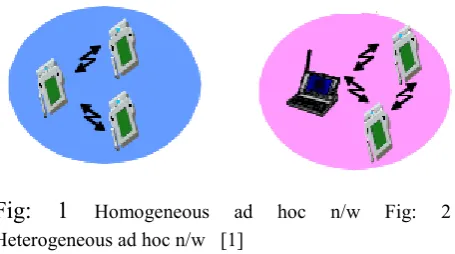
Ad hoc network is a wireless network. Ad hoc network is a collection of a two or more devices can wireless communication. Devices can communication with another nodes that is immediately within their radio range or a outside their radio range. The communication between a nodes anytime and in any place. The communication between has a devices either a
homogenous or heterogeneous way.
Homogenous way communication between a devices means all nodes have a identical
responsibilities. Heterogeneous way
communication between devices all nodes have different responsibilities.
Fig: 1 Homogeneous ad hoc n/w Fig: 2 Heterogeneous ad hoc n/w [1]
International Journal of Research (IJR)
e-ISSN: 2348-6848, p- ISSN: 2348-795X Volume 2, Issue 07, July 2015Available at http://internationaljournalofresearch.org
a router that is they also route packet for other nodes. MANET can be applied to different applications like educational, entertainment, enterprise, emergency [2] , personal area network and Bluetooth and collaborative work [3].MANET support a peer to peer communication means two nodes can communicate with each other directly. In MANET the range of transmission information is limited so the routing protocol is used for transfer the information source to destination.
For transfer the information source to destination they are used a various routing protocols.
Requirements of routing protocol:
1. Route Discovery: First find the route from source to destination for transfer the information.
2. Packet Forwarding: After find the path then transfer the information.
3. Route Maintenance: Route maintenance
is needed when the any route is move to
the position.
Following are the type of routing protocol:
Fig: 3 routing protocol
There are a different ways to transfer information source to destination is reactive and proactive. Proactive (table driven) routing protocol is kind of protocol that if you want to transfer the information the information then the route is maintain in advance in the form of table. In a table maintain a route information of each node for transfer the data. example DSDV , OLSR , WRP. Reactive (source on de and drive) routing protocol is kind of protocol that if you want to transfer the information then firstly can route discover and that can transfer the information[4] example AODV, DSR
Hybrid routing protocol is a communication of proactive and reactive routing protocol. Example TORA
2.
Survey
In this survey i am explain the different protocols are used in MANET.
2.1
DESTINATION SEQUENCE DISTANCE VECTOR(DSDV)
International Journal of Research (IJR)
e-ISSN: 2348-6848, p- ISSN: 2348-795X Volume 2, Issue 07, July 2015Available at http://internationaljournalofresearch.org
information. The second one is SMALLER INCREMENTAL packets this is help to maintained the those type of information that has been changed the last FULL DUMB.
2.2
OPTIMIZED LINK STATE ROUTING(OLSR)
OLSR routing protocol can be divided into three parts.[6]
1. Neighbor/link sensing:neighbors and links are detected by HELLO messages. Messages can
be transfer a symmetric and asymmetric ways. A simple neighbor detected scenario.
Fig: 4 neighbor/link sensing [6]
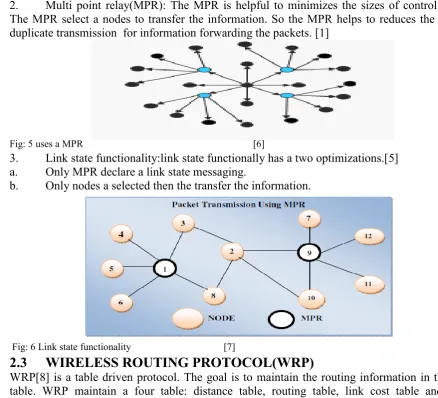
2. Multi point relay(MPR): The MPR is helpful to minimizes the sizes of control messages. The MPR select a nodes to transfer the information. So the MPR helps to reduces the number of duplicate transmission for information forwarding the packets. [1]
Fig: 5 uses a MPR [6]
3. Link state functionality:link state functionally has a two optimizations.[5]
a. Only MPR declare a link state messaging.
b. Only nodes a selected then the transfer the information.
Fig: 6 Link state functionality [7]
2.3
WIRELESS ROUTING PROTOCOL(WRP)
International Journal of Research (IJR)
e-ISSN: 2348-6848, p- ISSN: 2348-795X Volume 2, Issue 07, July 2015Available at http://internationaljournalofresearch.org
2.4
DYNAMIC SOURCE ROUTING(DSR)
Dynamic source routing(DSR)[1] is a on demand routing protocol. DSR used the two phases: route discovery and route maintenance. Suppose want to send a information source to destination then check whether the already path is exist or not. It the path is not exist then makes the paths for send a information. For create a path the route discovery phase is used. Each node a address and unique identification number Then the source broadcast the route request message to all nodes. Each nodes receiving the packet whether is known for destination. If it not known then add the address of the route record of the packet and forward the packet along its outgoing links. A route reply is generated when either the route request reaches the destination.
Fig: 7route discovery in DSR Fig: 8 propagation of route reply in DSR [1]The route maintenance is accomplished is through the route error. When the node is move to the route then the route error message is send to the source with the help of intermediate nodes the route is destroy and then create the again route.
2.5
AD HOC DEMAND DISTANCE VECTOR PROTOCL (AODV)
Ad hoc on demand distance vector protocol [1] is a on demand driven protocol. It is a combination of dynamic source routing(DSR) and destination sequence dictation distance vector(DSDV). DSR is helpful for creating and maintain the route on demand and DSDV is helpful for maintain the sequence number of each nodes. AODV has two phases route discovery and route maintenance. AODV can minimizes the number of broadcast packets comparison the DSDV. Because the DSDV maintained the list of route for transfer the information. In route discovery phase it broadcast the route request (RREQ) to its neighbor. Each node has its sequence number and the broadcast id. During the process of forwarding the RREQ the intermediate nodes maintain in there route tables the address of neighbors from which the first copy of the broadcast packet was received , it helpful for establish the reverse path. Reverse path is help for the destination and intermediate nodes by Unicast a route reply (RREP) packet back to the neighbor from which it first received the RREQ. The route maintenance path is used when the path is destroy from the source to destination then route error (RERR) message is send to source the source may be re initiate the path.
Fig:9AODV routing protocol with RREQ [7]
International Journal of Research (IJR)
e-ISSN: 2348-6848, p- ISSN: 2348-795X Volume 2, Issue 07, July 2015Available at http://internationaljournalofresearch.org
2.6
TEMPORARY ORDERED ROUTING PROTOCOL(TORA)
Temporary ordered routing protocol (TORA) is a hybrid routing protocol. it is used to initiate the route on demand. There are the three phase of TORA protocol, route creation, route maintenance and route erase. For the route creation and route maintenance phase uses the height metric to establish a DAG(directed acyclic graph) root at the destination. For route creation the query and update packet are used. The source broadcast query packet to the nodes. Then the reply is send to source with the help of update packet.
Fig: 11 and Fig:12 used for creation route in TORA [7]
In a route maintenance Changes in topology cause routes to be reestablished and the Route Erasure Upon partition detection routes are removed.
3
Comparison of MANET routing protocol
This table define the comparison of MANET routing protocol
Fig: 13 comparison of MANET routing protocol
s.no Parameter DSDV WRP OLSR AODV DSR TORA
1. Proactive YES YES YES NO NO NO
2. Reactive NO NO NO YES YES NO
3. Hybrid NO NO NO NO NO YES
4. Broadcast
request
NO NO NO YES YES YES
5. Message
retransmissio n list(MRL)
NO NO YES NO NO NO
6. Require
sequencing
YES NO NO YES YES NO
7. Update
information
N/W load Again
maintain table
Effect on height metric
Route rediscover
Route rediscovery
Route rediscovery
8. Route
information maintain
According to sequence number
Maintai n table
Maintain table
Maintain table
On demand On demand
9. Route
regenerate
Sequence no change
Send control message
Link reversal route repair
Error message received source
Error message received source
10. 1 Distributed NO NO NO YES YES YES
International Journal of Research (IJR)
e-ISSN: 2348-6848, p- ISSN: 2348-795X Volume 2, Issue 07, July 2015Available at http://internationaljournalofresearch.org
access delay (MAC)
12. Execution
time
FAST FAST FAST SLOW SLOW SLOW
13. Throughput MORE MORE MORE LESS LESS LESS
14. Bandwidth
wastage
NO NO NO YES YES YES
15. More load or
control overhead
LESS LESS LESS MORE MORE MORE
16. End to End
delay
LESS LESS LESS YES YES YES
17. Summary Each node
maintain a route table.
The n/w
load problem
slove by
full dumb and
incremental table
Maintai n route informat ion four table. MRL, link cost routing, routing table and distance table.
Its used
for sensing neighbor, multi point relay and link state functionali ty Broadcast a packet neighbor nodes for route discovery
and error
message is used for the route maintenanc e.
Broadcast a packet neighbor
nodes for
route discovery
and error
message is used for the route
maintenance .
DAG graph is used for route
creation and route
maintenance .
CONCLUSION
In this paper discussed the MANET routing protocol like a on demand proactive, reactive and hybrid and also discussed the comparative analysis of the MANET routing protocol like DSDV, AODV, OLSR, TORA, DSR etc. In the above comparative analysis of routing protocol the DSDV routing protocol is best because the throughput is more and execution speed is fast because all the information is get about of transfer the information in advance. In AODV routing protocol is best because it is on demand routing protocol but the execution speed is slow and throughput is less as comparison to the DSDV because if the routing path is destroy then make the new routing again and again until the information is transfer. To overwrite the disadvantage of the AODV routing protocol used the AODMV routing
protocol. In AOMDV used multiple paths used for transfer the information source to destination. The new path is generated until the all paths are not destroy and also increased the throughput as comparison to the AODV.
REFERENCES
[1] Drs. Baruch Awerbuch & Amitabh Mishra “introduction to ad hoc network”
[2] Manjeet Gupta and Sonam Kaushik “Performance Comparison Study of AODV, OLSR and TORA Routing Protocols for
MANETS” International Journal Of
Computational Engineering Research, Vol. 2, Issue No.3, May-June 2012, page no. 704-705
International Journal of Research (IJR)
e-ISSN: 2348-6848, p- ISSN: 2348-795X Volume 2, Issue 07, July 2015Available at http://internationaljournalofresearch.org
[4] Marco Fotino, Antonio Gozzi, Floriano De Rango, Salvatore Marano, Juan-Carlos Cano, Carlos Calafate Pietro Manzoni “Evaluating Energy-aware Behavior of Proactive and Reactive Routing Protocols for Mobile Ad Hoc Networks”
[5] Charles E. Perkins, Pravin Bhagwat “Highly Dynamic Destination Sequenced Distance Vector Routing (DSDV) for mobile computers” in processing of ACM SIGCOMM 94, page no 234-244, September 1994.
[6] Andreas Tønnesen http:// www.olsr.org
[7]Tamilarasan-Santhamurthy “A
Quantitative Study and Comparison of AODV, OLSR and TORA Routing Protocols in MANET” IJCSI International Journal of Computer Science Issues, Vol. 9, Issue 1, January 2012
![Fig: 11 and Fig:12 used for creation route in TORA [7]](https://thumb-us.123doks.com/thumbv2/123dok_us/7796844.1293581/5.595.88.518.196.353/fig-fig-used-creation-route-tora.webp)
