Papers presented in ICRRTET Conference can be accessed from
http://edupediapublications.org/journals/index.php/IJR/issue/archive
P a g e
|
182
Improving K-copy intelligent caching efficiency based on
multi-channel protocol in DTNs: A Survey
Saurabh Rathi [1]; Ashwini Akhade[2] & Minal Pendor[3]
Department of Computer Engineering BDCE, Sewagram
[email protected]
;
[email protected]
;
[email protected]
Guided by
Prof. Ms. Amrin Sheikh
Department of Computer Engineering BDCE, Sewagram
[email protected]
Abstract-
Mobile nodes in some challenging network
scenarios suffer from intermittent connectivity and
frequent partitions e.g. battlefield and disaster
recovery scenarios. Disruption Tolerant Network
(DTN) technologies are designed to enable nodes
in such environments to communicate with one
another. In this paper, our main focus is on
improvement of caching efficiency. So, in this
paper we use K- copy intelligent scheme for
caching scheme. However in previous paper,
author already use this caching scheme but he use
in single channel. And we use this scheme for
multiple channels. Along with Ad hoc on demand
distance Vector (AODV) for message routing
protocol. We conduct extensive simulation studies
to evaluate efficiency of K-copy intelligent scheme
for multi-channel over single channel.
Keyword- Disruption Tolerant Network; multi-channel.
I. INTRODUCTION
There is Rapid growth in advancement in
technology, we have many wireless computing devices
e.g. PDAs, sensors etc. Such devices can form infrastructure less adhoc networks and communicate with one another via the help of intermediate nodes. Such adhoc networks are very useful in several scenarios e.g. battlefield operations, vehicular adhoc networks and disaster response scenarios. There is a situation there is some interruption in network
and we are not able to send or received or retrieve any information via network. We can say that there is some
disruption is created in network. So, to avoid such disruption in network, researcher find the new network
called “Disruption Tolerant Network (DTN)”. Since
the ultimate goal of having such a network is to allow mobile nodes to access information quickly and efficiently. For example, in a battlefield, soldiers need to access information related to detailed geographical maps, intelligent information about enemy locations, new commands from the general, weather information etc.
In this paper, we use K-copy intelligent scheme for channel. This data caching scheme use in multi-channel is more efficient scheme as it helps to reduce delay time, increase throughput, reduce energy consumption etc. As we know that data is flow in network in terms of packet. When packets is transfer from one node to another there is some data caching scheme is needed to caches this packet in particular
Papers presented in ICRRTET Conference can be accessed from
http://edupediapublications.org/journals/index.php/IJR/issue/archive
P a g e
|
183
one node to another node there is some caching scheme is present to caches data or packet in particular node so that user can retrieve data in disruption tolerant network. In previous paper author present caching scheme in single channel so that there is large amount of time is wasted in Waiting for caching data. Using our approach we can save lots of time, increase throughput, save energy and etc.
Organizing of the paper in this as Section II describe the Literature Survey, Section III describe Proposed Work i.e. work done by us, Section IV describe conclusion remark.
II. LITERATURE SURVEY
Author compared two caching scheme i.e.
K-copy intelligent scheme and K-K-copy random scheme for data caching scheme in [1] and used LNS for query dissemination, and Prophet or HEFR scheme for message routing. . He found that K-copy intelligent scheme combined with LNS for query dissemination along with HEFR for message routing is more efficient than K-copy random scheme. But there is one issues in this paper is that K-copy intelligent scheme is used in single channel. So there is increase in delay time. So, there is large energy consumption due to passing large
amount of packet in single channel. So we are
work on these issues to minimize energy consumption, reduce delay time, and increase efficiency of a network.
Same author as in [1] works on query dissemination scheme [9]. But in this paper he uses same data caching scheme i.e. compare both K-copy random with K-copy intelligent
scheme. In this paper, author compare W-copy
Selective Query Spraying (WSS) scheme with L-hop Neighborhood Spraying (LNS) scheme. Author found that WSS scheme can achieve a higher query success ratio when compared to a scheme that does not use any data and query replication. The issues in this paper are also related with data caching scheme. It gives better results with WSS scheme, but in this paper it is works for single channel.
Author proposed an cooperative caching for DTNs in [3], which enabled the sharing and coordination of
cached data among multiple nodes. Author basic idea is to intentionally cache data at a set of Network Central Locations (NCLs), which can be accessed by other nodes in the network. Author proposed an scheme which ensures appropriate NCL selection based on a probabilistic selection metric and coordinates multiple caching nodes to optimize the tradeoff between data accessibility and caching overhead. But there is one drawback is that whatever the data is cached in the NCLs if there is some disruption in that path or if there is some loss of data in the particular NCL then the whole data stored on that NCL are loss. Cache resolution and cache management are two problem of cooperative caching.
To address the problem of intermittent connectivity, network nodes store messages on their buffers, carrying them through the network while waiting for transfer opportunities. The storage capacity of the nodes affects directly the network performance. Therefore, it is important to incorporate suitable network protocols
using self-contained messages to improve
communication that supports store-carry-and-forward
operation procedures. Clearly, such procedures
motivate content caching and retrieval. Author surveys the state-of-the art on intelligent caching and retrieval mechanisms focusing on ad-hoc and delay tolerant networks (DTN) in [4]. These approaches can offer important insights for upcoming proposals on intelligent caching and retrieval mechanisms for VDTNs.
Author considering the cache placement problem in [8] of minimizing total data access cost in ad hoc networks with multiple data items and nodes with limited memory capacity. The above optimization
problem is known to be NP-hard. Defining benefit as
the reduction in total access cost, author present a polynomial-time centralized approximation algorithm that provably delivers a solution whose benefit is at least one-fourth (one-half for uniform-size data items) of the optimal benefit. The approximation algorithm is a enable to localized distributed implementation, which is shown via simulations to perform close to the approximation algorithm. This distributed algorithm naturally extends to networks with mobile nodes.
Papers presented in ICRRTET Conference can be accessed from
http://edupediapublications.org/journals/index.php/IJR/issue/archive
P a g e
|
184
author present simulation results that illustrate the usefulness of the custody transfer feature, and a message ferry in improving the end-to-end message delivery ratio in a multi-hop scenario where link availability can be as low as 20%.
A caching scheme for Internet based MANETs was presented in [11]. In this scheme, an Aggregate Caching mechanism is proposed. Here each mobile node stores data item in its local cache and these local caches are aggregated to unified large cache. The data items can be received from local caches of the mobile nodes or through an access point or a data center connected to the Internet. When a node needs a data item, it broadcasts a request to all of the adjacent nodes. The node which has the data item in its local cache will send a reply to the requester; otherwise, it will forward the request to its neighbors. Thus a request is broadcasted to the other connected nodes and eventually acknowledged by an access point or some nodes with cached copies of the requested data item. A broadcast based approach, called Simple Search (SS) algorithm, is implemented on the top of existing routing protocols, to locate the requested data items.
A store-and-forward approach has been proposed for disruption tolerant networks [10]. In authors earlier paper, they have evaluated a combined multi-hop and message ferrying approach in disruption tolerant networks. In that paper, author assume that a special node is designated to be a message ferry. A more flexible approach is to let regular nodes volunteer to be message ferries when network dynamics mandate the presence of such ferries to ensure communications. Thus, after this, author designed a node density based adaptive routing (NDBAR) scheme in [12] that allows regular nodes to volunteer to be message ferries when there are very few nodes around them to ensure the feasibility of continued communications.
III. PROPOSED WORK
In this paper, we use K-copy intelligent scheme for data caching scheme and Ad hoc on demand Vector (AODV) for message routing protocol. Its inbuilt
capability also helps for query dissemination. Our
system supports both push and pulls mechanisms that work in disruption tolerant network environment.
DATA CACHING SCHEME-
For the push mechanism, we use one data caching scheme i.e. K-copy Intelligent caching Scheme.
K-copy Intelligent Caching-
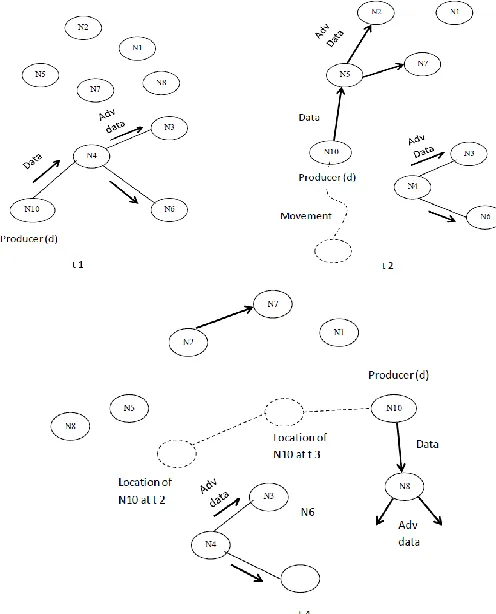
Since the nodes may move with different maximum speeds, the nodes that move faster can encounter more nodes and hence are good candidates for storing replicated data items. Thus author propose having each node measure the number of unique nodes that it observes within each observation window (set to be the same as the beacon interval in this paper) and maintains a metric called friendliness metric (FM) which is merely a smoothed estimate of the average number of unique nodes it encounters during an observation window [1] Fig. illustrate the working of K-copy intelligent caching scheme.
Fig. K-copy intelligent caching scheme.
K is set to 3 in the picture. Let us assume that the node
N10 is the generator of a data item, d. Then, N10 needs
Papers presented in ICRRTET Conference can be accessed from
http://edupediapublications.org/journals/index.php/IJR/issue/archive
P a g e
|
185
store the data since the FM value of N4 exceeds the FM_threshold. Then, N4 starts advertising the data item to N5 and N6. Later, at time t2, Thus, N5 is also selected as a storage node for the data item, d. As N10 moves along, it encounters nodes N7, N1 at time t3 but since their FM values are below the FM_threshold, N10 does not select them as storage nodes for the data item
d. When N10 encounters N8 with a FM value that
exceeds the FM_threshold at time t4 , N10 selects this
node to be the last storage node for the data item, d. N4, N5, and N8 will then include a description of the data item d in their beacons.
ROUTING PROTOCOL-
In this paper, we use AODV for message routing protocol, which will be describe below:
Ad hoc On demand Vector (AODV)-
Ad hoc On-Demand Distance Vector (AODV) Routing is a routing protocol for mobile ad hoc networks (MANETs) and other wireless ad hoc networks.
The AODV (Ad-Hoc On-Demand Distance Vector) routing protocol is a reactive routing protocol that uses some characteristics of proactive routing protocols. Routes are established on-demand, as they are needed. However, once established a route is maintained as long as it is needed. Reactive (or on-demand) routing protocols find a path between the source and the destination only when the path is needed (i.e., if there are data to be exchanged between the source and the destination). An advantage of this approach is that the routing overhead is greatly reduced. A disadvantage is a possible large delay from the moment the route is needed (a packet is ready to be sent) until the time the route is actually acquired. In AODV, the network is silent until a connection is needed. At that point the network node that needs a connection broadcasts a request for connection. Other AODV nodes forward this message, and record the node that they heard it from, creating an explosion of temporary routes back to the needy node. When a node receives such a message and already has a route to the desired node, it sends a message backwards through a temporary route to the requesting node. The needy node then begins using the route that has the least number of hops through other nodes. Unused entries in the routing tables are recycled after a time.
When a link fails, a routing error is passed back to a transmitting node, and the process repeats.
Much of the complexity of the protocol is to lower the number of messages to conserve the capacity of the network. For example, each request for a route has a sequence number. Nodes use this sequence number so that they do not repeat route requests that they have already passed on. Another such feature is that the route requests have a "time to live" number that limits how many times they can be retransmitted. Another such feature is that if a route request fails, another route request may not be sent until twice as much time has passed as the timeout of the previous route request.
The advantage of AODV is that it creates no extra traffic for communication along existing links. Also, distance vector routing is simple, and doesn't require much memory or calculation. However AODV requires more time to establish a connection, and the initial communication to establish a route is heavier than some other approaches.
In this paper, we use multi-channel for delivery of packets. We use same caching scheme but instead of single channel we use multi-channel. So it helps to reduce delay time, increase throughput, decrease energy consumption and so on.
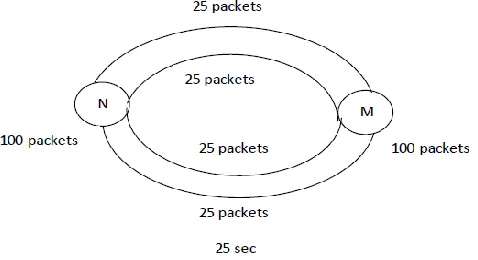
Suppose, we have two node in a network i.e. N and M. We take first case for single channel and second case for multi-channel. In both case we use K-copy intelligent scheme for data caching scheme and AODV for routing protocol.
Case I:- Suppose we have 100 packets in node N and it take 100 sec to reach to M. (Single channel)
Fig. Packets flow through Single channel
Papers presented in ICRRTET Conference can be accessed from
http://edupediapublications.org/journals/index.php/IJR/issue/archive
P a g e
|
186
Case II: - Now we use multi-channel so that packet is distributed in each channel. Suppose we take there is 4 channels. So 25 packets is distributed in each channel so that it takes only 25 sec to reach node M.
Now we can see that there is lots of time reduces in delay. Also energy consumption reduces, packet require less power to reach their destination.
Fig. Packets flow through multi-channel
So, thus we can improve our network caching efficiency using Multi-channel K-copy intelligent caching scheme.
IV. CONCLUSION
In this paper, we work on improving the caching efficiency by using multi-channeling for transmit packets from one node to another. Here, we use K-copy intelligent caching scheme for data caching and AODV for routing protocol. We work these schemes on
multi-channel. Our main focus on reducing the
communication cost in terms of bandwidth and power consumption. So using multi-channel we can also reduce delay time, increase throughput, decrease energy consumption and so on.
REFERENCES
[1] M. Chuah, P. Yang, “Performance Evaluation
of Content-Based Information Retrieval Schemes for DTNs”, IEEE Milcom, pg. 1-7, October, 2007.
[2] Tuan Le, You Lu, Mario Gerla, “Social
Caching and Content Retrieval in Disruption Tolerant Networks (DTNs)”, Computing, Networking and communications (ICNC), 2015.
[3] Wei Gao, Guohong Cao, et. al, “Cooperative
Caching for Efficient Data Access in Disruption Tolerant Networks” , IEEE Trans. , Volume: 13, Issue:3, pg. 611 - 625, 2014.
[4] Bruno M. C. Silva, Vasco N. G. J. Soares, et.
al, “Towards Intelligent Caching and Retrieval Mechanisms for Upcoming Proposals on Vehicular Delay-Tolerant Networks” , JCOMSS , 2011.
[5] S. Manju, Mrs. K. Vanitha, “Efficient Message
Caching Scheme for MANET”, IJIRCCE, March, 2014.
[6] Mrs. K.Shanmugavadivu, Dr M.Madheswaran,
“Caching Technique for Improving Data Retrieval Performance in Mobile Ad Hoc Networks” ,IJCSIT ,vol. 1(4) ,pg. 249-255,2010.
[7] M. Chuah, R. Metgzer, “Secure Data Retrieval
System (SEDAR) for DTNs”, IEEE Milcom, pg. 1-7, 2008.
[8] B. Tang, H. Gupta, and S. Das, “Benefit-Based
Data Caching in Ad Hoc Networks,” IEEE Trans. Mobile Computing, vol. 7, no. 3, pg. 289-304, Mar. 2008.
[9] M. Chuah, P.Yang, “Performance Evaluations
of Data-Centric Information Retrieval Schemes for DTNs”, Proceedings of Milcom, October, 2007.
[10] Mooi-Choo Chuah, Peng Yang, et. al,
“Store-and-Forward Performance in a DTN” , IEEE VTC, Volume: 1, pg. 187 – 191, 2006.
[11] S. Narravula, H.-W. Jin, et. al, “Designing
Efficient Cooperative Caching Schemes for Multi-Tier Data-Centers over RDMA-enabled Networks”, IEEE, volume:1, pg. 401-408, 2006.
[12] M. Chuah, P. Yang, “Node Density-Based
Adaptive Routing Scheme for Disruption Tolerant Networks”, IEEE MILCOM, pg. 1-6, 2006.
[13] Sunho Lim, et. al, “A novel caching scheme for
improving Internet-based mobile ad hoc networks performance”, Proc .12th Int. Conf. Computer Comm.