c e-ISSN: 2348-6848, p- ISSN: 2348-795X Volume 3, Issue 05, March 2016
International Journal of Research (IJR)
Available at http://internationaljournalofresearch.orgActive Power Filter for Renewable Energy applications Using
Predictive Control Scheme
Shaik.Shamsheer
1& Dr. Akbar Khan
2 1M.Tech Scholar, Dept of EEE , Nimra Institute of Science and Technology, JNTUK, A.P
2
Professor, Nimra Institute of Science and Technology, JNTUK, A.P
Abstract: —
In this paper an active power filter
implemented with a four-leg voltage-source inverter
using a predictive control scheme is presented. The
use of a four-leg voltage source inverter allows the
compensation of current harmonic components, as
well as unbalanced current generated by
single-phase nonlinear loads. A detailed yet simple
mathematical model of the active power filter,
including the effect of the equivalent power system
impedance, is derived and used to design the
predictive control algorithm. The compensation
performance of the proposed active power filter and
the associated control scheme under steady state
and transient operating conditions is demonstrated
through simulations results. In recent times, fuzzy
logic controller was applied for active power filter
(APF) control application, as the APF is nothing but
a current controlled VSI. In this project, a fuzzy
logic based shunt APF is presented based on the
effective time concept. The effective time concept
eliminates the trigonometric calculations and sector
identification, thereby it reduces the computational
effort. Simulation results demonstrate the efficacy of
the APF with the fuzzy logic based control strategy.
Simulation results are obtained for both predictive
control scheme and fuzzy logic controller and the
results are care compared. The response time for
compensation is 0.02sec. Computer simulation by
MATLAB/ SIMULINK has been used to support the
developed concept.
Keywords:
Active power
filter;
current
control; four-leg converters; predictive control;
Fuzzy logic controller
I.
I
NTRODUCTIONElectric utilities and end users of electric power are becoming increasingly concerned about meeting the growing energy demand. Seventy five percent of total global energy demand is supplied by the burning of fossil fuels. But increasing air pollution, global warming concerns, diminishing fossil fuels and their increasing cost have made it necessary to look towards renewable sources as a future energy solution. Since the past decade,
there has been an enormous interest in many countries on renewable energy for power generation. The market liberalization and government’s incentives have further
accelerated the renewable energy
sector growth. Distributed generation (DG) systems are presented as a suitable form to offer high reliable electrical power supply [1]. The concept is particularly interesting when different kinds of energy. Resources are available, such as photo-voltaic panels, fuel cells, or speed wind turbines [2], [3]. Most part of these resources need power electronic interfaces to make up local ac grids [4], [5]. This way, inverters or ac-to-ac converters are connected to an ac common bus with the aim to share properly the disperse loads connected to the local grid [6]. Most sustainable energy sources supply energy in the form of electrical power. Distributed generation (DG) systems are often connected to the utility grid through power electronic converters. A grid connected inverter provides the necessary interface of the DG to the phase, frequency and amplitude of the grid voltage, and disconnects the system from the grid when islanding. Such a DG system can be designed to operate in both standalone and grid-connected modes flexibly according to Grid conditions [1], [2]. When the utility grid is not available or the utility power is accidentally lost, the DG is used as an on-site power or standby emergency power service, effectively being an extended uninterruptible power supply (UPS) that is capable of providing long-term energy supply.
The non-linear load current harmonics may result in voltage harmonics and can create a serious PQ problem in the power system network. Active power filters (APF) are extensively used to compensate the load current harmonics and load unbalance at distribution level. This results in an additional hardware cost. However, in this paper authors have incorporated. The features of APF in the, conventional inverter interfacing renewable with the grid, without any additional hardware cost.
c e-ISSN: 2348-6848, p- ISSN: 2348-795X Volume 3, Issue 05, March 2016
International Journal of Research (IJR)
Available at http://internationaljournalofresearch.orgpower filter is also presented. Finally, the proposed active power filter and the effectiveness of the associated control scheme compensation are demonstrated through simulation and validated with experimental results
obtained in a 2 kVA
laboratory prototype.
II.
PROPOSED TOPOLOGY – FOUR LEG
CONVERTER MODEL
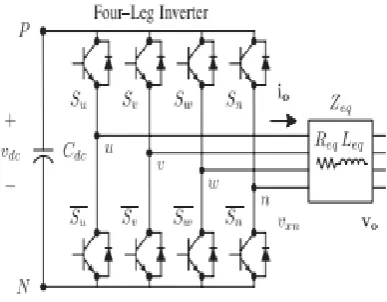
The four-leg PWM converter topology is shown in
Fig. 1. This converter topology is similar to the conventional three-phase converter with the fourth leg connected to the neutral bus of the system. The fourth leg increases switching states from 8 (23) to 16 (24), improving control flexibility and output voltage quality [11], and is suitable for current unbalanced compensation.Fig. 1.Two-level four-leg PWM-VSI topology
III.
PROPOSED TOPOLOGY – DIGITAL
PREDICTIVE CURRENT CONTROLThe block diagram of the proposed digital
predictive current control scheme is shown in Fig. 2. This control scheme is basically an optimization algorithm and, therefore, it has to be implemented in a microprocessor. Consequently, the analysis has to be developed using discrete mathematics in order to consider additional restrictions such as time delays and approximations [10], [11–[12]. The main characteristicof predictive control is
the use of the system model to predict the future behaviour of the variables to be controlled. The controller uses this information to select the optimum switching state that will be applied to the power converter, according to predefined optimization criteria. The predictive control algorithm is easy to
implement and to understand, and it can be implemented with three main blocks, as shown in Fig. 2.
Fig. 2. Proposed predictive digital current control block diagram
IV.
PROPOSED TOPOLOGY –
CURRENTREFERENCE GENERATION
A dq-based current reference generator scheme is used to obtain the active power filter current
reference signals. This scheme
presents a fast and accurate signal tracking capability. This characteristic avoids voltage fluctuations that deteriorate the current reference signal affecting compensation performance [4]. The current reference signals are obtained from the corresponding load currents as shown in Fig. 3. This module calculates the reference signal currents required by the converter to compensate reactive power, current harmonic and current imbalance. The displacement power factor (sin φ(L)) and the maximum total harmonic distortion of the load (THD(L)) defines the relationships between the apparent power required by the active power filter, with respect to the load, as shown
where the value of THD (L) includes the maximum compensable harmonic current, defined as double the sampling frequency fs. The frequency of the maximum
current harmonic component
c e-ISSN: 2348-6848, p- ISSN: 2348-795X Volume 3, Issue 05, March 2016
International Journal of Research (IJR)
Available at http://internationaljournalofresearch.orgFig.3.dq-based current reference generator block diagram.
The dq-based scheme operates in a rotating reference frame; therefore, the measured currents must be multiplied by the sin(wt) and cos(wt) signals. By using dq-transformation, the d current component is synchronized with the corresponding phase-to-neutral system voltage, and the q current component is phase-shifted by 90◦. The sin(wt) and cos(wt) synchronized reference signals are obtained from a synchronous reference frame (SRF) PLL [9]. The SRF-PLL generates a pure sinusoidal waveform even when the system voltage is severely distorted. Tracking errors are eliminated, since SRF-PLLs are designed to avoid phase voltage unbalancing, harmonics (i.e., less than 5% and 3% in fifth and seventh, respectively), and offset caused by the nonlinear load conditions and measurement errors [13]. The bellow equation shows the relationship between the real currents iLx(t) (x = u,v,w) and the associated dq components
(id and iq )
A low-pass filter (LFP) extracts the dc component of
the phase currents id to generate the harmonic reference components −id. The reactive reference components of the phase-currents are obtained by phase-shifting the corresponding ac and dc components of I q by 180◦. In order to keep the dc-voltage constant, the amplitude of the converter reference current must be modified by adding an active power reference signal ie with the d-component. The resulting signals i∗ d and i∗ q are transformed back to a three-phase system by applying the inverse Park and Clark transformation, as shown in bellow equation. The cutoff frequency of the LPF used in this paper is 20 HzThe current that flows through the neutral of the load is compensated by injecting the same instantaneous value obtained from the phase-currents, phase-shifted by 180◦, as shown next
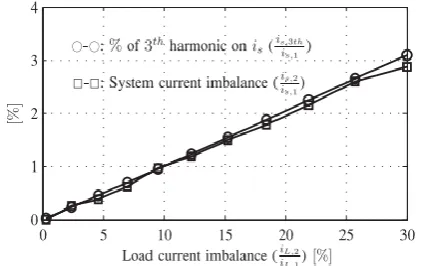
One of the major advantages of the dq-based current reference generator scheme is that it allows the implementation of a linear controller in the dc voltage control loop. However, one important disadvantage of the dq-based current reference frame algorithm used to generate the current reference is that a second order harmonic component is generated in id and iq under unbalanced operating conditions. The amplitude of this harmonic depends on the percent of unbalanced load current (expressed as the relationship between the negative sequence current iL,2 and the positive sequence current iL,1). The second-order harmonic cannot be removed from id and iq , and therefore generates a third harmonic in the reference current when it is converted back to abc frame [11]. Fig. 4. shows the percent of system current imbalance and the percent of third harmonic system current, in function of the percent of load current imbalance. Since the load current does not have a third harmonic, the one generated by the active power filter flows to the power system.
c e-ISSN: 2348-6848, p- ISSN: 2348-795X Volume 3, Issue 05, March 2016
International Journal of Research (IJR)
Available at http://internationaljournalofresearch.organd system current imbalance (with respect to positive sequence of the system current, is,1 )
V.
MATLAB BASED SIMULATION & RESULTS DISCUSSIONTo verify the feasibility of the proposed system a simulink model is developed with modular converter which gives output. Fig.5 & Fig.6 shows the sub system in the developed simulink model
Fig.5. MATLAB based simulation diagram of proposed system with masked blocks
Fig.6. MATLAB based simulation diagram of proposed system with masked blocks
Fig.7. Shows the MATLAB based simulation of the proposed control scheme dc voltage
Fig.7. MATLAB based simulation of the proposed control scheme dc voltage
Fig.8. Shows the MATLAB based simulation of the proposed control scheme Load Current
Fig.8. MATLAB based simulation of the proposed control scheme Load Current
Fig.9. Shows the MATLAB based simulation of the proposed control scheme - Active power filter neautral current
Fig.9. MATLAB based simulation of the proposed control scheme - Active power filter neautral current
Fig.10. Shows the MATLAB based simulation of the proposed control scheme – Isabc
c e-ISSN: 2348-6848, p- ISSN: 2348-795X Volume 3, Issue 05, March 2016
International Journal of Research (IJR)
Available at http://internationaljournalofresearch.orgThe compensation effectiveness of the active power filter is corroborated in a 2 kVA experimental setup. A six-pulse rectifier was selected as a nonlinear load in order to verify the effectiveness of the current harmonic compensation. A step load change was applied to evaluate the transient response of the dc voltage loop. Finally, an unbalanced load was used to validate the performance of the neutral current compensation. Because the experimental implementation was performed on a dSPACE I/O board, all I/O Simulink blocks used in the simulations are 100% compatible with the dSPACE system capabilities. The complete control loop is executed by the controller every 20 μs, while the selected switching state is available at 16 μs. An average switching frequency of 4.64 kHz is obtained.
Table.I shows the simulation parameters for the proposed system
TABLE.I.SIMULATION SPECIFICATIONS
Parameter Rating
Source Voltage 55 V
Dc Voltage 162 V
Frequency 50Hz
DC Voltage 760
DC Link Capacitance 2200 µF
Sampling Time 20 µsec
4 kW
Filter Inductance 5 mH
CONCLUSION
Improved dynamic current harmonics and a reactive power compensation scheme for power distribution systems with generation from renewable sources has been proposed to improve the current quality of the distribution system. Advantages of the proposed scheme are related to its simplicity, modeling, and implementation. The use of a predictive control algorithm for the converter current loop proved to be an effective solution for active power filter applications, improving current tracking capability, and transient response. Simulated and experimental results have proved that the proposed predictive control algorithm is a good alternative to classical linear control methods. The predictive current control algorithm is a stable and robust solution. Simulated and experimental results have shown the compensation effectiveness of the proposed active power filter.
R
EFERENCES[1]
J. Rocabert, A. Luna, F. Blaabjerg, and P.
Rodriguez,
“Control
of
power
converters in AC microgrids,”
IEEE Trans. Power
Electron.
, vol. 27, no. 11, pp. 4734–4749, Nov.
2012.
[2]
S. Naidu and D. Fernandes, “Dynamic
voltage restorer based on a fourleg voltage source
converter,”
Gener. Transm. Distrib., IET
, vol. 3, no.
5,pp. 437–447, May 2009
[3]
N. Prabhakar and M. Mishra, “Dynamic
hysteresis current control to minimize switching for
three-phase four-leg VSI topology to compensate
nonlinear load,”
IEEE Trans. Power Electron.
, vol.
25, no. 8, pp. 1935– 1942, Aug. 2010.
[4]
V. Khadkikar, A. Chandra, and B. Singh,
“Digital signal processor implementation and
performance evaluation of split capacitor, four-leg
and three h-bridge-based three-phase four-wire shunt
active filters,”
Power
Electron., IET
, vol. 4, no. 4,
pp. 463–470, Apr. 2011.
[5]
F. Wang, J. Duarte, and M. Hendrix, “Grid
interfacing converter systems with enhanced voltage
quality for microgrid application;concept and
implementation,”
IEEE Trans. Power Electron.
, vol.
26, no. 12, pp. 3501– 3513, Dec. 2011.
[6]
R. de Araujo Ribeiro, C. de Azevedo, and R.
de Sousa, “A robust adaptive control strategy of
active power filters for power-factor correction,
harmonic compensation, and balancing of nonlinear
loads,”
IEEE
Trans.
Power Electron.
, vol. 27, no. 2, pp. 718–730, Feb.
2012.
[7]
X. Wei, “Study on digital pi control of
current loop in active power filter,” in
Proc. 2010
Int. Conf. Electr. Control Eng.
, Jun. 2010, pp. 4287–
4290.
[8]
P. Cortes, G. Ortiz, J. Yuz, J. Rodriguez, S.
Vazquez, and L. Franquelo, “Model predictive
control of an inverter with output
LC
filter for UPS
applications,”
IEEE Trans. Ind. Electron.
, vol. 56,
no. 6, pp. 1875–1883, Jun. 2009.
c e-ISSN: 2348-6848, p- ISSN: 2348-795X Volume 3, Issue 05, March 2016