Copyright1998 by the Genetics Society of America
Genetic Diversity at a Single Locus Under Viability Selection
and Facultative Apomixis: Equilibrium Structure and Deviations
from Hardy-Weinberg Frequencies
R. Deborah Overath and Marjorie A. Asmussen
Department of Genetics, University of Georgia, Athens, Georgia 30602
Manuscript received May 20, 1997 Accepted for publication January 12, 1998
ABSTRACT
We extensively analyze the maintenance of genetic variation and deviations from Hardy-Weinberg frequencies at a diallelic locus under mixed mating with apomixis and constant viability selection. Analytical proofs show that: (1) at most one polymorphic equilibrium exists, (2) polymorphism requires overdominant or underdominant selection, and (3) a simple, modified overdominance condition is sufficient to maintain genetic variation. In numerical analyses, only overdominant polymorphic equilibria are stable, and these are stable whenever they exist, which happens forz78% of random fitness and mating parameters. The potential for maintaining both alleles increases with increasing apomixis or outcrossing and decreasing selfing. Simulations also indicate that equilibrium levels of heterozygosity will often be statistically indistin-guishable from Hardy-Weinberg frequencies and that adults, not seeds, should usually be censused to maximize detecting deviations. Furthermore, although both censuses more often have an excess rather than a deficit of heterozygotes, analytical sign analyses of the fixation indices prove that, overall, adults are more likely to have an excess and seeds a deficit at equilibrium.
M
ATING systems can have profound effects on plant nance of genetic variation, several important issuesre-population diversity and structure. For example, main. For example, studies of the classic selection models
HamrickandGodt(1989) found that predominantly with mixed mating, such as the one including apomixis
selfing species contain less genetic variation than mixed byMarshallandWeir(1979), do not address the full
mating or outcrossing species. In addition, populations equilibrium structure in terms of the precise conditions
of selfing species tend to show greater differentiation, under which a stable polymorphic equilibrium exists
presumably because gene flow is reduced. In contrast, and how often one is maintained. In addition, most
species capable of both sexual and vegetative asexual of these investigations were restricted to overdominant
reproduction have comparable, or even somewhat greater fitnesses, assuming, without proof, that overdominance
variation, within populations and comparable differenti- was the only form of selection that could maintain
ge-ation between populge-ations, relative to sexually repro- netic variation. Finally, little is known about the
com-ducing species (HamrickandGodt1989;Hamricket bined effects of mating system and selection on the
al. 1992). generation of detectable deviations from
Hardy-Wein-These empirical findings confirm key results of a num- berg expectations. Here we address these issues by
de-ber of theoretical investigations on the effects of mating limiting the complete equilibrium structure of
Mar-system. For example, in mixed mating models with con- shall and Weir’s (1979) generalized mixed mating
stant viability selection, selfing reduces the amount of model under overdominant, underdominant, and
di-heterozygosity possible at equilibrium and the range of rectional selection. We then quantify the effect of each
fitness values over which maintenance of allelic variation mating parameter on the potential for maintaining
per-is possible (Hayman1953;WorkmanandJain1966;
Mar-manent genetic variation and generating statistically
sig-shallandWeir1979). Asexual reproduction, such as
nificant deviations from Hardy-Weinberg expectations. apomixis (production of seeds without meiosis), can at
least partially counteract the effect of selfing by main-taining diversity over a wider range of fitness values (
Mar-THE BASIC MODEL
shallandWeir1979).
Although the existing selection models for nonrandom We explore the effect of apomixis as well as mixed
mating populations provide useful insight into the mainte- selfing and outcrossing on the maintenance and form
of genetic variation under the diallelic version of the one-locus constant viability selection models introduced
Corresponding author: R. Deborah Overath, Department of Genetics,
byMarshallandWeir(1979). These models of faculta-University of Georgia, Athens, GA 30602-7223.
E-mail address: [email protected] tive apomixis offer the flexibility to study (1) the
alized mixed mating model with all three forms of repro- equation (10) can be simplified to duction; (2) the classic mixed mating model, which
2(2w122w112w22)w ^ 2
combines outcrossing with selfing; and (3–4) the two alternative mixed mating models, which combine
apo-1{2(11a)(w11w222w212)2s[w12(w111w22)22w11w22]}w ^
mixis with either selfing or outcrossing.Marshalland
Weir’s (1979) formulations are based on the standard
1(2a1s)w12[w12(w111w22)22w11w22]50. (6)
Hardy-Weinberg assumptions, with the exceptions that
A more informative method is to express the internal selection is allowed between the zygote (or seed) stage
(i.e., polymorphic) equilibria in terms of the equilib-and the adult stage equilib-and that in each generation,
individ-rium fixation index fˆ512vˆ/2pˆqˆ, where vˆ is the
equilib-uals outcross with probability t, self with probability s,
rium frequency of heterozygotes in seeds. These formu-and reproduce apomictically with probability a, where
lae can be derived directly from the genotypic and allelic
t1s1a51.MarshallandWeir(1979) considered
recursions or via an extension of a technique developed two cases that differ in the time of censusing. Model I
by Kimura andOhta (1971) for the standard mixed
assumes an adult census followed by mating and then
mating model without apomixis. In either case, the equi-selection before the next generation of adults is
cen-librium fixation index satisfies sused. Model II, on the other hand, assumes a seed
census followed by selection and then mating. We have
g( fˆ )52ifˆ22(222a2s22it)fˆ1s22i(a1s)50
reparameterized these models in terms of the allele
(7)
frequencies and the fixation index, which measures the
deviation from Hardy-Weinberg frequencies (Wright which determines the equilibrium allele frequencies via
1951). This parameterization greatly simplifies the
anal-yses, as it also does for the standard mixed mating model pˆ 5 w122w222fˆ(w122w11)
(2w122 w112 w22)(12fˆ )
(8) (WorkmanandJain1966). Here we primarily focus on
the seed census model, the easier case to analyze. The where
adult census model and key equilibrium relationships between the two censuses are presented inappendix a.
i5(w122w11)(w122w22) w12(2w122w112w22)
. (9)
The seed census is represented by lowercase letters,
with p the frequency of allele A1,q512p the frequency The equilibrium genotypic frequencies can then be
cal-of allele A2, and f5 1 2 freq(A1A2)/2pq, the fixation culated from the standard relationships,
index in seeds. The constant viability of genotype AiAj
uˆ 5 pˆ21 fˆpˆ(12pˆ) (10)
is denoted by wij(i,j51,2). The f and p recursions for
the seed census are then vˆ5 2pˆ(12 pˆ)(1 2fˆ ) (11)
and
f9 5a1 s1(2a1s)(f21)w12w
2w1w2 (1)
wˆ 5(12 pˆ)21fˆpˆ(1 2pˆ ) (12)
p9 5pw1
w (2) which require (for admissibility) that
and
2min
3
pˆ 12pˆ,12pˆ
pˆ
4
# fˆ#1. (13)where
Note that the above formulae also apply to the special
w15p(12 f )(w112w12)1 f(w112w12)1 w12 (3)
case of no outcrossing (t50), for which fˆ5(s/2i)21
or fˆ 5 1; whereas, as noted by Marshall and Weir
w25p(12 f )(w122w22)1w22 (4)
(1979), the approach based on wˆ leads only to the single
are the marginal fitnesses of alleles A1and A2, respec- root fˆ51. [The latter can determine valid polymorphic
tively, and equilibria only when the two homozygotes have equal
fitness (i.e., w115 w22).]
w5pw11 (12p)w2 (5)
In analyzing the full equilibrium structure of this
sys-is the mean fitness of the population. The prime symbol tem, the first issue is the exact number of polymorphic
(9) denotes a value in the next generation. equilibria and when they exist. Our approach uses the
Intermediate Value Theorem from calculus to bracket the roots of the fˆ quadratic in (7) based on its sign at
ANALYTICAL METHODS AND RESULTS
five critical points, and the basic facts that a quadratic equation has at most two real roots and all frequencies
Analysis of equilibrium structure:MarshallandWeir
(1979) obtained polymorphic equilibria equation as a must be in the interval [0,1]. Details of this analysis
are given in appendix b. The results provide a formal
function of the equilibrium mean fitness wˆ . After
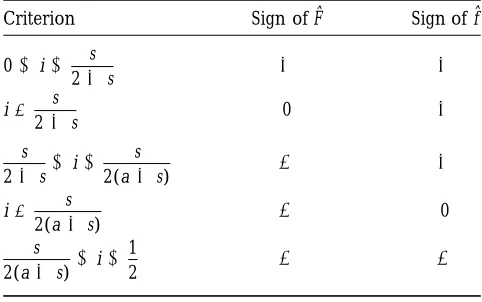
equilib-TABLE 1
rium can exist for a given set of fitnesses and mating
system parameters and that such equilibria exist only Sign of the equilibrium fixation indices
for overdominant and underdominant selection. [The
case of no outcrossing (t5 0) is a slight exception in Criterion Sign of Fˆ Sign of fˆ
that when w115w22it has an infinite number of
(neu-trally stable) equilibria.] 0,i, s
21s 1 1
More important, this approach reveals exactly when
i5 s
21s 0 1
a polymorphic equilibrium will occur. For overdomi-nant or underdomioverdomi-nant fitnesses, (7) always has exactly
one root ( fˆ ) in the maximal admissible interval [21,1]. s
21s,i, s
2(a1s) 2 1
This root determines a valid internal equilibrium if and
only if the corresponding allele frequency in (8) is in i5 s
2(a1s) 2 0
the interval (0,1) and the bounds in (13) are satisfied.
s
2(a1s),i,
1
2 2 2
Consequently, equilibrium frequencies will be valid and a polymorphic equilibrium will exist, if and only if
Fˆ is the equilibrium fixation index for the adult census fˆ,min
3
w122w11w122w22,
w122w22
w122 w11
4
5f *. (14) and fˆ the corresponding value for the seed census under thegeneralized mixed mating model, and i is the function of fitness defined in (9).Graphing the quadratic in (7) shows that inequality (14)
holds if and only if g( f *) , 0. Thus, a polymorphic
equilibrium will exist for overdominant selection (w12.
gotes (Fˆ,0), whereas seeds will necessarily be in
Hardy-wii. wjj) if and only if
Weinberg equilibrium ( fˆ50).
The overdominant results also reveal an important
sw12(wii2wjj)2 2(w122 wii)[wii2(1 2t)wjj], 0
distinction between the generalized mixed mating model (15)
and the model with only mixed selfing and outcrossing.
and for underdominant selection (wii . wjj . w12) if When all three forms of reproduction are present, both
and only if the adult and seed census can have either negative or
positive fixation indices. For the standard mixed mating
sw12(wjj2 wii)22(w122wjj)[wjj2(1 2t)wii]. 0. model (a50), this is true only when adults are censused
(16) [as Workman and Jain (1966) illustrated for specific
values via phase diagrams] because i,1/2 ensures the
Sign of the equilibrium fixation index:The
equilib-seed census always has a positive fixation index. In equilib-seeds, rium analysis based on fˆ shows exactly when the
fre-apomixis is clearly necessary to produce an excess of quency of heterozygotes at an internal equilibrium will
heterozygotes at equilibrium ( fˆ , 0) when selfing is
be above (fˆ , 0), below (fˆ . 0), or equal to ( fˆ 5
present; however, apomixis itself is not sufficient be-0) the Hardy-Weinberg frequency 2pˆqˆ. In particular,
cause in the absence of outcrossing (t50) other condi-although with underdominant selection fˆ is always
posi-tions (s,2i) must hold. tive, with overdominant selection the sign of fˆ is given
Local stability of the equilibria: In the absence of by the sign of the quantity s/2(a 1 s)2 i, where i is
mutation and gene flow, polymorphism maintained in the function of fitness defined in (9). The adult census
adults must be maintained in seeds and vice versa. Con-gives the same results, except that for overdominance
sequently, although genotypic frequencies and fixation the sign of Fˆ, the equilibrium fixation index in adults,
indices for internal equilibria differ between the two is given by the sign of the quantity s/(21 s)2 i.
Com-census times, the criteria for existence of such equilibria, paring these two sign criteria reveals that s/2 (a 1 s)
and the stability properties of all equilibria, apply to
$ s/(2 1 s) (with equality only if s 5 0) and hence
both models. The analytical conditions under which suggests that as long as some selfing occurs, the adult
an internal equilibrium will be locally stable are very census is the more likely to have a negative fixation
complex. The local stability conditions for the boundary index, whereas the seed census is the more likely to
equilibria, that is, the fixation of one allele, however,
have a positive value (Table 1). If s 5 0 and a . 0,
are much more tractable, especially when derived from however, fˆ and Fˆ are both negative at overdominant
the genotypic recursions (appendix c). These show that
polymorphisms. Note also that when t50 an excess of
fixation of allele Ai will be locally stable if
heterozygotes requires s,1 for seeds but not for adults (appendix b). Finally, although the sign criteria are
w12, 2wii
22s (17)
invalid for completely random mating populations (a 5 s5 0, t 5 1), inspection of this case shows that
stw12wjj2 [(12t)wjj2wii][(2 2s)w1222wii], 0 only sufficient and not necessary to prevent the loss of
either allele, it does suggest that simple overdominance (18)
will not always maintain variation when any selfing
oc-for j≠ i5 1,2. Note that these two inequalities imply curs. Moreover, ignoring the complications of the
un-that wii.(1 2t)wjjwhen fixation for Aiis stable. likely case of equality in (17) or (18), the modified
Two general observations are evident from the above
overdominance criterion (19) is, in fact, the exact condi-criteria. First, the stability of each fixation state depends
tion for a protected polymorphism under the special on all three genotypic fitnesses, as long as the population
conditions of no selfing (s 5 0), complete selfing (s5 is not mating completely at random (t,1). [If t51, we
1), no outcrossing (t50), and complete random mating have the classical selection model for which a5s 50
(t5 1).
and (17) and (18) reduce to w12 , wii.] Second, the For comparison to the numerical results below, we
criterion (18) corresponds to the fixation boundary
also calculated analytically how often the sufficient PP
curves inMarshallandWeir’s (1979) phase diagrams
condition (19) holds by evaluating the appropriate mul-[their equation (15)]. However, because this criterion
tiple integrals under a uniform distribution on the rele-does not necessarily imply the first [in fact, it implies
vant parameter space. The results reveal that, on average,
the reverse of (17) when wii, (1 2 t)wjj], the phase the modified overdominance condition (19) holds for
diagram curves do not appear to completely describe
17/72 (23.6%) of all sets of fitnesses and mating parame-the local stability conditions of parame-the fixation states for
ters and for 17/24 (70.8%) of the random overdomi-this system.
nant parameter sets. These two fractions are somewhat
Conditions for protected polymorphism: These
for-lower, 7/36 (19.4%) and 7/12 (58.3%), for both the mal stability conditions determine the exact conditions
standard mixed mating model with selfing and outcross-under which genetic variation is preserved through a
ing (s1t51) and the alternate mixed mating model
protected polymorphism (PP), which prevents the loss
with selfing and apomixis (a1s51). Similar analysis of either allele. In particular, a PP exists for the
general-shows that a given degree of selfing, (19) holds for (2 ized mixed mating model with selection if for both
2 s)2/12 of random fitnesses and for (2 2 s)2/4 of
boundary equilibria (fixation of A1or A2) either (17)
random overdominant fitnesses. As s increases from 0 or (18) is reversed, because both fixation states are then
to 1, the fraction of fitnesses meeting the sufficient PP unstable. Closer examination of these local stability
con-condition (19) decreases from 33.3 to 8.3% of random ditions, in conjunction with the conditions for a
poly-fitnesses and from 100 to 25% of random overdominant morphic equilibrium in (15) and (16), reveals that for
fitnesses, a fourfold drop in each case. overdominance a PP exists if and only if a valid internal
equilibrium also exists (seeappendix d). Similar
analy-sis indicates that for underdominance both of the
NUMERICAL ANALYSIS
boundary equilibria will always be stable whenever a
polymorphic equilibrium exists, and therefore a PP Computer simulations provided further insight into
never exists under these conditions. Because two adja- the number, stability pattern, and nature of the
equilib-cent equilibria are unlikely to be both stable or both ria. The program randomly generated fitnesses
(over-unstable, these results also suggest that (in the absence dominant, underdominant, or directional) and
associ-of cycling) overdominant polymorphic equilibria will ated sets of mating system parameters using a random
be stable whenever they exist, whereas underdominant number generator with a uniform distribution on the
polymorphic equilibria will always be unstable. interval [0,1]. Random fitness sets of a specific form
Interpretation of the biological implications of the were generated by choosing w
11, w12, and w22at random
precise PP conditions is difficult; however, sufficiently and then interchanging their values as necessary to
strong overdominance, achieve the desired pattern (e.g., w
12 5 max {wij} for
overdominance). When all three modes of
reproduc-w12. 2w11
22s,
2w22
22s (19) tion were present, a uniform distribution of the mating
parameters was ensured by first choosing two random numbers to divide the interval [0,1] into three pieces will clearly [see (17) and (18)] always be sufficient to
and then using the lengths of these pieces as the values maintain both alleles in the population through a PP
of the three mating parameters (Karlin1969, pp. 241–
under any combination of selfing, random outcrossing,
242). Adapting the approach ofAsmussenand
Basna-and apomixis. Analysis of the coefficient 2/(2 2s) as
yake(1990), we determined how many (if any)
polymor-a function of s shows thpolymor-at polymor-as the selfing rpolymor-ate increpolymor-ases
phic equilibria exist [from (7)–(13)], the stability of all from 0 to 1, this fitness condition increases from simple
equilibria (using the analytically derived local stability overdominance (w12 . w11,w22) to “double
overdomi-conditions), and the value of the fixation index at poly-nance” (w12.2w11,2w22), in which the fitness of
hetero-morphic equilibria, for each combined set of parame-zygotes exceeds twice that of both homoparame-zygotes.
parameter sets, and reported values are means of 100 such runs.
Analysis of equilibrium structure: The simulations confirmed the analytical predictions that fitnesses must be overdominant to produce a stable polymorphic equi-librium and that such overdominant equilibria are stable whenever they exist. Moreover, a stable polymorphic equi-librium exists if and only if both fixation equilibria are unstable and selection is overdominant. Consequently, only four equilibrium patterns are possible in these sys-tems: SU, US, SUS, and USU [where the end entries indicate the stability of fixation for A1and A2(S5locally
stable, U5unstable) and the intermediate entry refers to a polymorphic equilibrium (when present)]. The
equilibrium structure, in terms of the number and stabil- Figure1.—Mean probability of a stable polymorphism for
random overdominant selection with fixed rates of apomixis
ity patterns of the equilibria, is thus the same as for the
(solid line), selfing (short-dashed line) or outcrossing
(long-classical selection model for random mating
popula-dashed line). Each curve was generated by setting one of
tions. the mating parameters to a constant value (from 0 to 1 in
Because only overdominance will maintain genetic increments of 0.1), while 10,000 sets of the other two and the
variation, further analysis of the equilibrium structure fitnesses were chosen at random, and then checking for a
stable polymorphic equilibrium using (7)–(13) and the
analyt-was restricted to this case. The results reveal that, on
ical local stability criteria. Points are means of 10,000 random
average, when all three mating parameters are chosen
parameter sets obtained using a random number generator
at random, 78% of random overdominant parameter
with a uniform distribution on the interval [0,1].
sets retain both alleles at equilibrium. Of the three sub-sumed models with only two forms of reproduction,
mixed apomixis and outcrossing (s 5 0, and a and t from 100% to onlyz25%. (Note that the 25% for
com-plete selfing agrees with the analytically derived fraction chosen at random) preserves genetic variation 100% of
the time if selection is overdominant, as predicted by of overdominant fitnesses with a PP, which occurs in
the case of s5 1 if and only if w12.2w11,2w22.)
the PP condition (19). This percentage decreases to
70% for the standard mixed mating model (a50, with Significant deviations from Hardy-Weinberg
expecta-tions:The nature of genetic diversity in this system was
s and t chosen at random) and to 58% for mixed selfing
and apomixis (t 50, with a and s chosen at random), characterized by computing the proportion of
polymor-phic equilibria meeting Hardy-Weinberg expectations indicating the extent to which simple overdominance
is insufficient to maintain genetic diversity when selfing (HWE) as well as the sign distribution of the equilibrium fixation indices at both census times. To facilitate com-occurs. These results also show, in conjunction with the
analytical calculations above, that condition (19) is a parisons with studies of natural populations, these calcu-lations were based on values that are statistically distin-fairly accurate predictor of when genetic polymorphism
will be retained. This criterion is actually a perfect pre- guishable from HWE using Li and Horvitz’s (1953)
test statisticx2 5 f2N(k2 1) with k(k2 1)/2 degrees
dictor in the absence of outcrossing (t 50) or selfing
(s 5 0), when it is the exact condition for a PP. On of freedom, where N is the sample size, k is the number
of alleles, and f is the equilibrium fixation index ( fˆ for average, the modified overdominance condition (19)
underestimates the maintenance of genetic variation by seeds, Fˆ for adults). Values are reported for a sample
size of N5100 and k52 alleles, which requires|f|.
17% when apomixis is absent (a 50; i.e., the standard
mixed mating model) and by ,10% when all three 0.2 for significance at the 0.05 level. A lower N of course
would mean that fewer fixation indices would be distin-forms of reproduction are present.
Next, we explored the average effect of each of the guishable from HWE (and that the curves in Figure 2
would be higher and those in Figure 3 would be lower). three forms of reproduction on the maintenance of
genetic diversity by setting one of the mating parameters On average, with overdominant fitnesses and all mating
parameters chosen at random, 32% of equilibria for to a constant value (from 0 to 1 in increments of 0.1)
and generating 10,000 sets of the other two at random, adults and 60% for seeds are statistically
indistinguish-able from HWE. Qualitatively similar results were ob-as described above. The results in Figure 1 show that,
on average, the likelihood of obtaining a stable polymor- tained for the three subsumed models (a5 0, s 5 0,
or t50, with the other two mating parameters chosen
phic equilibrium steadily increases to 100% as apomixis
or outcrossing increases to 1 and is always at least 58% at random). In addition, the mixed selfing and apomixis
models (t50) have the lowest expected fraction
indis-along these two curves (0 # a # 1; 0 # t # 1). As
selfing increases from 0 to 1, however, the potential tinguishable from HWE (15% for adults and 27% for
has the highest (47% for adults and 65% for seeds). The average values for mixed apomixis and outcrossing
(s50) are intermediate, with 22% for adults and 51%
for seeds.
For both censuses of the complete model, the average proportion of equilibria meeting HWE ultimately de-creases to 0 as apomixis inde-creases (Figure 2A). This makes sense intuitively, because with more apomixis the favored heterozygotes are producing more heterozy-gous offspring. Seeds are much more likely to meet HWE than adults until the rate of apomixis approaches 0.7, after which the difference between the two census times rapidly disappears. As s increases to z0.3, the proportion meeting HWE increases under both cen-suses (to 35% for adults and 70% for seeds) and then decreases sharply in seeds (to z20%) but only slightly in adults (Figure 2B). As a result, at high levels of selfing (s.0.8), fewer equilibria meet HWE when seeds, rather than adults, are censused, contrary to the results for all other conditions studied. This is consistent, however, with the greater deviation from HWE expected with high selfing rates because of the loss of heterozygotes in seeds. As t increases, the proportion of equilibria indistinguishable from HWE steadily increases toz40% in adults and to 100% in seeds, reflecting the greater effect of viability selection upon adult frequencies at high levels of outcrossing (Figure 2C).
Sign of the equilibrium fixation index: The results from the numerical sign analysis of the equilibrium fixa-tion indices are in accord with analytical predicfixa-tions: adults have a lower frequency of significantly positive fixation indices and a higher frequency of negative ones than seeds because of increased heterozygosity follow-ing overdominant viability selection. More specifically, in the general model the average proportion of signifi-cantly positive fixation indices is 15% for seeds vs. 4% for adults, whereas for negative values the average pro-portions are 25% for seeds and 64% for adults. Under
the standard mixed mating model (a 5 0), the seed
census has no negative fixation indices and a substantial proportion (35%) of statistically positive ones, as ex-pected. The adult census, however, has a substantial proportion of negative values (46%) and a small propor-tion of positive ones (8%). Both of the two alternate mixed mating models have a fairly high proportion of
negative fixation indices in seeds (49% for s 5 0 and
56% for t50) and adults (78% for s50 and 81% for
t 5 0). However, although the mixed apomixis and
outcrossing models (s 5 0) never have a significant
deficit of heterozygotes, the mixed apomixis and selfing models (t50) do have a low average frequency of such
Figure2.—Mean frequency of overdominant polymorphic equilibria (4% in adults and 17% in seeds).
equilibria that are statistically indistinguishable from Hardy- The effect of each mating system parameter on the Weinberg expectations (HWE) for fixed rates of apomixis sign distribution of the fixation indices under the gener-(A), selfing (B), or outcrossing (C). Fixation indices were
alized model is shown in Figure 3 as the average frequency
considered insignificant if|f| , 0.2, where f is fˆ for seeds
of significantly positive (Figure 3, A–C) or negative (Figure
(dashed line) and Fˆ for adults (solid line). Curves were
Figure 3.—Mean frequency of statistically significant positive (A, B, C) and negative (D, E, F) equilibrium fixation indices
(Figure 3, A and D) naturally increases the proportion of Marshall and Weir (1979) based on individual
phase diagrams. For instance, we are able to compare of negative values at both census times because the
favored heterozygotes produce exact copies of them- the full model with the three subsumed models and
gauge the relative effects of the different mating param-selves when they reproduce apomictically. For selfing
(Figure 3, B and E), the frequency of significantly posi- eters on the overall likelihood of maintaining genetic
diversity. Only mixed apomixis and outcrossing will al-tive fixation indices is essentially zero at low selfing rates
and only increases as selfing increases above 0.2. Adults, ways maintain genetic variation with overdominant
se-lection. The full model does so for 78% of random however, show a decrease in this frequency at very high
levels of selfing (s . 0.9), consistent with Hayman’s overdominant parameter sets, followed by the standard
mixed mating model (70%) and, finally, mixed apo-(1953) individual phase diagrams for the standard
mixed mating model. In the case of increased outcross- mixis and selfing (58%). Clearly, the presence of selfing
in the mating system reduces the overall potential for ing, rather than becoming more positive or more
nega-tive, the average value of the equilibrium fixation index maintaining variation.
In interpreting the numerical results here, however, appears to be approaching 0 in seeds and some small
negative number in adults (Figure 3, C and F, and data it must be realized that they are based on random
fit-nesses and mating parameters drawn from a uniform not shown).
distribution. How often genetic variation or significant deviation from Hardy-Weinberg frequencies is actually
DISCUSSION
maintained in natural populations depends on the un-known, true distribution of fitnesses and mating system The comprehensive analysis here provides the exact
conditions that maintain genetic variation under a gener- parameters in nature. By quantifying the fraction of the parameter space with the specified evolutionary outcome, alized mixed mating model with apomixis, selfing,
out-crossing and constant viability selection at a single, diallelic our results instead provide a baseline for comparing differ-ent biological scenarios and developing hypotheses. For locus. A combination of analytical and numerical results
shows that the full system, as well as the three subsumed example, the numerical investigation of the average effect of each mode of reproduction indicates that an increase cases with only two forms of reproduction, has the same
general equilibrium structure as the classical selection in the selfing rate dramatically reduces the possibility
of maintaining variation. In contrast, increasing apo-model with random mating: (1) at most one
polymor-phic equilibrium exists; (2) a polymorpolymor-phic equilibrium mixis or outcrossing has a positive, but smaller, effect
on the maintenance of genetic diversity. Therefore, con-exists only with overdominance or underdominance;
(3) a stable polymorphic equilibrium exists only when trary to the traditional view that apomictic species
should be genetically depauperate (reviewed in Asker
selection is overdominant; and (4) a protected
polymor-phism, with both fixation states unstable, exists when- and Jerling 1992), we would expect that apomictic
species capable of some sexual reproduction should ever a stable internal equilibrium exists, and vice versa.
The one critical difference is that when any self-fertiliza- have levels of genetic diversity comparable to their sex-ual relatives. Recent allozyme studies suggest that this tion occurs, simple overdominant selection may not be
sufficient to maintain both alleles in the population. may indeed be the case (Bayer1989; Hamricket al.
1992;OverathandHamrick1998).
In addition to delimiting the full equilibrium
struc-ture of the models, we have obtained a simple, sufficient In addition to motivating hypotheses, our numerical
results lead to several practical guidelines for those condition for the existence of a protected
polymor-phism. This shows that genetic variation will be main- studying natural populations. For instance, our
discov-ery of little deviation from Hardy-Weinberg expecta-tained whenever w12.2w11/(22s), 2w22/(22s).
Fur-thermore, numerical analyses demonstrate that this tions (HWE) quantitatively reinforces previous cautions
that the fixation index can be quite unreliable in de-modified overdominance condition is an excellent
pre-dictor of the maintenance of genetic polymorphism, tecting the presence of evolutionary forces (Wallace
1958;LewontinandCockerham1959;Li1959;
Work-because for the full model it holds for .90% of the
parameter sets that produce a stable polymorphic equi- man1969;Schaap 1980;Li 1988;Lessios1992). This
equilibrium analysis also revealed an important differ-librium. In fact, under the alternate mixed mating
mod-els in which apomixis is mixed with either just outcross- ence between the complete and classical mixed mating
models: when apomixis is present, excesses of heterozy-ing (s5 0) or just selfing (t5 0), the over-dominant
criterion is a perfect predictor. Under the standard gotes can occur at both seed and adult censuses.
With-out apomixis, this can occur only in adults. Perhaps mixed mating model, without apomixis, the predictive
power is somewhat less than that for the full model finding a significant excess of heterozygotes in studies
using a seed census could be used as an indication that (83%), but it is still substantial.
Together, our analytical and numerical investigations apomixis is occurring; however, apomixis would need to
be fairly high under most conditions for the equilibrium of the equilibrium structure of this system formally
Lynch, M.,1987 The consequences of fluctuating selection for
iso-HWE (Figure 2A). Finally, our results also indicate that
zyme polymorphisms in Daphnia. Genetics 115: 657–669.
adults should usually be censused, except in highly Marshall, D. R.,and B. S.Weir, 1979 Maintenance of genetic
variation in apomictic plant populations. I. Single locus models.
selfing species, in order to maximize the possibility of
Heredity 42: 159–172.
detecting any significant deviation from HWE.
Overath, R. D., andJ. L. Hamrick, 1988 Allozyme diversity in
One aspect of the maintenance of genetic variation Amelanchier arborea and A. Laevis (Rosaceae). Rhodora (in press).
Schaap, T.,1980 The applicability of the Hardy-Weinberg principle
not considered here is the potential for long-lived
tran-in the study of populations. Ann. Hum. Genet. 44: 211–215.
sient polymorphism. If the time to fixation is rather
Wallace, B.,1958 The comparison of observed and calculated
zy-long, polymorphism may be effectively maintained, even gotic distributions. Evolution 12: 113–115.
Workman, P. L., 1969 The analysis of simple genetic
polymor-if fixation is the expected outcome. Given that apomixis
phisms. Hum. Biol. 41: 96–114.
is known to slow the approach to equilibrium in the
Workman, P. L.,andS. K. Jain,1966 Zygotic selection under mixed
absence of selection (Marshall and Weir 1979), it random mating and self-fertilization: theory and problems of
estimation. Genetics 54: 159–171.
would not be surprising to find that the duration of
Wright, S.,1951 The genetical structure of populations. Ann.
Eu-polymorphism can be quite long in cases with high levels
genics 15: 323–354.
of apomixis. Variation may be maintained in such cases
Communicating editor:A. H. D. Brown
because natural populations are not at or near equilib-rium and before an allele can be lost, selection changes (see Lynch1987) or new alleles enter the population
through migration or mutation. Consequently, the pos- APPENDIX A
sibility of long-lived transient polymorphism merits
care-Recursions for the adult census model:Using upper-ful study to upper-fully understand the dynamics of the models
case letters to designate adults, the adult census re-presented here and to better interpret data from natural
cursions are populations.
We thank C. Bastenfor supplying random number generators
F9 511[(2a1 s)F1s22]w12W
2W1W2 (A1)
andJ. T. Overathfor suggesting ways to make the programs more efficient. We also thankM. L. Arnold, J. C. Avise, A. H. D. Brown, J. L. Hamrick, K. E. Holsinger,and anonymous reviewers for their
P9 5PW1
W (A2)
comments on an earlier draft. This work was supported by National Institutes of Health Training Grant GM-07103 to R.D.O. and by
Na-and
tional Science Foundation Grant DEB-9210895 to M.A.A.
where
W1 51
2P(w122w11)[(2a1s)F1s22]
LITERATURE CITED
Asker, S. E., andL. Jerling,1992 Apomixis in Plants. CRC Press,
11
2(w112 w12)[(2a1s)F1s]1w12 (A3)
Boca Raton, FL.
Asmussen, M. A., andE. Basnayake,1990 Frequency-dependent selection: the high potential for permanent genetic variation in
the diallelic, pairwise interaction model. Genetics 125: 215–230. W2 51
2P(w222w12)[(2a1s)F1 s2 2]1w22 (A4)
Bayer, R. L.1989 Patterns of isozyme variation in Antennaria rosea (Asteraceae: Inuleae) polyploid complex. Syst. Bot. 14: 389–397.
W5PW11(1 2P)W2. (A5)
Hamrick, J. L.,andM. J. W. Godt,1989 Allozyme diversity in plant species, pp. 43–63, in Plant Population Genetics, Breeding, and Genetic
At equilibrium, the two censuses are related by Pˆ 5 pˆ,
Resources, edited byA. H. D. Brown, M. T. Clegg, A. L. Kahler
Wˆ 5wˆ , and Fˆ5 (2fˆ2s)/2(a 1s) [Equation A.11 in andB. S. Weir.Sinauer, Sunderland, MA.
Hamrick, J. L., M. J. W. Godt andS. L. Sherman-Broyles, 1992 MarshallandWeir(1979)].
Factors influencing levels of genetic diversity in woody plant species. New For. 6: 95–124.
Hayman, B. I.,1953 Mixed selfing and random mating when
homo-APPENDIX B zygotes are at a disadvantage. Heredity 7: 185–192.
Karlin, S.,1969 A First Course in Stochastic Processes. Academic Press,
Existence of polymorphic equilibria and the sign of New York.
Kimura, M.,andT. Ohta,1971 Theoretical Aspects of Population Genet- their fixation indices:Most of the results follow by using
ics. Princeton University Press, Princeton, NJ.
the Intermediate Value Theorem to bracket the roots
Lessios, H. A.,1992 Testing electrophoretic data for agreement
of the fˆ quadratic (7) in the maximal admissible
inter-with Hardy-Weinberg expectations. Mar. Biol. 112: 517–523.
Lewontin, R. C.,andC. C. Cockerham,1959 The goodness-of-fit val [21,1], based on the sign of g ( fˆ ) at five critical test for detecting natural selection in random mating
popula-points: g (21)5 2(12a), g (0)5 s22i(a 1s), g(1) tions. Evolution 13: 561–564.
5 2t(2i 2 1), and g (6∞) 5 (sign of i)∞, where the
Li, C. C.,1959 Notes on the relative fitness of genotypes that forms
a geometric progression. Evolution 13: 564–567. latter is shorthand for
Li, C. C.,1988 Pseudo-random mating populations. In celebration
of the 80th anniversary of the Hardy-Weinberg Law. Genetics lim fˆ→6∞
g ( fˆ ). 119:731–737.
Li, C. C.,andD. G. Horvitz,1953 Some methods of estimating
gen-TABLE B1 The sign patterns for the Fˆ quadratic under the adult census,
The sign of g ( fˆ ) at five critical points
under three selection schemes (2a1s)iFˆ21[2(12a)(i21)1s]Fˆ1s2(21s)i50
g (2∞) g (21) g (0) g (1) g (1∞) differ from those for fˆ with overdominance in two ways. First, under the complete model and the two
sub-Overdominance (w12.w11,w22)
sumed models a 50 and t50, the sign of Fˆ is that of
s
2(a1s),i 1 1 2 2 1 s 2 i(21 s). Second, the exact solutions for t50 are
Fˆ5 1 and Fˆ5 [s2 i(21 s)]/i(22 s), which implies s
2(a1s)51 1 1 0 2 1 that for adults, obtaining a negative Fˆ for t 5 0 does
not require s , 1; in particular, if s5 1 an excess of
s
2(a1s).i 1 1 1 2 1 heterozygotes will occur whenever i.1/3.
Underdominance (w12,w11,w22)
2 1 1 2 2
APPENDIX C Directional selection (w11,w12,w22)
Genotypic recursions and local stability analysis for
w12.
w111w22
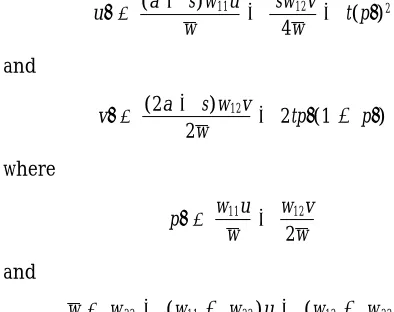
2 2 1 1 2 2 the seed census: Letting u 5 freq(A1A1) and v 5
freq(A1A2) in zygotes (seeds), the genotypic recursions
for the seed census model are
eral seed census model with all three forms of
reproduc-u9 5(a1s)w11u
w 1
sw12v
4w 1t(p9)
2
tion present are summarized in Table B1.
When selection is overdominant, 0 , i , 1/2 and
and the sign changes of g (fˆ ) across (2∞,∞) show that one
root of the quadratic is in (21,1) and the other is in
v9 5(2a1s)w12v
2w 12tp9(1 2p9)
(1,∞). Exactly one solution for fˆ therefore exists in the maximal admissible interval for any set of
overdomi-nant fitnesses, and it has the sign of s/2(a 1 s) 2 i. where
With underdominant selection, i, 0; again, only one
root lies in (21,1), but in this case it is always positive. p9 5w11u
w 1
w12v
2w
The overdominant and underdominant roots in [21,1]
determine valid polymorphic equilibria if and only if and
(14) holds. Directional selection with w11,w12,w22and
w5w221(w112w22)u1(w122 w22)v.
w12 . (w11 1 w22)/2 yields the same sign pattern as
underdominance, but evaluation of (8) shows that the
An equilibrium (uˆ,vˆ) is locally stable if both
eigenval-root in (0,1) is inadmissible because pˆ,0. The
Interme-ues of its local stability matrix have magnitude,1. These
diate Value Theorem is uninformative when w11, w12 eigenvalues are given by the roots of the characteristic
,w22and w12,(w111 w22)/2; however, (8) and (12) equationl22Bl 1C50 where
show that in this case either pˆ. 1 or wˆ , 0 for any
fˆP(21,1). Therefore, no polymorphic equilibria exist
B5 ]u9 ]u 1
]v9
]v (C1)
under directional selection.
A few differences arise for the three subsumed systems
and with only two of the three forms of reproduction (i.e.,
a50, s50, or t5 0). For t50, the underdominant
C5
1
]u9 ]u21
]v9
]v
2
21
]u9]v
21
]v9]u
2
(C2)sign pattern differs from Table B1 in that g (1) 5 0,
indicating that fˆ 5 1 is the only admissible root. In
addition, the case t50 has two roots when selection is with the partials evaluated at (uˆ,vˆ). At the fixation
equi-overdominant: fˆ5 1 and fˆ5(s/2i)21. Note that the libria, B.0, and the two roots are real numbers (because latter implies that when t50, an excess of heterozygotes B2 2 4C . 0); therefore, fixation for A
i will be locally
can occur in seeds only if s, 1 because 2i , 1. The stable if Bi, 2 and Bi2Ci,1, where for i≠j51,2,
root fˆ51 determines a valid equilibrium for
underdom-inance and overdomunderdom-inance only if w115w22(in which Bi5(1 2t)wjj
wii 1
1
12 s2
2
w12 wii
case every state in which u1w51 is an equilibrium).
The distinctions of a50 and s50 are that with over- and
dominance, fˆ . 0 for a 5 0, because then g (0) 5
s(122i). 0, whereas fˆ,0 for s 50, because g(0) 5 C
i5
1
12 s22t
2
w12wjj w2
ii
are (C1) and (C2), respectively, evaluated at the fixation sw12(w222w11).2(w122w22)[w222(12t)w11] (D4)
of Ai. Rewriting the two stability criteria as
for the fixation of A2(pˆ5 0).
Consider the case of overdominance with w12 . w11
2[(12t)wjj 2wii]1(22 s)w1222wii, 0 (C3)
.w22, which implies, by (15), that a polymorphic
equi-and librium exists if and only if
stw12wjj2[(12t)wjj2wii][(22s)w1222wii],0 (C4) sw12(w112 w22),2(w122w11)[w112(12t)w22]. (D5)
Now suppose that an internal equilibrium exists; thus, it follows that fixation of Aiis locally stable if (C4) holds
(D5) holds. This condition is the reverse of inequality together with
(D2) and therefore implies that fixation of A1is unstable
whenever a polymorphic equilibrium exists. Fixation of
w12, 2wii
22 s (C5) A2will also be unstable and is so whenever w12.w11.
w22, because then either w22$(12t)w11, in which case
and
(D4) fails, or w22,(1 2t)w11, in which case (D3) and
(D4) cannot both hold. By symmetry, pˆ5 1 and pˆ50
wii.(12 t)wjj. (C6)
are also both unstable if a polymorphic equilibrium
This reduces to the requirement that (C4) holds to- exists when w
12.w22.w11. Thus, a PP exists whenever
gether with (C5), because this ensures (C6) is satisfied. a valid internal equilibrium exists for overdominant fit-nesses. Now suppose a PP exists when w12.w11.w22.
The instability of pˆ 5 1 implies that either inequality
APPENDIX D (D1) or inequality (D2) is reversed (where we are
ignor-ing the complications posed by the unlikely event of
Co-occurrence (or not) of a valid internal equilibrium
strict equality). For this fitness order, however,
inequal-and a protected polymorphism:In the case of the seed
ity (D2) is reversed whenever inequality (D1) is reversed, census, recall that a polymorphic equilibrium exists for
and hence (D5) always holds when pˆ 5 1 is unstable.
w12. wii.wjjif and only if inequality (15) holds and
Therefore a PP implies a valid polymorphic equilibrium for wii. wjj. w12if and only if inequality (16) holds
exists. By symmetry, the same is true for the case w12.
(i ≠j5 1,2). Showing that a protected polymorphism
w22.w11. This completes the proof that a polymorphic (PP) and a valid internal equilibrium always
simultane-equilibrium exists whenever a PP exists and vice versa ously exist or not is facilitated by rewriting the local
when selection is overdominant. stability conditions in (17) and (18) as
Consider next the case of underdominance with w11
sw12. 2(w122 w11) (D1) .w22.w12. Note first that this fitness order implies that
(D1), (D2), and (D3) hold. Also, by (16), a polymorphic and
equilibrium exists if and only if (D4) holds. Therefore, in this case, both fixation states are stable, and there
sw12(w112w22).2(w122w11)[w112(12t)w22] (D2)
is no PP whenever an internal equilibrium exists. By
for the fixation of A1(pˆ51) and as symmetry, the same is true for w22.w11.w12. Thus, in
the case of underdominance, a polymorphic equilibrium
sw12. 2(w122 w22) (D3)
implies that both pˆ5 1 and pˆ 50 are stable, which in