Software Risk Management In Virtual Team
Environment
Salman Afaq, Salman Qadri, Shabir Ahmad, Abu Buker Siddique, Muhammad Perbat Baloch, Anam Ayoub
Abstract: Research on the major risk factors for traditional projects is abundant; however, despite research citing increased communication and trust issues in virtual environments, research on the major risks for projects conducted in virtual environments is scarce. This paper addresses that void by reporting on a research study of virtual project risk that culminated in a survey of 107 virtual project management practitioners from throughout the United States. Prior literature, in-person interviews and a focus group were used to develop a comprehensive list of fifty-five potential risk factors. Survey participants were asked to rate each of these potential risks, by considering the degree of impact it had on the successful completion of a recent virtual project in which they participated. Similar to past surveys focused on traditional software development projects, the goal of this research was to identify a set of major virtual project risks, those risks most likely to have the greatest impact on the successful completion of a virtual software development project. The results of this study will benefit project management practitioners in managing risk in a virtual project environment.
Index Terms: Risk Management, Risk Factor, Software Projects, Virtual Environment, Organization.
————————————————————
1. INTRODUCTION
Projects are temporary work efforts, each with a specific goal or objective to be completed within a specified time frame. Virtual projects have been defined as projects where team members are distributed across work locations in different cities, states, countries and/or time zones, mak i ng face-to-face communication difficult or impossible. Such teams are referred to as virtual teams. Since team members work from distributed locations, a need is created for project team members to rely heavily on technology for communication, i.e. collaboration tools, often referred to as information and communication technologies or ICTs. Powell, et al. [1] identified a some- times “exclusive reliance” on ICTs as a distinctive feature of virtual teams. Risk factors on projects have often led to challenged projects as well as project disasters [2, 3]. The importance of researching project risk has been acknowledged widely in the literature. Zmud [4], in his research found a “major source of the software problem” to be the failure to assess the project risk, as well as failure to adapt management methods based on the assessed risk. Boehm [5] developed a method to formalize risk assessment through risk identification, analysis and prioritization as a means of achieving project success. Finally, Wallace et al. [6] established that project risk factors can adversely affect a project if the project manager does not address them with appropriate countermeasures. Although project risk on traditional software development projects has been researched at length, traditional software projects no longer dominate software development. Rather, virtual teamwork has emerged as a growing means of conducting projects [7, 8]. Several driving forces have catapulted the use of virtual teams into the forefront, including the growth of global organizations, the continuing rise in business travel costs, widespread budgetary concerns, and an increase in outsourcing and off shoring [9, 10]. While the use of virtual teams has become quite commonplace, the initiation and rapid growth of virtual project work was not accompanied by customized processes and procedures, standards, methodologies or guide- lines developed specifically for the virtual environment. Most project management practitioners instead rely upon existing traditional project risk assessment and handling methods, originally designed for co-located project teams. However, unique issues have
been documented in virtual environments, including communication issues [11], trust issues [12, 13, 14] and issues with invisible team members, sometimes referred to as “deadbeats” or “free- riders”. Although such issues could occur on traditional projects, the literature cited above suggests these problems may occur more frequently or with greater intensity when the environment is virtual. Supporting this position [15, 16, 17, 18] in their research found a number of risks, which they labeled “hazards” that can be more dangerous on virtual software projects than on traditional projects. The researchers specifically cited the following risks in the “hazard” category: mistrust, cliques, uninformed managers and the allure of other interesting but unrelated work. Thus, prior research suggests that virtual project risks may differ from traditional project risks. Since prior research addressed traditional project risk, our objective in this research was to identify a set of top risks that are likely to have the greatest impact on the successful completion of a virtual software development project. The benefit of a top or critical risk factor list was validated by Boehm [5], who in his research on traditional success. In particular, these methods were related to evolutionary development and the evolutionary
life cycle, which promoted the segmentation of
271
situation may be a result of an ever-changing technological environment, the in- creasing span and sophistication of the research methods used, or variation in the goals and methods of the re- search. In any case, all of the research studies focused on the relationship between risks and the success of the project in some manner. However, none focused on virtual projects.
2. METHODOLOGY
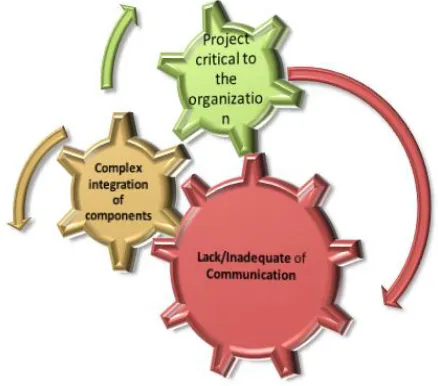
This research study employed a multi-step methodology, designed to culminate in a survey. The survey method was chosen because seminal literature indicated several prior research studies on traditional projects made use of this method [20, 21]. The purpose of the first few steps in the process was to develop a comprehensive set of potential risk factors upon which to base the ultimate survey. The objective of the survey in the second segment was to determine which of these risk factors posed the greatest threat to virtual projects. After an in-depth literature review identifying previously identified risk factors, an open-ended questionnaire was and piloted using face-to-face interviews with IS project management practitioners. This approach used open-ended questions to elicit risk factors from the project managers as they discussed their specific projects. A focus group was conducted using an electronic collaboration tool. Participants in this focus group were part-time Information Technology (IT) graduate students who worked fulltime as IT professionals. The resulting list of project risk factors from the focus group, the face-to-face interviews and literature review were combined then sorted and grouped in an iterative process to create a list of fifty-five specific risk factors for inclusion in the survey. Once the survey was revised from the open-ended questionnaire used in the face- to-face interviews, it was converted into an electronic format which included the fifty-five risk factors and piloted again. Finally, the survey was mass distributed to IS/IT project management practitioners. The following section will discuss the results from the analysis of the survey data and elaborate on details of the survey questionnaire. Chi-square tests were used to determine significance between observed and expected frequencies. As shown in Table 4, of the fifty-five risk factors tested, three risks emerged as major. Figure 1 shows the corresponding percentages of survey participants reporting various levels of these three risks. The three risk factors identified here had both the lowest p-values and the highest percentages of impact of any type among all of the fifty-five potential risks studied. Interestingly, as shown in Figure 1, for the Integration of project components is complex risk factor, the “moderate” impact level was two percentage points higher than the “high” impact level. Together 82% of respondents felt there was an impact and the percentage of respondents who felt there was “no impact” or did not have this risk occur on their project was very low at 18%. The “moderate” impact level percentages of the other two risk factors were lower than the “high” impact level percentages.
Table 1: Respondents Reporting Risk Impact (n=107)
No Impact
Moderat e Impact
Major Impact
p-value Inadequate
Communication 22 41 44 0.018 Project Critical
to the Organization
24 35 48 0.017
Integration of components is complex
19 45 43 0.003
One method to attack complexity risk is through diligent requirements definition, ensuring all necessary interfaces are identified and thoroughly analyzed and de- signed. On a virtual project, extra efforts may be needed to ensure all necessary users and experts are included in these discussions. The use of the appropriate ICTs may be required so that written documents, drawings and meeting notes can be stored in a well organized, easy to retrieve manner and in a format that is easy to interpret. In projects with high levels of complexity but without face-to-face communication, extra expense may be needed to acquire high-quality tools such as groupware, collaboration tools and videoconferencing equipment and to then train the project team, consultants, experts and users to utilize the tools effectively. Constant monitoring may be necessary to ensure the tools are being used and the documentation is accurate. Most importantly, team members must feel engaged and comfortable with the use of the tools. Finally, as in the case of the other two major risk factors identified by this research, much further re- search must be done into the nature of the risk and how it can best be managed and mitigated on virtual projects.
2.1 Relationships among critical risks
Figure 1: Relationship of three critical risk factors in virtual teams
3. RESULTS
The 107 survey participants self identified as IS/IT project leaders/managers and systems analysts playing a leading role in a virtual project. This selection and self-identification of participants is a limitation of this study and may have produced some self-reporting bias. The majority of the survey participants managed their project as either the project manager or project leader (65%). 19% served as team leads on the project, while 5% of respondents were team members and 11% were in roles such as executive positions overseeing multiple IS/IT projects. The size of the projects reported upon varied widely, and was measured by three factors, the cost, duration, and project team size, as shown in Table 3. The majority of the project costs were in the $100,000 to $1 mil- lion range, with a large number of projects falling in the over $1 million range. Half of the projects were less than one year in duration. Projects that are high profile or necessary to the success or continued existence of the company as a whole bring with them increased anxiety for project team members and particularly for the project manager. Project managers on high profile projects often find their careers either skyrocket or plummet, depending largely on the project's success. Further, working on such a project can be similar to living in a fishbowl; everyone appears to be watching and many have an opinion about how well the team is doing and how they could do a better job. With heavy involvement of multiple levels of management, high profile projects run the risk of having too much active management, as in the old adage that "too many cooks spoil the broth." This risk factor may have a higher impact on virtual projects for a variety of other reasons, as well. Distributed teams cannot easily observe and respond appropriately to the reactions of users or management. In a face-to-face traditional environment, subtle cues, including body language and tone of voice, can be observed and interpreted. In a virtual environment, body language is typically hidden during conference calls and both body language and tone of voice are stripped from written communication, including email, wikis, electronic work groups, and the like. Alternatively, the
virtual nature of these projects may draw increased management attention and cause them to be treated as more critical than other similar projects developed using traditional co- located teams. Without further research into this risk factor, it is impossible to declare definitively how project managers should best address this risk. However, certainly an increased emphasis on communication, particularly communication involving management, would be beneficial. Proactively anticipating communication needs may increase the comfort level of managers at all levels, and thus lessen any potential micromanagement or conflicting directions.
4. DISCUSSION
273
there may only be one or two critical projects in a given year, but for a large company in a very competitive environment there might be ten or twenty projects. Being one of twenty critical projects may be less stressful than being one of two. Responses indicate a majority of virtual software project respondents (approximately 78%) believe their project outcome was negatively impacted by the fact that their project was critical to the organization. A majority of the respondents (40.19%) indicated this risk factor had a high impact, while a slightly higher number (42.71%) perceived the impact was moderate. The total percentage of impact was 82% when moderate and high impact was combined. In addition, the low percentage of “no impact/did not occur” (17.76%) also emerged as a solid indicator of critical risk. These results reflect the need for virtual project management practitioners to always evaluate this risk on their projects as well as develop a plan to manage this risk should it occur to prevent it from becoming a risk. This research has demonstrated that the virtual environment does indeed spawn different major project risk factors than those previously identified on traditional projects involving co-located project team members. Given that virtual projects have emerged as a permanent part of the Information Technology landscape, we now need to openly recognize that virtual project risk is not identical to traditional project risk. Only then will virtual project risk receive the research attention it requires.
REFERENCES
[1] Powell, Anne, Gabriele Piccoli, and Blake Ives, "Virtual Teams: A Review of Current Literature and Directions for Future Research." The DATA BASE for Advances in INformation Systems 35, no.1 (Winter 2004): 6-36.
[2] Keil, Mark, P.E. Lyytinen, and R.C. Schmidt. "A Framework for Identifying Software Project Risks." Communications of the ACM 41, no. 11 (1998): 76-83.
[3] Szilagyi, Jeffery G. "Bank of America's Masternet System: A Case Study in Risk Assessment." Sloan School of Management (Sloan School of Management), 1992.
[4] Zmud, Robert W. "Management of Large Software Development Efforts." MIS Quarterly 4, no. 2 (June 1980): 45-55.
[5] Boehm, B.W. "Software Risk Management: Principles and Practices." IEEE Software, January 1991: 32-41.
[6] Wallace, Linda. The Development of an Instrument to Measure Software Project Risk. Atlanta, GA: Georgia State University College of Business, 1999.
[7] Potter, R E, R A Cooke, and P A Balthazard, "Virtual Team Interaction: Assessment, Consequences and Management." Team Performance Management 6, no. 7/8 (2000): 131-137.
[8] Stevenson, W, and E W McGrath. "Differences Between On-Site and Off-Site teams: Manager Perceptions." Team Performance Management 10, no. 5/6 (2004): 127-132.
[9] Jones, Robert, Robert Oyung, and Lise Pace, Working Virtually: Challenges of Virtual Teams. Hershey, PA: Cybertech Publishing, 2005.
[10] Mayer, Margery. The Virtual Edge: Embracing Technology for Distributed Project Team Success. Newtown Square, PA: Project Management Institute Headquarters, 1998.
[11] Lee-Kelley, Liz, and Tim Sankey. "Global Virtual Teams for Value Creation and Project Success: A Case Study." International Journal of Project Management 26 (2008): 51-62.
[12] Majchrzak, A., A. Malhotra, J. Stamps, and J.Lipnack. "Can Absence Make a Team Grow Stronger?" Harvard Business Review 82, no. 5 (2004): 131-137.
[13] Mitchell, Alanah, and Ilze Zigurs. "Trust in Virtual Teams: Solvedor Still a Mystery?" The DATABASE for Advances in Information Systems 40, no.3 (August 2009): 61-83.
[14] Ahmad, Shabir, and Bilal Ehsan. "The Cloud Computing Security Secure User Authentication Technique (Multi Level Authentication)." IJSER 4(12): 2166-2171 (2013).
[15] Majchrzak, Ann, et al. "Technology adaptation: The case of a computer-supported inter-organizational virtual team." MIS quarterly (2000): 569-600.
[16] Khan, Kamran, et al. "Evaluation of PMI’s Risk Management Framework and Major Causes of Software Development Failure in Software Industry." IJSTR 3(11): 120-124, 2014.
[17] Azam, Farooq, et al. "Framework Of Software Cost Estimation By Using Object Orientated Design Approach." IJSTR 3(8): 97-100, 2014.
[18] Baloch, Muhammad Perbat, et al. "Comparative Study of Risk Management in Centralized and Distributed Software Development Environment." Sci.Int.(Lahore), 26(4), 1523-1528, 2014.
[19] McFarlan, F.W. "Portfolio Approach to Information Systems." Harvard Business Review 59, no. 5 (Sept-Oct 1981): 142-150.
[21] Alter, Steven. "Implementation Risk Analysis." TIMS Studies in the Management Sciences 13, no. 2 (April 1979): 103-119.
[22] Keil, Mark, P.E. Lyytinen, and R.C. Schmidt. "A Framework for Identifying Software Project Risks." Communications of the ACM 41, no. 11 (1998): 76-83.
[23] Hussain, Shafiq, et al. "Threat Modelling Methodologies: A Survey." Sci.Int.(Lahore),26(4),1607-1609, 2014.
[24] Siddique Buker et al. “Integration of Requirement Engineering with UML in Software Engineering Practices” Sci.Int.(Lahore),26(5), 2157-2162, 2014.