Effect of Fly Ash as Partial Replacement of
Cement in PPC Concrete
Vinit Kumar Singh1, Vikas Srivastava2, V.C Agarwal3, AlvinHarison2
P.G. Student, Dept. of Civil Engineering, Sam Higginbottom Institute of Agriculture, Technology and Sciences (Deemed University), Allahabad, India1
Assistant Professor, Dept. of Civil Engineering, Sam Higginbottom Institute of Agriculture, Technology and Sciences (Deemed University), Allahabad, India2
Professor and Head, Dept. of Civil Engineering, Sam Higginbottom Institute of Agriculture, Technology and Sciences (Deemed University), Allahabad, India3
ABSTRACT: During last few decades several researches have been carried out on blending of the fly ash in Ordinary pozzolanic cement (OPC). In the present study fly ash is used in Portland pozzolanic material (PPC) concrete as partial replacement of PPC. Fly ash is a pozzolanic material which produces calcium-silicate-hydrate (C-S-H) when reacts with free lime present in cement during the hydration. This paper present the experimental result carried out to determine workability and compressive strength of concrete at different replacement of PPC. M-25 grade of concrete (1:1.53:3) at w/c of 0.42 was designed as per IS-10262-2009. Result shows that PPC can be replaced up to 20% by fly ash without compromising compressive strength of concrete.
KEYWORDS: Fly ash, Workability, Compressive strength, Lime, Workability
I. INTRODUCTION
In the era of advancement and development maintaining the sustainability in the field of construction is a great challenge for civil engineers an environmentalist. Cement is most widely use construction material is responsible for production of about 90% CO2 as per its own production. Major component of OPC are naturally available hence limited
in terms of resources. To conserve this availability reduction in use of OPC was in practice based on numerous researches carried out in the field of blending of supplementary cementious material (most commonly fly ash) in OPC however commercially production of PPC is a result of making blended cement.
In the recent past based on studies carried out by few researchers it is revealed that even while using blended cement content in concrete, the proportion of cement can be reduced by addition of pozzolanic material like fly ash as partial replacement of PPC.It is reported that it is possible to produce low cost High Performance Concrete (HPC), with 90 day strength in the range of 70 N/mm2, using low quality fly ash. It is possible to replace up to 40% of cement by low quality fly ash[1]. In the study carried out byHarison et al, 2014[2]PPC was replaced by fly ash accordingly in the range of 0 to 60 % by weight of PPC at water cement ratio 0.48 for M-25 mix design and reported that, up to 30% replacement level compressive strength is more and almost equal to the referral concrete at 56 days, further increase in replacement of PPC by fly ash results in gradual decrease in compressive strength of concrete.Parveen, et al, 2015 [3] carried out an experimental work in which cement and fine aggregate were partially replaced by fly ash at the replacement levels of 10%, 20%, 30%, 40% and 60% by weight of cement for M-25 Mix Concrete mix. The specimens were molded, tested and compared in terms of compressive and split tensile strength.
Keeping in the view this concept an experimental investigation was proposed to work out the suitability of addition of fly ash as partial replacement of PPC in concrete with the following objective.
To determine the compressive strength of PPC concrete at different replacement level of PPC with fly ash
To compare the result workability and compressive strength of PPC concrete made using fly ash with referral PPC concrete.
II. MATERIALS AND METHODOLOGY Cement
In this work, Portland pozzolona cement (PPC) obtained from single batch was used throughout the investigation. The properties of PPC are given in table.
Table1. Properties of Cement Standard Consistency 31%
Initial Setting Time 245 minutes Final Setting Time 310 minutes 7 days Compressive Strength 31 N/mm2 28 days Compressive Strength 42 N/mm2 Specific Gravity 2.70
Fine Aggregate
The fine aggregate was locally available river sand which was passed through 4.75 mm sieve the fineness modulus, specific gravity and moisture content 2.83, 2.23 and 2.0% respectively.
Coarse Aggregate
The coarse aggregate was locally available having two different sizes, one fraction was passing through 20mm sieve and its fineness modulus was 7.5, and another fraction passing through 10mm sieve and its fineness modulus was 6.8. The specific gravity and water absorption of coarse aggregate was 0.8 and 2.66 respectively for both the fractions.
Fly ash
In the present work the fly ash is obtained from the NTPC, TANDA AMBEDKAR NAGAR, U.P (INDIA). The physical and chemical properties of the fly ash was tested and the result is shown below
Table 2: Properties of the fly ash
Physical Properties
PPC Fly ash
Specific gravity 2.72 2.10
Mean grain size (μm) 23. 20
Specific area (cm2/gm.) 3770 2690
Colour Grey Grey to black
Chemical Composition (%)
PPC Fly ash
Silicon dioxide (SiO2)+ Aluminium oxide (Al2O3) + Iron
oxide (Fe2O3)
- 95.5
Silicon dioxide (SiO2) - 60.5
Sulphur trioxide (SO3) 2.12 (3 % max) 0.2
Reactive Silica (SiO2) - 33.4
Chlorides (Cl) 0.011(0.1 % max) 0.01 Magnesium oxide (MgO) 2.5 (6% max) 0.6 Loss on Ignition 1.74 (5% max) 1.1 Sodium oxide (Na2O) - 0.1
Super plasticizer
KEM SUPLAST 101 S super plasticizer manufactured by Chembond Chemicals was used in this investigation. It was man-made super plasticizer base forming sulphonated naphthalene and immediately dispersible in water having specific gravity 1.2.
Results and discussion
Referral concrete as well as concrete made using fly ash as partial replacement of PPC at different replacement levels were tested for their workability in green state and for compressive strength after 7,28 and 56 days curing. Results of same are discussed here in after.
Workability
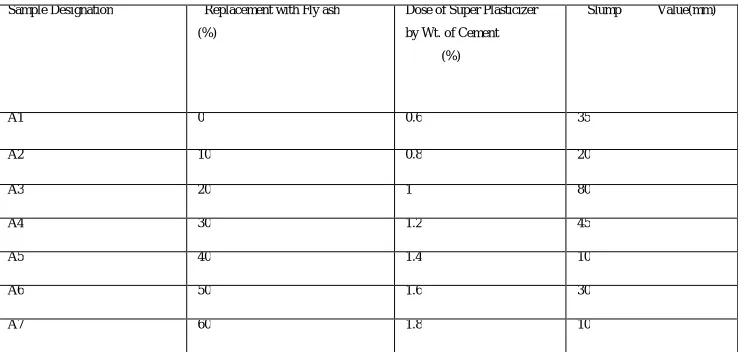
The workability of PPC concrete was determined by the slump test. Workability is used to describe the ease or difficulty with which the concrete is mixing, compacting and placing between the forms with minimum loss of homogeneity. The slump test shows the behavior of a compacted concrete cone under the action of gravitational forces. Slump test were used to gauge the workability of mixed concrete.The slump values of concrete for different percentage of fly ash and corresponding dose of super plasticizer is given in table 3
Fig. 1 Workability Measured by Slump Test
Table 3 Workability of concrete
Sample Designation Replacement with Fly ash
(%)
Dose of Super Plasticizer
by Wt. of Cement (%)
Slump Value(mm)
A1 0 0.6 35
A2 10 0.8 20
A3 20 1 80
A4 30 1.2 45
A5 40 1.4 10
A6 50 1.6 30
Compressive strength
Compressive strength is defined as the ratio of the load per unit area. Compressive strength is estimated by dividing the maximum load by the original cross-sectional area of a specimen in a compression test.
The compressive strength of different specimens for same concrete mix is different, so average compressive strength of three specimen sample was used for strength calculation.Compressive strength of referral concrete as well as concrete made using fly ash as partial replacement of PPCis shown in table below.
Table 4: Compressive strength of Fly ash concrete (W/C = 0.42)
S. NO.
Cube designation
% age of fly ash
Compressive strength (N/mm2) 7 days 28 days 56 days
1 A1 0 20 35 39.62 2 A2 10 20.96 38.37 46.29 3 A3 20 20.27 35.38 42.59 4 A4 30 18.37 26.81 38.88 5 A5 40 14.88 18.88 22.5 6 A6 50 9.77 15.03 21.30 7 A7 60 8.22 12.57 18.42 Same results are also reproduced in graphical form in figure for visual observation.
Fig 2
0 5 10 15 20 25 30 35 40 45 50
0% 10% 20% 30% 40% 50% 60%
co
m
p
re
ss
iv
e
s
tr
en
gt
h
in
k
N
Fly ash in (%)
7 Days
28 Days
Fig. 3
It is observed that on addition of fly ash up to 20% partial replacement of PPC increased compressive strength is achieved at all ages as compared to the referral concrete. However the compressive strength is maximum at 10% replacement level. At 10% replacement level the compressive strength is 4.8%, 9.62% and 16.83% more than referral concrete at 7, 28 and 56 days respectively. At 20% replacement level the compressive strength is 1.35%, 1.08% and 7.49% more than the referral concrete at 7, 28 and 56 days respectively.
The increase in compressive strength is due to the fact that fly ash being pozzolanic material reacts with free lime present in PPC and produce C-S-H gel, which has good binding properties thereby increase the compressive strength in general. Another reason of increase in compressive strength may be packing of voids in concrete by fly ash particles. Since specific gravity of fly ash is less than that of PPC hence on equal weight basis volume of fly ash replaced with PPC is more as such more fine particles are available for packing of voids resulting which more dense concrete as compared to referral concrete.
Further it is seem that beyond 20% replacement level compressive strength is decreased with increase of replacement at all the ages. This decrease may be due to fact that volume of fly ash replaced with PPC is substantially more than that needed for packing of voids in concrete. This increase volumes need more water for lubrication resulting is decrease in compressive strength.
III. CONCLUSIONS
From the above study following conclusion may be drown
1. Fly ash can be added in PPC concrete as partial replacement of PPC up to 20% without compromising compressive strength of concrete.
2. Workability is decreased with increase in replacement level.
3. Beyond 20% replacement level compressive strength is substantial decrease at all ages.
ACKNOWLEDGEMENT
I would like to express my gratitude to all the respected professors, faculty staff and my friends especially Miss. AnamikaSoni,Mr. Mukesh Kumar and Mr.Sarfaraj Ahmad for their co-operation, support and guidance during entire investigation.
0 5 10 15 20 25 30 35 40 45 50
0% 10% 20% 30% 40% 50% 60%
st
re
n
gt
h
(n
/m
m
2)
Fly ash in (%)
Compressive strength
7 Days
28 Days
REFERENCES
1. P.K.Mukherrijee, and B Chojnacki., Laboratory evaluation of a concrete superplasticizing admixture, Super-plasticizers in concrete, V. M. Malhotra, editor, American Concrete Institute, ACI SP-62, Vol. I, pp.
403-424.1978
2. A Harison, V Srivastva, C.B.Gupta; Fly Ash as Supplementary Cementious Material in Portland Pozzolana Cement Concrete” International Journal of Engineering Trends and Technology (IJETT) – Volume 6 Number 3- Dec 2013,pp 113-117 Department of Civil Engineering, SHIATS, Allahabad- 211007, U.P 2013
3. Parveen1, Vivek2, Bhupinder Singh3, “Effect of Fly Ash in PPC Concrete” International Journal of Recent Development in Engineering and Technology (ISSN 2347-6435(Online) Volume 4, Issue 1, pp 12-17January 2015
4. Y. Alhassan and A. O.Apata, “The Behaviour of Portland - Pozzolana Cement Concrete in Aggressive Environments”. Journal of Emerging Trends in Engineering and Applied Sciences.Vol. 3 (4): pp.673-676. 2012.
5. J. Alam andM.NAkhtar., “Fly ash utilization in different sectors in Indian scenario”.International journal of emerging trends in Engineering and Development. Issue1, Vol 1August,2011
6. IS 383:1970, Specification for Coarse and fine aggregate from natural source for concrete, Bureau of Indian standard, New Delhi 7. IS:516-1959, Method of Test for strength of concrete, Bureau of Indian standard, New Delhi
8. IS:10262-2009, Guidelines for concrete mix design proportion,Bureau of Indian standard, New Delhi 9. IS:1199-1991,Method of sampling and analysis of concrete ,Bureau of Indian standard, New Delhi
10. Despande, V.P. “Removal of suspension from ash slurry in Effluent of stream Generation plant.”Indian Journal of environmental Health 24(1). (1982)
11. S.Danshen―The Concrete of Fly Ashǁ, Publishing House of Railway of China, Beijing, pp. 152(1989),
12. M.Garg and M.Singh,ǁ Phosphogypsum - Fly ash cementitious binder - Its hydration and strength developmentǁ, Cement and Concrete Research, Volume 25, Issue 4, Pages 752-758(1995),ǁ
13. M.Garg, andMCSingh, ementitious binder from fly ash and other industrial wastesǁ,Cement and Concrete Research, Volume 29, Issue 3, Pages 309-314, (1999),ǁ
14. NGhafoori., YCai.,B Ahmadi., “Use of dry bottom ash as a fine aggregate in roller compacted concrete,” ACI Spec. Publ. (SP-171) 487– 507.February.1997
15. M. K. Gupta and AKumar.,“factors affecting cement content in concrete”, department of civil & environmental engineering delhi college of engineering bawana road, delhi -110042 university of delhijuly 2008.