INSTRUCTION
MANUAL
FOR
RUGER
®
DEERFIELD
®
CARBINE
AUTOLOADING RIFLE
For Product Service on This Model Please Call:
(603) 865-2442 (See p. 28)
STURM, RUGER & Company, Inc.
Southport, Connecticut 06490 U.S.A.
THIS INSTRUCTION MANUAL SHOULD ALWAYS ACCOMPANY THIS FIREARM AND BE TRANSFERRED WITH IT UPON CHANGE OF OWNERSHIP, OR WHEN THE FIREARM IS LOANED ORREAD THE INSTRUCTIONS AND
WARNINGS IN THIS MANUAL CAREFULLY
BEFORE USING THIS FIREARM
BLUED
STEEL
This firearm was originally sold
with a key-operated locking device.
While it can help provide secure
storage for your
unloaded
firearm,
any locking device can fail. All guns
are designed to fire if they are
loaded and the trigger is pulled.
Therefore,
never install the locking
device inside the trigger guard or
in any way that it can possibly pull
the trigger!
Do not leave the keys
in the lock.
The ultimate responsibility for
secure storage of any firearm must
depend upon its owner and his or
her individual circumstances.
Guns should be securely stored
unloaded, in a secure location,
separate from their ammunition.
See “Storage Warning”, page 25.
NEVER INSTALL
LOCKING DEVICE
INSIDE TRIGGER GUARD
WARNING – LOCKING DEVICES
DO NOT INSTALL
INSIDE TRIGGER GUARD
INSTALL LOCK
AS SHOWN HERE
FIREARMS SAFETY-YOUR RESPONSIBILITY
SAFETY MUST BE THE FIRST AND CONSTANT
CONSIDERATION OF EVERY PERSON WHO
HANDLES FIREARMS AND AMMUNITION.
This Instruction Manual is designed to assist you in learning how to use and care for your RUGER® DEERFIELD®CARBINE properly. Please contact usif you have any questions about it.
Only when you are certain you fully understand the Manual and can properly carry out its instructions should you practice loading, etc. with live ammunition. If you have any doubts about your ability to handle or use a particular type of gun safely, then you should seek supervised instruction. Such personalized instruction is often available from gun dealers, gun clubs or police departments. If none of these sources can help you, write to the National Rifle Association, 11250 Waples Mill Road, Fairfax, VA 22030-7400. They will assist you.
The person possessing a gun has a full-time job. You cannot guess; you cannot forget. You must know how to use your firearm safely.Do not use any firearm without having a complete understanding of its particular characteristics and safe use.
Remember: There is no such thing as a foolproof gun.
TABLE OF CONTENTS
Page
General Information . . . .5
Operation of Safety . . . .6
The Bolt Lock . . . 8
Ammunition . . . 9
To Load and Fire (With Magazine) . . . 11
To Load and Fire (Without Magazine) . . . 13
To Unload . . . 14
To Extract and Eject a Chambered Cartridge . . . 15
To Clear a Malfunction (“Jam”) . . . 15
To Minimize Malfunctions (“Jams”) . . . .16
Disassembly . . . .18
Reassembly . . . .21
Magazine Inspection and Care . . . .22
Care and Cleaning . . . .23
Storage . . . .24
Attaching Ruger Scope Rings . . . 26
Sight Adjustment . . . 26
Service and Parts Policy . . . 28
Parts Drawing . . . 33
The Basic Rules of Safe Firearms Handling . . . .34
FIREARMS ARE DANGEROUS WEAPONS–
READ THE INSTRUCTIONS AND WARNINGS
IN THIS MANUAL THOROUGHLY AND
CAREFULLY BEFORE USING.
GENERAL INFORMATION
AND MECHANICAL CHARACTERISTICS
The RUGER®DEERFIELD®CARBINEis a gas operated, rotary magazine fed, autoloading rifle. It is simple, reliable, and consists of a relatively few rugged components. The mechanism employs the Ruger fixed piston/moving cylinder gas system in conjunction with a simplified rotating bolt.Music wire coil springs are used throughout the mechanism. The RUGER®
DEERFIELD®CARBINE has a cross-button safety which is located in the foward portion of the trigger guard. The safety blocks the trigger and sear while permitting the slide to be cycled with the safety “ON”. A bolt lock mechanism is provided for convenience in holding the bolt open for loading and inspection. The firing pin is retracted mechanically as the bolt starts to unlock and the rifle will fire only when the bolt is locked. The one-piece stock is American hardwood.
WARNING–ALTERATIONS
This product was designed to function properly in its original condition. Alterations can make it unsafe. Do not alter any part or add or substitute parts or accessories not made by Sturm, Ruger & Co. Inc.
DO NOT ALTER ANY GUN
WARNINGS OF GREAT IMPORTANCE ARE
FOUND ON THE FOLLOWING PAGES:
Locking Devices 3 Unloading 13
Alterations 5 Malfunctions 17
Manual Safety 7 Disassembly 17
Ammunition 9 Lubrication 24
Lead Exposure 10 Storage 25
Firing 12 Parts Purchasers 29
Handling 13
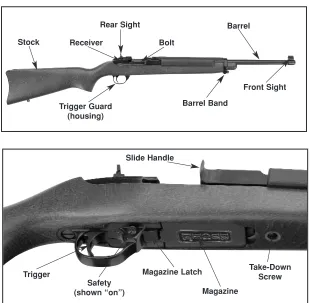
Figure 1. In this illustration the frequently used operating components are identified. Note that the safety is protruding fully from the right side of the trigger guard and is therefore in its “ON” (safe) position.
NOMENCLATURE
The RUGER®DEERFIELD®CARBINEhas an internal buffer system that effectively absorbs the shock of the slide block striking the receiver in recoil. The bolt lock plunger is located at the rear of the slide handle, and when depressed, fits into a slot in the receiver holding the bolt open. The ejector is an integral part of the receiver and ejects the empty cartridges out to the side. The patented Ruger integral scope mounts take all standard Ruger scope rings of various heights. A standard bead type front sight is used, with a flip-up type folding rear peep sight, adjustable for windage and elevation.
OPERATION OF SAFETY
The RUGER®DEERFIELD®CARBINE has a cross-button safety which
Bolt
Barrel
Front Sight
Barrel Band
Take-Down Screw
Magazine Slide Handle
Magazine Latch Safety
(shown “on”) Trigger
Trigger Guard (housing)
Receiver Stock
Keep the safety on unless actually firing. Always move the safety fully to its intended position and check it. The safety is not “ON” unless it is completely “ON”. Never depend on a safety mechanism or any other mechanical device to justify careless handling or permitting the rifle to point in an unsafe direction. The only “safe” rifle is one in which the bolt is open, the chamber is empty, and there is no magazine in the gun.
KNOW HOW TO USE THE SAFETY
The safety is “on” when it protrudes fully from the right side (the slide handle side) of the trigger guard assembly, as shown in Figure 1. In this position the trigger and sear are blocked, and the gun cannot be fired from a normal pull on the trigger. The safety should always be in the “on” (safe) position except when the shooter is actually firing the gun. The safety should be moved to the “on” position whenever the shooter ceases firing, even temporarily.
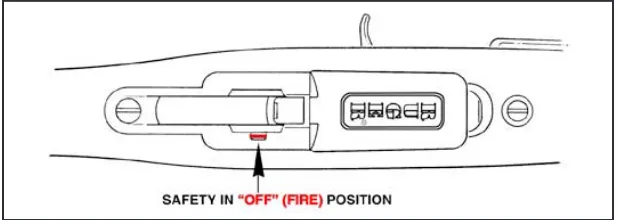
The safety is “off” (fire) when it protrudes from the left side of the trigger guard assembly, as shown in Figure 2. When the safety is off, the red band shows on the safety button, but do not totally rely on the appearance of the red band to indicate that the safety is off. In poor light or if dirt is present, the red band may not be visible. If the safety is “off” and the trigger is pulled, the rifle will fire.
Figure 2.The underside of the trigger guard section of the rifle. In this illustration the safety is shown in the “off” (fire) position. The position of the safety and red band indicate the safety is “off.” It should be in this position only when you are actually firing at a target.
The safety is held in its “on” or “off” position by a plunger that is under spring tension. When the safety is moved to either the “on” or “off” position, a distinct “click” should be heard. Frequently check the position of the safety to be certain the safety has not been inadvertently moved. If the safety seems to move too easily, or if the click is not heard when the safety is moved, stop using the rifle and return it to the Newport Product Service Department for repair (see p. 28).
THE BOLT LOCK
The bolt lock is located in the rear of the slide handle (see Figure 1, p. 6). The bolt lock is the manually operated means of retaining the bolt in the rearward (open) position. When the bolt is locked open, the rifle is in an inoperative safe condition for inspection of the chamber, cleaning, etc.
WARNING: The bolt lock is nota safety device. It should not be used to hold the bolt back when there is a loaded magazine in the rifle. A slight jar to the butt end of the rifle will cause the bolt lock to disengage and to feed a cartridge into the chamber.
The bolt lock should be relied on only to hold the bolt in its rearward position when the chamber is empty and an empty magazine is in place. The only purpose of the bolt lock is for convenience in changing magazines and for holding the bolt in its rearward position when the rifle is unloaded for the purpose of cleaning or inspection.
OPERATION OF BOLT LOCK
To manually engage the bolt lock to keep the bolt open: (See Figure 3)
1. Pull the slide handle all the way to the rear.
2. Depress the bolt lock plunger and allow the slide to move forward slightly until it stops.
3. Put safety “ON”(push fully to the right).
To release the slide (which allows the bolt to go forward) keep safety “ON”and draw the slide handle to the rear and release. Do not “ride” the slide handle forward with your fingers, as this may result in misfeeding of cartridges (see “To Minimize Malfunctions”, p. 16)
CAUTION: Slide is under heavy spring tension and can injure fingers when it slams shut. Keep fingers away from chamber and trigger.
Figure 4
Closing The Bolt
Figure 3
Death, serious injury, and damage can result from the use of wrong ammunition, bore obstructions, powder overloads, or incorrect cartridge components. Even the strongest gun can be “blown up” as a result of excess pressure.Always wear shooting glasses and hearing protectors.
IMPROPER AMMUNITION
DESTROYS GUNS
WARNING – AMMUNITION
AMMUNITION
The RUGER®DEERFIELD®CARBINErelies upon the gases produced from the fired cartridge to cycle the action and is chambered onlyfor the .44 Magnum cartridge. It should not be used with any other .44 caliber ammunition, such as the .44 Special. Most .44 Magnum ammunition factory loaded to U.S. industry specifications is suitable for use. However, “Medium Velocity” non-jacketed ammunition may not produce the volume of gas necessary to consistently cycle the action or give optimum accuracy and is not recommended. Do not use lead bullets -- they will clog the gas port in the barrel and prevent proper action cycling. Aluminum-cased ammunition should not be used, as it may stick in the chamber when fired, resulting in extraction and functioning problems. .44 Magnum cartridges with bullet weights below 215 grains are generally not compatible with the Ruger Deerfield Carbine, and those with bullet weights above 255 grains generally exceed the maximum overall length of 1.610” allowed by U.S. Industry Standards and may not fit into the magazine. Such cartridges at either end of the spectrum of .44 Magnum ammunition loadings should not be used in the Ruger Deerfield Carbine. See “Ammunition Warning” below, & “Ammunition Notice”, p. 10.
AMMUNITION (CARTRIDGES) NOTICE
WE SPECIFICALLY DISCLAIM RESPONSIBILITY FOR ANY
DAMAGE OR INJURY WHATSOEVER OCCURRING IN
CONNECTION WITH, OR AS THE RESULT OF, THE USE IN
RUGER FIREARMS OF FAULTY, OR NON-STANDARD, OR
“REMANUFACTURED” OR HAND LOADED (RELOADED)
AMMUNITION, OR OF CARTRIDGES OTHER THAN THOSE
FOR WHICH THE FIREARM WAS ORIGINALLY CHAMBERED.
WARNING – LEAD EXPOSURE
Discharging firearms in poorly ventilated areas, cleaning firearms, or handling ammunition may result in exposure to lead and other substances known to the state of California to cause birth defects, reproductive harm, and other serious physical injury. Have adequate ventilation at all times. Wash hands thoroughly after exposure.
TO LOAD AND FIRE (WITH MAGAZINE)
Practice this important aspect of gun handling (with an unloaded rifle) until you can perform each of the steps – described below – with skill and confidence. But before you do anything with the rifle, please first read completely through this manual.1.Keep the muzzle pointed in a safe direction. (See Rule 2, p. 34).
2. Pull the slide handle rearward. Engage the bolt lock so that the bolt is held open. Check the chamber to be certain it is empty. Engage the safety.(See Figure 1, p. 6).
3. Remove the magazine from the rifle. (See Figure 5, below).
Figure 5.The safety should be in the “Safe” position when the magazine is being removed or inserted.When the forward section of the magazine latch is pushed in (pivoted upward), the magazine is released. One way of removing the magazine is to cradle the rifle in the left hand with the palm under - but not against - the magazine. Use the right forefinger to fully depress the magazine latch and the magazine will drop free. Another way (illustrated) is to depress the latch with the thumb and at the same time grasp the magazine between the thumb and forefinger and draw it out of the gun.
Removing Magazine
(Safety “On”)
4. Load the magazine by sliding up to four (4) cartridges into the magazine throat-opening as described below. (See Figure 6). The Ruger Deerfield Carbine is designed to function properly only with standard Ruger 4-shot rotary magazines loaded with factory .44 Rem. Mag. cartridges of the correct type. (See “Ammunition”, p. 9)
NOTE:The .44 magnum magazines for the Ruger 96/44 lever action rifle and the Ruger 77/44 bolt action rifle will notfit into the Deerfield Carbine rifle due to dimensional differences. Do notattempt to use either of them in the Deerfield Carbine.
Figure 6.To load the magazine, press the rim of the cartridge against the magazine rotor at the widest section of the magazine throat until the cartridge enters far enough to be pushed to the rear end of the magazine. Each succeeding cartridge is pressed against the body of the top cartridge and slid to the rear of the magazine until a maximum of four (4) cartridges are in the magazine
5. Insert magazine into the firearm, with bullet end of the cartridges toward the muzzle. (Magazine cannot be seated if reversed).
6. Load a cartridge into the chamber by fully retracting the slide handle (which will automatically release the bolt lock) and then releasing the handle. Don’t touch the trigger.Do not ‘ride’ the slide handle as it moves forward. Do not apply force to the slide handle to chamber a cartridge. If a cartridge does not readily chamber, eject it from the rifle, lock the bolt open, remove the magazine and see MALFUNCTION WARNING, p. 17.
7. The rifle is now fully loaded. If the rifle is not to be fired immediately, the safety should remain “ON”(See Figure 1, p. 6). Only when you are ready to fire at a selected target, move the safety to the “off” position. The rifle will fire a single cartridge each time the trigger is pulled and released until all the cartridges in the magazine, and the one in the chamber, have been fired. Firing will automatically reload and recock the rifle.NOTE THAT EVERY TIME THE TRIGGER IS PULLED, IF A CARTRIDGE IS IN THE CHAMBER, THE RIFLE WILL FIRE – BE CAREFUL!
8.Immediately following the firing of a shot, and if a subsequent shot is not to be fired at once, put the safety “ON” while the rifle is still pointing in a safe direction down range.The safety should be moved to the “on” position as soon as firing is completed, and it should be “on” at all times except when the rifle is on target and being fired.
9. The bolt does not remain open after the last shot has been fired, nor does the bolt automatically lock open when the magazine is empty. When firing is completed, put the safety “ON” and manually retract the bolt, lock it open, and visually check the chamber to be sure it is empty. If the bolt is shut, the shooter should always assume that there is a cartridge in the chamber. Don’t rely on your memory to know if a gun or magazine is loaded. Visually inspect the magazine and the chamber.
WARNING – FIRING
The bolt automatically opens and shuts quickly while firing. Keep face and hands away from it. Hot brass and powder gas are ejected quickly and can burn you. The rifle should be fired from the right shoulder. Always wear shooting glasses and hearing protectors.
So that the rifle can be used as a single loader, it will fire whether or not a magazine is in the gun if a cartridge is chambered. Removing magazine does not unload rifle! To unload, first remove magazine, then pull slide to rear, eject chambered cartridge, and visually inspect chamber. The safety should always be in the “on” (safe) position when loading or unloading the rifle.Keep safety “on”.
GUN WILL FIRE WITH
“MAGAZINE” OUT
If dropped or
struck with the
safety “off”, the
rifle may fire.
Keep chamber
empty unless
actually firing!
Keep safety “on”
unless actually
firing!
ANY GUN
MAY FIRE IF
DROPPED
WARNING – HANDLING
TO LOAD AND FIRE (WITHOUT MAGAZINE)
The rifle can be used as a single shot rifle in the absence of a magazine or for safety or training purposes. To do so, follow steps 1 and 2, p. 11. Then load a cartridge into the chamber, and follow steps 6 through 9, p. 12, disregarding the magazine. Engage the safety between shots, and disengage it only when actually firing at a selected target.TO UNLOAD
NOTE:This sequence must be followed exactly as spelled out. Failure to do so can result in the rifle’s chamber becoming unintentionally loaded with a cartridge!
1. Keep the muzzle pointed in a safe direction at all times and keep fingers outside the trigger guard. Move the safety to the “on” (“safe”) position.
2. Remove the magazine. Rememberthat even though the magazine has been removed, a cartridge remaining in the chamber can still be fired!
3. Retract the bolt to its open position and lock it there. This should eject any cartridge in the chamber, but...
4.Always visually double check the chamber to be certain it is empty. The only “safe” rifle is one in which the bolt is open and the chamber and magazine are empty.
5. Cartridges can be removed from the magazine by simply pushing them lightly downward and forward with the thumb, forefinger, or the rubber eraser end of a pencil against the rim of the top cartridge. Do not use a loaded cartridge as a ‘tool’ to strip cartridges from the magazine.
6. If desired, the slide can be left in the open position, being held there by the slide lock. If it is desired to close the slide, again look to be certain the chamber is empty. Put the safety “on”, retract the slide to its rearmost position to release the slide lock and let the slide snap forward. Keep your fingers out of the receiver!
7.With the muzzle pointed in a safe direction,push the safety to the “off” position and pull the trigger to decock it. The rifle can be “dry fired” for practice as long as it is empty and pointed in a safe direction.
8. Push empty (unloaded) magazine into the rifle until the catch locks it in place.
TO EXTRACT AND
EJECT A CHAMBERED CARTRIDGE
When the rifle is fired, the same gas pressure that drives the bullet forward acts through the gas port to push the slide and bolt to the rear. This action causes extraction and ejection of the fired cartridge case. If a cartridge fails to fire or if the shooter wishes to eject the chambered cartridge manually, follow the procedure “To Unload” step 3, p. 14. When the slide handle is operated there can be a failure to extract the cartridge from the chamber, or a failure to eject the cartridge clear of the rifle. These failures usually are the result of the slide handle not being pulled rearward vigorously. From the foregoing, it is clear that the gun user must:
1.Always visually check the chamber and the breech-face after opening the slide to eject a chambered cartridge. If the slide is not vigorously retracted, the extracted cartridge can be “ejected” into the magazine area or remain held to the breech-face by the extractor.
2. Thoroughly clean the chamber and the extractor as often as necessary. If an empty magazine is in the rifle when the slide handle is being retracted to extract a cartridge, the cartridge may drop on top of the magazine or remain held to the breech-face by the extractor. Then, when the slide goes forward, the cartridge will be chambered again! REMEMBER -- always remove the magazine before clearing the chamber, and visually check to ensure that no cartridges remain in the gun. Keep the safety “on” at all times except when actually firing.
TO CLEAR A MALFUNCTION (“JAM”)
Any autoloading firearm may occasionally malfunction. If it does:1.Be certain the muzzle is pointed in a safe direction and the safety is “on”.
2. If possible, first remove the magazine. It may be necessary to manually remove a jammed cartridge which has only partially been stripped from the magazine.
If so, use extreme care. Lock the slide open with the slide stop before attempting to clear the jam. Drawing the slide fully to the rear may bring the jammed cartridge along. Keep your face away from the ejection port during this operation.When attempting to clear a jam, use only wood ‘tools’ so that a cartridge will not be ignited if you strike a primer, and so that the chamber and magazine will not be damaged. A 3/16” wood dowel rod with a point on one end is useful. Use this tool to carefully remove the jammed cartridge and any foreign materials that may have caused the jam.
TO MINIMIZE MALFUNCTIONS (“JAMS”)
Most malfunctions are caused by improper or damaged magazines, incorrect ammunition, or poor maintenance.1. If it appears that the gun and magazine are not at fault and that the jam was caused by the type of cartridge being used, then try another type.
2. If changing to another type or brand of cartridges does not at once eliminate malfunctioning, then the following steps should be taken:
a. Make certain the gun and the magazine are unloaded and that the safety is “on”. Remember, the magazine should be removed first, then check the chamber and be certain it and the magazine-well are clear of cartridges.
b. Thoroughly clean the magazine (See “Magazine Inspection and Care”, p. 22) and bolt mechanism, paying particular attention to removing accumulated grease. Use a bristle brush and solvent to remove grease and fouling from the bolt face, the extractor, the chamber, and the feed ramp. (See the “Care and Cleaning” section of this manual for detailed cleaning instructions).
c. Check to see that the magazine rotor spring tension is adequate. d. Check the magazine throat and chamber area to be certain they are free of nicks and burrs and are not deformed.
e. Remove excess oil and solvent from all cleaned components, load the magazine, and try the firearm again. As always, proceed slowly. Be certain bystanders are not close and that you are wearing eye and hearing protection and that your face is a safe distance from the rifle so that any discharge resulting from a jammed cartridge will not injure anyone.
If the above procedures do not result in a smooth and reliably functioning firearm, don’t use the gun. The rifle can be returned directly to our Newport, New Hampshire Product Service Department for repair. See the Service and Parts Policy section, p. 28 of this manual for packing and shipping information.
A cartridge can be “discharged” before it is chambered if its primer receives a sharp blow. If a cartridge hangs up, jams, or binds when being chambered or when being fed from the magazine into the chamber, do not attempt to force it into the chamber by pushing or striking the bolt.Any jam or feeding problem is a signal to immediately stop using the gun until it can be determined what is wrong. Most failures of a cartridge to feed or to chamber are caused by a damaged magazine, improper gun handling, or defective ammunition.
Whatever the cause, cartridge jams can result in the potentially dangerous situation of a cartridge discharging before it is chambered. If this occurs, the cartridge case will rupture and its fragments will fly out of the gun with sufficient force to cause injury. Always wear shooting glasses and hearing protectors! Keep face away from chamber!
STRIKING PRIMER
CAN BURST CARTRIDGE
WARNING – MALFUNCTIONS
WARNING – DISASSEMBLY
Always
unload
a firearm
before cleaning, lubrication,
disassembly or assembly.
UNLOAD BEFORE
CLEANING
BASIC DISASSEMBLY AND REASSEMBLY
Before attempting to disassemble the rifle for the first time, study the parts drawing and parts list so as to be familiar with the relative position, appearance and name of each part. Carry out the disassembly slowly, and carefully note the position of the part in the gun before starting to remove it. If a part is under spring tension (such as, the Safety Selector, Bolt Stop, Trigger) remove it cautiously and anticipate the direction the spring and plunger are most likely to “jump.”
WARNING: If a spring or plunger become lost, do not use a substitute. Springs of correct tension are vital to the safe and reliable performance of firearms.Before starting disassembly, remove the sling, scope and rings and place the rear sight blade in its down flat position.
DISASSEMBLY
Make Sure Rifle Is Unloaded and Safety is in the “ON” (Safe) Position!
Fold the rear sight down in order to avoid damage during disassembly 1.With the rifle pointing in a safe
direction, remove magazine, open the slide and visually make certain there is not a cartridge in the chamber.Then allow the slide to close. The rear sight leaf should be down, and the hammer should be cocked. (See Fig. 7).
2. Loosen the Barrel Band Screw (B-69) (See Fig. 8a) and remove Barrel Band (CS06800) and Handguard (CS16600). (See Fig. 8b)
Figure 7
Figure 10 4. Loosen Front Mounting
Screw (CS04700). (See Fig. 10)
Figure 11 5. Grasp barrel and the
fore end of the stock and lift barrel and receiver assembly from stock. (See Fig. 11).
Figure 9a 3. Remove Trigger Housing
Screw (CS04800) (See Fig. 9a) and pivot Trigger Housing (CS01300) forward and out from the stock. (See Fig. 9b).
Figure 14 8. Move Slide (CS23701) to the rear to the disassembly notch in the Receiver
(CS00101). The slide is now rolled clockwise to disengage it from the Bolt’s (CS01000) cam follower and the Receiver. (See Fig. 14).
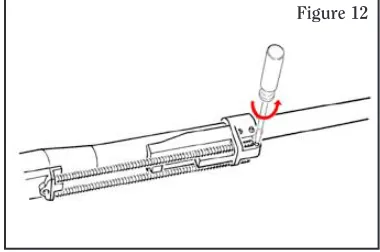
Figure 12 6. Carefully remove Guide
Rod Retainer Screw (CS03901) from Gas Block (CS03500) using a small screw driver. (See Fig. 12).
7. Slide the Recoil Spring Guide Rods (CS03900) forward (one at a time) enough to remove the Recoil Springs (CS00601) and Buffer (CS04000). (See Fig. 13).
CAUTION: The springs are heavily compressed - use eye protection and care when disassembling and reassembling to prevent the springs from escaping forcibly and possibly causing injury.
Remove Recoil Spring Guide Rods.
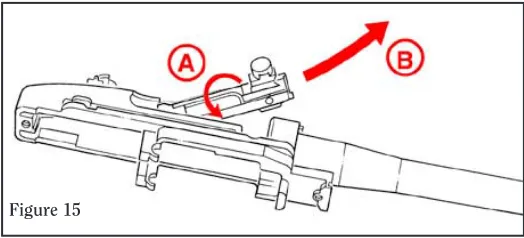
Figure 15
9. Grasp bolt and lift up and forward and rotate in a counterclockwise direction until the rear bolt guide on the back of the bolt enters the disassembly slot. Now rotate the bolt in a clockwise direction and lift bolt from receiver. (See Fig. 15).
REASSEMBLY
Again, Make Sure Rifle is Unloaded
and Safety is in the “ON” (Safe) Position!
1. With the bolt facing forward, insert the rear of the bolt into the disassembly slot of the receiver and align the Firing Pin (KCS01101) projection with the slot in lower receiver bridge. Slowly rotate bolt counterclockwise while sliding bolt into position.
2. With the Bolt in its rearward position, align the Slide handle with the disassembly notch in the rear of the receiver disassembly slot and right-hand Bolt locking lug projection. Rotate the slide counterclockwise to engage the Bolt and Receiver, making sure that the piston end of the Slide is correctly aligned under the barrel. Move Slide to the forward position engaging the Gas Piston (KCS03600).
3. Slide one Recoil Spring Guide Rod through Gas Block and slip one Recoil Spring over it. Compress the spring and then slide the Recoil Spring Guide Rod and Spring Assembly to the rear and insert through the Buffer into the Receiver. Repeat for remaining Recoil Spring Guide Rod. Replace Guide Rod Retainer screw, making sure that it is centrally located on the Gas Block.
4. Replace the assembled barreled action into the stock, making sure that it is fully seated to the rear of the Stock. With a screwdriver, snug down the Front Mounting Screw, but do not tighten completely at this point.
5. Make sure the Hammer (CS01700) is cocked and the Safety is “ON” (safe). To reinstall the Trigger Housing, make sure the assembly lugs on the Trigger Housing engage the assembly notches in the Receiver. Pivot the Trigger Housing into the stock, and then install the Trigger Housing Screw.
6. Now securely tighten both the Front Mounting Screw and the Trigger Housing Screw.
7. Replace the Handguard atop the Barrel.
8. Replace the Barrel Band and tighten its screw securely.
9. Cycle the Slide Handle and Safety a few times to be certain the components are correctly assembled. Put the Safety back “ON” (safe) and keep it there.
MAGAZINE INSPECTION AND CARE
Check the magazine frequently. The rotor must move freely and have adequate tension so that each cartridge is quickly raised to the feeding position. The .44 magnum magazine is automatically tensioned (rotor wound 1 1/2 turns) if properly assembled.To test the rotor tension, load one cartridge into the magazine and then firmly press against the side of the cartridge case. Remove your finger quickly. The cartridge should instantly and fully move in to the feeding position. If it does not, the magazine should be cleaned. If cleaning does not restore proper rotor tension, do not use the magazine.(NOTE: After testing, remove the test cartridge).
When cleaning is necessary, use a solvent that will not rust the metal
components or adversely affect the plastic magazine box. After the magazine has been soaked in solvent to loosen foreign matter, be certain to shake it vigorously (with the loading opening away from you) to remove solvent or residue from within the magazine.
CARE AND CLEANING
Make Sure Gun is Unloaded!
Before cleaning, be certain the rifle and its magazine contain no cartridges.
At regular intervals, or whenever the rifle has been exposed to sand, dust, extreme humidity, condensation, immersion in water, or other adverse conditions, disassemble, clean and oil it. Proper periodic maintenance is essential to the reliable functioning of any firearm.
To clean the rifle, proceed as follows:
1. Disassemble (field-strip) the rifle to the extent described on pages 18 - 21.
2. Using a cleaning rod, run a solvent-wetted patch through the bore several times. Then attach a solvent-wetted bristle brush to the rod and run it back and forth the full length of the bore as many times as necessary to remove grease and dirt from the bore and chamber. Clean bore with dry patches and examine. Bore fouling can contribute to reduced accuracy, and grease accumulation in the chamber can interfere with proper feeding of cartridges from the magazine.
3. Using powder solvent on a clean patch or bristle brush, remove powder residue from all components of the mechanism. After cleaning, run a dry patch through the bore, then follow with a patch that is very lightly oiled. Wipe all surfaces clean with cloth, then wipe all surfaces with a patch or cloth that has been very lightly oiled.
DAMAGED, NON-STANDARD, OR IMPROPERLY
ASSEMBLED MAGAZINES SHOULD NOT BE USED.
THEY CAN CAUSE THE RIFLE TO MALFUNCTION.
Firing a rifle with oil, grease, or any other material even partially obstructing the bore may result in damage to the rifle and serious injury to the shooter and those nearby. Do not spray or apply lubricants directly on
ammunition. If the powder of a cartridge is affected by the lubricant, it may not be ignited, but the primer firing may push the bullet into the bore where it may be lodged. Firing a subsequent bullet into the obstructed bore may damage the rifle and cause serious injury or death to the shooter and those nearby. Use lubricants properly. You are responsible for the proper care and maintenance of your firearms.
IMPROPER LUBRICATION
DESTROYS GUNS
WARNING – LUBRICATION
4. NOTE: Only a light application of oil is needed to provide adequate lubrication of moving parts and to prevent rust. Excess accumulations of oil tend to attract particles of dust and dirt and may congeal in cold weather which can interfere with the safe and reliable functioning of the rifle.
STORAGE
GUNS SHOULD NOT BE STORED LOADED!
USE THE LOCKING DEVICE SUPPLIED WITH THE RIFLE FOR STORAGE. (SEEPAGE3)
Do notstore the rifle in a leather case or scabbard. Leather attracts moisture, even though it may appear to be dry.
TO RENDER THE RIFLE INOPERATIVE FOR SAFE STORAGE
With the muzzle pointed in a safe direction, remove the magazine, open the bolt, and check the chamber to be sure the rifle is completely unloaded! Remove the trigger housing screw and pivot the trigger housing forward and out of the stock. The trigger housing assembly contains most of the firing mechanism.
Store the rifle and the trigger housing assembly in different locations. When disassembled in this manner, the rifle is inoperable. It is impossible to fire the rifle until the trigger housing assembly has been correctly replaced into the rifle.
Never place or store any firearm in such a manner that it may be dislodged. Firearms should always be stored securely and unloaded, away from children and careless adults. Use the locking device originally supplied with this firearm for storage. The use of a locking device or safety lock is only one aspect of responsible firearms storage. For increased safety, firearms should be stored unloaded and locked in a location that is both separate from their ammunition and inaccessible to children and any other unauthorized person.
STORE SECURELY & UNLOADED
WARNING – STORAGE
SIGHT ADJUSTMENT
Shooting to determine the setting of the elevation slide (aperture) should be done from a bench rest and over a measured distance.
Since the impact point and accuracy of different .44 magnum ammunition can vary considerably (a 180 grain bullet load may impact the target 15” higher than a 300 grain bullet load at 50 yards), to accomodate the majority of ammunition the open sights are factory zeroed at 50 yards with standard U.S. factory-loaded 240 grain jacketed bullet ammunition.
ATTACHING RUGER SCOPE RINGS
Each Ruger telescope ring is a mated assembly of a top and a base. Do not mix the parts of the two ring assemblies as they are not interchangeable. On the underside of each mounting ring assembly there is an integral lug, located off center with respect to the front and back sides of the mount. The lug is nearer to the front surface. By reference to the lug, the mounting ring can be correctly assembled with the front of the ring toward the muzzle of the rifle.1. Disassemble one ring and reassemble over the scope body between the turret and the eyepiece. Remember - the lug on the base should be on the front side of the scope.
2. Install the four top screws. Do not tighten.
3. Disassemble the other ring and install it on the forward section of the scope tube with the lug forwardly also. Install the four top screws. Again, do not tighten.
4. Assemble the rings to the receiver with the lugs engaging the recesses in the top surface of the receiver. Tighten the clamp nuts so that the rings are locked to the semicircular cuts on the sides of the receiver.
5. Rotate the scope until cross-hairs are aligned properly and slide scope to desired eye relief. then tighten the eight top screws each a bit at a time to grip the scope body.
6. Sight in according to the directions with your scope.
7. If ejected cases strike the scope, try using higher scope rings or different ammunition. If this condition persists, you should use the supplied Ruger Scope Shield (part no. SP17339).
The rear sight is adjustable for both windage and elevation. Lateral (windage) adjustment is made by loosening the Rear Sight Windage Lock Screw (with the hex-head wrench provided with the rifle) until the sight base requires finger pressure to be moved. (See illustration below). Move the sight in the direction you wish to move the point of impact. Before moving the sight, pencil mark an index line on the sight base and on the receiver so that the amount of sight movement can be detected. After desired positioning of the sight base has been achieved, tighten the lock screw firmly.
WINDAGE ADJUSTMENT:Loosen windage lock screw. To move the bullet impact point to the left, move the rear sight base to the left. To move the bullet impact point to the right, move the rear sight base to the right. Be sure to carefully retighten lock screw after adjustment.
ELEVATION ADJUSTMENT:To move the bullet impact point upor down, move the elevation slide (the “peep”) by loosening both elevation lock screws (using a small screwdriver with a blade tip that exactlyfits the screw-heads) only slightly so the slide doesn’t move too freely. Move the slide in the direction you want the point of impact of the bullet to move. When the slide is positioned at the desired height, be sure to carefully retighten both screws.
To Move Impact Up
Raise Rear Sight
To Move Impact Down
Lower Rear Sight
To Move Impact To Left,
Move Rear Sight Left
To Move Impact To Right,
SERVICE AND PARTS POLICY
If you have any question with regard to the performance of your RUGER®
DEERFIELD®CARBINE please write or call (603-865-2442) our Product Service Department in Newport, New Hampshire 03773, fully describing all circumstances and conditions involved. If you should return your rifle to the factory for repair, or order parts for it, please comply with the following suggestions for prompt service:
WARNING: BEFORE SHIPPING ANY FIREARM,
BE ABSOLUTELY CERTAIN THAT IT AND ITS
MAGAZINE ARE UNLOADED. DO NOT SHIP
CARTRIDGES WITH A FIREARM.
SHIPPING FIREARMS FOR REPAIR
RUGER®DEERFIELD®CARBINE’sreturned to the factory for repair should be sent to: Sturm, Ruger & Company, Inc., Product Service Department, 411 Sunapee St., Newport, New Hampshire 03773. Telephone (603) 865-2442. Guns should be sent prepaid. We will not accept collect shipments.
The Federal Gun Control Act, as well as the laws of most States and localities, do not prohibit an individual (who is not otherwise barred from purchasing or possessing a firearm) from shipping a firearm directly to the manufacturer for repair. However, before you ship your rifle to us, be certain that your State or locality does not have a law or regulation which will prohibit you from receiving the rifle from us after it has been repaired. If such receiving is prohibited, then please have a Federally Licensed firearms dealer ship the gun to us. If your rifle is sent to us by a dealer, it will be returned to him after being repaired. If a handgun (pistol or revolver) is shipped by an individual who does not hold a Federal Firearms License, it must be shipped via U.P.S. (Next Day Air). Persons who do not hold a Federal Firearms License are prohibited by Federal law from shipping a handgun by Mail. Handguns mailed in violation of the law are impounded by the Post Office.
DO NOT SEND GUN BOXES OR LITERATURE THAT YOU CONSIDER TO BE COLLECTOR’S ITEMS – THESE ARE INVARIABLY DAMAGED OR DESTROYED IN SHIPMENT.Please do not include rifle case, sling, telescopic sights or custom accessories with a firearm being shipped to the factory for service. Rifles and shotguns may be shipped via Parcel Post. Always insure your shipment.
Enclose a letter which includes your name, address, telephone number, serial number and model of the firearm. Describe in detail the trouble you have experienced with your firearm, or the work you wish to have done. Merely stating that the firearm “needs repair” is inadequate information.
WARNING –PARTS PURCHASERS
It is the purchaser’s responsibility to be absolutely certain that any parts ordered from the factory are correctly fitted and installed. Firearms are complicated mechanisms and
IMPROPER FITTING OF PARTS MAY RESULT IN A DANGEROUS MALFUNCTION, DAMAGE TO THE FIREARM, AND SERIOUS INJURY TO
THE SHOOTER AND OTHER PERSONS. The
purchaser and installer of parts must accept full responsibility for the correct adjustment and functioning of the rifle after such installation.
PARTS MUST FIT CORRECTLY
ORDERING PARTS
Please contact the New Hampshire Product Service Department for parts availability and current prices. All parts orders for the RUGER®
DEERFIELD®CARBINEshould be sent to: Sturm, Ruger & Co., Inc., Product Service Department, 411 Sunapee Street, Newport, New Hampshire 03773, 603-865-2442. We cannot comply with open account or C.O.D. orders. Payment in the form of a check, money order, Visa or Mastercard must accompany your order. Credit Card orders must include the account number, expiration date and whether it is a Visa or Mastercard account. Minimum parts order is $1.00 plus $3.50 shipping and handling charge. Order parts by Part Name and Part Number and include the entire serial number of the firearm for which the parts are being ordered. There is a minimum net labor charge of $20.00 plus $12.00 shipping and handling charge if the parts are factory fitted. All factory fitted parts are fit on an exchange basis only. We will not return the replaced parts.
Barrels, and a number of other component parts must be fitted at the factory. Company policy is to proof-test and/or function fire all barrels after fitting to the receivers in which they are to be used. This procedure ensures maximum protection to our customers. The special proof-test ammunition used in this testing is sold only to bonafide firearms manufacturers and is not available to gun shops, gunsmiths, or individuals.
Because the receiver of the RUGER®DEERFIELD®CARBINE is a serial numbered component, it is defined as a “firearm” by Federal law and is not sold as a separate component.
*Parts designated by an asterisk must be factory fitted. These parts are fitted on an exchange basis only. We will not return the replaced parts. We will not return any part that is broken, malfunctioning, badly worn or has been modified. See “Warning – Parts Purchasers”, above.
30
RUGER
®DEERFIELD
®CARBINE
PARTS LIST
Design, prices and specifications subject to change without notice.
SPECIFY MODEL & SERIAL NUMBER WHEN ORDERING
(See Exploded View on Page 33)
Part Name
Part No.
Model
* Barrel
0C8001
99/44
Barrel Band
CS06800
99/44
Barrel Band Screw
B-69
99/44
Bolt Only
CS01000
99/44
* Bolt Assembly, Complete
CS01001
99/44
Buffer
CS04000
99/44
Butt Plate
C-63
99/44
Butt Plate Screw, 2 Req’d.
B-64
99/44
Cable Lock, 10”
-
For Ruger Rifles
Only
PM120A
99/44
Extractor
CS01400
99/44
Extractor Plunger
KCS01600
99/44
Extractor Spring
MS01500
99/44
* Firing Pin
KCS01101A
99/44
Front Mounting Screw
CS04700
99/44
Front Sight, With Gold Bead
B27501
99/44
Part Name
Part No.
Model
Gas Block Cross Pin, Outer, 3 Req’d
CS06100
99/44
Gas Block Cross Pin, Inner, 2 Req’d
CS06200
99/44
Gas Pipe
KCS03600
99/44
Guide Rod, 2 Req’d
CS03900
99/44
Guide Rod Retainer Screw
CS03901
99/44
* Hammer
CS01700
99/44
Hammer Pivot Pin
L02600
99/44
Hammer Spring, Left
L01810
99/44
Hammer Spring, Right
L01800
99/44
Hammer Spring Support Pin
L02500
99/44
Handguard
CS16600
99/44
Magazine, Complete, 4-Shot Capacity
CS22706
99/44
Magazine Latch
CS03101
99/44
Magazine Latch Plunger
CS03620
99/44
Magazine Latch Spring
CS05000
99/44
Rear Sight Assembly
MS25501
99/44
Rear Sight Windage Lock
MS05910
99/44
Rear Sight Windage Lock Screw
MS05710
99/44
Recoil Spring, 2 Req’d
CS00601
99/44
Safety Button
CS05200
99/44
Safety Detent Plunger
B-53
99/44
Safety Detent Plunger Spring
B-54
99/44
Scope Protector, Complete (Not Illustrated)
SP17339
99/44
Part Name
Part No.
Model
Scope Rings, High Rings
S100RH
99/44
Accomodate 52mm Lens
Scope Ring Clamp
D-74
99/44
Scope Ring Nut
D-73
99/44
Scope Ring Screws, 8 Req’’d
D-76
99/44
* Secondary Sear
CS02300
99/44
Secondary Sear Spring
S-41
99/44
Slide
CS23701
99/44
Slide Spring
D-32
99/44
Slide Lock Plunger
CS04500
99/44
Sling Swivel Adapter
B08600
99/44
Sling Swivel Stud, Rear
S-87
99/44
Stock Assembly, Complete
CS00400
99/44
* Trigger
CS02000
99/44
Trigger Housing
CS01300
99/44
Trigger Housing Screw
CS04800
99/44
Trigger Pivot Pin
B-21
99/44
Trigger Spring
CS02400
99/44
* PARTS SO MARKED MUST BE FACTORY FITTED
RUGER
®DEERFIELD
®CARBINE
EXPLODED VIEW
THE BASIC RULES OF SAFE FIREARMS HANDLING
We believe that Americans have a right to purchase and use firearms for lawful purposes. The private ownership of firearms in America is traditional, but that ownership imposes the responsibility on the gun owner to use his firearms in a way which will ensure his own safety and that of others. When firearms are used in a safe and responsible manner, they are a great source of pleasure and satisfaction, and represent a fundamental part of our personal liberty.
Firearms do not cause accidents! Firearms accidents are almost always found to have been the result of carelessness, or ignorance on the part of the shooter of the basic rules of safe gun handling.
The following rules must be observed by gun users at all times. Safe gun handling is not just desirable, it is absolutely essential to your safety, the safety of others, and the continuation of gun ownership and sport shooting as we know it today.
1. LEARN THE MECHANICAL AND HANDLING
CHARACTERISTICS OF THE FIREARM YOU ARE USING.
Not all firearms are the same. The
method of carrying and handling
firearms varies in accordance with
the mechanical provisions for
avoiding accidental discharge and the
various proper procedures for loading
and unloading. No person should
handle any firearm without first
having thoroughly familiarized
himself with the particular type of
firearm he is using, and with safe gun
handling in general.
2. ALWAYS KEEP THE
MUZZLE POINTED IN A
SAFE DIRECTION.
Be sure of the bullet stop behind
your target, even when dry-firing.
Never let the muzzle of a firearm
point at any part of your body or at
another person. This is particularly
important when loading or
unloading a firearm. In the event of
an accidental discharge, no injury
can occur as long as the muzzle is
pointing in a safe direction. A safe
direction means a direction which
RUGER
®
INSTRUCTION MANUAL READ THE INSTRUCTIONS AND WARNINGS IN THIS
A safe direction must take into account the fact that a bullet may
penetrate a wall, ceiling, floor, window, etc., and strike a person or
damage property. Make it a habit to know exactly where the muzzle of
your gun is pointing whenever you handle it, and be sure that you are
always in control of the direction in which the muzzle is pointing, even
if you fall or stumble. Keep your finger off the trigger until you are ready
to shoot.
3. FIREARMS SHOULD BE UNLOADED WHEN NOT IN
USE.
Firearms should be loaded only
when you are in the field or on the
target range or shooting area,
ready to shoot. Firearms and
ammunition should be securely
locked in safes, racks or cabinets,
or by using the locking device
supplied with the firearm, when
not in use. Ammunition should
safely be stored separate from
firearms. Store your firearms out
of sight of visitors and children. It
is the gun owner’s responsibility to
be certain that children and
persons unfamiliar with firearms cannot gain access to firearms,
ammunition, or components.
4. BE SURE THE BARREL IS CLEAR OF OBSTRUCTIONS
BEFORE SHOOTING.
E
ven a bit of mud, snow or excess
lubricating oil or grease in the
bore may cause the barrel to
bulge, or even burst on firing, and
can cause serious injury to the
shooter and bystanders. Be sure
that you are using ammunition of
the proper caliber and loading for
the gun you are using. If the
report or recoil on firing seems
weak, or doesn’t seem quite right,
CEASE FIRING IMMEDIATELY,
unload your firearm, and check to
be sure that no obstruction has
5. BE SURE OF YOUR
TARGET BEFORE YOU
SHOOT.
Don’t shoot unless you know
exactly where your bullet is going
to strike. Be sure of the bullet
stop behind your target, even
when dry-firing with an unloaded
gun. If you are in the field
hunting, do not fire at a
movement or noise. Take the time
to be absolutely certain of your
target before you pull the trigger.
6. WEAR SHOOTING
GLASSES AND HEARING
PROTECTORS WHEN
YOU SHOOT.
All shooters should wear
protective shooting glasses and
adequate hearing protectors when
shooting. Exposure to shooting
noise can damage hearing, and
adequate eye protection when
shooting is essential.
7. NEVER CLIMB A TREE
OR FENCE WITH A
LOADED FIREARM.
8. DON’T SHOOT AT A
HARD SURFACE, OR AT
WATER.
Bullets can glance off many
surfaces like rocks or the surface
of water and travel in
unpredictable directions with
considerable velocity.
9. NEVER TRANSPORT A
LOADED FIREARM.
Firearms should always be
unloaded before being placed in a
vehicle. A suitable carrying case
or scabbard should be used to
carry an unloaded firearm to and
from the shooting area.
10. AVOID ALCOHOLIC
BEVERAGES WHEN
SHOOTING.
A BRIEF ACCOUNT OF AN EXTRAORDINARY
ACHIEVEMENT: RUGER FIREARMS
One of the few American firearms manufacturers whose
manage-ment has remained unchanged since starting in business, Sturm, Ruger &
Company, Inc., had its beginning in a small machine shop occupying a
rented frame building in Southport, Connecticut. In January, 1949, with an
initial investment of only $50,000 and an idea, William B. Ruger and
Alexander M. Sturm started production of a .22 caliber autoloading pistol – a
design which was so successful that it became the cornerstone upon which
one of the most comprehensive lines of sporting firearms ever made in
America was established. After Alex Sturm’s death in 1951, William B. Ruger
continued to direct the company alone and today, as Chairman Emeritus of
the Board, he continues to provide the guidance which has made this
52-year-old company a sound and successful enterprise.
Sturm, Ruger & Company, in this relatively short time, has established itself
as a leading small arms design organization, developing a unique and broad
line of fine quality sporting, military and police firearms to become one of
the world’s most famous producers of revolvers, pistols, rifles and shotguns.
From 1949 thru 2001 Ruger craftsmen have built many millions of firearms.
During its five decades of growth and progress under the leadership of
William B. Ruger, the company has developed a business philosophy and
implemented policies which represent a constructive influence in the life of
modern America. From the beginning, Sturm, Ruger & Company played a
positive role in conservation efforts and has supported the interests of
shooters through such groups as the National Rifle Association, National
Shooting Sports Foundation, and many regional sportsmen’s organizations.
The company has always endeavored to market its firearms for constructive
and recreational purposes, to emphasize the traditional aspects of shooting,
to render meaningful public services and to encourage shooters in
constructive, responsible, and safe participation in the shooting sports.
Today, Sturm, Ruger & Company is particularly mindful of those elements
which have contributed to the creation of its success, and extends heartfelt
thanks to its many loyal employees and customers.
WHY NO WARRANTY CARD HAS BEEN
PACKED WITH THIS NEW RUGER FIREARM
The Magnuson-Moss Act (Public Law 93-637) does not require any
seller or manufacturer of a consumer product to give a written
warranty. It does provide that if a written warranty is given, it must be
designated as “limited” or as “full” and sets minimum standards for a
“full” warranty. Sturm, Ruger & Company, Inc. has elected not to
provide any written warranty, either “limited” or “full”, rather than to
attempt to comply with the provisions of the Magnuson-Moss Act and
the regulations issued thereunder. There are certain implied
warranties under state law with respect to sales of consumer goods. As
the extent and interpretation of these implied warranties varies from
state to state, you should refer to your state statutes. Sturm, Ruger &
Company wishes to assure its customers of its continued interest in
providing service to owners of Ruger firearms.
STURM, RUGER & Company, Inc.
Southport, Connecticut 06490 U.S.A.
http://www.ruger.com
“Arms Makers For Responsible Citizens”
®
A COPY OF THE INSTRUCTION MANUAL FOR ANY RUGER FIREARM IS AVAILABLE FROM THE FACTORY FREE ON REQUEST.
THESE INSTRUCTION MANUALS CONTAIN IMPORTANT WARNINGS WHICH MUST BE UNDERSTOOD
BEFORE USING THESE FIREARMS.
“RUGER”, the Sturm, Ruger logo, “SINGLE-SIX”, “BLACKHAWK”, “REDHAWK”, “SECURITY-SIX”, “SPEED-SIX”, “SERVICE-SIX”, “BEARCAT”, “OLD ARMY”, “10/22”, “MINI-14”, “MINI THIRTY”,
“RANCH RIFLE”, “M77”, “77/22”, “77/44”, “77/50”, “GP-100”, “SP101”, “P-85” and “VAQUERO” are registered U.S. trademarks.