Volume 2008, Article ID 147407,10pages doi:10.1155/2008/147407
Research Article
Downsampling Non-Uniformly Sampled Data
Frida Eng and Fredrik Gustafsson
Department of Electrical Engineering, Link¨opings Universitet, 58183 Link¨oping, Sweden
Correspondence should be addressed to Fredrik Gustafsson, [email protected]
Received 14 February 2007; Accepted 17 July 2007
Recommended by T.-H. Li
Decimating a uniformly sampled signal a factorDinvolves low-pass antialias filtering with normalized cutofffrequency 1/D followed by picking out everyDth sample. Alternatively, decimation can be done in the frequency domain using the fast Fourier transform (FFT) algorithm, after zero-padding the signal and truncating the FFT. We outline three approaches to decimate non-uniformly sampled signals, which are all based on interpolation. The interpolation is done in different domains, and the inter-sample behavior does not need to be known. The first one interpolates the signal to a uniformly sampling, after which standard decimation can be applied. The second one interpolates a continuous-time convolution integral, that implements the antialias filter, after which everyDth sample can be picked out. The third frequency domain approach computes an approximate Fourier transform, after which truncation and IFFT give the desired result. Simulations indicate that the second approach is particularly useful. A thorough analysis is therefore performed for this case, using the assumption that the non-uniformly distributed sampling instants are generated by a stochastic process.
Copyright © 2008 F. Eng and F. Gustafsson. This is an open access article distributed under the Creative Commons Attribution License, which permits unrestricted use, distribution, and reproduction in any medium, provided the original work is properly cited.
1. INTRODUCTION
Downsampling is here considered for a non-uniformly sam-pled signal. Non-uniform sampling appears in many applica-tions, while the cause for nonlinear sampling can be classified into one of the following two categories.
Event-based sampling
The sampling is determined by a nuisance event process. One typical example is data traffic in the Internet, where packet arrivals determine the sampling times and the queue length is the signal to be analyzed. Financial data, where the stock market valuations are determined by each transaction, is an-other example.
Uniform sampling in secondary domain
Some angular speed sensors give a pulse each time the shaft has passed a certain angle, so the sampling times depend on angular speed. Also biological signals such as ECGs are natu-rally sampled in the time domain, but preferably analyzed in another domain (heart rate domain).
A number of other applications and relevant references can be found in, for example, [1].
It should be obvious from the examples above that for most applications, the original non-uniformly sampled sig-nal is sampled much too fast, and that oscillation modes and interesting frequency modes are found at quite low frequen-cies compared to the inverse mean sampling interval.
The problem at hand is stated as follows.
Problem 1. The following is given:
(a) a sequence of non-uniform sampling times,tm,m=
1,. . .,M;
(b) corresponding signal samples,u(tm); (c) a filter impulse response,h(t); and (d) a resampling frequency, 1/T.
Also, the desired intersampling time,T, is much larger than the original mean intersampling time,
μT Etm−tm−1
≈tM
Letxdenote the largest integer smaller than or equal to
x. Find
z(nT), n=1,. . .,N,
N=
tM
T
M
D,
(2)
such thatz(nT) approximatesz(nT), where
z(t)=hu(t)=
h(t−τ)u(τ)dτ (3)
is given by convolution of the continuous-time filterh(t) and signalu(t).
For the case of uniform sampling,tm =mTu, two well-known solutions exist; see, for example, [2].
(a) First, ifT/Tu=Dis an integer, then (i)u(mTu) is fil-tered givingz(mTu), and (ii)z(nT)= z(nDTu) gives the decimated signal.
(b) Further, ifT/Tu = R/S is a rational number, then a frequency domain method is known. It is based on (i) zero paddingu(mTu) to lengthRM, (ii) computing the discrete Fourier transform (DFT), (iii) truncating the DFT a factor S, and finally computing the inverse DFT (IDFT), where the (I)FFT algorithm is used for the (I)DFT calculation.
Conversion between arbitrary sampling rates has also been discussed in many contexts. The issues with efficient implementation of the algorithms are investigated in [3–
6], and some of the results are beneficial also for the non-uniform case.
Resampling and reconstruction are closely connected, since a reconstructed signal can be used to sample at desired time points. The task of reconstruction is well investigated for different setups of non-uniform sampling. A number of iterative solutions have been proposed, for example, [1,7,8], several more are also discussed in [9]. The algorithms are not well-suited for real-time implementations and are based on different assumptions on the sampling times,tm, such as bounds on the maximum separation or deviation from the nominal valuemTu.
Russel [9] also investigates both uniform and non-uniform resampling thoroughly. Russell argues against the iterative solutions, since they are based on analysis with ideal filters, and no guarantees can be given for approximate so-lutions. A noniternative approach is given, which assumes periodic time grids, that is, the non-uniformity is repeated. Another overview of techniques for non-uniform sampling is given in [10], where, for example, Ferreira [11] studies the special case of recovery of missing data and Lacaze [12] re-constructs stationary processes.
Reconstruction of functions with a convolutional ap-proach was done by [13], and later also by [14]. The sampling is done via basis functions, and reduces to the regular case if delta functions are used. These works are based on sampling sets that fulfill the non-uniform sampling theorem given in [15].
Reconstruction has long been an interesting topic in im-age processing, especially in medical imaging, see, for exam-ple, [16], where, in particular, problems with motion arti-facts are addressed. Arbitrary sampling distributions are al-lowed, and the reconstruction is done through resampling to a uniform grid. The missing pixel problem is given at-tention in [9,17]. In [18], approximation of a function with bounded variation, with a band-limited function, is consid-ered and the approximation error is derived. Pointwise re-construction is investigated in [19], and these results will be used inSection 5.
Here, we neither put any constraints on the non-uniform sampling times, nor assumptions on the signal’s function class. Instead, we take a more application-oriented approach, and aim at good, implementable, resampling procedures. We will consider three different methods for converting from non-uniform to uniform sampling. The first and third al-gorithm are rather trivial modifications of the time and frequency-domain methods for uniformly sampled data, re-spectively, while the second one is a new truly non-uniform algorithm. We will compare performance of these three. In all three cases, different kinds of interpolation are possible, but we will focus on zero-order hold (nearest neighbor) and first order hold (linear interpolation). Of course, which in-terpolation is best depends on the signal and in particular on its inter-sample behavior. Though we prefer to talk about decimation, we want to point out that the theories hold for any type of filterh(t).
A major contribution in this work is a detailed analysis of the algorithms, where we assume additive random sampling, (ARS),
tm=tm−1+τm, (4)
whereτm is stochastic additive sampling noise given by the known probability density functionpτ(t). The theoretical re-sults show that the downsampled signal is unbiased under fairly general conditions and present an equivalent filter that generatesz(t)=hu(t), wherehdepends on the designed filterhand the characteristic function of the stochastic dis-tribution.
The paper is organized as follows. The algorithms are de-scribed inSection 2. The convolutional interpolation gives promising results in the simulations inSection 3, and the last sections are dedicated to this algorithm. InSection 4, theo-retic analysis of both finite time and asymptotic performance is done. The section also includes illustrative examples of the theory.Section 5investigates an application example and is-sues with choosing the filterh(t), whileSection 6concludes the paper.
2. INTERPOLATION ALGORITHMS
For Problem1, withTu=tM/M, compute
(1)tmj =arg min
tm< jTu|jTu−tm|,
(2)u(jTu)=u(tmj),
(3)z(kT)= M
j=1hd(kT−jTu)u(jTu),
wherehd(t) is a discrete time realization of
the impulse responseh(t).
Algorithm1: Time-domain interpolation.
2.1. Interpolation in time domain
It is well described in literature how to interpolate a signal or function in, for instance, the following cases.
(i) The signal is band-limited, in which case the sinc in-terpolation kernel gives a reconstruction with no error [20].
(ii) The signal has vanishing derivatives of ordern+ 1 and higher, in which case spline interpolation of ordernis optimal [21].
(iii) The signal has a bounded second-order derivative, in which case the Epanechnikov kernel is the optimal in-terpolation kernel [19].
The computation burden in the first case is a limiting fac-tor in applications, and for the other two examples, the inter-polation is not exact. We consider a simple spline interpola-tion, followed by filtering and decimation as inAlgorithm 1. This is a slight modification of the known solution in the uni-form case as was mentioned inSection 1.
Algorithm 1is optimal only in the unrealistic case where the underlying signalu(t) is piecewise constant between the samples. The error will depend on the relation between the original and the wanted sampling; the larger the ratioM/N, the smaller the error. If one assumes a band-limited signal, where all energy of the Fourier transformU(f) is restricted
to f <0.5N/tM, then a perfect reconstruction would be
pos-sible, after which any type of filtering and sampling can be performed without error. However, this is not a feasible so-lution in practice, and the band-limited assumption is not satisfied for real signals when the sensor is affected by addi-tive noise.
Remark 1. Algorithm 1findsu(jTu) by zero-order hold in-terpolation, where of course linear interpolation or higher-order splines could be used. However, simulations not in-cluded showed that this choice does not significantly affect the performance.
2.2. Interpolation in the convolution integral
Filtering of the continuous-time signal,u, yields
z(kT)=
h(kT−τ)u(τ)dτ, (5)
For Problem1, compute
(1)z(kT)= M
m=1τmh(kT−tm)u(tm).
Algorithm2: Convolution interpolation.
and using Riemann integration, we getAlgorithm 2. The al-gorithm will be exact if the integrand,h(kT−τ)u(τ), is con-stant between the sampling points,tm, for allkT. As stated before, the error, when this is not the case, decreases when the ratioM/Nincreases.
This algorithm can be further analyzed using the inverse Fourier transform, and the results in [22], which will be done inSection 4.1.
Remark 2. Higher-order interpolations of (5) were studied in [23] without finding any benefits.
When the filter h(t) is causal, the summation is only taken over msuch thattm < kT, and thus Algorithm 2is ready for online use.
2.3. Interpolation in the frequency domain
LP-filtering is given by a multiplication in the frequency do-main, and we can form the approximate Fourier transform (AFT), [22], given by Riemann integration of the Fourier transform, to getAlgorithm 3. This is also a known approach in the uniform sampling case, where the DFT is used in each step. The AFT is formed for 2Nfrequencies to avoid circular convolution. This corresponds to zero-padding for uniform sampling. Then the inverse DFT gives the estimate.
Remark 3. The AFT used in Algorithm 3is based on Rie-mann integration of the Fourier transform of u(t), and would be exact whenever u(t)e−i2π f t is constant between sampling times, which of course is rarely the case. As for the two previous algorithms, the approximation is less grave for large enoughM/N. This paper does not include an investiga-tion of error bounds.
More investigations of the AFT were done in [22].
2.4. Complexity
In applications, implementation complexity is often an issue. We calculate the number of operations,Nop, in terms of
addi-tions (a), multiplications (m), and exponentials (e). As stated before, we haveMmeasurements at non-uniform times, and want the signal value atNtime points, equally spaced with
T.
(i) Step (3) inAlgorithm 1is a linear filter, with one addi-tion and one multiplicaaddi-tion in each term,
N1
For Problem1, compute
(1)fn=n/2NT,n=0,. . ., 2N−1,
(2)U(fn)= M
m=1τmu(tm)e
−i2π fntm,n=0,. . .,N,
(3)Z(fn)=Z(f2N−n)=H(fn)U(fn),
n=0,. . .,N,
(4)z(kT)=1/2NT2N−1
n=0
Z(fn)ei2πkT fn
k=0,. . .,N−1.
Here,Zis the complex conjugate ofZ.
Algorithm3: Frequency-domain interpolation.
Computing the convolution in step (3) in the fre-quency domain would require the order ofM log2(M) operations.
(ii) Algorithm 2is similar toAlgorithm 1,
N2
op=(2m+ 1a)MN, (7)
where the extra multiplication comes from the factor
τm.
(iii)Algorithm 3performs an AFT in step (2), frequency-domain filtering in step (3) and an IDFT in step (4),
N3
op =(2m+ le+ la)2M(N+ 1)
+ (lm)(N+ 1) + (le+ lm+ la)2N2.
(8)
Using the IFFT algorithm in step (4) would give
Nlog2(2N) instead, but the major part is stillMN. All three algorithms are thus of the orderMN, though Algo-rithms1and2have smaller constants.
Studying work on efficient implementation, for example, [9], performance improvements, could be made also here, mainly for Algorithms1and2, where the setup is similar.
Taking the length of the filterh(t) into account can sig-nificantly improve the implementation speed. If the impulse response is short, the number of terms in the sums in Algo-rithms1and2will be reduced, as well as the number of extra frequencies needed inAlgorithm 3.
3. NUMERIC EVALUATION
We will use the following example to test the performance of these algorithms. The signal consists of three frequencies that are drawn randomly for each test run.
Example 1. A signal with three frequencies, fj, drawn from a rectangular distribution, Re, is simulated
s(t)=sin2π f1t−1
+ sin2π f2t−1
+ sin2π f3t
, (9)
fj∈Re
0.01, 1
2T
, j=1, 2, 3. (10)
The desired uniform sampling is given by the intersampling timeT =4 seconds. The non-uniform sampling is defined by
tm=tm−1+τm, (11)
τm∈Re(tl,th), (12)
and the limitstlandthare varied. In the simulation,Nis set to 64 and the number of non-uniform samples are chosen so
thattM> NTis assured. This is not in exact correspondence
with the problem formulation, but assures that the results for differentτm-distributions are comparable.
The samples are corrupted by additive measurement noise,
utm
=stm
+etm
, (13)
wheree(tm)∈N(0,σ2),σ2=0.1.
The filter is a second-order LP-filter of Butterworth type with cutofffrequency 1/2T, that is,
h(t)=√2π
Te
−(π/T√2)tsin π
T√2t
, t >0, (14)
H(s)= (π/T)
2
s2+√2π/Ts+ (π/T)2. (15)
This setup is used for 500 different realizations of fj,τm, ande(tm).
We will test four different rectangular distributions (12):
τm∈Re(0.1, 0.3), μT =0.2, σT =0.06, (16a)
τm∈Re(0.3, 0.5), μT=0.4, σT =0.06, (16b)
τm∈Re(0.4, 0.6), μT =0.5, σT =0.06, (16c)
τm∈Re(0.2, 0.6), μT =0.4, σT =0.12, (16d)
and the mean values, μT, and standard deviations,σT, are shown for reference. For every run, we use the algorithms presented in the previous section and compare their results to the exact, continuous-time, result,
z(kT)=
h(kT−τ)s(τ)dτ. (17)
We calculate the root mean square error, RMSE,
λ
1
N
k
z(kT)−z(kT)2
. (18)
The algorithms are ordered according to lowest RMSE, (18), andTable 1presents the result. The number of first, second and third positions for each algorithm during the 500 runs, are also presented.Figure 1presents one example of the re-sult, though the algorithms are hard to be separated by visual inspection.
Table 1: RMSE values, λ in (18), for estimation of z(kT), in Example 1. The number of runs, where respective algorithm fin-ished 1st, 2nd, and 3rd, is also shown.
E[λ] Std(λ) 1st 2nd 3rd
Setup in (16a)
Alg. 1 0.281 0.012 98 258 144
Alg. 2 0.278 0.012 254 195 51
Alg. 3 0.311 0.061 148 47 305
Setup in (16b)
Alg. 1 0.338 0.017 9 134 357
Alg. 2 0.325 0.015 175 277 48
Alg. 3 0.330 0.038 316 89 95
Setup in (16c)
Alg. 1 0.360 0.018 6 82 412
Alg. 2 0.342 0.015 144 329 27
Alg. 3 0.341 0.032 350 89 61
Setup in (16d)
Alg. 1 0.337 0.015 59 133 308
Alg. 2 0.331 0.015 117 285 98
Alg. 3 0.329 0.031 324 82 94
200 190 180 170 160 150 140 130 120 110 100
Time,t −3
−2 −1 0 1 2 3
Figure1: The result for the four algorithms, inExample 1, and a certain realization of (16c). The dots representu(tm), andz(kT) is
shown as a line, while the estimatesz(kT) are marked with a∗(Alg. 1),◦(Alg. 2) and + (Alg. 3), respectively.
(i) Comparing a given algorithm for different non-uniform sampling time pdf,Table 1shows that pτ(t), in (16a), (16b), (16c), (16d), has a clear effect on the performance.
(ii) Comparing the algorithms for a given sampling time distribution shows that the lowest mean RMSE is no guarantee of best performance at all runs.Algorithm 2
has the lowest E[λ] for setup (16a), but still performs worst in 10% of the cases, and for (16d),Algorithm 3
is number 3 in 20% of the runs, while it has the lowest mean RMSE.
(iii) Usually,Algorithm 3has the lowest RMSE (1st posi-tion), but the spread is more than twice as large (stan-dard deviation ofλ), compared to the other two algo-rithms.
(iv) Algorithms 1 and 2 have similar RMSE statistics, though, of the two,Algorithm 2performs slightly bet-ter in the mean, in all the four tested cases.
In this test, we find thatAlgorithm 3is most often number one, butAlgorithm 2is almost as good and more stable in its performance. It seems that the realization of the frequencies,
fj, is not as crucial for the performance ofAlgorithm 2. As stated before, the performance also depends on the down-sampling factor for all the algorithms.
The algorithms are comparable in performance and com-plexity. In the following, we focus onAlgorithm 2, because of its nice analytical properties, its online compatibility, and, of course, its slightly better performance results.
4. THEORETIC ANALYSIS
Given the results forAlgorithm 2in the previous section, we will continue with a theoretic discussion of its behavior. We consider both finite time and asymptotic results. A small note is done on similar results forAlgorithm 3.
4.1. Analysis ofAlgorithm 2
Here, we study thea priori stochastic properties of the es-timate,z(kT), given byAlgorithm 2. For the analytical cal-culations, we assume that the convolution is symmetric, and get
z(kT)=
M
m=1
τmh
tm
ukT−tm
=
M
m=1
τm
H(η)ei2πηtmdη
U(ψ)ei2πψ(kT−tm)dψ
=
H(η)U(ψ)ei2πψkT
M
m=1
τme−i2π(ψ−η)tmdψ dη
=
H(η)U(ψ)ei2πψkTWψ−η;tM
1
dψ dη
(19)
with
Wf;tM
1
=
M
m=1
τme−i2π f tm. (20)
Let
ϕτ(f)=E
e−i2π f τ=
e−i2π f τp
τ(τ)dτ=F
pτ(t)
(21)
denote the characteristic function for the sampling noiseτ. Here,F is the Fourier transform operator. Then, [22, Theo-rem 2] gives
EW(f)= − 1
2πi
dϕτ(f)
df
1−ϕτ(f)M
where also an expression for the covariance, Cov(W(f)), is given. The expressions are given by straightforward calcula-tions using the fact that the sampling noise sequencesτmare independent stochastic variables andtm= mk=1τkin (20).
These known properties ofW(f) make it possible to find E[z(kT)] and Var(z(kT)) for any given characteristic func-tion,ϕτ(f), of the sampling noise,τk.
The following lemma will be useful.
Lemma 1(see [22, Lemma 1]). Assume that the continuous-time functionh(t)with FTH(f)fulfills the following condi-tions.
(1) h(t)andH(f)belong to the Schwartz class,S.1
(2) The sumgM(t)= mM=1pm(t)obeys
lim M−→∞
gM(t)h(t)dt=
1
μTh(t)dt=
1
μTH(0), (23)
for thish(t).
(3) The initial value is zero,h(0)=0.
Then, it holds that
lim M−→∞
1−ϕτ(f)M 1−ϕτ(f)
H(f)df = 1
μT
H(0). (24)
Proof. The proof is conducted using distributions from func-tional analysis and we refer to [22] for details.
Let us study the conditions onh(t) andH(f) given in
Lemma 1a bit more. The restrictions from the Schwartz class could affect the usability of the lemma. However, all smooth functions with compact support (and their Fourier trans-forms) are in S, which should suffice for most cases. It is not intuitively clear how hard (23) is. Note that, for any ARS case with continuous sampling noise distribution, pm(t) is approximately a Gaussian for higherm, and we can confirm that, for a large enough fixedt,
gM(t)=
M
m=1
1
√
2πmσTe
−(t−mμT)2/2mσ2T −→ 1
μT, M−→ ∞,
(25)
withμT andσT being the mean and the standard deviation of the sampling noiseτ, respectively. The integral in (23) can then serve as some kind of mean value approximation, and the edges ofgN(t) will not be crucial. Also, condition 3 fur-ther restricts the behavior ofh(t) for smallt, which will make condition 2 easier to fulfill.
Theorem 1. The estimate given byAlgorithm 2can be written as
z(kT)=hu(kT), (26a)
1 1h∈s⇔tkh(1)(t) is bounded, that is,h(1)(t)=θ(|t|−k), for allk,l≥0.
whereh(t)is given by
h(t)=F−1HW(f)(t), (26b)
withW(f)as in(20).
Furthermore, if the filterh(t)and signalu(t)belong to the Schwartz class, thenS[24],
Ez(kT)−→z(kT) if M
m=1
pm(t)−→
1
μT,M−→ ∞, (26c)
Ez(kT)=z(kT) if M
m=1
pm(t)=
1
μT,∀M, (26d)
withμT=E[τm], andpm(t)is the pdf for timetm.
Proof. First of all, (5) gives
z(kT)=
H(ψ)U(ψ)ei2πψkTdψ, (27a)
and from (19), we get
z(kT)=
U(ψ)ei2πψkT
H(η)W(ψ−η)dη
H(ψ)
dψ (27b)
which implies that we can identifyH(f) as the filter opera-tion on the continuous-time signalu(t), and (26a) follows.
FromLemma 1and (22), we get
EW(f)y(f)df
=
Eτe−i2π f τ1−ϕτ(f) M
1−ϕτ(f)
y(f)df −→y(0)
(28)
for any function y(f) fulfilling the properties ofLemma 1. This gives
Ez(kT) =
H(η)U(ψ)ei2πψkTEW(ψ−η)dψ dη
−→
H(ψ)U(ψ)ei2πψkTdψ
=z(kT),
(29)
whenH(f) andU(f) behave as requested, and (26c) follows. Using the same technique as in the proof ofLemma 1, (26d) also follows.
From the investigations in [22], it is clear thatH(f), in (27b), is the AFT of the sequenceh(tm) (cf. the AFT ofu(tm) in step (2) ofAlgorithm 3).
Requiring that bothh(t) andu(t) be in the Schwartz class is not, as indicated before, a major restriction. Though, some thought needs to be done for each specific case before apply-ing the theorem.
Algorithm 3can be investigated analogously.
Theorem 2. The estimate given byAlgorithm 3can be written as
whereh(t)is given by the inverse Fourier transform of
H(f)= 1
2NT
N−1
n=0
Hfn
e−i2π(f−fn)kTW(f
n−f)
+
2N−1
n=N
H−fn
e−i2π(f−fn)kTW− f
n−f
,
(30b)
andW(f)was given in(20).
Proof. First, observe that real signals u(t) and h(t) give
U(f) = U(−f) and H(f) = H(−f), respectively, the rest is completely in analogue with the proof ofTheorem 1, with one of the integrals replaced with the corresponding sum.
Numerically, it is possible to confirm that the require-ments onpm(t), in (26c), are true for Additive Random Sam-pling, since pm(t) then converges to a Gaussian distribution withμ=mμT andσ2=mσT. A smooth filter with compact support is noncausal, but with finite impulse response (see e.g., the optimal filter discussed inSection 5).
A noncausal filter is desired in theory, but often not pos-sible in practice. The performance ofzBW(kT) compared to the optimal noncausal filter inTable 2is thus encouraging.
4.2. Illustration ofTheorem 1
Theorem 1shows that the originally designed filterH(f) is effectively replaced by another linear filterH(f) when using
Algorithm 2. SinceH(f) only depends onH(f) and the re-alization of the sampling times tm, we here study H(f) to exclude the effects of the signal,u(t), on the estimate.
First, we illustrate (26b) by showing the influence of the sampling times, or, the distribution of τm, on E[H]. We use the four different sampling noise distributions in (16a), (16b), (16c), (16d), using the original filterh(t) from (14) withT=4 seconds.Figure 2shows the different filtersH(f), when the sampling noise distribution is changed. We con-clude that both the mean and the variance affect|E[H(f)]|, and that it seems possible to mitigate the static gain offset fromH(f) by multiplyingz(kT) with a constant depending on the filterh(t) and the sampling time distributionpτ(t).
Second, we show thatEH−→HwhenMincreases, for a smooth filter with compact support, (26c). Here, we use
h(t)= 1
4df cos
π
2
t−dfT
dfT
2
, t−dfT< dfT, (31)
wheredf is the width of the filter. The sampling noise distri-bution is given by (16b).Figure 3shows an example of the sampled filterh(tm).
To produce a smooth causal filter, the time shiftdfT is used. This in turn introduces a delay ofdfTin the resampling procedure. We choose the scale factordf =8 for a better view of the convergence (higherdfgives slower convergence). The width of the filter covers approximately 2dfT/μT =160 non-uniform samples, and more than 140 of them are needed for
10−1
10−2
Frequency,f (Hz) 0.85
0.88 0.91 0.94 0.97 1
Re(0.1, 0.3) Re(0.3, 0.5) Re(0.4, 0.6)
Re(0.2, 0.6) H(f)
Figure2: The trueH(f) (thick line) compared to|E[H(f)]|given by (14) andTheorem 1, for the different sampling noise distribu-tions in (16a), (16b), (16c), (16d), andM=250.
24T 20T 16T 12T 8T
4T 0T
Time,t(s) 0
0.005 0.01 0.015 0.02 0.025 0.03 0.035
Figure3: An example of the filterh(tm) given by (31), (16b), and
T=4.
a close fit also at higher frequencies. The convergence of the magnitude of the filter is clearly shown inFigure 4.
5. APPLICATION EXAMPLE
10−1
10−2
Frequency,f(Hz) 10−4
10−3
10−2
10−1
H(f) M=160 M=150
M=140 M=120 M=100
Figure4: The true filter,H(f) (thick line), compared to|E[H(f)]|
for increasing values ofM, whenh(t) is given by (31).
Example 2. Data from a wheel speed sensor, like the one dis-cussed above, have been collected. An estimate of the angular speed,ω(t),
ωtm
= 2π
Ltm−tm−1
, (32)
can be computed at every sample time. The average inter-sampling time,tM/M, is 2.3 milliseconds for the whole sam-pling set. The set is shown inFigure 5. We also indicate the time interval where the following calculations are performed. A sampling timeT = 0.1 second gives a signal suitable for driver assistance systems.
We begin with a discussion on finding the underlying sig-nal in an offline setting and then continue with a test of dif-ferent online estimates of the wheel speed.
5.1. The optimal nonparametric estimate
For the data set inExample 2, there is no true reference sig-nal, but in an offline test like this, we can use computationally expensive methods to compute the best estimate. For this ap-plication, we can assume that the measurements are given by
utm
=stm
+em
(33)
with
(i) independent measurement noise,e(tm), with variance σ2, and
(ii) bounded second derivative of the underlying noise-free functions(t), that is,
s(2)(t)< C, (34)
which in the car application means limited accelera-tion changes.
1400 1200 1000 800 600 400 200 0
Time,t(s) 0
10 20 30 40 50 60 70 80 90 100
In
stantaneous
angular
speed
estimat
e,
ω
(r
ad/s)
Figure5: The data from a wheel speed sensor of a car. The data in the gray area is chosen for further evaluation. It includes more than 600 000 measurements.
Under these conditions, the work by [19] helps with opti-mally estimating z(kT). When estimating a function value
z(kT) from a sequenceu(tm) at timestm, a local weighted lin-ear approximation is investigated. The underlying function is approximated locally with a linear function
m(t)=θ1+ (t−kT)θ2, (35)
andm(kT)=θ1is then found from minimization,
θ=arg min θ
M
m=1
utm
−mtm 2
KB
tm−kT
, (36)
whereKB(t) is a kernel with bandwidth B, that is,KB(t)=0
for|t|> B. TheEpanechnikov kernel,
KB(t)=
1−
t B
2
+
, (37)
is the optimal choice for interior points,t1+B < kT < tM−B, both in minimizing MSE and error variance. Here, subscript + means taking the positive part. This corresponds to a non-causal filter forAlgorithm 2.
This gives the optimal estimatezopt(kT)=θ1, using the
noncausal filter given by (35)–(37) withB=Boptfrom [19],
Bopt=
15σ2
C2MT/μ
T 1/5
. (38)
In order to findBopt, the values ofσ2,C, andμTwere roughly estimated from data in each interval [kT−T/2,kT+T/2] and a mean value of the resulting bandwidth was used forBopt.
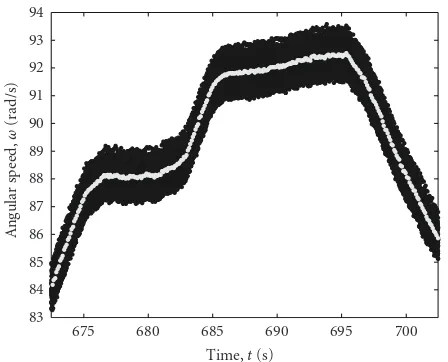
The result from the optimal filter, zopt(kT), is shown
compared to the original data in Figure 6, and it follows a smooth line nicely.
700 695 690 685 680 675
Time,t(s) 83
84 85 86 87 88 89 90 91 92 93 94
A
n
gular
sp
eed,
ω
(r
ad/s)
Figure6: The cloud of data points,u(tm) black, fromExample 2,
and the optimal estimates,zopt(kT) gray. Only part of the shaded
interval inFigure 5is shown.
butKB(t)=(1−t/B)+,t∈[−B, 0] is optimal in MSE sense.
Fan and Gijbels still recommend to always use the Epanech-nikov kernel, because of both performance and implemen-tation issues. [19] does not include a result for the optimal bandwidth in this case. In our test we need a causal filter and then chooseB=2Boptin order to include the same number
of points as in the noncausal estimate.
5.2. Online estimation
The investigation in the previous section gives a reference value to compare the online estimates to. Now, we test four different estimates:
(i) zE(kT): the casual filter given by (35), (36), the kernel (37) for−B < t≤0 andB=2Bopt;
(ii) zBW(kT): a causal Butterworth filter, h(t), in Algo-rithm2; the Butterworth filter is of order 2 with cutoff frequency 1/2T=5 Hz, as defined in (14),
(iii)zm(kT): the mean ofu(tm) fortm ∈[kT −T/2,kT+
T/2];
(iv)zn(kT): a nearest neighbor estimate;
and compare them to the optimalzopt(kT). The last two
estimates are included in order to show if the more clever estimates give significant improvements.Figure 7shows the first two estimates,zE(kT) andzBW(kT), compared to the optimalzopt(kT).
Table 2shows the root mean square errors compared to the optimal estimate,zopt(kT), calculated over the interval
indicated in Figure 5. From this, it is clear that the casual “optimal” filter, giving zE(kT), needs tuning of the band-width, B, since the literature gave no result for the opti-mal choice of B in this case. Both the filtered estimates,
zE(kT) and zBW(kT), are significantly better than the sim-ple mean,zm(kT). The Butterworth filter performs very well, and is also much less computationally complex than using
654 653 652 651 650 649 648 647
Time,t(s) 78
78.2 78.4 78.6 78.8 79 79.2 79.4 79.6 79.8
A
n
gular
sp
eed,
ω
(r
ad/s)
Figure7: A comparison of three different estimates for the data in Example 2: optimalzopt(kT) (thick line), casual “optimal”zE(kT)
(thin line), and causal ButterworthzBW(kT) (gray line). Only a part
of the shaded interval inFigure 5is shown.
Table2: RMSE from optimal estimate,E[|zopt(kT)−z∗(kT)|2],
inExample 2.
Casual “optimal” Butterworth Local mean Nearest neighbor
zE(kT) zBW(kT) zm(kT) zn(kT)
0.0793 0.0542 0.0964 0.3875
the Epanechnikov kernel. It is promising that the estimate fromAlgorithm 2,zBW(kT), is close tozopt(kT), and it
en-courages future investigations.
6. CONCLUSIONS
This work investigated three different algorithms for down-sampling non-uniformly sampled signals, each using inter-polation on different levels. Two algorithms are based on ex-isting techniques for uniform sampling with interpolation in time and frequency domain, while the third alternative is truly non-uniform where interpolation is made in the con-volution integral. The results in the paper indicate that this third alternative is preferable in more than one way.
Numerical experiments presented the root mean square error, RMSE, for the three algorithms, and convolution inter-polation has the lowest mean RMSE together with frequency-domain interpolation. It also has the lowest standard devia-tion of the RMSE together with time-domain interpoladevia-tion.
Theoretic analysis showed that the algorithm gives asymptotically unbiased estimates for noncausal filters. It was also possible to show how the actual filter implemented by the algorithm was given by a convolution in the frequency domain with the original filter and a window depending only on the sampling times.
Thus, the results are encouraging for further investiga-tions, such as approximation error analysis and search for optimality conditions.
ACKNOWLEDGMENTS
The authors wish to thank NIRA Dynamics AB for providing the wheel speed data, and Jacob Roll, for interesting discus-sions on optimal filtering. Part of this work was presented at EUSIPCO07
REFERENCES
[1] A. Aldroubi and K. Gr¨ochenig, “Nonuniform sampling and re-construction in shift-invariant spaces,”SIAM Review, vol. 43, no. 4, pp. 585–620, 2001.
[2] S. K. Mitra,Digital Signal Processing: A Computer-Based Ap-proach, McGraw-Hill, New York, NY, USA, 1998.
[3] T. A. Ramstad, “Digital methods for conversion between ar-bitrary sampling frequencies,”IEEE Transactions on Acoustics, Speech, and Signal Processing, vol. 32, no. 3, pp. 577–591, 1984. [4] A. I. Russell and P. E. Beckmann, “Efficient arbitrary sam-pling rate conversion with recursive calculation of coeffi -cients,”IEEE Transactions on Signal Processing, vol. 50, no. 4, pp. 854–865, 2002.
[5] A. I. Russell, “Efficient rational sampling rate alteration using IIR filters,”IEEE Signal Processing Letters, vol. 7, no. 1, pp. 6–7, 2000.
[6] T. Saram¨aki and T. Ritoniemi, “An efficient approach for con-version between arbitrary sampling frequencies,” in Proceed-ings of the IEEE International Symposium on Circuits and Sys-tems (ISCAS ’96), vol. 2, pp. 285–288, Atlanta, Ga, USA, May 1996.
[7] F. J. Beutler, “Error-free recovery of signals from irregularly spaced samples,” SIAM Review, vol. 8, no. 3, pp. 328–335, 1966.
[8] F. Marvasti, M. Analoui, and M. Gamshadzahi, “Recovery of signals from nonuniform samples using iterative methods,”
IEEE Transactions on Signal Processing, vol. 39, no. 4, pp. 872– 878, 1991.
[9] A. I. Russell, “Regular and irregular signal resampling,” Ph.D. dissertation, Massachusetts Institute of Technology, Cam-bridge, Mass, USA, 2002.
[10] F. Marvasti, Ed.,Nonuniform Sampling: Theory and Practice, Kluwer Academic Publishers, Boston, Mass, USA, 2001. [11] P. J. Ferreira, “Iterative and noniterative recovery of missing
samples for 1-D band-limited signals,” inSampling: Theory and Practice, F. Marvasti, Ed., chapter 5, pp. 235–282, Kluwer Academic Publishers, Boston, Mass, USA, 2001.
[12] B. Lacaze, “Reconstruction of stationary processes sampled at random times,” inNonuniform Sampling: Theory and Prac-tice, F. Marvasti, Ed., chapter 8, pp. 361–390, Kluwer Academic Publishers, Boston, Mass, USA, 2001.
[13] H. G. Feichtinger and K. Gr¨ochenig, “Theory and practice of irregular sampling,” inWavelets: Mathematics and Applica-tions, J. J. Benedetto and M. W. Frazier, Eds., pp. 305–363, CRC Press, Boca Raton, Fla, USA, 1994.
[14] Y. C. Eldar, “Sampling with arbitrary sampling and recon-struction spaces and oblique dual frame vectors,”Journal of Fourier Analysis and Applications, vol. 9, no. 1, pp. 77–96, 2003. [15] K. Yao and J. B. Thomas, “On some stability and interpolatory properties of nonuniform sampling expansions,”IEEE Trans-actions on Circuits and Systems, vol. 14, no. 4, pp. 404–408, 1967.
[16] M. Bourgeois, F. Wajer, D. van Ormondt, and F. Graveron-Demilly, “Reconstruction of MRI images from non-uniform sampling and its application to intrascan motion correction in functional MRI,” inModern Sampling Theory, J. J. Benedetto and P. J. Ferreira, Eds., chapter 16, pp. 343–363, Birkh¨auser, Boston, Mass, USA, 2001.
[17] S. R. Dey, A. I. Russell, and A. V. Oppenheim, “Precompen-sation for anticipated erasures in LTI interpolation systems,”
IEEE Transactions on Signal Processing, vol. 54, no. 1, pp. 325– 335, 2006.
[18] P. J. Ferreira, “Nonuniform sampling of nonbandlimited sig-nals,”IEEE Signal Processing Letters, vol. 2, no. 5, pp. 89–91, 1995.
[19] J. Fan and I. Gijbels,Local Polynomial Modelling and Its Appli-cations, Chapman & Hall, London, UK, 1996.
[20] A. Papoulis, Signal Analysis, McGraw-Hill, New York, NY, USA, 1977.
[21] M. Unser, “Splines: a perfect fit for signal and image process-ing,”IEEE Signal Processing Magazine, vol. 16, no. 6, pp. 22–38, 1999.
[22] F. Eng, F. Gustafsson, and F. Gunnarsson, “Frequency domain analysis of signals with stochastic sampling times,” to appear inIEEE Transactions on Signal Processing.
[23] F. Gunnarsson and F. Gustafsson, “Frequency analysis using non-uniform sampling with application to active queue man-agement,” inProceedings of IEEE International Conference on Acoustics, Speech, and Signal Processing (ICASSP ’04, vol. 2, pp. 581–584, Montreal, Canada, May 2004.