!
"
#"#
$ % %#
&
'
((( )
A Comparative Study using Wavelet and SVM for Devanagri Characters Recognition
Anil Kumar N. Holambe* (Research Student)
Department of Information Technology College of Engineering
Osmanabad,India
Dr.Ravinder C. Thool
Department of Information Technology
Shri Guru Gobind Singhji Institute of Engg & Technology, Vishnupuri,India
Sushil Kumar N.Holambe Department of Information Technology
College of Engineering Osmanabad,India
Ganesh K. Pakle
Department of Information Technology
Shri Guru Gobind Singhji Institute of Engg & Technology, Vishnupuri.India
Abstract:This paper presents a wavelet-based approach for recognizing handwritten and printed Devnagari characters. In this paper we have
used wavelet for feature extraction of the character. We have developed six handwritten data feature sets and six printed data feature set ,each dataset is divided in four part for our experimentation. We have also used wavelet kernels and regular kernels in SVM classification. Each SVM kernel is applied on total 12 x4=48 feature datasets.
Keywords:Wavelet; MAT; Complex Wavelet; Autocorrelation.
I. INTRODUCTION
Handwritten and printed character & digit recognition is an important topic in OCR applications and pattern classification . There are so many techniques of Pattern Recognition such as Template Matching, Neural Networks, Syntactical Analyses, Wavelet Theory, Hidden Markov Models, Bayesian theory etc have been used to develop efficient OCRs for different languages. OCR work on printed Devanagri script started in early 1970s. Some of the efforts on Devanagri character recognition are due to Sinha [1,7,8] and Mahabala [1]. Sethi and Chatterjee [5] also have done some earlier studies on Devanagri script and presented a Devanagri hand-printed numeral recognition system based on binary decision tree classifier. They [6] also used a similar technique for constrained hand-printed Devanagri character recognition. The first complete OCR system development of printed Devanagri is perhaps due to Palit and Chaudhuri [4] as well as Pal and Chaudhuri [3]. A survey for hand-written recognition of character is proposed [2]. In this paper we are using wavelet theory based feature extraction methods.
II. DATASET
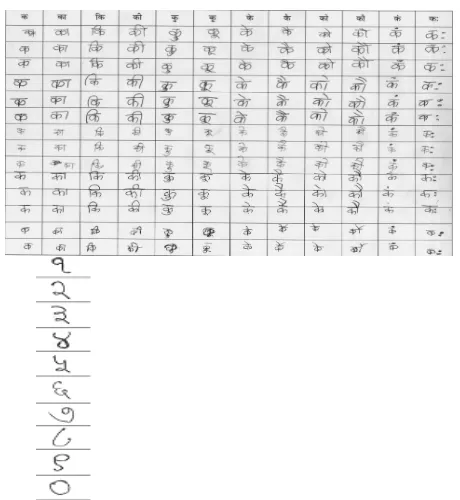
In the present work we have developed printed and handwritten database. For printed we have used different ISM office fonts. and for handwritten we have collect dat from people of different age groups and from different profession . This data were scanned at 600 dpi using a HP flatbed scanner and stored as gray-level images. A few samples from this database are shown in Figure1.
[image:1.612.323.553.387.637.2]
Figure 1.Samples from database of handwritten Devanagari characters and numerial.
III. FEATUREEXTRACTION
A. Wavelet Theory
A character image of size NXN can be decompose into its wavelet cofficents by using Mallat’s pyramid algorithm [8]. Mathematically, it can be describes as the following recursive equations [9]:
) 4 ( 2 / ,..., 1 2 / ; 2 / ,..., 1 2 / , ] * ] * [[ ) , ( ) 3 ( 2 / ,..., 1 2 / ; 2 / ,..., 1 , ] * ] * [[ ) , ( ) 2 ( 2 / ,..., 1 ; 2 | ,..., 1 2 / , ] * ] * [[ ) , ( ) 1 ( 2 / ,..., 1 ; 2 | ,..., 1 , ] * ] * [[ ) , ( 1 1 2 1 ___ 1 2 ___ ) 1 ( ) ( 1 2 1 ___ 1 2 ___ ) 1 ( ) ( 1 2 1 ___ 1 2 ___ ) 1 ( ) ( 2 1 ___ 1 2 ___ ) 1 ( ) ( − − ↓ ↓ − − ↓ ↓ − − ↓ ↓ − ↓ ↓ − + = + = = + = = = = + = = = = = k k k k k rows k k k k k rows k k k k k rows k k k k rows K N N n N N m G G LL n m HH N N n N m H H LL n m HL N n N N m G H LL n m LH n n N m H H LL N M LL
Here LL, LH, HL, and HH represent four subimages of the image being decomposed. After wavelet decomposition, the object image energy is distributed in different subbands ,each subband image contains one feature.
B. Feature set S1: Directional – Based Wavelet Features
Kirsch nonlinear edge enhancement algorithm is used to extract statistical features from the characters and then wavelet transform is applied on these statistical features to form original features. Kirsch nonlinear edge enhancement algorithm is applied to an NxN character Image to extract horizontal, Vertical, Right-diagonal and left-diagonal directional features and global features; then 2-D wavelet transform is used to filter out the high frequency components of each directional Feature image and character image, respectively, and to convert the feature matrix into a 4x4 matrix.Apply Daubechies -4 wavelets to four directional feature matrices and the character image, and only keep 4x4 low frequency components of each as features. Total, 16x5=80 features can be extracted from each character, detail can be found in [10][11][12][13][14].
C. Feature Set S2: MAT based Gradient Features
Medial Axial Transformation Algorithm is used to finding a binary image centre skeleton and to converts a binary image into a grayscale image with maximum values on the central skeleton of the character. we can extract MAT Gradient-based features by Normalize the MAT image with its pixel values from
0
.
0
~
1
.
0
;
we use sobel operator to convolute the normalized image to generate the amplitudes and phases of the gradient image. We count the gradient direction of each pixel of the convoluted image with nonzero gradient magnitude values as a direction feature. Finally to get the features each gradient direction is quantized into one of eight directions atπ
/
4
intervals. Each normalized gradient image is divided into 16 sub-images. The number in each direction of each sub-image is counted as a feature. The total number of features are 4x4x8=128 detail can be found in[10][11][12][13][14].D. Feature Set S3: Complex Wavelet Features
A character image of size 28(N)X28(N) is divided into four sub band images : LL, LH,HL,HH at the first level of
tree and each of the sub band images has a size of 2 2 .
N x N
At each higher level, the decompositions are based on the LL sub band image at the previous level. The feature extraction is conducted at the third level. The number of features = 4X4(for each sub band image) *3 (high frequency
sub band image for each tree) *2 (trees) +4X4(for each sub band image) *2(trees)*2(parts: real and imaginary) =160 detail can be found in[10][11][12][13][14].
E. Feature Set S4: Median Filter Gradient Features
For this feature extraction set we convolute a character image by a 2D median filter;weo use Robert operators on the median –filtered image to generate the amplitudes and phases; and finally count the gradient direction of each pixel with nonzero gradient magnitude values as a direction feature. So the total number of features is 128 detail can be found in[10][11][12][13][14].
F. Feature Set S5 : Image Thinning Distance Features
In this feature set, the distance features in both horizontal and vertical directions are extracted firstly, an NxN character image is thinned and the thinned image is scaled into an 8x8 array. The thinned image is scanned both horizontally and vertically respectively. In the horizontal scanning, for each pixel in the 8x8 thinned image, if the value of the pixel is 0 (black), then the distance is 0; otherwise, the distance is set to the distance from that pixel to the nearest black pixel in both horizontal directions on the scanning line. For any pixel, if there are no nearest black pixels in both directions, the distance of the pixel is set to the distance from the pixel to one of two edges, whichever has longer distance to the edge. In the vertical scanning, the same algorithm is applied. In total there are 128 features detail can be found in[10][11][12][13][14].
G. Feature set S6: DCT – Based Wavelet Features
The discrete wavelet transform (DWT), which is based on sub-band coding is found to yield fast computation of wavelet transform .Binarize the image using Otsu method apply morphological thinning, operation.In order to extract local features compute the standard Deviation of the image block. In order to get image bock Apply DCT and divide the magnitude (image) of DCT into 4 equal non-overlapping block,Perform Wavelet (Daubechies 4) decomposition for the magnitude (image) of DCT to obtain approximation ,vertical, horizontal and diagonal coefficients.Compute the Standard Deviation for each frequency bands separately. Store all the computed features in a vector detail can be found in[14][15].
IV. SUPPORTVECTORMACHINE
The support vector machine (SVM) was first developed by Vapnik and used for classification in many applications such as handwritten digit recognition, image classification, face detection, object detection, text classification etc.
[16-20]. Given an training example set
)},
,
(
),...,
{(
X
1,y
1X
ny
nwhere
X
∈
R
N,
y
∈
{
−
1
,
1
}.
The kernel function can map the training examples in input space into a feature space such that the mapped training examples are linearly separable. The problem can be converted to maximize the following dual optimization problem:),
,
(
2
1
)
(
1 1 1 j j j i n i n j i i n ii
y
y
K
X
X
W
α
α
α
α
= = =
−
=
(5)]. , 1 [ ]. , 0 [ 0 1 n i for C y i n i i i ∈ ∈ = = α α
The decision function becomes
) 7 ( , ) , ( ) 6 ( , , ( ) ( 1 1 + − = + = = = l i i r i i r n i j i i i b X X K y Y b b X X K y sign x f α α
Where
(
X
r,
y
r)
is any training example. We are using following SVM kernels.A. Polynomial
A polynomial kernel is a popular method for non-linear modeling. d X X X X
K ' '
, ) ,
( = (7)
Where d is the degree of the polynomial
B. Gaussian radial Basis function
Gaussian radial basis function is defined as
. 2 exp ) , ( 2 2 ' ' = − −
σ
X X X X K (8)C. Exponential radial basis function
Exponential radial basis function is defined as
. 2 exp ) , ( 2 2 ' ' = − −
σ
X X X X K (9)It produces a piecewise linear solution that is attractive when discontinuities are acceptable.
D. Spline
A spline kernel is defined as
, ) , min( 6 1 ) , ( min , 2 1 , 1 ) ,
( ' ' ' ' '3
X X X X X X X X X X
K = + + − (10)
E. Wavelet
The Wavelet kernel is defined as
∏
=−
=
N i ia
x
x
X
X
K
1 ' 1 ',
)
,
(
ψ
(11)Where
(x)
=
cos(1.75x)
exp
(
x
/
2
),
N
2
−
ψ
is thedimension of the input feature vector, and a is the scale factor.
F. Autocorrelation Wavelet kernel
A Translation invariant kernel K(X,X')=K(X−X')is an admissible support vector (SV) kernel if and only if its Fourier transform is non-negative [21]. This can be satisfied by defining the following auto-correlation wavelet kernel [22]:
(
,
)
,
(
1 ' 1 '∏
=−
=
N i ia
x
x
X
X
K
ψ
12)Where N is the dimension of the input feature vector and a is the scale factor. It should be mentioned that we can choose any compactly supported wavelet function to construct auto correlation wavelet kernel K(x,x’ ).Details can be found in [23].
V. RESULTANDOBSERVATION
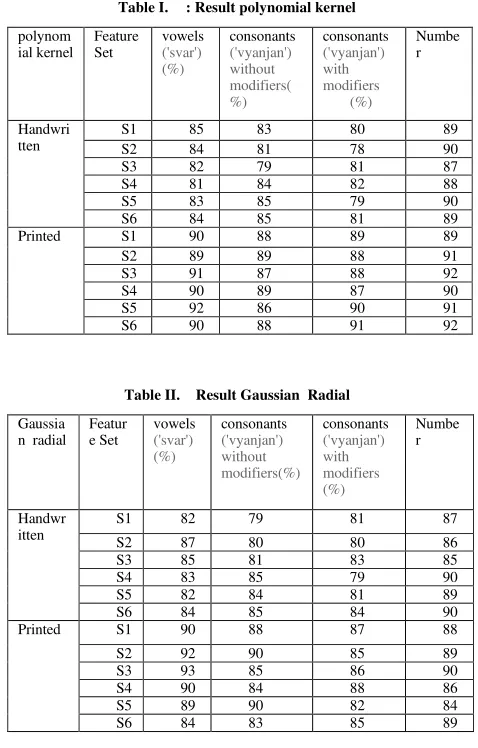
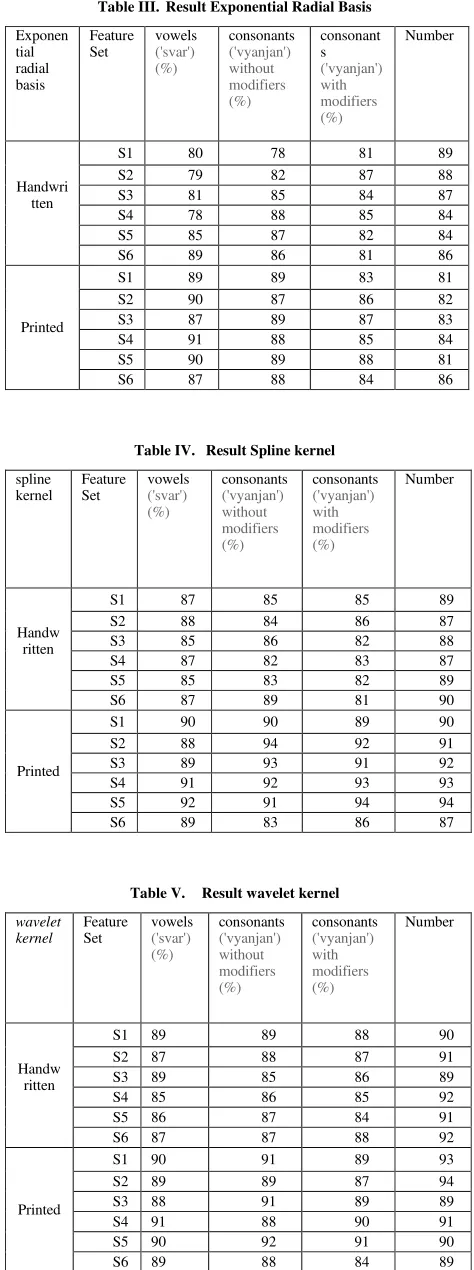
[image:3.612.319.558.325.699.2]Data used for the present work were collected from different individuals. We considered 15000 basic characters (vowels as well as consonants) and 10000 numerical samples of Devnagari for the experiment of the proposed work.we have collected this data from different writer.The age group of writter is from 5years child to 60 years old man.we have also consider the profession of the writer i.e. student, clerk, officer, lecturer ect.we also formed printed database of ISM office fonts, in which we have used font size of 16 and different fonts.Here we have developed the six feature sets from our data collected and six for printed characters.Each feature set is divided in four parts i.e. vowels ('svar'), consonants ('vyanjan') without modifiers, consonants ('vyanjan') with modifiers, Number.Then we have used SVM with six different kernels. The results are given in following tables for different kernels used with SVM classifier.
Table I. : Result polynomial kernel
polynom ial kernel Feature Set vowels ('svar') (%) consonants ('vyanjan') without modifiers( %) consonants ('vyanjan') with modifiers (%) Numbe r Handwri tten
S1 85 83 80 89 S2 84 81 78 90 S3 82 79 81 87 S4 81 84 82 88 S5 83 85 79 90 S6 84 85 81 89 Printed S1 90 88 89 89 S2 89 89 88 91 S3 91 87 88 92 S4 90 89 87 90 S5 92 86 90 91 S6 90 88 91 92
Table II. Result Gaussian Radial
Gaussia n radial
Featur e Set vowels ('svar') (%) consonants ('vyanjan') without modifiers(%) consonants ('vyanjan') with modifiers (%) Numbe r Handwr itten
Table III. Result Exponential Radial Basis
Exponen tial radial basis
Feature Set
vowels ('svar') (%)
consonants ('vyanjan') without modifiers (%)
consonant s ('vyanjan') with modifiers (%)
Number
Handwri tten
S1 80 78 81 89 S2 79 82 87 88 S3 81 85 84 87 S4 78 88 85 84 S5 85 87 82 84 S6 89 86 81 86
Printed
S1 89 89 83 81 S2 90 87 86 82 S3 87 89 87 83 S4 91 88 85 84 S5 90 89 88 81 S6 87 88 84 86
Table IV. Result Spline kernel
spline kernel
Feature Set
vowels ('svar') (%)
consonants ('vyanjan') without modifiers (%)
consonants ('vyanjan') with modifiers (%)
Number
Handw ritten
S1 87 85 85 89 S2 88 84 86 87 S3 85 86 82 88 S4 87 82 83 87 S5 85 83 82 89 S6 87 89 81 90
Printed
[image:4.612.57.294.52.687.2]S1 90 90 89 90 S2 88 94 92 91 S3 89 93 91 92 S4 91 92 93 93 S5 92 91 94 94 S6 89 83 86 87
Table V. Result wavelet kernel
wavelet kernel
Feature Set
vowels ('svar') (%)
consonants ('vyanjan') without modifiers (%)
consonants ('vyanjan') with modifiers (%)
Number
Handw ritten
S1 89 89 88 90 S2 87 88 87 91 S3 89 85 86 89 S4 85 86 85 92 S5 86 87 84 91 S6 87 87 88 92
Printed
[image:4.612.320.552.78.261.2]S1 90 91 89 93 S2 89 89 87 94 S3 88 91 89 89 S4 91 88 90 91 S5 90 92 91 90 S6 89 88 84 89
Table VI. Result Autocorrelation Wavelet kernel
Autocorr elation Wavelet kernel
Featur e Set
vowels ('svar') (%)
consonants ('vyanjan') without modifiers (%)
consonants ('vyanjan') with modifiers (%)
Number
Handwrit ten
S1 88 87 86 81 S2 85 86 82 80 S3 87 84 84 83 S4 86 82 83 79 S5 87 85 86 81 S6 87 81 81 84
Printed
S1 90 90 90 81 S2 92 93 89 82 S3 91 91 92 83 S4 89 92 94 84 S5 88 89 88 81 S6 87 87 81 86
VI. CONCLUSION
we can conclude from abov result is that wavelets serve as a good feature set for the character images. The result obtained for recognition of Devnagari characters show that reliable classification is possible using SVMs kernels.
VII.REFERENCES
[1] R.M.K. Sinha, H. Mahabala,,”Machine recognition of Devanagri script”, IEEE Trans. System, Man Cybern. 9(1979) 435-441.
[2] Plamondon, R. Srihari, S.N., Ecole Polytech, Montreal, Que.; Online and Offline Handwriting Recognition: A comprehensive Survey, 1EEE Transactions on Pattern Analysis and Machine Intelligence. VOL. 22, NO. 1. JANUARY 2000 63
[3] U. Pal , B.B. Chaudhuri , “Printed Devanagri script OCR system”, Vivek 10 (1997) 12-24
[4] S. Palit, B.B. Chaudhuri,,”A feature-based scheme for the machine recognition of printed Devanagri script”, P.P. Das, B.N. Chatterjee (Eda.) Pattern Recognition, Image Processing and Computer Vision, Narosa Publishing House: New Delhi, India 1995, pp. 163-168
[5] I.K. Sethi, B. Chatterjee, “Machine recognition of constrained hand-printed Devanagri numerals”, J. Inst.Electron. Telecom. Eng. 22 (1976) 532-535.
[6] I.K. Sethi, B. Chatterjee,“Machine recognition of constrained hand-printed Devanagri characters”, Pattern Recognition 9 (1977) 69-76
[7] R.M.K. Sinha, “A syntactic pattern analysis system and its application to Devanagri script recognition”, Ph.D. Thesis, Electrical Engineering Department, Indian Institute of Technology, India, 1973.
[8] K. Jain, P. W. Duin, and J. Mao, "Statistical Pattern Recognition: A Review," IEEE Trans. on Pattern Analysis and Machine Intelligence, vol. 22, no. 2, pp. 5-37, 2000.
[9] S. G. Mallat, "A Theory for Multiresolution Signal Decomposition: the Wavelet Representation," IEEE Trans. on Pattern Analysis and Machine Intelligence, vol. 11, no. 7,pp. 674-693, 1989
[image:4.612.58.295.404.682.2][11] Ping Zhang, Reliable recognition of handwritten digits using a cascade ensemble classifier system and hybrid features, Ph.D. thesis, Concordia University, Montreal, P.Q., Canada, 2006.
[12] N. G. Kingsbury, Image Processing with Complex Wavelets, Phil. Trans. R. Soc. Lond, A 357, 1999, pp. 2543-2560.
[13] C. K. Chu, Wavelets: A Mathematical Tool for Signal Processing, Philadelphia: Society for Industrial and Applied Mathematics, 1997.
[14] S. Mallat, A Wavelet Tour of Signal Processing, Second Edition, Academic Press, 1999.
[15] Kannada, English, and Hindi Handwritten Script Recognition using multiple features, Proc. of National Seminar on Recent Trends in Image Processing and Pattern Recognition (RTIPPR-10), Editors: Dr. P. S. Hiremath et. al., Excel India Pub., New Delhi, ISBN: 93-80043-74-0, pp 149-152.
[16] V.N. Vapnik, The Nature of Statistical Learning, Springer-Verlag, New York, 1995.
[17] V.N. Vapnik, Statistical Learning Theory, Wiley, New York, 1998.
[18] C. Cortes, V.N. Vapnik, Support vector networks, Machine Learning 20 (1995) 273–297.
[19] Q. Song, W.J. Hu, W.F. Xie, Robust support vector machine for bullet hole image classification, IEEE Transactions on Systems, Man and Cybernetics – Part C 32 (4) (2002) 440–448.
[20] L. Zhang, W. Zhou, L. Jiao, Wavelet support vector machine, IEEE Transactions on Systems, Man, and Cybernetics – Part B 34 (1) (2004) 34–39.
[21] Smola, B. Scholkopf, K.-R. Muller, The connection between regulation operators and support vector kernels, Neural Network 11 (1998) 637–649.
[22] G.Y. Chen, G. Dudek, Auto-correlation wavelet support vector machine and its applications to regression, in: Proceedings of the 2nd Canadian Conference on Computer and Robot Vision, May 9– 11, British Columbia, 2005.