Citation:
Soobhany, AR and Sheikh Akbari, A and Schreuders, ZC (2017) Reinforced source camera
iden-tification using non-decimated wavelet transform. In: IET International Conference on Biomedical
Image and Signal Processing, 13 May 2017 - 14 May 2017, Wuhan, China.
Link to Leeds Beckett Repository record:
http://eprints.leedsbeckett.ac.uk/3733/
Document Version:
Conference or Workshop Item
Proceedings will be formally published (final paper will be published on IET Digital Library)
The aim of the Leeds Beckett Repository is to provide open access to our research, as required by
funder policies and permitted by publishers and copyright law.
The Leeds Beckett repository holds a wide range of publications, each of which has been
checked for copyright and the relevant embargo period has been applied by the Research Services
team.
We operate on a standard take-down policy.
If you are the author or publisher of an output
and you would like it removed from the repository, please
contact us
and we will investigate on a
case-by-case basis.
REINFORCED SOURCE CAMERA IDENTIFICATION USING
NON-DECIMATED WAVELET TRANSFORM
A.R. Soobhany, A. Sheikh Akbari, Z.C. Schreuders
Cybercrime and Security Innovation Centre, Leeds Beckett University, Leeds, LS6 3QR, United Kingdom [email protected], [email protected], [email protected]
Keywords: Sensor Pattern Noise, Source Device Identification, Non-decimated Wavelet Transform, Multimedia Forensics, Information Security
Abstract
The Sensor Pattern Noise (SPN) extracted from digital pictures can be interpreted as a unique sensor fingerprint for a digital camera and can be used to perform source identification of digital cameras. Scene details can contaminate SPN signatures. This paper presents a method to extract the SPN by applying non-decimated wavelet transform to digital pictures and then disinfect the contaminated SPN in order to improve the identification rate of the SPNs. The coefficients within the resulting wavelet high frequency sub-bands are filtered to extract the SPN of the image. By using non-decimated wavelet transform, we perform a two-step comparison technique that first isolates all the contaminated components of the SPN and neutralise these components from a contaminated SPN. The reinforced SPN is then matched against the corresponding components in the reference camera fingerprint. The two-step comparison technique provides a reinforced SPN of reduced contamination for the matching against the camera reference fingerprint. Experimental results were performed using images of ten cameras to identify the source camera of the images. Results show that the proposed technique generates superior results to that of the non-reinforced SPNs.
1 Introduction
In this day and age, the availability of portable imaging devices such as digital cameras, phones and tablets have led to an explosion of digital photographs created by the cameras of these devices. Some of these digital pictures can be used for illicit purposes. It would be helpful for law enforcement agencies to have the ability to link these digital pictures to the cameras that created them or to other pictures originating from the same source device. The cameras and related suspects can help in the identification of victims of crime.
Artefacts from the camera pipeline are imbedded in digital pictures that are created by a camera. These artefacts can be extracted as features to aid in linking the pictures to their source imaging devices and can originate from characteristics of the device or processing inside the device [1]. Some of the methods for image source linking are lens aberration [2],
identification of the CFA interpolation and demosaicing algorithms [3], determining the quantization tables used for JPEG compression [4, 5], applying higher-order wavelet statistics for camera model and make identification, together with binary similarity measures and image quality measures as well as a SVM classifier [6], extraction of sensor pattern noise (SPN) as feature [7]. The lens aberration and SPN features can determine the specific device instead of the make or model of the device, although the lens aberration is linked to the lens of the camera, which is relatively easy to swap. The SPN occurs in the sensor of a digital camera and is a deterministic feature found in all pictures taken by the camera and consist mainly of the PRNU (Photo Response Non-Uniformity) and the fixed pattern noise (FPN) as well as other stochastic noises. The SPN exists due to imperfections arising from the manufacturing process of the sensor and due to slight variations in conversion of light to electrical energy by individual pixel sensors [8].
There are several methods that have been explored for the extraction of SPN for device identification and image linkage. A simplified version of the Total Variation based noise removal algorithm has been used to extract the PRNU [9]. Singular Value Decomposition (SVD) was used to extract the PRNU of images by first estimating the PRNU energy of each image and then converting the PRNU to an additive noise to facilitate extraction using the SVD method [10]. Kang et al, proposed an SPN predictor based on context-adaptive interpolation algorithm to suppress the effect of image scene [11]. Another method of SPN extraction is based on employing discrete wavelet transform to an image and applying a denoising function to separate the SPN from the image [7]. The authors have developed a non-decimated wavelet based source camera identification method for digital images [12]. Most of the wavelet based extraction methods use decimated wavelet transform, which is shift variant and loses some information from the image during the transformation process.
presents a method to extract the SPN from an image by applying non-decimated wavelet transform and then clean the contaminated SPN in order to improve the identification rate of the SPNs and produce a reinforced SPN. A two-step comparison technique is performed, that first isolates all the contaminated components of the SPN and neutralise these components from a contaminated SPN. The re-organised SPN is then matched against the corresponding components in the reference camera fingerprint. Experimental results on pictures from cameras show that the proposed technique generates superior results to that of the non-reinforced SPNs. The rest of the paper is organised as follows. The proposed reinforced SPN method is elaborated in section 2 followed by a description of the experiments and results obtained in section 3. Finally the paper will be concluded in section 4.
2 Proposed reinforced SPN method
A simplified model for a noisy image I can be represented as
I = I0 + I0.K + η (1)
where Io is the clean image (perfect absorption of light energy
by pixels), K is the PRNU and η is the remaining noise, such as shot noise, dark noise and read-out noise, associated with the image [10]. From Equation 1, the SPN can be represented as
SPN = K + η (2)
A method has been developed to improve the quality of the SPN, extracted using decimated wavelet transform, by attenuating the interference of scene details in SPN using an enhancer described in [13], where the enhanced SPN was shown to increase the identification rate and allows the use of smaller image crop size. However, the overall quality and strength of the SPN is decreased, which is already a weak signal.
The method proposed in this paper is based on the non-decimated wavelet transform extraction method, which retains all the information contained in the picture whilst decimated wavelet transform discards some of the image information due to its decimation process. Non-decimated wavelet transform also makes wavelet transform shift invariant. The steps of the algorithm are explained below:
Step 1: An input image, which can be colour or grayscale, is passed to the algorithm. The image is transformed to the frequency domain by applying Discrete Fourier Transform (DFT), where a 2D Wiener filter is used to reduce FPN (Fixed Patter Noise). The periodical noise FPN can occur due to quantization which creates blockness effects in JPEG images.
Step 2: A one-level 2D non-decimated wavelet transform is performed on the image. The transform is applied first to the rows followed by the columns
of the image, which produces a 2d representation of the image in the wavelet domain that is four times the size of the image in the spatial domain. The increase in size is due to the fact that the transform retains all the information contained in the image. The image is divided into 4 sub-bands namely, LowLow, LowHigh, HighLow and HighHigh frequency bands.
Step 3: Three of the sub-bands contain high frequency details and the SPN is located in the medium to high frequencies. A 2D Wiener filter is applied to the LowHigh, HighLow and HighHigh sub-bands. The Wiener filter acts as a low-pass filter that discards all medium to high frequency detail coefficients from the sub-bands, thus leaving only low frequency detail coefficients behind.
Step 4: The low pass product obtained in step 3 is subtracted from the 2D representation of the three sub-bands obtained in step 2 and the result is the SPN as represented below:
SPN = I – f(I) (3)
where I is the image and f is denoising function that performs as a low-pass filter to extract the required signal. Only the medium to high frequency components are retained from the non-decimated wavelet transform.
Step 5: The 2D Wiener filter in the DFT frequency domain is applied to the SPN to attenuate periodic patterns introduced during the denoising filtering steps. The blockness removal filter decreases the possibility that SPN extracted from pictures coming from cameras of the same model are not falsely matched as coming from the same source.
Step 6: The one-level extracted SPN is a two-dimensional signal, which is reshaped to a 1D vector. The reason for reshaping the SPN is that different levels of wavelet decompositions are of different dimensions and it is less complex to concatenate the SPN of the previous level to the current level as a 1D signal.
Step 7: If another level of wavelet decomposition is needed steps 2 to 6 are repeated, on the LowLow frequency sub-band coefficient details of the current level, until the last relevant level of wavelet decomposition is reached. Finally all the concatenated sections of SPN form the final SPN signature of the image. The level of decomposition is passed as a parameter at the start of the algorithm.
contaminated SPN is performed. Each component of the SPN is checked against the comparator to establish is that value of that component lies within the range of –K and K, where K is a constant that has been determined empirically. If the element value is within the range –K and K, the value is left unchanged. When the element value is outside the range of –K and K, that element is set to the value of –K or K respectively.
Step 9: The previous step 8 is repeated until all the components in the SPN have been examined. The reinforced SPN is produced.
The objective of setting the components outside the range to the value of –K or K, is to reduce the effect of high frequency scene details and other stochastic noises that pollutes the SPN. Reinforced SPN is produced only for SPNs that are extracted from images that contain scene details, because flatfield and smooth pictures do not contain scene details and does not need to be cleaned. Once the reinforced SPNs have been produced, they can be matched against a camera reference SPN fingerprint.
3 Experiments and results
The proposed reinforced SPN was assessed by performing source device identification using a dataset of 1400 pictures. The performance of the proposed method was compared against the state of the art SPN wavelet extraction method. In general, the identification of source devices is performed by extracting the digital signatures from a number of images, say, 50 test pictures, flatfield pictures with no scene details, from the camera. The average of these signatures is calculated to form the camera reference signature. The signatures of recovered suspect images with scene details are extracted and compared against the camera reference signature for possible matches. The comparison method used in the experiments was the cross-correlation coefficient (CCC). The binary hypothesis being under test is:
H0 = Image was not created by camera
H1 = Image was created by camera (3)
where H0 is the null hypothesis and H1 is the alternative
hypothesis. The threshold for acceptance is set empirically to a correlation coefficient of 0.01 [13]. The SPN signature of a picture is matched against the SPN camera reference fingerprint and if the score is above the acceptance threshold,
H0 is rejected. The source code for the decimated wavelet
SPN extraction method, used in [14], was downloaded from [15].
The experiment was set up with 1400 pictures originating from 10 imaging devices comprising of digital cameras and camera phones. The pictures for the digital cameras were sourced from the Dresden public image dataset [16] and that of the camera phones are from [10]. Table 1 shows the list of cameras used together with the camera make and model as
well as the resolution of the pictures and the number of pictures used for each camera.
The digital cameras provided 150 pictures each and the 2 camera phones 100 pictures each respectively of natural scenes. All the pictures selected were from the highest resolution of the respective camera. There are three Canon cameras with two of these from the same model; hence it was decided to use the Canon_Ixus70_0 to create the camera reference SPN signature so that the ability of the algorithm to differentiate between devices from the same make and model can be assessed. The 50 test pictures for the Canon_Ixus70_0
were downloaded separately from the natural scene pictures. All the pictures processed in the experiments were cropped from the centre to a size of 512 x 512 pixels.
Device Id Device
Make Device Model Picture Resolution (px) Number of Pictures
Agfa_DC-733s_0 Agfa DC-733s 3072 x 2304 150
Canon_Ixus55_0 Canon Ixus55 2592 x 1944 150
Canon_Ixus70_0 Canon Ixus70 3072 x 2304 150
Canon_Ixus70_1 Canon Ixus70 3072 x 2304 150
Rollei_RCP-7325XS_0
Rollei RCP-
7372XS
3072 x 2304 150
Rollei_RCP-7325XS_1
Rollei RCP-
7372XS
3072 x 2304 150
Samsung_L74wide_ 0
Samsung L74wide 3072 x 2304 150
Samsung_L74wide_ 0
Samsung L74wide 3072 x 2304 150
zte_orange_sanfrisc o_A
ZTE Orange
sanfrancisco
1536 x 2048 100
zte_orange_sanfrisc o_B
ZTE Orange
sanfrancisco
1536 x 2048 100
Table 1: List of cameras used in the experiment with the resolution and number of pictures used for each camera.
The camera reference SPN for the Canon_Ixus70_0 camera was created for both the proposed method and the state of the art method. The SPN signatures of the 1400 images were extracted using both methods and compared against their respective camera reference SPN. The proposed method is called reinforced SPN and the state of art is called normal SPN in the results section. The value of K was determined empirically by comparing the reinforced SPNs extracted using different values of K against the camera reference fingerprint for the Canon_Ixus70_0. A value of 4 for K was found to produce better maching results. Hence the range of -4 and -4 was used for creating the reinforced SPN.
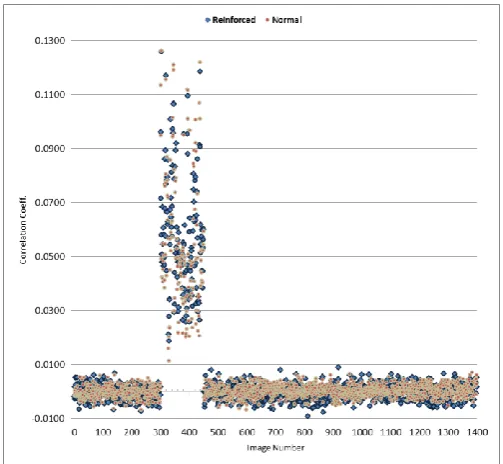
The results obtained are displayed in Figure 1, where the SPNs from 1400 pictures are compared against the
where the majority of the positive matches lies above 0.03. This shows a better demarcation between positive matches and negative matches for the reinforced method. The mean correlation values for the reinforced SPNs was 0.0574 and for the normal SPNs was 0.0551 respectively. The variance in correlation coefficients for these images 301 to 450 was 0.00048 and 0.00066 for the reinforced and normal SPNs respectively. It can be seen that the reinforced SPNs provided better correlation matches.
Figure 1: Correlation coefficient results for 1400 images when compared against the Canon_Ixus70_0 camera reference fingerprint. Images 301 to 450 originate from
the reference camera.
The images 451 to 600 originate from the Canon_Ixus70_1
camera, which is the same make and model camera as the
Canon_Ixus70_0 camera. Both extraction methods produced correlation values close to zero for these pictures, which shows that the reinforced extraction method can differentiate between cameras of the same make and model. The rest of the images (image 1 to 300 and image 601 to 1400) originate from other cameras and all the correlation values for these images were below the threhold of 0.01. The mean correlation values for both reinforced SPNs and normal SPNs were close to zero and the variance was 0.000005 and 0.000006 for the normal and reinforced SPNs respectively.
4 Conclusion
This paper introduced a method to improve the quality of SPNs by identifying components in the SPN that have been contaminated by scene details and stochastic noises. The proposed algorithm applies non-decimated wavelet transform to digital pictures, identifies the contaminated components then neutralises these components by setting them to a predefined constant value. The reinforced SPN is then compared against a camera reference SPN fingerprint. The method is based on non-decimated wavelet based source
camera identification method to enable the source identification of digital pictures. A dataset of 1400 pictures from 10 cameras were used to generate the results to compare the proposed method to the state of the art extraction method. The results obtained showed that the reinforced SPN improved identification of the pictures to their device sources. Further works to improve the selection of the predefined constant for choosing the contaminated components and to reduce the dimensionality of the reinforced SPN is underway.
Acknowledgements
This work, as part of the CARI project, is supported by the Police Knowledge Fund, which is administered by the College of Policing, the Home Office, and the Higher Education Funding Council for England (HEFCE). Thanks to Sofia Soobhany for her astute observations.
References
[1] T. Gloe, M. Kirchner, A. Winkler, R. Böhme. “Can We Trust Digital Image Forensics?”, Proceedings of the 15th International Conference on Multimedia, Augsburg, Germany, pp. 78-86, (2007).
[2] K. San Choi, E. Y. Lam, K. K. Y. Wong. "Source camera identification using footprints from lens aberration", Digital Photography II SPIE, volume 6069, pp. 172–179, (2006).
[3] A. Swaminathan, M. Wu, K. J. R. Liu. "Nonintrusive component forensics of visual sensors using output images", IEEE Transactions on Information Forensics and Security, volume 2, pp. 91-106, ( 2007).
[4] H. Farid. "Digital image ballistics from JPEG quantization," Dept. Comput. Sci., Dartmouth College, Hanover, NH, Tech. Rep. TR2006-583, (2006).
[5] M. J. Sorell. "Conditions for effective detection and identification of primary quantization of re-quantized JPEG images," in E-Forensics '08: Proceedings of the 1st International Conference on Forensic Applications and Techniques in Telecommunications, Information, and Multimedia and Workshop, Adelaide, Australia, pp. 1-6, (2008).
[6] O. S. Celiktutan, B. Avcibas. "Blind identification of source cell-phone model," IEEE Transactions on Information Forensics and Security, volume 3, pp. 553-566, (2008).
[7] J. Lukas, J. Fridrich, M. Goljan. "Digital camera identification from sensor pattern noise," IEEE Transactions on Information Forensics and Security, volume 1, pp. 205-214, (2006).
[8] J. Fridrich. "Digital Image Forensic Using Sensor Noise," IEEE Signal Processing Magazine, volume 26, pp. 26–37, (2009).
[10] A. R. Soobhany, K. P. Lam, P. Fletcher, D. Collins. “Source Identification of Camera Phones Using SVD”,
IEEE International Conference on Image Processing,
Melbourne, VIC, pp. 4497-4501, (2013).
[11] X. Kang, J. Chen, K. Lin, P. Anjie. “A Context-Adaptive SPN Predictor for Trustworthy Source Camera Identification”, EURASIP Journal on Image and Video Processing,volume 2014, no. 1, pp. 1–11, (2014). [12] A. R. Soobhany, A. Sheikh-Akbari, and Z. C.
Schreuders, “Source Camera Identification Using Non-decimated Wavelet Transform,” in Global Security, Safety and Sustainability - The Security Challenges of the Connected World: 11th International Conference, ICGS3 2017, London, UK, January 18-20, 2017, Proceedings, pp. 125–133, (2017).
[13] C.-T. Li. "Source Camera Identification Using Enhanced Sensor Pattern Noise," IEEE Transactions on Information Forensics and Security, volume 5, pp. 280-287, (2010).
[14] M. Goljan, J. Fridrich, T. Filler. “Large Scale Test of Sensor Fingerprint Camera Identification”, Proceedings of SPIE Electronic Imaging, Media Forensics and Security XI, volume 7254, pp 0I-01–0I-12, (2009). [15] MATLAB implementation of digital camera fingerprint
extraction. http://dde.binghamton.edu/download/camera fingerprint/, (accessed Nov 2016).
[16] T. Gloe, R. Böhme. “The `Dresden Image Database' for Benchmarking Digital Image Forensics”, Proceedings of the 25th Symposium on Applied Computing (ACM SAC),