Volume 7, No. 3, May-June 2016
International Journal of Advanced Research in Computer Science
REVIEW ARTICLE
Available Online at www.ijarcs.info
Design and implementation of Intelligent Household LED Lighting System considering
Energy Efficiency and User Satisfaction Based on the Technology of PoE
Girish V Chavan
Dept. Electronics and Telecommunication Dr. D. Y. Patil School of Engineering
Pune, India
Prof. Anil Wanare
Dept. Electronics and Telecommunication Dr. D. Y. Patil School of Engineering
Pune, India
Abstract: Now a day energy saving has one of the most importance thinks. The large amount of energy waste is introduced by not efficient use of the consumer electronic. Specially a lighting system can be accounts great part of overall consumption of energy. There are many advanced lighting system can be introduced in the current markets, because the traditional lighting system is outdated and energy-inefficient. Because of this reason the existing lighting system cannot be successfully applied to the office building and home. Therefore, the propose system of this LED lighting system considering user satisfaction and energy efficiency. The proposed system can be use wireless communication technology and multi sensors in order to control an LED light system according to the user satisfaction and energy efficiency. The proposed systems of new LED lighting system can automatically control and minimum light intensity value to improve both user satisfaction and energy efficiency. By using this new LED lighting system large amount of reduce the power consumption.
Keywords: New LED lighting system, reducing the minimum light intensity control algorithm, control on situation awareness, POE Module.
I. INTRODUCTION
India nation can be required large amount of in electricity demand then it can be necessary required energy efficient lighting systems. Lighting system can be consumption electricity load in our country is very high about 17-18% of total electricity load. By increasing the efficiency of lighting system then it can be required significant energy saving and reduction in peak load lighting system. Then it can be necessary required the lighting system which can be reduced the electricity demand up to 30% to 35 % of the morning and evening peak demand.
Energy saving solution in buildings not only saves the money but also helps to protect the environment and natural resources. In a present day building lighting system can be required to satisfy the dual aim of maximum occupant comfort and minimum energy consumption. When these proposed system can be successfully implemented then it is suitable for the environmental policy brings to develop both capacity building within a nation’s human resources and environmental awareness within the community. Now a day user can be used large variety of lighting system such as day lighting control and LED which can be used some new methodologies which is useful for reduce the and energy impact on environment and future generations
Now a day various embedded lighting system can be introduced which can be adjust the lighting levels automatically according to the time of day, function of space, available light level. The proposed system of new intelligent lighting system can be control automatically, such as, occupancy sensors, dimming, lighting control panels, and Building Management Systems. To save the energy became increasingly essential in the recent year because environment problem such as global warming and climate change. Environmental problems are very important aspect in these days, these environment problems are largely introduced by the unnecessary use of energy.
A lighting system can be consume for approximately 20 percent of the world’s overall total energy consumption. The new implementation of a light emitting diode (LED) is
significantly reduced the energy consumption of a light, because the LED lighting system can be consumes 50 percent of the energy consumption as compared to the fluorescent lighting device (low pressure sodium) and incandescent lighting device (high pressure sodium).
Recently, new intelligent lighting control system can be used various sensors and communication modules such as PIR sensor and illumination sensor. The PIR sensor can be detect the human interaction in the room and automatically adjust the room light intensity according to user movement. The illumination sensor can be working according to external environmental changes such as when room outside brightness is high then illumination sensor has high resistance and it can be adjust the low brightness in the internal side of the room. When room outside brightness is low then illumination sensor has low resistance and it can be adjust the high brightness in the internal side of the room. Means it can be adjust room light intensity according to external environmental changes.
However, the traditional lighting control systems can support for only dimming control or simple on-off according to user movement or brightness of surroundings but this lighting system is hard to applicable for the complex environments such as house or office. Thus the complex environment means it can be required a variety of control because of the presence of a variety of users.
By considering all these things, design proposed of the new intelligent LED lighting control system is as follows:
It can be designed to maximum used of LED light.
It can be designed to have the communication capability.
It can be designed to control based on the situation awareness such as internal in the room condition and external in the environmental condition.
It can be designed to enhance both user satisfaction as well as energy efficiency.
II. RELATED WORK
This study focus on the advanced technology of the new intelligent LED lighting system which can be reduce the energy consumption and also suitable for the environment parameter by various way.
Jinsung Byun et al. Proposed system can be present the large amount of energy waste is introduced by not efficient use of the consumer electronic. The proposed system can be use wireless communication technology and multi sensors in order to control an LED light system according to the user satisfaction and energy efficiency. The proposed system of the new LED lighting system can automatically control and minimum light intensity value to improve both user satisfaction and energy efficiency [1]. Qiang Gao et al. With the improvement of Internet of Things, innovation of Power over Ethernet can take enough power to LED lighting framework. Depending upon the detected data of the present brilliance and the quantity of persons in a room, the framework can naturally recognize and apply a predefined brightness [2]. Jiande Wu et al. In the Power over Ethernet (PoE) framework, the conventional powered device (PD) with two sets design can just give power below 20W loads, which extraordinarily limits its applications in numerous territories. An advanced type of four sets design with an input current equalization capacity for the PoE framework is proposed framework enhance the power level, as well as accomplish the high conversion efficiency [3].
F. Leccese et al. The proposed utilizes ZigBee-based remote device which enable more efficiency road light framework administration, because of a propelled interface and control design. It utilizes a sensor mix to control and ensure the proposed framework parameters the data is exchanged point by point utilizing ZigBee transmitters and beneficiaries and is sent to a control terminal used to check the condition of the road lights and to take proper measures if there should be an occurrence of failure[4]. A. A. Siddiqui et al. The proposed framework presents client user energy efficient control design for road lights. The framework uses ZigBee technology to execute remote cross section system of road lights. The proposed framework involves LED lights and administration programming that offer remote checking and control of the lights [5]. F. J. Bellido-Outeirino et al. The proposed framework focus on the joining of Digital Addressable Lighting Interface (DALI) device in remote sensor systems. Since various producers for the most part manage one part of building robotization. The primary reason for these framework is to give the end consumer a economical completely framework in which home machines are control by remote sensor system [6].
Tao Chen et al.The energy utilization issue in the mobile business has become crucial. For the supportable development of the mobile business. The point is to pick up a superior comprehension of energy utilization and distinguish key energy effectiveness research issues in remote access systems. Grouping system energy saving technologies into the time, frequency, and spatial spaces, the fundamental arrangements in every area are described briefly [7]. J. Byun et al. The proposed framework can be introduced Self-adjusting intelligent framework utilized for giving building control and energy saving administrations in structures. Our framework comprises of a gateway (self-adapting intelligent gateway) and a sensor (self-adjusting intelligent sensor). Thus, additionally propose a energy efficiency self-clustering sensor network (ESSN) and a node type indicator based routing (NTIR) convention that considers the necessities of WSNs, for example, system lifetime and framework resources administration[8]. J. Han et
al. The proposed framework can be describes more proficient home energy administration framework to decrease power utilization in home territory. We consider the room effectively controllable with an IR remote control of a home appliance. The room has electrical plugs, a light, and a ZigBee center point. The ZigBee center point has an IR code learning work and teaches the IR remote control sign of a home machine associated with the electrical plug. The ZigBee center points in every room speak with the home server and report the force utilization data to the home server [9].
Y. Uhm et al. Traditional frameworks are only designed for power reduction of the consumer electronics. The propose framework can be available a force mindful LED light empowering agent with light sensors, movement sensors and system interfaces. The proposed framework can be available a versatile middleware encourages the learning system which breaks down the enlightenment and the client movement, and controls the LED lights just when clients exist around the gadgets[10]. S. Matta et al. The propose framework can be available a framework with detailed configuration saving electrical energy by controlling the intensity of artificial light to a satisfactory level and getting utilization of the sunshine when possible with the best effort for energy saving. The framework utilizes Controller Area Network (CAN) as the media of correspondence with the sensors and the actuators. The framework is measured and can be extended to span large buildings [11]. Ç. Atıcı et al. Customary street lighting frameworks are obsolete and ought to be supplanted with frameworks which can sense their surroundings. To comprehend these necessities, subjective analyses ought to be directed in a down to earth testbed, like our own. we first present the best in class arrangements in the writing. At that point, we portray the framework design of our testbed sent on a genuine road alongside the preparatory analyses [12].
S. Tompros et al. Given the energy waste issue in contemporary family units and the subsequent requirement for ideal energy utilize, this article exhibits a novel system engineering that is generically appropriate on local apparatuses, such as white goods, and varying media and correspondence hardware, and is fit for performing ongoing administration of their vitality utilization [13]. T. J Park et al. Lighting control frameworks give different advantages in building administration, and Building Automation and Control Network (BACnet) is a universal standard information correspondence convention for building mechanization and control systems. We present a reference model for BACnet-based lighting control frameworks and assess its execution utilizing an exploratory model [14]. G. W. Denardin et al. One of the significant difficulties right now is the change of the present road lighting framework. These frameworks are viewed as obsolete due the absence of correspondence abilities, not permitting framework input. This work intends to add correspondence capacities to the frameworks as of now being used, through the reconciliation of a ZigBee perfect handset to the photoelectric transfer used to turn the HPS lights on/off. This change will transform every gadget into a hub of an extensive remote system over the city [15].
III. SYSTEM DESIGN
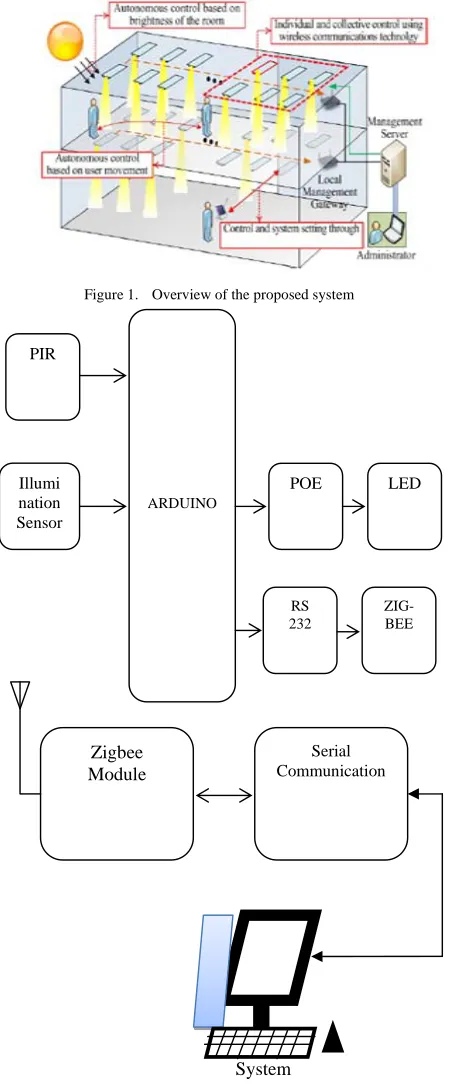
intensity illumination according to external environment brightness. By using these two sensors the rooms light intensity can be automatically adjust by introducing human interaction and external environment condition.
[image:3.612.69.294.101.645.2]
Figure 1. Overview of the proposed system
Figure 2. Block Diagram of the system
IV. METHODOLOGY
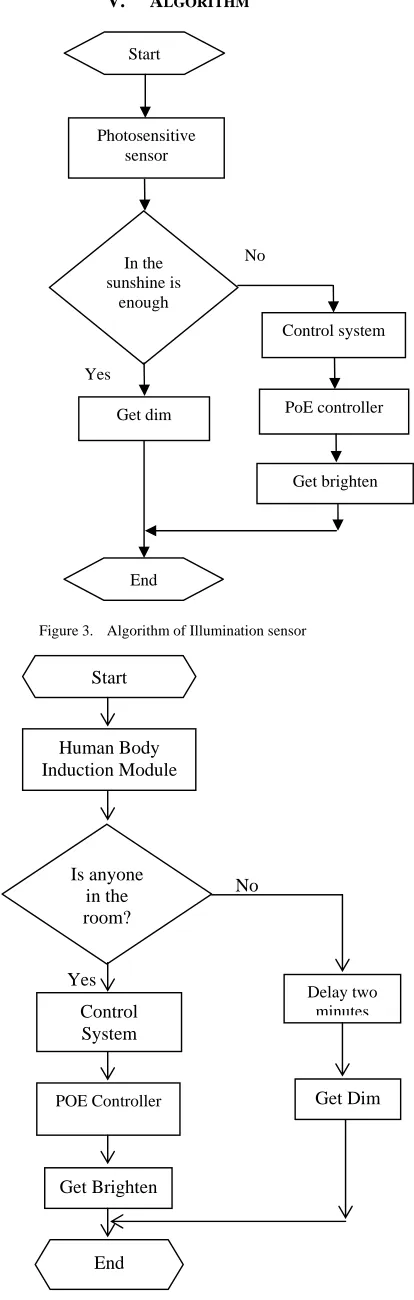
Passive infrared sensor can be work when human interaction can be introduced in the room. When human activities can be introduced in the room then the PIR sensor
module output become high level and sensor can be increase the brightness of the room means it can be improve the standard illumination and light intensity. When there is no human interaction can be introduced in the room then the PIR sensor module output become low level and sensor can be decrease the brightness of the room means it can be reduced the standard illumination and light intensity.
Illumination sensor can be adjust the light intensity value according to room outside external environment Means it can be adjust room internal light intensity illumination according to external environment brightness. When external environment brightness is low then the illumination sensor resistance is very small and it can be increase the room light intensity illumination value. When external environment brightness is high then the illumination sensor resistance is very high then it can be automatically decrease the room light intensity illumination value.
Illumination sensor can be collect the information of room light intensity through the Ethernet cable and send electrical signal to the control system. Then the control system can be collect the information and it can be analyze the collected information and sent the instruction to the power over Ethernet (PoE) controller. According to the collected information LED lighting system of PoE controller can be automatically adjust the brightness of the room.
In telecommunications sector, RS-232 can be used for a standard serial communication transmission of data. RS-232 Can be provide the signals connecting between a data terminal equipment (DTE) such as a computer terminal and a data circuit-terminating equipment(DCE), originally it can be defined as data communication equipment such as a modem device. The RS-232 standard is very commonly useful in computer serial ports. The RS-232 can be defines the standard electrical characteristics and timing of signals and the physical size and pin out of connectors. The latest version which can be current used for the standard is TIA-232-F which can be Interface between Data Terminal Equipment and Data Circuit-Terminating Equipment Employing Serial Binary Data Interchange.
The Arduino Ethernet shield with PoE Module is based on the Wiznet W5100 ethernet chip. Thus Wiznet W5100 provides a network stack capable of both transmission control protocol (TCP) and user/ universal datagram protocol (UDP). TCP and UDP can be supports less than four simultaneous socket connections. In the TCP protocol, message can be transfer through the internet from one computer to another computer. Thus the TCP is suitable for application that required high reliability and transmission time is relatively less critical. But the speed of TCP is slow as compared to the UDP. TCP also provide the reliability such as, data can be send in any format then same format can received the data. TPC can be provides header size up to 20bytes. In the UDP protocol, message can be transfer through the wireless by using load on packet. UDP is suitable for application that need fast, efficient transmission such as game. UDP is Useful when severs can be introduced that answer small queries from huge number of clients.UDP is faster as compared to TCP because there is no error checking for packet. Thus the UDP not provides reliability such as, there is no guarantee that the message or packets sent would reach at all. UDP header size is 8 bytes. When proposed system can be design by using any processor it cannot be used PoE module because of these reason when it can be connected any sensor it can be required external power supply ,these processor cannot provide any internal power supplybut in these proposed system can be used a PoEmodul, when PoE module can be connected in the Ethernet board and can be connected any sensor then it cannot be required any external power supply because PoE can ARDUINO
PIR
Illumi nation Sensor
POE LED
RS 232
ZIG-BEE
Zigbee Module
Serial Communication
be provide the internal power supply of the any sensor module. Hence by using the PoE module power consumption can be reduced.
[image:4.612.370.553.52.369.2]Zigbee and Bluetooth have different application focus both are based on the IEEE 802.15 standards. Bluetooth is made with mobile phones as its centre of universe enabling media transfer at rates in excess of 1 Mbps while Zigbee is built with emphasis on low data rate control system sensors featuring slower data of just 250 kbps.
Table I. Comparison of Wi-fi, Bluetooth and ZigBe
Many years ago, when Bluetooth technology was introduced, Bluetooth technology can be provided the data rate up to 1Mbps, range is 10 mater, it can be consume very less power, it can be provided security such 64 and 128 bit encryption, operating frequency 2.4 GHz But it has two limitation such as very small network topology and high complexity. Then another technology can be introduced such as Wi-Fi, Wi-Fi can be provide 11Mbps and 54 Mbps data rate, range is 100 meter, it can be provide point to hub network topology, operating frequency is 2.4 GHz and 5GHz, high security but it has some limitation such as high complexity, high power consumption. The limitation Bluetooth and Wi-Fi device can be overcome by introducing zigbee device. Zigbee provides network topology such as peer to peer, star and mesh. Zigbee range is 100 meter, operating frequency is 2.4 GHz, low complexity, less power consumption device, zigbee provide high security such as 128 AES (Advanced encryption standard) plus application layer security but one limitation can be introduced in zigbee as compared to Wi-Fi and Bluetooth such it can be provided 20Kbps, 40Kbps, 250kbps data range which is less than Bluetooth and Wi-Fi. Zigbee has low cost and low power for energy efficient and cost effective intelligent devices.
V. ALGORITHM
[image:4.612.347.554.56.706.2]Figure 3. Algorithm of Illumination sensor
Figure 4. Algorithm of PIR sensor
Start
Photosensitive sensor
Control system
Get brighten PoE controller In the
sunshine is enough
Get dim
End Yes
No
No Start
Human Body Induction Module
Is anyone in the room?
Control System
POE Controller
Get Brighten
End Yes
Delay two minutes
[image:4.612.64.295.157.364.2]VI. ADVANTAGES
Reduction in power consumption.
Saves energy up 18% to 20%.
Improves life of devices.
Autonomous control based on user movement.
Autonomous control based on brightness of the room.
Proposed system can be Design to maximum the
utilization of an LED.
Proposed system can be Design to have the
communication capability.
Proposed system can be Design to control based on the situation awareness.
Proposed system can be Design to enhance both energy efficiency and user satisfaction.
VII. CONCLUSION
Now a day energy saving has one of the most importance thinks. The traditional lighting system can be acquire approximately 16% to 18% of the overall word energy consumption. Thus a lot of study related to the energy saving no product can be introduced in both user satisfaction and energy efficient than the traditional lighting system cannot be successfully applicable to the office building and home. Then the propose system can be used a wireless communication technology and many sensor which can be control the LED lighting system according to the surrounding environment and user state. The proposed system of new LED lighting system can be automatically control and minimum light intensity value to improve both user satisfaction and energy efficiency. The proposed new LED lighting system can be reduced the overall power consumption up to 18% to 20%.
VIII. ACKNOWLEDGEMAENT
This study is useful for the study and understanding of advanced technology of new intelligent household LED lighting system which can be reduce power consumption and also suitable for environment.
IX. REFERENCES
[1] QiangGao, Xiangyu Li, Yuxian Sui, HaiqingGu,
Zhizhong Yu, Qing Zhang, Peng Li,” Design and Implementation of LED Intelligent Lighting System Based on the Technology of PoE,” 978-1-4799-7016-2/15/$31.00_c 2015 IEEE.
[2] JinsungByun, Insung Hong, Byoungjoo Lee, and Sehyun Park “Intelligent Household LED Lighting System Considering Energy Efficiency and User Satisfaction ” IEEE Transactions on Consumer Electronics, Vol. 59, No. 1, February 2013.
[3] Jiande Wu, Haimeng Wu, Chushan Li, Wuhua Li,
Xiangning He, Changliang Xia, ”Advanced Four-Pair
Architecture With Input Current Balance Function for Power Over Ethernet (PoE) System,” IEEE transactions on power electronics, vol. 28, no. 5, may 2013.
[4] F. Leccese, "Remote-Control System of High Efficiency and Intelligent Street Lighting Using a ZigBee Network of Devices and Sensors," IEEETrans. on Power Delivery, vol. 28, no. 1, pp. 21-28, Jan. 2013.
[5] A. A. Siddiqui, A. W. Ahmad, H. K. Yang, and C. Lee, "ZigBee based energy efficient outdoor lighting control system," in Proceedings of theInternational Conference on Advanced Communication Technology, pp. 916-919, 2012.
[6] F. J. Bellido-Outeirino, J. M. Flores-Arias, F. Domingo-Perez, A. Gil-de- Castro, and A. Moreno-Munoz, "Building lighting automation through the integration of DALI with wireless sensor networks," IEEE Trans. OnConsumer Electron., vol. 58, no. 1, pp. 47-52, Feb. 2012.
[7] Tao Chen, Yang Yang, Honggang Zhang, Haesik Kim, and K. Horneman, "Network energy saving technologies for green wireless access networks," IEEE Wireless Communications, vol. 18, no. 5, pp. 30-38, Oct. 2011. [8] J. Byun and S. Park, "Development of a self-adapting
intelligent system for building energy saving and context-aware smart services," IEEETrans. on Consumer Electron., vol. 57, no. 1, pp. 90-98, Feb. 2011.
[9] J. Han, C.-S. Choi, and I. Lee, "More efficient home energy management system based on ZigBee communication and infrared remote controls," IEEE Trans. on Consumer Electron., vol. 57, no. 1, pp. 85-89, Feb. 2011.
[10] Y. Uhm, I. Hong, G. Kim, B. Lee, and S. Park, "Design and implementation of power-aware LED light enabler with location-aware adaptive middleware and context-aware user pattern," IEEE Trans. OnConsumer Electron., vol. 56, no. 1, pp. 231-239, Feb. 2010.
[11] S. Matta and S. M. Mahmud, "An intelligent light control system for power saving," in Proceedings of the Annual Conference of the IEEEIndustrial Electronics Society, pp. 3316-3321, 2010.
[12] Ç. Atıcı, T. Özçelebi, and J. J. Lukkien, "Exploring user-centered intelligent road lighting design: a road map and future research directions," IEEE Trans. on Consumer Electron., vol. 57, no. 2, pp. 788-793, May 2011.
[13] S. Tompros, N. Mouratidis, M. Draaijer, A. Foglar, and H. Hrasnica, "Enabling applicability of energy saving applications on the appliances of the home environment," IEEE Network, vol. 23, no. 6, pp. 8-16, Nov.- Dec. 2009. [14] T.-J. Park and S.-H. Hong, "Experimental Case Study of a
BACnet- Based Lighting Control System," IEEE Trans. on Automation Science and Engineering, vol. 6, no. 2, pp. 322-333, Apr. 2009.