DOI: http://dx.doi.org/10.26483/ijarcs.v8i9.5189
Volume 8, No. 9, November-December 2017
International Journal of Advanced Research in Computer Science
RESEARCH PAPER
Available Online at www.ijarcs.info
ISSN No. 0976-5697
NOVEL APPROACH FOR COST ESTIMATION OPTIMIZATION BASE
FEATURE SELECTION AND CLASSIFICATION
Swati Sharma
Student of M.tech ,Department Of computer Science Palampur(H.P) India
MunishKatoch,
Assistant Professor , Department Of computer Science Palampur(H.P) India
Abstract- Software development effort estimation is the process of predicting the most realistic effort required to develop or maintain software. It is important to develop estimation models and appropriate techniques to avoid losses caused by poor estimation. IN text mining is use for understand user requirement, so understanding features optimize by ant colony optimization, it reduce the overlapping of features and then learn by generative classifier using Naïve Bayes.
Keywords-Optimization, Naïve Bayes, ACO, cost estimation
I. INTRODUCTION
Predictive modeling has been broadly utilized within IT enterprise environments, uses of which run from recommendation-based IT benefit conveyance and support [2], [10] to desert expectation for business software [7]. This exploration specifically goes for software effort estimation which has been examined in various software outline and development enterprises. In spite of the fact that there have been diverse estimation models grew so far, no single model has been appeared to be out performing others. Subsequently there is a requirement for new anticipating models because of dynamic changes in the environment. As of late more research consideration was attracted to factual modeling so as to address general effort estimation challenges. Authors in [8] gave a relative investigation comprising of more than twelve learning models against various benchmarks. Likewise in [5] an ensemble learning approach was proposed for effort estimation to support estimation exactness. Within Agile environments, nonetheless, there has not been much research for effort estimation utilizing supervised learning models.
Software development effort estimation is the way toward foreseeing the most reasonable effort required to create or keep up software in light of inadequate, dubious as well as loud information. Within Agile Development projects with a high level of client inclusion at each iteration, it is especially vital to have precise appraisals. It gives status visibility to the partners, contrasting arranged advance and the real advance. Effort gauges are utilized as contribution to extend plans, iteration designs, spending plans, and offering rounds.
Agile tries to limit the effect of inadequate estimation exactness by guaranteeing that the most vital functionality is created first. This is accomplished through an adaptable development process with short iterations. In Agile a client story is the unit at which software highlights are evaluated and created.
Every story is in the dialect of the client, and regularly written on a record card. The cards fill in as updates for
discussions to be had about the components. The points of interest are then fleshed out later in the discussions, and passed on and archived as tests [2].
In section II the related work and the state of the art research in software effort estimation will be discussed; in section III the methodology for proposed algorithm is described, in section IV the key steps in building and validating system model are shown. Experimental results on improved estimation methods will be presented in section V. Finally conclusions are in section VI.
II. LITERATURE REVIEW
development effort. The regression display uses item size and application sorts to anticipate effort. Item estimate is measured as far as the comparable source lines of code. The analysis depends on experimental information gathered from 317 extremely late projects executed inside the United States Department of Defense through the span of nine years starting in 2004. Statistical outcomes demonstrated that source lines of code and application sort are critical supporters of development effort. The condition is less difficult and more feasible to use for early gauges than customary parametric cost models. The impact of item measure on software effort should be translated alongside application area.
Agile software development process [4] speaks to a noteworthy departure from conventional, design based ways to deal with software building. Evaluating effort of agile software precisely in beginning period of software development life cycle is a noteworthy test in the software business. For enhancing the estimation exactness, different streamlining strategies are used. The Support Vector Regression (SVR) is one of these methods that aides in getting ideal assessed esteems. The primary goal of the exploration work did in this paper is to evaluate the effort of agile softwares utilizing story point approach. An endeavor has been made to advance the outcomes acquired from story point approach utilizing different SVR strategies to accomplish better forecast exactness. An execution examination of the models acquired utilizing different SVR bit strategies is likewise introduced with a specific end goal to feature execution accomplished by every technique. The required effort of an errand can be evaluated subjectively in interviews with specialists in an association in various ways. Meeting systems managing which sort of things to ask are assessed and strategies for consolidating gauges from people into one gauge are looked at in an investigation. The outcome demonstrates that the meeting procedure is not as vital as the combination method. The gauge which is best regarding mean esteem and standard deviation of the effort depends on an equivalent weighting of every individual gauge. The analysis is performed inside the Personal Software Process (PSP) [5]. Despite many years of research, there is no accord on which software effort estimation strategies [6]-[7]create the most exact models. Prior work has detailed that, given M estimation strategies, no single technique reliably beats all others. Maybe as opposed to prescribing one estimation technique as best, it is savvier to create gauges from outfits of different estimation strategies. Strategy: Nine students were consolidated with 10 preprocessing choices to create 9 × 10 = 90 solo strategies. These were connected to 20 datasets and assessed utilizing seven mistake measures. This recognized the best n (in our case n = 13) solo techniques that demonstrated stable execution over numerous datasets and mistake measures. The best 2, 4, 8, and 13 solo strategies were then joined to produce 12 multi-methods, which were then contrasted with the performance techniques. 1) The main 10 (out of 12) multi-methods fundamentally outflanked each of the 90 solo techniques. 2) The blunder rates of the multi-methods were fundamentally
strategies. This examination in [7] focuses on development of effort estimation show for agile software projects. Development and use of the model is clarified in detail. The model was aligned utilizing the exact information gathered from 21 software projects. The trial comes about demonstrate that model has great estimation exactness as far as MMRE and PRED (n).In [8], analyzed how complex adaptive systems (CAS) hypothesis can be used to build our understanding of how agile software development practices can be used to build up this capacity. A mapping of agile practices to CAS standards and three measurements (item, process, and individuals) brings about a few proposals in systems development for "best practices". To give a superior understanding of lean software development methodologies and how they are connected in agile software development, in [9] they have inspected 30 encounter reports distributed in past agile software meetings in which encounters of applying lean methodologies in agile software development were accounted for. The analysis distinguished six sorts of lean application. The consequences of their investigation demonstrate that lean can be connected in agile processes in various conducts for various purposes. Lean ideas, standards and practices are frequently used for consistent agile process change, with the latest presentation being the kanban approach, presenting a persistent, flow-based substitute to time-boxed agile processes. In [10], the proposed development approach adjusts agile standards and examples keeping in mind the end goal to manufacture implanted control systems concentrating on the issues identified with the framework's imperatives and wellbeing. Solid unit testing is the establishment of the proposed procedure for guaranteeing convenience and rightness. Also, stage based plan approach is used to adjust costs and time-to-showcase in perspective of execution and functionality requirements. They presume that the proposed procedure lessens essentially the plan time and cost and also prompts better software measured quality and dependability.
III. ALGORITHM USED
A. Ant Colony Optimization
Where
𝜂𝜂𝑥𝑥𝑥𝑥priority heuristic information,
𝜏𝜏𝑥𝑥𝑥𝑥pheromones trail amount on the edge (x, y) at the time
T,
The pheromone trail and heuristic information relative effects are identified by two factors i.e., 𝛼𝛼and 𝛽𝛽. And the city’s neighborhood set that are reasonable is denoted by 𝐼𝐼𝑥𝑥𝑘𝑘. After a visit is finished by every ant, a constant dissipation rate at first bringing down them which refreshed the pheromone trail. Inferable from which every ant is permitted effective pheromone affidavit on curves which is its visit part as appeared in the condition underneath:
𝜏𝜏𝑥𝑥𝑥𝑥 = (1− 𝜌𝜌).𝜏𝜏𝑥𝑥𝑥𝑥 +� Δ𝜏𝜏𝑥𝑥𝑥𝑥𝑘𝑘 𝑁𝑁 𝑘𝑘=1 Where
𝜌𝜌Pheromones rate of trail evaporation,
Nno. of ants,
The pheromone trail that is boundless aggregated is averted
by the utilization of parameter ρ which empowers the awful
choices to be overlooked by the calculation. The no. of cycles declining the pheromone quality related on circular segments which ants don't choose. Δ𝜏𝜏𝑥𝑥𝑥𝑥𝑘𝑘 , the trail substance quality per unit length which lays nervous (y,x) is given as takes after:
Δ𝜏𝜏𝑥𝑥𝑥𝑥𝑘𝑘 =�
𝑄𝑄
𝐿𝐿𝑘𝑘 𝑒𝑒𝑖𝑖𝑎𝑎𝑎𝑎𝑡𝑡𝑘𝑘𝑒𝑒𝑎𝑎𝑒𝑒𝑡𝑡𝑒𝑒𝑡𝑡𝑡𝑡𝑡𝑡𝑒𝑒𝑡𝑡𝑒𝑒𝑒𝑒𝑒𝑒𝑒𝑒𝑒𝑒𝑒𝑒𝑒𝑒 (𝑥𝑥,𝑥𝑥)
0 𝑃𝑃𝑡𝑡ℎ𝑒𝑒𝑒𝑒𝑒𝑒𝑒𝑒𝑒𝑒𝑒𝑒
Where
Qconstant that is predefined,
𝐿𝐿𝑘𝑘length of the tour.
B. Support Vector Machine
SVM for classification in high-dimensional space builds a hyper plane. A hyper plane attaining best performance which maximizes the distances of both classes nearest training instances that is, functional margin maximization. The generalized error reduction is the main objective which makes it over fitting resistant.
A classification task is considered as: {𝑡𝑡𝑒𝑒,𝑣𝑣𝑒𝑒},𝑒𝑒 ∈
1, 2, … … ,𝑎𝑎,𝑣𝑣𝑒𝑒 ∈{−1, 1}𝑎𝑎𝑎𝑎𝑒𝑒𝑡𝑡𝑒𝑒 ∈ 𝑃𝑃
Where
𝑡𝑡𝑒𝑒Data point,
𝑣𝑣𝑒𝑒 Corresponding label,
For separation, the hyper plane is given as: 𝑥𝑥𝑡𝑡𝑡𝑡+𝑎𝑎= 0
Where
x coefficient vector, aoffset from origin
The optimization objective solving helps in obtaining ideal margin in case of separation.
𝑀𝑀𝑒𝑒𝑎𝑎𝐺𝐺(𝑥𝑥,𝜉𝜉) =12‖𝑥𝑥‖2+𝑐𝑐 � 𝜉𝜉
𝑒𝑒 𝑙𝑙
𝑒𝑒=1 𝑣𝑣𝑒𝑒(𝑥𝑥𝑇𝑇𝑡𝑡𝑒𝑒+𝑎𝑎)≥1− 𝜉𝜉𝑒𝑒,,𝜉𝜉 ≥0 Here
cgeneralized parameter, 𝝃𝝃Positive slack variable
The Lagrangian multiplier 𝛼𝛼𝑒𝑒(𝑒𝑒= 1, 2, … . .𝑙𝑙) is introduced for the reduction of optimization problem to Lagrangian dual problem (obtaining x and a). Therefore, the linear discriminant problem is given below:
𝐺𝐺(𝑡𝑡) =𝑒𝑒𝑒𝑒𝑎𝑎([� 𝛼𝛼𝑒𝑒𝑣𝑣𝑒𝑒𝑡𝑡𝑒𝑒𝑇𝑇𝑡𝑡] +𝑎𝑎) 𝑙𝑙
𝑒𝑒=1
When linear line do not separate the classes, thus mapping the original feature space to high dimensional feature space. The representation of the new decision function is:
𝐺𝐺(𝑡𝑡) =𝑒𝑒𝑒𝑒𝑎𝑎([� 𝛼𝛼𝑒𝑒𝑣𝑣𝑒𝑒𝜙𝜙(𝑡𝑡𝑒𝑒)𝑇𝑇𝜙𝜙(𝑡𝑡)] +𝑎𝑎) 𝑙𝑙
𝑒𝑒=1 Where
𝑡𝑡𝑒𝑒𝑇𝑇𝑡𝑡input space in feature space depicted as 𝜙𝜙(𝑡𝑡𝑒𝑒)𝑇𝑇𝜙𝜙(𝑡𝑡)]
Kernal function is utilized for computing 𝜙𝜙(𝑡𝑡)and SVM (support vector machine) utilizes several kernel functions. 𝛾𝛾defines the pre-defined parameter which controls the Gaussian kernal width.
IV. SYSTEM MODEL
The description of the system model flow:
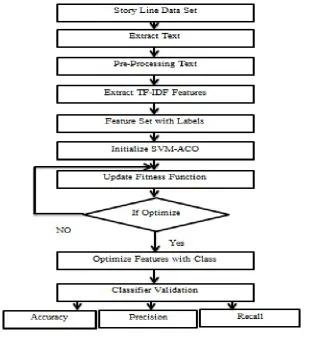
Step1: Input the storyline dataset from with the text is extracted.
Step 2: TF-IDF features are extracted after the pre-processing of text.
Step 3: The extracted features are labeled and Ant Colony Optimization is initialized.
Step 4: Fitness function is updated and optimization of features takes place.
Step 5: Classification validation of the obtained optimized features with class in this step.
V. EXPERIMENTAL RESULT
Table 1: Performance comparison table between two classifiers: Nave Bayes and SVM-ACO
Parameters Naïve Bayes Naive-ACO
Accuracy 71.156 77.777
Precision 69.666 81.666
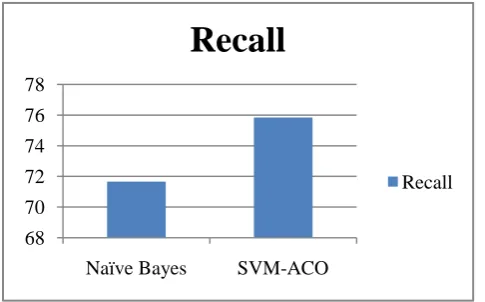
Recall 71.666 75.833
Figure1: Comparison graph of accuracy between Naive Bayes and SVM-ACO
66 68 70 72 74 76 78 80
Naïve Bayes SVM-ACO
Accuracy
Figure 2: Comparison graph of precision between Naïve Bayes and SVM-ACO
Figure 3: Comparison graph of recall between Naive Bayes and SVM-ACO
VI. CONCLUSION
Cost Estimate gets better trained on the story cards, human estimates, and actual effort data. Therefore by the later stages of the project the algorithm is more reliable than manual Planning Poker estimates and thus suitable as a tool for augmenting human effort estimation. For future work we propose research with larger datasets, and using features which were not used in this experiment (developers’ demographics, story criticality, and other system and framework aspects).
VII. REFERENCES
[1] TharwonArnuphaptrairong, “Early Stage Software Effort
Estimation Using Function Point Analysis: Empirical Evidence”, in IMECS Vol-2,2013
[2] Nassif, Ali Bou, Luiz Fernando Capretz, and Danny Ho. "Software effort estimation in the early stages of the software life cycle using a cascade correlation neural network model." Software Engineering, Artificial Intelligence, Networking and Parallel & Distributed Computing (SNPD”), 2012 13th ACIS International Conference on.IEEE, 2012.
[3] Rosa, Wilson, et al. "Simple empirical software effort estimation model." Proceedings of the 8th ACM/IEEE International Symposium on Empirical Software Engineering and Measurement”,In ACM, 2014.
[4] Satapathy, ShashankMouli, Aditi Panda, and Santanu Kumar Rath. "Story point approach based agile software effort estimation using various svr kernel methods." (2014).
[5] Höst, Martin, and ClaesWohlin. "An experimental study of individual subjective effort estimation and combinations of the estimates." Proceedings of the 20th international conference on Software engineering.IEEE Computer Society, 1998.
[6] Kocaguneli, Ekrem, Tim Menzies, and Jacky W. Keung. "On the value of ensemble effort estimation." IEEE Transactions on Software Engineering 38.6 (2012): 1403-1416.
[7] Ziauddin, Shahid Kamal Tipu, and Shahrukh Zia. "An effort estimation model for agile software development." Advances in computer science and its applications (ACSA) 314 (2012): 314-324.
[8] Meso, Peter, and Radhika Jain. "Agile software development: adaptive systems principles and best practices." Information systems management23.3 (2006): 19-30.
[9] Wang, Xiaofeng, Kieran Conboy, and OisinCawley. “Leagile” software development: An experience report analysis of the application of lean approaches in agile software development." Journal of Systems and Software 85.6 (2012): 1287-1299.
[10] Cordeiro, Lucas, et al. "An agile development methodology applied to embedded control software under stringent hardware constraints." ACM SIGSOFT Software EngineeringNotes 33.1(2008).
60 65 70 75 80 85
Naïve Bayes SVM-ACO
Precision
Precision
68 70 72 74 76 78
Naïve Bayes SVM-ACO