University of Windsor University of Windsor
Scholarship at UWindsor
Scholarship at UWindsor
Electronic Theses and Dissertations Theses, Dissertations, and Major Papers
Winter 2014
Analysis of heat transfer in spray cooling systems using
Analysis of heat transfer in spray cooling systems using
numerical simulations
numerical simulations
Masoumeh Jafari
University of Windsor
Follow this and additional works at: https://scholar.uwindsor.ca/etd
Part of the Mechanical Engineering Commons
Recommended Citation Recommended Citation
Jafari, Masoumeh, "Analysis of heat transfer in spray cooling systems using numerical simulations" (2014). Electronic Theses and Dissertations. 5028.
https://scholar.uwindsor.ca/etd/5028
This online database contains the full-text of PhD dissertations and Masters’ theses of University of Windsor students from 1954 forward. These documents are made available for personal study and research purposes only, in accordance with the Canadian Copyright Act and the Creative Commons license—CC BY-NC-ND (Attribution, Non-Commercial, No Derivative Works). Under this license, works must always be attributed to the copyright holder (original author), cannot be used for any commercial purposes, and may not be altered. Any other use would require the permission of the copyright holder. Students may inquire about withdrawing their dissertation and/or thesis from this database. For additional inquiries, please contact the repository administrator via email
ANALYSIS OF HEAT TRANSFER IN SPRAY COOLING SYSTEMS USING NUMERICAL SIMULATIONS
by
Masoumeh Jafari
A Thesis
Submitted to the Faculty of Graduate Studies
through Mechanical, Automotive and Materials Engineering in Partial Fulfillment of the Requirements for
the Degree of Master of Applied Science at the University of Windsor
Windsor, Ontario, Canada 2013
ANALYSIS OF HEAT TRANSFER IN SPRAY COOLING STYSTEMS USING NUMERICAL SIMULATION
by
Masoumeh Jafari
APPROVED BY:
_____________________________________________________ Dr. R. Carriveau
Department of Civil and Environmental Engineering
_____________________________________________________ Dr. D. Ting
Department of Mechanical, Automotive and Materials Engineering
_____________________________________________________ Dr. R. Barron, Co-Advisor
Department of Mathematics and Statistics, Department of Mechanical, Automotive and Materials Engineering
_____________________________________________________ Dr. R. Balachandar, Co-Advisor
Department of Civil and Environmental Engineering, Department of Mechanical, Automotive and Materials Engineering
_____________________________________________________
iii
Declaration of Co-Authorship
Co-Authorship Declaration
I hereby declare that this thesis incorporates the outcome of a joint research undertaken in collaboration under the co-supervision of Dr. Barron and Dr. Balachandar. The collaboration is covered in Chapter 2, 3, 4, 5, 6 and 7 of the thesis. In all cases, the key ideas, primary contributions, numerical simulation designs, data analysis and interpretation were performed by the author.
I am aware of the University of Windsor Senate Policy on Authorship and I certify that I have properly acknowledged the contribution of other researchers to my thesis and have obtained written permission from each of the co-authors to include the above materials in my thesis.
I certify that, with the above qualifications, this thesis, and the research to which it refers, is the product of my own work.
I declare that to the best of my knowledge, my thesis does not infringe upon anyone’s copyright nor violate any proprietary rights and that any ideas, techniques, quotations, or any other material from the work of other people included in my thesis, published or otherwise, are fully acknowledged in accordance with the standard referencing practices. Furthermore, to the extent that I have included copyrighted material that surpasses the bounds of fair dealing within the meaning of the Canada Copyright Act, I certify that I have obtained a written permission from the copyright owners to include such material(s) in my thesis.
iv
Abstract
The impingement of sprays onto dry and wet walls and the associated heat transfer occurs in many engineering applications. These applications include internal combustion engines, gas turbines, spray drying, spray coating and spray cooling. The fluid dynamics and heat transfer characteristics of liquid films created by spray impingement are very complex and determining the underlying physics requires fundamental studies.
In this study, an efficient and practical approach is devised for tackling many aspects of the spray cooling process. The computational fluid dynamics (CFD) methodology used here includes numerous droplets and it is designed to predict the spray-wall impact outcome based on reliable correlations. Even though it is not an exact representation of the interaction between the spray and the liquid layer due to computational considerations, it provides an acceptable picture of the transport phenomena. The STAR-CCM+ CFD code has been used to solve continuity, momentum, and energy equations coupled with a Lagrangian-Eulerian solver capable of simulating droplets as well as thin fluid film.
The model is validated against relevant experimental data available in the literature and good agreement is observed for heat transfer coefficient (HTC) values for cases involving spray impact and fluid film formation over a flat solid surface. The effect of mass flux and spray Reynolds number on the spray behaviour has been studied. The model is extended to predict the cooling performance of sealed cans containing hot liquids when the cans are cooled by the impingement of spray formed from a cold liquid. The CFD results are compared with field data obtained at Heinz Canada, Leamington, ON. The effect of the can rotational speed on the cool-down behaviour is investigated. The results show that there is an optimum rotational speed beyond which the heat transfer enhancement will not be as significant.
v Dedication
vi
Acknowledgements
I would like to express my sincerest gratitude to my advisors, Dr. Barron and Dr. Balachandar, for their endless support and advice during the course of this research. Without their patience, understanding and help, I would not have been able to successfully complete this work.
I would like to thank my thesis committee members, Dr. D. Ting and Dr. R. Carriveau for their time and valuable input.
Financial support from the Natural Sciences and Engineering Research Council of Canada (NSERC) through the Engage program is gratefully acknowledged. Also, I would like to express my gratitude to Heinz Canada for giving access to their facilities in Leamington to collect data on their spray cooling operation.
vii
Table of Contents
Declaration of Co-Authorship iii
Abstract iv
Dedication v
Acknowledgements vi
List of Tables x
List of Figures xi
List of Abbreviations, Symbols, Nomenclature xi
Chapter 1. Introduction 1
1.1 Background 1
1.2 Motivation 6
1.3 Objectives 7
1.4 Thesis Outline 8
Chapter 2. Literature Review 10
Chapter 3. Numerical Modeling 20
3.1. CFD Code Used in this Study 20
3.1.1 STAR-CCM+ 20
3.2 Introduction 21
3.3. Droplet Interaction with the Wall 22
3.4. Governing Equations 26
3.4.1 Conservation of Mass 28
3.4.2 Momentum Balance for Material Particle 29
3.4.2.1 Conservation of Momentum 29
3.4.3 Turbulence Model 31
3.4.4 Conservation of Energy 33
3.5 Fluid Film Formulation and Numerical Implementation 34
3.5.1 Film Dynamics 34
3.6 Governing Equation for Fluid Film 35
viii
3.6.2 Conservation of Momentum 36
3.6.3 Pressure Source Term 37
3.6.4 Conservation of Energy 37
3.7 Modeling of the Heat Transfer in Spray Cooling 38
3.7.1 Wetting and Non-wetting Droplet Heat Transfer 38
3.7.2 Parameters Affecting Droplet Contact Heat Transfer 38
3.8 Energy Balance for a Material Particle 39
3.8.1 Heat Transfer Coefficient 40
Chapter 4 Validation of the CFD Model 41
4.1 Experimental Data Used for Validation 41
4.2 Spray Parameters 43
4.3 CFD Modeling Procedure in STAR-CCM+ 44
4.3.1 Modeling Geometry in STAR-CCM+ 45
4.3.2 Meshing 45
4.3.3 Physics Model 47
4.3.4 Boundary and Initial Conditions 49
4.3.5 Convergence Criteria 49
4.4 Fine Tuning 50
4.5 Spray Parameters 50
4.6 Results 51
Chapters 5. Experimental Setup and Procedure 60
5.1 Introduction 60
5.2 Cooling Process 61
5.3 Spray Nozzle 63
5.4 Preliminary Experimental Data 64
5.5 Analytical Approach 66
Chapter 6 Proposed CFD Model for Heinz Setting 74
6.1 Introduction 74
6.1.1Dividing the Problem into 3-D and 2-D Parts 75
ix
6.3 Model Setup 77
6.3.1 Material Properties 77
6.3.2 Solver Setting 77
6.3.3 Boundary Conditions 78
6.3.4 Computational Details 79
6.4 Numerical Approach 81
6.5 Results and Discussion 82
6.5.1 3-D Model Results 82
6.5.2 Effect of RPM on Tomato Juice Temperature Distribution 82
6.6 Closure 87
Chapter 7 Conclusions and Recommendations 89
7.1 Conclusions 89
7.2 Recommendations for Future Work 91
References 93
x
List of Tables
Table 4.1– Experimental setup data of Karwa et al. (2007) 41
Table 4.2– Operating parameters, Karwa et al. (2007) 43
Table 4.3 – Parameters considered for convergence of the simulation 50
Table 4.4 – Comparison of the simulation results and experiments for three cases 58
Table 5.1– Parameters of nozzle while performing 61
Table 5.2 – Data for the cans used in Heinz 62
Table 5.3 – Conveyor characterization carrying different size of tomato juice cans 63
Table 5.4 – Measured temperature values for bath section 65
Table 5.5– Measured temperature values for location A 65
Table 5.6 – Measured temperature values for location B 65
Table 5.7– Measured temperature values for location C 66
Table 5.8 – Measured temperature values for location D 66
Table 6.1– Properties of the tomato juice and the can used for the simulation 77
Table 6.2 – Parameters used in 2-D simulation 78
Table 6.3– Heinz’s nozzle performance data 79
Table 6.4 – Operating parameters for the numerical model 80
xi
List of Figures
Figure 1.1 – Comparison of heat transfer coefficient for different cooling techniques 2
Figure 1.2 – (a) Stages of spray development (b) The formation of secondary droplet and film formation (Tropea, 2007) 3
Figure 1.3 – Spray impinging a heated surface 3
Figure 1.4 – Schematic diagram of spray cooling 4
Figure 1.5 – Typical boiling curve and associated boiling regimes 6
Figure 3.1 – Three-dimensional simulation of spray liquid layer interaction 23
Figure 3.2 – Spray wall impingement regimes based on Bai-Gosman model 27
Figure 3.3 – Interfacial transport processes of heat 40
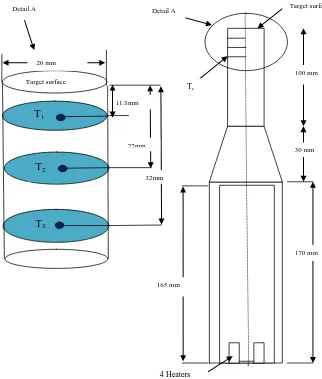
Figure 4.1 – Schematics of the heater-target assembly for Karwa et al. experiment 42
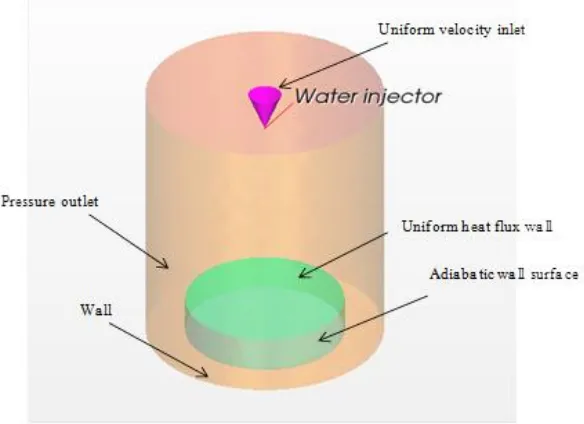
Figure 4.2 – Geometry of the CFD model including the domain, injector and target 46
Figure 4.3 – Different mesh sizes 46
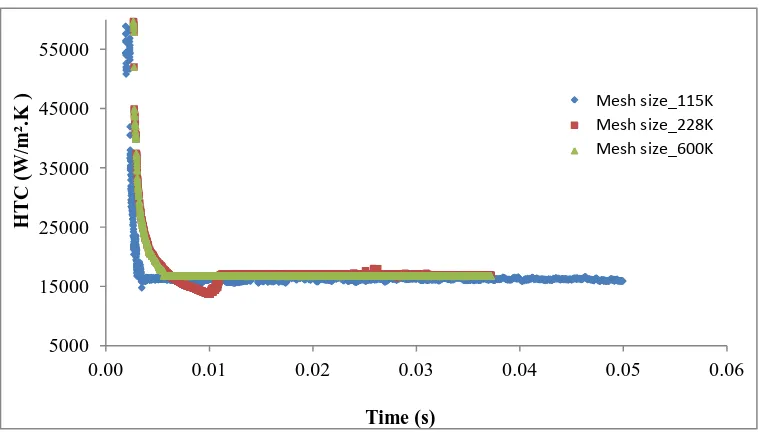
Figure 4.4 – Mesh independency for case 1 47
Figure 4.5 – Boundary conditions for validation case 49
Figure 4.6 – Setup for measuring the spray angle 51
Figure 4.7 – Instantaneous temperature distribution inside plate for case 1 at 1 msec 52
Figure 4.8 – Spray droplets’ velocity vectors visualized for case 1 (top), case 2 (middle) and case 3 (bottom) at 15 msec 53
Figure 4.9 – Film thickness distribution on the solid surface for case 1 (top), case 2 (middle) and case 3 (bottom), respectively at 15 msec 54
Figure 4.10 – Temperature variations versus surface radius for three cases 55
Figure 4.11 – Heat transfer coefficient distribution vs. surface radius for all cases 56
Figure 4.12 – Temperature variations versus surface radius for three cases 57
Figure 4.13 – Heat transfer coefficient versus flow rate for three cases 57
Figure 4.14 – Comparison of CFD results with Karwa et al. (2007) and Wang et al. (2011) 59
Figure 5.1 – Schematic picture depicting moving cans while spinning on the conveyor 60 Figure 5.2 – A sample nozzle used in Heinz spray cooler 61
xii
Figure 5.4 – Spray cooling setup in Heinz 62
Figure 5.5 – Different sizes of cans used for tomato juice production 62
Figure 5.6 – Comparison of measured temperature of tomato juice can at different locations with Newton's Cooling Law 68
Figure 5.7 – Picture of iButton 68
Figure 5.8 – Calibration of the iButtons against thermocouple 69
Figure 5.9 – Temperature variation of tomato juice inside the small can versus the length of the conveyor for from the first nozzle to the exit 70
Figure 5.10 – Temperature variation of juice inside a small can vs traveling time 70
Figure 5.11 – Temperature variation of tomato juice inside the medium can versus the length of the conveyor from the first nozzle to the exit 71
Figure 5.12 – Temperature variation of juice inside a medium can vs traveling time 71
Figure 5.13 – Temperature variation of tomato juice inside a large can versus the length of the conveyor from the first nozzle to the exit 72
Figure 5.14 – Temperature variation of juice inside a large can vs traveling time 72
Figure 6.1 – 3-D and 2-D geometry of the model 77
Figure 6.2 – Generated mesh and the boundary conditions presented in 3-D model 80
Figure 6.3 – A 2-D model boundary conditions was presented for CFD simulation: (a) can wall (b) two end of the can 80
Figure 6.4 – Generated mesh for the 3-D and 2-D models 81
Figure 6.5 – Residual for (a) stationary can (b) rotating can 25 rpm 83
Figure 6.6 – Variation of velocity vectors with time (a) 25 rpm (b) 50 rpm 84
Figure 6.7 – Temperature contour for (a) stationary can or 0 rpm (b) 25 rpm (c) 50 rpm after 300 seconds of actual cooling time 84
Figure 6.8 – Variation of temperature versus time for different rpms 85
Figure 6.9 – Temperature variations versus the can radius for different rpms 85
xiii
List of Abbreviations, Symbols, Nomenclature
cp Specific Heat at Constant Pressure
0 p
c Specific Heat at Constant Pressure and Temperature (293 K)
Cd Drag Coefficient of the Droplet
ζ Local Coordinate Normal to the Wall
d0 Nozzle Orifice Diameter
dp Mass Median Droplet Diameter
D Diameter of the Heated Target
ε Dissipation Rate
Film Thickness
E Energy
f Fluid Phase (subscript)
fb Body Force
g Gravitational Acceleration/ Gas Phase (subscript)
G Water Mass Flux
h Enthalpy/Heat Transfer Coefficient
H0 Formation Enthalpy of the Substance
HT Distance to the target
K Turbulence Kinetic Energy/Specific Heat Ratio
La Laplace Number
µ
μm
Dynamic Viscosity
Micron
Σ Surface Tension
Kinematic Viscosity
Nu Nusselt Number
P Pressure
∇ p Pressure Drop Across the Nozzle
Pr Prandtl Number
q″ Heat Power Divided by Heat Surface Area
xiv
ρ Density
r Radius
Re Reynolds Number
Rep Reynolds Number of Particle
sat Saturation (subscript)
sub Subcooling (subscript)
Sm Momentum Source Corresponding to the Mass Source
Sh Energy Sources
Su Energy Source/Sink Term per Unit Film Area
t Time
t1 Total Travel Time
T Temperature
Tbb Temperature Before Bath
Tab Temperature After Bath
T1 Can Temperature
T0 Can Temperature at the Entrance
Tw Water Temperature
Tinlet Fluid Temperature at the Entrance of the Nozzle
Te Environment Temperature
Tboiling Boiling Temperature of the Working Fluid
τ Shear Stress
U Mean Velocity
Ud Droplet Normal Component of Impinging Velocity
Vt Tangential Component of the Droplet Velocity
V Droplet Mean Velocity
ω Specific Dissipation Rate/Angular Velocity
θ Spray Cone Angle
We Weber Number
Oh Ohnesorge Number
CFD Computational Fluid Dynamics
xv
HTC Heat Transfer Coefficient
I.L Inner Left
I.R Inner Right
O.L Outer Left
O.R Outer Right
NCL Newton’s Cooling Law
RANS Reynolds Averaged Navier-Stokes
RPM Revolutions Per Minute
SCZ Slowest Cooling Zone
SHZ Slowest Heating Zone
SMD (d32) Sauter Mean Diameter
TAB Taylor Analogy Breakup
URF USG
1
Chapter 1. Introduction
In this chapter, the process of spray cooling and its various applications are introduced. In addition, the motivation for the present research and its objectives are detailed. The thesis outline is presented as well.
1.1 Background
Spray impact on surfaces, involving multiphase flow of liquid droplets in a gas, occurs in many industrial applications. Examples include applications of spray cooling and fuel sprays in internal combustion engines and gas turbines and cooling of electronic devices (e.g. computer chips, sensors, lasers) used in space technology. Cooling applications are also found in the agricultural industry, food industry and medical applications.
In some of these applications, there is a need to dissipate heat fluxes well in excess of 1000 W/cm2 (Yang et al., 1996). For these applications, the conventional air-cooled system is not sufficient for removing the heat fluxes, but the liquid-based approach (whether impinging jets or spray cooling) is more effective.
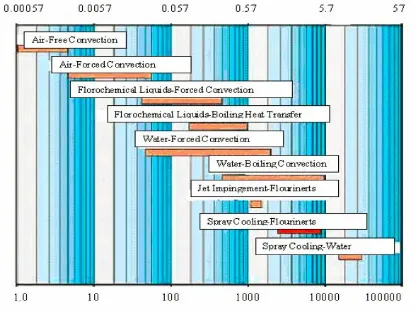
A comparison of the heat transfer coefficients for different cooling techniques is shown in Fig. 1.1. These techniques include free (natural) convection, forced convection, boiling convection, and jet and spray cooling using different working fluids. As can be seen in the figure, the highest values of heat transfer coefficients occur in spray cooling. The main advantage of spray cooling over jet cooling is that it more uniformly cools a large surface and removes larger amounts of heat, while in jet cooling the resulting surface temperature will be highly non-uniform (Mudawar, 2000).
gas-2
liquid interface becomes unstable to the point that the viscous forces do not dampen the instabilities. Eventually, the instability dominates the surface tension forces and disintegrates the liquid. This is referred to as secondary breakup. Beyond this point, that is, the region where disintegration happens, the spray can be said to be fully developed. Until that stage, the spray is called a free spray. If the spray strikes a plate, the process is called an impinging spray. At the fully developed spray stage, smaller droplets with higher total surface contact area can be achieved. As a result, higher heat transfer rates can be achieved. For this reason, the distance of the nozzle to the impingement point plays an important role in the heat transfer process.
Figure 1.1 Comparison of heat transfer coefficient for different cooling techniques (Website:
3
(a) (b)
Figure 1.2 Stages of spray formation and impact (a) spray formation and (b) spray breakup, impingement and film formation (Tropea, 2007)
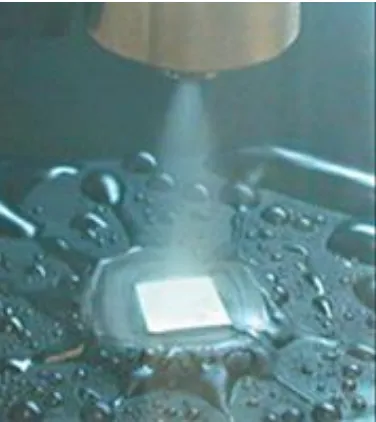
By introducing a plate at the end of the spray, different mechanisms of droplet impingement come into play, characterized by the impact energy. The possible outcomes of impingement are stick, spread, splash and rebound. The droplets that stick or spread, if the spreading area is small enough, form a continuous thin liquid film that has an important role in the cooling process. Figure 1.3 shows spray impingement on a heated surface accompanied with a fluid film.
Figure 1.3 Spray impinging on a heated surface (Website: www.valcompanies.com)
4
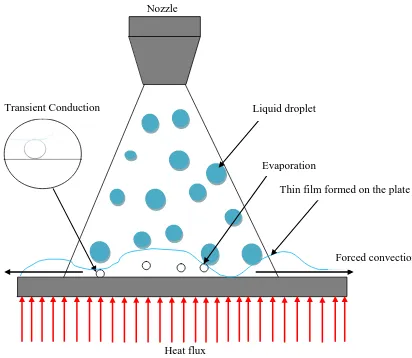
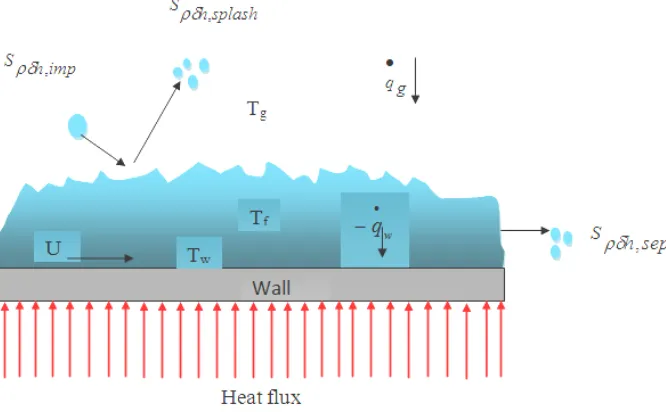
continually impinge and interact with the growing bubbles within the film, resulting in high heat removal through conduction, convection, and phase change. The spray cooling process is shown schematically in Fig. 1.4. Sprays can be either dilute or dense. A spray is considered dilute if the mass flux is less than 2 kg/m2s and dense if it has a mass flux of at least 8 kg/m2s (Deb and Yao, 1989).
Figure 1.4 Schematic illustration of spray cooling
One important aspect of spray cooling is the basic boiling phenomenon that occurs. Boiling is an efficient means of heat transport in which liquid is vaporized when the temperature of the liquid exceeds the saturation vapour pressure. Typically, in boiling, a large amount of heat can be removed at relatively low temperature difference. It is useful to first consider the boiling processes in the absence of an incoming spray. Boiling
Heat flux Nozzle
Transient Conduction Liquid droplet
5
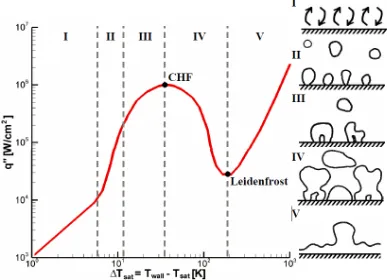
heat transfer is usually characterized by a boiling curve (Fig. 1.5) with various boiling regimes.
In the first regime (indicated as I in Fig. 1.5), free convection occurs when no vapour is generated because of low wall superheat and insufficient nucleation sites. This single-phase regime can be treated analytically or with correlations such as that provided by Churchill and Chu (1975). This regime ends when bubble generation begins. Even this simple regime is quite complicated in spray cooling because of the motion of the liquid film and the mixing caused by impinging droplets. The nucleate boiling regime (Regions II - III) begins once bubbles are generated, and is characterized by two sub-regimes. The first is the isolated bubble regime (Region II), where bubbles form at their own nucleation sites and depart without interacting with each other. Following this sub-regime, at higher wall superheat, the departure frequency is so large that the bubbles immediately begin to coalesce both horizontally and vertically. This is the regime of slugs and columns (Region III).
6
In the film-boiling regime, heat must be conducted across a continuous vapour film before it can be transferred to the liquid. This inefficient process can result in large heat fluxes, but the temperatures required are very high. The film-boiling regime is therefore not practical as a mean of cooling many devices.
Figure 1.5 Typical boiling curve and associated boiling regimes (Coursey, 2007)
1.2 Motivation
7
Computational modeling can be an effective analysis and design tool for spray equipment manufacturers and process engineers. Depending on the application, modeling can also be very complex, requiring accurate physical models to represent the effects of droplet momentum, layer thickness, gravity, surface tension, surface characteristics and phase change. These phenomena must often be simulated over a very diverse range of length scales, for hundreds or thousands of droplets, with diameters that are typically orders of magnitude smaller than the object being impacted.
Computational Fluid Dynamics (CFD) results for a wide variety of droplet sizes, velocities, heat fluxes and wall surface temperatures can be used to provide physical insight into the best ways to achieve maximum spray cooling heat transfer coefficients and avoid surface flooding as well as dry spotting. The task of combining the individual complex phenomena mentioned above together to successfully model the spray cooling is a great challenge.
Recently, a few numerical studies on spray cooling have been conducted. Selvam et al. (2005) presented the computer modeling of multiphase flow using the level set method to identify the interface between vapour and liquid. Guechi et al. (2012) developed a numerical model to predict the heat transfer with phase change between a hot plate surface and a two-phase impinging spray using FLUENT software. Even though these models are not an exact representation of the interaction between the spray and the liquid layer, they provide a good indication of how to improve the heat transfer.
Based on this discussion, it can be concluded that numerical modeling could be a valuable tool through which several aspects can be studied quickly and at minimum cost. The results also can help shed some light on the current understanding of spray cooling. Continuous advances in computing power and CFD methodologies have led to a widespread use of numerical methods to directly simulate interface transport mechanisms of multiphase flows. However, despite some progress, a full simulation investigating detailed behaviour of every small droplet remains computationally very expensive.
1.3 Objectives
8
objective of this work is to develop a better understanding of the hydrodynamics and heat transfer associated with the spray impact onto a heated surface.
In order to simulate the spray impinging on heated flat and curved surfaces, a model is developed herein and simulated using the commercial software STAR-CCM+. Based on previous research, as the droplets impinge onto a heated surface, a thin fluid layer is formed, and the best way to investigate spray cooling is to specify the existence of this thin layer and study the interaction between the layer and the impinging spray droplets.
To gain confidence in the numerical results, it is important to validate the results with proper experimental results. To test the model validity for the non-boiling spray cooling regime, some case studies were selected and the simulations results were compared with available experimental data of Karwa et al. (2007). Since the main concern in any cooling method is the heat flux and surface temperature, the heat transfer coefficient and temperature distribution on the hot surface are used for validation.
Once the CFD model was validated, a model of the Heinz spray cooling process is developed in STAR-CCM+. Based on the field measurements done at the plant, a simple model is presented to predict the temperature of tomato juice at the end of the production line.
The specific goals of this work include:
• To develop a CFD model that can be used to study the heat transfer mechanism during spray cooling in the non-boiling regime.
• To validate the computed results with the experimental data (Karwa et al., 2007) in order to gain confidence on the fidelity of the numerical approach.
• To investigate the sensitivity of the CFD model for different mesh sizes and turbulence models.
• To apply the CFD model to the real-world application of spray cooling of tomato juice cans.
1.4 Thesis Outline
9
10
Chapter 2. Literature Review
In this chapter, a review of the most relevant previous studies in the field of spray cooling is presented. Overall, there are a number of major spray parameters such as spray mass flux, spray volume flux, droplet number, droplet velocity and cone angle, which have the most significant effect on the cooling performance. In most cases, a liquid film is created as a result of droplet impingement. The liquid film behaviour is also an important factor in cooling efficiency. The spray cooling performance is usually gauged by the non-dimensional Nusselt (Nu) number which is directly proportional to the heat transfer coefficient.
An ideal cooling system should provide high heat removal rates uniformly over a large surface area with a high critical heat flux (CHF). Critical heat fluxdescribes the thermal limit of a phenomenon where a phase change occurs during heating which suddenly decreases the efficiency of heat transfer, thus causing localized overheating of the heating surface.
Toda (1972) found that subcooling had a minor effect on single-phase and nucleate boiling heat transfer and did not have a dominant effect on CHF. Monde (1980) observed that the nucleate boiling gradient in spray cooling is nearly half that of pool boiling. Toda (1972) and Monde (1980) both found that the cooling performance is enhanced in every cooling regime by increasing the spray volume flux. Mudawar and Valentine (1989) also showed that the volume flux had the most dominant effect on the CHF compared to other hydrodynamic properties of the spray.
Pautsch (2004) suggested that spray cooling has often been misrepresented by the term “spray evaporative cooling”. He points out that some spray cooling system designs rely very little on the evaporation of fluid to remove heat. Furthermore, he suggested that spray cooling designs with higher values of CHF have less evaporation than the designs with lower values of CHF. As a result, in order to show the difference between them, he proposed a new name if there is phase change, namely “spray cooling with phase change”.
11
the CHF increases with increasing flow rate and increasing subcooling. They also found that the CHF is greater for smaller drops due to greater surface tension. For full cone sprays, Sauter mean diameter (d32), the diameter of a drop that has the same volume per unit surface area as the entire spray, is dependent upon orifice diameter and the Weber and Reynolds numbers based on the orifice flow conditions before the liquid breakup.
The effect of spray characteristics for non-critical heat flux in subcooled water spray cooling was experimentally investigated by Chen et al. (2002). They defined three independent spray parameters: mean droplet velocity (V), mean spray droplet flux (N), and Sauter mean droplet diameter (d32). The effect of these parameters on the CHF was determined, utilizing extensive experimental data. They suggested that CHF varies proportional to V1/4 and N1/6, and is relatively independent of d32. The CHF and the heat transfer coefficient showed an increase when V increased. Increasing N also resulted in an increase in CHF and heat transfer coefficient when other parameters were kept in narrow ranges. According to their results, in order to increase the CHF for a given N, a dilute spray with large droplet velocity is more effective than a dense spray with low velocities.
Toda (1972), using water as a working fluid, found that the CHF increased approximately 50% as the mean droplet diameter increased from 88 to 120 microns. However, Pais et al. (1992) and Estes and Mudawar (1996) suggested that CHF could be increased by decreasing the droplet diameter. Sehmbey et al. (1995) argued that the smaller droplets can produce the same values of CHF at smaller flow rates as larger droplets at larger flow rates. According to research by Bostanci (2010), increasing flow rate beyond a certain level (the medium flow rate in their case) has a minimal effect on CHF.
Peterson (1970) found that heat fluxes as high as 15 MW/m2could be removed from a spray cooled surface. At surface temperature of 130ºC, heat fluxes in the order of
2.2 MW/m2were removed by sprays used by Bonacina et al. (1979). Bonacina et al. (1975) found that if the wall is fully wetted, the heat transfer rate is higher. According to Kim et al. (1997), larger film thickness produces lower heat transfer.
12
superheat. Using FC-72 as the working fluid, a 1 MW/m2heat flux was obtained by Estes and Mudawar (1996).
Pautsch and Shedd (2006) found that the most important and the least studied parameter of spray cooling is the thickness of the liquid film layer which exists on the heated surface. The values of the film thickness were 0 to 75 microns. They also explained that once the droplets hit the surface, they are swept off by the flow of subsequent droplets, the surface is continually wetted, and a thin liquid film forms. They explained different mechanisms of heat transfer in this film: conduction, convection, bubble nucleation, and gas bubbles entrained by impacting droplets. They concluded that each of these components contributes to the total heat removal process although their exact portion of contribution is unknown and almost all affect the film thickness.
Pais et al. (1992) point out that the heat is conducted from the surface through the thin liquid layer. They reported that a thinner film results in higher heat transfer due to the increased thermal gradient across the layer.
Toda (1972) explained how the liquid droplets impinge on the heated surface and spread over the surface, becoming fully wetted by a thin liquid film. Under the effect of the momentum added by the incoming droplets, the film moves and evolves along the surface. The new droplets arrive at a temperature lower than the film temperature near the surface. The droplets which impact the surface of the film become part of the film and their kinetic energy maintains the flow.
13
reported that the mechanisms by which the critical heat flux is triggered during spray cooling are currently unknown. Two mechanisms were suggested; homogenous nucleation within the film and lift-off of the thin liquid layer due to nucleation within the film. Kim (2007) mentioned that spray cooling is not expected to be affected by the heater orientation relative to the gravity vector or by low gravity conditions, due to the large momentum of the spray. Kim (2007) suggested that it is not possible to model the spray cooling process from first principles due to the enormous number of droplets. Kim concluded that further advances in understanding spray cooling will require the development and application of new experimental techniques.
The thickness of liquid films resulting from both a low flow rate single nozzle and a high flow rate four-nozzle array was measured by Pautsch and Shedd (2006) using FC-72 as the working fluid. A non-intrusive optical technique based on total internal reflection was used. The reflected light rings that formed on the test surface were photographed. An automated program measured and recorded the radii, from which the thickness of the film was calculated using the fundamental equations of geometric optics. It was found that for the four-nozzle array, the regions which had previously shown the poorest heat transfer performance were the ones which had the thickest film. While using the single-nozzle spray, it was found that adding a heat load did not affect the film thickness.
Spray cooling is also a well known technique in steel plate manufacturing. It is used to control the steel temperature and hence the steel properties. Arrays of nozzles are placed in multiple stages in the plate direction for spray cooling. Kim et al. (1997) pointed out that it was not clear if the spray cooling heat transfer was enhanced by the liquid film flow on the steel plates. They concluded that in the presence of the liquid film, the heat transfer rate directly below the spray centre decreased and this deficit increases as the film becomes thicker. They also found that spray cooling heat transfer which includes the film flow is significantly enhanced as the spray droplet flux increases.
14
Pautsch and Shedd (2005), the two-phase heat transfer mechanisms contribute the equivalent of 25-30% of the total single-nozzle spray cooling heat rate and only 10-20% of the total four-nozzle spray cooling heat rate. Furthermore, their models indicate that in spray cooling systems where a thin liquid film exists on the heated surface, heat removal is dominated by the single-phase energy transfer rather than the phase-change mechanisms.
A number of attempts have been made to measure the thickness of the film in spray cooling. Kalantari and Tropea (2007) extensively studied the influence of film thickness on spray/wall interaction and developed a new theoretical model for prediction of the average film thickness as a function of mean Reynolds number, flux density of the impacting droplets and the average drop diameter.
The other heat transfer mechanism, according to Rini et al. (2002) and Yang et al. (1996), is secondary nucleation. They postulated that the impacting droplets entrain vapour and/or gas into the liquid film, creating nucleation sites and causing boiling within the film.
Oliphant et al. (1998) experimentally investigated both spray and jet impingement cooling in the non-boiling regime. According to their experiment, the heat transfer is dependent on the spray mass flux and droplet velocity. In their experiment, the impingement surface temperature was maintained below the saturation temperature of the spray liquid. The combination of unsteady thermal boundary layer and evaporative cooling resulted in an increase of the average heat transfer for sprays compared with jets in the non-boiling regime. They concluded that spray cooling can provide the same amount of heat transfer as jet cooling at a significantly lower liquid mass flux. Moreover, spray cooling shows promise because of the large surface area that is formed when a liquid is atomized into droplets by the spray nozzle.
15
found that nozzle orientation has no effect on spray cooling performance, provided the cooling system does not promote liquid build-up on the hot surface.
Karwa et al. (2007) reported that for spray cooling at lower wall superheats, the heat transfer occurs primarily through single-phase convection. The rate of evaporation is higher when the surface temperature is closer to the saturation temperature of the fluid and a thin film is formed. As mentioned by Lin and Ponnappan (2003), at higher mass flux, a thicker liquid film causes reduction in the evaporation from the free surface of the liquid. Karwa et al. (2007) also concluded that the droplet impingement onto the liquid film not only provides enhanced mixing, but also increases the turbulence in the film and thus enhances the heat transfer rate.
The heat transfer distribution for an isothermal surface under a single nozzle spray was experimentally investigated by Zhao et al. (2010). Water was used as the working fluid and the spacing between the nozzle and the heater surface was varied from 3 to 7 mm. In their experiments, the temperature was kept below 100ºC. For a given nozzle-to-surface distance, the highest temperature occurred directly under the spray nozzle. They also reported that with the increase of the radius away from the centre of the surface, the temperature decreases at first, and then increases beyond a certain position. Hsieh et al. (2004) suggested that this phenomenon is due to the non-uniform droplet distribution and film parameters.
According to experiments of Zhao et al. (2010), as the spray height increases from a certain point, the average surface temperature increases. This, according to them, might suggest that the spray’s heat transfer performance has an optimized value within a certain range of the spray height.
16
Roisman and Tropea (2004) presented hydrodynamic models for two extreme cases: (a) a very sparse spray impact characterized by small relative crown presence, such that the effect of their interaction can be neglected; and (b) a very dense spray impact. The velocities of the secondary droplets produced by the crown splash in a sparse spray were described theoretically. The fluctuations in the motion of the liquid film created by a dense impacting spray were analyzed statistically. This motion yields the formation of finger-like jets. The characteristic size and velocity of the film fluctuations were estimated. They validated two theoretical models against the experimental data and obtained good agreement. This agreement indicates that the inertial effect associated with drop impacts is the dominant factor in formation of the uprising sheets, whereas the capillary forces influence the velocity of the secondary droplets. They showed that the velocity of secondary droplets produced by very dense diesel spray impact are of the same order as the value of estimated characteristic velocity of film fluctuations and the average diameter of these secondary droplets is of order of the characteristic length of fluctuations.
Most of the relevant numerical studies have focused on impingement of a single droplet on a dry surface or a pre-existing liquid film in order to study the spray cooling behaviour. As described by Moreira et al. (2010), the flow systems involving spray nozzles are usually very complex and the underlying physics requires fundamental studies, which are often performed on simplified flow geometries. Specifically, a lot of effort has been put into trying to represent and predict the outcome of the spray impingement by impinging individual droplets in both experimental and numerical studies. This is often done despite the known fact that a spray does not behave as a summation of individual droplets. In order to be able to include numerous droplets in the computational model, specific models which can provide an acceptable prediction of the fate of each impinging droplet is required.
17
model for the gas phase and a stochastic Lagrangian method for the spray. The results of the comparisons between the calculated results and the measurement data show generally reasonable agreement.
In a recent survey done by Selvam et al. (2005) regarding the computational modeling of spray cooling, it was concluded that the best way to model the spray cooling is to have the spray impinge on a pre-existing thin liquid film on a hot surface. They stated that this will help understand and improve the performance of spray cooling. As a result of their survey, they found that theoretical understanding of spray cooling is still in its infancy and a focused effort to develop a comprehensive numerical model is of prime importance to this field. They also reported that the liquid film thickness cannot exceed 2 mm. For spray cooling designed for high heat flux, the liquid film thickness on the hot surface is less than 200 microns. It was reported that numerical modeling of nucleate boiling of thin films has never been attempted before. According to Selvam et al. (2005), the spray cooling heat transfer mechanism is quite complicated and there are a lot of contradictions in the experimental results.
Numerical modeling of multiphase flow in spray cooling using the level set method was studied by Selvam et al. (2005). The model considers the effect of surface tension between liquid and vapour, gravity, phase change and viscosity. The computer model was used to study the spray cooling phenomenon in the micro-environment of about 40 μm thickness liquid layers with vapour bubbles growing due to nucleation and droplet impact. The effect of velocity and density ratio variations on heat transfer was investigated systematically for the case of droplet impact on vapour bubble. A new non-dimensional equation was suggested for the solution of the Navier-Stokes equation which is more stable than the one reported in Selvam et al. (2009). In their model, the fluid properties including density, viscosity and thermal conductivity are constant in each phase and the flow is assumed to be incompressible.
18
of mass and momentum as a function of key dimensionless parameters for the incident droplet.
Cole et al. (2005) presented a Lagrangian spray wall impingement model integrated into the Eulerian free surface (Volume of Fluid) module of the multi-physics computational code, CFD-ACE
+
. The coupling of the two modules enables the modeling of spray impingement and splashing, including the effects of a fluid film on the wall. They demonstrated a functional link between Lagrangian spray transport and Eulerian simulation of fluid dynamics with two distinct fluid phases. The former uses the free surface volume of fluid model to resolve individual droplets with diameters in range of 50-100 microns and evaluate mass, momentum, and energy transfer from the spray droplets to the film as a function of droplet Weber number and dimensionless layer thickness.
Kuhlmanet al.(2011) described a Monte-Carlo simulation of spray cooling that is based upon a time scale analysis of the various relevant physical processes. They presented the results from an initial implementation of the model. The model correctly predicts trends of increasing areas where boiling occurs and where dry out occurs as the heater power increases at a constant spray volume flow rate, and trends of dry out of the heater surface being initiated near the outer edge of the circular heater for FC-72 and HFE-7000. Due to the much larger values of surface tension, specific heat, and latent heat of water, none of the droplet impact craters are predicted to dry out for water at the assumed values of the spray flow rate and heater power. However, their model does not accurately predict the relationship between heater surface temperature and the heat transfer rate.
19
parameter which was studied was the spray mass flow rate. It was found that increasing the spray mass flow rate improves the heat transfer by increasing the momentum.
Meredith et al. (2011) developed a model for simulating water film transport over solid-fuel surfaces. The model was coupled to a gas-phase solver, solid boundary condition, and spray transport model implemented in OpenFOAM®, a computational toolkit along with essential source terms for inter-phase transport. They showed that the initial validation of the model is in good agreement with the Nusselt solution for continuous film flows over inclined surfaces. They also compared the film model with available experimental measurements for film thickness, velocity and mass flow rate.
Based on the literature survey, it is clear that there are a number of major spray parameters such as spray mass flux, spray height, droplet velocity and liquid film thickness which have the most significant effect on the cooling performance. Spray cooling is a very complex phenomenon involving several parameters and this makes it difficult to draw specific conclusions based on the correlations in the literature if they are obtained for systems of totally different parameters.
In some cases, there is no consensus on the effect of a specific parameter. For example, by increasing the spray height, heat transfer rate might increase or decrease. One could conclude that there is an optimized spray height which could boost the rate of heat transfer. Increasing the mass flux brings more momentum, more agitation to the liquid film and a thinner thermal boundary layer which eventually enhances the heat transfer rate. Depending on thickness, the liquid film could have a negative or positive impact on the heat transfer rate.
20
Chapter 3. Numerical Modeling
In this chapter, details of the numerical method and the computational tool used for the study of spray impingement and film formation are provided. Where necessary, the reasons for making specific assumption(s) in regards to the flow conditions or selecting a certain computational technique will be provided.
3.1 CFD Code Used in this Study
This section provides a brief description of the commercial CFD code selected for this research work and the limitations of the code for simulating two-phase conditions, as well as its limitation on connecting the Lagrangian phase to the Eulerian phase.
3.1.1 STAR-CCM+
STAR-CCM+ is the commercial CFD software employed in this research to perform spray impingement and cooling simulations. It is developed and licensed by CD-adapco to carry out three-dimensional modeling of fluid flow and heat transfer in complex geometries (STAR-CCM+, 2012). Although the code supports multiphase fluid simulations, it is most extensively used for single phase simulations. The code is built on client-server architecture and has parallel processing capabilities to optimize the computational time. The main feature of STAR-CCM+ compared to other solvers such as FLUENT and CFX is its integrated environment that allows one to perform multi-dimensional CAD modeling, state-of-the-art meshing (for example tetrahedral, polyhedral, hexahedral), model solving and post processing, all within the same software.
STAR-CCM+ supports unstructured meshing and incorporates two types of flow and energy modeling approaches, namely i) segregated approach, and ii) coupled approach. Segregated approach uses the SIMPLE (Semi-Implicit Pressure Linked Equation) algorithm to solve the conservation equations, whereas the coupled approach uses a time marching methodology (STAR-CCM+, 2012). A variety of turbulence models are supported including several variants of k (standard, realizable, RNG),
21
control over parameters such as solver iterations, tolerance values and relaxation factors to manage the progress of convergence.
STAR-CCM+ also supports user-defined field functions to implement methods that are not directly supported by the software. Field functions are single-line, C-syntax type statements that allow the manipulation of variables and other field functions to construct complex logical statements.
3.2 Introduction
Studying the spray interaction with the liquid film layer requires solving the flow and heat transfer equations for spray droplets, liquid film and the surrounding gas. Currently there are two approaches for the numerical calculation of multiphase flows: the Euler-Lagrange approach and the Euler-Euler approach. In the Euler-Euler approach, the different phases are treated mathematically as interpenetrating continua by introducing the concept of phase volume fraction. Conservation equations for each phase are derived to obtain a set of equations, which have similar structure for all phases. These equations are closed by providing constitutive relations that are generally obtained from empirical information. The Euler-Euler approach uses the notion of interfacial area concentration which is defined as the area of interfaces between two phases per unit mixture volume. This approach allows for heat and mass transfer between phases but does not seek to determine the properties of each particle present in the flow. Rather, it calculates local properties of the multiphase flow.
22
impingement of droplets on the solid surface, resulting liquid film transportation and heat and possible disintegration of film into drops.
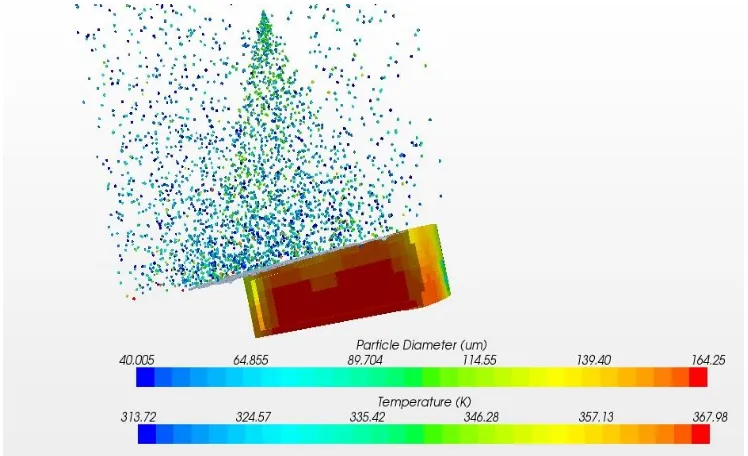
The code enables one to model the spray particles individually or in representative parcels using a Lagrangian reference frame, and account for the fluid layer using an Eulerian framework. In this approach, the mass, momentum, and energy of a spray parcel that enters a liquid region (numerical control volume) may be transferred to the liquid in that control volume. The mass, momentum, and energy are subsequently tracked on a control volume basis in the Eulerian framework. Whether the spray parcel is absorbed in the liquid-filled cell depends on parameters such as the cell Weber number and the droplet velocity. If a spray parcel penetrates all the way to a solid wall, its mass, momentum and energy interaction are modeled based on correlations of Bai et al. (2002). At low Weber numbers, the droplet will stick to the wall and contribute to any liquid film. At the other extreme, i.e. for higher Weber numbers, the droplet will splash and eject secondary droplets that may have significantly more mass than the original droplet. In the current model implementation, only a single secondary parcel is generated in response to an incident parcel hitting a wall under splashing conditions. Results of a sample simulation using the coupled Lagrangian- Eulerian approach are shown in Fig. 3.1, where part (a) shows the droplets of different sizes (coloured by different colors) at the moment of impact with the solid surface. In Fig. 3.1(b), the solid surface is coloured by contours of the liquid film thickness which, is non-zero (wetted) in the non-blue areas as the liquid film starts to trickle down the solid cylinder’s side faces.
The main topics covered in this chapter include: the governing equations for Computational Fluid Dynamics (CFD) modeling, description of the CFD code employed in this research to perform spray cooling simulations, and its limitations for tackling the problem at hand.
3.3 Droplet Interaction with the Wall
23
regimes are determined by the parameters describing the pre-impingement droplets, the wall surface conditions and the surrounding gas characteristics in a near-wall region. Of particular interest in identifying impingement regimes is the wall temperature, as stated by Bai and Gosman (1995).
(a) (b)
Figure 3.1 Three-dimensional simulation of spray-liquid film interaction (a) Model domain and
Lagrangian spray parcel distribution at the impact with the wall (b) Impacted, splashed, stuck and
rebounded Lagrangian spray parcels and the evolving liquid film contours after 10 milliseconds.
The Bai-Gosman wall impingement model is a wall impingement feature formulated within the framework of the Lagrangian approach, based on the experimental results and mass, momentum and energy conservation constraints. To reflect the stochastic nature of the impingement process, a procedure is adopted to determine how and when droplets break up or stick to the wall. This model is used with impermeable boundaries (wall, contact and baffle) as well as with fluid film. This allows secondary droplets resulting from a primary droplet splash to have a distribution of sizes and velocities. For fluid film boundaries, momentum and kinetic energy lost by the droplets are gained by the film.
24
film thickness, and fluid properties such as viscosity and surface tension. The following are the possible outcomes of droplets impacting the wall:
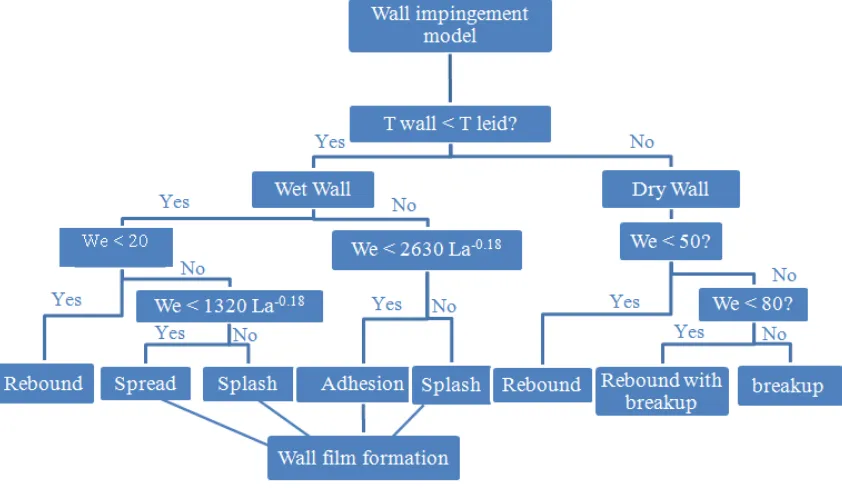
Adhesion (or Stick): The impinging droplet adheres to the wall in a nearly spherical form. This regime occurs when the impingement energy is extremely low. A droplet is assumed to coalesce completely with local film. The transition criterion for this regime is We < 20.
Rebound: The impinging droplet bounces back from the wall after impact. In this regime, the rebound droplet velocity magnitude and direction need to be determined.
Spread: The droplet impacts on a wetted wall and spreads out and forms a wall film.
Splash: After the collision of a droplet on a wall, the droplet transforms as a crown shape, then a part of the droplet further breaks up and is ejected as small droplets, while the rest is adhered to the wall. In this regime, many quantities need to be calculated in order to describe the splashing process. These quantities include the proportion of incident droplet mass deposited as part of the liquid film and the sizes, velocities and splashing angles of secondary droplets are based on their experimental. They can be represented by the following two non-dimensional characteristic numbers:
i) Droplet Weber number
The Weber number represents the ratio of droplet kinetic energy to surface tension, defined as:
2
d U d D
We (3.1)
where Ud is the droplet normal component of impinging velocity, Dd is the droplet
diameter and σis thesurface tension coefficient for the liquid.
ii) Droplet Laplace number
25 2 f d D La
(3.2)
where µf is the droplet dynamic viscosity.
Due to the limitations of current understanding of the mechanisms involved in the thin liquid sheet breakup mechanism of injectors, no reliable atomization model is yet available for them and it is outside the scope of this study to attempt development of such a model.
Droplet aerodynamic breakup and collision/coalescence are accounted for in the Bai-Gosman wall impingement model which was considered for the impingement spray. It is either assumed that the droplets in the spray have the same size as the Sauter mean diameter, or they have a non-uniform size distribution as suggested by Rosin and Rammler (1933) with the SMD as the mean of the distribution. The Rosin-Rammler distribution was developed to describe the volume distribution of particles as a function of their diameter, FV(Dp) . In STAR-CCM+, it is extended to be a generic size distribution, with the cumulative distribution function
q D e D F ) ( 1 ) (
(3.3)
in which the exponent q is a user-defined parameter, which is set to 1.5 by default and the reference size χ is defined as
q d D / 1 ) 10 ln 3 ( (3.4)
This form identifies the Rosin-Rammler distribution as a Weibull distribution. As noted above, the Rosin-Rammler distribution may be a cumulative mass, volume or number distribution, depending on the injector’s flow rate specification. A good option for determining the droplet diameter is to use the deterministic diameter, namely the average of size distribution, given by
q
D 1 1 (3.5)
26
During the spray penetration, there is a drag force exerted on the droplets from the surrounding gases, which tends to decrease the relative velocity between the drop and the gas flow. From Newton's Second Law, the deceleration of the droplet is calculated using the following equation:
f m d d C f u g u f u g u g dt f du 4 2 * 2
1
(3.6)
where ρg is density of the gas, ug is velocity of the gas uf is velocity of the droplet, Cd is
drag coefficient of the droplet, d is the droplet diameter, mf isdroplet mass. In the above
equations, subscripts g and f refer to gas and liquid, respectively. The droplet mass is calculated by: 3 3 4 d
mf f (3.7) The Liu dynamic drag coefficientis intended to account for the dependence of the drag of a liquid droplet on its distortion under the action of aerodynamic forces. As a basis, it uses the following expression for the drag coefficient of an undistorted sphere. The drag coefficient is given by the following equation:
1000 Re 424 . 0 1000 Re ) Re 6 1 1 ( Re 24 3 2 , p p sphere d
C (3.8)
If the wall temperature increases to the so-called Leidenfrost temperature, which is higher than the boiling temperature, the existent liquid on the wall evaporates immediately and, under the thermal radiation and conduction across the thin layer, the incoming droplets start evaporating before they reach the wall. As the result, there is a vapor film between the incoming droplets and the hot surface, and the wall surface will be dry. The impingement regimes can be summarized in Fig. 3.2.
3.4 Governing Equations
27
and energy. In the spray cooling process liquid droplets, known as the dispersed phase, interact with a gaseous or liquid continuous phase. In STAR-CCM+, the Lagrangian multiphase tracking approach is designed for this purpose. This model permits solving an arbitrary number of dispersed phases, each modeled in a Lagrangian framework, in which particle-like elements known as parcelsare followed through the continuum. The flow of material particles is governed by the momentum conservation equation. An energy conservation equation may also be solved, including convective heat transfer.
Figure 3.2Spray-wall impingement regimes based on Bai-Gosman model, Bai et al. (2002)
Specific models for liquid droplets in a gaseous medium include a mass conservation equation to account for the change in droplet mass due to evaporation or condensation and models for secondary breakup. The interaction between particles and boundaries is defined by boundary conditions. Particle behaviour at impermeable boundaries, in particular, requires modeling depending on the active models.
28
Parcels introduced into a turbulent carrier flow will each have their own random path due to interaction with the fluctuating turbulent velocity field. A turbulent dispersion model is provided to account for this phenomenon.
A few other relevant equations are also required to appropriately describe the fluid flow and heat transfer that includes, among others, the turbulence models and near-wall treatment. Brief descriptions of the three-dimensional modeling equations derived by considering a finite control volume element are provided in the following sections. Many of these equations can be found in the STAR-CCM+ User’s Manual (STAR-CCM+, 2012).
3.4.1 Conservation of Mass
The time rate of change of mass in a control volume is balanced by the net mass flow into the control volume and the generation of the mass within the control volume. In the limit, as the control volume shrinks to a point, one obtains
( )0
j j x
u
t
(3.9)
This is the expression of conservation of mass for a compressible fluid. The first term represents the rate of change of density with time. The second term represents the gradient of mass change along the three spatial coordinate directions. This equation is also the differential form of the continuity equation. In this study, fluid is considered to be incompressible (i.e., fluid density is constant). For incompressible fluids with no source, equation (3.9) simplifies to:
0
j j x u
(3.10)
In these equations, is fluid density, t is time, xj are spatial coordinates i.e., x, y, z coordinates, uj are the fluid velocity components along the spatial coordinate
29
3.4.2 Momentum Balance for a Material Particle
There are different forces acting on the particles identified separately as surface forces and body forces. Forces that act on the surface of the particles can be presented as the drag force and pressure force. The only body force in our case is gravity.
The momentum transfer to the particle from the continuous phase is due to forces that act on the surface of the particle. If the two-way coupling model is active, this is accumulated over all the parcels and applied in the continuous phase momentum equation. The pressure force comes from the gradient of the static pressure in the continuous phase. The drag force is a result of the different velocity between the air and the particles.
3.4.2.1
Conservation of Momentum
The three-dimensional conservation of momentum equations in the spatial directions is given in equation (3.11). The equations are derived by setting the rate of change of the momentum in a particular component direction equal to the net force acting on the element in that direction (due to the surface stress) plus the gravitational and external forces. i i j ij j j j i i F g x x p x u u t u ( ) ( ) (3.11)
where p is pressure, ij is shear stress, and gi is gravitational acceleration and Fi
represents the external body force. ij is expressed as
i j j i ij i i ij x u x u x
u
3 2
(3.12)
where ij is Kronecker delta function.
30
development, is applicable only to flows at low Reynolds number with simple flow geometries.
As an alternative, time-averaged equations such as the Reynolds-Averaged Navier-Stokes equations (RANS) are used in practical CFD applications when modeling turbulent flows. The main assumption in this approach is to decompose the transient velocity into a mean and turbulent fluctuating part and solve the resulting simplified equations. As a result of this decomposition, a new set of unknowns, called Reynolds stresses, arise in the model, which are related to turbulent viscosity. The decomposition of velocity is
uiUi ui (3.13) where Ui is the meanvelocity and ui is the turbulent fluctuating velocity.
The resulting simplified RANS equations for an incompressible flow under steady state conditions are
j ij j j i i k i k x R x x U x p x U U 2
(3.14)
i j j i t ij j i ij x u x u k u u
R
3 2
(3.15)
where t is the turbulent viscosity and Rij is Reynolds shear stress.
Turbulence models are used to evaluate turbulent viscosity. There are several methods available for turbulence modeling, such as (i) linear eddy-viscosity models, including one-equation models (Spalart-Allmaras, Baldwin-Barth) and two equation models (k ,k), (ii) nonlinear eddy-viscosity models, (iii) Reynolds Stress Model (RSM), and (iv) Large Eddy Simulation models. The linear eddy-viscosity models, mainly the two-equation models, are mostly used for practical engineering applications. In this research, the CFD model was evaluated with several formulations of k and