Improved Color Satellite Image segmentation
Using Cuckoo Search Algorithm
S.Vennila1, A.Venkatesan 2
PG Scholar, Dept. of CSE., Ganadipathy Tulsi’s Jain Engineering College, Vellore, Tamil Nadu, India.
Assistant Professor, Dept. of CSE., Ganadipathy Tulsi’s Jain Engineering College, Vellore,
Tamil Nadu, India.
ABSTRACT: The project is to improve the segmentation of the color satellite images. In this proposed method the color satellite image can be segmented by using Tsallis entropy and Granular computing methods with the help of Cuckoo search algorithm. The Tsallis and Granular computing methods will used to find the maximum possibility of threshold limits and the Cuckoo search will find the optimized threshold values based on threshold limit. The feasibility of the proposed Cuckoo search and Tsallis entropy based approach was tested on different satellite images and bench marked with differential evolution and solving the multilevel colored image thresholding problems. The multilevel thresholding will be used for the segmentation of color satellite images. By using these Cuckoo search algorithm experimental results will help to select the optimized threshold values for multilevel thresholding effectively and properly.
KEYWORDS: Cuckoo Search, Segmentation, Tsallis, Granular computing, Optimize.
I. INTRODUCTION
The splitting of image in to various parts is called image segmentation. The segmentation used to make the image to be understandable. The image segmentation is used to find the object and the background of an image by the help of boundaries like line, curve etc [1].
The thresholding is basic segmentation technique of images. Basically image object and background is differentiating by single value of threshold. The color image can be threshold based on their RGB values of an image. While distinguish an image into various different regions based on various threshold limits is called multilevel thresholding.
The image is differentiated by the single limit T and if gray value is greater than T is considered to be an object else other gray value are considered to be background. The basic technique is not given the good result when coming to images of remote sensing because of this there will be essential of multilevel thresholding [2]. The non-extensive entropy of image segmentation the thresholding technique used on various kinds of gray scale images. The optimization algorithm had given the better threshold value by using Bacterial foraging algorithm [1]. The Bacterial foraging algorithm was used Tsallis objective function for the multilevel thresholding and they had associated with GA and PSO [4] methods and it got better result and converges faster than the PSO and GA methods.
In the granular computing for the segmentation it has the following processes to achieve the thresholding [4]. The granules are characterized with RGB values and it should combine the 2 granules to get larger granule and finally, establish by the U operation on granules to get threshold t of granules.
The main objective of this paper is follows, the satellite images are captured by satellite (Remote sensing) from the space. The capturing the images by the use of the remote sensing devices (machines) that faces many problems in the resolution of the images.
Those problems are follows
Many satellite images have been affected by the shadows of the cloud in the sky. The whether condition and light have big changes over the satellite images.
Objects are blocked by trees and shadows surrounding object with similar colors i.e., roof tops. These conditions can make the objects predictability impossible [1].
Based on the above details explanation the existing algorithms the image segmentation color images using multilevel thresholding approach that are a critical and challenging task and it takes huge number of line coding to done the segmentation and in multilevel thresholding has some problem when the level increases that will produce the good result and because of more levels in thresholding have also increased the computational cost higher and moreover the time of computational also increased.
In this proposed method improve the segmentation based on Tsallis entropy and granular computing methods with the help of CS optimization algorithm and the paper [6] have proved that the CS is the best optimization algorithm when compared to the others.
The rest of the paper is organized as follows, section 2 will be explain about the concepts that are used in this algorithm, section 3 will be the proposed work, section 4 contains the experimental results and in section 5 will be the conclusion.
II. OVERVIEW
In this section contains the explanation of the various methods that are used in the segmentation of the color satellite image.
A. Image Segmentation:
Image segmentation is the process of partitioning a digital image into multiple segments (set of pixels, also known as super-pixels). The goal of segmentation is to simplify and/or change the representation of an image into something that is more meaningful and easier to analyze.
Image Segmentation is a process where the image is partitioned into several segments. The main objective of segmentation is to change the representation, so that the analysis becomes easier. This process is typically used to find the objects and its boundaries or edges.
Image segmentation is very fundamental and critical task in image processing and pattern recognition. Segmentation is a technique of dividing an image into a set of distinct classes whose characteristics such as intensity, color, texture, etc. are similar.
Image segmentation can be carried out using different methods. There are two categories in image segmentation partitioning, first category is to divide the image based on its intensity levels, second is to divide the image into regions which are similar. Region growing, thresholding and region splitting & merging use the second method. Computational speed and simplicity of implementation have made image thresholding an important concept in the applications of image segmentation. It is required in many image processing applications. For example optical character recognition, automatic target recognition ,medical imaging etc[14].
B. Multilevel Thresholding:
threshold. In local threshold the value is given to each pixel whereas in global threshold a single threshold value is given for the entire image. Computational efforts in Tsallis entropy can be reduced by intelligent optimization methods such as bacterial foraging algorithms, neural networks, and swarm algorithms.
Thresholding is the simplest method of image segmentation. From a grayscale image thesholding can be used to create binary images. Pixel having a gray tone larger than the threshold value become white and Pixel having lower value become black. And within the threshold value the color will not changed. Common image thresholding algorithms include histogram and multilevel thresholding.
This paper presents the multilevel thresholding based color image segmentation, which is important in image analysis and in understanding pattern recognition and computer vision field. The method is based on segmentation of subsets of bands using multi thresholding, followed by the fusion of resulting segmentation channels. For color images, the band subsets are chosen as the RGB pairs, whose two-dimensional histograms are processed via a peak-picking algorithm to effect multilevel thresholding[6].
Multilevel thresholding has been used widely as a tool to segment gray level images, but a limited amount of work has been published on multilevel thresholding of color images. In gray level images, multilevel thresholding is relatively straight forward and realized by some peak-picking or valley-searching algorithm on the histogram.
III. FUNDAMENTAL CONCEPTS
A. Tsallis Entropy:
The entropy is the measure the states logarithmically with significant probability of being occupied. The Tsallis entropy is also called non-extensive entropy. The advantage of the Tsallis entropy method is the use of global property and objective property of the images.
And (1)
L -gray level between { }.
pixels in gray level i and it should in . N is total number of pixels in a given image.
Pi is probability valuation.
Thresholding for multilevel using Tsallis define blow.
(2)
In physics ,the Tsallis entropy is a generalization of the standard Boltzmann-Gibbs entropy. It was introduced in 1998 by constantiono Tsallis as a basis for generalizing the standard statistical mechanisms, and is identical in form to Havrda-Charvat structural α–entropy within information theory.
Where, (3)
In the above formula, t1, t2... tM are threshold levels and it should be in t1 <t2 <t3...< tM.
B. Granular Computing (GrC):
given by user and the values contains in a granule are appear based on the probability of the pixels in the granule[1, 12].
Rough entropy(l)=e/2[obj_roughness(l)loge(obj_roughness(l))+ back roughness (l) loge(back roughness(l))]; Topt=argmax(Rough entropy(l)); (4)
C. Cuckoo Search Algorithm:
It is an optimization algorithm and it has been process same as cuckoo. The Cuckoo Search algorithm can find the new solution is attempted to be examine over the previously founded finest results [2,5,6].
There are 3 steps as follows.
Each cuckoo lays one egg (a potential solution) at one time and dumps it in a randomly chosen nest. The finest nest contains the great quality of eggs.
The probability of finding destination nest by destination bird pa is belongs to [0,1].
CS is a meta heuristic algorithm developed by Yang and Deb, inspired by aggressive reproduction of cuckoo species with of Lévy flight behavior. The female cuckoo lays her fertilized eggs in nests of other host birds. In this way, the host birds unwittingly raise her brood. If a cuckoo’s egg in a nest of a host bird is discovered, the host bird will throw it out or abandon her nest and start her own brood elsewhere. In the CS algorithm, each egg of host birds in a nest represents a solution, and a cuckoo egg represents a new solution. If a new solution is better than the one in the nest, the worse one will be replaced. To formulate in terms of mathematics, given only one egg (solution) in each nest, and generation of new solution is followed a law of Lévy flight, since Yang and Deb discovered that random-walk style search is better performed by Lévy flight rather than simple random walk.
Cuckoo Search(CS) uses the following representations: Each egg in a nest represents a solution, and a cuckoo egg represents a new solution.
IV. PROPOSEDALGORITHM
In this algorithm the thresholding of multilevel is using for the color satellite image segment and for the
optimization purpose the optimization algorithm called cuckoo search (CS) is used to discover the optimized thresholded values of the color satellite images that is supported by non extensive entropy that is called Tsallis entropy and another supporting method called granular computing. The both the tsallis entropy and granular computing are combine and used to find the maximum possible levels of the thresholding for an image. Finally in experimental section, I have compare the quality between original image and result image by using following matrices MSE, PSNR, SSIM, NCC.Cuckoo search (CS) algorithm is a nature-inspired search algorithm, in which all the individuals have identical search behaviors. However, this simple homogeneous search behavior is not always optimal to find the potential solution to a special problem, and it may trap the individuals into local regions leading to premature convergence. To overcome the drawback, this paper presents a new variant of CS algorithm with non homogeneous search strategies based on quantum mechanism to enhance search ability of the classical CS algorithm.
Cuckoo birds are most popular because of their attractive voice and fascinating style; moreover, their reproduction policy is also one of the most aggressive among the birds. Cuckoo scan engage indirect conflict with the host birds. Usually, host birds either through the alien eggs from the nest or they leave the nest to make a new nest.
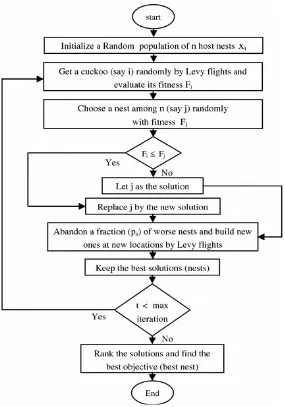
In the below Figure 1 described has below in the steps,
Find the initial population of host nests n and select the suitable value for the probability parameter. Select the lower and upper bound of the search domain based on the constraints.
Latch the random initial solution based on calculating Tsallis function as described in above formula-1 and acquire the finest nest based on the constraint given in an above equations.
If stopping criteria is not satisfied then do the cuckoo randomly by levy flight and find the quality fitness function f.
Hold the best solution and find the current nest by ranking. Finally, based on the best nests find the optimal threshold values.
Figure 1. Flowchart of Cuckoo Search Algorithm
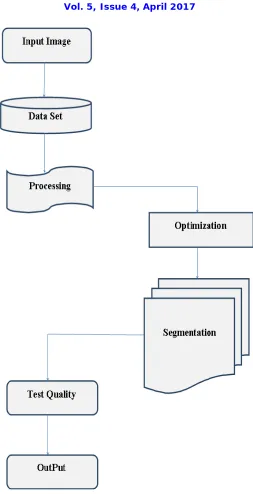
V. SYSTEM DESIGN
Figure 2 . System Architecture
VI. RESULT ANALYSIS
Figure 3 . In the above Figures (A1-A3) are original satellite images and Figures (B1-B3) are their equivalent histograms
The Figure 3 shows, the original satellite images and their equivalent histograms. Based on the threshold values the original images were frequently changed. Which gives the satellite images are properly and clearly viewed. By using optimized threshold values the output will get efficiently.
VII. CONCLUSION
In this proposed method the color satellite image segmentation has achieved the good results by the help of cuckoo
search and that have supported by Tsallis entropy and Granular computing and because of this new algorithm the result have got the very optimized threshold values because of this optimized threshold values the execution time and computational cost have reduced to very lower and the segmentation of color satellite image have done effectively when compare to the previous algorithms.REFERENCES
1. P.D.sathya and R.kayalvizhi.,”Optimum Multilevel image thresholding based on tsallis entropy method with bacterial foraging algorithm”.
2. Hassan Id Ben Idder and Nabil Laachfoubi.,”Unsupervised Multilevel thresholding method for weather satellite cloud segmentation”.
3. Ashish kumar bhandari, Vineet kumar singh, Anil kumar, Girish kumar singh.,”Cuckoo search algorithm and wind driven optimization based
study of satellite image segmentation for multilevel thresholding using kapur’s entropy”.
4. Hongbing Liu, Lei Li and Chang an Wu.,”Color image segmentation algorithms based on Granular Computing clustering”.
5. Agrawal.S, Panda.R, Bhuyan.S & Panigrahi.B.K.,”Tsallis entropy based optimal multilevel thresholding using cuckoo search algorithm, Swarm
and Evolutionary Computation”, 2013.
6. Bhandari.A.K ,Kumar.A ,Singh.G.K ,”Tsallis entropy based multilevel thresholding for colored satellite image segmentation using
evolutionary algorithms”, 2015.
7. Ali.M.,Siarry,P.,& Pant,M.,”An efficient differential evolution based algorithm for solving multi objective optimization problems”, 2012.
8. Bhandari.A.K, Kumar,A., Singh,G.K., & Soni,V.,”Performance study of evolutionary algorithm for different wavelet filters for satellite image
denoising using sub band adaptive threshold”, 2015.
9. Bhandari,A.K, Soni,V, Kumar,A,& Singh,G.K.,”Cuckoo search algorithm based satellite image contrast and brightness enhancement using
DWT–SVD”, 2014.
10. Manikandan,S.,Ramar,K.,Willjuice,I.M.,&Srinivasagan,K.G., ”Multilevel thresholding for segmentation of medical brain images using real
11. Oliva,D., Cuevas,E., Pajares,G., Zaldivar,D., & Perez-Cisneros,M.,”Multilevel thresholding segmentation based on harmony search optimization”, 2013.
12. Patra,S., Gautam,R., & Singla,A.,”A novel context sensitive multilevel thresholding for image segmentation”, 2014.
13. Hammouche,K., Diaf,M., & Siarry,P.,”A multilevel automatic thresholding method based on a genetic algorithm for fast image
segmentation”,2008.
14. Hamdaoui,F., Sakly,A., and Mtibaa,A.,”An Efficient multilevel thresholding method for image segmentation based on the hybridization of
modified PSO and Otsu’s method”, 2015.
15. Ngaam J. Cheung, Xue-Ming Ding, and Hong-Bin Shen., “A Nonhomogeneous Cuckoo Search Algorithm Based on Quantum Mechanism for
Real Parameter Optimization”, 2016.
BIOGRAPHY
Vennila.Sis a PG Scholar in the Computer Science Department, Ganadipathy Tulsi’s Jain Engineering
College., Vellore. She received a B.Tech (IT) degree in 2015 from under Anna University, Ganadipathy Tulsi’s Jain Engineering College., Vellore. Her research interests are Granular Computing, Computer Networks, Neural Networks, Cloud Computing etc.
VENKATESAN.A is a Assistant Professor in the Computer Science Department, Ganadipathy Tulsi’s Jain