Dynamic Trajectory Mechanism for Node
Localization in Wireless Sensor Networks (WSN)
Manpreet Kaur¹, Er. Abhilasha ²
Student, Dept. of Computer Science Engineering, GZS PTU campus, Bathinda, Punjab, India1
Professor, Dept. of Computer Science Engineering, GZS PTU campus, Bathinda, Punjab, India 2
ABSTRACT: In wireless sensor network, abundant of wireless nodes exists which localize themselves in order to remain in each other’s range to send information to base station. In many applications these nodes are deployed in hostile environment, therefore finding locations of these nodes becomes a worth mentioning issue. Better localization will augment the energy efficiency in the network. However fixed path mechanism followed using distance based technique consumes more energy and has more overhead. To solve this issue, dynamic trajectory based method using multilateration technique is proposed which can increase the lifetime of the network. We have implemented the dynamic based method and compared with the existing fixed trajectory method. The comparative results revealed that proposed technique performs better in terms of energy, localization time and overhead.
KEYWORDS: Wireless Sensor Networks, Localization Algorithms, Anchor nodes
I. INTRODUCTION
Due to the extension in recent communication technologies, it has been feasible to utilize sensor networks of wireless sensors for various monitoring and control applications as it could measure several properties like temperature, light, acoustics, and pollution [1]. The foremost application scenarios comprises of disaster aid applications such as in recognition of wildfire or forest fire, control in the environment like revealing of chemical pollution, earth movements , habitat inspection, intellectual buildings as in HVAC systems have power of optimizing energy consumption, assessment of stress levels mechanically[10] in building structures, management of facility such as in tracking the people , checking the
leakage of chemicals in chemical plants, and in protective preservation of machines, health care and medicine .
A sensor node is small and low battery device with special computation and communication tendencies. In a localization problem in WSN, two groups of sensors are there:
Anchor nodes or Beacon nodes: The nodes of the network with known positions are called anchor nodes. Non-anchor nodes: The nodes of the network which are to be localized are called non anchor node
The WSNs could be produced at a generally of low price and can be placed in a different ways of settings. Localization is a major issue for WSN applications. Initially all the sensors are being deployed in random manner, or they move in the area even after deployment. The location of sensor will be useful for the development of energy efficient routing protocols. Information of the position is really indispensable in numerous location-known sensor network communiqué protocols generally known as packet routing and sensing coverage [2].
II. RELATED WORK
The node localization in WSN is actually technology attracting large number of researchers’ interest. Due to the limited resources of network sensors and their high failure rate, countless problems are prevailing in the detection of the sensor node’s location. The main application parameters such as scalability, energy efficiency, cost,
Overhead and time of computation have an wide impact on the research as well as expansion of sensor localization systems. We briefly illustrate different strategies related to our work.
M.S. Aruna (2015) et al proposed the modified ‘z’ based trajectory. Focus was given on the sensor node that follows the fixed ‘z’ trajectory .The beacon node always moves in ‘z’ path to lessen the energy consumed of the beacon node. Execution of path mechanism was performed with the help of network simulator (NS2) [14].
Gabriele Oliva (2015) has performed study on distance-based network localization which would generate solution if the network is globally firm. At the last, shadow edges are produced to form the fact that chosen nodes are not capable to sense each other in the network [15]. Werb and Lanzl [5] have proposed the Pinpoint’s 3D-iD structure to position the small devices and asset the indoors.
Harter [6] is known to develop the Bat location system that comprises of a group of nodes at fixed points properly arranged in a grid.
Hightower et al. have produced the Spot ON tags to locate the location in indoor sensing on the basis of the strength of the signal received. further used in localization to predict the distance from the strength of the signal. Priyantha et al. [8] is known to develop the Cricket localization system in indoor activities with fixed number of beacons which distributes local information to the nodes of the listener to incline the accuracy of distance estimation. Bulusu et al. worked on single hop and range free scheme in which radio connectivity is used to group anchor nodes for estimation of coordinates. [9]. The coordinates of the non-anchor nodes are received by the calculation of the centroid of all the available anchors in the nodes of radio-range.
The Amorphous Positioning algorithm has shed the lights on the uses of offline hop-distance calculations like the DV Hop which helps in improving the location estimates via a neighbor’s information exchange.
Savides et al. [11] are known to introduce the N-Hop multilateration technique together with the use of the bounding box method for position computation to avoid the error accumulated in the sensor network which ultimately helps in improving the accuracy too.
Xin Tan(2015) has performed the research that the wireless sensor networks can facilitate the monitoring in real time as in pipeline environments which can assist important applications like as structure recognition and fault analysis. The magnetic induction (MI)-based techniques gives
efficient and most reliable wireless communications in sensor nodes in most challenging environments. This particular paper proposes a localization strategy for MI-based wireless sensor network to face the complexity in the pipeline environment without needing any extra infrastructure [16].
M. R. Ghafouri Fard(2015) found the location of the object which had become very popular in recent years. Various monitoring and control strategies are brought to use in industrial and commercial applications which are discussed in this paper. Researchers usually use wireless networks or GSM cellular data to estimate the location of an object or a wireless node by using the given reference point. This paper provides a newly line of sight technique for passive localization which is based on transmitting multi frequency antenna collection and a receiver [17].
IV. PROPOSED WORK
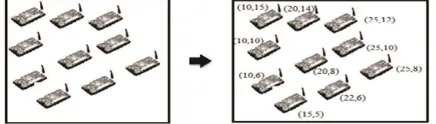
The existing work uses the concept of fixed path trajectory. Whereas in proposed work, dynamic trajectory is followed in which multilateration technique is used. Actually lateration is a method of detecting the location of nodes whose position is totally unknown on the basis of the precise measurements to three non collinear anchors.
intermediate node. But still in that case the ‘z’ trajectory is followed. So in current research dynamic way of localization is better approach as it needs less energy and time in multiple communication of the wireless sensor nodes.
ALGORITHM
Step1 Build a scenario of the wireless sensor network by placing N sensor nodes randomly in the sensor field and having same initial energy.
Step2. Place four beacon nodes at all the four corners of sensor field. These nodes will collect the total information about the locations of all sensor nodes.
Step3. Evaluate the position of the sensor node close to the beacon node by applying distance calculation formula as follows:
(i): D = √ (x1-0)² + (y1-0)²
Where (0,0) are the coordinates of the origin and (x1,y1)are the coordinates of the unknown node near to the beacon node.
(ii) Now calculate inter distance between the nodes itself as follows:
Input: Four beacon nodes and group of sensor nodes nodes Sn where n=1,2,3,….N
Output: Distance ‘d’ between sensor node and beacon node
1.Initially generate the total number of concentric circles within the range of the signals.
2. Firstly transmit the beacon message with time t1
3.Calculate the time of received beacon message t2
4. Estimate difference in time T T = t1 – t2
5.The propagation speed of the signal is
S = 3× 10^8m/s
6.Calculate the distance estimated (dest) = T×S
7.Calculate the actual distance (dact) on the basis of radius of ‘k’number of circles generated
8.Find the error Error = dact − dest
9.Now the actual distance could be found dact = dest + Error
10.Repeat the above steps for the rest of the nodes
Step4 Now apply the trilateration technique as explained above to know the position of other sensor nodes with respect to three known reference points as follows:
Step5 Repeat the process for rest of the nodes. When more then three nodes are available, then the method is called multilateration.
Step6 Now dynamically identifies the trajectory of the wireless sensor nodes through which data is to be sent to the beacon (sink) node.
Step6 Finally evaluates the energy and time for whole communication for sending the packets from source to the destination.
Figure.3. ‘Z’ based Trajectory
IV. SIMULATION AND PERFORMANCE
We employ a MATLAB toolbox to simulate the results of the proposed scheme.
A. Simulating Environment
The set-up consists of the sensor area of 100x100 m².Nodes are deployed in random position in the working area. We are using 10 sensor nodes i.e. N=10. The specifications of the simulation environment and the processes involved are shown in the table 1 below.
Table3. Scenario Properties
S. No Input Parameters Specifications
1. Area 100* 100 m2
2. Number of sensor nodes 10
3. Number of anchor nodes 4
4. Routing protocol AODV
B. Evaluation Metrics
1.)Energy Consumption- This factor is indicator of lifetime of the network. If the network is consuming more energy ,less will be the lifetime.
As from above graph it is clear that there is large difference in the energy dissipation in old as well as new technique. Energy in case of new technique is very less compared to the old technique. The results in case of energy consumed have shown the improvement of 43%.
2) Overhead Parameter- In wireless sensor networks(WSN) data formed by one or more sources generally has to be
routed through several intermediate nodes to reach the destination. Problem arises when intermediate Nodes fail to forward the incoming messages. The reliability of the system can be increased by providing several paths from source to destination and sending the same packet through each of them.
Figure.5 .Overhead evaluation
3.) Time Parameter- It is the time taken by theinformation generated by sensor node to reach the destination.
Figure.6.Time evaluation
As in case of time parameter, the results again have shown the improvement. There requires less time in case of new technique. That is total time taken for communication in case of new technique is 91% less. It is because of dynamic trajectory only.
V. CONCLUSION
Localization in Wireless sensor network has fascinated considerable interest of researchers. This concerned paper has given a study of the various localization techniques used in WSN. The Proposed scheme makes use of dynamic trajectory using multilateration technique. For the applications in hostile environment, mutilateration technique is more practical.
VI. FUTURE SCOPE
In future, more focus can be given on the efficiency aspect that has to be improved further by reducing the overhead more and by lessening the error rate so that the prescribed localization concept could be used for some more hostile environments whereby the information of location has to be precise.
REFERENCES
[1]I.F.Akyildiz, W. Su, Y. Sankarasubramaniam, and E. Cayirci, “Wireless sensor networks: A survey,” Computer Networks J., 38(4), 393–422, 2002.
[2] L. Hu , D. Evans, “Localization for mobile sensor networks,” Proc. 10th Annual Int. Conf. on Mobile Computing and Networking, Philadelphia, PA, USA, 2004.
[3] R. Peng and M. L. Sichitiu, ”Angle of Arrival Localization for Wireless Sensor Networks,”
[4] K.W. Cheung, H.C. So, W.K. Ma, Y.T. Chan, ‘‘Received Signal Strength Based Mobile Positioning via Constrained Weighted Least Squares,’’ Proc. of Int. Conf. on Acoustics, Speech, and Signal Processing (ICASSP 2003), vol. 5, 2003.
[5] J. Werb, C. Lanzl, “Designing a positioning system for finding things and people indoors,” Spectrum, IEEE, 35(9), 71-78, 1998. [6] A. Harter, “A distributed location system for the active office,” IEEE Network, 8(1), 62-70, 1994.
[7] P. Bahl and V. Padmanabhan, “RADAR: An in-building RF-based user location and tracking system” Proc. of NFOCOM, pp. 775–784, March 2000.
[8] N. Priyantha, A. Chakraborthy, and H. Balakrishnan, “The cricket location support system,” Proc. of ACM/IEEEInt. Conf. on Mobile Computing and Networking (MOBICOM), August 2000.
[9] N. Bulusu, J. Heidemann, and D. Estrin. “GPS-less Low Cost Outdoor Localization for Very Small Devices,” IEEE Personal Communications Magazine, 7(5), 28-34, Oct.2000.
[10] M. Kaur, A. Jain and A. K. Goel, "Energy efficient two level distributed clustering scheme to prolong stability period of wireless sensor network," Advances in Computing, Communications and Informatics (ICACCI, 2014 International Conference on, New Delhi, 2014, pp. 68-73. 10.1109/ICACCI.2014.
[11] A. Savvides, H. Park and M.B. Srivastava, “The n-Hop Multilateration Primitive for Node Localization Problems,” Mobile Networks and Applications, 8, 443-451, 2003.
[12] Hanen Ahmadi (1,2), Ridha Bouallegue (1) “Comparative study of learning-based localization algorithms for Wireless Sensor Networks : Support Vector Regression, Neural Network and Naïve Bayes”, 978-1-4799-5344-8/15/$31.00 ©2015 IEEE
[13] A. Boukerche10.1109/MWC 2007.4407221, Horacio A. B. F. Oliveira, Eduardo F. Nakamura, ”Localization systems for wireless sensor networks”, 1536-1284/07/$20.00 © 2007 IEEE