Emotion Recognition Using Neural Network
Approaches
Prerna R. Ingle 1, Vijay L. Agrawal2
M.E Student, Dept. of Electronic and Telecommunication, HVPM’S College of Engineering and Technology,
Amravati, India
Associate Professor, Dept. of Electronic and Telecommunication, HVPM’S College of Engineering and Technology
Amravati, India
ABSTRACT: Emotion Recognition is proposed, which uses the WHT transform over the entire face image as feature
detector and a constructive one hidden layer feed forward neural network as a facial expression classifier proposed
technique is applied to a database consisting of images of 37 having eight facial expression images(neutral, smile, anger, sad, cry, disgusted, fear, surprise). Images of 24 are used for network training, and the remaining images of 13 are used for cross validation. It is demonstrated that the best recognition rates are 100% for the training as well as cross validation. Furthermore, The Average Classification Accuracy of GFF Neural Network comprising of one hidden layers with 3 PE’s organized in a typical topology is found to be superior (100 %) for Training . Finally, optimal algorithm has been developed on the basis of the best classifier performance. The algorithm will provide an effective alternative to traditional method of facial captured image analysis for deciding the Human emotion.
KEYWORDS: Neural solution, MatLab, Excel, CT scan images.
I. INTRODUCTION
Facial expression plays the major role in non-verbal communication, and also an active research area in human-computer interaction (HCI). Facial expression recognition (FER) is the technology for HCI, which is applied on images (or sequences of images). Facial expression are the consequences of the certain movements of facial features like eyes & mouth (having the essential role in formation of facial expression) and caused by various factors, that affect the human feelings such that mental status, non-verbal communications, physiological activities (pain, tiredness), verbal communication etc. The six basic emotions (Happy, Sad, Angry, Surprise, Fear, Disgust, Cry, Neutral,) also known as eight universal emotions are used by most researchers. In this work, we have taken these basic emotions in consideration
The pre-processing step for recognizing facial expressions is face detection. The steps involved in converting a image to a normalized pure facial image for feature extraction is detecting feature points, rotating to line up, locating and cropping the face region using a rectangle, according to the face model. The face detection involves methods for detecting faces in a single image.
Fig. 1.1 Methods for Face Detection
The human visual system efficiently recognizes those emotions within difficult scenes having variations in illumination and perspective.
The features that are to be extracted include image statistics, 2-D image transform domain features, entropy, energy, texture, etc. Optimal feature vector is determined on the basis of relative significance of each feature. In another approach, 2-D principal component analysis is applied on the ROI of each image in order to reduce the dimensions of the input features and a suitable number of principal components are included in the feature vector in addition to some image statistics.
II. PROPOSED ALGORITHM
A. RESEARCH METHODOLOGY :
Figure2.1 Methodology of work
It is proposed to study Emotion Recognition Using Neural Network Approaches.. Data acquisition for the proposed classifier designed for the Recognition of Human Emotion shall be in the form of facial images. Image data will be Collected from the different- different Faces .The most important un correlated features as well as coefficient from the images will be extracted .In order to extract features, statistical techniques, image processing techniques, transformed domain will be used.
B. IMAGE PRE-PROCESSING
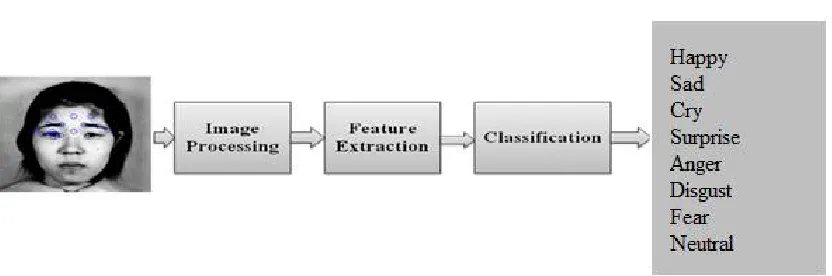
Fig2.2Facial expression recognition system overview
1) Neural Networks
Following Neural Networks are tested:
a) Feed-Forward Neural Networks
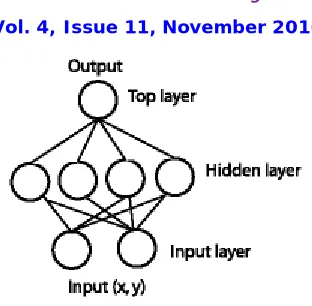
Fig. 2.1.1 A feed-forward network.
Feed-forward networks have the following characteristics:
1. Perceptrons are arranged in layers, with the first layer taking in inputs and the last layer producing outputs. The middle layers have no connection with the external world, and hence are called hidden layers.
2. Each perceptron in one layer is connected to every perceptron on the next layer. Hence information is constantly "fed forward" from one layer to the next., and this explains why these networks are called feed-forward networks.
3. There is no connection among perceptrons in the same layer.
Fig. 2.1.2 A feed-forward network with one hidden layer.
Learning Rules used:
Momentum
Momentum simply adds a fraction m of the previous weight update to the current one. The momentum parameter is used to prevent the system from converging to a local minimum or saddle point. A high momentum parameter can also help to increase the speed of convergence of the system. However, setting the momentum parameter too high can create a risk of overshooting the minimum, which can cause the system to become unstable. A momentum coefficient that is too low cannot reliably avoid local minima, and can also slow down the training of the system.
Conjugate Gradient
CG is the most popular iterative method for solving large systems of linear equations. CG is effective for systems of the form A=xb-A (1) where x _is an unknown vector, b is a known vector, and A _is a known, square, symmetric, positive-definite (or positive-indefinite) matrix. (Don’t worry if you’ve forgotten what “positive-definite” means; we shall review it.) These systems arise in many important settings, such as finite difference and finite element methods for solving partial differential equations, structural analysis, circuit analysis, and math homework.
Developed by Widrow and Hoff, the delta rule, also called the Least Mean Square (LMS) method, is one of the most commonly used learning rules. For a given input vector, the output vector is compared to the correct answer. If the difference is zero, no learning takes place; otherwise, the weights are adjusted to reduce this difference. The change in weight from ui to uj is given by: dwij = r* ai * ej, where r is the learning rate, ai represents the activation of ui and ej is the difference between the expected output and the actual output of uj. If the set of input patterns form a linearly independent set then arbitrary associations can be learned using the delta rule.
It has been shown that for networks with linear activation functions and with no hidden units (hidden units are found in networks with more than two layers), the error squared vs. the weight graph is a paraboloid in n-space. Since the proportionality constant is negative, the graph of such a function is concave upward and has a minimum value. The vertex of this paraboloid represents the point where the error is minimized. The weight vector corresponding to this point is then the ideal weight vector.
Quick propagation
Delta by Delta
Developed by Widrow and Hoff, the delta rule, also called the Least Mean Square (LMS) method, is one of the most commonly used learning rules. For a given input vector, the output vector is compared to the correct answer. If the difference is zero, no learning takes place; otherwise, the weights are adjusted to reduce this difference. The change in weight from ui to uj is given by: dwij = r* ai * ej, where r is the learning rate, ai represents the activation of ui and ej is the difference between the expected output and the actual output of uj. If the set of input patterns form a linearly independent set then arbitrary associations can be learned using the delta rule.
It has been shown that for networks with linear activation functions and with no hidden units (hidden units are found in networks with more than two layers), the error squared vs. the weight graph is a paraboloid in n-space. Since the proportionality constant is negative, the graph of such a function is concave upward and has a minimum value. The vertex of this paraboloid represents the point where the error is minimized. The weight vector corresponding to this point is then the ideal weight vector. [10]
III. SIMULATION RESULTS
1) Computer Simulation
The GFF neural network has been simulated for 37 different facial emotion images out of which 24 were used for training purpose and 13 were used for cross validation.
The simulation of best classifier along with the confusion matrix is shown below :
Fig.3.1 GFF neural network trained with DBD learning rule
2) Results
Output /
Desired FEAR SURPRICE SMILE SADNESS NUTRAL DISGUSTED CRY ANGER
FEAR 1 0 0 0 0 0 0 0
SURPIRICE 0 1 0 0 0 0 0 0
SMILE 0 0 1 0 0 0 0 0
SADNESS 0 0 0 2 0 0 0 0
NUTRAL 0 0 0 0 2 0 0 0
DISGUSTE
D 0 0 0 0 0 2 0 0
CRY 0 0 0 0 0 0 2 0
ANGER 0 0 0 0 0 0 0 2
Output /
Desired FEAR SURPRICE SMILE SADNESS NUTRAL DISGUSTED CRY ANGER
FEAR 2 0 0 0 0 0 0 0
SURPIRICE 0 2 0 0 0 0 0 0
SMILE 0 0 3 0 0 0 0 0
SADNESS 0 0 0 4 0 0 0 0
NUTRAL 0 0 0 0 3 0 0 0
DISGUSTE
D 0 0 0 0 0 4 0 0
CRY 0 0 0 0 0 0 3 0
ANGER 0 0 0 0 0 0 0 3
TABLE II. Confusion matrix on Training data set
Here Table I and Table II Contend the C.V as well as Training data set.
Performan
ce FEAR SURPIRICE SMILE SADNESS NUTRAL DISGUSTED CRY ANGER
MSE 0.002 0.0898 0.001 0.0144 0.0009 0.012 0.003 0.002
NMSE 0.038 1.265 0.022 0.110 0.006 0.0926 0.028 0.0197
MAE 0.045 0.148 0.036 0.101 0.0242 0.0584 0.049 0.0495
Min Abs
Error 0.009 0.0018 0.002 0.0299 9.774 0.0010 0.0093 0.0234
Max Abs
Error 0.109 0.9590 0.055 0.2512 0.0579 0.3746 0.146 0.0555
r 0.982 0.6661 0.994 0.948 0.996 0.9557 0.9882 0.9975
Percent
Correct 100 100 100 100 100 100 100 100
TABLE III. Accuracy of the network on CV data set
Performance FEAR SURPIRICE SMILE SADNESS NUTRAL DISGUSTED CRY ANGER
MSE 0.0009 0.001 0.001 0.0008 0.0005
0.00100768
2 0.001 0.002
NMSE 0.012 0.014 0.015 0.006 0.005 0.007 0.010 0.0232
MAE 0.024 0.027 0.037 0.025 0.018 0.026 0.028 0.048
Min Abs Error 0.001 0.001 0.002 0.0005 0.0003 0.001 0.001 0.012
Max Abs Error 0.055 0.055 0.055 0.055 0.055 0.0653 0.054 0.055
R 0.995 0.995 0.997 0.997 0.998 0.996 0.997 0.998
Percent
Correct 100 100 100 100 100 100 100 100
Here Table III and Table IV Contain the C.V and Training result. Table III show the result or identify the all 8 type of Emotion 100%and also Table IV show the result or identify all 8 type of Emotion 100% .
IV.CONCLUSION AND FUTURE WORK
The GFF classifier with DBD learning rule gives best performance of 100% in Training as well as in Cross validation Also identify 100% .
VI. ACKNOWLEDGMENT
We are very grateful to our HVPM College of Engineering and Technology to support and other faculty and associates of ENTC department who are directly & indirectly helped me for these paper.
REFERENCES
[1] J. Majumdar, R. Avabhrith, Human face expression recognition, International Journal of Emerging Technology and Advanced Engineering Website 4 (7) (2014) 559–565.
[2] Lin, Facial expression recognition based on geometric features and geodesic distance, International Journal of Signal Processing, Image Processing and Pattern Recognition 7 (1) (2014) 323–330.
[3] G.U.Kharat, S. Dudul, Emotion recognition from facial expression using neural networks, Human computer systems interaction advances in intelligent and soft computing.
[4] S. Mariooryad, C. Busso, Exploring cross-modality affective reactions for audiovisual emotion recognition, Affective Computing, IEEE Transactions on 4 (2) (2013) 183–196. doi:10.1109/T-AFFC.2013.11.
[5] S. Zafeiriou, M. Petrou, Nonlinear non-negative component analysis algorithms, IEEE T-IP 19 (4) (2010) 1050–1066.
[6] Z.-L. Ying, Z.-W. Wang, M.-W. Huang, Facial expression recognition based on fusion of sparse representation, Advanced Intelligent Computing Theories and Applications. With Aspects of Artificial Intelligence (2010) 457–464.
[7] R. S. El-Sayed, A. E. Kholy, M. Y. ElNahas, Robust facial expression recognition via sparse representation and multiple gabor filters, International Journal of Advanced Computer Science and Applications 4 (3).
[8] A. A. A. Youssif, W. A. A. Asker, Automatic facial expression recognition system based on geometric and appearance features, Computer and Information Science 4 (2).
[9] S. Wang, Z. Zhuo, H. Yang, H. Li, An approach to facial expression recognition integrating radial basis function kernel and multidimensional scaling analysis, Soft Computing 18 (7) (2014) 1363–1371.
[10] D.-T. Lin, Facial expression classification using pca and hierarchical radial basis function network, Journal of Information Science and Engineering 22 (5) (2006) 1033–1046.
[11] Javier G. R´azuri, David Sundgren, Rahim Rahmani, Antonio Moran Cardenas, “Automatic emotion recognition through facial expression analysis in merged images based on an Artificial Neural Network”, 2013 12th Mexican International Conference on Artificial Intelligence, 978-1-4799-2604-6/13 $31.00 © 2013 IEEE, DOI 10.1109/MICAI.2013.16, pp. 85-96.
[12] B. Lucas, T. Kanade, An iterative image registration technique with an application to stereo vision, in: Proc. 7th Int. Joint Conf. on Artificial Intelligence(IJCAI), 1981, pp. 674–679.
[13] C. Tomasi, T. Kanade, Detection and tracking of point features, Tech. rep., Carnegie Mellon University Technical Report CMU-CS-91-132 (1991).
[14] Y. Freund, R. E. Schapire., A decision-theoretic generalization of on-line learning and an application to boosting., Journal of Computer and System Sciences 55 (1) (1997) 119– 139.
BIOGRAPHY
Miss.Prerna R. Ingle M.E student Dept Electronics and Telecommunication, HVPM’s college of