Data Aggregation in Wireless Sensor Network
for Big Data
T.Akshatha, Praveena.T
PG Student, Dept. of CSE, R.V College of Engineering, Bangalore, India Assistant Professor, Dept. of CSE, R.V College of Engineering, Bangalore, India
ABSTRACT: This work proposes for Data aggregation in Wireless Sensor Network in Big Data, billions of people with mobile devices and small devices such as sensors, actuators, and robots generates tremendous amount of data. Big data where it strongly demands a network infrastructure having the capability to efficiently collect, process, cache, share, and deliver the data instead of simple transmissions, such network designs show the requirements of energy efficiency, availability, and high performance and data-aware intelligence. Big data is characterized by volume, variety, velocity, value and its applications face challenges in acquiring, storing, processing, sharing, transmitting, analyzing and visualizing data. This work focus on the network designs for big data sharing. To meet these requirements, we adopt the information-centric networking (ICN) approach where data are retrieved through names and in-network caching is utilized.
KEYWORDS: Big data, Information centric network, CCN, Energy-efficiency
I.INTRODUCTION
Sensor networks are collection of sensor nodes which co-operatively send sensed data to base station. As sensor nodes are battery driven an efficient utilization of power is essential in order to use networks for long duration hence it is needed to reduce data traffic inside sensor networks, reduce amount of data that need to send to base station. The main goal of data aggregation algorithms is to gather and aggregate data in an energy efficient manner so that network lifetime is enhanced. Wireless sensor networks (WSN) offers that sensor nodes need less power for processing as compared to transmitting data. It is preferable to do in network processing inside network and reduce packet size. One such approach is data aggregation which is an attractive method of data gathering in distributed system architectures and dynamic access via wireless connectivity. Wireless sensor networks have limited computational power and limited memory and battery power, this leads to increased complexity for application developers and often results in applications that are closely coupled with network protocols. In this paper, a data aggregation framework on wireless sensor networks is presented. The framework works as a middleware for aggregating data measured by a number of nodes within a network.
ISSN(Online): 2320-9801
ISSN (Print): 2320-9798
I
nternational
J
ournal of
I
nnovative
R
esearch in
C
omputer
and
C
ommunication
E
ngineering
(An ISO 3297: 2007 Certified Organization)
Vol. 4, Issue 8, August 2016
II.LITERATURESURVEY
Sanjeev SETIA et al [1] described many sensor applications; the data collected from individual nodes is aggregated at a base station or host computer. To reduce energy consumption many systems perform in-network aggregation of sensor data at intermediate nodes and enroute to the base station. Most existing aggregation algorithms and systems do not include any provisions for security and consequently these systems are vulnerable to a wide variety of attacks. In particular, compromised nodes can be used to inject false data that leads to incorrect aggregates being computed at the base station. We discuss the security vulnerabilities of data aggregation systems, and present a survey of robust and secure aggregation protocols that are resilient to false data injection attacks.
Tsung-Yi Tsai et al [2] proposed a method for wireless sensor networks which are used extensively in environment and habitat monitoring; the large volume of data transmission can increase the workload of the sensor nodes and reduce their useful lifetime. The compressive sampling techniques have been proposed to reduce the volume of data transmission when the data is sparse in certain domain, while finding the optimal routing path that minimizes data traffic is an NP-complete problem, a near-optimal routing protocol in the literature requires omniscient knowledge of the entire network and thus incurs extensive message exchanges in real applications. This work proposes for a distributed algorithm that uses local minimization to dynamically construct a routing path to reduce the data traffic for compressive sampling based aggregation. This algorithm does not require the omniscient knowledge of the global network topology and incurs much lower overhead than the near optimal solution and therefore is more suitable for practical applications.
Mohammad Abu et al [3] proposed a method for wireless sensor networks to monitor dynamic environments that change rapidly over time. This dynamic behavior is either caused by external factors or initiated by the system designers themselves. To adapt to such conditions, sensor networks often adopt machine learning techniques to eliminate the need for unnecessary redesign. Machine learning also inspires many practical solutions that maximize resource utilization and prolong the lifespan of the network. In this paper, we present an extensive literature review over the period 2002-2013 of machine learning methods that were used to address common issues in wireless sensor networks (WSNs). The advantages and disadvantages of each proposed algorithm are evaluated against the corresponding problem. It also provides a comparative guide to aid WSN designers in developing suitable machine learning solutions for their specific application challenges.
Jyoti Rajput et al [4] described that in wireless Sensor network data aggregation is an important technique to achieve power efficiency in the sensor network. In some applications such as: wireless sensor network, data mining, cloud computing data aggregation is widely used. Because sensor node has limited battery power so data aggregation techniques have been proposed for wireless sensor networks. A challenge to data aggregation is how to secure aggregated data from disclosing during aggregating process as well as obtain accurate aggregated results. Alsodescribed various protocols for securing aggregated data in wireless sensor networks.
III.PROPOSEDSYSTEM
Figure 1: Architecture of Proposed System
a. Network initialization
Initialization is the process of locating and using the defined values for variable data that is used by a computer program. For example, an operating system or application program is installed with default or user-specified values that determine certain aspects of how the system or program is to function. Typically, these values are stored in initialization files (in Windows, these can be identified as files with an INI suffix). When the operating system or an application program is first loaded into memory, a part of the program performs initialization - that is, it looks in the initialization files, finds definite values to substitute for variable values and acts accordingly. For example, the desktop appearance and application programs that are to be started along with the operating system are identified and loaded.
Network initialization starts with grouping sensor nodes under single cluster head [6] called parent node. Cluster head collects aggregated data from all nodes in cluster and sends to sink or base node. There will be many such clusters in network under single sink node. Every node in cluster is identified by node ID.
b. Cluster using LEACH Protocol
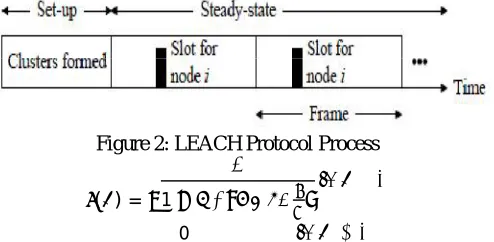
LEACH Protocol is a typical representative of hierarchical routing protocols. It is self- adaptive and self-organized. LEACH protocol uses one round as unit, each round is made up of cluster set-up stage and steady-state stage. For the purpose of reducing unnecessary energy costs, the steady state stage must be much longer than the set-up stage. The process of it is shown in Figure: 2.
Figure 2: LEACH Protocol Process
ISSN(Online): 2320-9801
ISSN (Print): 2320-9798
I
nternational
J
ournal of
I
nnovative
R
esearch in
C
omputer
and
C
ommunication
E
ngineering
(An ISO 3297: 2007 Certified Organization)
Vol. 4, Issue 8, August 2016
node will be selected as head node with probability 1, when 1/P rounds finished all nodes will return to the same starting line. When clusters have formed the nodes start to transmit the inspection data. Cluster heads receive data sent from the other nodes, the received data is sent to the gateway after fused. This is a frame for data transmission. In order to reduce unnecessary energy cost, steady state is composed of multiple frames and the steady state is much longer than the set-up state.
c. Data Aggregation
Data aggregation is a process of aggregating the sensor data using aggregation approach. The algorithm uses the sensor data from the sensor node and then aggregates the data by using some aggregation algorithms such as centralized approaches LEACH (Low Energy Adaptive Clustering Hierarchy), TAG (Tiny Aggregation) etc. This aggregated data [9] is transferred to sink node by selecting the efficient path. In these data aggregation algorithms we gather and aggregate data in an energy efficient manner so that network lifetime is enhanced. Wireless sensor networkoffers, that a sensor nodes need less power for processing [8] as compared to transmitting data. It is preferable to do in network processing inside network and reduce packet size. One such approach is data aggregation with attractive method of data gathering in distributed system architectures and dynamic access via wireless connectivity. Wireless sensor networks have limited computational power, limited memory and battery power, this leads to increased complexity for application developers and often results in applications that are closely coupled with network protocols.
d. ESP 8266 Module
The ESP8266 module is a TTL "Serial to Wireless Internet" device. Providing your microcontroller has the ability to talk to a TTL serial device (most do) you'll be in business! The original instructions have been translated from Chinese into cryptic data sheets. We'll try to change that with this Instruct able. The ESP8266 module is a 3v device, but it's no wimp. It draws quite a bit of power. In fact, you'll probably need to make sure that your circuit's power supply can handle at least 1 amp of power.
In order to provide security over collected data from sensors a Blowfish algorithm [12] is used for encrypting and decrypting data sent from cluster head to sink node. A symmetric key distributed by sink node to all nodes in cluster. Data collected at sink node is sent through ESP8266 Wi-Fi module to the server.
e. Data Security
Figure 3: Overall Block Diagram for Arduino UNO Connections
IV. RESULTS
Results from the proposed system can be inferred that, as number of nodes increase in a network there is a decrease in loss of system energy when compared to existing system. Below graph shows a result for proposed system. Results from the below graph f, g can be inferred that, when number of nodes increase in a cluster packet drop from respective nodes also increase. In proposed system from stimulation results in MATLAB it is easy to find a particular node that drops the packet and that particular node is avoided in further rounds. Therefore, with implementation of LEACH protocol [10] proposed system improves system energy and authentication
ISSN(Online): 2320-9801
ISSN (Print): 2320-9798
I
nternational
J
ournal of
I
nnovative
R
esearch in
C
omputer
and
C
ommunication
E
ngineering
(An ISO 3297: 2007 Certified Organization)
Vol. 4, Issue 8, August 2016
(a) Network Initialization; (b)
(b) Key Distribution;
(d) Cluster Head Selection and Key Distribution;
ISSN(Online): 2320-9801
ISSN (Print): 2320-9798
I
nternational
J
ournal of
I
nnovative
R
esearch in
C
omputer
and
C
ommunication
E
ngineering
(An ISO 3297: 2007 Certified Organization)
Vol. 4, Issue 8, August 2016
(f) number of nodes vs system energy;
(g) Number of nodes vs packet drop
(i)Aurdino Board
(j) Overall System Connection using ESP8266 Wifi Module
V.CONCLUSION
According to this work proposed here Wireless Sensor Networks is very useful in various applications such as militarysurveillance, health, home, office monitoring and in many intelligent and smart systems[11]. In Wireless Sensor Networks there are several issues to the security of the network and secure data aggregation is also a big issue. This paper introduces a brief discussion of wireless sensor network, data aggregation, various approaches of data aggregation in WSN, security needs to data aggregation, overview of various security protocols and their comparison.
ISSN(Online): 2320-9801
ISSN (Print): 2320-9798
I
nternational
J
ournal of
I
nnovative
R
esearch in
C
omputer
and
C
ommunication
E
ngineering
(An ISO 3297: 2007 Certified Organization)
Vol. 4, Issue 8, August 2016
[7] Kiran Maraiya, Kamal Kant, Nitin Gupta, “Efficient Cluster Head Selection Scheme for Data Aggregation in Wireless Sensor Network”.
International Journal of Computer Applications,Vol 23, 2011.
[8] Md. Zair Hussain, M. P. Singh and R. K. Singh, “ Analysis of Lifetime of Wireless Sensor Network”, International Journal of Advanced Science and Technology, Vol. 53, 2013
[9] Anindita Ray, Debashis De, “Data Aggregation Techniques in Wireless Sensor Network: A Survey”,International Journal of Engineering
Innovation & Research, Vol 1, Issue 2.
[10] Chunyao FU, Zhifang JIANG, Wei WEI2and Ang WEI, “An Energy Balanced Algorithm of LEACH Protocol in WSN”, IJCSI International
Journal of Computer Science Issues, Vol. 10, Issue 1, 2013.
[11] Joseph Polastre, Robert Szewczyk, Alan Mainwaring, David Culler and John Anderson, “Analysis of Wireless Sensor networks For Habitat