Vol. 5, Issue 12, December 2017
Digital Colour Image Compression using
Block Truncation Code
Dev Prakash Singh1, Dr. Vineeta Saxena Nigam2
M. Tech. Scholar, Department of Electronics and Communication, UIT, RGPV, Bhopal, India1
Professor, Department of Electronics and Communication, UIT, RGPV, Bhopal, India 2
ABSTRACT: In the present era of multimedia, the requirement of image/video storage and transmission for video conferencing, image and video retrieval, video playback, etc. are increasing exponentially. As a result, the need for better compression technology is always in demand. Modern applications, in addition to high compression ratio, also demand for efficient encoding and decoding processes, so that computational constraint of many real-time applications is satisfied.Two widely used spatial domain compression techniques are block truncation coding (BTC) and vector quantization (VQ). BTC method results in good quality image with high bit-rate, while the VQ is well known for low bit-rate but produces poor quality images. In further work of this paper is multi-level BTC includes BTC algorithm as well as vector quantization method for purpose of multi-leveltechnique for gray and color image.
KEYWORDS: Block Truncation Code (BTC), PSNR, Block Size, Compression Ratio
I. INTRODUCTION
The rising multimedia technology and growth of GUIbased software have made digital image data an inherent part of modern life. When a 2-D light intensity function issampled and quantized to create a digital image, the amountof data generated may be large in volume that it results intremendous storage, processing and communicationrequirements. Therefore, the theory of data compressionbecomes more and more important for reducing the dataredundancy to save more hardware space and transmissionbandwidth.
In computer science and information theory,data compression is the process of encoding informationusing less number of bits or some other information bearingunits. Compression is useful as it helps to reduce the consumption of expensive resources such as hard disk spaceor transmission bandwidth [1] [2]. BTC is a simple and fast lossy compression technique for gray scale images. The basic idea of BTC [3] is to perform moment preserving quantization for blocks of pixels. The input image is divided into non-overlapping blocks of pixels of sizes 4×4, 8×8 and so on. Mean and standard deviation ofthe blocks are calculated. Mean is considered as thethreshold and reconstruction values are determined usingmean and standard deviation.
Then a bitmap of the block isderived based on the value of the threshold which is thecompressed or encoded image. Using the reconstructionvalues and the bitmap the reconstructed image is generatedby the decoder. Thus in the encoding process, BTCproduces a bitmap, mean and standard deviation for eachblock. It gives a compression ratio of 4 and bit rate of 2 bitsper pixel when a 4×4 block is considered. This methodprovides a good compression without much degradation onthe reconstructed image. But it shows some artifacts likestaircase effects or raggedness near the edges. Due to itssimplicity and easy implementation, BTC has gained wideinterest in its further development and application for imagecompression.
Vol. 5, Issue 12, December 2017
II. BLOCK TRUNCATION CODE
BTC-VQ Method
The encoding method of VQ is time consuming, whereas its decoding method uses table look-up method and is very fast. This method results in higher compression ratio, though quality of the reconstructed image is usually not as good as BTC. BTC is a simple and fast method, which enables high quality reconstruction but bit-rate is also high. Comparatively, the encoder of BTC is faster than that of VQ, while its decoder is little slower. A compromise between these two methods gives a fast decoder, maintains good quality for reconstructed image with moderate bit-rate. Again, this hybrid method can also be used in image feature extraction. That means the compressed data due to this method can directly be used to compute image features like, edge [5-6], and so on.
The method of selection of the best fit pattern for an image block B of size
n
n
is as follows. For an image block B, let the pixels coordinates arex
1,
x
2,...
..
x
n2and the corresponding pixel intensities aref
(
x
i)
. Available patternsare, say,
P
1,
P
2...
...,
P
Mof sizen
n
and the levels present in a pattern are represented byt
where1
t
Q
.Thus, any pattern is represented as
)
)(
(
)
(
1
k
A
d
k
k
A
d
km
(1)2 2
2
k
(
A
d
)
(
k
k
)(
A
d
)
km
(2)
Solving for A and d we get
)
(
2
)
2
(
1k
k
k
k
k
m
A
(3))
(
2
1k
k
k
k
m
d
(4)Hence, intensity
f
ˆ
(
x
i)
of the pixels of the corresponding block in the reconstructed image is given by
1 1)
(
ˆ
C
x
if
d
A
C
x
if
d
A
x
f
i i i (5)It is clear that a = A − d and b = A + d, where a and b are the quantization levels for partition.
III. WORKING OF BLOCK TRUNCATION ENCODING
Vol. 5, Issue 12, December 2017
known as quantization and selecting the threshold pixel value from image. The second step is Coding the Quantization, encode the given quantization data of an image block. Before sending data to encoder, there must be important choice of which data should be encoded. Standard BTC have two alternative approaches for sending the quantization data to the decoder a). The first approach the quantization data is describe by two statistical values that is mid –value and variation quantity
b). other one is to compute the quantization levels. In this approach one can decrease both the computation and the quantization error computation needed at the decoding phase. Next step is Reduction in bit plan; use less bit plan for representing quantized data. Above are the three basic steps of standard Block Truncation Coding (BTC). The basic block diagram of BTC technique is as following.
Advantages of Block Truncation Coding
1. Block Truncation encoding is very fast encoding of lossy image compression technique.
2. Block Truncation Encoding requires little memory space 3. BTC technique easy to implement
4. Standard BTC involves less computational complexity. 5. This technique very less prone to transmission errors.
Disadvantages of BTC
1. It required high bit-rate when compared to method like Vector quantization and discrete cosine transform etc
Figure 1: The Basic block diagram of BTC for image decompression
IV. EXPERIMENTAL ANALYSIS
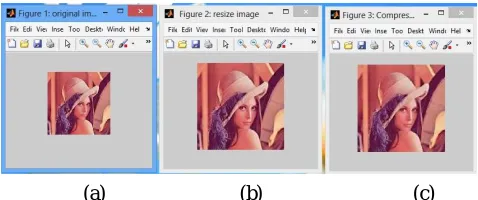
Performance of the MBTC and multi-level BTChave been evaluated for a set of standard test images, viz., ‘lena 256×256’, ‘cameraman 256×256’, and ‘bird256×256’. Figure 5.1; show the Lena image of 4×4 block pixel. In this figure 1 (a) show the random image of the Lena image and resize the image of the 256×256 in the Lena image show in figure 1 (b). The compressed image is 4×4 block pixel of Lena image shown in figure 1 (c) respectively.
Vol. 5, Issue 12, December 2017
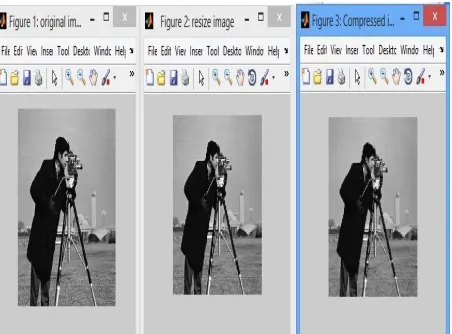
Figure 2; show the Cameraman image of 4×4 block pixel. In this figure 2 (a) show the random image of the Cameraman image and resize the image of the 256×256 in the dog image show in figure 2 (b). The compressed image is 4×4 block pixel of Cameraman image shown in figure 2 (c) respectively.
Figure 2: Multi-level BTC Algorithm applied on Cameraman Image of block size 4×4
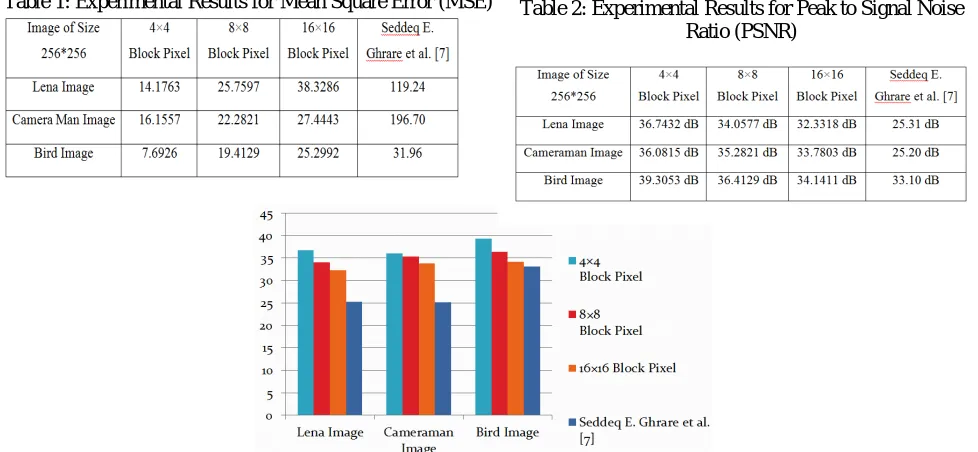
Figure 4: MSE for Different methods using Lena, Camera Man and Bird Image
Figure 3; show the Bird image of 4×4 block pixel. In this figure 3 (a) show the random image of the Bird image and resize the image of the 256×256 in the Bird image show in figure 3 (b). The compressed image is 4×4 block pixel of
Vol. 5, Issue 12, December 2017
Figure 3: Multi-level BTC Algorithm applied on Bird Image of block size 4×4
Table 1: Experimental Results for Mean Square Error (MSE)
Figure 5: PSNR for Different methods using Lena, Camera Man and Bird Image
V. CONCLUSION
The objective of this paper is to develop an image compression method for which the decoder would be very efficient. Such method is suitable in situations where image or image is compressed once but decoded frequently. It is clear that the decoding time due to spatial domain based compression is much less than that of the sub-band compression techniques. Two widely used spatial domain compression techniques are block truncation coding (BTC) and vector quantization (VQ). BTC method results in good quality image with high bit-rate, while the VQ is well known for low bit-rate but produces poor quality images. In his paper the study of different types of technique for image compression. In this paper implementation of the proposed algorithm and results are based on that algorithm is discussed for the different block size i.e. 4*4, 8*8 and 16*16.
REFERENCES
[1] C. Senthilkumar, “Color and Multispectral Image Compression using Enhanced Block Truncation Coding [E-BTC] Scheme”, accepted to be presented at the IEEE WiSPNET, PP. 01-06, 2016 IEEE.
[2] Jing-Ming Guo, Senior Member, IEEE, and Yun-Fu Liu, Member, IEEE, “Improved Block Truncation Coding Using Optimized Dot Diffusion”, IEEE TRANSACTIONS ON IMAGE PROCESSING, VOL. 23, NO. 3, MARCH 2014.
[3] Jayamol Mathews, Madhu S. Nair, “Modified BTC Algorithm for Gray Scale Images using max-min Quantizer”, 978-1-4673-5090-7/13/$31.00 ©2013 IEEE.
Vol. 5, Issue 12, December 2017
[4] M. Brunig and W. Niehsen. Fast full search block matching. IEEE Transactions on Circuits and Systems for Video Technology, 11:241 – 247, 2001.
[5] K. W. Chan and K. L. Chan. Optimisation of multi-level block truncation coding. Signal Processing: Image Communication, 16:445 – 459, 2001.
[6] Ki-Won Oh and Kang-Sun Choi, “Parallel Implementation of Hybrid Vector Quantizerbased Block Truncation Coding for Mobile Display Stream Compression”, IEEE ISCE 2014 1569954165.
[7] Seddeq E. Ghrare and Ahmed R. Khobaiz, “Digital Image Compression using Block Truncation
Coding and Walsh Hadamard Transform Hybrid Technique”, 2014 IEEE 2014 International Conference on Computer, Communication, and
Control Technology (I4CT 2014), September 2 - 4,
2014 - Langkawi, Kedah, Malaysia.
[8] C. C. Chang and T. S. Chen. New tree-structured vector quantization with closed-coupled multipath searching method. Optical Engineering,
36:1713 –
1720, 1997.